What Is Assay Development? a Complete Guide for 2026
Learn what is assay development: its design, optimization and validation stages, and the metrics that prove results are reliable.

How does a laboratory know that a clear, repeatable signal represents the molecule it intended to measure? An instrument can produce tidy results even when a reagent binds the wrong target or the sample interferes with detection.
That gap explains why assay development matters. The work turns an observable response into a measurement procedure with a defined purpose, tested limitations, and documented performance.
Assay Development in Plain Terms
How does a lab know a measurement is right? A measuring tape offers a useful analogy: repeated readings don't establish accuracy if the tape itself hasn't been checked against a known standard. Laboratory measurements need an equivalent foundation.
Assay development is the systematic process of designing and optimizing a laboratory test to reliably detect, identify, or quantify a target analyte for a defined purpose. An assay might establish whether a molecule is present, identify it, or determine its concentration. Those are different tasks, so developers must specify which result the experiment needs.
The analyte is the substance being investigated, such as a protein, antibody, metabolite, nucleic acid, or research compound. The sample matrix is everything surrounding it, such as serum in a blood-derived specimen or the components of a tissue extract.
A signal isn't a concentration. The laboratory must establish how the measured response relates to the target in the actual sample.
From biological question to measurement
Consider a plate-based assay that produces a colored signal when an antibody binds a target protein. A darker well might indicate more target, but that interpretation requires appropriate standards, controls, and evidence that other sample components aren't producing the response.
The FDA's bioanalytical method guidance identifies calibration curves, quality-control samples, selectivity, sensitivity, accuracy, precision, recovery, stability, reference standards, and critical reagents among the elements that may require characterization during development. Selecting a plate reader addresses only part of that work.
A practical answer to what is assay development therefore extends beyond choosing equipment or improving brightness. Developers connect a biological question to a repeatable procedure, establish its operating conditions, and define where its results can be trusted.
A method that produces a signal is not yet a method that produces defensible numbers.
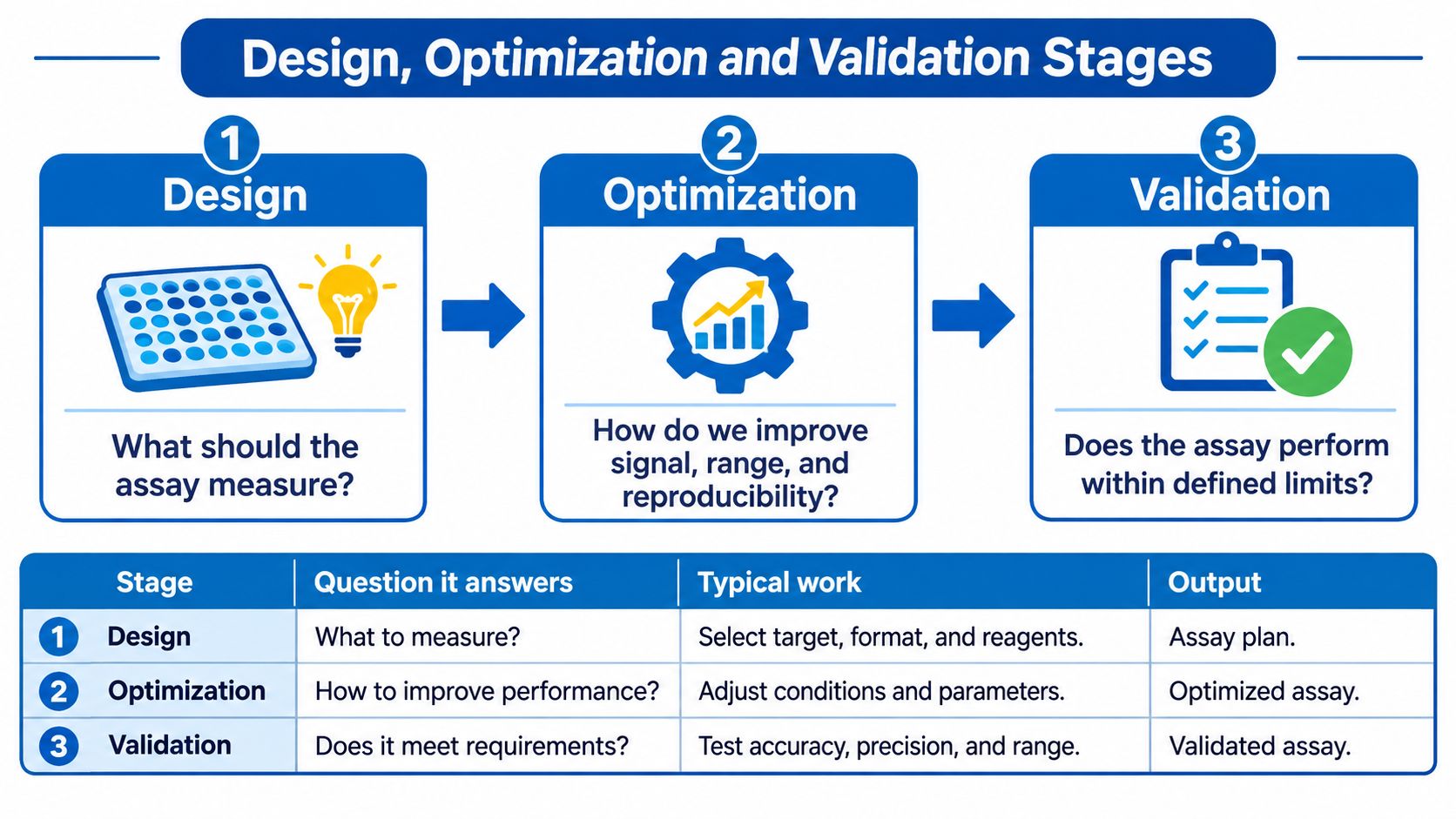
Design, Optimization and Validation Stages
Assay development stages and what each produces
| Stage | Question It Answers | Typical Work | Output |
|---|---|---|---|
| Design | What must the assay measure, and over what range? | Define intended use, reportable range, reference standard, critical reagents and matrix | Assay design and defined reportable range |
| Optimization | Does the signal respond reliably under realistic conditions? | Tune reagents, incubation, sample preparation and controls; test for matrix interference | Working protocol with set operating conditions |
| Validation | Does performance meet predefined limits every time? | Run accuracy, precision, selectivity, sensitivity, range, stability and robustness experiments | Documented evidence that the method is fit for its intended purpose |
Design begins with the decision the result must support. Developers define the intended use and anticipated concentration range, select a reference standard and critical reagents, and choose a calibration model that relates response to concentration.
Optimization turns that design into workable laboratory conditions. Scientists adjust reagent concentrations, binding or separation conditions, incubation, and sample preparation, then challenge the procedure with replicate controls spanning the intended range. Checking solubility during laboratory sample preparation helps distinguish poor dissolution from weak assay response.
Validation tests the finalized procedure against predefined requirements. The FDA's Bioanalytical Method Validation guidance describes performance characteristics including accuracy, precision, sensitivity, selectivity, range, reproducibility, and stability, with performance demonstrated under actual conditions of use.
A research peptide ELISA example
For a hypothetical research peptide ELISA, design establishes the reportable range from expected sample concentrations and selects the reference standard and capture antibody. ELISA means enzyme-linked immunosorbent assay, a format that connects antibody binding to a measurable enzyme-generated response.
During optimization, the scientist titrates the coating antibody and adjusts incubation time. Low, middle, and high controls spiked into blank matrix help reveal whether conditions that work in buffer also work in study samples.
In this hypothetical validation plan, accuracy and precision experiments span at least three days, with replicate controls at each level. That schedule illustrates a study design, not a universal requirement for every peptide ELISA.
Reagent lots, matrix effects, analyte degradation, nonspecific binding, instrument response, and unsuitable calibration models all deserve investigation. A stage isn't complete just because an experiment worked: the laboratory must document the protocol, results, limitations, and rationale for its decisions.
Biochemical and Cell-Based Assay Formats Compared
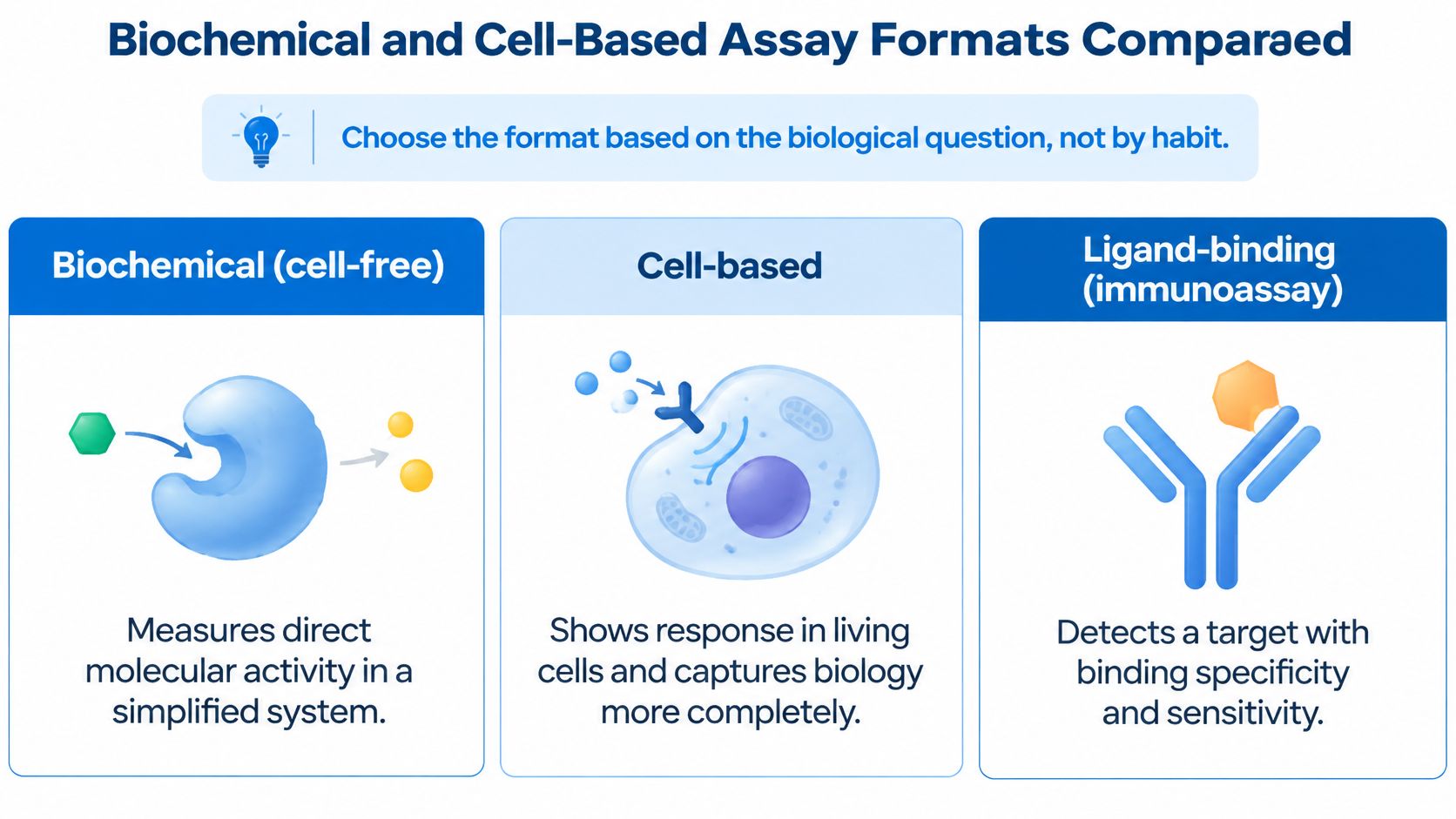
The biological question determines the format, not the instrument already sitting on the bench. Measuring direct molecular binding, a cellular response, and analyte concentration requires different experimental arrangements.
Common assay formats compared
| Format | What It Measures | Typical Readout | Main Strength | Main Limit |
|---|---|---|---|---|
| Biochemical (cell-free) | Binding or enzyme activity of a purified target | Fluorescence, absorbance or luminescence | Controlled, reproducible conditions | Misses cellular context |
| Cell-based | Response of living cells to a compound or peptide | Reporter signal, viability or pathway readout | Captures biology in a cellular setting | More variability and harder to standardize |
| Ligand-binding (immunoassay) | Analyte concentration captured by an antibody or receptor | ELISA or electrochemiluminescence signal | High throughput for proteins and biomarkers | Cross-reactivity and matrix interference |
A biochemical assay isolates a molecular interaction in a simplified, cell-free system. For example, a scientist might investigate whether a research compound changes the activity of a purified enzyme while controlling substrate concentration and buffer composition. That control makes interpretation more direct, but it doesn't establish what happens inside living cells.
A cell-based assay examines responses in cultured cells. A reporter signal might reflect pathway activation, while a viability readout assesses a different aspect of cell behavior. Cell condition, culture history, and handling become additional experimental variables, so greater biological context comes with more demanding standardization.
Concentration and function aren't interchangeable
A ligand-binding immunoassay uses an antibody or another binding reagent to capture an analyte. ELISA and electrochemiluminescence provide practical readouts for protein and biomarker measurements, but developers must investigate unwanted binding and interference from the sample.
These categories can overlap. An immunoassay may also be cell-free, and a binding experiment can be performed in cells. The labels describe useful design approaches rather than mutually exclusive boxes.
The distinction that matters most is the result's meaning. An antibody assay reporting peptide concentration doesn't automatically establish that the peptide retains biological activity; an enzyme assay showing activity doesn't establish a response in cultured cells.
Format selection rule: More biological context generally means more experimental variables to control.
A laboratory should select the simplest format that answers its stated question without removing the biology essential to interpreting the result.
Sensitivity, Specificity and Precision Explained
Core assay metrics and typical acceptance targets
| Metric | Plain Question | How Developers Test It | Common Reference Target |
|---|---|---|---|
| Sensitivity | What is the smallest amount reliably quantified? | Replicate samples at the lower limit of quantification | Accuracy within ±20% and CV no greater than 20% at the lower limit |
| Specificity and selectivity | Does the assay distinguish the target from other substances? | Spike related molecules and analyze matrix blanks | No meaningful signal from interferents |
| Accuracy | Is the result close to the accepted reference value? | Compare against reference material or spiked samples | Within ±15% of nominal at low, middle and high levels |
| Precision | How much do repeat results scatter? | Repeatability, intermediate precision and reproducibility runs | CV no greater than 15% |
| Robustness | Does performance hold under normal variation? | Deliberately vary time, temperature, reagent lot and analyst | Results stay within acceptance limits |
The FDA bioanalytical guidance describes common quantitative acceptance targets of accuracy within ±15% and precision no greater than 15% coefficient of variation, widening at the lower limit of quantification to ±20% accuracy and 20% CV. These are context-specific reference targets, not universal limits for every assay format, particularly ligand-binding methods.
A credible assay must satisfy its applicable criteria across the intended range. A detectable response alone doesn't establish that the laboratory can report a dependable concentration.

What the experiments establish
Sensitivity, in this quantitative context, concerns the lower limit of quantification, or LLOQ. Replicate low-level samples establish whether the laboratory can quantify that concentration acceptably, rather than merely distinguish it from background.
Specificity and selectivity concern discrimination. Developers analyze matrix blanks and challenge the procedure with related molecules or potential interferents. Accuracy experiments then compare reported concentrations with accepted reference values, using suitable reference materials, spiked samples, or an independent method.
Precision describes scatter rather than closeness to the correct value. ICH Q2(R2) describes repeatability designs using three replicates at three concentration levels, totaling nine determinations, or six determinations at the 100% test concentration. Intermediate precision examines changes across days, analysts, or equipment; reproducibility examines agreement across laboratories.
Interpreting failure patterns
Assessing how well a method holds up under variation means scientists deliberately vary realistic operating conditions rather than testing only the most favorable setup. The ICH robustness training materialsQ14_TrainingMat_Module_6_2025_0620.pdf) frame this work around maintaining expected performance during normal use.
Poor low-end precision suggests investigating background, signal strength, and matrix interference. Between-day drift directs attention toward reagent stability, calibration preparation, analyst technique, or instrument behavior. These patterns guide troubleshooting, but they don't identify a cause without follow-up experiments.
Checks Specific to Peptide and Compound Testing
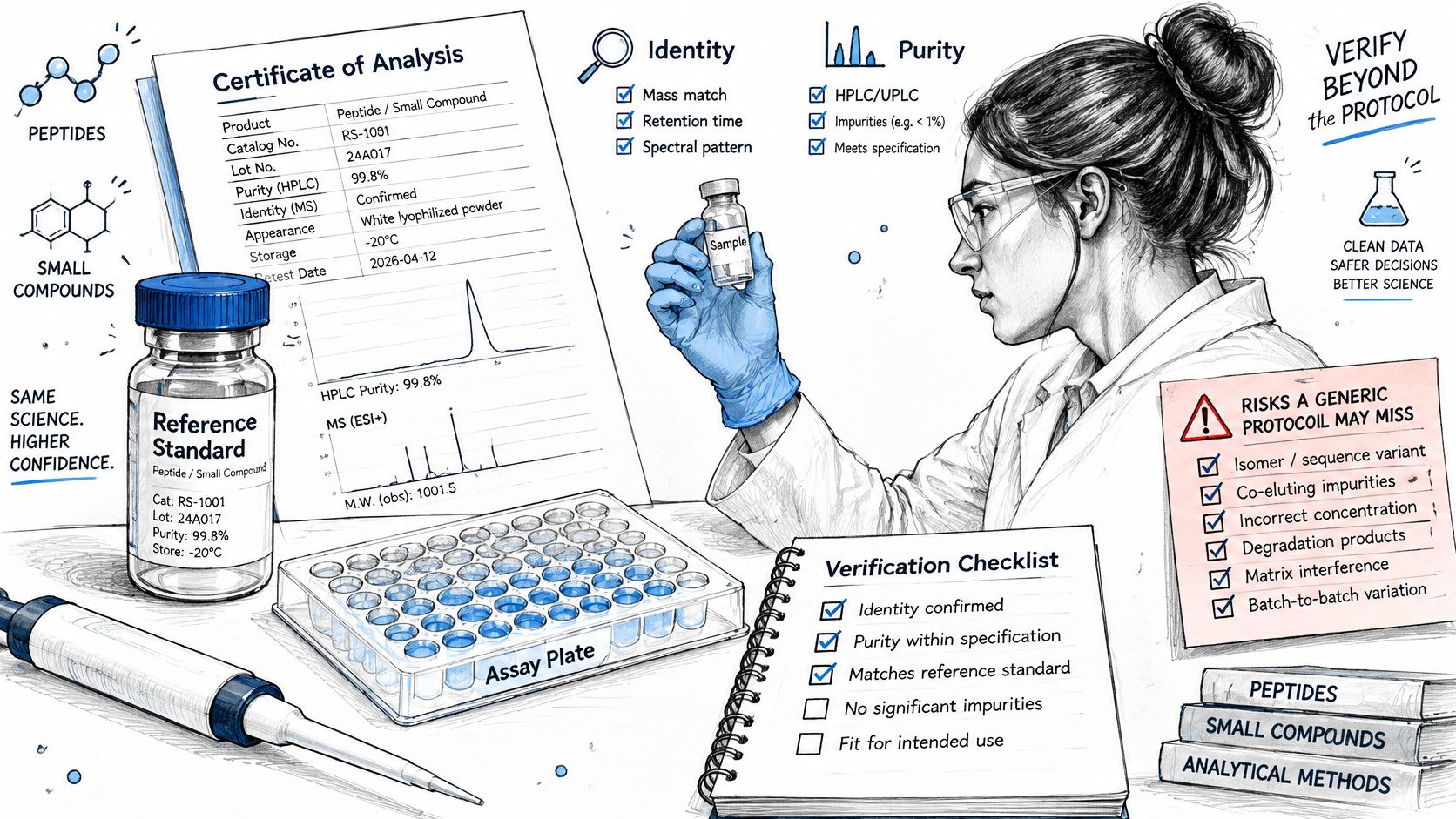
Peptides and other research compounds introduce handling risks that an otherwise well-designed protocol can miss. A sample may change between receipt and measurement, so developers need evidence about the material entering the assay, not just the final instrument response.
Establish the material's starting condition
Begin with identity and purity. Compare the material with an appropriate reference standard and review its Certificate of Analysis, or COA, a batch-specific document containing available laboratory testing results and identifying information for a product. The document's lot number must match the material being examined.
Identity and purity answer different questions: whether the intended substance is present and what other material may accompany it. A practical review of peptide purity testing helps explain why a purity result alone doesn't establish assay suitability. ProTecPep provides batch-specific COAs and assistance locating matching batch documentation.
Follow the sample through preparation
Stability checks should reflect actual storage, preparation, and bench conditions. Peptides may degrade or aggregate, so scientists record elapsed time, temperature, and handling history rather than assuming a freshly prepared solution remains unchanged.
Reconstitution is strictly laboratory sample preparation, performed by trained personnel under documented procedures. The protocol should identify the solvent, mixing conditions, labware, and evidence that the material dissolved adequately.
Nonspecific binding can reduce the amount remaining in solution when peptides adhere to tubes or microplates. Testing low-level controls in the actual labware helps reveal losses that might be less apparent in concentrated stock solutions.
Matrix effects require separate attention. Serum proteases may alter a peptide, while sample solvents or other components may change the analytical response. Comparing spiked recovery in matrix with suitable reference preparations helps distinguish sample-related losses from assay response problems.
Before interpreting results, the laboratory record should include:
- Material traceability: Matched lot identifiers, COA, and reference-standard details.
- Preparation history: Solvent, mixing, labware, and handling conditions.
- Stability evidence: Storage and bench-condition assessments.
- Recovery checks: Results addressing surface losses and matrix interference.
- Protocol deviations: Any departure that could affect interpretation.
Matching Validity and Validation Level to Your Question
A reproducible assay isn't automatically a useful one. Consider a hypothetical ELISA intended to quantify an intact research peptide: its antibody also recognizes a degradation fragment, producing tight, stable measurements that combine both substances. The procedure can be precise while failing its stated measurement objective.
Analytical validity establishes whether a method measures what it claims to measure with appropriate performance. The FDA's biomarker guidance distinguishes technical characteristics, such as sensitivity, specificity, accuracy, and precision, from evidence that a biomarker is useful for its intended clinical purpose. Even a technically sound measurement doesn't independently establish biological relevance or clinical usefulness.
Repeating the wrong measurement more consistently doesn't make it the right measurement.
Development, qualification and validation
Development establishes the procedure and its operating conditions. Qualification provides a scoped assessment of suitability for a specified purpose, often within a limited research context. Validation provides a more formal, predefined demonstration of performance under the conditions relevant to the intended application.
Those labels shouldn't substitute for examining the evidence. More experiments aren't automatically better if they don't address the decision the laboratory needs to make.
An exploratory in-vitro investigation may justify a narrower assessment than a method supporting regulated preclinical studies, clinical testing, or commercial release. Conversely, exploratory status doesn't excuse missing controls that are essential to interpreting the experiment.
Questions that define a defensible plan
- What is the analyte and its expected concentration range? Specify whether the target is an intact molecule, fragment, binding interaction, or functional response.
- Which sample matrix will be examined? Identify the actual specimen or preparation rather than assuming buffer performance will transfer.
- Is the question exploratory, preclinical, clinical, or for release? Match the evidence package to that decision context.
- Which format captures the needed biology? Choose biochemical, cell-based, or ligand-binding methods for a stated reason.
- Which reference standard and COA anchor the work? Establish material traceability, supported by an understanding of batch testing.
- Which metrics must meet acceptance targets? Specify the experiments and runs that will demonstrate performance.
- Which conditions will be varied for reliability? Prioritize realistic sources of laboratory variation.
Results from these laboratory research procedures are research-use data, not diagnoses or recommendations. Before experimental work begins, the investigator should write the intended use in a single sentence and check that every planned experiment serves it.
ProTecPep supplies compounds exclusively for laboratory research, analytical testing, and scientific investigation, with batch-specific COAs and assistance locating documentation. Qualified laboratory researchers can visit Pro Tec Pep to review research materials and applicable batch records while planning fit-for-purpose assay development.