BPC 157 KPV Identity and Evidence Guide
Compare BPC 157 KPV sequences, study types, COA checks, storage, and research-use limits for qualified laboratory work.

The popular advice to treat BPC-157 and KPV as a recovery stack skips the first question a laboratory analyst should ask: what, exactly, is in each vial? These are separate peptide sequences, and their free-base and acetate forms require separate identification. A paired marketing name doesn't establish chemical identity, a shared mechanism, or evidence for a combined preparation.
For a research audience, the useful starting point isn't a proposed outcome. It's a match between the label, the chemical form, the lot-specific analytical record, and the preparation described in a published experiment.
BPC-157 and KPV at a Glance
Before any comparison of effects, an analyst compares identities. This card separates what is known about each molecule at the level of sequence and form.
BPC-157 versus KPV identity card
| Property | BPC-157 | KPV |
|---|---|---|
| Compound class | Synthetic 15-amino-acid peptide | Synthetic tripeptide from alpha-MSH |
| Sequence | GEPPPGKPADDAGLV | Lys-Pro-Val |
| Forms named in FDA briefings | Free base and acetate, listed separately | Free base and acetate, listed separately |
| Best-known published models | Animal gastrointestinal, tendon, and wound models | Cultured intestinal cells and mouse colitis models |
The FDA briefing materials name BPC-157 free base, BPC-157 acetate, KPV free base, and KPV acetate as four separate bulk-drug-substance candidates in the regulatory meeting document. Four names, four entries. That granularity is the right model for laboratory records: each chemical form gets its own line, its own identifier, and eventually its own analytical file.
BPC-157 is a synthetic peptide related to a gastric protein. KPV is the C-terminal Lys-Pro-Val fragment of alpha-melanocyte-stimulating hormone, commonly abbreviated alpha-MSH. Because the sequences differ entirely, an observation involving one molecule cannot establish the behavior of the other.
Chemical form belongs in the identity record
A peptide sequence describes the amino-acid chain, but the chain alone doesn't describe everything contributing to the weighed material. Counterions, water, and residual solvents can all sit inside the same vial. An acetate salt works like a parcel shipped with its packing material: the number on the scale includes more than the item itself.
This is why a specification states identifiers for a defined chemical form rather than for a generic name. A KPV specification, for example, assigns a formula weight of 456.5 g/mol and CAS number 67727-97-3 to the specified material. Free-base mass and the formula weight assigned to a supplied preparation aren't automatically interchangeable, and acetate should appear explicitly in the specification when applicable. A researcher calculating an assay concentration needs the laboratory's stated basis for peptide content, not merely the gross mass printed on the container. Otherwise, apparently identical preparations may enter an experiment at different actual peptide concentrations.
The same distinction matters when comparing analytical results. A chromatogram is interpretable only alongside its method, sample preparation, and chemical identity. Salt form can influence sample behavior and the relevant impurity assessment, while differences in chromatographic conditions can change retention and separation.
Identity rule: A vial belongs to a defined sequence and chemical form, not to a marketing pair name.
Match the vial before interpreting the literature
A useful receiving record includes the peptide name, sequence, stated salt form, supplier, and lot identifier. If the label says only BPC-157 or KPV, the accompanying specification should resolve the missing chemical-form information before quantitative work begins.
Once identity is fixed, evidence can be sorted correctly. A gastrointestinal finding for KPV doesn't assign a mechanism to BPC-157, and a tendon-model result for BPC-157 doesn't establish that KPV behaves similarly. Each of the four named preparations carries its own chain of evidence, running from chemical identity through the experimental model to the measured endpoint. Treating the four forms as one recovery stack collapses that chain at the first link.
Two Sequences and Two Mechanisms
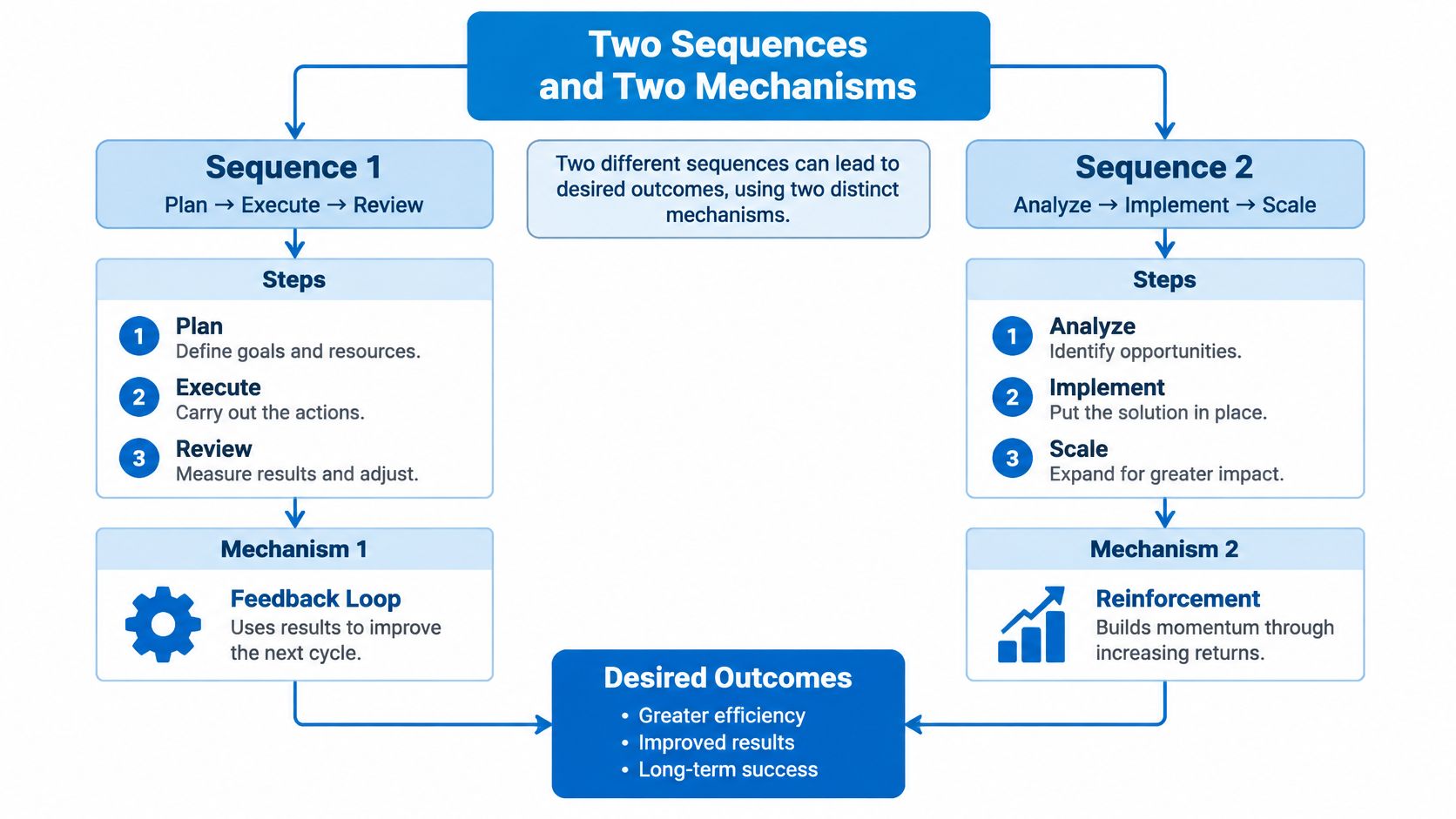
A laboratory comparing inflammatory signaling in cultured intestinal cells faces a precise question: does the experiment establish a specific pathway for the specific sequence being tested? Whether both compounds appear in discussions of inflammation is beside the point.
The diagram below separates the two pathways visually. It is a prompt to keep the mechanisms apart, not evidence of a unified peptide action.
One more layer sits underneath the sequence distinction. Each peptide can also exist under more than one named chemical form, so a finding attaches to a defined form of a defined sequence, never to a two-peptide pair name.
KPV and transporter-mediated uptake
In cultured human intestinal epithelial and immune-cell models, nanomolar KPV concentrations inhibited NF-κB and MAP-kinase inflammatory signaling and reduced pro-inflammatory cytokine secretion, according to the published intestinal transport study. The investigators connected these effects to uptake through human peptide transporter 1, or hPepT1.
PepT1 works like a gated loading dock. Its presence influences whether the tripeptide enters particular cells and reaches intracellular processes. That analogy describes access to the cell only. It guarantees nothing about how other tissues respond.
The distinction from direct receptor binding matters for how the result is read. The full study manuscript describes transporter-mediated entry rather than direct binding to the interleukin-1 beta receptor. A researcher testing that interpretation would need to account for transporter expression and the experimental conditions that permit uptake.
In the animal component, oral KPV was associated with lower disease incidence and inflammatory cytokine expression in mouse dextran-sulfate-sodium and trinitrobenzene-sulfonic-acid colitis models. These are experimentally induced mouse disease models, not clinical outcomes.
BPC-157 requires a separate account
BPC-157 literature concerns gastrointestinal injury, tendon and wound models, and inflammatory processes. Those observations do not establish the KPV transporter mechanism for BPC-157, and they do not transfer across chemical forms of BPC-157 itself. Reporting summarized by the American Journal of Managed Care describes a predominantly preclinical literature that cannot establish a standardized human exposure or validated indication.
For a mixture, the unanswered questions multiply. A combined preparation would require direct investigation of chemical compatibility, stability, assay interference, and biological interaction. Separate positive findings cannot establish synergy.
A transporter finding in intestinal cells and colitis models does not establish an effect on tendon, exercise recovery, or another nonintestinal endpoint. It also does not establish human exposure parameters.
The embedded video is supplementary material; individual mechanistic claims still require examination of the underlying study.
A clear laboratory summary labels each observation in vitro, animal in vivo, or human clinical. Cultured human cells remain an in-vitro model, even though the cells originated from human tissue. Four labels, applied accurately, keep four separate bodies of evidence from collapsing into one recovery story.
What the Published Record Actually Shows
Evidence depth for BPC-157 and KPV
| Evidence slice | BPC-157 | KPV |
|---|---|---|
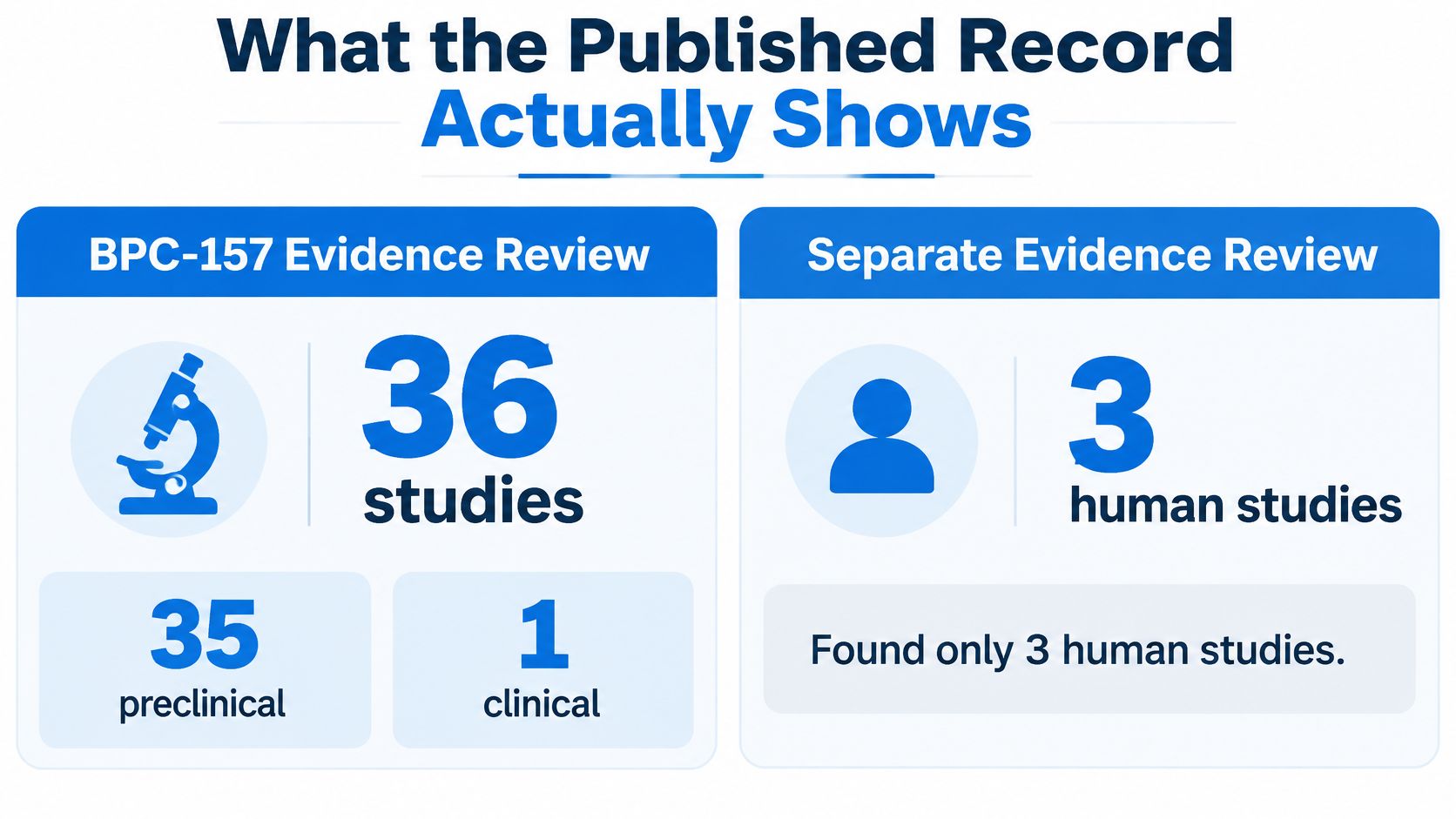
| 2025 orthopedic-sports review | 36 studies: 35 preclinical, 1 clinical, as summarized in the review overview | Not the subject of that review |
| Human studies in one evidence review | 3 studies, 30 participants, very low certainty, in the evidence summary accompanying the USADA material | No published human study identified in the human-evidence overview |
| Randomized human efficacy trials | None established in the cited summaries | None identified |
| FDA safety characterization | Insufficient clinical safety information for free base and acetate in the FDA briefing | No identified human clinical studies in the cited briefing summaries |
| WADA status noted by USADA | Prohibited under S0, Non-Approved Substances | Not covered by the USADA note |
| Combination evidence | No validated BPC-157 plus KPV regimen in the clinical-evidence discussion | Evidence does not transfer from BPC-157 |
The visual distinguishes the orthopedic-sports review from the separate human-evidence review.
Why the human reports cannot establish efficacy
The human-evidence summary included a retrospective knee-pain report involving 16 people, a retrospective interstitial-cystitis pilot involving 12, and a prospective intravenous safety pilot involving 2. These are the component reports behind the participant total in the table, not additional studies.
Retrospective reports examine information collected previously and are vulnerable to selection and reporting bias. Without an appropriate control group, an observed change cannot reliably be attributed to the compound rather than concurrent care, natural fluctuation, or other influences. A very small prospective safety pilot cannot characterize uncommon or delayed adverse effects.
The evidence review judged overall certainty very low because of bias, indirectness, and imprecision. That conclusion doesn't mean the underlying biology is nonexistent. It means that the available human observations cannot reliably establish the size, consistency, or duration of an effect.
Route and duration are separate evidence questions
The FDA materials reported insufficient clinical safety information for BPC-157 free base and acetate and no located human studies through the proposed oral, subcutaneous, nasal, or transdermal routes. A report involving a different route cannot fill those gaps.
For KPV, the available summaries identify neither published human clinical studies nor established human exposure information. Repeated exposure is especially uncertain because limited follow-up cannot characterize delayed effects, immunogenicity, or consequences associated with impurities, concerns discussed in Drug Topics' peptide briefing coverage.
Evidence boundary: The relevant question is whether the exact preparation, experimental exposure, route, and condition have been studied, not whether the peptide name appears in a publication.
For laboratory authors, uncertainty is the defensible conclusion. It should remain visible in abstracts, product descriptions, and interpretation of exploratory results.
Match the COA and Vendor File to the Vial
A certificate of analysis, or COA, is a lot-specific analytical record. It isn't clinical approval, and it doesn't establish that a material is suitable for every laboratory application. Its value comes from matching documented measurements to the container received.
Start with the identity line, not the purity headline. The record should identify GEPPPGKPADDAGLV or Lys-Pro-Val, specify the chemical form, and provide analytical support appropriate to that identity. A trade name alone is insufficient for distinguishing the materials.
Read the certificate as a matching exercise
COA lines to match before using a lot
| COA line | What a match looks like | Stop if you see |
|---|---|---|
| Identity | Sequence or mass for GEPPPGKPADDAGLV or KPV, plus salt form | Trade name only, or the other peptide |
| Purity | HPLC area percent with method and chromatogram | A percentage with no method |
| Net content | Measured peptide amount versus labeled fill | Label mass only |
| Batch | PDF lot identical to the vial | A certificate for another lot |
| Endotoxin and sterility | Method and limit when cell-work quality is claimed | Sterile language with no test |
| Heavy metals | Reported result or a stated limit | A metals claim with no result |
HPLC area purity is not the same measurement as peptide content. It describes the relative chromatographic signal under stated conditions. Without the method, detector information, and chromatogram, the number is difficult to interpret.
Net content needs a separate basis. A vial can contain material other than the target peptide, including moisture and counterions. The certificate should make clear whether a reported amount refers to total material, peptide-equivalent content, or another defined measurement.
For cell-based work, sterility and endotoxin results answer different questions. Neither replaces the other, and neither can be inferred from a visually clear solution. Heavy-metal results also need identifiable methods and reporting limits, rather than an unsupported quality slogan.
Recognize the mismatches that stop an assay
A certificate for the other salt form does not document the vial in hand. Even if the sequence matches, the researcher still needs the correct specification and content basis before preparing a quantitative assay solution.
A chromatogram whose dominant peak has an incompatible assigned mass needs investigation. Chromatography alone does not provide molecular mass; that comparison requires an associated mass-spectrometric result and correct interpretation of charge states and adducts. A retention-time match by itself isn't a substitute for identity testing.
A document bearing another batch identifier cannot authenticate the current lot. A date difference may be explainable, but a batch mismatch requires the correct certificate before the material enters the experimental workflow.
The quality-control review provides a documentation checkpoint for this matching process. ProTecPep assigns identifying batch information to support COA matching and offers assistance locating batch documentation.
Assemble a usable vendor file
The laboratory file should contain:
- Product specification: The sequence, chemical form, and relevant acceptance criteria.
- Lot certificate: Results tied to the material received.
- Container traceability: A batch identifier connecting the vial, certificate, and receiving record.
- Handling documentation: Storage, solubility, and sample-preparation information for that preparation.
Regulatory access belongs in a separate file from analytical evidence. As explained in Pharmaceutical Executive's regulatory coverage, compounding discussions do not establish approval, validated indications, standardized clinical exposure, or long-term safety.
A label screenshot cannot replace a matching COA. When a required document is absent, the appropriate action is to hold the lot and resolve the missing evidence.
Sample Prep Storage and Solubility in the Lab
Sample preparation should preserve chemical identity for an assay, not imply administration to a person. The controlling documents are the lot specification, the laboratory's validated procedure, and the requirements of the analytical method.
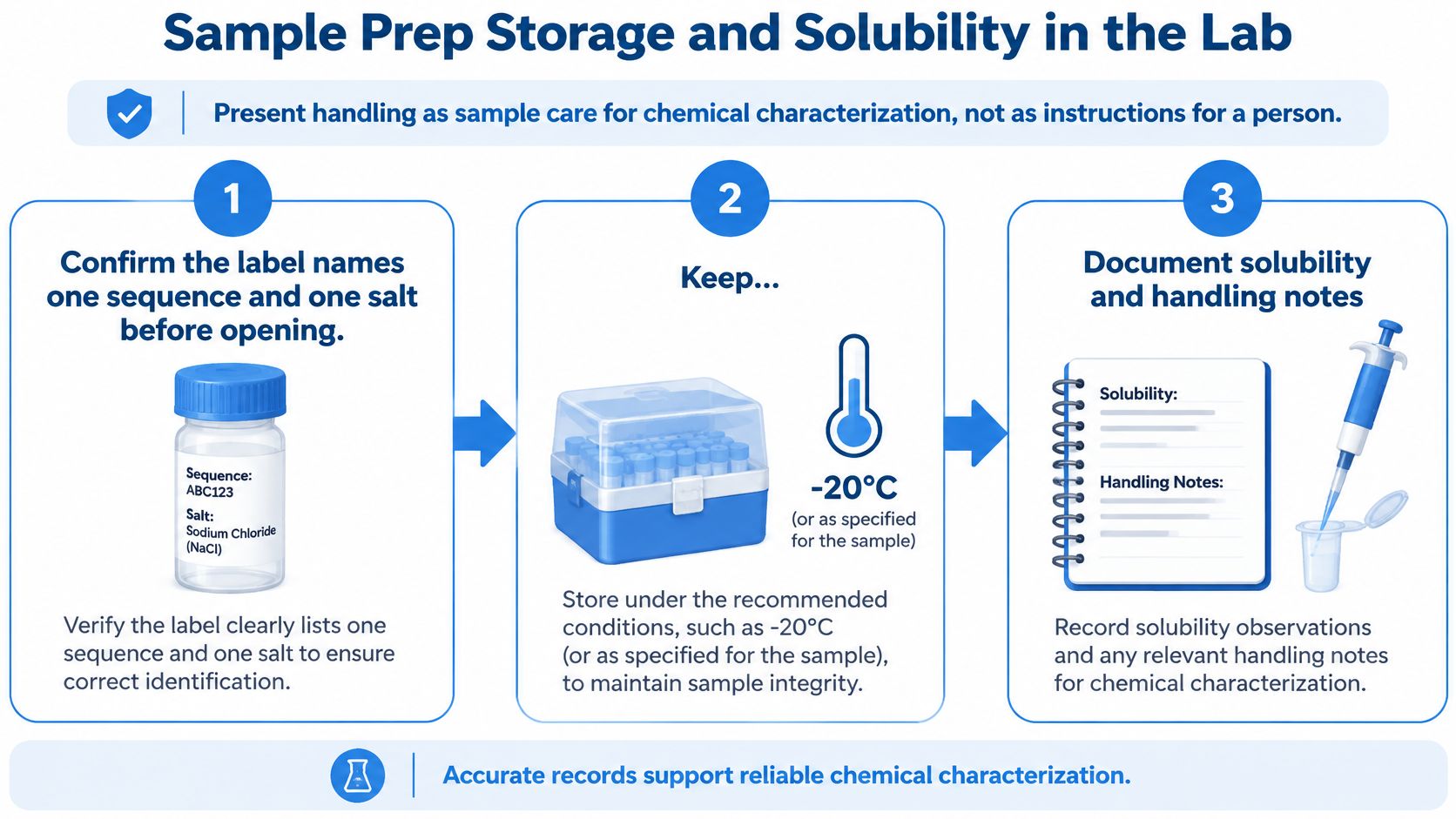
The workflow graphic emphasizes container identification, storage, and documentation.
A documented bench routine
Confirm identity before opening. The receiving record should name the sequence and chemical form. An unresolved label is a reason to quarantine the material.
Keep the unopened solid cold, dry, and protected from light according to its specification. ProTecPep specifies −20°C storage for its KPV material; that condition should not automatically be assigned to another supplier's preparation.
Allow the closed container to equilibrate before opening. This reduces the chance that moisture will condense into cold powder. The container should remain closed during equilibration.
Record appearance, lot identifier, and container mass where required by the laboratory procedure. A receiving photograph can supplement, but not replace, written identification.
Select solvent from documented compatibility information. If solubility is uncertain, a small laboratory solubility assessment should precede preparation of the working sample. Free-base and acetate preparations should not be assumed to behave identically.
For aqueous experiments, document the buffer, pH, and concentration achieved. Neutral phosphate-buffered saline should be verified as suitable, not treated as a universal peptide solvent.
Prepare traceable aliquots. Label each tube with sequence, chemical form, concentration, solvent, preparation date, and parent lot. Limit repeated freezing and thawing according to the stability procedure.
Quarantine solutions that become cloudy, discolored, or analytically inconsistent. Repeat HPLC or another appropriate method should determine whether the sample still meets the assay's acceptance criteria.
Preserve the connection to the certificate
Moisture can change weighed composition and promote degradation under unsuitable conditions. An unstated salt form undermines concentration calculations, while an unlabeled aliquot breaks traceability even if its contents appear unchanged.
KPV provides a short-chain example and BPC-157 a longer-chain example, but chain length alone doesn't determine a storage or solvent protocol. The long-term peptide storage guide can support laboratory planning alongside preparation-specific documentation.
The final bench check is whether the solution entering the assay still represents the chemical identity and quality described by the certificate.
Confirm Research Use Before You Order
The purchasing decision should follow the experimental purpose. These materials belong in lawful non-clinical laboratory work, with a defined method, qualified personnel, and documentation appropriate to the intended investigation.
Permitted research with ProTecPep materials includes analytical testing, chemical characterization, method development, reference-standard comparison, stability testing, instrument calibration, in-vitro laboratory investigation, and other lawful non-clinical research activities. A catalog listing alone does not establish suitability as a certified reference standard or calibration material; the applicable documentation must support that role.
Qualification and documentation come first
ProTecPep is a specialized chemical supplier. It is not a compounding pharmacy or chemical compounding facility under section 503A, nor an outsourcing facility under section 503B, of the Federal Food, Drug, and Cosmetic Act.
Its 7x Tested process evaluates seven quality areas: identity, purity, net content, conformity, sterility, endotoxins, and heavy metals. Researchers should examine the relevant lot record rather than assume that a process description supplies every result needed for a particular assay.
The research-use-only guidance provides a purchasing checkpoint for qualified laboratory personnel. ProTecPep may restrict or refuse fulfillment when a buyer does not meet its qualification criteria, and may review, hold, refuse, or cancel orders when intended use is unclear.
Before purchase, the researcher should document:
- Intended investigation: A lawful non-clinical purpose and a defined analytical or in-vitro question.
- Material selection: The required sequence and chemical form, rather than a paired marketing label.
- Lot traceability: Agreement between the product record, container identifier, and COA.
- Release decision: Acceptance criteria established before the material enters an experiment.
For BPC-157 and KPV, ordering is therefore a materials-selection decision, not an endorsement of a combined biological effect. A mismatch in sequence, salt, or batch should stop the order until the documentation is resolved.
ProTecPep offers research materials and COA assistance for qualified laboratory personnel examining peptide identity and analytical quality. Researchers comparing BPC-157 and KPV can visit Pro Tec Pep to review available materials and confirm the sequence, chemical form, and matching batch documentation before ordering.
For laboratory research use only. Not for human or veterinary use. Not a drug, food, or cosmetic. Not evaluated by the FDA. Not intended to diagnose, treat, cure, or prevent any disease. By purchasing, you certify you are a qualified researcher and agree to use this product solely for in-vitro laboratory research.