Quality Control Review: What Labs Should Check
Learn what a quality control review covers for research compounds: seven test categories, how to read a COA, and common failure modes.
Does a Certificate of Analysis prove that a batch is suitable for a laboratory experiment, or merely show that someone reported test results? The difference matters whenever a researcher receives material with a convincing purity figure but incomplete supporting records.
A quality control review treats the COA as a set of claims to verify, not a guarantee. The reviewer connects each claim to a batch, a method, a specification, and a record, then decides whether the evidence supports acceptance, a document request, or further testing.
Seven Checks Behind Every Quality Control Review
A quality control review is a structured check of a batch's documentation and test results before it is released for laboratory research. The reviewer asks what was tested, how it was measured, and whether the result meets a defined requirement.
ProTecPep evaluates each batch in seven categories: identity, purity, net content, sterility, endotoxins, heavy metals, and conformity. Every batch undergoes analytical testing before release, including High-Performance Liquid Chromatography (HPLC), Mass Spectrometry (MS), and Certificate of Analysis verification.
The seven batch evaluation categories
| Category | Question It Answers | Typical Method | Reviewer Note |
|---|---|---|---|
| Identity | Is the material the compound named on the label? | Mass spectrometry (MS) and HPLC retention comparison | Compare against a reference standard |
| Purity | How much of the sample is the target compound? | HPLC peak area percentage | Check that the method and peak integration are named |
| Net content | Is the stated quantity present? | Gravimetric or volumetric measurement | Compare the measured amount with the label |
| Sterility | Is the sample free of viable microorganisms? | Compendial sterility testing | Confirm that the test is listed and its result is reported |
| Endotoxins | Are bacterial endotoxin levels within limits? | Limulus amebocyte lysate (LAL) assay | Relevant for in-vitro cell work |
| Heavy metals | Are trace metals below reporting limits? | Inductively coupled plasma mass spectrometry (ICP-MS) | Check that the reporting limit is stated |
| Conformity | Does every result meet its specification? | Result-by-result comparison with the specification | Confirm that every listed test has a result |
Identity isn't purity. A sample can contain the expected compound alongside unwanted material. Likewise, an HPLC peak-area percentage describes the relative detector response under the stated method, not necessarily the target compound's proportion of the entire vial by mass.
Net content addresses quantity, not chemical composition. Sterility and endotoxin testing answer separate questions: a sterility result doesn't establish that bacterial endotoxins are below the laboratory's limit. Heavy-metal findings require named analytes, units, and reporting limits before a reviewer can interpret them.
Practical rule: A missing result is a documentation gap, not a pass. An unnamed method leaves the reviewer without enough information to judge the number.
Conformity is the comparison step, rather than another analytical test. A batch satisfies the complete checklist only when every required category has a reported result that meets its specification.
The intended setting also matters. Healthline's explanation of research chemicals distinguishes laboratory materials from approved medical products. This table therefore supports laboratory evaluation, not conclusions about personal outcomes or clinical suitability.
How to Read a Certificate of Analysis, Step by Step
A COA is a batch-specific document containing available laboratory results and identifying information. The reader should begin with the physical container, not with a downloaded file whose title merely resembles the product name.
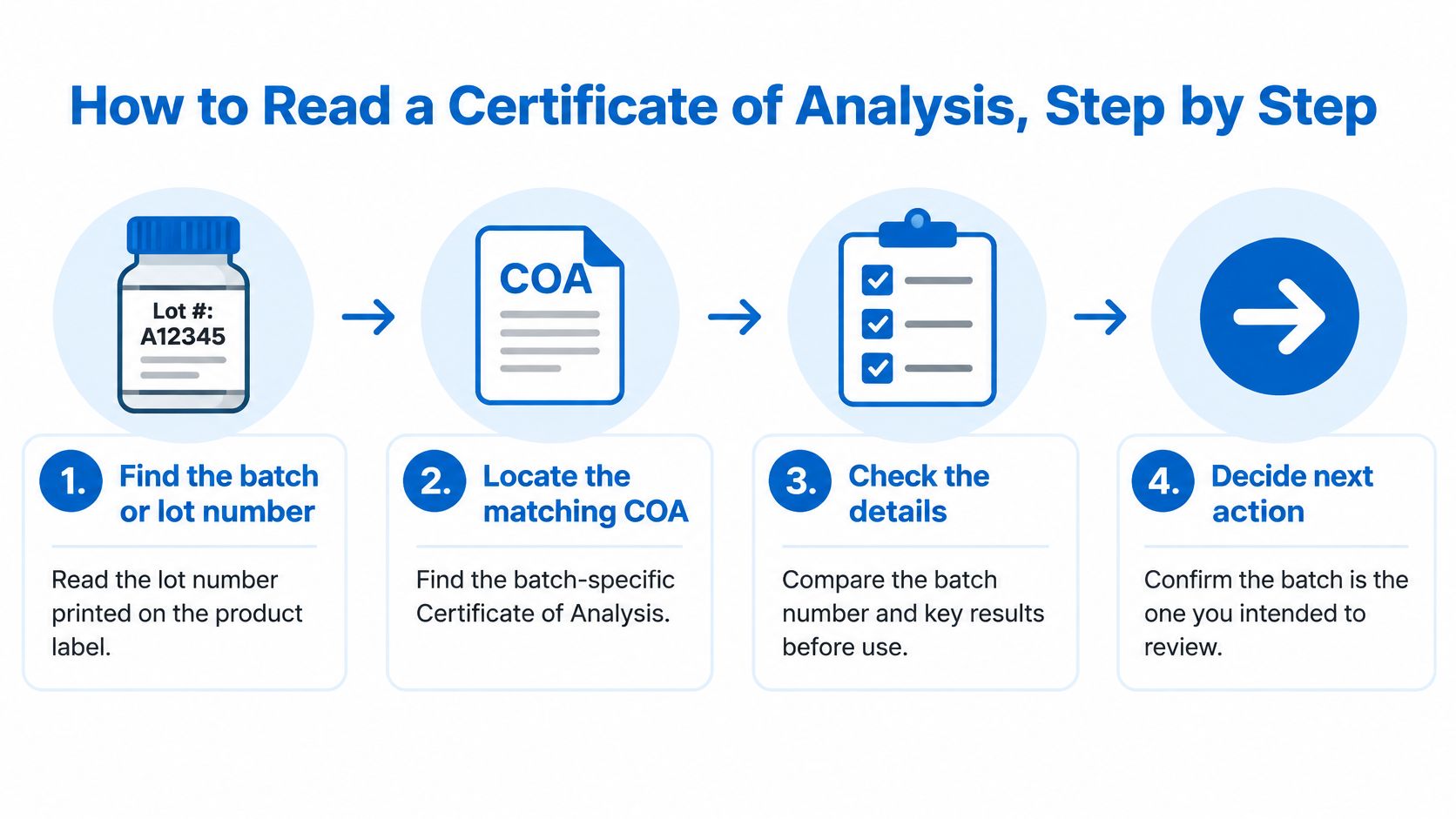
The bench-side sequence begins with matching the material to its document.
Match the record before interpreting results
Find the batch or lot number on the label. Record the identifier exactly, including letters, separators, and suffixes. Photographing the label helps prevent transcription errors when the receiving record is created.
Locate the matching COA on the website. Customers use the batch or lot number printed on the product to find its matching document. A COA for another batch of the same compound isn't an acceptable substitute.
Compare the identifying details. Check the compound name, lot number, and relevant dates against the container and receiving paperwork. A testing date and a production date can serve different purposes, so the reviewer should confirm what each date represents rather than expect every date to be identical.
Check category coverage and limits. Each required category should have a result and an acceptance criterion, either on the COA or in an identified supporting specification. A result without a limit cannot support a conformity decision.
Read the identity and purity methods. HPLC and MS entries should identify the applicable procedure and provide, or reference, enough conditions to interpret the result. When the summary omits those details, the reviewer should request the method record rather than infer the procedure from the instrument name.
Compare each result with its specification. Mark the result as conforming, nonconforming, or unresolved, and preserve the units. A statement such as “complies” should remain traceable to the underlying test record and acceptance criterion.
Confirm applicability before signing. Testing may vary by product or batch, so the applicable COA must govern the decision. Each ProTecPep product has identifying batch information to support inventory control, quality documentation, and COA matching.
What a complete match looks like
A complete review file contains the label record, matching COA, applicable specifications, and any supporting documents needed to resolve questions. The reviewer's name, review date, and disposition should make the decision traceable.
The reviewer can confirm label matching and document completeness at the bench. Confirming an analytical claim may require chromatograms, spectra, preparation records, or independent testing.
A missing or unmatched lot number is a reason to pause before further handling, even when the reported results appear acceptable.
Confirming the Measurement Before Trusting the Result
A precise-looking result can still come from an unreliable measurement process. Before interpreting a borderline purity or content result, the reviewer needs evidence that the method can distinguish sample differences from measurement variation.
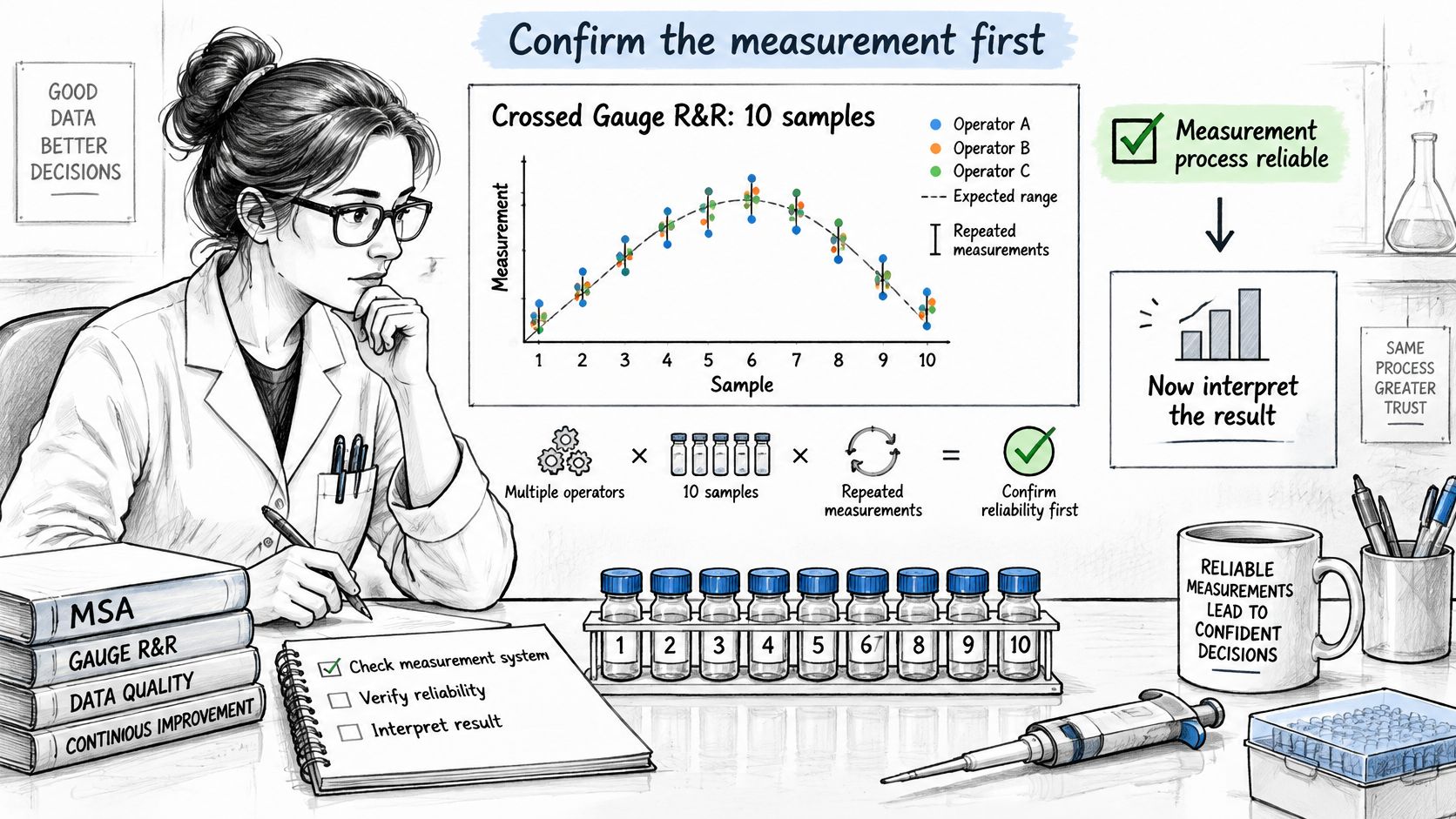
A crossed study helps organize that question.
Separate method variation from analyst variation
The Gauge R&R technical guide describes a crossed design with at least 10 parts, 2 to 3 trained appraisers, and at least 2 repeated measurements per part and appraiser; its common 3-appraiser, 10-part, 2-trial design produces 60 observations, with interpretation bands of below 10%, 10% to 30%, and above 30%.
Repeatability describes variation associated with the equipment or method. Reproducibility describes variation between analysts.
For HPLC work, replicate preparations of a well-characterized sample help examine preparation and instrument variation. Independent analysts can prepare and analyze those samples, but repeated measurements of one material alone don't replace a crossed study covering the expected sample variation.
Gauge R&R thresholds and reviewer action
| Percent Gauge R&R | Interpretation | Reviewer Action |
|---|---|---|
| Below 10% | Generally acceptable | Approve the data for release decisions, subject to other method requirements |
| 10% to 30% | Requires application-specific review | Review the study design and method with an engineer or method owner |
| Above 30% | Generally unacceptable | Do not approve for release; improve the method and repeat the study |
These are measurement-system guidelines, not a complete analytical-method validation standard. An unreliable system can reject conforming material or accept nonconforming material, weakening both release decisions and investigations.
The accompanying video provides additional context for the measurement review.
The reviewer should verify:
- Study design: Samples represent the expected measurement range.
- Analyst independence: Analysts prepare and record results without copying earlier findings.
- Calibration: Instrument records cover the testing period.
- Resolution: The number of distinct categories supports the intended discrimination.
- Traceability: Raw results connect to preparation records and the approved procedure.
The peptide purity testing guide supports interpretation of the analytical records. Purity or identity data should support release only after the measurement approach is shown to be fit for its intended purpose.
Common Review Findings and What They Mean
A useful first check is whether a reported purity value names its method. Without that information, the reviewer cannot reconstruct how the laboratory generated the result or determine whether another laboratory could meaningfully compare it.
A quality control review should distinguish a document problem from an analytical concern. Missing paperwork may be resolved by retrieving an existing record; an unexplained analytical discrepancy requires investigation and may require a retest.
Review findings, likely causes and actions
| Symptom | Likely Cause | Review Action |
|---|---|---|
| Purity reported without a named method | Incomplete documentation | Request method details before accepting the number |
| No lot number on the COA | Batch mismatch or missing document | Hold the batch until the COA is matched by lot number |
| Purity below specification | Possible storage degradation or preparation residue | Review storage history and stability data, then retest under an approved investigation |
| Identity peak does not match reference | Wrong material, labeling error, or degradation | Quarantine the batch and confirm against a reference standard |
| Net content below label | Fill or weighing variation, or instrument drift | Re-measure and check gauge calibration status |
| Endotoxin result above limit | Possible contamination during handling | Quarantine the batch and review handling records |
| Test category missing from COA | Incomplete testing scope | Request the full seven-category report |
The listed causes are investigation starting points, not established explanations. A low-purity result doesn't establish that the supplier released degraded material, and an identity mismatch doesn't establish that the container contains the wrong compound.
Choose the record that can resolve the finding
For a missing method, the relevant evidence is the procedure identifier, chromatographic conditions, integration record, and applicable revision. For a suspected storage problem, the reviewer needs receipt dates, temperature records, opening history, and available stability information.
A net-content investigation should identify what the reported quantity represents. Gross container weight, dry material mass, and analytically determined compound content are different measurements and shouldn't be substituted for one another.
Document requests can be resolved within days when the records already exist, although no fixed turnaround should be assumed. A laboratory retest generally requires additional preparation, instrument availability, and technical review.
- Document request: Appropriate when the test exists but its supporting record is missing.
- Retest: Appropriate when an approved investigation identifies an analytical question that additional testing can answer.
- Quarantine: Appropriate when identity is unresolved, endotoxins exceed the limit, or another significant discrepancy makes routine handling inappropriate.
Retesting should answer a documented question, not continue until an acceptable result appears.
The original result must remain in the investigation file. Any final disposition should explain why the evidence supports acceptance, rejection, or continued quarantine.
Keeping Batches Reproducible Over Time
Consistent laboratory results require more than a passing COA at receipt. The purchaser must maintain accurate inventory and chain-of-custody records, and appropriately trained personnel must handle materials in a controlled laboratory environment.
Custody records should identify who received, stored, transferred, opened, and prepared the material. Sample-preparation records should include the solvent, concentration calculation, storage temperature, and elapsed time between opening and the experiment.
Follow a recurring purity finding
Consider a hypothetical investigation in which low purity appears in two successive lots. That pattern makes shared storage conditions or supplier handling worth examining, but it doesn't establish either as the cause.
Containment starts with holding the affected material and identifying related samples. The investigator then compares preparation worksheets, storage logs, shipment records, and chromatograms to determine whether both lots encountered the same conditions.
Root-cause validation asks whether the proposed explanation accounts for the observations. If the investigator suspects storage, controlled comparisons should distinguish storage effects from analyst preparation, instrument performance, or differences already present at receipt.
The guide to long-term peptide storage can help organize handling questions. Product-specific instructions and laboratory procedures still govern the actual storage conditions.
Measure whether the correction worked
PRIZ Guru's discussion of root-cause analysis and quality management emphasizes recurrence-oriented evidence rather than closing a corrective action merely because someone completed an assigned task.
Useful corrective and preventive action (CAPA) measures include:
- Repeat nonconformity rate: Whether the same failure continues after the change.
- Time to containment: How promptly personnel control affected material.
- Time to validated root cause: How long the investigation needs to establish a supported explanation.
- CAPA effectiveness-pass rate: Whether completed actions meet their predefined effectiveness criteria.
- Repeat-finding rate: Whether related lots or suppliers show the same unresolved issue.
For the hypothetical purity investigation, the reviewer records a baseline, names an owner, sets a due date, and defines an observation window. The follow-up should include comparable material processed under normal laboratory conditions, not only a specially supervised preparation.
A corrective action closes when documented results demonstrate sustained improvement. The reviewer should also assess whether the same failure mechanism could affect other materials, storage locations, or preparation workflows.
What Research Use Only Does and Does Not Cover
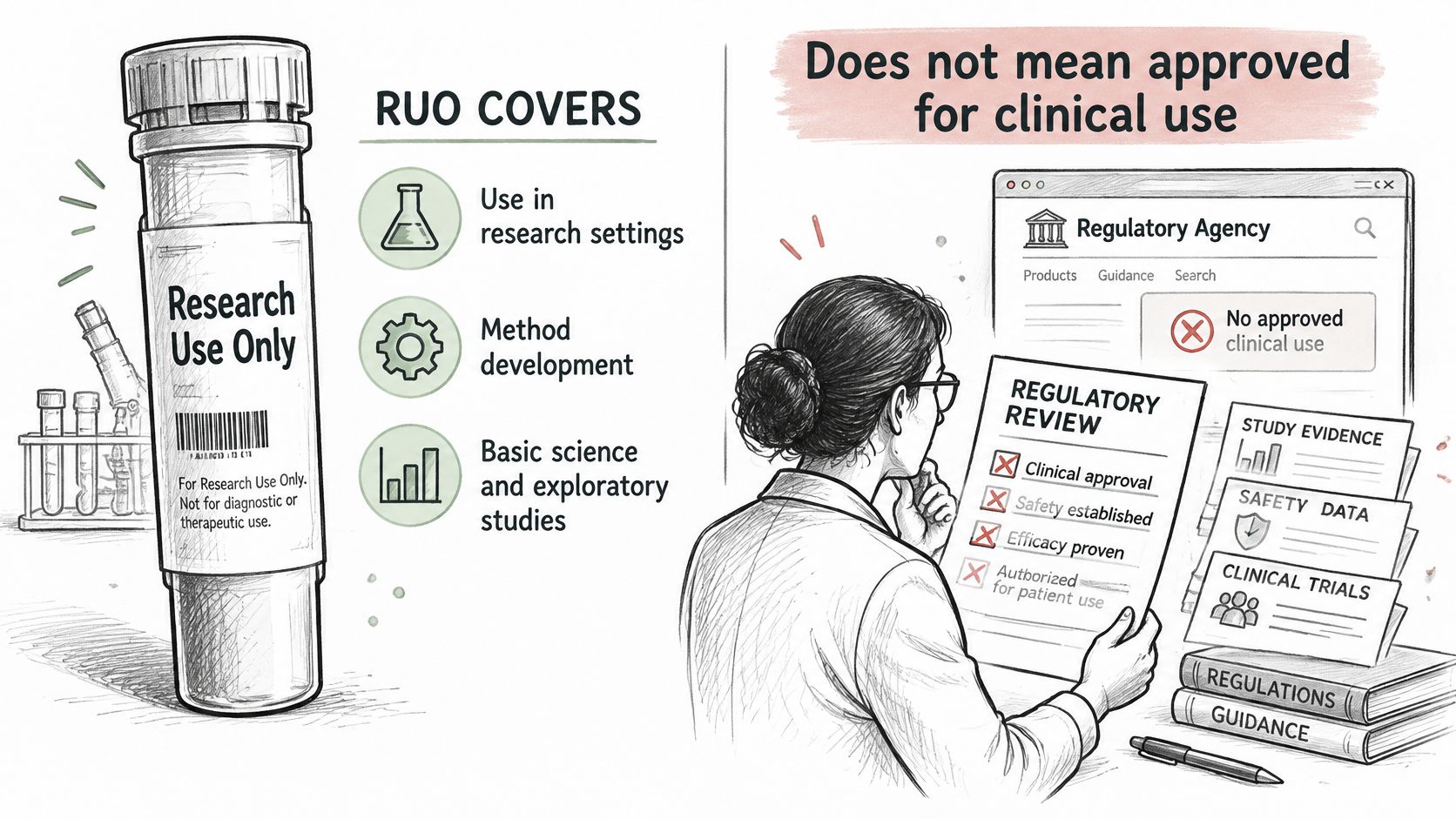
A research-use label doesn't end the regulatory review. An FDA warning letter concerning research-peptide marketing explains that regulators assess labeling, websites, and other evidence to determine intended use; a disclaimer alone doesn't override contrary marketing claims.
The relevant distinction is between a stated laboratory purpose and the product's overall presentation.
Check the intended activity
Research-focused documentation should describe laboratory investigation and identify the study type accurately. An in-vitro finding shouldn't be presented as a personal outcome, and a mechanism reported for an individual compound shouldn't be assigned to an unstudied proprietary blend.
Permitted research activities described for these materials include:
- Analytical work: Chemical characterization, method development, and reference-standard comparison.
- Measurement support: Instrument calibration and stability testing.
- Laboratory investigation: In-vitro experiments and other lawful, appropriately authorized non-clinical research.
The research-use-only peptide guide provides further context for this boundary. A general description of research chemicals may encompass nonhuman animal studies, but that description doesn't authorize such work for every product or override a product-specific restriction.
Keep analytical evidence separate from authorization
The purchaser is solely responsible for determining whether a proposed activity is lawful, appropriately authorized, and suitable for the material. ProTecPep reserves the right to review, refuse, hold, or cancel an order when its intended use is unclear.
The review file should therefore identify the proposed experiment, responsible laboratory, applicable approvals, and relevant product restrictions. When that information is incomplete, the reviewer should pause the batch rather than assume that a research-use label supplies permission.
A COA can document testing of a particular batch. It doesn't establish approval for a human purpose, demonstrate clinical suitability, or authorize an otherwise restricted experiment.
Decide Whether a Batch Moves Forward
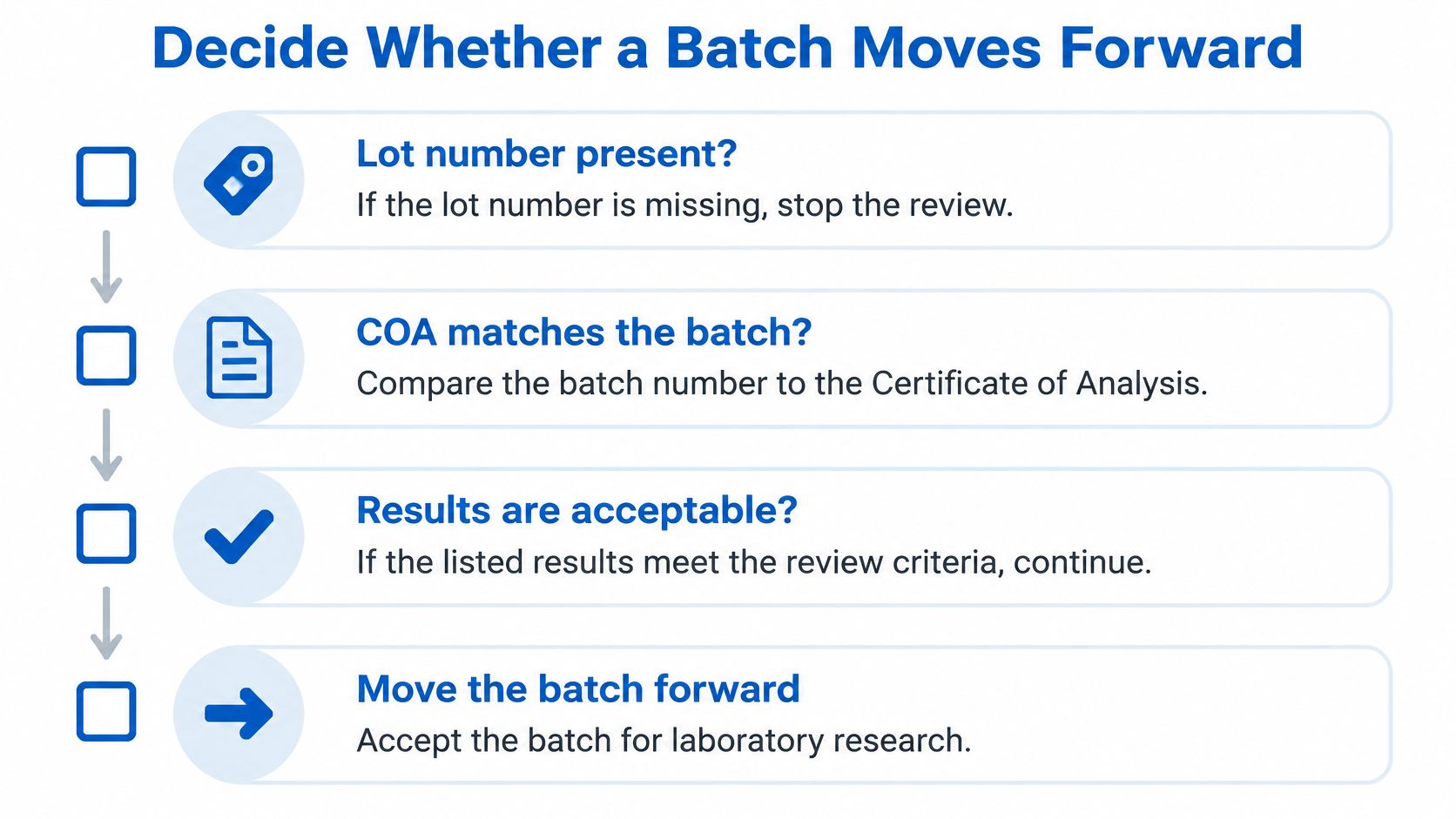
The final disposition should be accept, hold, or quarantine, with a written reason and a named decision-maker. A signed checklist without the supporting evidence doesn't provide a defensible release record.
The decision path begins with traceability and ends with authorization for the proposed laboratory work.
Apply the disposition rules
Hold an unmatched batch. If the lot identifier is absent or the COA belongs to different material, pause further handling and request the correct documentation. Preserve the receiving record so the discrepancy remains traceable.
Quarantine significant analytical discrepancies. An unresolved identity mismatch or an endotoxin result above its specification warrants segregation from accepted inventory. Assign an investigator to review the relevant reference, sampling, and handling records.
Investigate low purity or net content. Examine storage history, stability evidence, preparation calculations, and calibration before authorizing additional testing. The investigation should define what a retest will establish and how its result will affect disposition.
Reject unsupported measurement evidence. When a measurement-system study falls in the generally unacceptable band, the reviewer shouldn't approve its data for release. The method owner should improve the procedure and repeat the appropriate assessment before those data support a decision.
Stop when intended use is unclear. Confirm the activity, laboratory environment, and personnel qualifications before proceeding. Purchasers must be at least 21 years old and qualified to handle laboratory research materials.
Accept only with a complete decision record. Update inventory and custody logs, identify the approved research purpose, and record any required follow-up. An unresolved release-critical finding prevents acceptance; an administrative follow-up needs an owner and recheck point.
Preserve the basis for acceptance
The accepted-batch file should connect the physical container to the COA, supporting methods, review findings, and final disposition. If the batch remains on hold, the record should identify exactly which document or test result is needed next.
A quality control review is a risk-reduction control, not a guarantee of accuracy. Its value comes from documented decisions that another qualified reviewer can understand and verify.
ProTecPep offers batch-specific Certificates of Analysis and COA assistance to help qualified researchers locate the documentation needed for review. Qualified laboratory purchasers can visit Pro Tec Pep to locate applicable batch records and resolve documentation gaps before accepting material into laboratory inventory.