Research Chemicals for Sale: Lab Buyer Checks
Research chemicals for sale: match the lot to a COA, third-party HPLC and MS, 21-plus buyer checks, and research-use-only terms before you order.
The usual advice for finding research chemicals for sale starts with a purity percentage, a polished website, or a downloadable certificate. That's the wrong starting point for a laboratory purchase order. A procurement lead first needs to establish what the material is, whether the proposed transaction is lawful, and who is accountable for supplying that particular lot.
A listing is a hypothesis, not an accepted specification. The purchase should proceed only when the intended-use language, supplier identity, analytical records, and buyer qualifications support the same lawful laboratory activity.
Four Categories Behind a For Sale Listing
A research-chemical label doesn't establish laboratory grade, permission to possess a substance, or suitability for people. Before comparing prices or certificates of analysis, the buyer needs to sort the listing into a regulatory and procurement category.
The distinction matters because chemical identity, intended use, and legal status are separate questions. A clearly named compound can still be marketed improperly, while a research-focused page doesn't establish that shipment into the receiving jurisdiction is permitted.
Classify the transaction first
Lawful laboratory material has a defined identity and a legitimate research purpose. Its documentation supports analytical testing, chemical characterization, method development, reference comparison, stability work, instrument calibration, or in-vitro investigation. The buyer's next move is to continue the document check, not automatically approve the order.
An unapproved product with human-use signals requires a different response. An FDA warning document explains that research-only disclaimers don't prevent products from being treated as drugs when surrounding website evidence establishes intended human use under section 201(g)(1) of the Federal Food, Drug, and Cosmetic Act. A procurement lead should stop rather than reinterpret a medicine-like listing as an ordinary reagent.
A controlled substance or novel analogue needs a legal review based on its actual identity. Familiar effect descriptions and changing chemical names aren't substitutes for checking scheduling, analogue restrictions, and institutional authorization. The default action is not to order through routine procurement.
A jurisdiction-dependent listing belongs with institutional counsel before purchasing proceeds. A seller's statement that possession is permitted somewhere doesn't establish permission to import, market, transfer, or conduct the proposed work at the receiving laboratory.
How to classify a research chemical listing
| Category | What the page usually shows | What actually decides status | Buyer action |
|---|---|---|---|
| Lawful laboratory material | Analytical, in-vitro, or characterization language only | Qualified buyer and research-use terms as sale conditions | Continue to lot documents |
| Unapproved product with human-use signals | RUO disclaimer plus treatment or personal-outcome language | Intended use under drug law, not the disclaimer alone | Stop; don't treat as a lab reagent |
| Controlled substance or novel analogue | Familiar effect language or a shifting chemical name | Scheduling and analogue rules in the buyer's jurisdiction | Do not order |
| Status varies by country | Legal-to-possess claims without a jurisdiction | Possession rules and marketing rules can differ | Confirm counsel and institutional policy |
Read the whole page
The classification check covers descriptions, graphics, linked instructions, and checkout terms, not merely the footer. A page describing analytical characterization presents a different intended-use context from one promising a personal result.
The concept map separates the questions that procurement staff need to resolve.
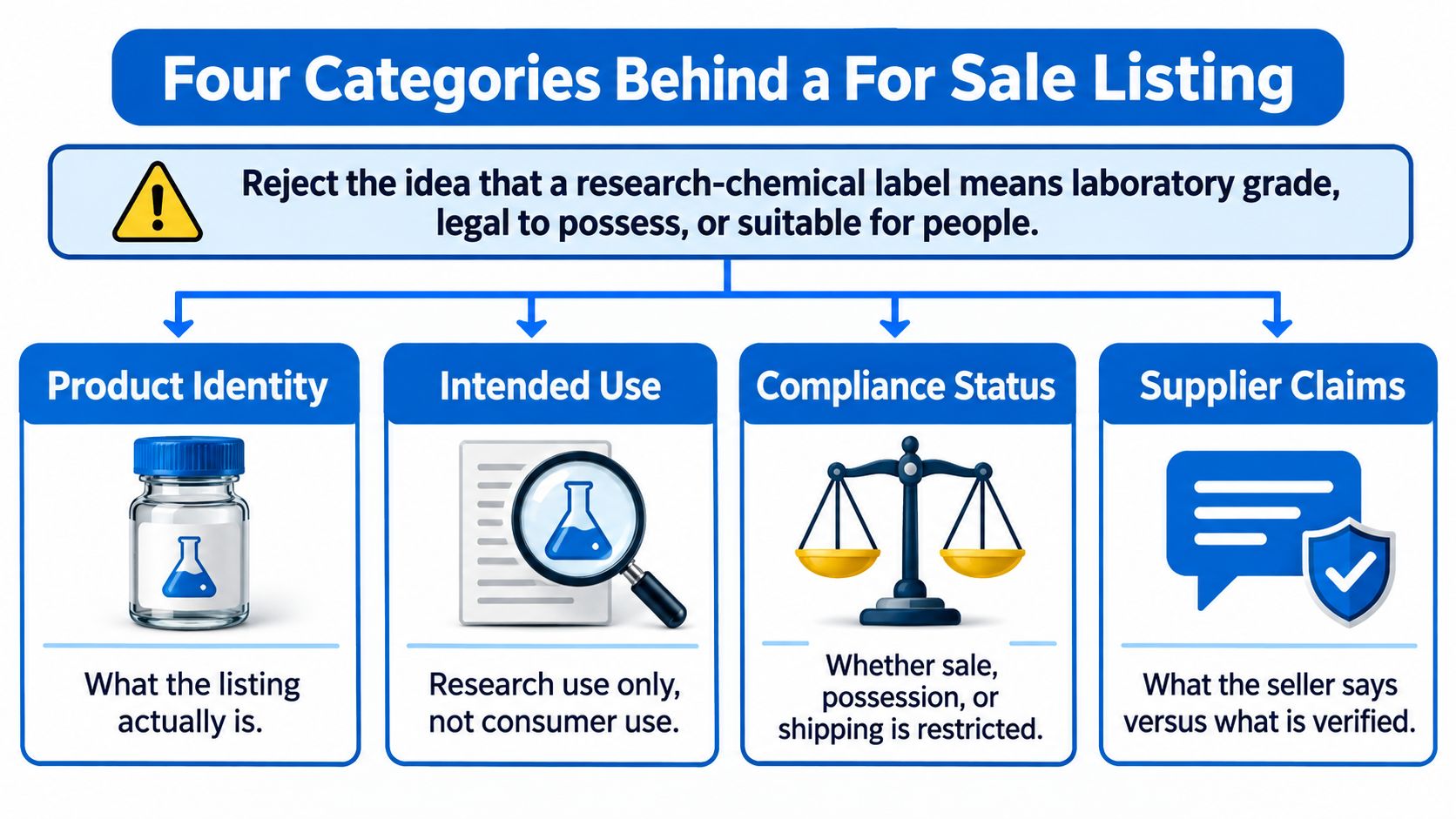
For ProTecPep, research use only, not for human consumption, and not for human or veterinary use are material conditions of every sale. They aren't decorative wording that a buyer can disregard after checkout.
Classification rule: A page naming a human outcome, an administration schedule, or a personal result shouldn't pass as a laboratory listing.
That rule doesn't resolve every legal question. It identifies listings that shouldn't enter the routine reagent-purchasing workflow in the first place.
Vet the Supplier Before Requesting a Quote
Supplier vetting should produce a file that another procurement officer can understand without reconstructing email conversations. A professional-looking storefront isn't enough.
Build a supplier record
Confirm the legal entity. Record the registered business name, business address, working telephone number, and a named person responsible for technical questions. Keep the response with the supplier application.
Establish the manufacturing chain. Request the manufacturer or synthesis source. Compare the names on the catalog page, sample certificate, and invoice; documented distributor relationships can explain differences, but unexplained substitutions cannot.
Check eligibility and destinations. Record the countries served and whether an institutional account or qualified-buyer review is required before a quote is issued.
Read the remedy policies. Save the refund, damaged-shipment, replacement, and temperature-excursion terms. A replacement promise is less useful when the supplier hasn't defined how a compromised shipment is assessed.
Search public enforcement records. Check regulatory warning letters, recalls, and enforcement notices against the legal entity, trading names, and relevant product family. Record the search date and any unresolved findings.
Compare product naming. Check the catalog, sample documents, and proposed shipping label. An abbreviation is acceptable only when the supplier maps it clearly to the same chemical identity.
Test technical responsiveness. Request written answers about sourcing, compliance, and research-use conditions. Refusal to identify the source or answer a straightforward compliance question is a failed check.
Supplier vetting establishes who supplied the material. It doesn't establish what the container contains.
A slower, documented response is more useful than an immediate quote that leaves responsibility unclear.
Lot Documents That Must Match Before You Buy
A certificate of analysis, or COA, should describe the lot being purchased, not a representative batch selected for marketing. Before payment, procurement staff should obtain the proposed lot record and establish which identifiers receiving staff will verify.
At receipt, staff should photograph the package, label, lot number, and seal before opening. A representative retained sample can support later investigation where institutional policy, material availability, and the approved handling procedure permit it.
Match identity before interpreting purity
An international-mail laboratory study published in the Journal of Forensic Sciences demonstrated screening with handheld Raman spectroscopy, portable FT-IR, and transportable mass spectrometry for unknown or mislabeled products. The procurement lesson is that orthogonal methods answer different questions: rapid spectroscopy can flag discrepancies, while validated chromatography–mass spectrometry provides stronger compositional confirmation.
HPLC purity isn't a complete identity assessment. A chromatographic result also doesn't independently establish concentration, sterility, storage stability, or the absence of hazardous impurities.
Lot document checklist before purchase
| Check | Passing record | Reject if |
|---|---|---|
| Identity | Chemical name plus CAS or defined sequence, matching label and invoice | Name, structure, or form disagree |
| Lot traceability | Lot or batch on label, COA, and shipping documents | One generic COA covers every batch |
| Purity method | HPLC result tied to that lot, method noted | A purity percentage has no method or date |
| Orthogonal identity | Mass spectrum consistent with the stated molecule | Only one rapid test or one in-house claim |
| Impurities | Named residuals or a stated limit, not a slogan | Pure appears without impurity information |
| Independence | Third-party laboratory name and report date where offered | A marketing sheet is presented as the only proof |
| Compound class | Correct class, blends listed by component | Hormone or coenzyme is mislabeled as a peptide, or a blend is given one mechanism |
| Buyer terms | Research-use-only conditions and qualified-buyer language | Human outcome, schedule, or personal-result claims |
The analyst should also record the salt, acetate, sequence, or other specified form, together with stated residual solvents. A nominally matching catalog name doesn't resolve a form mismatch that could affect the experiment.
Separate testing claims from usable evidence
ProTecPep's batch-release process includes High-Performance Liquid Chromatography, Mass Spectrometry, and COA verification. Independent third-party analytical testing, including COAs, accompanies its products where available.
Availability still needs to be checked for the proposed lot. The explanation of what third-party tested means helps distinguish an outside laboratory report from a supplier's summary of testing.
The trade-off is straightforward: independent confirmation adds expense and lead time, but accepting an unsupported specification can invalidate later comparisons. The laboratory should establish its acceptance criteria before ordering rather than relaxing them after the parcel arrives.
Record the actual compound class
A procurement register may contain Retatrutide, BPC-157, TB-500 (Thymosin Beta-4 Acetate), Tesamorelin, GHK-Cu, KLOW, BBG70, NAD+, MOTS-c, Ipamorelin, IGF-1LR3, HCG, AOD9604, CJC-1295, Tirzepatide, SS-31, Sermorelin Acetate, Semax, Selank, Epithalon, DSIP, and 5-Amino-1MQ. Catalog placement alone shouldn't determine their classification or specifications.
KLOW and BBG70 are proprietary blend names, so each component needs its own identity and supporting literature. A blend name doesn't establish a unified mechanism, and component findings shouldn't be presented as evidence from a study of the finished mixture. NAD+ is a coenzyme, not a peptide; HCG is a hormone, not an ordinary single-chain research peptide.
For hCG, a peer-reviewed review of its molecular forms describes regular hCG as a glycoprotein with a 145-amino-acid beta subunit, a 92-amino-acid alpha subunit, and an approximate molecular weight of 36,000, while distinguishing hyperglycosylated hCG and its free beta subunit. The lot record should name the molecular form because glycosylation and subunit composition affect assay comparability.
Release criterion: identity, lot records, and independent confirmation must agree before the laboratory accepts the specification for reproducible work.
How to Place a Research Use Only Order
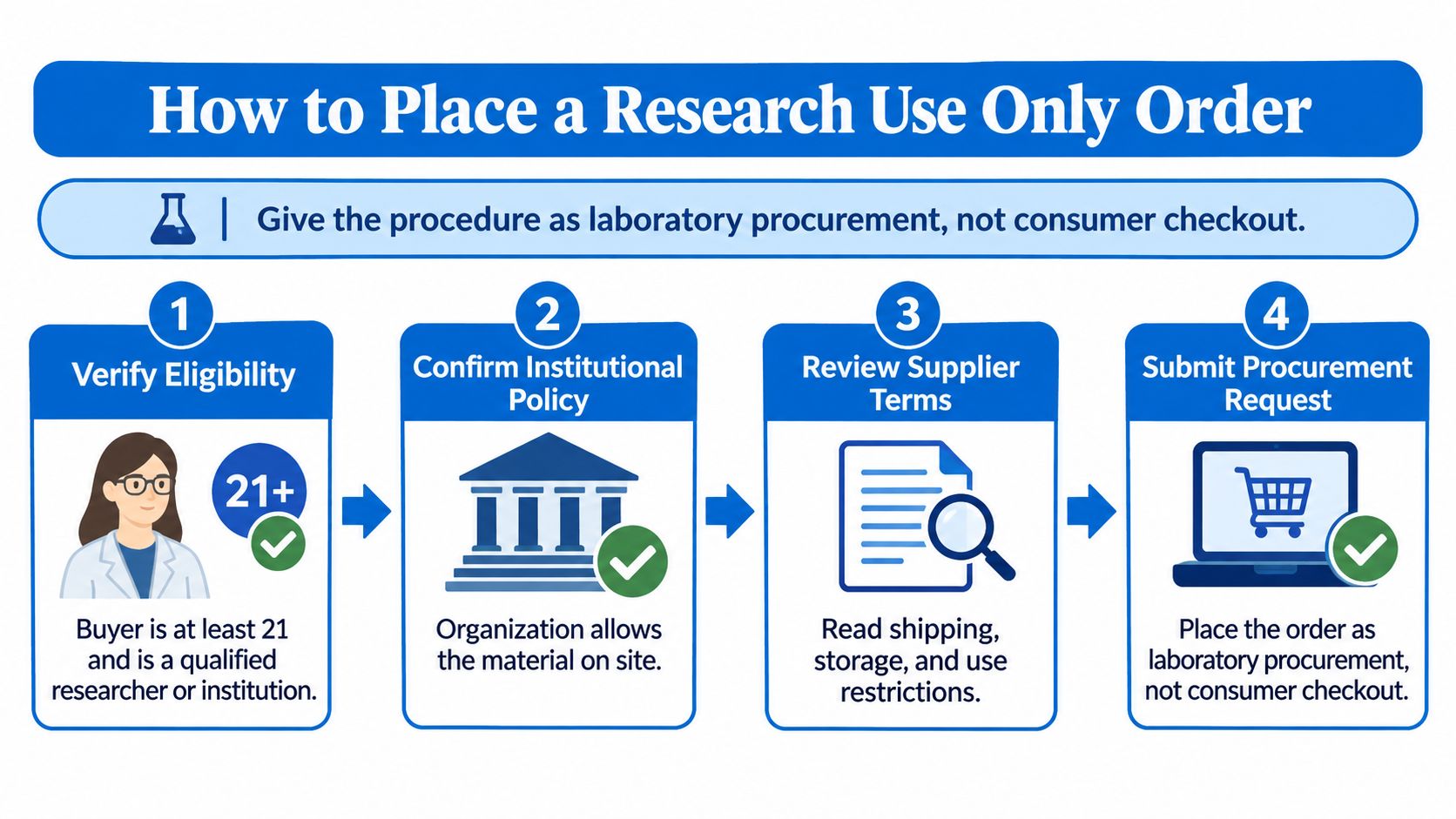
Laboratory procurement starts with an authorized research activity, not a shopping cart. Each step should create a record showing who approved the transaction and what the institution intends to investigate.
Create the authorization record
Verify eligibility. ProTecPep purchasers must be at least 21 years old and qualified to handle laboratory research materials. The procurement record should identify the qualified researcher or institution responsible for the order.
Confirm institutional permission. Obtain approval for the specific material and proposed activity before committing funds. The record should identify the approving department and any restrictions on receipt, access, or disposal.
Define the research purpose. Describe analytical testing, characterization, method development, reference-standard comparison, stability testing, instrument calibration, or in-vitro investigation. A statement such as comparison of chromatographic retention and molecular identity gives procurement staff an auditable purpose without implying human administration.
Match the catalog specification. Compare the chemical identity, form, and quantity with the approved protocol. Record the quantity required for the experiment and expected analytical repeats, not a personal-use schedule.
The procurement flow keeps eligibility and institutional approval ahead of order submission.
Complete the transaction record
Attach the analytical package. Place the accepted lot documents, approved specification, supplier responses, and quote in the purchase file before payment. If the supplier allocates a different lot, the laboratory should review the replacement documents before shipment.
Complete purchaser verification. ProTecPep may request additional information about age, identity, intended research purpose, organization, qualifications, or eligibility. The response should identify the lawful research activity accurately rather than supply a generic explanation designed to bypass review.
Accept the sale restrictions. ProTecPep buyers verify their eligibility and agree not to resell or transfer the materials. The research-use-only peptides explanation provides context for documenting these restrictions alongside the purchase authorization.
Record fulfillment and transport arrangements. Save the quoted order-to-ship lead time, transit estimate, cold-chain availability, and expected arrival date. The receiving plan should name the staff member present during delivery and identify any weekend or holiday gap.
Resolve handling-window questions before dispatch. Confirm whether the supplier plans to ship immediately before a closure and whether the proposed packaging supports the stated transit conditions. Keep the quote, cold-chain note, and delivery arrangement with the lot documents; no unverified shipping duration should become an assumed stability allowance.
Inspect and hold the shipment. Receiving staff should compare the lot, seal, and any temperature indicator against the approved order. The material remains quarantined until the receiving record and acceptance checks are complete.
Respect a refusal. ProTecPep may restrict or refuse fulfillment when a purchaser doesn't meet its qualified-research-personnel criteria. Staff shouldn't reroute an order through an unqualified person or another account to avoid that control.
Procurement safeguard: A refused order is preferable to a purchase file that cannot establish the buyer's authority and lawful non-clinical purpose.
The completed file should stand on its own during an internal audit. An email saying approved isn't sufficient unless the attached records identify the material, responsible researcher, intended activity, and applicable restrictions.
Storage Cold Chain and Lab Sample Prep
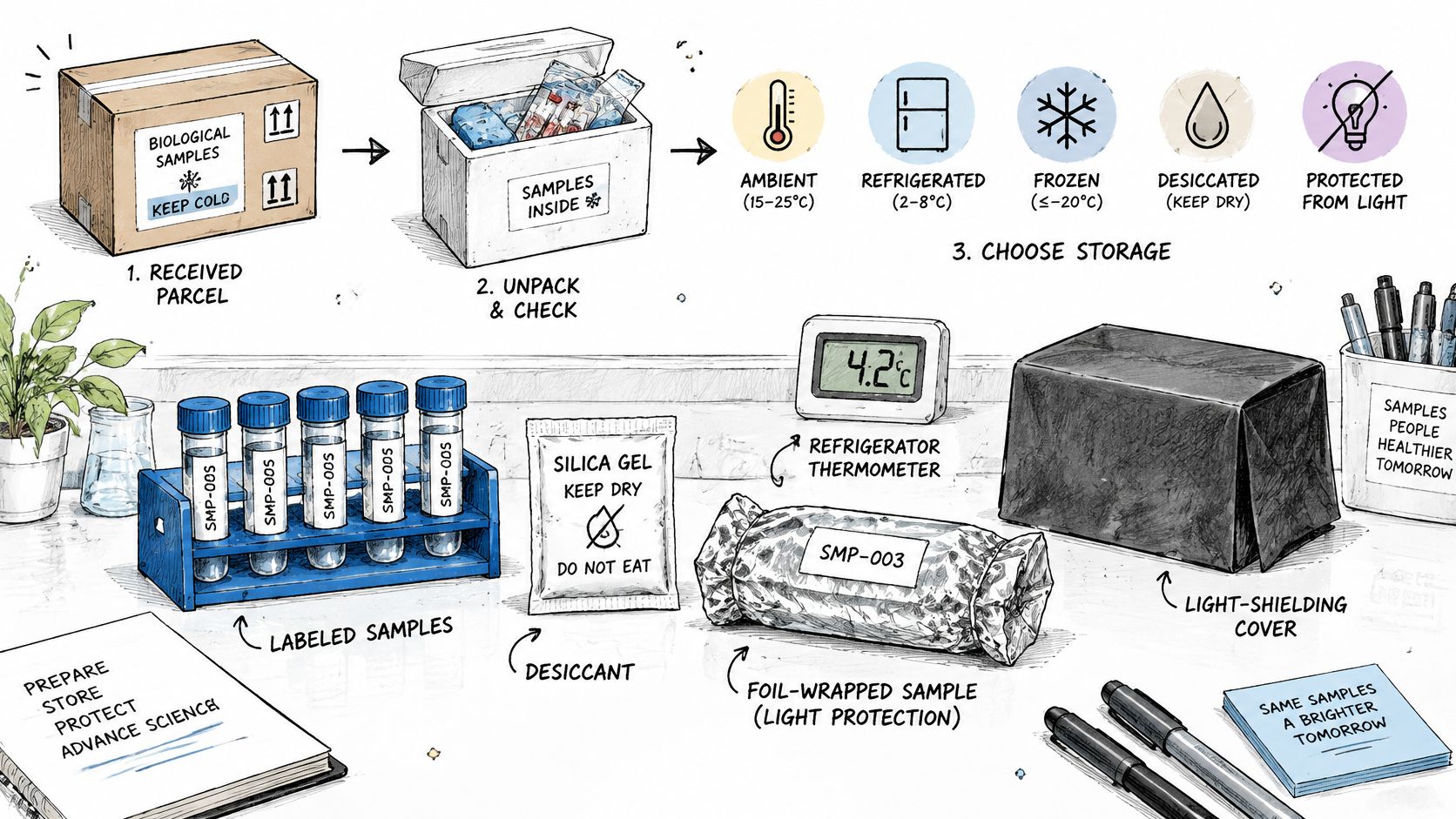
Storage planning belongs before dispatch, even though physical handling begins at receipt. The laboratory should read the supplier's stated condition, whether ambient, refrigerated, frozen, desiccated, or protected from light, without assuming that colder storage is automatically better.
The receiving workflow should preserve both the material and the evidence needed to assess its condition.
Log receipt before opening
Receiving staff should record arrival time, package condition, indicator status, and any visible thawing or leakage. Photographs should preserve the condition before packing materials are discarded.
For a cold-chain shipment, the laboratory needs the carrier arrangement, expected transit window, and an identified receiver if normal operations are interrupted. The discussion of cold-chain shipping can support that planning, but the lot's actual handling documents control acceptance.
- Move to the specified condition. Transfer the closed primary container to its documented storage environment while the acceptance review proceeds.
- Preserve traceability. Carry the parent lot number onto every aliquot label and link each prepared sample to its preparation record.
- Separate material states. Identify neat material and prepared solutions distinctly, since the laboratory shouldn't assume they share the same stability.
- Apply hazard controls. ProTecPep materials should be treated as potentially hazardous research materials unless reliable information establishes otherwise. A missing safety data sheet isn't evidence of low hazard.
Temperature indicators are evidence about transport conditions, not a replacement for chemical assessment. An acceptable indicator doesn't resolve a broken seal or mismatched label.
Prepare samples for the approved method
Reconstitution belongs in an analytical or in-vitro sample-preparation procedure. The analyst should select the solvent specified by the validated or approved method, record the prepared assay concentration, and document preparation time when solution stability matters.
The preparation record should also identify the solvent lot, container, analyst, and any deviation. A chromatographic solvent system suitable for one method shouldn't be copied into another assay without checking compatibility.
The following video is supplementary material, not a substitute for the laboratory's approved procedure.
Quarantine compromised shipments and samples
A weekend delivery without a receiver creates an undocumented exposure interval. Staff should preserve the transport evidence and obtain a documented disposition rather than assume the packaging remained adequate.
A warm indicator on a frozen shipment requires quarantine against the supplier's excursion criteria. Identity testing alone may not establish retained stability, so further testing must address the suspected failure.
A hygroscopic powder left open on the bench requires a deviation record because absorbed moisture may compromise the prepared concentration. Qualified staff should determine whether suitable testing can resolve the uncertainty; otherwise, disposal follows institutional waste rules.
None of these cases supports proceeding because the material still looks unchanged.
Red Flags and the Final Go or No-Go
Familiar packaging cannot confirm a product's identity or contents. Counterfeit products may contain no active ingredient, the wrong ingredient, or an incorrect quantity, so appearance alone is not reliable evidence (DEA counterfeit-pill fact sheet.
No universal purchasing success rate can replace product-specific verification. Stop procurement if a supplier makes unsupported purity claims, repeats undated reports across products, relies on personal-outcome narratives, provides administration instructions or disease-treatment claims, or refuses to verify buyer eligibility.
Make the release decision
- Listing accepted. The stated use is lawful analytical or in-vitro laboratory research.
- Records reconciled. Supplier identity, lot documents, and purchase authorization agree.
- Buyer authorized. The purchaser meets ProTecPep's eligibility requirements and has institutional permission.
- Receipt supported. The laboratory can meet the documented storage conditions when the shipment arrives.
A failed check means the purchase is not approved. Refer unclear legal status to institutional counsel.
ProTecPep is a specialized chemical supplier, not a compounding pharmacy or an outsourcing facility under the Federal Food, Drug, and Cosmetic Act. Physician-led clinical care and dispensing by a licensed pharmacy are separate from laboratory procurement.
All products are for laboratory research use only and are not for human or veterinary use, consumption, administration, diagnosis, treatment, or prevention of any condition. By purchasing, buyers confirm they are at least 21 and qualified to handle research materials, and agree not to resell or transfer them.
ProTecPep supplies research compounds for lawful laboratory research, analytical testing, and in-vitro scientific investigation. Qualified procurement teams can review the research-use terms and available analytical documentation at Pro Tec Pep, then reconcile the proposed material and lot with institutional requirements before ordering.