What Does Third Party Tested Mean for Research Lots
What does third party tested mean for research compounds, and how a batch COA shows identity, purity, and contaminant results from an independent lab.
Third-party tested means a laboratory independent of the seller evaluates a defined batch against stated specifications. The phrase alone doesn't identify the methods, disclose numerical results, or authorize human or veterinary use.
A laboratory buyer comparing similar research lots may find the same compound name and packaging on each product page, but an independent-testing badge on only one. The useful difference isn't the badge itself. It's whether the buyer can inspect records that connect the supplied material to an appropriate analysis.
Why a Research Label Is Not a Result
A procurement lead holds research vials from competing suppliers. Both containers appear consistent with the purchasing request, but only one carries a third-party-testing claim. Before either material enters an assay workflow, the lead still needs answers that the label cannot provide.
Which laboratory performed the work? Did it examine the lot being delivered, or another lot with the same product name? Which analytical methods and acceptance limits did the laboratory apply?
For academic laboratories, biotechnology teams, and contract research organizations, these aren't cosmetic documentation questions. They determine whether the purchasing file contains evidence that can support a material-acceptance decision.
A sealed envelope isn't a graded exam
A testing badge resembles a sealed envelope labeled “exam reviewed.” A graded exam contains something more useful: the questions, the answers, the marking criteria, and the result. The badge announces an evaluation; the report shows what that evaluation means.
A certificate of analysis, commonly called a COA, should make the underlying claim inspectable. A buyer shouldn't have to infer whether “tested” means identity confirmation, contaminant screening, or just a reported purity result.
Procurement rule: A testing claim belongs in the purchasing conversation, but the supporting report belongs in the purchasing record.
Consider a research lot labeled Semax. Its product name alone doesn't establish that the laboratory confirmed the declared material, measured its composition, or assessed contaminants relevant to the planned experiment. Those are separate questions requiring documented evidence.
Start with the intended laboratory work
The buyer's first task is to identify which material attributes matter to the protocol. That creates a reason to request particular records rather than accepting whatever certificate happens to be available.
- Material identification: The report should identify the submitted sample and connect it to the supplied lot.
- Analytical coverage: The buyer needs to know which questions the laboratory investigated.
- Acceptance criteria: A favorable conclusion needs a stated standard against which the result was judged.
Research-use-only materials are not offered as drugs, foods, or cosmetics, or for diagnosing, treating, curing, or preventing disease. That boundary should remain explicit throughout procurement. A laboratory testing claim doesn't change the material's research-only status.
What Third-Party Tested Actually Means
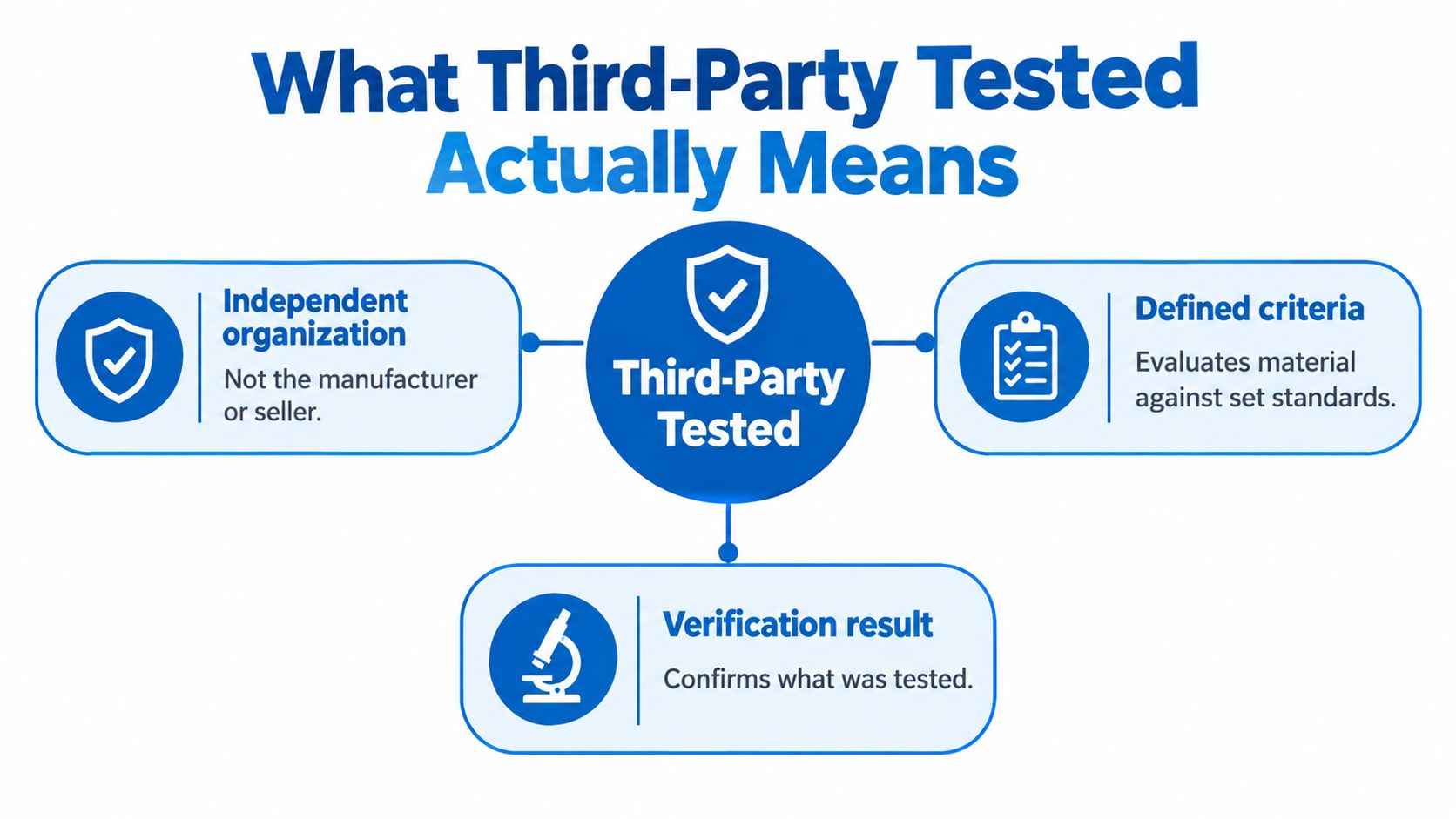
The question “What does third party tested mean?” has a relationship component and an evidence component. Independence describes the relationship between the testing organization and the seller. Defined specifications describe what the organization evaluated.
In plain procurement language, first-party testing is work performed by the maker, second-party checking is performed by the customer, and third-party analysis comes from an outside organization. A referee provides a useful analogy: independence separates the evaluator from the participant, but the referee still needs clear rules.
The concept map separates those responsibilities.
Independence and competence are different questions
An external laboratory isn't automatically an accredited laboratory. The phrase third-party tested doesn't establish accreditation status, sample size, analytical coverage, or the criteria for acceptance.
The ISO description of laboratory competence requirements applies to laboratories operating under different organizational relationships. That distinction matters because “outside the seller's organization” and “technically competent for this particular analysis” aren't interchangeable statements.
A buyer therefore needs more than a laboratory name. The evidence should identify the material examined, the attributes measured, and the specifications used to interpret the findings.
Where the verification model developed
A foundational example was the United States Pharmacopeia's Dietary Supplement Verification Program, launched in February 2001, with historical accounts also dating its public verification mark to November 2001, as described in the Cleveland Clinic review of supplement verification. Its model combined documentation review, facility auditing, laboratory testing, and continuing surveillance.
That history illustrates a verification framework, not a claim that research compounds belong to the same product category or approval pathway.
For research materials, the practical translation is straightforward:
- Define the sample: Identify the batch rather than relying on a product-family certificate.
- Define the attributes: Specify whether the work concerns identity, composition, amount, or particular contaminants.
- Define the evidence: Report the analytical procedure, result, and acceptance criteria.
A batch-specific report is stronger evidence than a generic document because it links the findings to the supplied lot. Its reach still depends on sampling, method capability, detection limits, and the scope of the work. Independence identifies who evaluated the material; the report establishes what the buyer can reasonably conclude.
Why Independence Has to Be Ongoing
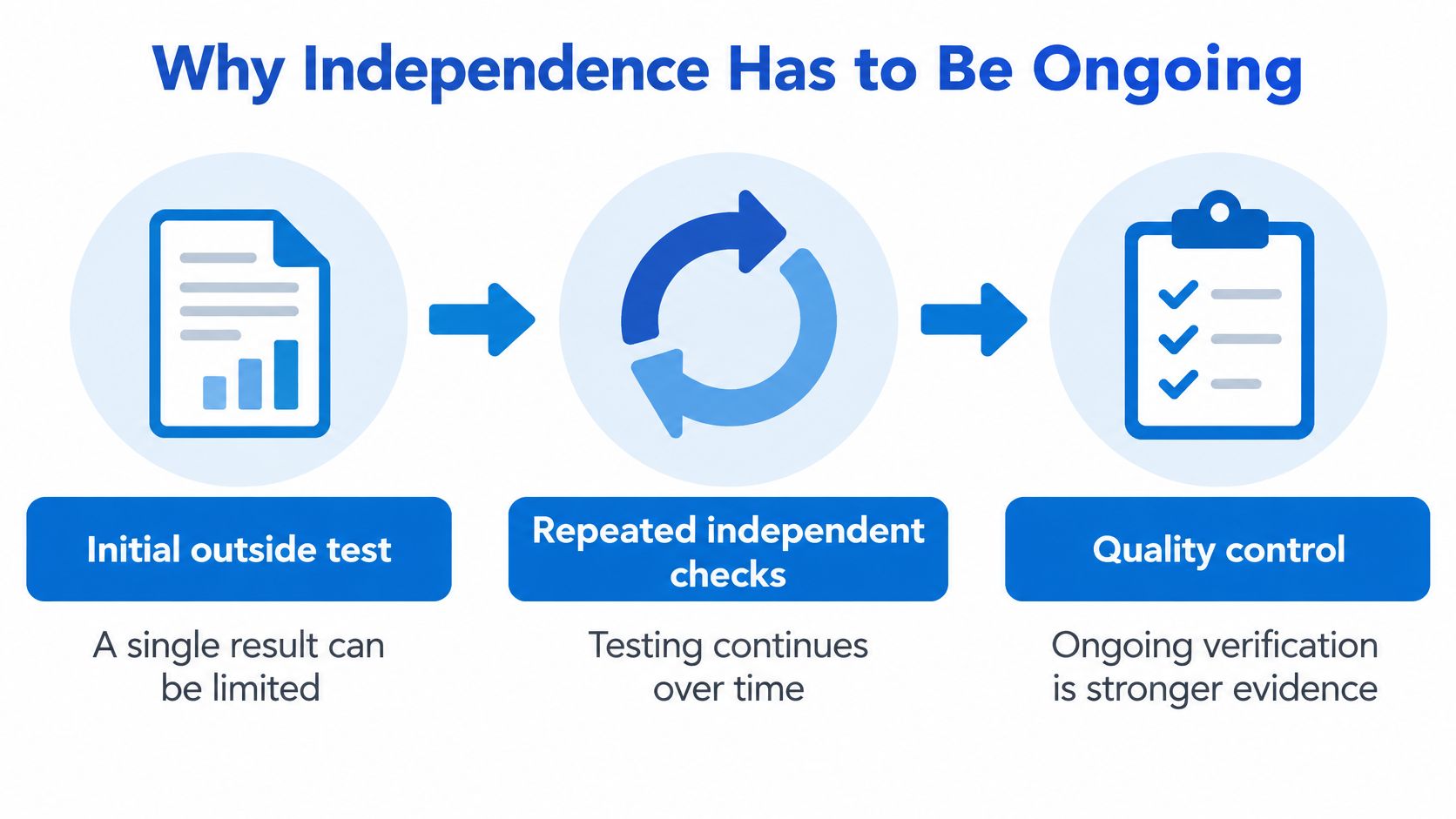
An outside result is a snapshot. Even a well-documented passing sample cannot establish that every later manufacturing lot will be identical.
Inspecting a cookie from a newly prepared batch illustrates the limitation. That inspection may support a conclusion about the sampled material, but it says less about how the bakery controls ingredients, equipment, production changes, and later batches.
The distinction between an isolated result and continuing verification is shown below.
Different controls answer different questions
The published discussion of USP verification practices describes a framework incorporating facility assessment, manufacturing-record review, laboratory analysis, monitoring of changes, and continuing surveillance. These controls complement one another rather than replacing one another.
- Facility assessment: Examines production conditions and quality systems rather than only a finished sample.
- Record review: Checks the manufacturing and quality documentation behind the material.
- Laboratory testing: Evaluates the submitted sample against defined standards.
- Change monitoring: Addresses later revisions to manufacturing or specifications.
- Surveillance: Provides additional checks after initial verification.
A supplier's independent test report shouldn't be assumed to include this entire framework. Buyers need to distinguish a discrete testing service from a broader certification or surveillance program.
Make each result traceable
For a purchasing decision, meaningful evidence connects lot, date, specification, and method. These fields establish which material was examined, when the work occurred, and how the laboratory reached its conclusion.
A purity entry should disclose the measured percentage and analytical technique rather than merely a passing judgment. An identity entry should explain how the material was identified. Sterility and endotoxin entries need their applicable procedures and reporting thresholds.
A passing sample supports a bounded conclusion about that sample. Continuing controls provide additional evidence about the process that produced it.
Production controls and final testing address different opportunities for error. A laboratory can obtain useful information from a finished sample without establishing that the manufacturer's process remains consistently controlled.
For procurement teams, ongoing verification therefore means asking whether current documentation exists for the current material, and whether changes trigger appropriate review. It supports transparency and risk reduction, not regulatory approval or clinical suitability.
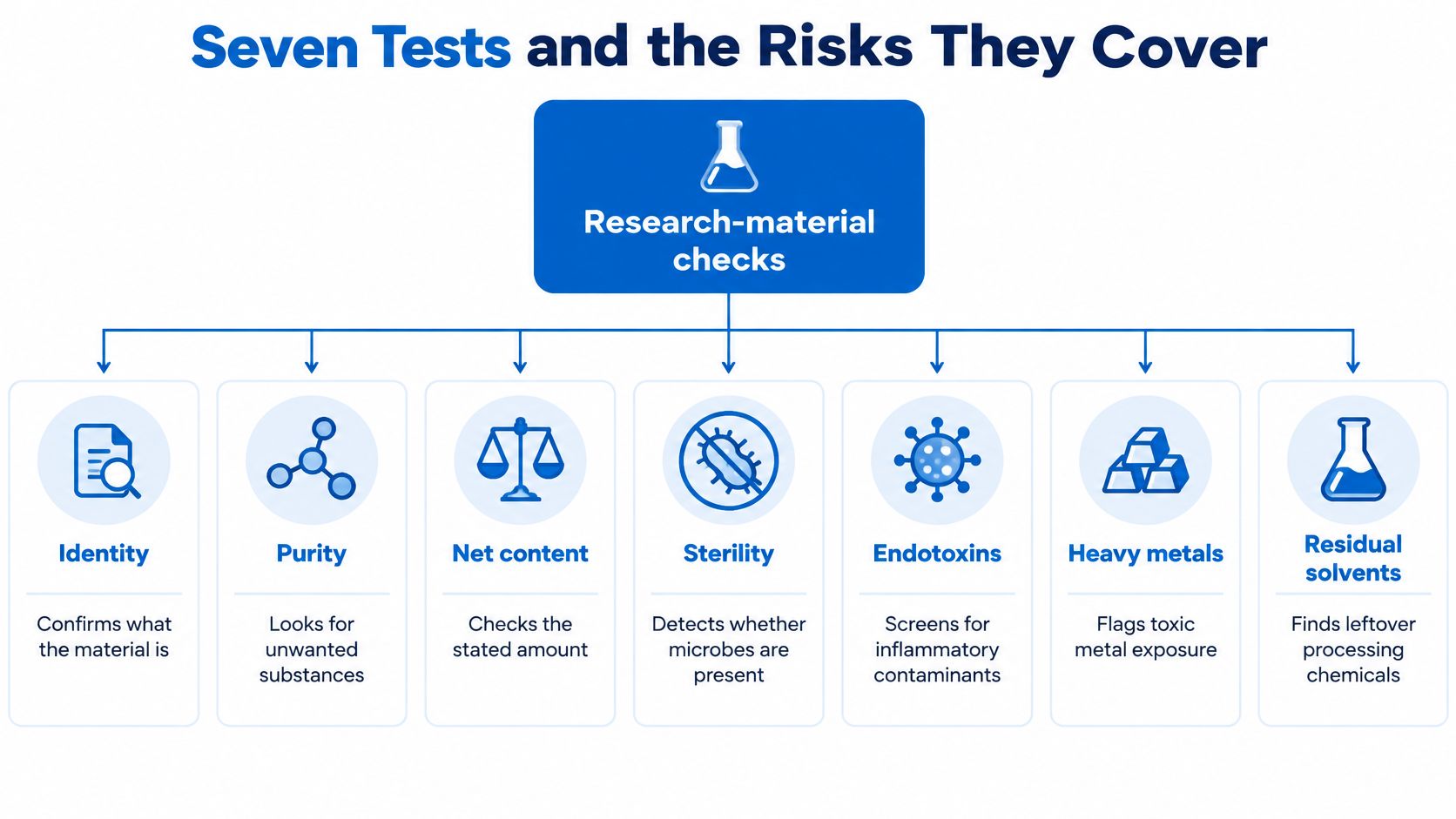
Seven Tests and the Risks They Cover
A research-material panel is most useful when the buyer reads each category as a different question. A pass in one category doesn't answer the others. The relevant combination depends on the experiment and its sensitivity to particular sources of interference.
The illustration separates common analytical concerns; residual solvents, shown in the graphic, require their own assessment rather than being assumed covered by another result.
Composition and quantity
- Identity: Establishes whether the sample is the declared compound. An identity finding doesn't establish its amount or contaminant profile.
- Purity: Examines composition and related substances using the stated method. Chromatographic area percentage describes detected peaks, not automatically absolute assay, correct molecular mass, sequence integrity, residual solvents, metals, or biological activity.
- Net content: Checks the stated amount. A satisfactory amount doesn't establish that the material has the intended composition.
For a research lot such as Tesamorelin, these entries should remain distinguishable. A buyer needs to know whether the laboratory confirmed the declared material, evaluated its composition, and checked its stated amount, rather than treating those claims as synonyms.
Microbiological and elemental concerns
Sterility testing evaluates whether viable microorganisms are detected under specified conditions. Endotoxin testing addresses a different concern and cannot be inferred from a sterility result.
The USP bacterial-endotoxins test chapter describes gel-clot and photometric approaches, with results expressed against reference endotoxin in USP Endotoxin Units. Biologically active endotoxin can remain relevant even when viable organisms aren't recovered.
Heavy-metal testing, or elemental-impurity analysis, addresses an elemental contaminant class. An identity or chromatographic purity result doesn't substitute for that analysis.
Conformity is the decision
Conformity is the judgment that a result meets a stated specification under the applicable decision rule. It isn't another contaminant measurement. Without the specification, a passing judgment leaves the buyer unable to assess whether the criterion fits the proposed work.
For each applicable category, the record should disclose:
- Procedure and sensitivity: The method and relevant detection or quantitation limit.
- Specification and finding: The acceptance criterion, actual result, units, and interpretation.
- Applicability: Evidence that the method is appropriate for the sample and intended analytical question.
The research-material testing overview provides a supplier-level reference for comparing these categories with available documentation. Buyers should also review storage and shipping conditions, because analysis cannot restore material that degraded afterward. No analytical panel authorizes human or veterinary use.
How to Read a Batch Certificate of Analysis
A COA should be read as a technical record, not as a decorative attachment. The first comparison is between the lot number on the document and the lot number on the physical container. A mismatch interrupts the connection between the reported findings and the material received.
Next comes method suitability. An outside laboratory can produce a precise result that still doesn't answer the buyer's analytical question if the method cannot distinguish the intended material from relevant alternatives.
Read the identity line carefully
The ICH analytical-procedure validation guideline_Guideline_2023_1130.pdf) describes specificity in terms of identifying or quantifying the intended analyte without interference from impurities, degradation products, related substances, matrix components, or isomers. For a research peptide, that makes the method's discrimination more important than a simple identity-pass entry.
A useful identity record names the technique, reference standard or comparator, and sample identification. Supporting documentation should clarify whether closely related structures were challenged.
A purity percentage similarly needs its analytical context. When a technique cannot distinguish closely related species, orthogonal confirmation, using a complementary analytical approach, can strengthen confidence.
COA Fields Worth Checking
| COA field | Useful record | Weak record |
|---|---|---|
| Material and lot | Defined material matching the container | Product name without a lot |
| Laboratory | Named testing organization | Unidentified outside laboratory |
| Quality status | Verifiable status and relevant scope | Accreditation logo alone |
| Test date | Date connected to the reported work | Undated certificate |
| Procedure | Identified analytical method | “Laboratory tested” |
| Reference or comparator | Stated where relevant | Unexplained identity judgment |
| Results and units | Actual findings with applicable units | Pass stamp alone |
| Limits and decision rule | Defined basis for acceptance | Unexplained conformity claim |
| Authorization | Identified reviewer or approval record | Unattributed document |
Accreditation needs its own scope check. The ISO requirements for laboratory competence, impartiality, and consistent operation support evaluating laboratory capability, but accreditation doesn't automatically cover every method or analyte that a laboratory offers.
Accept, question, or hold
A procurement reviewer can use the same reading sequence each time: establish sample traceability, examine the procedures, compare results with specifications, and verify authorization. Consistency makes the review repeatable even when suppliers format certificates differently.
Document review: An unexplained passing result is a reason to request clarification, not a reason to invent the missing specification.
A complete certificate may support acceptance under the laboratory's purchasing criteria. Missing information may justify a question or a hold pending clarification. A record that cannot be connected to the received material shouldn't be treated as evidence for that lot.
What the Phrase Does Not Guarantee
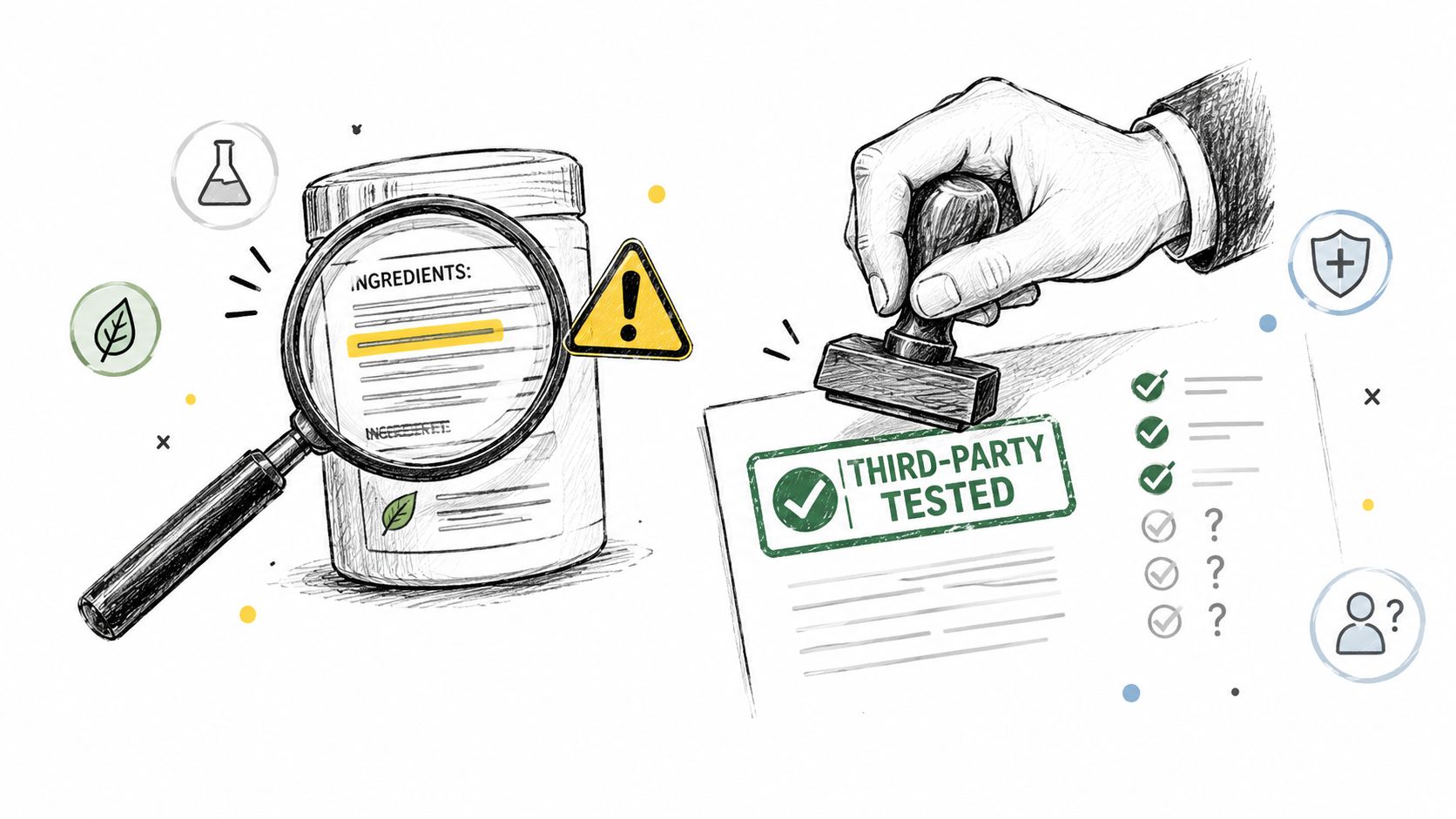
Third-party tested does not mean universally safe, sterile, or suitable for human use. A result supports the specific attributes and sample examined, not every property a reader might associate with quality.
The illustration contrasts a broad label with the closer inspection needed to understand it.
A high purity result still has boundaries
A certificate reporting identity and chromatographic purity leaves other attributes unresolved unless they have their own methods and findings. Those include sterility, endotoxin status, elemental contaminants, residual solvents, and stability.
The chromatographic limitation deserves particular attention. Substances that don't respond to the detector, don't elute, or co-elute with another component may not be represented distinctly in the reported percentage. The percentage therefore needs to be interpreted as a result from a particular measurement system, not a universal description of everything present.
The 2025 review of peptide testing documentation frames independent testing around identification and content specifications rather than proof of every safety attribute. The practical question is what the laboratory examined and which risks remain untested.
The accompanying video is an additional resource, not a substitute for inspecting the laboratory record.
A genuine report can still be unrepresentative
A report can be authentic without representing every supplied unit. Sampling and chain of custody determine how confidently the submitted sample can be connected to the delivered material.
- Sampling: The buyer should establish what was selected and whether that selection reasonably represents the lot.
- Custody: Records should preserve the connection between sample collection, laboratory receipt, and analysis.
- Handling: Conditions before and after testing can affect whether the reported findings remain relevant.
The contrarian conclusion is straightforward: third-party describes who performed the analysis, not its scope, competence, representativeness, or regulatory meaning.
A research-use-only policy establishes a separate procurement boundary. Neither a laboratory report nor a purchasing policy proves that a material fits a particular experiment. The research team still needs an acceptance rationale based on the protocol, the available evidence, and the unresolved risks.
Choosing Records That Support Reproducible Work
Documentation can be compared without relying on the supplier's strongest adjective. The useful distinction is whether the buyer can reconstruct what was examined and connect the findings to the material entering the laboratory.
A marketing badge without a report provides little basis for technical review. A generic certificate may explain the supplier's usual specifications, but it doesn't establish the findings for the received lot. A batch-linked certificate naming the laboratory, methods, limits, and results provides a more inspectable basis for acceptance.
Compare the purchasing evidence
| Documentation pattern | Procurement implication |
|---|---|
| Badge without supporting analysis | Request the report before evaluating the claim |
| Certificate without a matching lot | Resolve traceability before relying on the findings |
| Batch-linked analytical record | Evaluate method suitability and results against laboratory needs |
These records help researchers distinguish known material attributes from assumptions. That distinction matters when documenting an assay, investigating an unexpected result, comparing later lots, or explaining a purchasing decision during an institutional review.
Specifications outside the COA also deserve attention. Formal names, synonyms, CAS numbers, sequences where applicable, formula weight, solubility, storage, and stability information help researchers identify the intended material and plan laboratory sample preparation. The compound research library is one place to begin checking that product-level context.
Evaluate supplier statements against the actual lot
The publisher's stated offering includes batch-specific COAs and a seven-category panel covering identity, purity, net content, sterility, endotoxins, heavy metals, and conformity. Those statements should be checked against the available product and batch records rather than treated as a substitute for them.
Listed-item purity minimums of at least 98 percent and broader statements of up to 99 percent, where applicable, also need the correct context. A product specification is an acceptance target; the lot report is where the buyer should inspect the measured finding.
The supplier also describes optional cold-chain shipping and standard 24-hour processing as logistics controls, alongside 21-plus age verification and research-only purchasing restrictions. These controls address transit and eligibility concerns, not analytical suitability for an assay.
Before ordering, the researcher should open the current lot COA, confirm the identifier against the supplied material, and verify that every required analytical question has a method, limit, and result. Missing fields should prompt a documentation request before acceptance. Materials remain restricted to lawful in-vitro laboratory research by qualified researchers, not human or veterinary use.
Pro Tec Pep offers research-use-only compounds with batch-linked documentation and product specifications for laboratory review. Researchers can visit the catalog to inspect the relevant COA and confirm that its methods, limits, and results address the planned experiment before placing an order.