Buy SS 31 Peptide: How to Verify Research-Grade Sources
Want to buy SS 31 peptide for research? Learn how to verify COAs, confirm RUO status, and check cold-chain shipping before you order.

The most common advice for those looking to buy SS 31 peptide is to compare purity claims and choose a convenient seller. That's the wrong starting point. A vendor listing remains an unverified claim until the buyer can connect the vial to lot-specific analytical results, documented laboratory-only restrictions, and an acceptable shipping record.
For a laboratory buyer, the useful question isn't whether SS-31 has an impressive research reputation. It's whether the material arriving at the bench is identified, traceable, and suitable for the planned in-vitro experiment. Marketing language can't establish any of those things.
Confirm Research-Use-Only Status and Age Checks
Research-use-only status describes intended laboratory use. It does not authorize human or veterinary use, and it is not a quality certification. An RUO label answers one question only: who may lawfully handle the material. Identity, purity, and storage history are separate questions that the label cannot settle.
Screen the seller before requesting documents
Locate the laboratory-only statement. Matching research-use-only wording should appear on the product page and the vial label. A restriction buried in general terms does not resolve contradictory wording beside the purchase button.
Certify qualified-researcher status at checkout. The attestation creates a record of the intended purchaser and purpose. It does not establish competence or product quality on its own, but a checkout without it tells the buyer the seller screens no one.
Require an adults-only checkout check. An age gate is a procurement-screening requirement, not evidence that the compound is appropriate for personal experimentation. A seller that skips this check fails the screening standard.
Confirm destination eligibility, a physical business address, and a working contact. These details identify who can answer a shipment complaint or investigate a disputed lot. A seller reachable only through a web form leaves the buyer no one to hold accountable.
Reject personal-outcome marketing. Promises about performance, sleep, sexual health, or recovery conflict with laboratory-only positioning. A disclaimer at the bottom of the page does not neutralize those promises.
Save the purchasing record. Dated copies of the listing, RUO statement, and available COA preserve what the seller represented when the order was placed. That record is the buyer's only basis for disputing a shipment that arrives different from what was advertised.
Vendor screening checks before requesting documents
| Check | What it confirms | Red flag |
|---|---|---|
| RUO statement | Research-use-only wording on the product page and vial label | Claims of personal results, performance, sleep or recovery |
| Researcher attestation | Buyer certifies qualified-researcher status at checkout | No attestation step |
| Age verification | Adults-only check at checkout | No age gate |
| Business identity | Physical business address and working contact on the site | No address, or contact limited to a web form |
| Shipping policy | Destination permitted and dispatch cut-off stated | Destination excluded, or no cut-off given |
| Saved record | Dated listing, RUO statement and COA saved on the order date | Missing or undated purchasing record |
Keep the restriction separate from approval
A laboratory's procurement policy should define these checks explicitly, using a consistent interpretation of research-use-only peptides. Neither a checkbox nor an age gate substitutes for analytical verification.
The accelerated-approval pathway for Barth syndrome does not extend to research-vendor products or unrelated purposes. An RUO label cannot transfer a medicine's regulatory status to a laboratory vial. A buyer who treats vendor availability as implied legitimacy has already abandoned the screening standard these checks exist to enforce.
Verify the Certificate of Analysis Before You Order
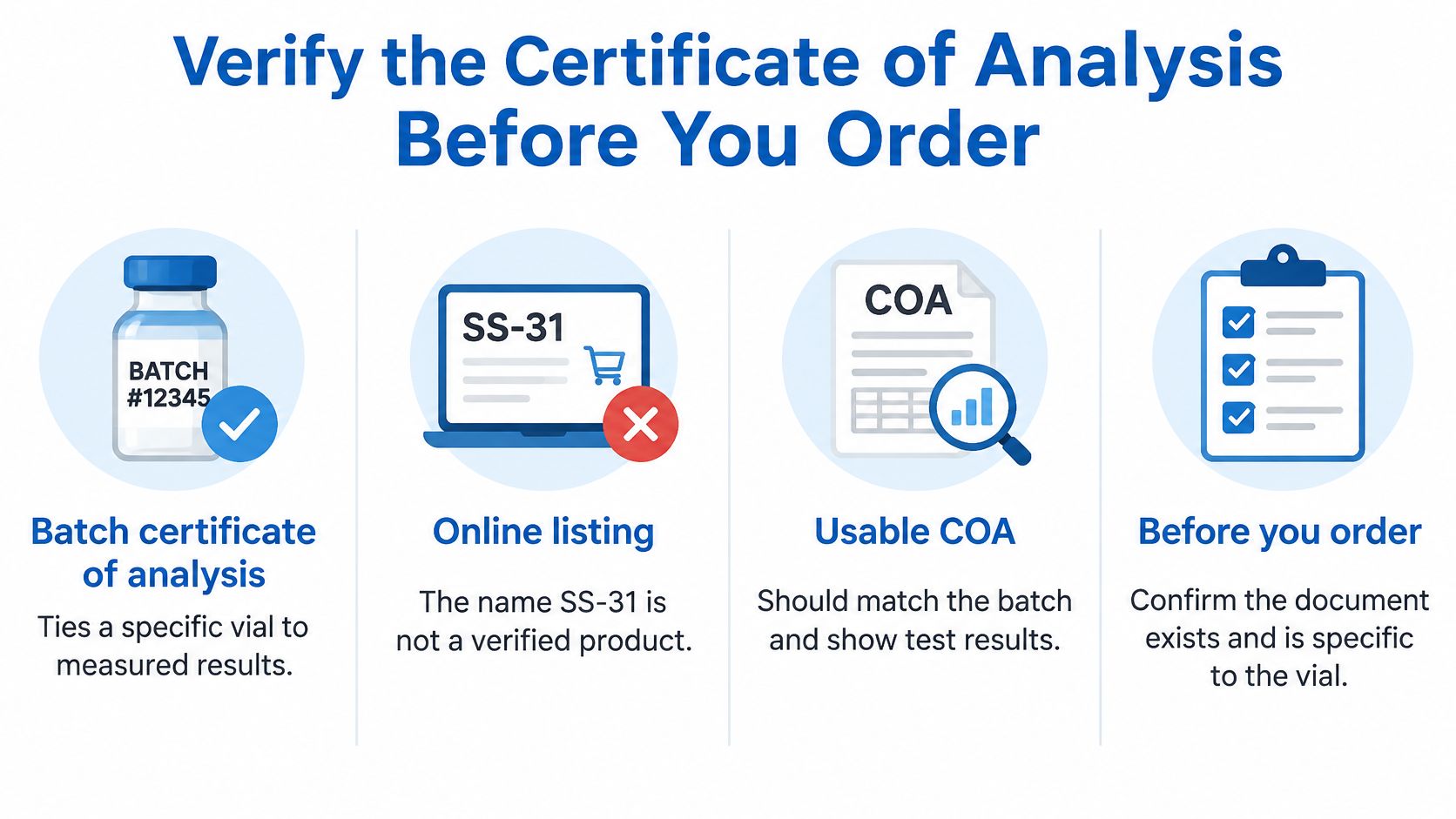
The COA must match the lot number on the vial. A batch certificate of analysis connects a specified batch to reported measurements; a generic certificate establishes no such connection. Even a matching document requires scrutiny because a printed result isn't independent confirmation that the laboratory performed the stated test.
A usable COA identifies the lot, report date, testing laboratory, and analytical method behind each result. The elamipretide scientific review supports separating mechanistic findings from clinical outcomes and checking identity, purity, salt form, sterility, concentration, storage, and chain of custody before comparing products.
The document review should follow a fixed sequence.
Read the analytical results in order
Identity comes first. Mass-spectrometry results should agree with the expected peptide identity, with sufficient method information to interpret the reported signal. A molecular formula copied into a certificate isn't measured identity data.
Next comes chromatographic purity. The buyer needs the HPLC chromatogram, integration result, and named method, rather than a percentage standing alone. HPLC purity doesn't establish net peptide content, absence of microbial contamination, or suitability for every assay.
COA checks for a SS-31 lot
| Check | What it confirms | Red flag |
|---|---|---|
| Identity by mass spectrometry | Measured molecular mass matches the expected peptide sequence | No mass data, or a mass that does not match the stated sequence |
| Purity by HPLC | Main-peak percentage with the chromatogram and method named | Purity stated with no method, no chromatogram or no lot number |
| Salt form and net peptide content | Counterion and the net peptide share of the total weight | Salt form missing, or only gross weight given |
| Sterility and endotoxin | Microbial and endotoxin results for the same lot | No testing reported, or results for a different lot |
| Lot number and date | Ties the COA to the vial in hand | COA not matched to the lot, or undated |
| Storage and water content | Recommended storage conditions and residual water | Generic storage text with no supporting data |
Resolve composition and traceability
The salt form and net peptide content matter because gross powder weight can include counterions and residual water. Calculating laboratory sample concentration from gross weight alone can misstate the peptide concentration.
Microbial and endotoxin results should identify the tested lot and method. These are distinct measurements: a sterility result doesn't replace endotoxin testing, and neither replaces identity testing. Missing results mean the lot fails this procurement specification, not that contamination has been proven.
The storage entry should have supporting stability information appropriate to the supplied material. Residual-water results help characterize the powder, while custody records connect the tested batch to the packaged vial.
ProTecPep's Research Peptide listings each include a COA link. That provides a starting document, not an exemption from peptide purity testing review or lot matching.
Document rule: A certificate without a named analytical method is incomplete. If identity or purity cannot be matched to the vial's lot, the order doesn't proceed.
What SS-31 Research Covers and Where Evidence Stops
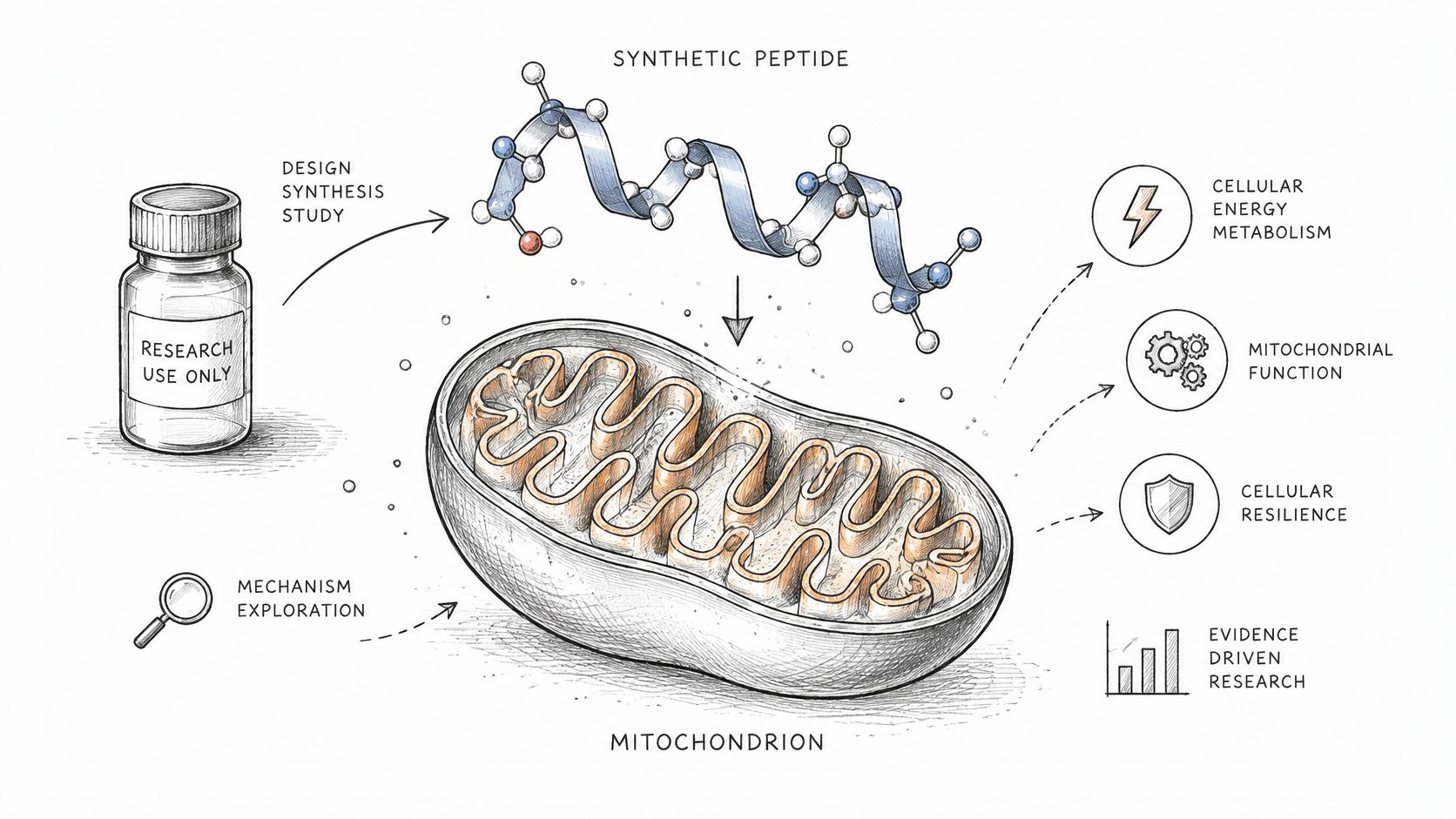
SS-31 is a synthetic tetrapeptide, also called elamipretide or MTP-131, studied for association with cardiolipin in the inner mitochondrial membrane. The Peptigraph SS-31 results overview describes that mechanism alongside a clinical record that doesn't support broad performance or recovery claims.
The mitochondrial target explains scientific interest, not a guaranteed functional outcome.
Separate mechanism from measured outcomes
In-vitro mechanistic work and animal experiments address biological processes under controlled conditions. Neither permits a seller to convert mitochondrial plausibility into claims about personal wellness.
The human record is mixed. The FDA regulatory document describes accelerated approval on September 19, 2025, under Forzinity, for Barth syndrome in patients weighing at least 30 kilograms, based on knee-extensor strength with a confirmatory study required; it also describes heart-failure work involving 71 patients over 28 days without improvement in left-ventricular end-systolic volume.
Reported SS-31 evidence by study type
| Study | Design and population | Endpoint | Reported result |
|---|---|---|---|
| MMPOWER-3 | Phase 3 randomized, placebo-controlled trial involving 218 adults with primary mitochondrial myopathy | Six-minute walk test and fatigue score | Missed both co-primary endpoints; walk difference −3.2 m, p=0.69, as described in the Atlas SS-31 clinical overview |
| Separate phase 3 | Randomized, double-blind, placebo-controlled study involving 102 participants with primary mitochondrial myopathy over 48 weeks | Six-minute walk, five-times sit-to-stand, three-minute timed-up-and-go, PGI-S | No greater improvement than placebo at week 48, according to the clinical trial registry |
| Phase 2 heart failure | Randomized, placebo-controlled study, 71 patients, once-daily subcutaneous investigational regimen over 28 days | Left-ventricular end-systolic volume | No improvement versus placebo |
| TAZPOWER Barth syndrome | Randomized crossover, 12 participants entering the randomized phase | Two co-primary endpoints | Did not meet both; uncontrolled open-label follow-up reported a 95.9 m walk gain at week 36, p=0.024, in the Barth syndrome trial publication |
| Mouse cigarette-smoke model | In-vivo mouse exposure model with lower and higher experimental treatment groups | Lung malondialdehyde, myeloperoxidase, superoxide dismutase | Attenuated oxidative-stress markers with graded changes across treatment groups in the mouse-model publication |
Apply an endpoint test to vendor claims
Open-label observations lack the same protection against bias as blinded placebo comparisons. Animal tissue responses also remain animal findings, regardless of how confidently a listing describes them.
The accompanying video belongs alongside the written evidence, not in place of it.
A buyer evaluating a claim should identify study type, indication, and endpoint. If the cited experiment measured a lung biomarker in mice, it cannot substantiate a human recovery promise.
A credible mechanism justifies an experiment. It doesn't establish an outcome the experiment never measured.
Cold-Chain Transit and On-Arrival QC
A parcel held over a long weekend is a preventable procurement failure. The buyer should establish the dispatch date, carrier handoff, and expected receiving window before payment, rather than assuming a processing promise describes the parcel's full journey.
For this laboratory procurement specification, the shipment should contain lyophilized powder only, not a prepared solution. That restriction keeps sample preparation under the receiving laboratory's SOP; it isn't a claim that every lyophilized peptide remains stable through uncontrolled transit.
Establish the shipping acceptance criteria
A vendor's 24-hour processing statement, when offered, describes dispatch handling, not temperature protection or delivery time. Purchasing staff should request the dispatch cut-off, carrier service, insulated-packaging specification, temperature-indicator arrangement, and weekend or holiday holding plan.
The acceptance criteria must reflect documented stability information for the actual material. Ice packs alone don't establish an acceptable temperature history, and a parcel that feels cool doesn't replace a readable indicator or transit record.
Transit conditions, risks and arrival actions
| Transit condition | Risk to the sample | Action on arrival |
|---|---|---|
| Dispatch on a weekend or holiday, with 24-hour processing stated | Extended hold in unknown conditions before carrier pickup | Obtain dispatch date and tracking entries before payment |
| Transit time longer than the vendor's stated window | Stability of lyophilized powder no longer assured | Record transit time and compare with documented storage and excursion limits |
| Package arrives warm, or indicator has changed | Possible loss of stability or potency | Photograph the parcel, log the indicator and request replacement |
| Vial arrives cold on ice packs | Condensation if the vial is opened before warming | Allow the sealed vial to reach room temperature before opening |
| Insulated packaging intact, indicator unchanged | Lower apparent transit risk when other checks pass | Proceed to on-arrival QC and storage |
| Carrier or temperature data not provided | Unknown exposure history | Quarantine pending acceptable shipping documentation |
A warm parcel isn't proof that the peptide has degraded. It is a reason to stop release when the shipment fails the agreed acceptance criteria. The laboratory shouldn't improvise an acceptable excursion limit from another peptide's storage instructions.
An institutional cold-chain shipping procedure should identify who reviews exceptions and who has authority to release quarantined material. Without a named decision-maker, receiving staff may place a questionable shipment directly into available inventory.
Perform receiving checks in sequence
Inspect the packaging and vial. Receiving staff should check for cracks, a loose seal, leakage, and moisture inside the packaging. Physical damage can compromise the sample independently of its analytical certificate.
The product name, lot number, quantity, and salt form should match the purchase record and COA. A correct compound name with the wrong salt form still fails the receiving specification.
Create the arrival record. The inventory log should include arrival date and time, indicator reading, tracking reference, and the person completing inspection. Photographs should remain attached to the shipment record rather than scattered across email accounts.
The sealed vial should enter labeled storage at the documented temperature, protected from light as specified. The storage location should be recorded so another researcher can retrieve the same lot without guessing.
Allow the sealed vial to reach room temperature before opening for sample preparation. This reduces condensation associated with exposing cold material to room air. Warming should occur only when preparation is planned, not as an unnecessary receiving ritual.
Laboratory personnel should prepare in-vitro samples only under the approved SOP, using sterile diluent compatible with the assay and documented material specifications. Concentration calculations should use net peptide content, with solvent identity and preparation details entered in the laboratory record.
Aliquot working stocks. The SOP should define suitable aliquot containers and storage conditions so routine experiments don't repeatedly freeze and thaw the master stock. Each aliquot should retain a connection to the parent lot and preparation record.
Quarantine exceptions rather than explaining them away
Opening a cold vial, calculating from gross powder weight, and skipping the receiving log create different problems. The first can introduce moisture, the second can misstate concentration, and the third removes evidence needed to investigate an unexpected assay result.
A broken or unreadable temperature indicator is grounds for a replacement or refund request under the purchase agreement, not acceptance into usable stock. Affected material should remain segregated while the vendor resolves the discrepancy.
Receiving standard: Acceptable appearance supports inspection, but appearance alone cannot establish identity, purity, or stability.
A releasable lot has an appearance consistent with its specification and a complete connection between vial, analytical paperwork, shipment record, and storage log. Any unexplained mismatch remains a documented exception.
Go or No-Go Decision
The order proceeds only when every procurement gate passes. A missing document or failed shipping condition isn't a minor detail to negotiate away because an experiment is scheduled.
Apply the release gates
- Listing gate: Does the product carry laboratory-only wording, qualified-researcher attestation, and an adults-only purchasing check? Contradictory personal-outcome marketing disqualifies the listing.
- Analytical gate: Does the certificate identify the vial's lot and provide interpretable identity and purity methods? A reusable certificate with no batch connection fails.
- Evidence gate: Does each scientific claim match the study design, population, and measured endpoint? A claim that exceeds its citation should prevent supplier approval.
- Shipment gate: Did the parcel meet the agreed transit criteria with intact, readable indicators? A receiving exception requires documented resolution before laboratory release.
The practical distinction is between placing an order and releasing material for experiments. A buyer may approve a supplier's documents before dispatch, but final acceptance remains conditional on what arrives.
Laboratory managers should retain the approval record with the inventory entry and identify the person responsible for release. That creates a usable audit trail if a later assay produces an unexpected result, rather than forcing researchers to reconstruct procurement decisions from memory.
A research purchase isn't a route to personal health care; personal health questions belong in an individual evaluation with a licensed clinician responsible for any prescribing and monitoring under applicable law.
No lot-matched evidence, no order.
ProTecPep supplies research compounds for laboratory research, analytical testing, and scientific investigation, with COA links on its Research Peptide listings. Qualified laboratory buyers can visit Pro Tec Pep to examine the available documentation and assess an SS-31 listing against their institution's procurement requirements before ordering.
For laboratory research use only. Not for human or veterinary use. Not a drug, food, or cosmetic. Not evaluated by the FDA. Not intended to diagnose, treat, cure, or prevent any disease. By purchasing, you certify you are a qualified researcher and agree to use this product solely for in-vitro laboratory research.