Peptide Purity Testing: Methods, COAs, and Vendor Checks
Peptide purity testing explained for scientists. Learn HPLC and MS methods, how to read batch COAs, acceptance criteria, and key questions to ask your supplier.
A postdoc has a custom 10 mg peptide vial in hand, the assay is scheduled for tomorrow morning, and the label looks reassuring. The decision is less simple: should the seal be opened, should the material be reconstituted, or should the lot be held until its documentation is checked?
Before a peptide enters an experiment, the laboratory needs evidence for three separate questions. Is the declared material present? Is the stated purity appropriate for the assay? Are the known impurities compatible with the downstream system? Peptide purity testing answers those questions by combining chromatography, mass spectrometry, structural analysis, content measurements, and batch documentation.
What a Researcher Actually Needs to Know Before Opening the Vial
The first check is traceability. The batch or lot number on the COA must match the vial label exactly, because a certificate that applies to a different lot doesn't establish the quality of the material on the bench. DNALab Research's COA guidance specifically emphasizes batch-specific documentation and exact lot matching.
The header should also identify the peptide name, sequence or formal designation, formulation state, analysis date, and supplier or testing laboratory. A generic specification sheet can describe what a supplier intends to provide, but it can't prove what was tested in the vial received. A batch-specific Certificate of Analysis creates the link between the analytical result and the physical sample.
The incoming-lot check
A practical review can follow this order:
- Match the label: Confirm the product name, lot number, stated mass, formulation, and storage requirement.
- Inspect the container: Look for a damaged seal, unusual discoloration, visible particulates, or evidence that the vial was opened.
- Review transit conditions: Check whether the shipment encountered a temperature excursion or a cold-chain break. Lyophilized material doesn't universally require cold-chain shipping for short domestic transit, but stability guidance from Ares Research Lab says properly sealed, lyophilized peptides generally tolerate ambient transit over 1–5 business days when they aren't exposed to temperatures above about 40°C for extended periods. The same guidance recommends cold-chain packaging for international shipments.
- Locate the COA: Confirm that the report is specific to the received lot and includes enough raw or summarized data to evaluate identity and purity.
Storage documentation matters because a correct COA describes the material at the time of analysis, not necessarily after prolonged exposure to heat, moisture, oxygen, or repeated handling. A vial can have strong original data and still require investigation if its storage history is uncertain.
Bench rule: A purity number is a decision aid, not permission to skip identity, integrity, and traceability checks.
The remaining evaluation should connect each COA field to a laboratory decision. HPLC helps assess the relative chromatographic profile. MS checks molecular identity. Water, counterion, residual solvent, endotoxin, and microbial data help determine whether the lot's actual composition could interfere with the planned assay.
Defining Peptide Purity in Modern Laboratory Practice
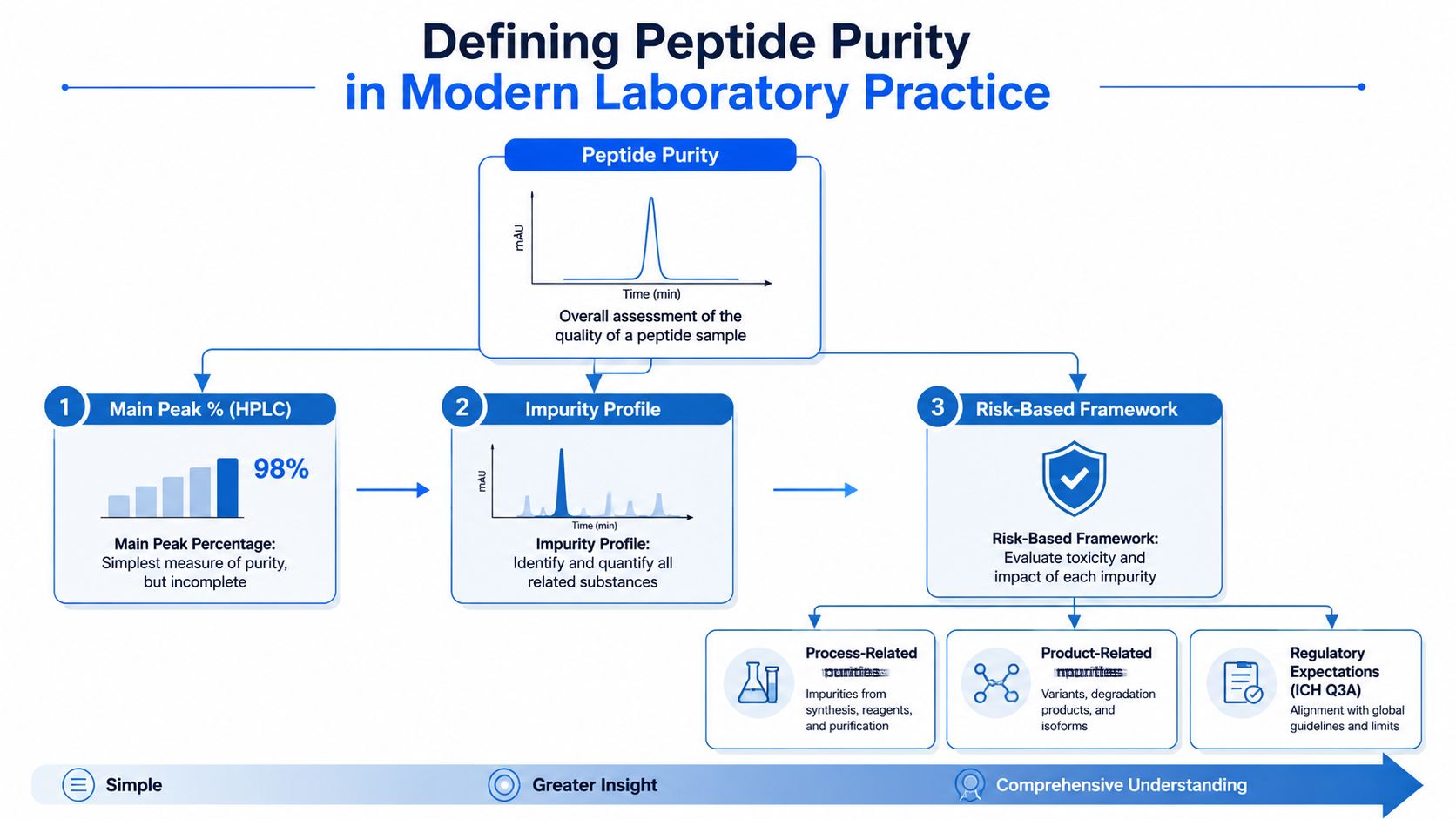
The simplest definition of peptide purity is the proportion of chromatographic signal assigned to the principal peak. In reversed-phase HPLC, the main peak area is compared with the combined area of detected peaks, producing an area-percent purity value. That number is useful, but it only describes what the chosen method detects under its chosen conditions.
Modern quality control treats purity as a broader, impurity-specific question. A major peer-reviewed review describes HPLC as “extremely versatile” for peptides that vary widely in source, quantity, and complexity, and identifies HPLC as a core purification and purity-testing platform for about 25 years. The review in PMC also documents the development of peptide-specific USP expectations, including <1503> Quality Attributes of Synthetic Peptide Drug Substances and <1504> Quality Attributes of Starting Materials for the Chemical Synthesis of Therapeutic Peptides, published in the USP-NF by 2024.
Three meanings of purity
Chromatographic purity is the main peak's relative area under a defined HPLC method. It can show that most detected, UV-responsive material elutes in one region. It can't establish the exact molecular structure of every signal or reveal a co-eluting compound that produces a similar response.
Absolute peptide content asks how much actual peptide is present by mass. Water, residual solvents, and counterions add to the weighed material but aren't necessarily part of the peptide molecule. A sample can therefore show 98% HPLC area purity while containing substantially less peptide by corrected mass if moisture, trifluoroacetate, or solvent contributions are high. HPLC area percent and mass-based content answer different questions.
Biological purity concerns the fraction of material that behaves as the intended molecule in a functional assay. A chromatographic peak may contain a structural variant with similar UV response, while a mass-confirmed peptide may still behave differently if stereochemistry, folding, aggregation, or another structural feature changes activity.
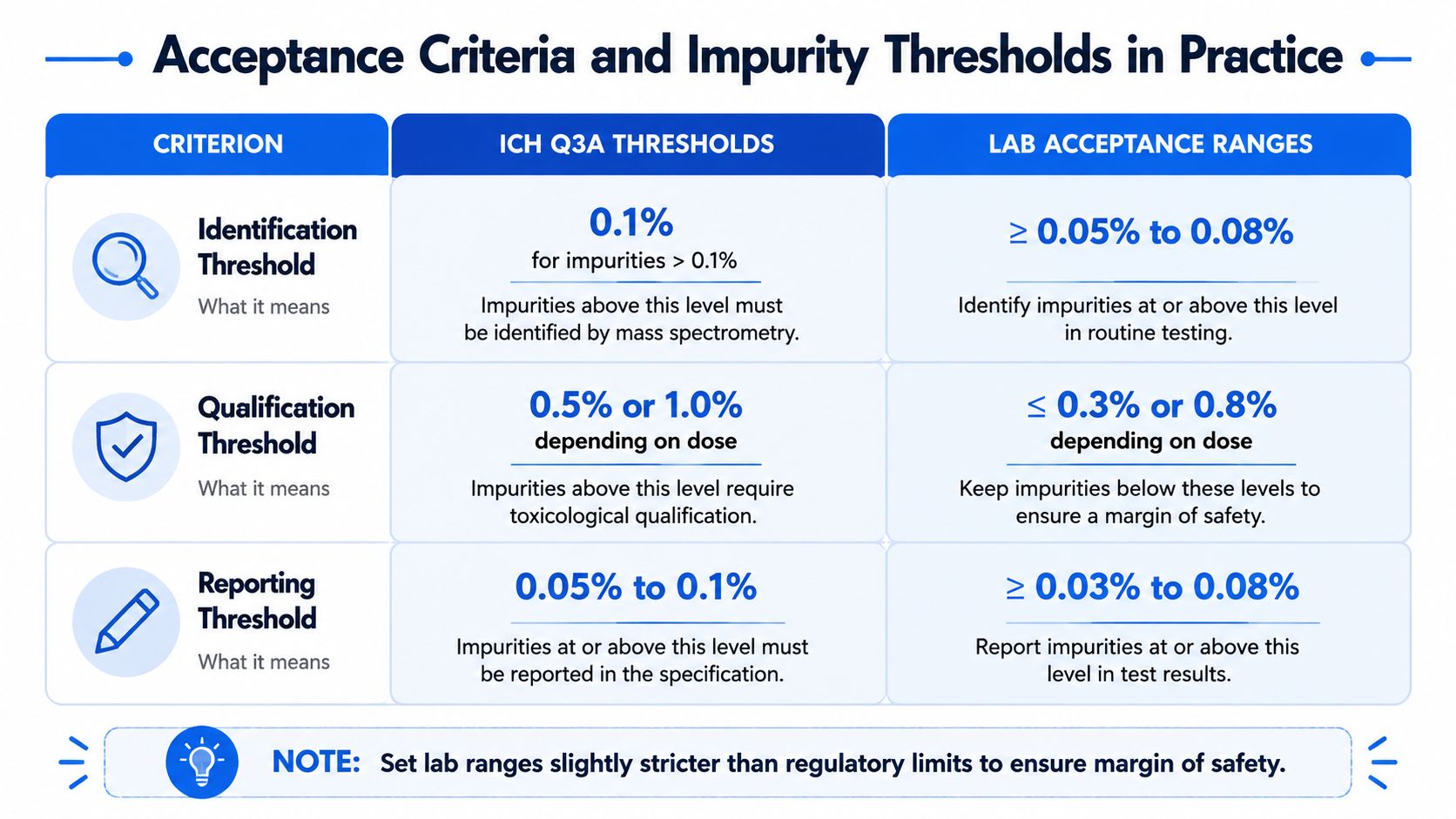
The USP framework reflects this shift from a single percentage to a risk-based impurity strategy. The cited USP material notes that common impurities and degradants are controlled relative to the reference listed drug, while new impurities are generally limited to 0.5%. Impurities in the 0.10%–0.5% range require identification and justification. These thresholds show why a usable lot can't be defined by one headline value. Purity is a stack of measurements that describes identity, related substances, content, formulation, and contamination risk.
Major Analytical Techniques and What Each One Proves
Each technique has a specific job. Problems arise when a laboratory asks one method to answer a question that belongs to another.
Reversed-phase HPLC with UV detection is the principal release assay for relative purity. It separates species by their interaction with a hydrophobic stationary phase and an aqueous-organic mobile phase, then compares the main peak with the other integrated peaks. The method answers, “How much detected chromatographic signal is in the principal peak, and how many separated signals are present?”
It doesn't answer what a minor peak is. A shoulder could represent a deletion sequence, a degradation product, a wrong-sequence analog, or an artifact caused by poor dissolution or an aging column. FDA peptide quality guidance supports pairing HPLC with LC-MS or another orthogonal chromatographic method because HPLC alone can't establish the structure of an unknown impurity.
LC-MS adds mass-to-charge information to chromatographic separation. It can confirm whether the principal peak carries the expected molecular mass and can flag mass-shifted species, including oxidation or truncation-related products. Because the mass spectrum is collected for separated elution regions, LC-MS can expose impurities that HPLC-UV places near, or beneath, the principal signal.
High-resolution MS provides more precise mass measurement and supports elemental-composition assessment and impurity identification. It remains an identification tool, not a substitute for validated chromatographic quantification. A signal's intensity in MS can be affected by ionization efficiency, suppression, and instrument settings.
NMR, including proton and two-dimensional experiments, provides structural and formulation information that complements chromatography and MS. It can support confirmation of molecular structure and counterion identity, but it typically requires more material and isn't the most sensitive approach for very low-level impurities.
Amino acid analysis and peptide content assays provide an orthogonal view of total peptide quantity. They can help separate actual peptide content from water, counterions, and other mass contributions, although amino acid composition alone doesn't prove sequence order.
| Technique | Question It Answers | Limitations |
|---|---|---|
| RP-HPLC with UV | What proportion of detected chromatographic area belongs to the main peak? | Can't identify unknown peaks or reliably reveal co-eluting species |
| LC-MS | Does each separated component have the expected mass? | Ionization response varies, and mass alone doesn't prove sequence order |
| High-resolution MS | Can closely related or nominally similar masses be distinguished? | Requires specialized instrumentation and still needs separation context |
| NMR | Is the structure and counterion environment consistent with the assigned material? | Requires more sample and may miss trace-level impurities |
| Amino acid analysis | How much peptide-related material is present by composition? | Doesn't establish residue order or distinguish all related sequences |
The strongest workflow uses orthogonal evidence. A lot can pass HPLC and fail MS identity, or pass MS while carrying a UV-silent contaminant. A complete COA should therefore combine HPLC purity with mass-spectrometry identity confirmation. American Peptide's COA explanation states that a report containing only one of these measurements is incomplete, even when its purity figure appears strong.
Preparing Samples for Reliable Purity Results
Sample preparation should begin with the peptide's properties, not with a universal recipe. Sequence length, hydrophobicity, counterion form, concentration, and aggregation tendency all affect whether the chromatogram reflects the lot or merely reflects a poor injection.
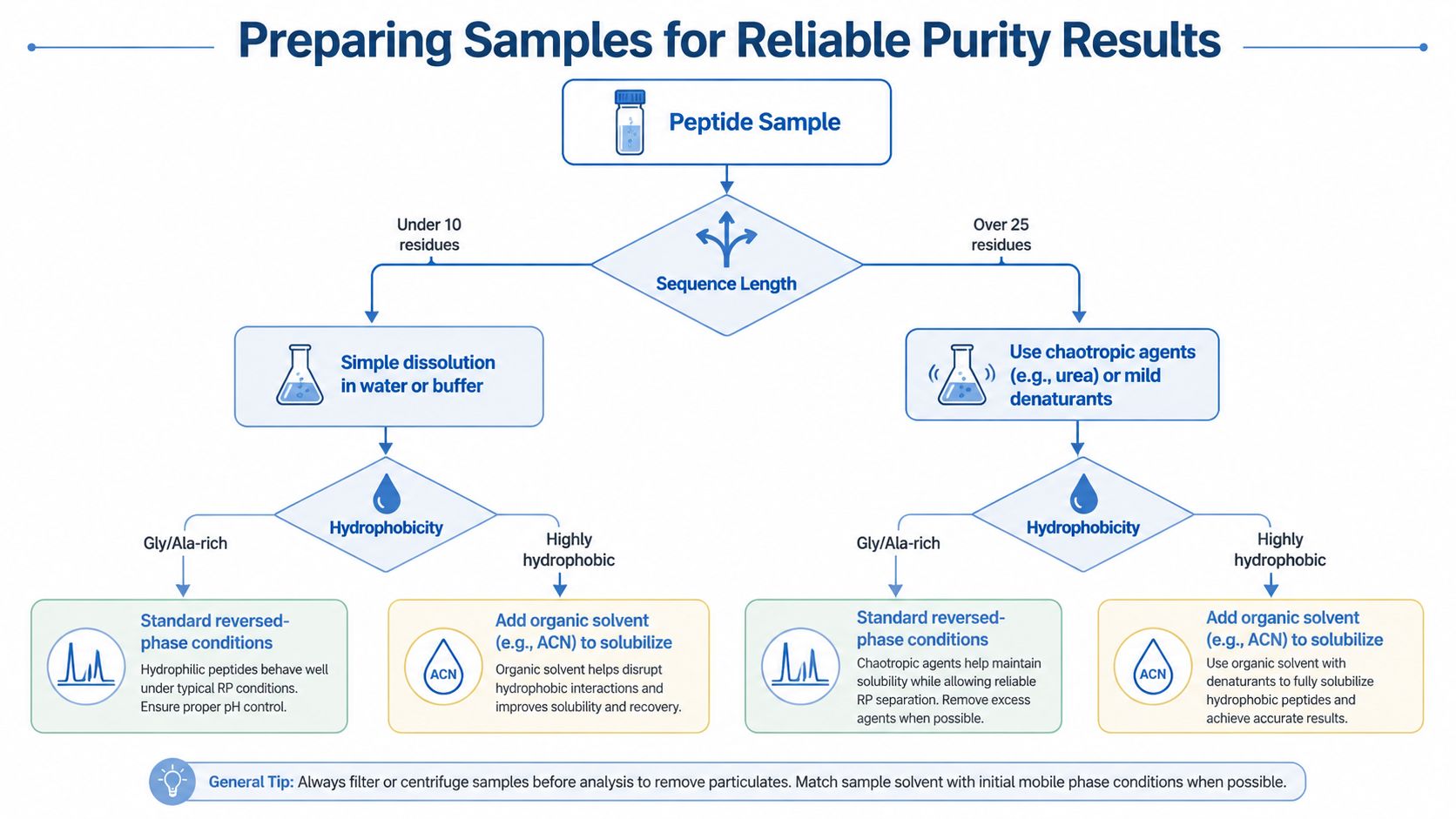
A short sequence, such as one under 10 residues, may dissolve readily in water or a compatible buffer. A longer sequence, such as one over 25 residues, may need a more deliberate solvent strategy, especially if it contains hydrophobic stretches or forms aggregates. Glycine- and alanine-rich material often behaves differently from a leucine- or isoleucine-rich sequence, which may require more organic content to remain in solution.
A practical decision tree
Start with visual inspection. Particulates, haze, or incomplete dissolution should be treated as sample-preparation findings before they are interpreted as chemical impurities. The counterion also matters. TFA, acetate, and hydrochloride forms can change solubility, ionic strength, apparent mass, and downstream assay compatibility.
For RP-HPLC, a common starting system is an acetonitrile and water gradient with 0.1% TFA, adjusted for the sequence and the column. Hydrophobic or aggregation-prone peptides may require an acidic aqueous diluent or a compatible amount of DMSO before dilution into the injection solvent. The laboratory should verify that the final solvent composition won't cause precipitation at the column head.
Concentration can be checked by UV absorbance at 280 nm when aromatic residues provide useful response, or at 214 nm for peptide-bond detection. A solvent blank should be run first so gradient artifacts, contaminant peaks, and baseline features aren't assigned to the sample.
Poor preparation can create tailing, split peaks, low recovery, or apparent shoulders. Over-dilution can make minor features difficult to interpret, while insufficient dissolution can produce a false impression of heterogeneity. A repeat injection from a properly dissolved preparation often distinguishes a real impurity from a preparation artifact.
Reading a Batch Certificate of Analysis With Confidence
A COA should be read from the top down. The first question isn't “What purity percentage is printed?” It is “What exact material does this document describe?”
The header should state the peptide name, sequence or identifier, lot number, manufacturing or analysis date, and formulation. The lot number must match the vial exactly, as emphasized in DNALab Research's batch traceability guidance. If the document doesn't identify the tested batch, the analytical result can't be confidently assigned to the received material.
The identity block
Theoretical and observed mass should appear together. Agreement supports molecular composition, but the report should make clear whether the result came from LC-MS, MALDI-TOF, or another instrument. If sequence order matters, MS/MS or another sequence-confirmation approach provides stronger evidence than intact mass alone.
The HPLC result needs its method context. A useful report identifies the column chemistry, mobile phases, gradient, detector wavelength, retention time, and integration approach. A headline percentage without a chromatogram or method description is difficult to audit because the result depends on what the method separated and counted.
A research-grade COA commonly reports an HPLC percentage such as 99.4%, but that figure should be read alongside the chromatogram, theoretical and observed molecular mass, analysis date, and lot identifier. PeptidesLab UK's COA interpretation guide identifies those fields as important for verifying the exact tested material.
| COA Field | What It Tells You | Red Flag to Watch |
|---|---|---|
| Peptide name and sequence | Whether the assigned material matches the order | Ambiguous synonym or absent sequence |
| Lot number | Whether the report belongs to the vial | Generic number or mismatch |
| Observed and theoretical mass | Whether molecular composition is consistent | Missing observed value or unexplained difference |
| HPLC purity and chromatogram | Relative chromatographic profile | Percentage without trace or method |
| Column and gradient | How the separation was produced | No method conditions |
| Counterion content | How much salt contributes to net mass | No formulation or counterion information |
| Water content | How moisture affects mass-based content | No moisture result for a hygroscopic material |
| Residual solvents | Whether process solvents remain | Summary claim without analytical result |
| Endotoxin and microbial limits | Whether biological contamination was assessed | Absent data for sensitive assays |
Counterion content, residual solvents, and water are often overlooked because they don't appear as ordinary impurity peaks. Yet they can shift the relationship between vial mass and actual peptide content. USP's peptide standards package also places purity alongside appearance, identification, residual solvent, bacterial endotoxin, microbial limits, elemental impurities, water content, and counterion content, showing that peptide quality control is an integrated set of attributes rather than one isolated assay. The USP peptide standards document also emphasizes mass balance and weight-based assay against a reference standard of known purity.
Acceptance Criteria and Impurity Thresholds in Practice
A research laboratory can borrow regulatory discipline without pretending that every research lot is a regulated drug substance. The key is to separate three decisions: reporting, identification, and qualification or acceptance.
The USP source describes a framework in which new impurities are generally limited to 0.5%, while impurities between 0.10% and 0.5% require identification and justification. Those values support a defensible review process, but they aren't a universal release specification for every research assay. The assay's sensitivity to related substances, the compound's role in the experiment, and the laboratory's reproducibility requirements still matter.
Match the threshold to the decision
A cell-based screening assay may tolerate a broader impurity profile than a receptor-binding experiment, where a structurally related species could interact with the same target. A structure-activity relationship study usually needs tighter lot comparability because a related sequence can be mistaken for a sequence-dependent activity change.
A useful internal policy can be tiered:
- Strict acceptance: Require the declared identity, interpretable HPLC trace, orthogonal MS confirmation, and documented handling for experiments where small structural differences could alter the conclusion.
- Moderate acceptance: Permit a qualified lot for exploratory in-vitro work when the main peak and identity are supported, but require impurity review and an explicit record of limitations.
- Preliminary screening: Allow broader exploratory material only when the experiment is designed to identify candidates rather than establish a quantitative mechanism.
The laboratory should document the reason for any deviation, identify the impurity or missing field, record who approved the decision, and preserve the relevant chromatogram and MS data. A supplier's stated release floor may be useful, but it shouldn't replace the laboratory's own assay-specific acceptance rationale.
Interpretation principle: The right question isn't whether a lot has a large purity number. It is whether the remaining uncertainty could change the experiment's conclusion.
Research reference materials illustrate why this discipline matters. A 2023 peer-reviewed paper reported the use of RP-HPLC to assess lot homogeneity, stability, identity, content, and purity for synthetic peptide reference materials, then used established bulk purity to assay lyophilized vials by compendial HPLC methods. The USP-linked reference-standard document places that work in the broader context of standardized reference materials and multi-attribute control.
Troubleshooting Unexpected Results and Validation Gaps
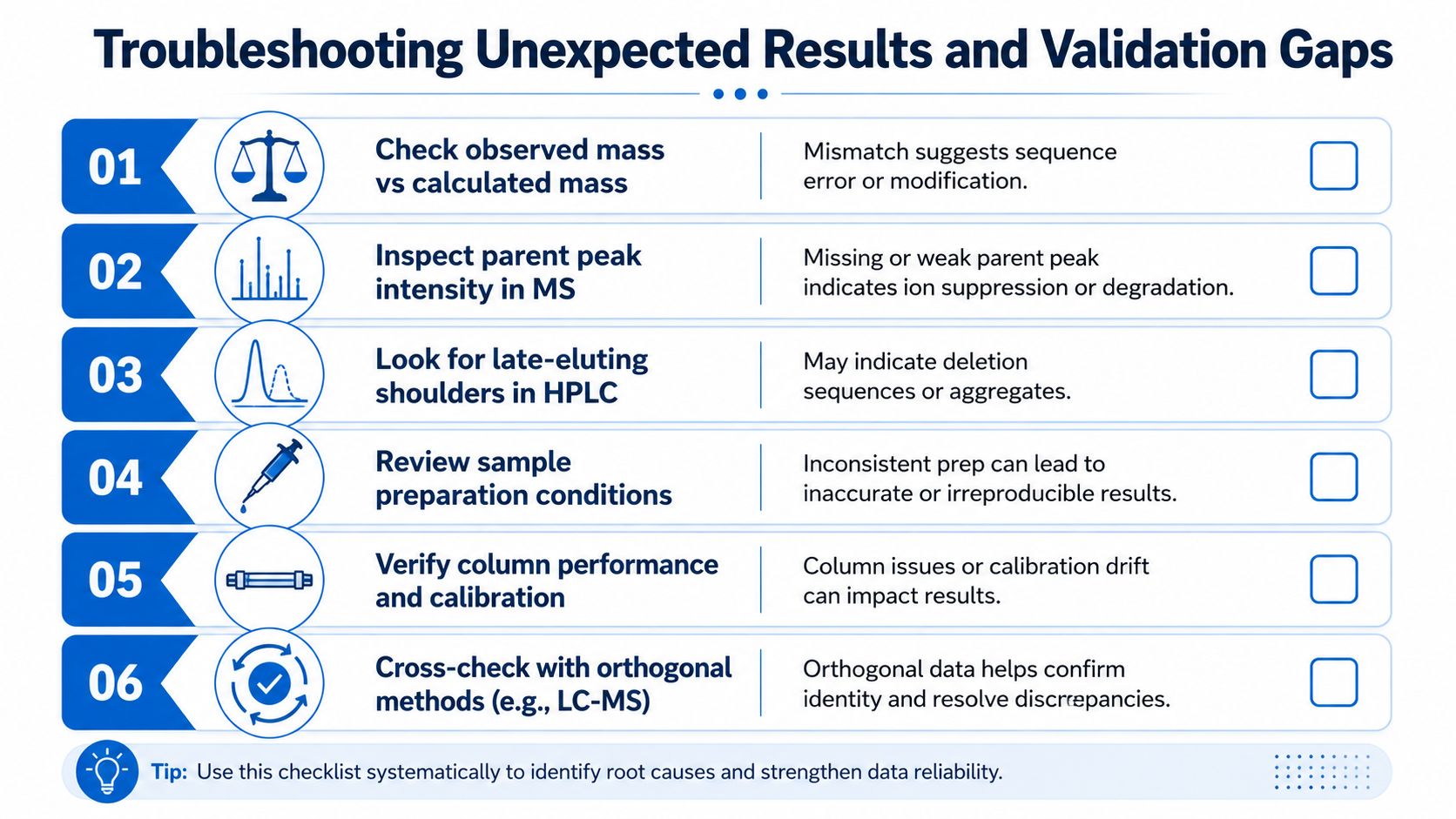
Unexpected results usually fall into one of two categories. Lot-to-lot drift points toward synthesis, purification, formulation, or storage differences. Run-to-run drift more often points toward sample preparation, column performance, mobile-phase quality, integration, or instrument condition.
A mismatched observed mass should trigger a repeat measurement against a suitable reference or an orthogonal LC-MS check. The laboratory should also review whether the calculated mass used the correct sequence, terminal groups, modification state, and counterion assumption. A weak or missing parent ion may reflect degradation, ion suppression, poor desolvation, or a concentration problem rather than immediate proof that the material is absent.
Match each artifact to a check
- Unexpected mass: Recalculate the theoretical mass and confirm the modification and salt form before contacting the supplier.
- Weak parent peak: Re-inject a clean preparation and review ionization conditions for suppression.
- Late-eluting shoulder: Extend or refine the chromatographic separation, then assess the feature by LC-MS.
- Baseline drift: Compare with a solvent blank and inspect column age, mobile-phase preparation, and detector stability.
- Inconsistent net content: Correct the mass interpretation for water and counterion contribution, then review the content method.
- Different retention time: Run a reference standard or a previously characterized lot to separate column drift from material change.
A short local check can catch many avoidable errors. The sequence should include a blank run, system-suitability review, replicate injections, reference-standard bracketing, and preservation of the raw chromatogram and spectrum. Formal method validation may be outside the scope of an incoming-lot screen, but these controls still make the conclusion more defensible.
A supplier COA and an in-house result don't need to match perfectly to be useful. They do need comparable method conditions, clear integration rules, and a documented explanation when the profiles differ.
Vendor Quality Signals and Questions Worth Asking Suppliers
Vendor evaluation should begin with documentation, not price per milligram. A supplier that provides a generic specification sheet gives the laboratory a claim. A supplier that provides a batch-specific COA, chromatogram, identity data, and supporting content information gives the laboratory something that can be reviewed and archived.
The testing package should match the experiment. HPLC remains the standard purity method, but a stronger package adds orthogonal MS, counterion analysis, water content, residual solvent data, and endotoxin or microbial testing where the assay makes those attributes relevant. USP's peptide quality framework lists these attributes together, reinforcing that purity isn't isolated from the rest of quality control.
Questions for the supplier
A researcher can ask:
- Purity method: Which HPLC method produced the stated purity, including column, gradient, detector wavelength, and integration approach?
- Identity basis: Was identity confirmed by intact-mass MS, LC-MS, MS/MS, or another method?
- Batch linkage: Does the COA apply only to the lot supplied, and does its lot number match the vial?
- Formulation: Is the material supplied as a TFA, acetate, hydrochloride, or another salt form?
- Content: Was net peptide content corrected for water and counterion contribution?
- Contaminants: Are residual solvents, endotoxins, microbial limits, and elemental impurities tested where relevant?
- Raw evidence: Can the chromatogram and mass spectrum be reviewed rather than only a summary percentage?
- Stability: What storage and retest information accompanies the specific lot?
- Response process: How does the supplier handle a mismatch between the COA and an incoming-lot result?
The supplier should also be able to explain whether testing is performed in-house or by an independent laboratory, and whether the report has an identifiable laboratory reference. A responsive answer doesn't eliminate the need for independent verification, but evasiveness around lot identity, method conditions, or impurity data is a meaningful quality signal.
Pro Tec Pep offers research-use-only compounds with batch-specific COAs, product-level analytical information, and a documented third-party testing framework that includes identity, purity, net content, sterility, endotoxins, heavy metals, and conformity. Researchers evaluating incoming materials can review the available documentation and compare its fields with the decision points in this guide by visiting Pro Tec Pep.
Before the next peptide lot enters an assay, match the vial to its COA, inspect the analytical method behind the purity figure, and confirm identity with orthogonal evidence where the experiment demands it. Visit Pro Tec Pep to review batch documentation and research-use-only materials that support a traceable peptide QC workflow.