Research Use Only Peptides: Lab Compliance Guide
Understand research use only peptides, regulatory boundaries, COA verification, and cold-chain handling for reproducible lab research.
A plate has failed twice, the assay controls are drifting, and the supplier's certificate reports only a single purity figure. The protocol hasn't changed, yet the results have. In many laboratories, the missing variable isn't the instrument or the analyst. It's the material record behind the vial.
Research use only peptides should be managed as defined experimental inputs, not as informal substitutes for approved medicines. Identity, composition, storage history, and intended use all affect whether a result can be reproduced, compared across lots, or defended during an institutional review.
Understanding Research Use Only Peptides in the Laboratory
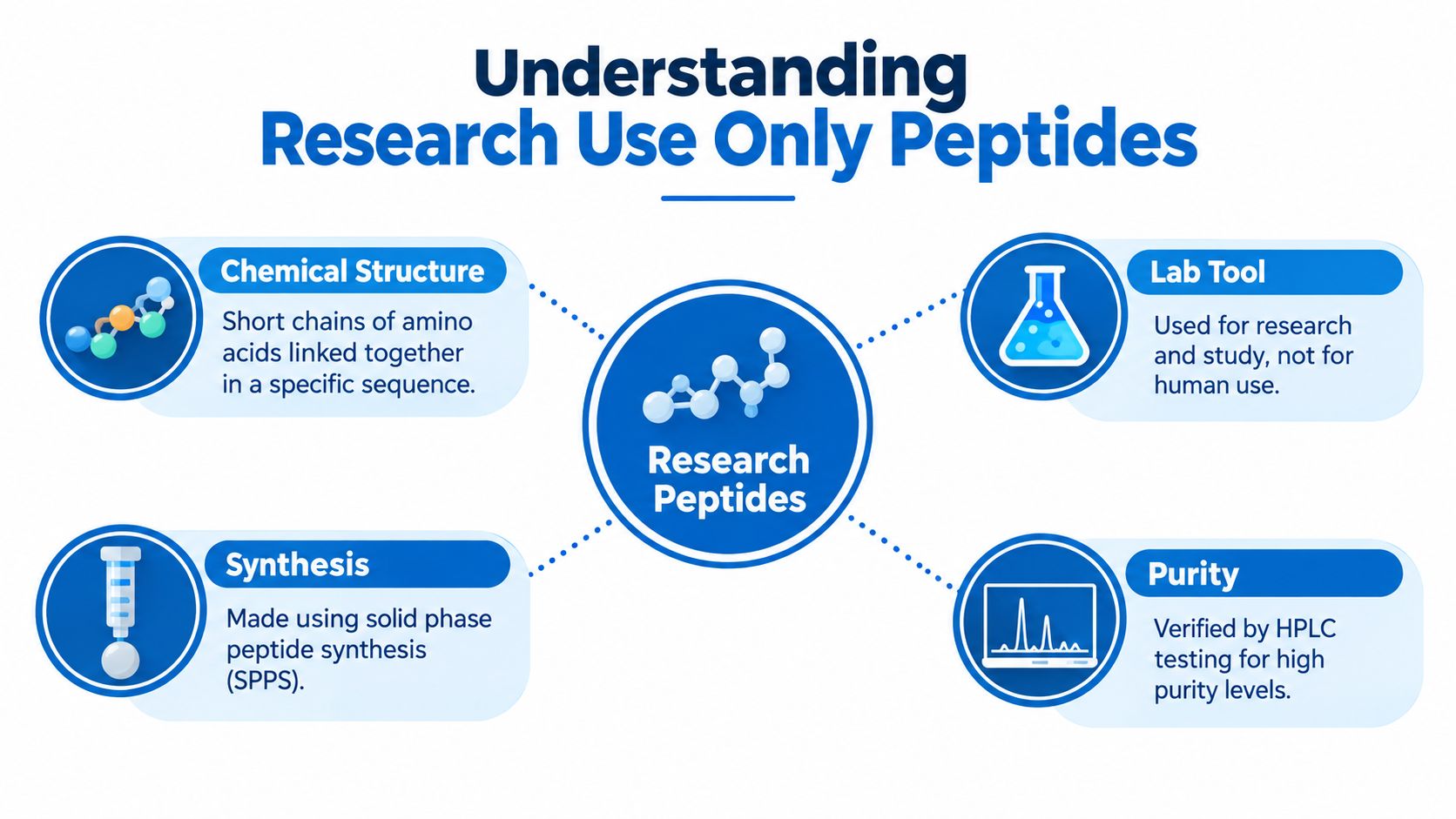
Research use only peptides are supplied for laboratory investigation, including biochemical assays, receptor studies, analytical characterization, and drug-discovery research. They may serve as test analytes, reference materials, assay probes, or inputs for structural work. Their value comes from controlled experimental use, not from any implied suitability for administration.
The term research use only, or RUO, describes intended use. It doesn't establish clinical approval, safety, efficacy, sterility for administration, or suitability for a particular assay. A correctly labeled RUO vial can still be inadequately characterized, poorly documented, or unstable under the conditions selected by a laboratory.
Start with the material record
A reliable workflow begins before the material enters the freezer. Procurement and laboratory operations teams should connect the product name to the exact lot, formal identity, formulation state, analytical record, and storage requirements.
A practical intake record should include:
- Material identity: Record the formal name, sequence where applicable, molecular formula, formula weight, and any relevant identifier supplied with the batch.
- Lot traceability: Link the vial, invoice, certificate, and internal sample code to the same lot number.
- Intended experiment: State whether the material is supporting an in-vitro assay, receptor study, analytical method, or another laboratory investigation.
- Handling history: Document receipt condition, transit exposure, storage location, reconstitution solvent, concentration, and freeze-thaw events.
Practical rule: Treat an RUO peptide like a technical reference material. The label defines the laboratory lane, while the batch record determines what the material can support.
This distinction prevents a common procurement error. A product page may describe a compound in broad scientific language, but only lot-specific evidence can show what was supplied. The laboratory must then qualify that material for its own assay rather than infer performance from a headline purity percentage.
Why Synthesis History Matters for Reproducible Research
A vial arrives for an assay with a familiar peptide name, but the supporting record says little about how it was made. That gap matters. Synthesis history helps the laboratory judge which quality attributes may affect a result, rather than treating a headline purity value as proof of suitability.
Modern synthetic peptide research rests on several technical advances. In 1953, Vincent du Vigneaud completed the first total synthesis of oxytocin, showing that a biologically active peptide could be chemically constructed. In 1963, Robert Merrifield introduced solid-phase peptide synthesis, allowing amino acids to be assembled sequentially on a solid support. This made peptide production more practical, repeatable, and suitable for laboratory investigation, as described in the review of synthetic and therapeutic peptide science.
For laboratory staff, the practical lesson is to record more than the product name. Synthetic production enables investigation through purification, sequencing, mass analysis, receptor experiments, and biochemical testing. It also introduces possible sources of assay variation, including incomplete reactions, side products, chemical modifications, counterions, and changes during storage. A synthesis record can indicate which of these attributes require confirmation for a particular experiment.
A shared lineage, different regulatory position
Insulin became the first commercial peptide drug in the early 1920s. Later milestones included goserelin's approval for cancer treatment in 1989 and enfuvirtide's approval for HIV treatment in 2003. These examples show how peptide chemistry moved from research methods into regulated pharmaceutical development.
RUO peptides share part of that scientific lineage, but their regulatory position remains different. A synthetic research material may use chemistry related to pharmaceutical production while lacking the clinical manufacturing controls, safety evidence, efficacy evidence, and regulatory review required for a medicine.
When drafting protocols or methods sections, identify the study type explicitly, whether an in-vitro assay, animal model, or clinical investigation. Keep that context attached to the result, and do not turn published human-use evidence into a human-use claim for an RUO product.
Building a Defensible Quality Package for Peptide Assays
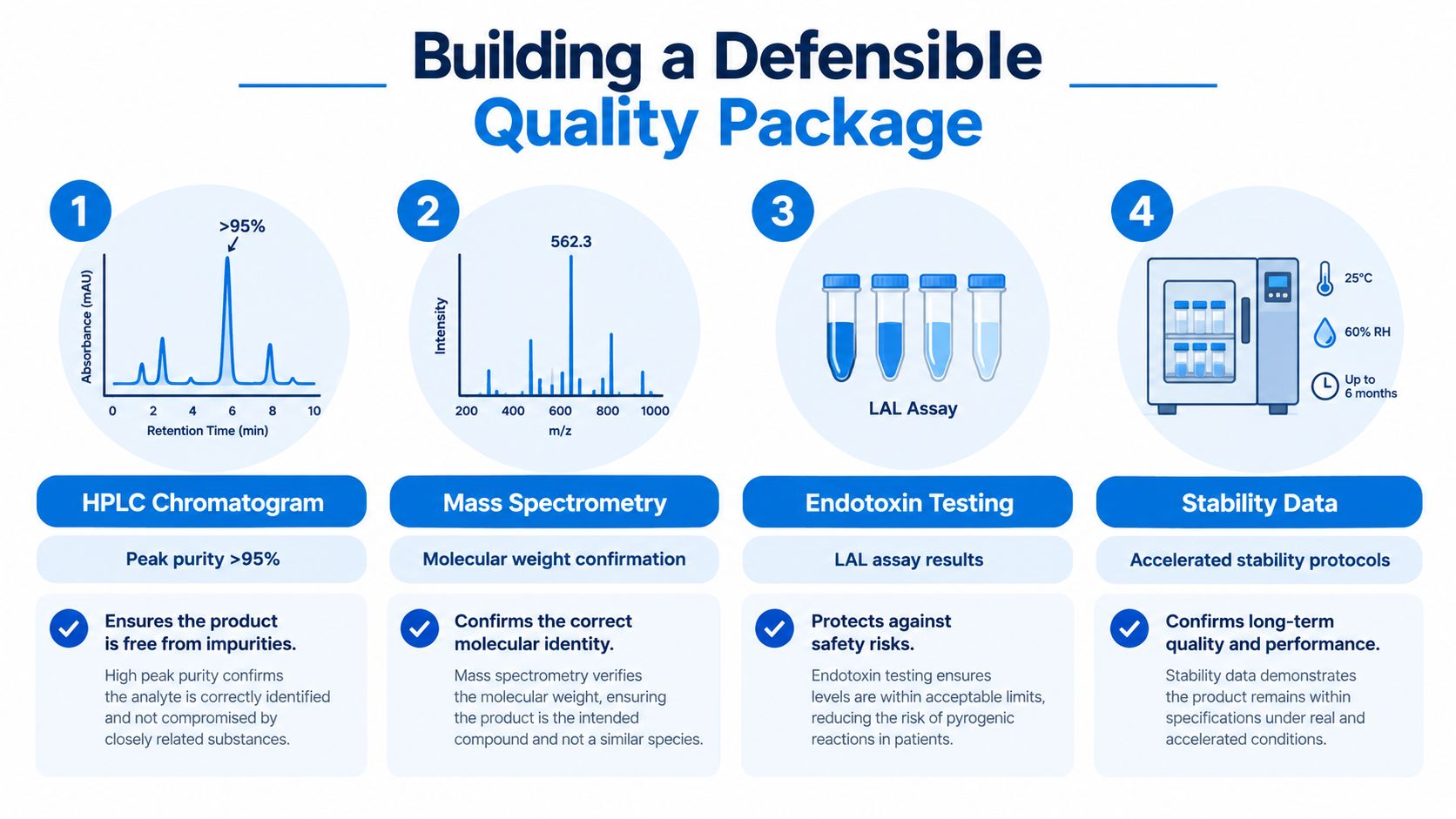
A single HPLC purity figure rarely answers the question a laboratory needs to resolve: what is this lot, and is it suitable for this assay? Reversed-phase HPLC can separate related substances and describe chromatographic homogeneity, but it doesn't independently confirm molecular mass or sequence.
A defensible package uses orthogonal methods. LC–MS or MS/MS can support molecular-mass and sequence confirmation, while NMR or chiral testing may be appropriate when structural ambiguity matters. Independent peptide-reference-standard guidance recommends combining HPLC, mass spectrometry, and other orthogonal techniques, as described in this analytical guidance for peptide identity and purity.
Match evidence to assay risk
The appropriate documentation depends on what the assay can reveal and how strongly the result depends on material attributes.
| Assay need | Documentation that matters |
|---|---|
| Structural or analytical characterization | Molecular mass, sequence evidence, chromatogram, and detected modifications |
| Quantitative calibration | Absolute content or assay value, water content, counterion information, and lot-specific testing |
| Enzymatic or receptor work | Identity confirmation, related substances, concentration basis, and post-storage performance |
| Cell-based experiments | Identity, impurities, endotoxin or bioburden information where relevant, formulation details, and handling history |
USP quality guidance separates identity, assay or content, impurities, and general characteristics for synthetic peptide substances. It also identifies orthogonal approaches such as mass spectrometry, LC-MS/MS, peptide mapping, amino-acid analysis, and NMR. Larger peptides may require high-resolution mass spectrometry, as discussed in this quality framework for synthetic peptide substances.
A lot-specific certificate should identify the tested batch, analytical methods, acceptance criteria, principal HPLC peak information, theoretical mass, observed mass, and detected modifications. Laboratories can also review the supplier's peptide testing documentation before approving a material for assay development.
Evidence beats the headline: Chromatographic purity describes one attribute. It doesn't replace identity confirmation, content determination, impurity profiling, or stability evidence.
Storing and Preparing Peptide Samples for Long-Term Stability
A lyophilized peptide can arrive with visible clumping after a prolonged customs hold at ambient temperature. The vial may still carry an acceptable release certificate, yet condensation on the cap, moisture uptake, or a collapsed lyophilized cake can change how the material dissolves and performs in an assay.
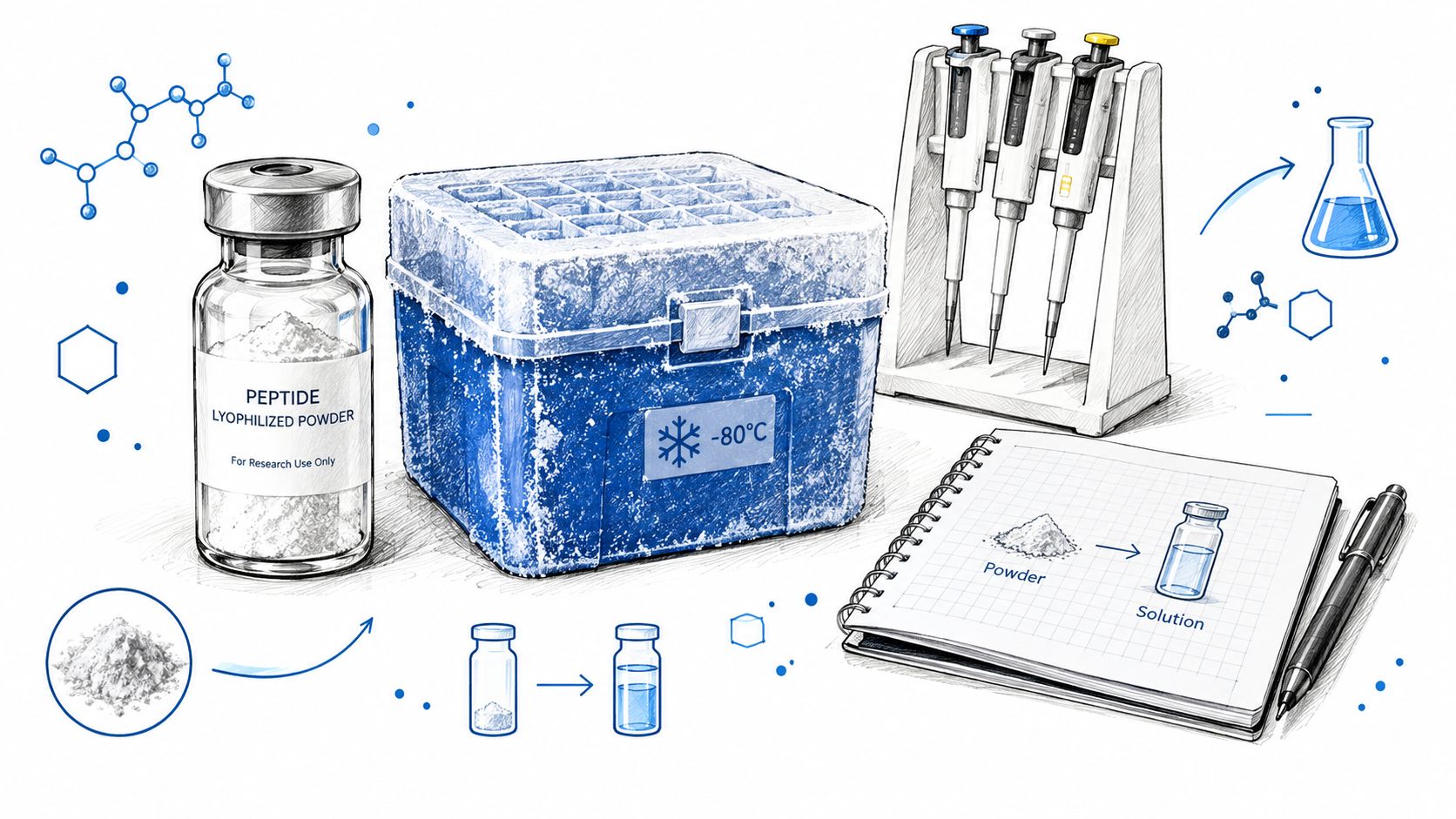
Published mass-spectrometry assay recommendations identify lyophilized peptides as the preferred general format for storage longer than six months, at approximately −20°C to −80°C. These peptide stability recommendations do not make those conditions universal guarantees. The compound, solvent, container, concentration, and handling history still determine whether the stored material suits a particular assay.
Document the events that change the sample
Transport records should show the shipment temperature, duration of any hold, receipt condition, and time from delivery to freezer placement. A missing temperature log can conceal a brief thaw, while repeated freezer cycling can create condensation inside the vial or loosen material from the cake. Record visible changes, including clumping, discoloration, cracked stoppers, or unusual dissolution.
Preparation records need the same level of detail. Capture whether the vial arrived lyophilized or in solution, the stated storage condition, solvent, final concentration, container material, mixing method, preparation date, and aliquot identifiers. These details connect a later assay result to the material used.
Repeated freeze-thaw cycles, evaporation, adsorption to container surfaces, microbial degradation, secondary-structure formation, and chemical modification can each alter assay response. Aliquot solutions into volumes that limit thawing and room-temperature exposure. Use sealed tubes and avoid vigorous handling when the peptide or assay is sensitive to surface loss or aggregation.
A laboratory peptide stability guide recommends minimizing repeated freeze-thaw cycles and keeping re-solubilized calibrator solutions frozen at temperatures at or below −70°C in sealed tubes. Treat that guidance as a starting point for method qualification, not as a substitute for compound-specific evidence.
Cold-chain selection also depends on the sample matrix and intended measurement. In serum peptide biomarker research, investigators recommended −80°C or liquid nitrogen rather than −20°C for the studied material. The biomarker stability study supports recording exact temperature and exposure duration.
Before a full assay campaign, test the intended buffer, container, concentration, aliquot plan, and freeze-thaw schedule. Compare post-storage appearance and assay response with freshly prepared material, and retain the handling record with the lot documentation.
Choosing Reliable Suppliers Through Transparent Documentation
You receive a Certificate of Analysis from Vendor A listing ≥98% purity, but the document does not show whether the tested lot matches the vials in your order. Do not approve the material from that figure alone. Traceability is the first purchasing decision.
Start by checking whether the certificate is tied to the specific batch, order, shipment, vial, and internal inventory record. A representative certificate supports preliminary screening, while a batch-specific Certificate of Analysis supports material acceptance, investigation of unexpected results, and repeat ordering.
Review the record against the assay
Confirm the identity evidence first. Mass spectrometry or another suitable method should identify the formal compound clearly. Then examine the purity information, including HPLC conditions or chromatographic results, so purity is not confused with identity.
Match contaminant data to the assay rather than requesting every possible test. Sterility, endotoxin, bioburden, residual solvent, and heavy-metal results may matter when the method or sample type makes them relevant.
The record should also state the material specifications: sequence, formula, formula weight, formulation state, solubility guidance, and storage requirements. These details determine whether the supplied form can be prepared consistently in the intended buffer and concentration.
Finally, review logistics records. Look for transit conditions, packaging details, receipt instructions, and a defined process for reporting temperature excursions. Record the vial condition when it arrives and reconcile the shipment with the certificate and inventory entry.
Cold-chain shipping is necessary for compounds listed as requiring it, but it does not substitute for verifying the supplier's temperature-log documentation and your own receipt inspection. Clear packaging and standardized product information also let institutional buyers assess eligibility before placing the order.
Recognizing the Compliance Boundaries of Research-Only Labels
A laboratory can receive a vial marked RUO and still encounter compliance problems if the surrounding sales material suggests personal use. Intended use is communicated through the entire sales environment, including product pages, advertising, social-media content, product presentation, customer screening, support responses, and packaging. Review that context before relying on the label.
FDA guidance indicates that RUO products used for product development rather than clinical use can be exempt from most regulatory controls, including IDE requirements. The designation does not make the material a human-use drug, validate it for clinical application, or establish safety and efficacy. Read the FDA guidance on research use only products together with the supplier's actual claims and customer-facing practices.
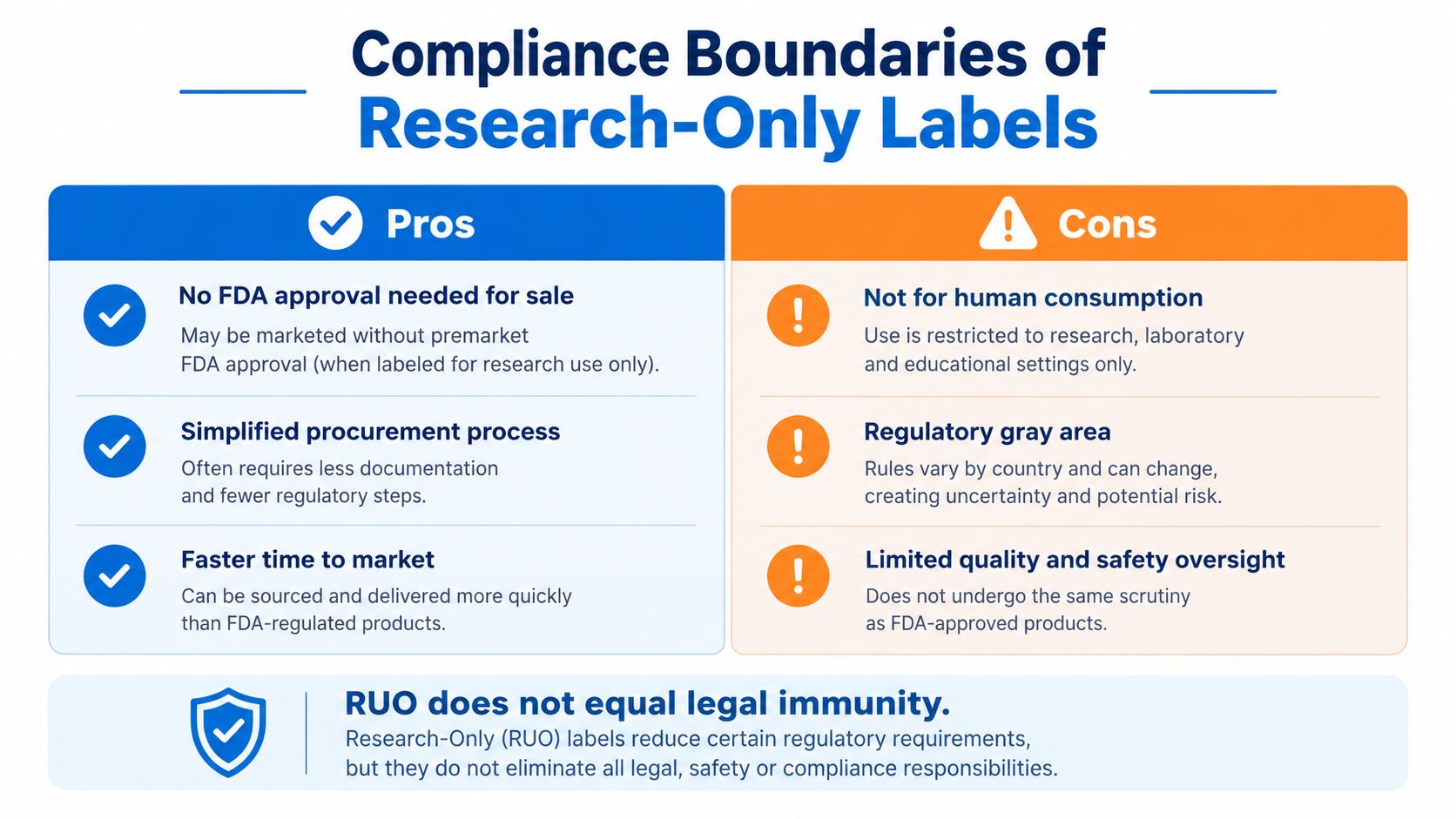
The label is only one control
A laboratory's file should show a clear boundary between assay work and consumer self-experimentation. Remove language about administration, treatment outcomes, personal dosing, or comparisons with approved therapies. Supplier replies and internal notes should use the same research-specific wording as the product record.
The hidden gap is often documentation of intent. Retain the assay or project purpose, the institutional buyer and purchasing authority, researcher qualification, and the product information supplied at the time of order. Keep these records together so an auditor can understand why the material was obtained and how its use was limited.
A practical record connects:
- Intended-use documentation to the named assay, project, or laboratory purpose.
- Eligibility records to institutional approval and purchasing authority.
- Chain of custody to receipt, storage location, transfers, and disposal.
- Communication records to supplier responses and product descriptions that avoid human-use implications.
Advertising and product presentation deserve particular attention. Enforcement scrutiny has included peptide sellers whose websites or social-media content implies human treatment, especially around GLP-1-related peptides. A compliant label cannot offset those signals.
The phrase research grade is not a globally harmonized regulatory category. It does not establish human safety, sterility, therapeutic efficacy, or equivalence to GMP clinical material. Use the research-use-only policy framework to separate laboratory intent from claims that could imply human use, then document that boundary before procurement.
Classifying Peptide Categories and Proprietary Blend Names
Catalog accuracy starts with chemical classification. HCG is a glycoprotein hormone, not a peptide. NAD+ is a redox coenzyme involved in cellular oxidation-reduction chemistry, not a peptide. Treating both as peptides can distort the literature search, analytical specification, and interpretation of an assay.
Proprietary names require the same caution. KLOW and BBG70 are blend names, not standard single-compound identities. A blend name doesn't establish a unified molecular structure or mechanism of action. Unless the supplier discloses the exact composition and each component is independently characterized, the laboratory should document the constituents separately.
Record the component, not the label alone
The same principle applies across a catalog that may include Retatrutide, BPC-157, TB-500 or Thymosin Beta-4 Acetate, Tesamorelin, GHK-Cu, MOTS-c, Ipamorelin, IGF-1LR3, AOD9604, CJC-1295, Tirzepatide, SS-31, Sermorelin Acetate, Semax, Selank, Epithalon, DSIP, and 5-Amino-1MQ. These names shouldn't be treated as interchangeable categories, and a product name alone doesn't establish assay suitability.
For each constituent, the record should include its identifier, formal name, analytical specifications, formulation, and relevant literature. Mechanistic language should identify whether evidence comes from an in-vitro assay, animal model, or clinical investigation. A blend page should never imply that a combined product has a mechanism demonstrated for the blend unless the exact composition and study design support that conclusion.
The compound research library can support initial literature organization, but the laboratory remains responsible for confirming the identity and evidence associated with every component.
Final Verification Steps Before Laboratory Procurement
Procurement should finish with an explicit release decision, not an assumption that a familiar product name is enough. The laboratory manager, principal investigator, or designated buyer should confirm that the material can be identified, stored, and documented for the intended experiment.
Use a release checklist
Before placing an order, verify the following:
- Confirm the exact identity. Check the formal name, sequence where applicable, formula, formula weight, formulation state, and lot-specific certificate.
- Separate purity from identity. Confirm that HPLC data is accompanied by LC–MS, MS/MS, or another suitable orthogonal method when the assay depends on structural certainty.
- Review content and impurities. Determine whether the work requires assay or absolute content, water, counterion, residual solvent, endotoxin, bioburden, or other impurity information.
- Validate storage conditions. Compare the supplier's recommendation with the compound, buffer, container, and planned storage interval. A generic freezer setting isn't compound-specific stability evidence.
- Confirm transit controls. Define how the shipment should arrive, what constitutes an excursion, and who records receipt condition.
- Approve the handling plan. Document reconstitution solvent, concentration, aliquoting, container, freeze-thaw schedule, and post-storage checks.
- Check institutional eligibility. Confirm qualified personnel, purchasing authority, approvals, chain of custody, storage access, and disposal procedures.
- Archive the complete record. Store the order, invoice, certificate, lot number, shipping record, preparation notes, and assay release decision together.
Product-page language should state the boundary plainly. The following disclaimer should appear verbatim where applicable:
"For laboratory research use only. Not for human or veterinary use. Not a drug, food, or cosmetic. Not evaluated by the FDA. Not intended to diagnose, treat, cure, or prevent any disease. By purchasing, you certify you are a qualified researcher and agree to use this product solely for in-vitro laboratory research."
A laboratory that follows these checks can distinguish a documented experimental input from an inadequately characterized vial. That distinction supports more reliable assay development, clearer investigations when results shift, and stronger reporting across lots and laboratories.
Pro Tec Pep offers research-use-only compounds with batch-linked documentation, product specifications, and logistics options designed around laboratory procurement workflows. Visit Pro Tec Pep to review available materials and assess the documentation needed for a controlled research workflow.