Cold Chain Shipping: A Research Compound Guide
Learn how cold chain shipping protects sensitive research compounds during transit. A practical guide to temperature control and compliance.
A research officer opens a delivery that was expected yesterday. The parcel arrives after a 36-hour delay, and the data logger shows 14°C. The material is a peptide intended for a binding assay scheduled around scarce plate-reader time. The receiving scientist now has to decide whether the assay should proceed, whether the lot should be quarantined, or whether the entire experiment should be postponed.
That decision isn't a routine shipping question. If the material has changed during transit, the assay may still produce a clean-looking curve, but the curve can represent altered material rather than the intended research compound. The cost can include fresh reagents, a lost instrument slot, additional review, and baseline data that becomes difficult to interpret.
Cold chain shipping protects more than a parcel. It protects the connection between compound identity, sample condition, assay performance, and research conclusions. That connection depends on the temperature band, packaging design, carrier handling, lane planning, monitoring records, and a receiving-side disposition process that exists before the package reaches the instrument.
When a Shipment Arrives Warm and the Assay Pays the Price
The receiving officer doesn't know whether the 14°C reading represents a short exposure or a prolonged event. The logger may show the maximum temperature, while the compound's actual condition depends on the full time-temperature profile, formulation, packaging position, and validated stability data. A later return to the intended range won't automatically reverse the earlier excursion.
The first practical action is to stop the lot from entering routine inventory. The receiver records the shipment condition, preserves the logger file, checks the vial and lot details, and moves the material into controlled quarantine. Proceeding directly to the binding assay would turn an unresolved shipping question into an assay-quality question.
Why a plausible result can still be unreliable
A degraded peptide doesn't always produce an obviously failed plate. It may produce lower apparent binding, a shifted curve, greater well-to-well variability, or a baseline that looks unusual only when compared with previous runs. If the material contains altered species, the assay may be measuring a mixture rather than the intended compound.
That creates a difficult operational problem. A failed visual inspection is easy to escalate. A result that looks plausible can travel into a report, a screening decision, or a follow-up experiment before anyone connects the pattern to the shipment.
Practical rule: A temperature excursion is a quality event first and a scientific interpretation problem second. The lot should remain quarantined until a documented review determines its disposition.
GDP-style systems call for continuous monitoring, temperature mapping under representative conditions, traceable calibration, and complete deviation and corrective-action records because a brief excursion can make a batch unsuitable for its intended purpose. Cold-chain quality guidance describes these controls in the context of temperature-sensitive pharmaceutical and research materials.
The purchasing decision therefore shouldn't end at “refrigerated” or “frozen.” It should specify the validated range, packaging qualification, logger requirements, carrier capability, delivery handoff, and receiving workflow. A lab that buys a low-cost shipper without defining those conditions may save on freight while exposing the assay to a much larger, less visible cost.
What Cold Chain Shipping Actually Means for Research Compounds
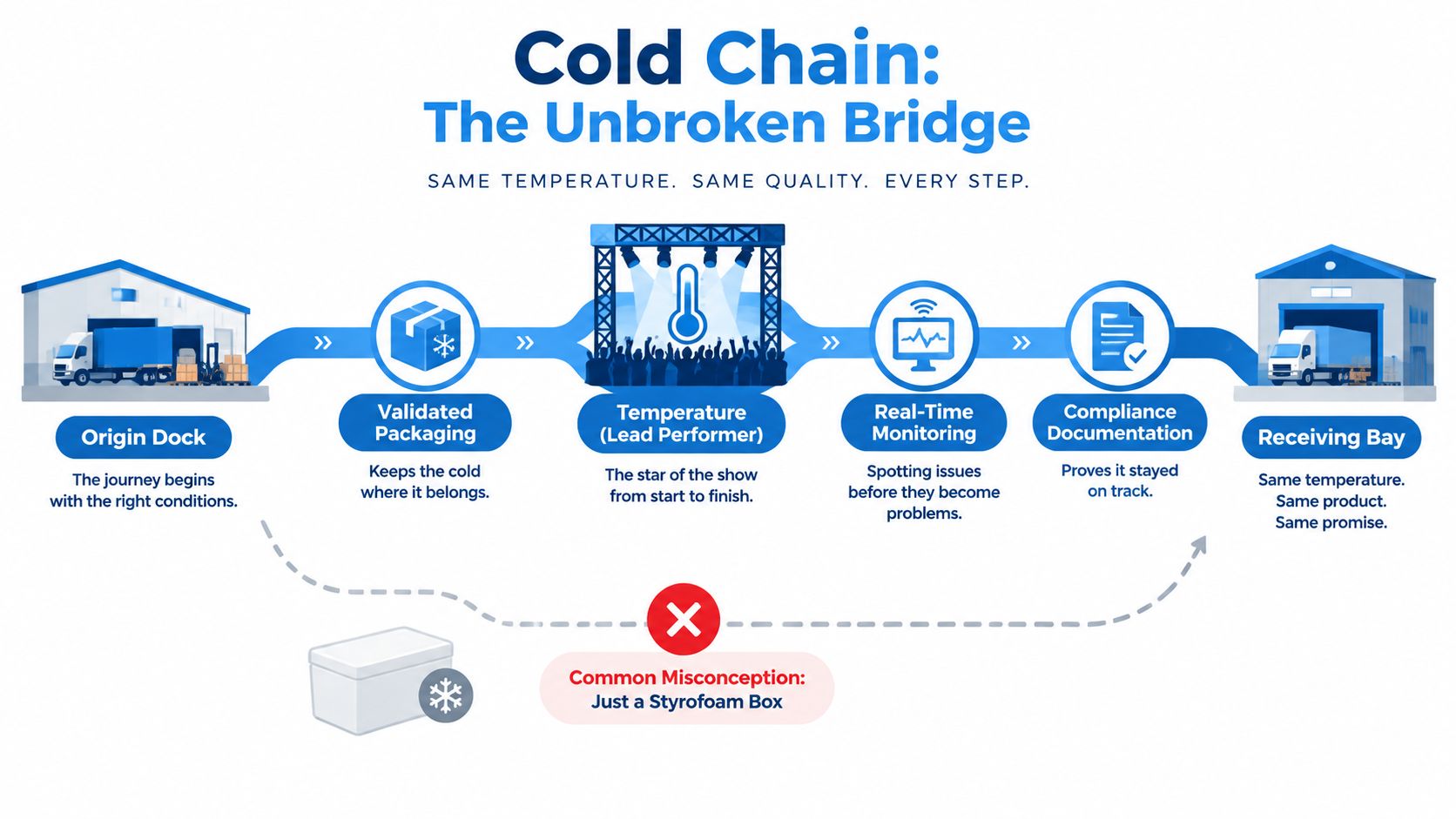
Cold chain shipping is an unbroken, temperature-controlled bridge from the origin dock to the receiving bay. It isn't just an insulated carton with cold packs. The shipper, refrigerant, logger, handling procedure, aircraft or vehicle environment, customs delay, final-mile transfer, and receiving process all contribute to the result.
A useful analogy is a concert pianist's instrument case. The case needs structural protection, the interior needs the right climate, and every handler must follow the handling plan. A high-quality case can't protect the instrument if it remains in unsuitable conditions for too long. Likewise, excellent insulation can't compensate for a missed flight, an unmonitored customs hold, or a receiver who accepts the box without reviewing the temperature record.
Why the material matters
Research peptides and related compounds can be sensitive to heat, moisture, oxidation, and repeated phase changes. A lyophilized presentation may tolerate a different shipping condition from a reconstituted sample. A small-molecule probe may have different stability constraints from a peptide, conjugate, or reference standard. The relevant question isn't whether the product category sounds “pharmaceutical.” The question is whether the selected shipping condition matches the compound's documented stability profile and the planned study.
This distinction matters because assay reproducibility depends on the material that enters the reaction. A sample can remain visually intact while its purity profile, aggregation state, or functional activity changes. For biologics and peptides, exposure outside the validated range can contribute to denaturation or aggregation, as explained in GDP excursion guidance.
The four parts of an unbroken bridge
- Validated packaging: The container needs a demonstrated hold profile for the intended ambient conditions and lane duration.
- Continuous monitoring: A calibrated logger creates evidence of what happened, not an assumption based on delivery time.
- Controlled handling: Pickup, transfer, customs, and final delivery must preserve the required range.
- Receiving disposition: The lab needs a defined process for accepting, quarantining, or rejecting material before assay work begins.
The research-quality analogy is straightforward. Cold chain shipping preserves the experimental input in the same way that calibrated pipettes, qualified plates, and controlled incubation preserve the experimental method. If the input changes before the first pipette touches it, later procedural precision can't restore the original sample.
Matching Temperature Ranges to Compound Sensitivity
Temperature bands should be selected from the compound's documented requirements, not from a generic courier menu. The lab's intended post-arrival storage condition also matters. A shipment that arrives at one temperature and is immediately transferred through another can add avoidable stress, particularly when the material is repeatedly thawed and refrozen.
For many refrigerated healthcare and research materials, the validated band is +2°C to +8°C. WHO vaccine guidance specifies +2°C to +8°C for transport, while also emphasizing that limits can differ by supply-chain stage and product requirement. WHO cold-chain guidance.pdf) supports the broader principle that temperature control must be stage-specific.
| Range | Typical Use |
|---|---|
| +2°C to +8°C | Refrigerated materials, including products with a validated chilled shipping profile |
| -20°C or below | Frozen compounds, heat-sensitive materials, and lots whose documentation specifies frozen storage |
| -80°C | Ultra-low-temperature materials requiring deeper frozen control |
| Dry ice conditions | Shipments that must remain substantially below ordinary frozen conditions during transit |
Refrigerated isn't automatically safer
A refrigerated lane can be appropriate for a short, qualified route, but it isn't a universal compromise. If the product specification calls for frozen storage, a +2°C to +8°C parcel may already be outside the accepted condition before the receiver opens it. Conversely, a material that only requires refrigeration can face unnecessary freeze damage if dry ice or an unsuitable frozen system is selected.
The purchasing officer should request the product-specific storage range, formulation state, permitted excursion information, and any restrictions on freeze-thaw exposure. Those details should be compared with the planned assay schedule and the lab's available freezer capacity.
Phase changes deserve special attention
Crossing a temperature phase boundary can matter more than the average temperature recorded across the route. A shipment that spends most of its journey cold but briefly freezes a refrigerated material may require a different review from a shipment that remains within a validated band. The same applies to a frozen lot that partially thaws and later returns to frozen storage.
Decision test: The selected shipping condition should match both the compound's validated stability profile and the storage condition available immediately after receipt.
For quantitative work, the receiving team should define in advance which excursions require quarantine, which may permit a qualified retest, and which require rejection. The decision should come from the manufacturer's or qualified quality review, not from an informal judgment based on whether the vial looks normal.
Packaging Systems That Hold the Line in Transit
Packaging is a thermal system with a limited operating window. Procurement teams should compare each option against lane duration, ambient exposure, compound sensitivity, and excursion tolerance, rather than choosing an insulated box by appearance or price alone.
A gel-pack shipper may suit a short refrigerated lane where the package moves quickly through controlled handling points. It can become a weak choice when the shipment faces extended staging, customs inspection, or an uncertain final-mile transfer. Expanded polystyrene, or EPS, and vacuum-insulated panels, or VIPs, provide more effective insulation for longer routes, but the qualification record still matters more than the material name.
Four common packaging tiers
Gel-pack insulated shippers are often selected for chilled materials and shorter routes. Their performance depends on pack conditioning, product placement, external temperature, and the validated hold time. Incorrectly conditioned gel packs can create local cold spots or fail to maintain the intended band.
EPS and VIP systems offer a stronger barrier for international lanes and extended handling. VIP systems can reduce thermal transfer, while EPS systems remain widely used for practical shipping applications. Neither system removes the need for a logger or a documented lane qualification.
Phase-change materials are designed to stabilize around a defined set point, such as a refrigerated or frozen target. They can reduce temperature swings when the selected phase-change profile matches the compound specification. Their value is highest when the shipper has been tested under representative ambient conditions.
Dry ice or cryogenic systems serve compounds requiring sub-zero transport. They introduce additional requirements for refrigerant placement, venting, labeling, replenishment planning, and carrier acceptance. WHO specimen packaging guidance explains that refrigerant placement must keep secondary packagings secure after the refrigerant dissipates, and that dry-ice packaging must vent carbon dioxide to prevent pressure buildup.
| Packaging Tier | Typical Hold Time | Relative Cost | Excursion Tolerance | Best-Fit Lane |
|---|---|---|---|---|
| Gel-pack insulated shipper | Short, validated refrigerated lane | Lower | Limited if delayed or poorly conditioned | Local or direct chilled delivery |
| EPS insulated shipper | Extended, qualification-dependent | Moderate | Moderate insulation protection | Domestic and international refrigerated routes |
| VIP insulated shipper | Extended, qualification-dependent | Higher | Stronger resistance to external heat | Long or volatile international lanes |
| Phase-change system | Set-point dependent | Moderate to high | Better control around the selected band | Tight refrigerated or frozen specifications |
| Dry ice or cryogenic shipper | Replenishment and qualification dependent | Higher | Strong sub-zero protection with handling constraints | Deep-frozen materials and selected biologics |
What the procurement file should contain
A qualified packaging supplier should provide hold-time data, conditioning instructions, packing diagrams, maximum payload, logger placement guidance, and the ambient profile used for qualification. The file should also state what happens if the parcel is delayed beyond the validated window.
Cost per parcel matters, but it shouldn't be the only comparison. A slightly more expensive shipper may be appropriate when the lot is difficult to replace, the assay window is limited, or the material's excursion tolerance is narrow. Conversely, expensive packaging doesn't justify a lane that lacks reliable carrier handling or a receiving team prepared to act on logger data.
Regulatory and Carrier Rules You Cannot Skip
Temperature control and transport compliance overlap, but they aren't the same thing. A package can remain cold and still be delayed because the refrigerant, labels, documentation, or declared shipment information doesn't satisfy carrier or air-transport requirements.
Dry ice requires particular attention. Procurement staff should confirm the applicable carrier and route rules, including the correct refrigerant declaration, package marking, and dangerous-goods documentation. The brief supplied for this guide mentions a dry-ice classification and package limit, but that detail isn't supported by the verified sources available here, so the shipment file should rely on the current carrier and IATA requirements rather than an assumed limit.
Labels must match the shipment
For temperature-sensitive healthcare shipments, IATA requires the external transportation temperature range to appear in Celsius on the lower half of the time-and-temperature-sensitive label. That lower half can't be left blank. If the label and the Air Waybill show different temperature indications, the Air Waybill indication prevails, according to IATA temperature-label guidance.
The shipper should also verify whether the material itself requires additional declarations, whether dry ice is present, and whether the carrier accepts the selected packaging on the intended service. A carrier's acceptance rules can be stricter than a general packaging specification.
Refrigerant placement affects safety
For refrigerated or frozen specimens, the refrigerant belongs outside the secondary packagings or within the outer packaging or overpack. Interior supports should keep secondary containers in position after ice or dry ice has dissipated. Dry ice systems also require venting because sublimation produces carbon dioxide gas.
A procurement officer should request a documentation pack before booking:
- Product specification: Validated temperature range, formulation state, storage condition, and excursion instructions.
- Packaging qualification: Hold-time evidence, packing configuration, conditioning requirements, and logger placement.
- Carrier acceptance: Approved service, handling restrictions, refrigerant rules, and route limitations.
- Shipment records: Commercial invoice, applicable classification details, chain-of-custody documents, and certificates relevant to the material.
- Monitoring evidence: Logger model, calibration status, activation instructions, and data-access process.
Documentation principle: The package should arrive with enough information for a qualified receiver to reconstruct what happened without relying on memory or assumptions.
When a parcel arrives without correct markings or required declarations, the carrier may hold it, reroute it, request corrections, or refuse onward transport. Those delays can become temperature events, which is why compliance preparation belongs in lane planning rather than at the dispatch counter.
Capacity, Lanes, and End-to-End Orchestration
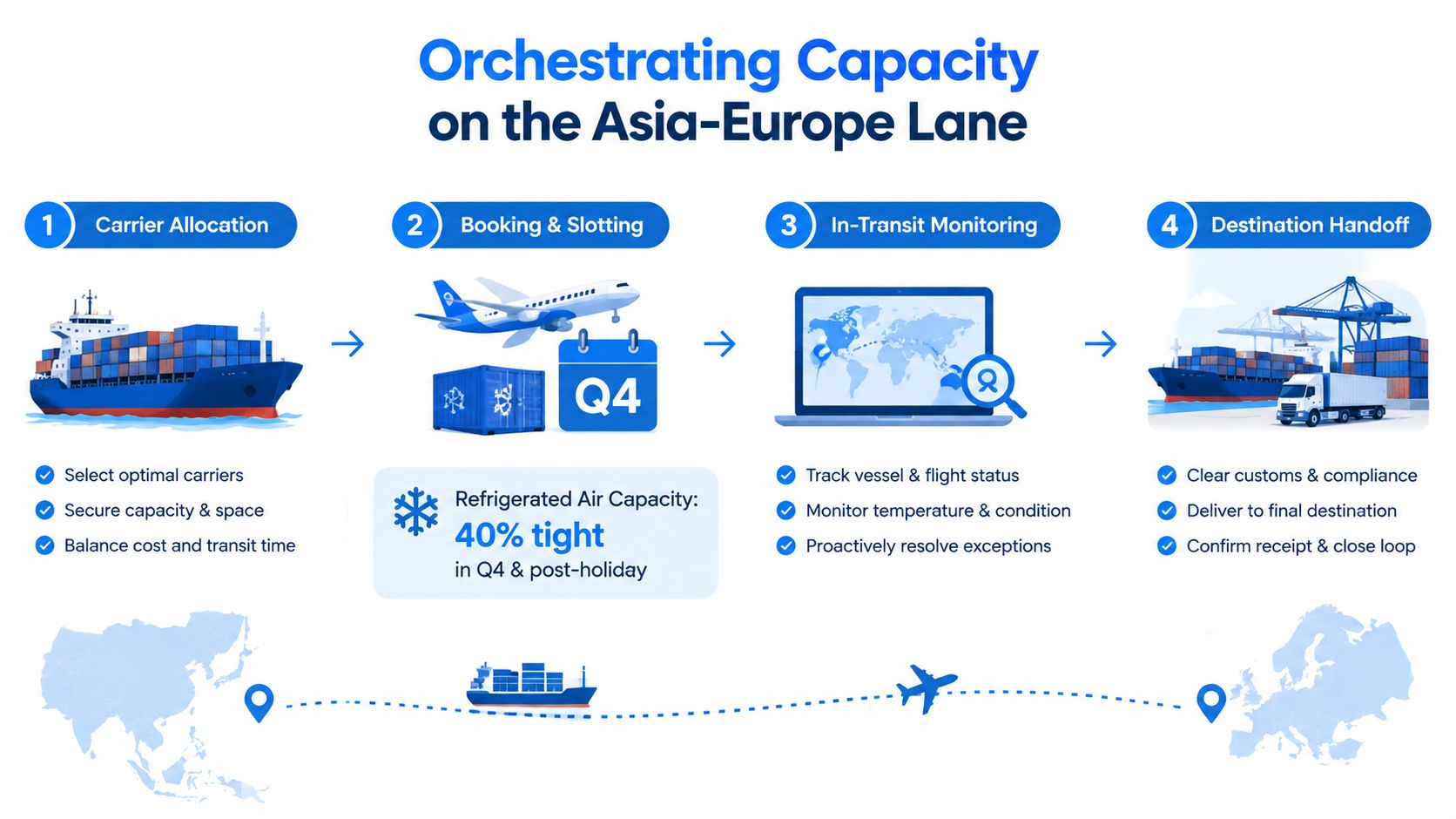
Cold chain shipping is an orchestration problem. Packaging is only one component in a chain that also includes carrier allocation, booking, customs readiness, monitoring, and the destination handoff.
The Asia to Northern Europe corridor illustrates the issue. Recent reporting describes a widening refrigerated-container capacity gap on that route, while market commentary also points to stronger demand for visibility, control, and flexible packaging systems. Route-capacity reporting connects infrastructure constraints with the need for earlier planning and more coordinated temperature-control decisions.
The route needs an owner
A lab should know who owns the shipment during each handoff. The origin supplier, freight forwarder, airline, customs broker, destination courier, and receiving facility may all touch the parcel. Without a named coordinator, a delay can remain invisible until the receiver opens a warm package.
Lane planning should confirm:
- Capacity allocation: The carrier has accepted the required temperature-controlled service.
- Customs readiness: Commercial invoice, HS information, SDS, certificates of analysis, and other requested documents are complete.
- Monitoring continuity: The logger remains active and its data can be retrieved after delivery.
- Destination handoff: The final-mile provider can deliver to a staffed receiving point with the required handling capability.
- Escalation ownership: One party can authorize intervention when a delay or excursion occurs.
The market's overall scale reinforces why this coordination matters. The global cold chain logistics market was estimated at about USD 363.8 billion in 2024 and is projected to exceed USD 1.2 trillion by 2033, according to cold chain market estimates. Those figures include refrigerated warehousing, transport, and packaging across pharmaceuticals, biologics, food, and other temperature-sensitive goods. For research procurement, the implication is practical: temperature-controlled infrastructure is now a core supply-chain capability, not a minor shipping add-on.
The embedded logistics video provides another visual way to understand how booking, monitoring, and destination handoff fit together.
From Receiving Bay to Disposition Decision
The receiving bay is part of the cold chain, not the endpoint after it. A shipment becomes research-ready only when the lab verifies its condition, documents the review, and assigns a disposition that follows the lot into storage and later assay work.
The dock review begins with the external condition, seal or closure condition, shipping label, logger status, and temperature record. The receiver then compares the time-temperature profile with the product specification and records the vial lot, quantity, arrival condition, and receiving time.
A controlled receiving sequence
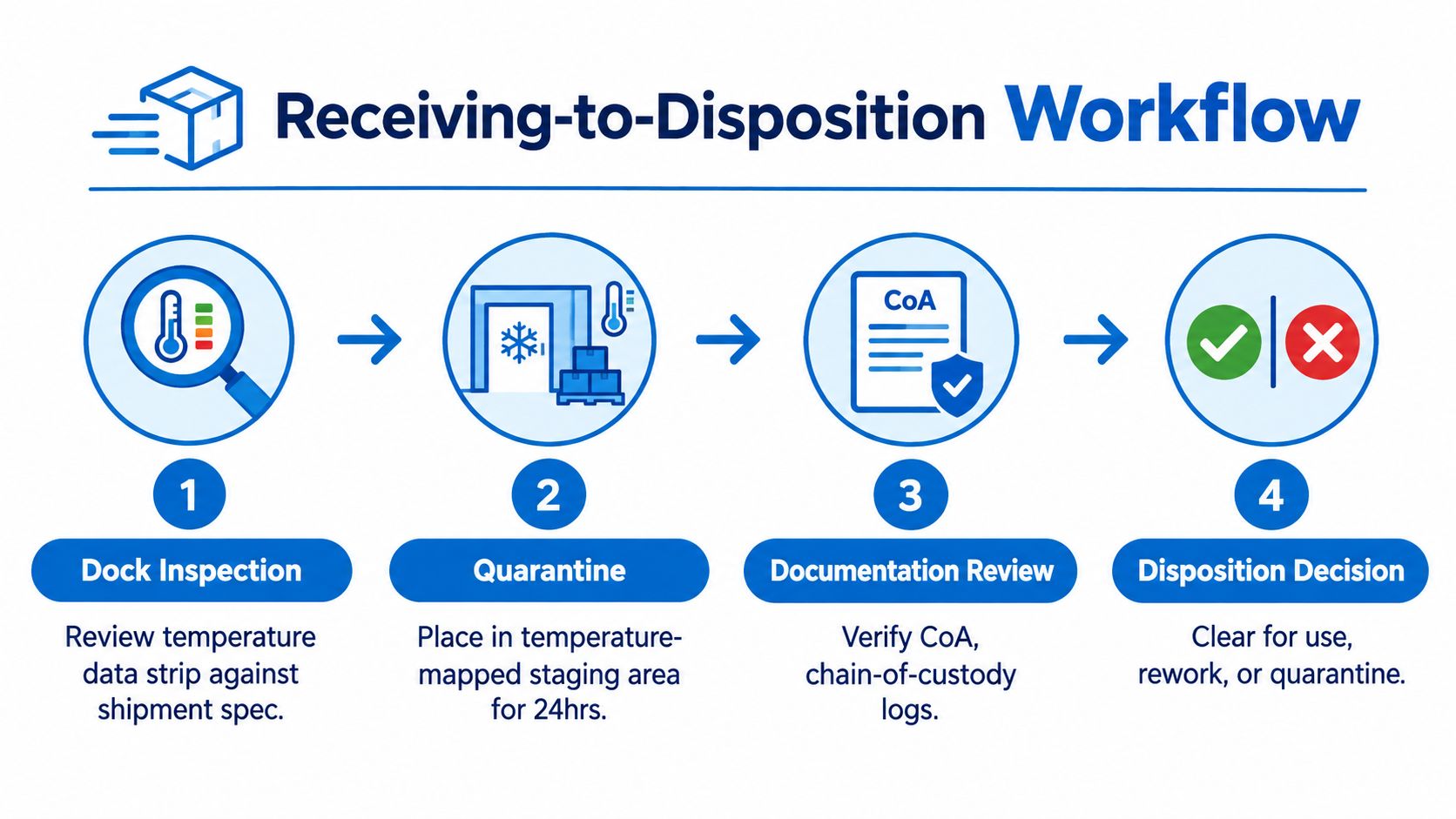
- Inspect at the dock. Review the logger or temperature strip against the shipment specification. Photograph unusual packaging conditions, condensation, damaged seals, or visible evidence of thawing.
- Quarantine the lot. Place the material in a temperature-mapped staging area or other controlled location defined by the lab's procedure. It shouldn't enter general inventory while the review remains open.
- Reconcile the records. Match the vial lot to the certificate of analysis, purchase record, packing list, and chain-of-custody documentation. A mismatch is a release blocker even when the temperature profile is acceptable.
- Examine the material. Check for sublimation, fogging, unusual moisture, collapsed cake structure, discoloration, or ice-crystal artifacts where the formulation makes those observations relevant.
- Assign disposition. The qualified reviewer may clear the lot, retain it for further evaluation, or reject it according to predefined excursion criteria and available stability information.
An excursion doesn't automatically mean disposal. Guidance emphasizes preserving the time-temperature record, quarantining the affected lot, and documenting the disposition through manufacturer or qualified quality review. Excursion disposition guidance highlights why informal decisions create avoidable risk.
When additional testing is appropriate
If the record falls outside specification but the material may still be scientifically useful, the lab can define a stability-indicating or identity-focused review before committing the lot to a critical assay. The appropriate test depends on the compound, study objective, available reference material, and qualified reviewer. It shouldn't be invented after the result appears questionable.
The final handover connects the receiving decision to the research record. The lot status, storage location, logger file, deviation record, certificate of analysis, and reviewer decision should be entered into the laboratory information management system or inventory platform. That creates an auditable link between the material tested and the storage event that preceded it.
Cold chain shipping also has a long operational history. Refrigerated rail transport began with the first refrigerated boxcar entering service in 1851, refrigerated trucking emerged in 1939, pharmaceutical and medical-supply transport began in the 1950s, and the last ice-cooled reefers retired in 1971, as documented in this history of cold chain logistics. The technology changed from ice to mechanical systems, but the research principle remains the same: material integrity depends on controlled conditions across every handoff.
Pro Tec Pep offers research-use-only compounds with batch-specific certificates of analysis, product documentation, and optional cold-chain handling for temperature-sensitive materials. Research laboratories and procurement teams can review the available catalog and fulfillment details at Pro Tec Pep, then align the selected compound, storage requirement, documentation, and receiving workflow before booking shipment.