How to Store Peptides Long Term in the Lab
Step-by-step guide on how to store peptides long term in research labs, covering lyophilized handling, freezer temperatures, aliquoting, and freeze-thaw best
A peptide shipment has arrived, the certificate of analysis is filed, and the vials are sitting on the bench while someone decides which freezer shelf to use. That short pause can become a long-term problem if humidity enters the vial, light reaches a sensitive sequence, or a reconstituted stock gets returned to the freezer repeatedly.
Learning how to store peptides long term starts with separating the material's physical state. A sealed lyophilized cake, an opened powder vial, and a reconstituted solution don't share the same storage risk. The practical hierarchy is clear: dry, sealed, and frozen powder lasts longest, while aqueous solutions require tighter handling and smaller, single-use portions.
Why Peptide Storage Is a Three-Stage Problem
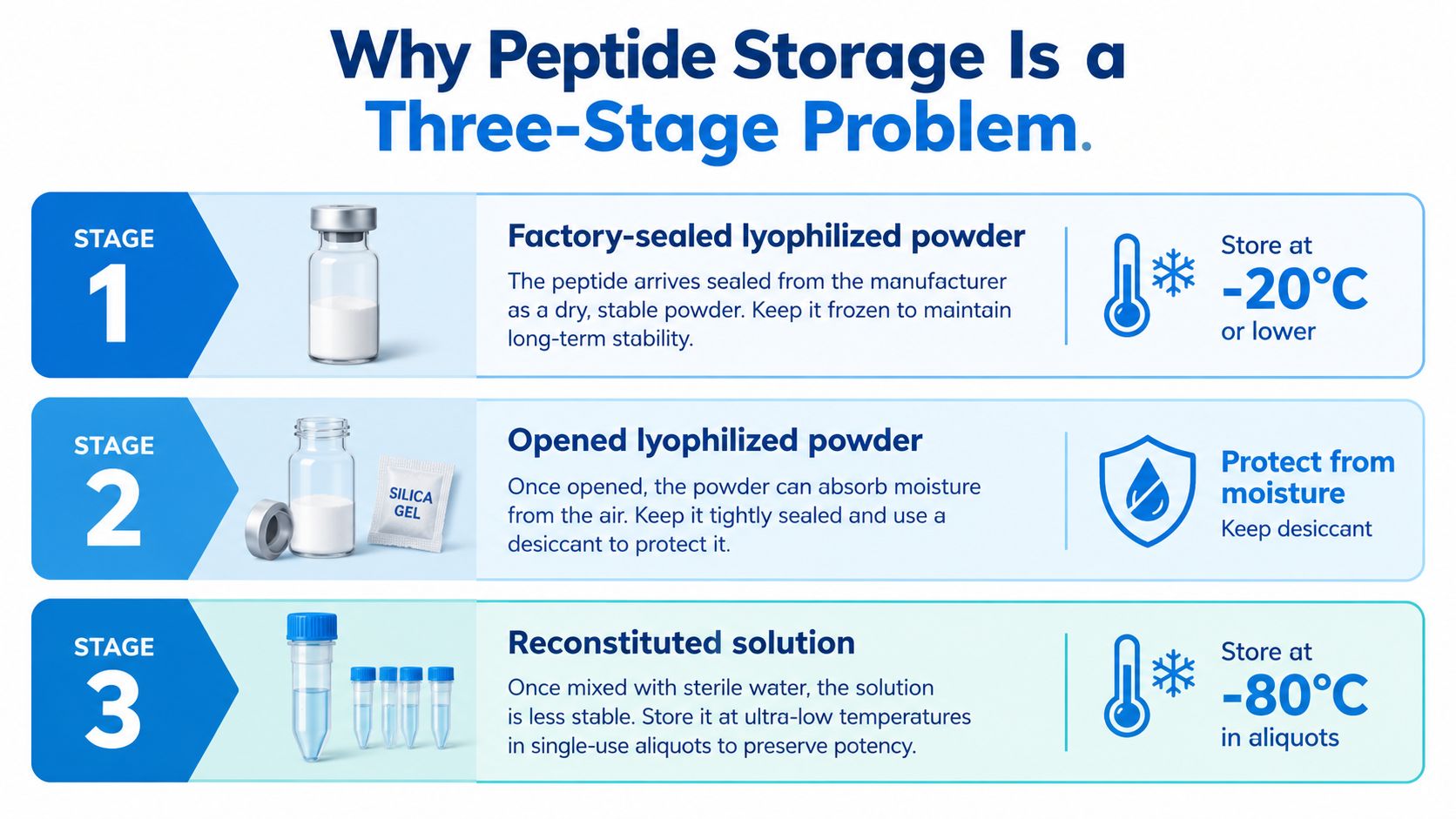
A vial can leave the freezer in three very different conditions: sealed powder, opened powder, or reconstituted solution. Each state changes the main failure risk, so the storage decision should follow the material's current state rather than a single freezer rule.
The first state is the factory-sealed lyophilized vial. Freeze-drying removes most water that supports hydrolysis and molecular movement, making sealed powder the most durable format for archival research storage. Many lyophilized peptides can remain stable for 2 to 5 years at -20°C when sealed and protected from moisture and light, while -80°C may suit particularly sensitive sequences (peptide storage and stability guidance). The trade-off is practical: colder storage may provide a larger stability margin, but it also increases freezer burden and handling constraints.
The second state starts when the stopper is punctured. The cake may still appear dry, yet the vial and headspace have contacted laboratory air. Moisture uptake, oxygen exposure, and contamination become more likely with every opening. Opened powder therefore needs controlled access, dry secondary containment, and a clear plan for how often it will be sampled.
The decision tree at the freezer door
Before handling a vial, answer three questions:
- Is the material sealed and lyophilized? Keep it dry, dark, and frozen. Use the product's instructions to choose between routine freezer storage and colder archival storage.
- Is the lyophilized vial open? Limit humidity exposure and unnecessary withdrawals. A tightly sealed, desiccated secondary container helps reduce moisture risk.
- Has the peptide been reconstituted? Confirm solvent compatibility, prepare only the amount needed, and divide the solution into single-use frozen aliquots. This reduces repeated freeze-thaw exposure and limits the time an aqueous stock remains in use.
Retain the original vial and lot information, minimize freezer-door cycling, and match aliquot size to the planned experiment. Convenience improves when portions are ready to use, but smaller aliquots consume more tubes and freezer space.
Researchers can consult a structured compound research library before selecting a storage path. A short, hydrophilic sequence and an oxidation-sensitive sequence may require different workflows, even when both arrive as dry powder.
Handling Lyophilized Peptides Before the Vial Is Opened
A sealed lyophilized vial can lose quality before it reaches the freezer. Receiving checks, inventory handling, and temperature changes deserve the same attention as the final storage location.
Receiving and recording
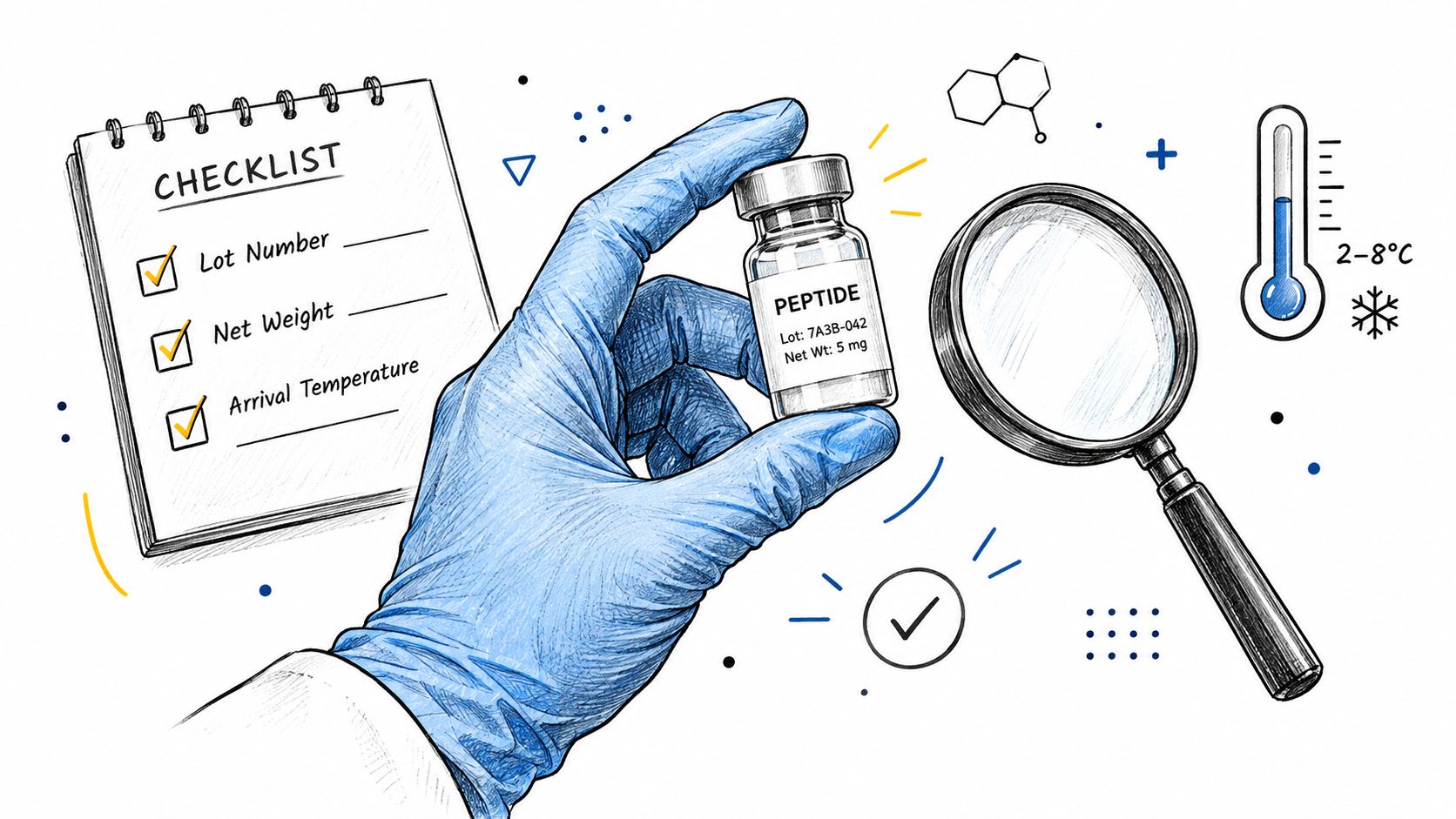
Inspect the vial as soon as it arrives. Check the stopper, label, outer pouch, and any visible signs of moisture, cracked glass, or other damage. Record the lot number, net peptide content, formulation state, and arrival temperature in the inventory system. Interpret net content alongside the listed counterion and trifluoroacetate contribution, since total vial mass does not necessarily equal peptide-only mass.
Attach the certificate of analysis to the lot record. Identity, purity, and content data provide a baseline if a later assay produces an unexpected result. Product-specific instructions take precedence over a generic freezer rule, particularly when the supplier specifies light, humidity, or temperature controls.
Choosing the initial freezer
For routine holding, -20°C is the standard starting point for sealed lyophilized material. Use -80°C when the sequence is particularly sensitive, the vial will remain untouched for an extended period, or the laboratory has an archival policy that requires colder storage. A colder setting is not automatically better. For a dry, sealed cake, stable temperature, low humidity, and limited handling often matter more than the coldest available shelf.
Keep the vial in the temperature range specified for that product. Avoid repeated transfers between refrigerators and freezers, and place newly received material where retrieval will not require leaving the door open while searching.
Keeping the cake dry and intact
Leave the vial in its original sealed pouch with desiccant until the first planned preparation. Do not open the pouch for casual inventory checks. Put it in a tightly closed secondary container or desiccator, away from heavy frost and locations with frequent temperature fluctuation.
Protect light-sensitive sequences deliberately, including those containing tryptophan, tyrosine, methionine, or cysteine. Amber secondary containment or foil wrapping provides a practical barrier during retrieval and staging. Store vials upright so the lyophilized cake remains settled rather than pressed against the stopper.
Use a dedicated peptide box instead of a mixed freezer rack. Clearly marked rack positions shorten retrieval, reduce frost exposure, and prevent unrelated samples from warming while a technician searches for one vial. Keep the pouch, lot record, and certificate information together so the sealed-powder workflow remains traceable from receipt through first use.
Reconstituting and Aliquoting for Long-Term Use
Reconstitution changes the storage problem completely. Once water or another solvent enters the vial, the peptide is no longer protected by a dry matrix. The laboratory must now manage solvent compatibility, concentration, adsorption, aggregation, and freeze-thaw stress.
Selecting the solvent
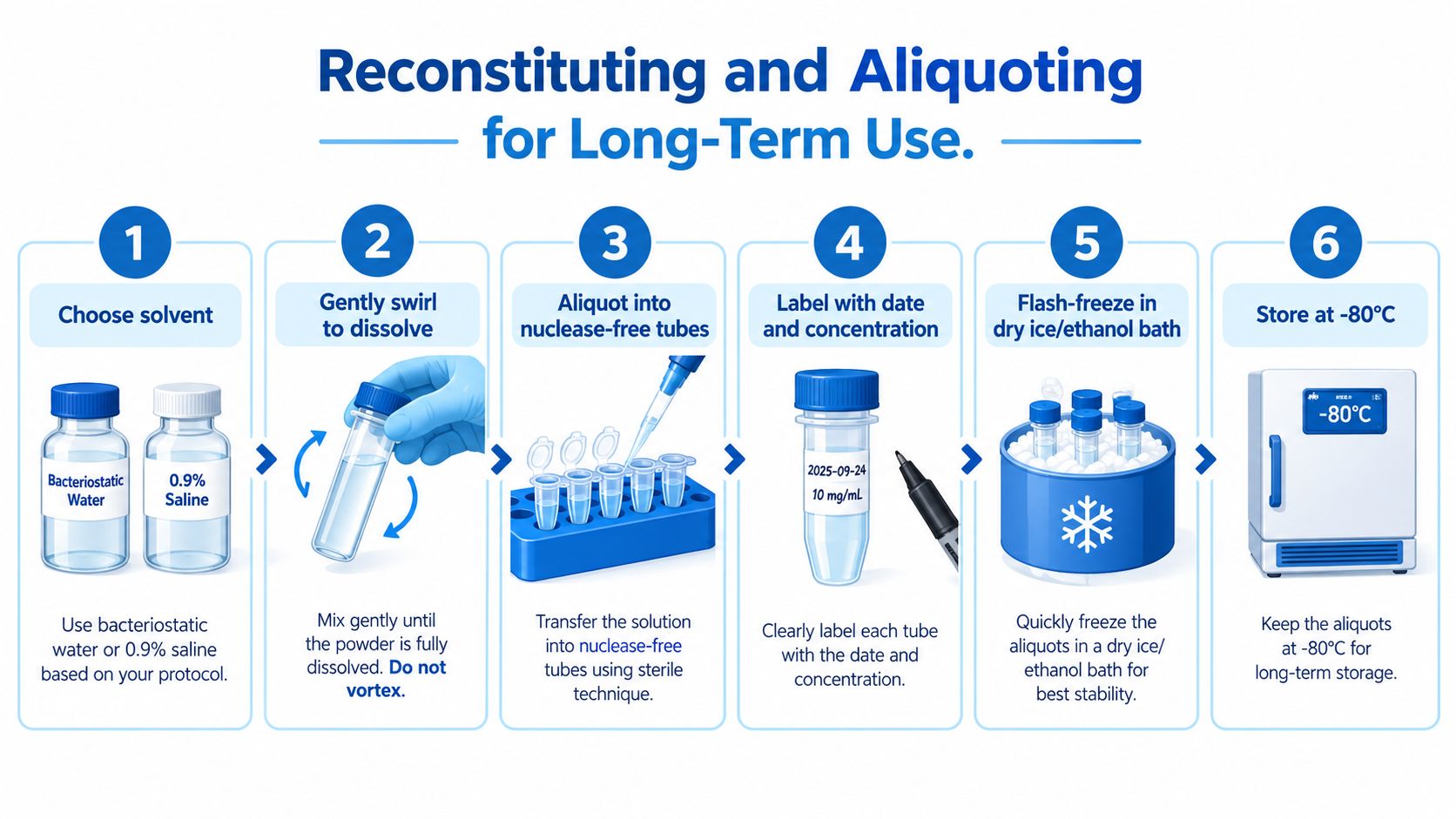
For short-term working stocks, laboratories commonly evaluate bacteriostatic water or sterile 0.9% saline where compatible with the sequence and assay. Hydrophobic sequences may require a dilute acetic acid or ammonia solution to achieve dissolution. DMSO can be useful for difficult compounds, but it shouldn't be treated as a default long-term frozen solvent. Excessive organic solvent can alter aggregation behavior and interfere with downstream assays.
The selected solvent should match the experimental system, not just the vial. Record the solvent, final concentration, pH where relevant, and preparation date in the sample record. If solubility is uncertain, a small-scale compatibility check is preferable to committing the entire vial to an unsuitable medium.
Preparing single-use portions
A practical workflow is:
- Allow the vial and solvent to equilibrate under controlled conditions.
- Add solvent carefully and let the material hydrate.
- Gently swirl until dissolved. Don't vortex oxidation-prone sequences, because high-energy mixing can introduce unnecessary air and shear.
- Spin briefly if droplets or material remain on the vial wall.
- Dispense into pre-labeled, low-binding cryovials.
- Freeze each portion promptly on dry ice or in a -80°C freezer.
- Transfer frozen aliquots to a mapped long-term storage box.
Aliquot volume should follow actual assay consumption. A small, single-use portion is more useful than a large tube that must be thawed, sampled, and refrozen. A technical peptide-handling guide reports that after 3 to 5 freeze-thaw cycles, many peptides show measurable increases in aggregates, sub-visible particles, and degradation products, while 10 or more cycles are associated with common loss of biological activity (freeze-thaw handling guidance).
Aqueous aliquots are less durable than the original powder. Their practical holding time depends on sequence and solvent, so the laboratory should set an internal review date rather than assume that frozen solution has the same stability as lyophilized material.
The following video can support staff training on the physical sequence of reconstitution and aliquoting:
Matching Freezer Temperature to Storage Window
A freezer choice should reflect three variables: material format, retrieval frequency, and planned holding time. Refrigeration suits a short-term working vial, while frozen storage protects material set aside for later use. For each container, record the target temperature, maximum time outside the freezer, and the person responsible for returning it.
| Temperature | Best For | Practical Use | Control Points |
|---|---|---|---|
| 2 to 8°C | Short-term working material | Suitable for limited refrigerated holding, with the exact period set by the assay and internal stability record (storage and reconstitution reference) | Use sealed secondary containment, limit door-open time, and keep the vial away from the refrigerator door |
| -20°C | Routine frozen stocks and sealed lyophilized powder | A practical default for material accessed periodically, provided packaging remains dry, dark, and intact (long-term storage guide) | Store in a stable laboratory freezer with desiccant and a defined box location |
| -80°C | Sensitive sequences and extended archival holding | Appropriate when the material will remain untouched for extended periods or sequence-specific stability concerns justify the added controls (technical storage guidance) | Reserve capacity in advance, maintain alarm coverage, and document every retrieval |
Set alarm limits against the freezer's validated operating range, with escalation before samples face a prolonged temperature excursion. Map shelves, racks, and boxes using a location code that staff can read without removing neighboring containers. Retrieval should be planned as a short, logged operation, not an open-door search.
Reconstituted material should remain in single-use aliquots rather than a repeatedly accessed master tube. Use the laboratory's validated working period for refrigerated solutions, and transfer long-term stocks directly to their assigned frozen location.
Household frost-free freezers are poor substitutes for laboratory units. Defrost cycles create fluctuations, while mixed storage increases frost, handling time, and the chance of losing container traceability.
What Changes After the Vial Is First Punctured
The first puncture changes the storage problem immediately. The stopper has been breached, room air can enter the headspace, and the powder may encounter humidity whenever the vial is handled.
Control four exposures after opening: moisture, oxygen, septum condition, and time outside controlled storage. Oxygen can promote oxidation in susceptible residues such as methionine, tryptophan, and cysteine. Moisture weakens the protective benefit of lyophilization. Repeated needle entries also increase contamination risk and can make the closure less dependable.
Treat each puncture as a handling event, not an incidental step. Record the date, operator, purpose, and any visible change in the lot history. That record helps the laboratory connect later assay results with actual exposure rather than relying on the label alone.
Practical rule: If a vial will be sampled repeatedly, compare continued powder storage with immediate reconstitution and single-use aliquoting. The more often the stopper is entered, the stronger the case for a workflow that limits repeated access.
Work in a low-humidity area and keep the vial out of controlled storage only for the required operation. Close it promptly, place it in a sealed secondary container with fresh desiccant, and return it to its assigned location. Check septum integrity before each use. Nitrogen or argon headspace management may suit oxidation-sensitive research material when the laboratory has the equipment, written procedure, and staff training to apply it consistently.
Do not use appearance as proof of chemical integrity. For material supporting a critical assay, identity and purity testing gives stronger evidence than an intact-looking cake. Review the available research testing information when defining the verification workflow, and document the result with the vial record.
Common Storage Mistakes and How to Avoid Them
Shared freezers reveal the same failures repeatedly. Most aren't dramatic. A technician skips a desiccant, returns a master tube after thawing, or labels a vial with a compound name but no concentration. Weeks later, the team can't reconstruct what happened.
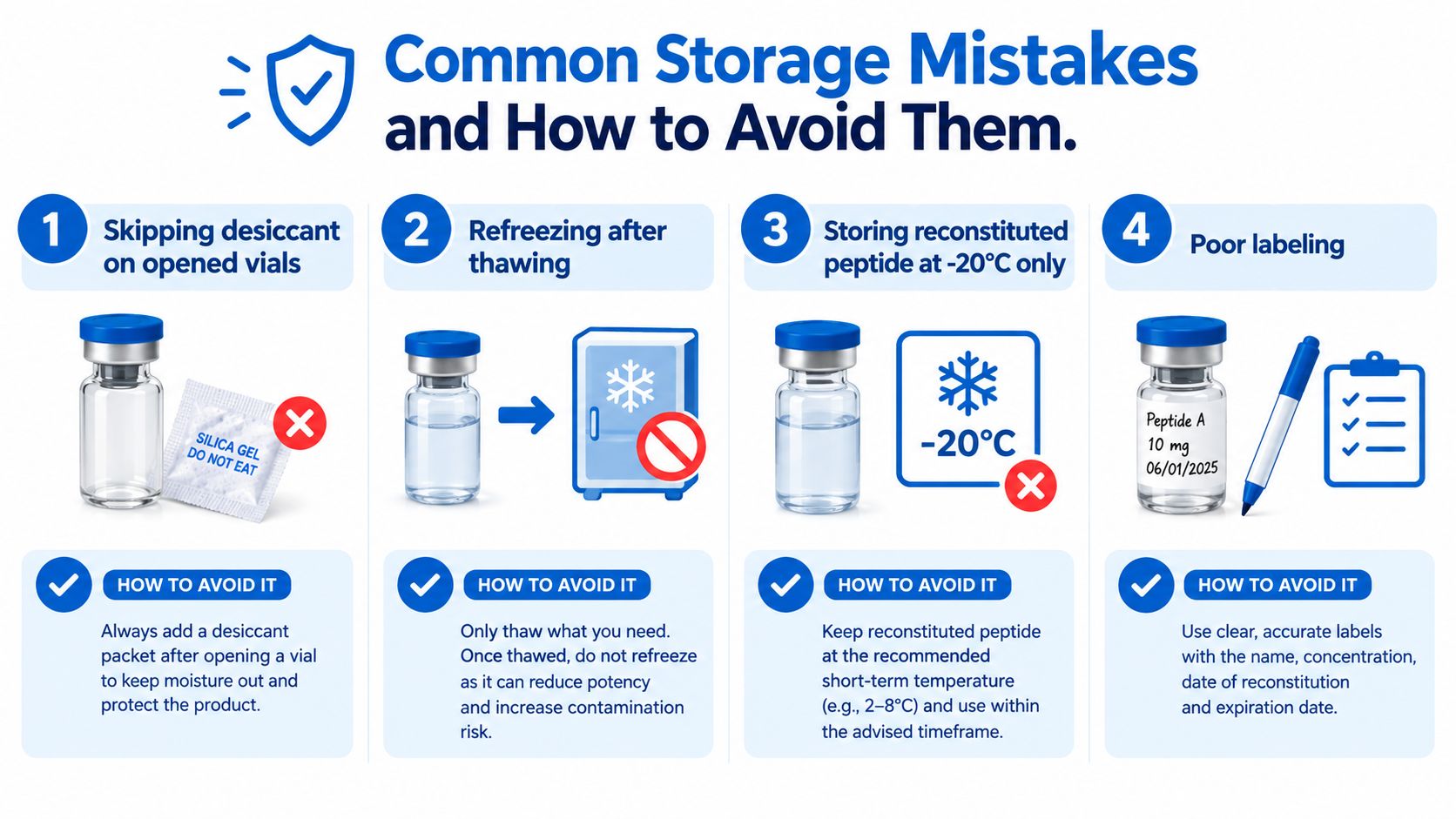
Errors seen in routine freezer work
- Skipping desiccant: An opened powder vial placed directly in a freezer rack remains vulnerable to humidity during handling. Put it inside a sealed secondary container with fresh desiccant and replace the desiccant when its indicator shows saturation.
- Keeping a working stock in one master tube: Every assay withdrawal forces another thaw and refreeze. Prepare single-use aliquots immediately after dissolution instead.
- Leaving reconstituted material refrigerated too long: Refrigerated solution is convenient, but aqueous material is far less durable than dry powder. Define a short working window in the assay SOP and freeze the remainder in validated aliquots.
- Labeling only the peptide name: A tube called “Semax” or “Tirzepatide” isn't enough for reproducibility. Add the lot, concentration, solvent, preparation date, operator initials, and freeze-thaw count.
- Using unsuitable tape: Tape that cracks at low temperature can detach and leave the sample unidentified. Use cryogenic labels and freezer-rated adhesive rather than ordinary laboratory tape.
- Placing vials on frost-prone coil shelves: Direct contact with coils or heavy frost can complicate retrieval and create uneven thermal exposure. Use organized boxes with physical separation from the coldest mechanical surfaces.
A pre-typed label template prevents omissions. A dated aliquot log should mirror the freezer map, while a freeze-thaw counter can be written directly on each tube with a cryogenic marker.
A freezer inventory should answer three questions immediately: what is the sample, what is in it, and how many times has it been thawed?
Organization also protects chemistry indirectly. A shared freezer loses material through misplacement, delayed retrieval, and undocumented transfers as often as through degradation. Dedicated racks, location codes, and quarterly inventory checks create a workflow that technicians can follow even during busy experiment days.
A Practical Long-Term Storage Playbook
A strong SOP doesn't need to be complicated. It needs to be consistent enough that every technician handles the material the same way, records the same information, and recognizes when a sample no longer represents its original specification.
The freezer-door checklist
- Receive the shipment. Inspect the packaging and vial, confirm the lot identity, and record the arrival condition.
- Verify the documentation. Review the COA, identity information, purity result, net content, formulation state, and any product-specific storage instruction.
- Store the sealed vial. Keep the original lyophilized container dry, dark, sealed, and frozen around -20°C. Use -80°C when the sequence or project requires extended archival protection.
- Log the sample. Record the peptide identifier, lot number, date received, freezer, rack, box, and position.
- Delay opening. Don't puncture a vial for an inventory check or speculative preparation. Open it only when the laboratory is ready to prepare the required material.
- Prepare under controlled conditions. Minimize humidity exposure, use compatible sterile diluent, and dissolve gently.
- Aliquot immediately. Transfer the solution into low-protein-binding, single-use tubes sized around the actual assay requirement.
- Label completely. Include peptide ID, lot, concentration, solvent, preparation date, operator, and freeze-thaw count.
- Freeze promptly. Use a pre-chilled rack, dry ice, or a -80°C freezer according to the validated SOP. Avoid leaving filled tubes on the bench.
- Move long-term aliquots to mapped storage. Place them in a -80°C box when extended holding or sequence sensitivity warrants it, and update the freezer map.
- Thaw one aliquot at a time. Keep the tube on ice during preparation and don't refreeze material that has thawed.
- Control short refrigerated holds. Material used in cell culture should be discarded after a defined short holding period, with 24 to 48 hours at 2 to 8°C specified in the workflow described here.
- Record observations. Note cloudiness, precipitation, unusual color, incomplete dissolution, or any unexpected assay behavior in the laboratory notebook.
- Review the system. Check freezer logs and sample locations quarterly, remove obsolete material according to institutional policy, and confirm that alarms and backup arrangements remain functional.
The exact solvent and temperature should be confirmed against the compound's product documentation. A supplier's research FAQ can help locate handling and storage information, but the laboratory's approved SOP remains the controlling document.
The listed research compounds include peptides and related molecules that shouldn't all be treated as the same chemical class. Retatrutide, BPC-157, TB-500, Tesamorelin, GHK-Cu, MOTS-c, Ipamorelin, IGF-1 LR3, AOD9604, CJC-1295, Tirzepatide, SS-31, Sermorelin Acetate, Semax, Selank, Epithalon, DSIP, and 5-Amino-1MQ each require product-specific review. HCG is a hormone, not a peptide, and NAD+ is a coenzyme, not a peptide. KLOW and BBG70 are proprietary blend names, so storage documentation should identify and assess their individual component compounds rather than assign a single assumed mechanism or stability profile to the blend.
Consistency beats perfection. A simple checklist followed for every vial preserves research integrity more reliably than an elaborate protocol that staff apply only occasionally.
Pro Tec Pep provides research-use-only compounds with batch-linked documentation, product-level storage information, and optional cold-chain handling for temperature-sensitive materials. Laboratories can compare the relevant COA and storage details before receiving material, then visit Pro Tec Pep to review compounds and research documentation for an organized long-term storage workflow.