What Is Batch Testing and Why It Matters in Research
Learn what is batch testing, how lot-traceable COAs and acceptance criteria support reproducible research, and why identity and purity are tested separately.

Batch testing is the examination of a defined sample from a production lot against predetermined specifications before the batch is accepted, released, or rejected. A passing result is a documented decision about the sample tested, not proof that every vial has identical purity or is free of every possible contaminant.
A researcher opens a peptide vial and sets its certificate of analysis (COA) beside it. The lot number on the label looks like a small detail, but it connects the material on the bench to the sample, methods, and results described in the paperwork. Asking “what is batch testing?” is really asking whether that chain of evidence is clear enough to support the work.
Batch Testing in Plain Language
A manufacturing batch is a specific quantity intended to have uniform character and quality within stated limits, produced under a single manufacturing order during one manufacturing cycle. Batch testing examines a defined sample from that production batch against predetermined specifications. The FDA's description of end-product testing specifies analytical procedures applied to a defined sample size after processing is complete.
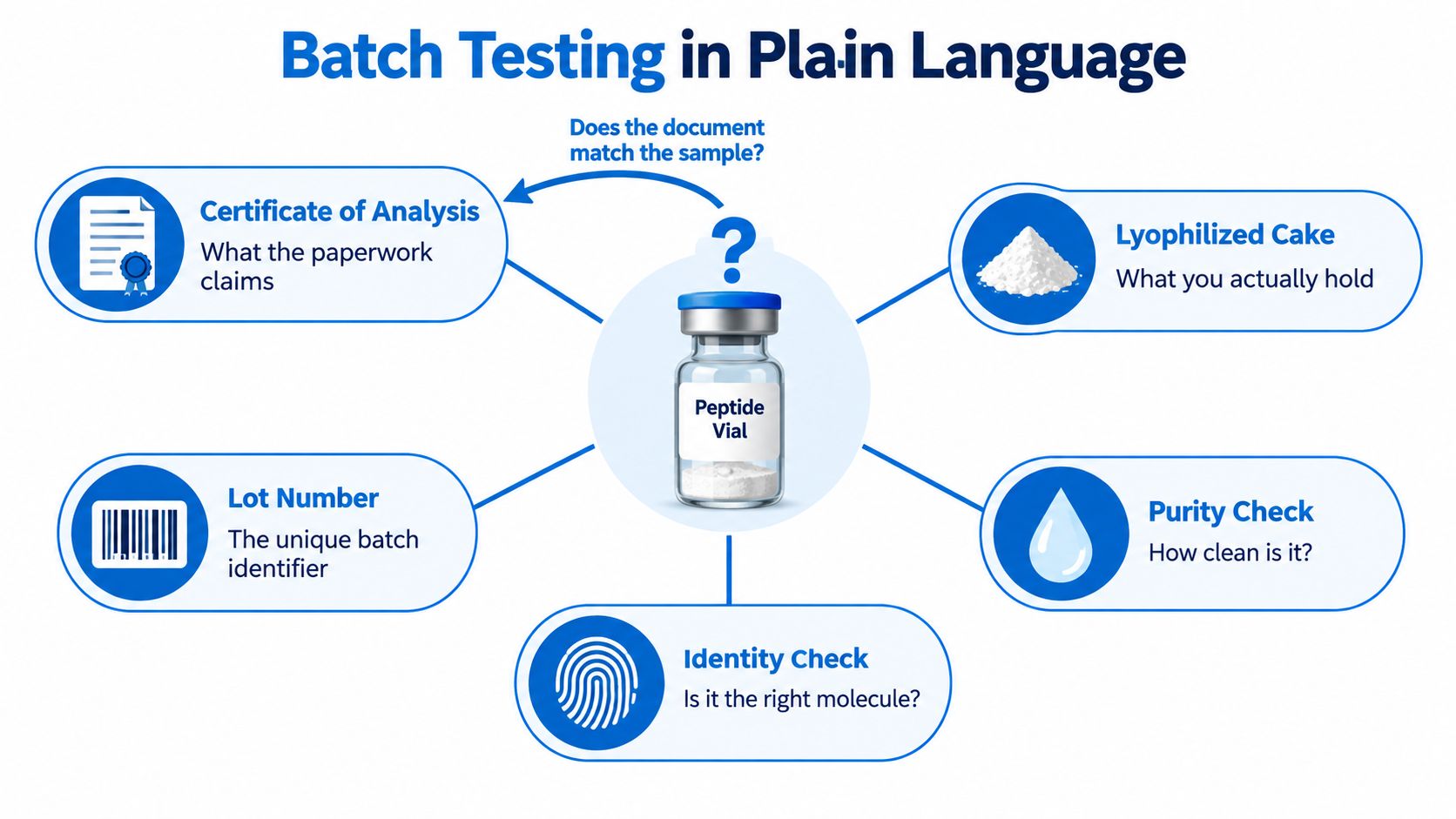
The word “batch” can also refer to an analytical batch, which is different from a manufacturing batch. An analytical batch is a group of samples and quality-control materials processed together under a method and instrument sequence. A laboratory may show that its analytical run met its QC criteria, but that result doesn't automatically establish that every unit in the manufacturer's lot is uniform.
The lot number connects the evidence
For a researcher, the practical starting point is the lot number on the vial. It identifies the production quantity the COA is meant to describe and helps connect the material to its identity, composition, purity or potency, and other relevant attributes. A document without a matching lot identifier may describe a general product, but it doesn't establish that its results came from the specific material in hand.
Batch testing also isn't the same as batch release. Release is a broader quality decision that includes review of test results, manufacturing records, and whether the quality system followed applicable Good Manufacturing Practice requirements. A single passing laboratory result is only part of that decision.
Bench-side rule: Start with the lot number, then check whether the document explains what was tested, how it was tested, and how the result was judged.
That distinction matters when a vial arrives with a polished COA. The useful question isn't only whether the certificate shows a pass. It's whether the sample, lot, method, acceptance criteria, and final disposition are linked clearly enough to make that pass meaningful.
What a Batch Test Actually Measures
A batch record should tell a connected story, beginning with the lot number and ending with a documented release decision. Each test answers a different question. A result in one category can't stand in for evidence in another.
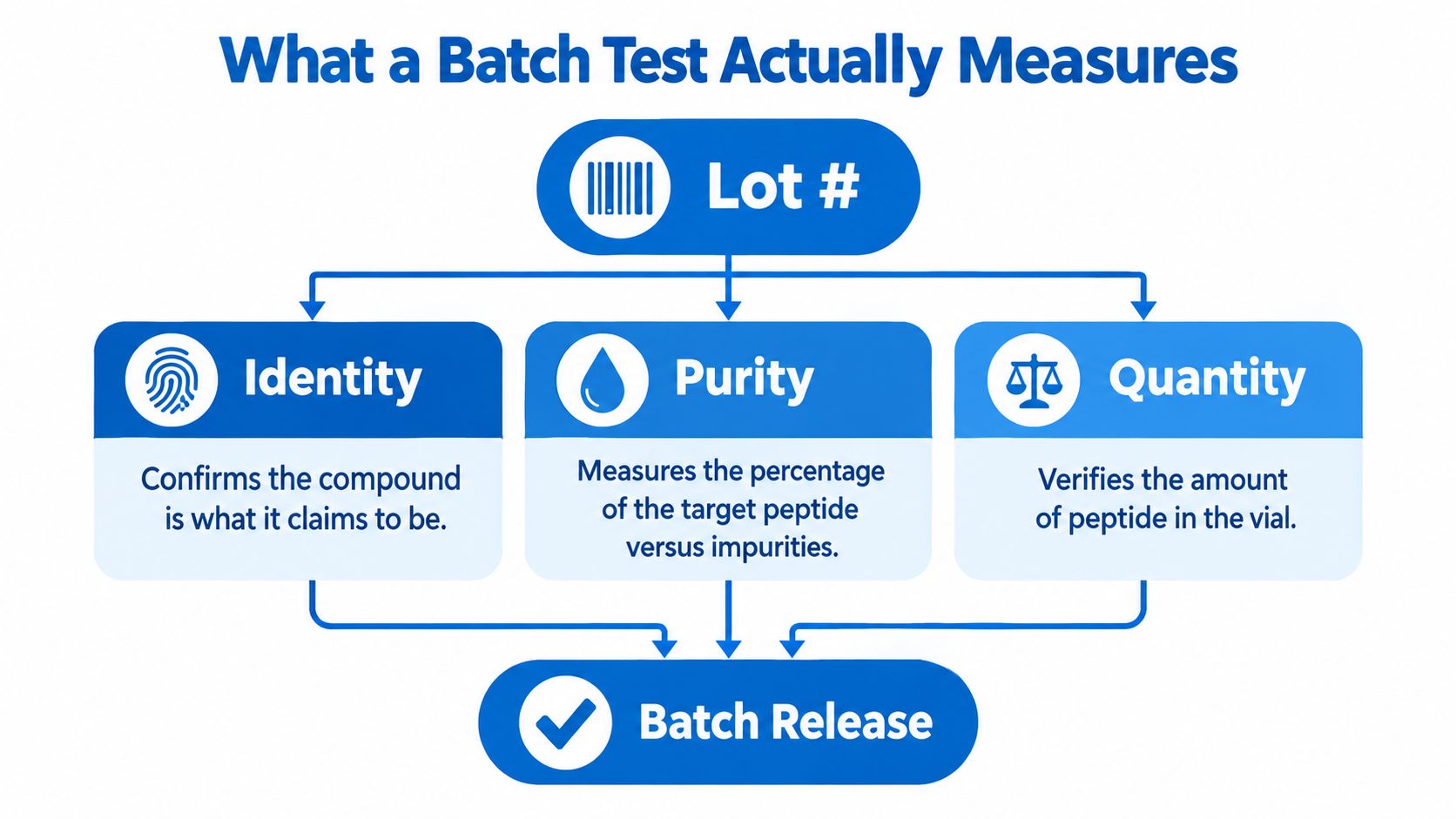
Identity asks whether the material is the compound named on the label. The method needs to distinguish the intended molecule from related structures that could produce a misleading result. Purity asks how much of the measured material corresponds to the target relative to detected impurities. These are separate quality attributes: ICH Q6A explains that a high chromatographic purity result can coexist with misidentification or structurally similar contaminants.
From measured signal to documented decision
Other tests address other properties. Content or assay evaluates how much material is present. Depending on the compound and its intended laboratory evaluation, testing may also address sterility, endotoxins, heavy metals, or conformity to defined requirements. These endpoints don't all mean the same thing, and a result for one doesn't establish the others.
Specifications should be set before testing begins. For each test, a defensible record identifies the procedure, the acceptance criteria, and the result, so the decision doesn't depend on a threshold chosen after someone sees the data. The batch record should also connect the lot to the analyst, raw data, instrument status, and interpretation.
A useful way to read the record is as a chain:
- Lot identifier: Which production quantity does the document cover?
- Test method: What procedure generated the result?
- Acceptance criteria: What limit was defined before evaluation?
- Measured result: What did the sample show?
- Disposition: Was the batch accepted, rejected, or otherwise handled under documented procedures?
That chain makes it easier to spot a mismatch. A material could match its identity criteria but fail a purity limit, or show a strong purity result while failing another specified test. Batch release depends on the combined evidence, not on treating one headline result as a summary of every quality attribute.
Why Identity and Purity Are Tested Separately
A chromatogram can look clean and still leave an important question unanswered: is the main peak the intended peptide? Purity measurement and identity confirmation are different analytical tasks. Treating them as interchangeable gives a COA more meaning than its data support.

For synthetic peptides, liquid chromatography coupled with tandem mass spectrometry can support identity confirmation by checking peptide mass and amino-acid sequence. Mass spectrometry can also assess monoisotopic mass, while fragmentation data can help verify sequence. A peer-reviewed reference-standard study describes LC–MS/MS for confirming peptide mass and sequence, and reversed-phase high-performance liquid chromatography (RP-HPLC) for evaluating lot homogeneity, peptide content, purity, and impurities.
Two methods, two kinds of evidence
RP-HPLC separates components in a sample. The resulting chromatogram can show how the target signal compares with detected impurities under that method's conditions. Retention-time agreement against an appropriate reference can contribute to identification, but it isn't the same as independently confirming molecular mass or sequence. USP material on peptide quality attributes likewise identifies reversed-phase HPLC and mass spectrometry as common identification methods, with HPLC purity methods designed to separate the peptide from process-related and degradation impurities (USP peptide quality attributes).
Consider two different outcomes. If a sample has a high chromatographic purity result but its mass doesn't match the expected peptide, the purity result doesn't rescue the identity failure. Conversely, a mass result consistent with the target peptide doesn't quantify every impurity or establish that the sample meets a purity specification.
A strong peptide COA keeps the identity evidence and purity evidence distinct, then links both to the same lot.
A researcher should therefore look for separate, interpretable results rather than a single percentage presented as a complete characterization. The methods and reference comparisons matter too. A lot-specific report helps show that the evidence belongs to the material on the bench, rather than to a generic product description or a chromatogram reused across lots.
The Role of Batch-Specific Certificates of Analysis
A COA is useful when it ties the measurements to the material being evaluated. A generic specification sheet can describe what a product is expected to meet, but it doesn't show what a particular lot measured. The lot number is the hinge between the claim and the result.
FDA chemistry, manufacturing, and controls guidance calls for descriptions of test methods used to assure identity, purity, strength or potency, stability, and lot-to-lot consistency. In the relevant submission context, that guidance requests COAs and analytical results for at least three consecutive batches. This is a regulatory submission context, not a universal rule that every research-material supplier's COA must contain the same set of data.
Batch-linked record versus standing specification
A useful comparison is whether a document records measured results for an identified lot or repeats product-level claims.
| Field | Batch-Linked COA | Generic Product Specification |
|---|---|---|
| Lot identification | Identifies the specific lot evaluated | May describe the product without naming a tested lot |
| Methods | Names the procedures used for reported tests | May list expected or general test categories |
| Limits and results | Shows acceptance criteria and measured results | May show targets without lot-specific measurements |
| Sample provenance | Connects the tested sample to the lot | May not explain which material was tested |
| Disposition | Records the decision for that lot | Usually doesn't document lot-specific disposition |
That distinction is practical, not cosmetic. A batch-linked COA supports traceability and helps a laboratory investigate unexpected results. A specification sheet can still be useful for understanding a product's stated requirements, but it can't replace a report tied to the lot on the vial. Researchers reviewing documentation can compare what a supplier says is tested with what the lot record reports, including on a supplier's batch-testing information page.
Research-use-only (RUO) labeling is a separate matter. It defines an intended-use boundary; it isn't evidence that a material is suitable for clinical diagnosis or human administration. For laboratory work, documentation should preserve that boundary and describe the material as intended for research rather than implying a clinical or therapeutic purpose.
What a Passing Result Does Not Prove
A pass is a decision against defined criteria for the sample tested. It isn't proof that every vial is identical, that no untested contaminant exists, or that the material will remain unchanged after shipping and storage. Batch acceptance is a statistical decision, not a guarantee of zero risk.
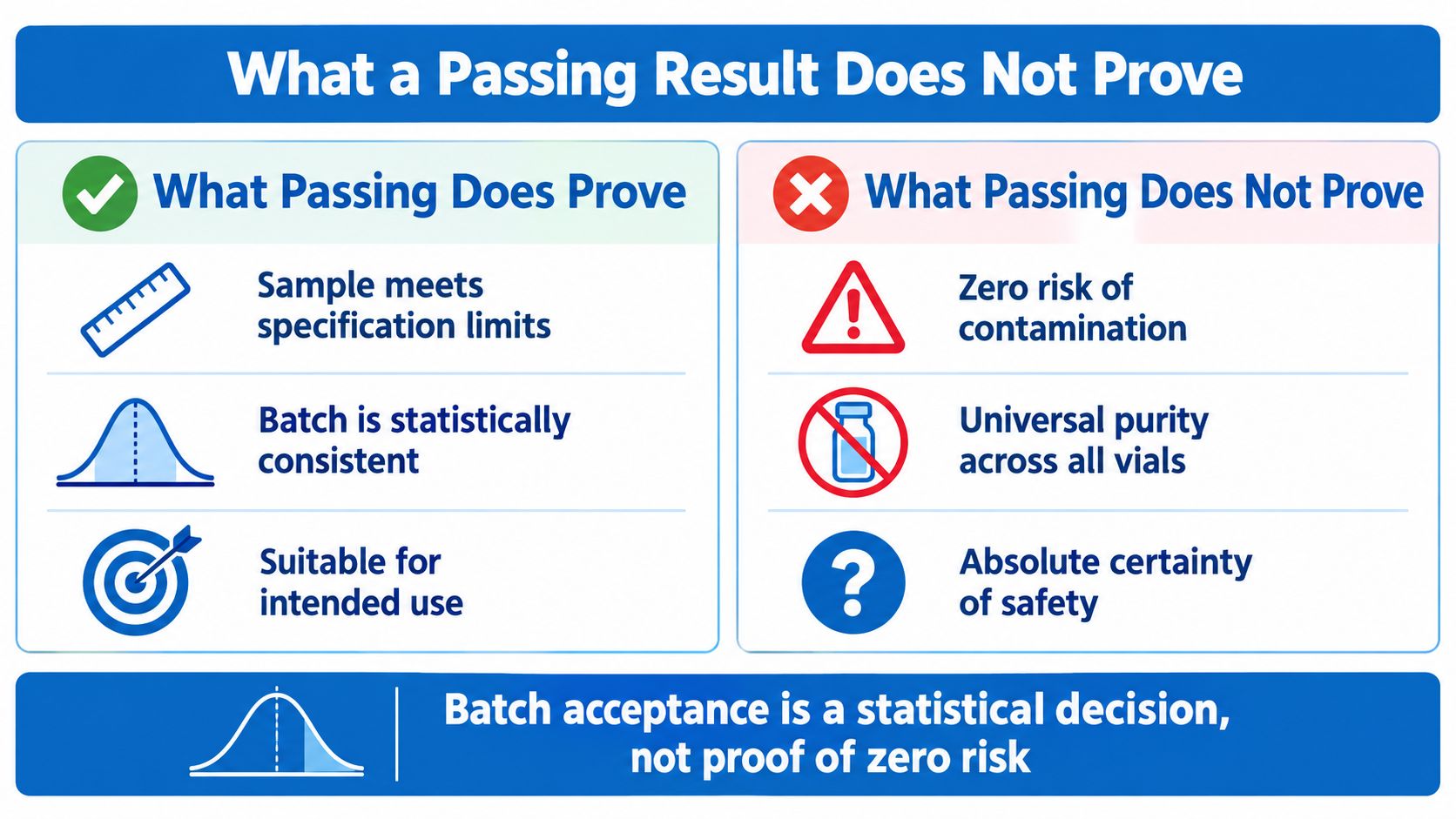
The sampling plan determines how far a result can reasonably be applied. FDA current Good Manufacturing Practice guidance calls for scientifically sound, representative sampling and explains that USP General Chapter <905>, Uniformity of Dosage Units, isn't itself a statistical sampling plan; its results shouldn't be extrapolated to larger populations (FDA sampling guidance). In some cases, replicate samples from different locations may be needed to assess whether variation within a batch matters.
The result belongs to a sample, not every unit
A convenient sample can be biased. Testing one vial doesn't automatically prove that every other vial in a large lot has the same composition or meets every specification. Sample selection, lot homogeneity, sample handling, and the method's ability to detect a particular impurity all affect what the result can support.
The analytical-batch distinction adds another limit. EPA guidance describes extraction, digestion, or analysis batches of up to 20 samples in common laboratory contexts (EPA quality-assurance terminology). That describes an analytical run, not the size or uniformity of a manufacturer's production lot. Passing run controls can support confidence in the analysis, but it doesn't prove that every unit in the production lot was sampled or has identical quality.
Out-of-specification results need controlled handling, not informal retesting until a pass appears. FDA guidance says individual results should be considered rather than relying only on averages; a confirmed out-of-specification result indicating a batch-quality problem should lead to rejection and appropriate disposition (FDA out-of-specification guidance). Any retesting should follow predetermined procedures and use appropriate material from the same homogeneous lot sample.
Interpret the pass narrowly: It supports a defined conclusion about tested material under a specified method. It doesn't establish universal purity or eliminate risks outside the test panel.
Research-use-only status also shouldn't be mistaken for a quality result. A supplier's research-use-only policy concerns intended use and labeling; it doesn't replace lot-specific analytical evidence.
How to Read a Peptide COA Before You Order
A COA is easier to evaluate when read in a fixed order. Start with the material itself, then follow the document's evidence from method to disposition. If a key link is missing, a bold result on the page can't fill the gap.
A practical document check
- Match the lot number. Compare the number on the vial label with the number on the COA. If they differ, the document hasn't established that its results describe the material in hand.
- Identify the method. Look for the analytical procedure and, where relevant, the reference comparison. A result without a method is difficult to interpret.
- Read the acceptance criteria. Check the defined limit alongside the measured result. A number alone doesn't explain whether the sample met the stated specification.
- Separate the endpoints. Identity, purity, content, sterility, endotoxins, and heavy metals answer different questions. Confirm which were tested and what each result means.
- Check provenance and disposition. Look for information connecting the sample to the lot, and for a documented decision rather than an unexplained pass mark.
The COA also needs to be read in context. A test result doesn't automatically describe what happened to the material after testing. Storage and shipping information can matter when evaluating whether a research compound's condition may have changed between analysis and arrival. The document should be considered alongside product handling information, not treated as a substitute for it.
FDA guidance states that products labeled for research use only must prominently carry that statement, and that research-use-only activity is limited to laboratory research, including work to identify test-kit methods, components, and analytes (FDA research-use-only guidance). RUO labeling describes the intended research boundary; it doesn't mean the material is cleared for clinical diagnosis or treatment.
A lab can turn these checks into a simple purchasing routine: verify the lot match before accepting the record, confirm which methods support identity and purity, and retain the COA with the study documentation. That makes it easier to connect an unexpected assay result to the material used, instead of discovering later that the paperwork described a different lot.
Reproducibility and the Research Bottom Line
Reproducibility depends on more than a purity figure. A researcher needs evidence that the lot contains the intended compound, that the reported impurities and content were assessed using suitable methods, and that the material's handling history is understood well enough for the research context. Lot traceability gives those checks a common reference point.
The record should help another researcher follow how the material was identified, tested, and accepted. That means keeping the lot number, methods, specifications, measured results, and disposition together in the study's procurement or quality documentation. It also means treating individual results carefully: FDA's out-of-specification guidance emphasizes that individual results, not only an average, matter when evaluating quality, and a confirmed batch-quality problem calls for rejection and appropriate disposition.
The bench-side takeaway
- A batch test evaluates a defined sample against criteria established before testing.
- Identity and purity are separate questions. A strong result for one doesn't establish the other.
- Sampling limits the conclusion. A passing sample doesn't prove uniformity across every unit or absence of contaminants outside the test panel.
- A batch-specific COA supports traceability. The lot number should connect the vial to the methods, results, and decision.
- RUO describes intended use. It isn't a substitute for analytical evidence or a claim of clinical suitability.
Those distinctions help researchers write clearer methods, choose appropriate controls, and investigate unexpected results without treating a certificate as a blanket guarantee. A research compound library can also help researchers review compound-specific information alongside batch documentation.
A passing batch test is best understood as a documented decision based on representative sampling and defined specifications. It's strong evidence about what was tested, not a universal claim about every vial or every possible risk.
For research teams comparing lot documentation, Pro Tec Pep offers research-use-only compounds with batch-specific certificates of analysis and information intended to support laboratory procurement. Review the lot documentation and handling details for the material under consideration before planning a study.