YK 11 for Sale: A Buyer's Research Procurement Guide
Looking for YK 11 for sale? Learn what to verify on COAs, RUO labeling, and documentation before procuring this research SARM.
The most popular advice for “YK-11 for sale” is also the least useful: compare prices, choose fast shipping, and click the listing with the highest purity claim. That approach treats an unapproved experimental compound like an ordinary retail product. A laboratory buyer needs a different standard. The first question isn't where YK-11 is cheapest. It's whether the material can be identified, traced, and defended in an audit.
YK-11 entered public discussion through laboratory research, not formal drug development. It was first described in 2011 by Japanese researcher Yuichiro Kanno as a steroidal SARM with myostatin-inhibitory properties observed in vitro, and it has never completed human clinical trials or received an approved medical indication. The published background on YK-11 makes the evidence gap clear.
Why YK-11 Is a Documentation Question, Not a Price Question
A consumer may compare price, delivery speed, and promotional codes. A research procurement specialist should compare batch identity, analytical evidence, chain of custody, and storage controls. Those are not cosmetic differences. They determine whether a laboratory can associate a received material with a reproducible experimental record.
A low-cost vial with a generic certificate of analysis is still unidentified material. A PDF stating “high purity” without a batch number, analytical method, chromatogram, or issuing laboratory doesn't establish what was tested. It only repeats a claim. For an unapproved, non-GMP experimental SARM, the laboratory carries the burden of checking whether the documentation supports the label.
Practical rule: A COA should identify the exact lot received, not merely describe the supplier's product page.
Batch-linked documentation matters because research results depend on traceability. If an assay produces an unexpected signal, the laboratory needs to know which lot was tested, which analytical data supported its identity, when the lot was released, and how it was handled during transit. Without that record, troubleshooting becomes speculation.
A supplier's research-use-only policy should also be treated as a procurement document, not a footer. It should clearly define intended use, buyer eligibility, prohibited human or veterinary application, and the company's approach to verification. A credible supplier won't frame YK-11 as a bodybuilding product or imply that laboratory material is interchangeable with an approved therapy.
What procurement teams should prioritize
- Batch specificity: The COA must match the lot number on the vial, invoice, and shipping record.
- Method transparency: The supplier should identify the analytical techniques used and provide meaningful result details.
- Independent confirmation: Third-party testing is more useful when the laboratory is named and its report can be verified.
- Transport controls: Packaging, temperature requirements, and shipping conditions should be documented.
- Research-only gating: The ordering process should require a clear research purpose rather than encouraging personal consumption.
Price can be recorded, but it shouldn't lead the decision. Documentation depth is the quality signal. If a supplier can't provide it before purchase, a discount doesn't solve the underlying identity problem.
What YK-11 Actually Is in the Literature
YK-11 is described in the scientific literature as a synthetic steroidal selective androgen receptor modulator and a gene-selective partial agonist of the androgen receptor. The original work reported partial agonist activity in a reporter assay and gene-selective androgen-receptor activity in MDA-MB-453 cells. It also reported increased myogenic differentiation markers and follistatin expression in laboratory models. The original in-vitro study supports a plausible anabolic pathway involving androgen-receptor signaling and myostatin-related gene regulation, but it doesn't establish a human outcome.
The distinction between molecular activity and clinical effect is essential. A receptor assay can show that a compound activates a biological target under controlled conditions. A cell-line experiment can reveal changes in gene expression or differentiation markers. Neither demonstrates human safety, pharmacokinetics, therapeutic effectiveness, or an appropriate administration protocol.
A later 2013 in-vitro study using C2C12 mouse myoblasts described YK-11 as activating androgen-receptor signaling without the N/C interaction associated with full androgen-receptor transactivation. The later cell-based study is useful for understanding receptor behavior, but it remains laboratory evidence rather than a human clinical result.
Identity checks before procurement
Research buyers should cross-reference the supplier's product record against recognized identity fields. The requested documentation should include:
- Chemical name and synonyms, so the laboratory can distinguish YK-11 from similarly marketed SARMs.
- CAS number 431579-34-9, where that identifier is the supplier's stated reference.
- IUPAC identifier, molecular formula, and approximate molecular weight.
- Structural description, including the steroidal and 4-azasteroid context stated by the supplier.
- Analytical confirmation, preferably using mass spectrometry alongside chromatographic data.
A compound library can help a laboratory organize research compound reference information, but a library entry isn't a substitute for lot-specific testing. The COA must connect the scientific identity to the exact material shipped.
The literature still doesn't provide the clinical foundation associated with a licensed medicine. A 2026 review describes YK-11's relevance to muscle and bone biology as a characterization based on in-vitro functional assays and experimental studies, not approved clinical use or established human evidence. That review of SARM biology reinforces the correct procurement posture: verify identity and handle the material as an experimental research chemical.
Legal Status and Anti-Doping Classification
YK-11 has no approved human or veterinary indication in the United States or elsewhere. It isn't an approved dietary ingredient, and the available evidence doesn't support presenting it as a food, supplement, or treatment. The FDA identifies YK-11 among ingredients found in unapproved bodybuilding products and states that those products haven't been reviewed for safety or effectiveness. The FDA's warning on bodybuilding products also links SARM-containing products with serious risks, including heart attack, stroke, and liver damage.
That regulatory position affects procurement language. A research listing should use research-use-only labeling, avoid human performance claims, and require an end-use attestation. A product page that markets YK-11 through physique promises, testimonials, or personal protocols signals a consumer-oriented sales model rather than a controlled laboratory supply process.
Three compliance questions
Labeling compliance comes first. The packaging and product record should identify the material as an unapproved research compound and avoid claims that imply medical, nutritional, or human performance use.
End-use attestation comes next. The buyer should be able to confirm institutional or laboratory affiliation, qualified research intent, and compliance with applicable laws. A supplier that treats these checks as unnecessary is creating avoidable risk for both parties.
Anti-doping exposure is separate from commercial legality. YK-11 is explicitly prohibited at all times under the World Anti-Doping Agency Prohibited List, Section S1.2, where it sits alongside other non-steroidal anabolic agents. The applicable UK legal instrument provides a relevant regulatory reference for the prohibited-substance framework.
If research involves samples connected with competitive athletes, the laboratory needs a documented governance process. An athlete-subject sample containing a prohibited SARM-class compound can create an adverse analytical finding, regardless of whether the material was obtained through a research channel. Research-use-only status doesn't erase anti-doping liability.
Jurisdictional rules can also differ. Before a purchase order is issued, the institution's compliance officer or legal counsel should assess import, possession, labeling, and end-use requirements in the relevant country. The absence of an approval is not permission to treat YK-11 as an ordinary commercial chemical.
What a Research-Grade Certificate of Analysis Should Show
A credible YK-11 COA should let a qualified reviewer answer one question without contacting the supplier repeatedly: what was tested, how was it tested, and does the report match the material being purchased?
The document should name the synthesizing or testing laboratory, identify the product, state the lot or batch number, and show a release date. It should include a responsible signatory and verifiable contact information. A supplier logo alone isn't evidence of laboratory accountability.
Identity and purity evidence
Identity confirmation should go beyond a product name. A complete file should include mass-spectrometry results and HPLC data, with the HPLC retention time identified and the chromatogram available for review. The supplier's stated CAS 431579-34-9 reference should match the compound record and any analytical report.
A claimed purity value has meaning only when the method is disclosed. The COA should identify the analytical method, detection wavelength where applicable, sample preparation basis, and acceptance criterion. Rounded figures with no method parameters are weak evidence, especially when the same number appears across unrelated products.
Analytical testing information should be specific enough for a laboratory to assess whether the report supports its intended assay work.
Contaminant and handling checks
The requested documentation should address relevant contaminants and material controls:
- Residual solvents: The report should identify the panel and compare results with the stated applicable limits, such as relevant ICH criteria.
- Heavy metals: Results should identify the tested elements and reporting units, not just state “pass.”
- Endotoxin: This should be addressed where the laboratory's work makes it applicable.
- Storage conditions: The supplier should state handling and storage requirements, including protection from heat, light, and moisture where relevant.
- Packaging and shipping: The record should explain how the lot was sealed, labeled, and transported.
A generic template is an immediate warning sign. Missing chromatograms, absent method details, unexplained purity figures, and no named signatory all weaken the record. A COA printed on the same template for every compound isn't research-grade documentation. It may be a marketing certificate rather than an analytical release record.
How Batch-Linked Testing Differs From Generic Listings
Two suppliers can publish the same headline claim and offer materially different procurement value. One may connect the COA to a specific lot number, release date, chromatogram, raw analytical record, and shipping history. The other may recycle a single “greater than 98% purity” PDF across every SKU.
The difference becomes clear when the buyer compares documentation attributes rather than storefront language.
Batch-Linked vs Generic COA Documentation
| Documentation Attribute | Batch-Linked COA | Generic Listing COA |
|---|---|---|
| Lot identification | Matches the vial, invoice, and shipping record | May be absent or unrelated to the shipment |
| HPLC evidence | Provides a chromatogram and retention-time information | States purity without supporting trace |
| Testing source | Names an in-house or third-party laboratory | Uses vague or undisclosed testing language |
| Analytical records | Retained against the specific batch | No clear record-retention process |
| Shipping traceability | Connects dispatch information to the lot | Treats fulfillment as separate from testing |
| Method disclosure | May provide method parameters or validation summaries | Often omits method conditions |
| Troubleshooting value | Supports repeat analysis and discrepancy review | Leaves the laboratory with no audit trail |
The batch-linked model supports reproducibility. If an assay fails, a researcher can compare the lot's identity data with the experimental record, request clarification, and determine whether a replacement lot should be evaluated. If a result differs between experiments, the laboratory can reconcile batch numbers and storage history instead of guessing.
Generic documentation prevents that process. A listing may look complete because it has a downloadable PDF, but a PDF without traceability doesn't establish that the tested sample is the shipped sample.
A high purity headline is only one reported result. A linked analytical record is a procurement system.
Third-party testing can add useful independence, but “third-party” alone isn't enough. The report should identify the laboratory, the scope of testing, and the batch examined. In-house data can also be useful when the supplier retains records and discloses methods transparently. The key question is whether another qualified reviewer can follow the evidence.
For laboratories buying YK-11, the practical quality signal is documentation depth, not the largest purity figure on the page.
Why the Toxicology Picture Is Still Unresolved
YK-11's toxicology cannot be described as established or well tolerated. The current evidence base remains preclinical, with no completed human clinical trials and no published Phase I pharmacokinetic or safety study. Metabolism data are also scarce because YK-11 is a non-approved experimental drug candidate.
Rodent research has reported increased oxidative stress, weakened antioxidant defenses, mitochondrial dysfunction, and possible neurochemical toxicity in the hippocampus. These findings matter because they show biological disturbance in animal models, but they don't create a human risk estimate. The PubMed-indexed toxicology discussion supports caution without resolving how the compound behaves in people.
Why animal findings don't become clinical conclusions
Species differences can affect absorption, metabolism, receptor activity, tissue distribution, and clearance. The experimental route and regimen can also alter exposure patterns. A result observed in a rodent liver or hippocampus may identify a hazard signal, yet researchers still need validated human pharmacokinetic and toxicological data before translating that signal into clinical risk.
The same limitation applies to reports of ALT, AST, or hepatic histopathology in animal work. Such markers can indicate liver injury or stress within the study design, but they don't establish a human threshold, duration relationship, or reversibility profile. Any listing that turns these unresolved findings into a claim of safety is overstating the evidence.
The correct response to safety language
A supplier should never describe YK-11 as “safe,” “well tolerated,” or suitable for personal performance use. Those statements aren't supported by the absence of human trials, and they replace research documentation with marketing language.
WADA's S1.2 prohibition also belongs in the risk review, but the ban isn't a clinical safety study. It indicates that the compound falls within a prohibited anabolic category for sport. Laboratories should keep the categories separate: regulatory status, anti-doping status, and toxicological evidence each answer different questions.
Putting It Together as a Procurement Workflow
A defensible order begins before the product page. The laboratory should establish that the buyer is qualified, the project has a legitimate research purpose, and the institution can receive and document an unapproved experimental compound.
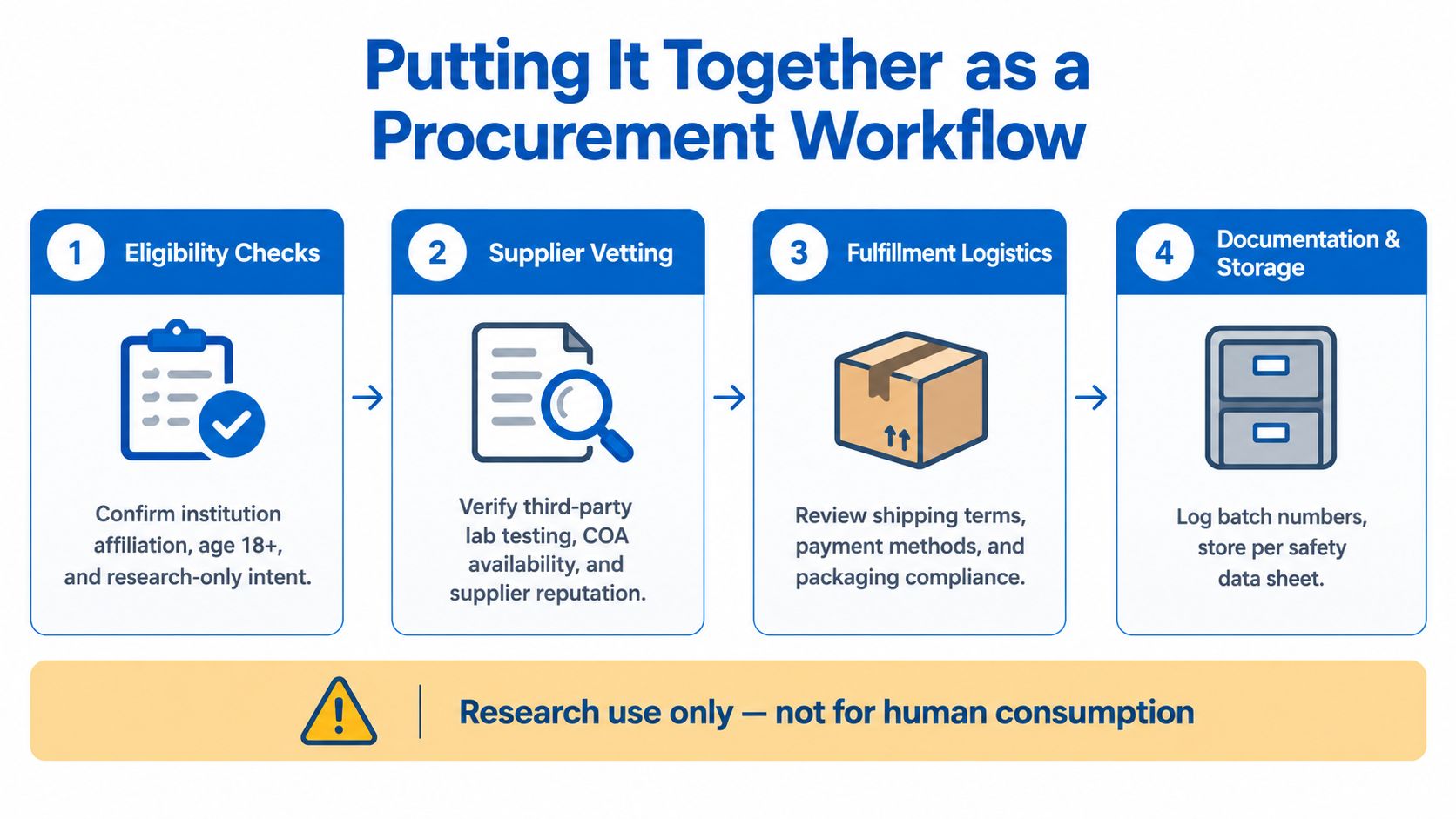
Eligibility checks
The buyer should confirm institutional affiliation, age eligibility, research-only intent, and any internal approval requirements. The order record should preserve the end-use statement and identify the responsible laboratory contact.
Supplier vetting
The procurement file should contain the supplier's research-use-only policy, product identity record, batch-linked COA, testing-laboratory details, and contact information. A supplier such as Pro Tec Pep presents research-use-only compounds with batch documentation and logistics options including optional cold-chain handling, giving laboratories specific records to review rather than relying solely on a storefront claim. The buyer still needs to assess whether the supplied documentation meets the project's own standards.
Fulfillment logistics
Shipping terms should be reviewed before payment. Packaging, temperature controls, labeling, delivery timing, and the process for reporting damaged or compromised material all belong in the purchasing record. The laboratory should reconcile the received vial against the purchase order and COA immediately on arrival.
Documentation and storage
The final record should log the product name, batch number, COA, receipt date, condition on arrival, and storage location. Storage should follow the supplier's safety data sheet and documented handling requirements. Any discrepancy should pause experimental work until the laboratory resolves the identity or integrity question.
A legitimate YK-11 for sale listing should therefore function as one part of a controlled procurement process, not as an invitation to personal use. The material remains an unapproved research chemical, and every downstream decision should preserve that boundary.
Pro Tec Pep provides research-use-only compounds, batch-linked documentation, and fulfillment support for laboratory procurement workflows. Qualified research teams can review the available records and sourcing options by visiting Pro Tec Pep.