What Is KPV Peptide? Sequence, Research Uses and Lot Checks
What is KPV peptide? A plain guide to its sequence, lab research uses, storage basics and COA checks for research-only lots.
A new vial lands on the bench, the label reads KPV, and the protocol, the paper, and the certificate each use a slightly different name. Before anyone opens the cap, the team has to decide whether those labels describe the same material.
That's the usual moment a lab first asks what is KPV peptide. The short answer is a three-residue fragment studied in cells and animals, not an approved medicine, and the salt form plus the lot paperwork belong in that identity.
What KPV Peptide Is and Where It Comes From
KPV is the three-amino-acid peptide lysine–proline–valine, written Lys-Pro-Val. It is the C-terminal fragment of alpha-melanocyte-stimulating hormone (α-MSH), a 13-amino-acid melanocortin peptide tied to pigmentation, immune signaling, and inflammatory regulation, as described in a 2012 airway-epithelium study.
A useful way to hold the structure is to treat α-MSH as a 13-word sentence. KPV is the last three words. Those three residues keep a piece of the message without carrying the whole hormone. Because the fragment is so small, labs have used it as a model for short-peptide delivery and transport, and for anti-inflammatory signaling that doesn't depend on the full parent sequence.
Studies describe KPV as naturally occurring. Its anti-inflammatory activity has been associated with suppression of nuclear factor kappa B (NF-κB)-related signaling. It doesn't contain the complete structural motif generally required for conventional melanocortin-receptor binding, so investigators have asked whether it can quiet inflammation without reproducing all of α-MSH's receptor-mediated actions. In immortalized human bronchial airway epithelium, that 2012 work reported dose-dependent inhibition of NF-κB signaling, matrix metalloproteinase-9 activity, and secretion of interleukin-8 and eotaxin. Those are cell findings. They place KPV as an experimental inflammation-modulating tripeptide, not as a clinically validated medicine.
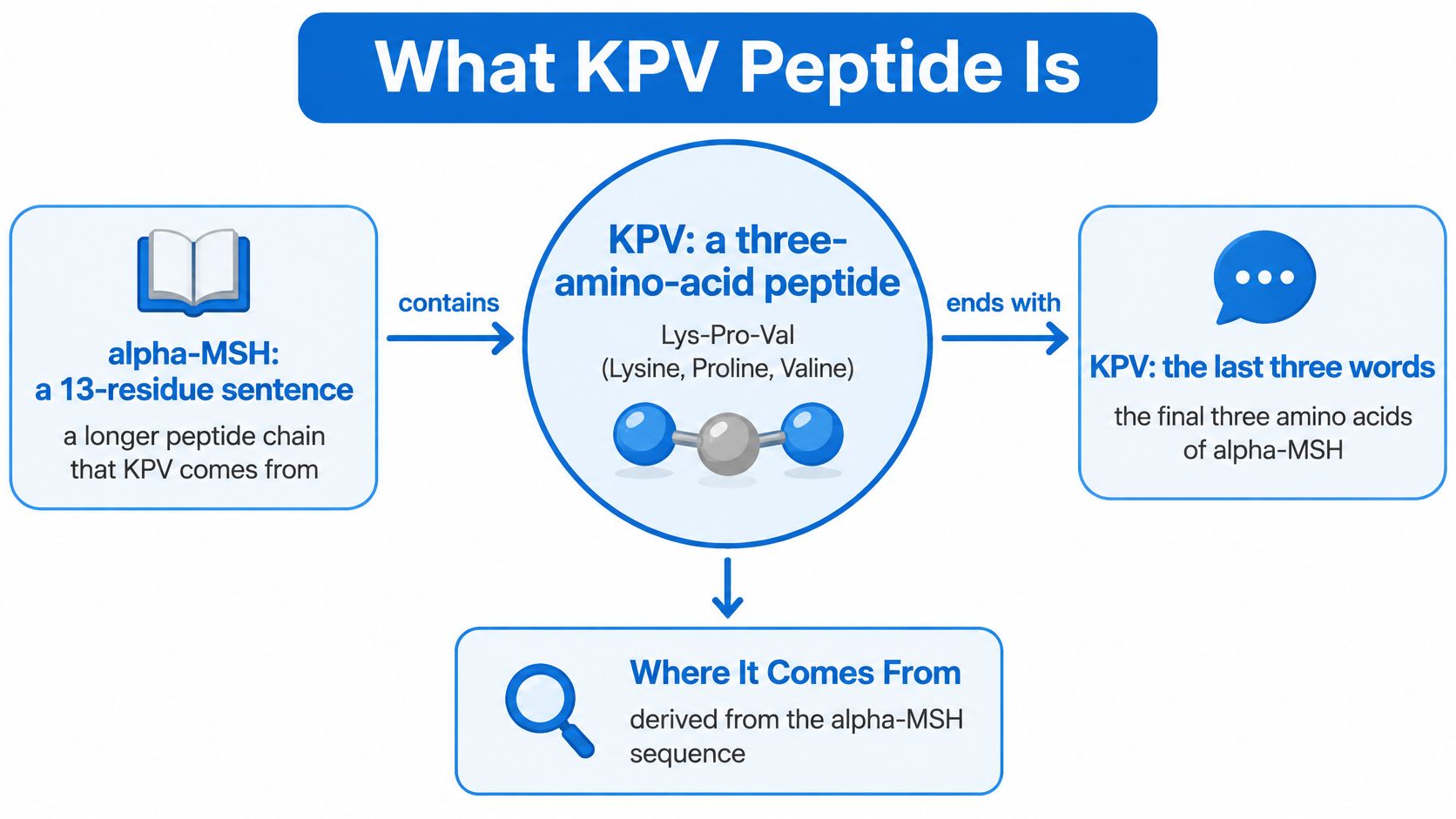
A map a protocol can point to
A concept map puts KPV in the center as Lys-Pro-Val. α-MSH sits to one side as the parent chain. NF-κB and MAPK sit as signaling nodes the fragment has been studied against. PepT1 is the transporter linked to intestinal uptake. MC1R is the melanocortin receptor the fragment doesn't need in order to show activity in the models that tested that question.
One-line definition: KPV is the naturally occurring C-terminal tripeptide Lys-Pro-Val of α-MSH, studied as a short research peptide for transport and NF-κB-linked inflammation, and not established as an approved human medicine.
Molecular Properties Every Lab Record Should Show
A name on a vial isn't an identity. The free tripeptide and the acetate salt are separate chemical entries, with different formulas, and a lab record that mixes them will mis-state every later concentration.
| Property | Value | Notes |
|---|---|---|
| Sequence (three-letter) | Lys-Pro-Val | Residues 11 to 13 at the C-terminus of α-MSH |
| Sequence (one-letter) | KPV | Same sequence, one-letter code |
| Synonyms | KPV tripeptide; alpha-MSH(11-13); L-lysyl-L-prolyl-L-valine | Use the form the COA names |
| Free tripeptide formula | C16H30N4O4 | Residue sum C16H28N4O3 plus one water |
| Free tripeptide molecular weight | about 342.4 g/mol | Calculated from that free-tripeptide formula |
| Acetate salt formula (PubChem) | C18H34N4O6 | Tripeptide plus acetic acid; confirm on the COA |
| Acetate salt molecular weight | about 402.5 g/mol | Calculated from the acetate formula |
| CAS number | Unknown until the lot COA states it | Don't fill this from memory |
| Supplied form | Often a lyophilized powder | Check the COA for the actual form |
| Salt form on the lot | Free base or acetate, as the COA states | The two forms aren't interchangeable in records |
PubChem lists the acetate as L-lysyl-L-prolyl-L-valine acetate, formula C18H34N4O6. That listing matches the calculation above: one acetic acid unit added to the free tripeptide. Copy it into the record only after the lot certificate confirms the same salt.
Two values that fail a check
The free tripeptide is the residue sum C16H28N4O3 plus one water, which gives C16H30N4O4 and about 342.4 g/mol. The acetate is C18H34N4O6 and about 402.5 g/mol. A free-base figure of 338.4, or an acetate figure of 390.4, is a miscalculation. Reject it rather than averaging it into the notebook.
Record the salt form, the lot number, and the value the certificate actually reports. Any field the certificate doesn't state stays marked unknown.
How KPV Acts in Research Models
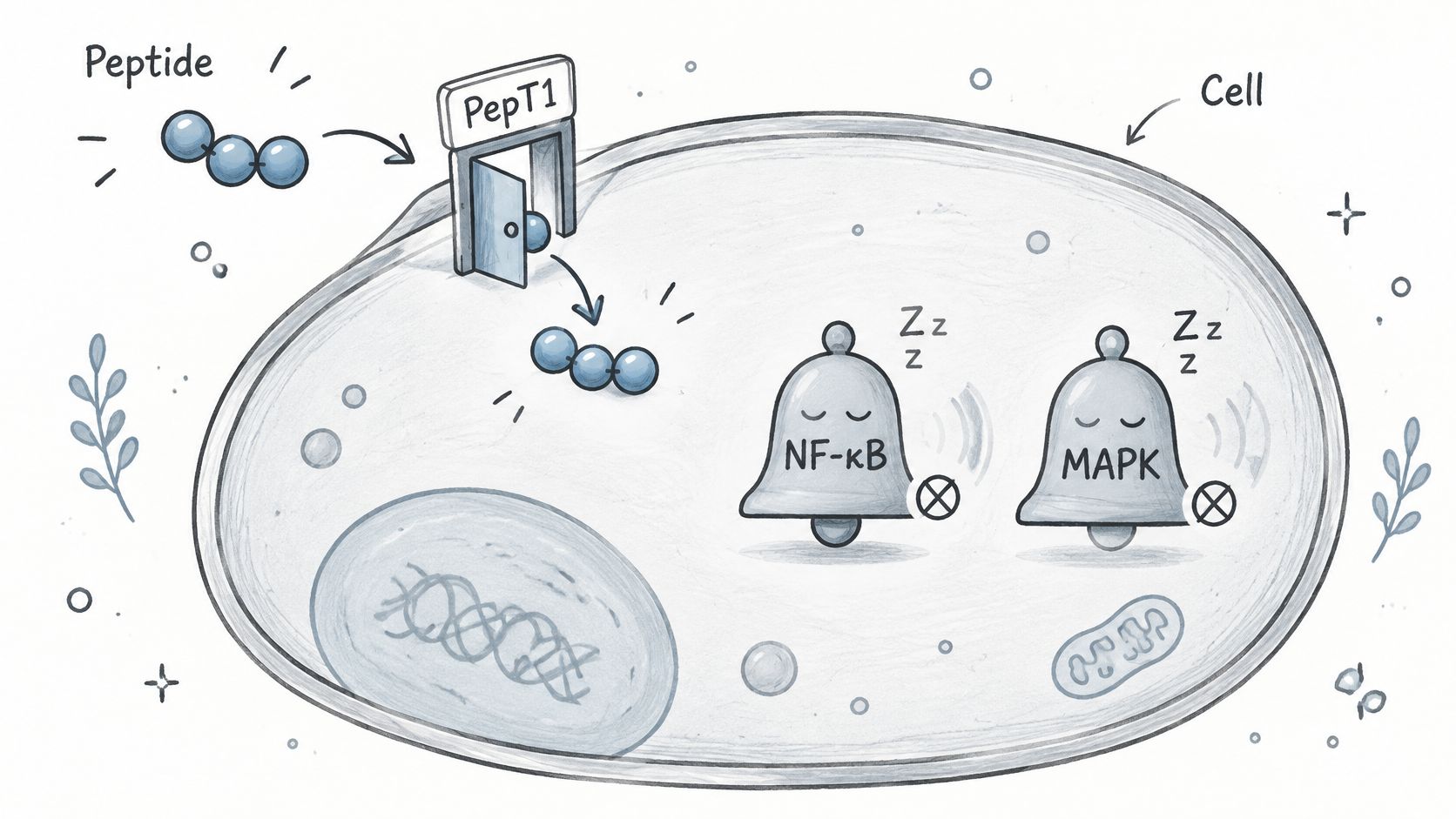
Think of the cell as a room with a door and an alarm. PepT1 is the door this tripeptide has been shown to use in intestinal epithelial and immune cells. NF-κB and MAPK are the alarm circuits that, once the peptide is inside, those same experiments reported as quieter.
Uptake comes first
In in-vitro intestinal work from 2007, nanomolar KPV inhibited NF-κB and mitogen-activated protein kinase signaling and reduced pro-inflammatory cytokine secretion. Cellular uptake was implicated because the effect followed PepT1-mediated transport and wasn't attributed to IL-1β-receptor binding. That means a new cell system has to measure transporter dependence. It can't be assumed from the older paper.
Signaling after entry
Inside those cells, the reported chain is suppression of NF-κB and MAPK, then lower cytokine secretion. That's a signaling readout, not a clinical outcome. Separate oral work in mice reduced inflammatory readouts in dextran-sulfate-sodium and trinitrobenzene-sulfonic-acid colitis, and part of the activity looked independent of MC1R. Endpoint details for those models belong with the model table below, not here.
The receptor question
Unlike intact α-MSH, KPV lacks the sequence motif required for binding known melanocortin receptors, which is why pigmentary effects of the parent hormone aren't the expected readout, according to keratinocyte experiments. In an in-vivo genetic control, KPV still rescued treated MC1R-deficient mice from death during DSS colitis. The anti-inflammatory activity in that model was at least partly independent of MC1R.
Calcium, and an open IL-1β question
In in-vitro human keratinocytes, KPV produced rapid intracellular calcium responses across 10^-15 to 10^-7 M, but only when cyclic-AMP signaling was pharmacologically modulated. Assay conditions, cell type, and pathway context change the result. Some descriptions link KPV to inhibition of IL-1β activity, while the PepT1 work didn't attribute the effect to IL-1β-receptor binding. Treat IL-1β as an open question, not a settled step.
KPV isn't a stand-in for α-MSH in a receptor-binding experiment. If the assay is built to read MC1R agonism, this fragment is the wrong tool.
Study Models, Endpoints and Their Limits
Cell hits and mouse colitis scores are easy to retell as if they were human results. They aren't. The indexed record stays preclinical.
| Model | Study type | Endpoints measured | Main limit |
|---|---|---|---|
| Immortalized human bronchial airway epithelium | In-vitro cell study (2012) | NF-κB activity, MMP-9 activity, IL-8, eotaxin | Single cell type; no tissue context |
| Human keratinocytes | In-vitro cell study | Intracellular calcium across 10^-15 to 10^-7 M | Response depended on cAMP modulation |
| Intestinal epithelial and immune cell models | In-vitro cell study (2007) | NF-κB and MAPK signaling, cytokine secretion, PepT1-linked uptake | Uptake dependence must be measured, not assumed |
| DSS colitis in mice | In-vivo animal model | Weight recovery, histologic infiltrates, colonic myeloperoxidase | Mouse data, not human outcomes |
| TNBS colitis in mice | In-vivo animal model | Inflammatory scores and mucosal injury | Mouse data; route-specific exposure |
| CD45RB-high T-cell transfer colitis in mice | In-vivo animal model | Earlier recovery and tissue inflammation markers | Mouse data only |
| MC1R-deficient mice in DSS colitis | In-vivo genetic control | Survival and body weight | Supports partial MC1R independence |
| Hyaluronic-acid and mucoadhesive hydrogel systems | Formulation study | Localization and release behavior | Formulation-dependent; not transferable |
| Controlled human trials | None identified in the cited indexed sources | No human efficacy endpoint identified | No human efficacy data identified |
A review of delivery and disease-model work describes a 2017 hyaluronic-acid oral system that attenuated inflammatory responses in colonic cells and examined PepT1 uptake, plus a 2021 in-situ mucoadhesive hydrogel that used KPV as the model drug. Mouse intestinal inflammation models, including DSS and TNBS colitis, have been used for inflammatory scores, cytokine signaling, and mucosal injury. In the DSS and T-cell-transfer colitis work, treated animals showed earlier recovery, stronger regain of body weight, fewer histologic infiltrates, and lower colonic myeloperoxidase.
What those rows don't carry
A cell monolayer doesn't reproduce whole-tissue exposure. A mouse colitis score doesn't predict human efficacy, and it doesn't predict topical or systemic performance either. An oral result and a transdermal or hydrogel result aren't the same experiment. Route, vehicle, and salt form change how much peptide reaches the site being measured.
The indexed sources support KPV as a laboratory compound for peptide transport, NF-κB-linked inflammation, and mucosal delivery. They don't establish approved human therapeutic use or human clinical efficacy. Published notes on the regulatory record have also flagged insufficient human information on immunogenicity, aggregation, and route-specific safety for both the free base and the acetate.
A reading rule for the next paper
Before a claim gets copied into a protocol, note four things.
- Study type: Cell, animal, formulation, or human. If the last box is empty, say so.
- Model: Which cells, which colitis inducer, or which carrier.
- Route and form: Oral, mucosal, transdermal, free base, or acetate. Don't collapse them into one word.
- Endpoint: Calcium, cytokine, histology, weight, or localization. Match the claim to that endpoint only.
Materials used this way stay inside a research-use-only policy, not a treatment plan.
Verify the Lot Before Any Prep
A certificate of analysis is the lot-level record that ties one vial to its own test results. A generic sheet, or a figure on a product page, isn't that record. Two papers can both say "KPV" and still have used different salts, purities, and fills. The check below is how a bench compares the physical vial with the paperwork before any solvent is chosen.
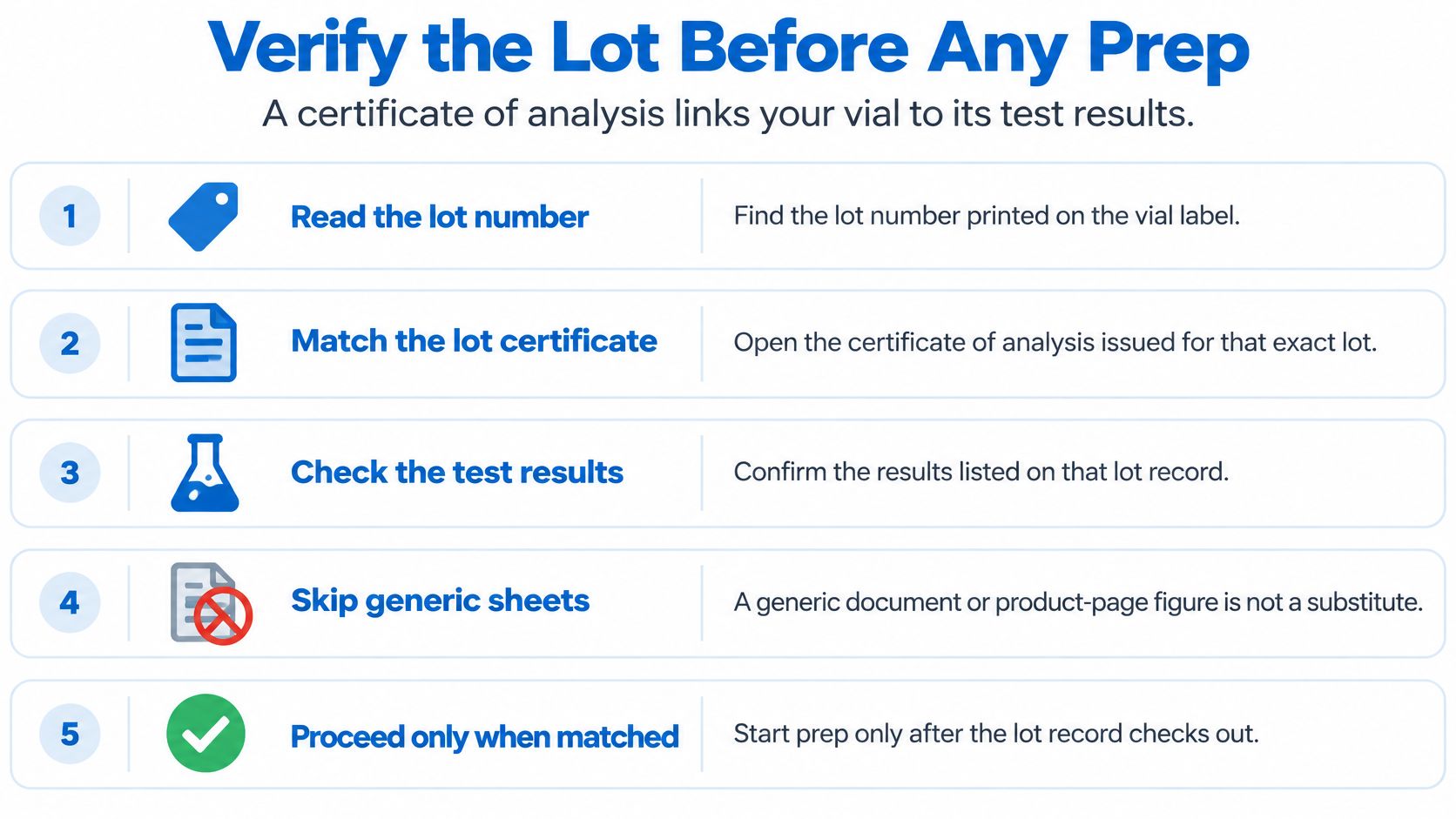
Match the vial in this order
Identity. The stated method, often mass spectrometry, should agree with Lys-Pro-Val and with the formula or mass printed on that certificate. If the mass matches the acetate and the label says free base, stop.
Salt form. Confirm free base or acetate, then use the matching molecular weight from the identifier table. Don't convert one into the other with a remembered factor.
Purity. Read the HPLC method and the percentage. Compare that number with what the assay can tolerate. A purity figure without a method name is incomplete.
Net content. Confirm the stated fill. Stock concentration later depends on this number, not on the catalog size.
Safety tests. Where the assay is sensitive to them, check sterility, endotoxin, and heavy metals. Silence on a line isn't a pass.
Lot match. The lot number on the certificate, the vial, and the invoice should be the same string. A close number is a different lot.
Suppliers differ in how they publish this. Pro Tec Pep, for example, links batch-specific certificates and describes seven-category third-party checks covering identity, purity, net content, sterility, endotoxins, heavy metals, and conformity. Whatever the vendor, the document in hand has to be the one for the vial in hand. A public overview of batch testing categories is a map of what to look for, not a substitute for the lot file.
Decision sequence
- Pull the certificate by lot number before ordering, not after the box arrives.
- Match identity fields to the record the protocol already uses.
- Compare the purity figure with what the assay tolerates.
- Confirm storage and shipping conditions on the document itself.
- If a field is missing or doesn't match, ask the supplier for the batch document and hold the lot until the question is closed.
Solvent choice and storage steps depend on that certificate. Verification sits ahead of sample prep, not after a failed assay.
How to Prepare KPV Samples in the Lab
Everything below is laboratory sample prep for an assay. It isn't an instruction for personal administration, and it isn't a schedule.
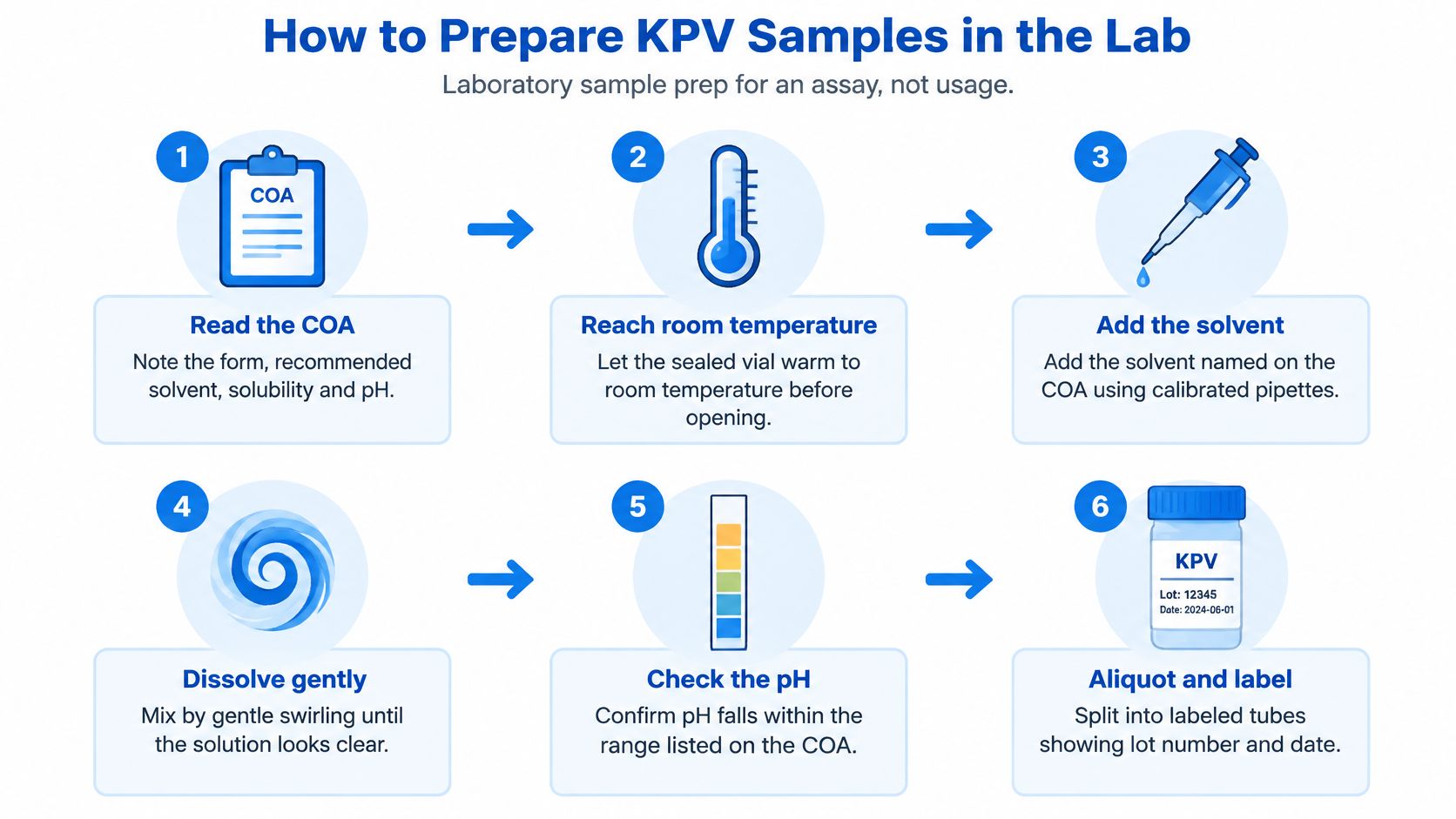
Before the cap comes off, read the supplier safety data sheet and wear standard laboratory PPE. Handle lyophilized powder so dust isn't inhaled. Lysine makes this peptide basic, so solvent pH and buffer pH are variables to write down, not details to skip.
- Read the certificate first. Note form, recommended solvent, solubility, and pH. The slip is grabbing a "usual peptide solvent" from the last project. That solvent may be wrong for this salt.
- Let the sealed vial reach room temperature. Condensation on cold powder adds uncontrolled water. Opening it straight from the freezer is the common slip.
- Centrifuge briefly. Powder that sits in the cap is lost when the vial opens, and the fill on the certificate no longer matches what's in solution.
- Add the solvent the certificate names, slowly. Record the volume and the resulting stock concentration in the same line. Eyeballing the volume makes every later dilution unverifiable.
- Swirl or rock gently. Vigorous vortexing can promote aggregation, and a cloudy tube then gets misread as a solubility success.
- Confirm the solution is clear, with no visible particles. Particles mean the stock concentration is lower than the label you just wrote. Don't assay through them.
- Aliquot into single-use, low-binding tubes. Short peptides adsorb to some plastics, and repeated thawing changes what's left. One large stock tube invites both problems.
- Label each aliquot with lot, concentration, date, and storage condition. An unlabeled tube is an unknown compound by the next week.
A short bench demo of careful peptide handling is worth watching once, then setting aside.
The prep record should let another lab rebuild the same stock: salt form, lot, solvent, volume, measured pH, appearance, and aliquot plan. If any of those lines is blank, the prep isn't finished.
Storage Conditions and Stability Checks
Moisture, warmth, repeated freeze-thaw cycles, and surface adsorption can all lower the amount of intact tripeptide left in a vial. For a three-residue peptide, that loss is easy to miss until an assay drifts.
The stability window printed on the lot certificate or the product page is the authority. Where that document is silent, the cell stays unknown. Don't paste in a general number from another peptide.
| Sample form | Typical lab condition | Handling rule | Stability limit source |
|---|---|---|---|
| Lyophilized powder, sealed | As the lot certificate states, often frozen and dry | Keep sealed until use; equilibrate before opening | Lot COA or product page; unknown if not stated |
| Reconstituted stock, aliquoted | Frozen, at the condition stated on the COA | Single-use aliquots; avoid repeated freeze-thaw | Lot COA; unknown if not stated |
| Working solution in assay buffer | Chilled, short-term | Prepare on the day of the assay | Lab validation; unknown until the lab measures it |
| Repeated freeze-thaw of any stock | Not recommended | Discard or re-aliquot after the first thaw | General laboratory practice |
| Shipped material on arrival | Check the temperature record | Record arrival condition in the log | Shipping documents; cold-chain option where the shipment needs it |
Walk the rows
Sealed powder stays closed until the day it's needed. Warming a sealed vial is about condensation, not about "activating" the peptide. Once it's in solution, freeze only what the certificate allows, in aliquots sized for one use. A working dilution in assay buffer is a same-day reagent. If the lab hasn't timed how long that dilution stays intact, the limit is unknown, not "overnight." A second thaw of a stock isn't a minor convenience. Treat it as a new, uncharacterized sample or throw it out.
A simple stability check
Compare an aged aliquot with a freshly prepared one by the analytical method named on the certificate, and write the date next to the result. If the chromatogram or the mass no longer matches the fresh aliquot, the older tube leaves the assay.
The lab log should show where the vial sat, when it was opened, how it was aliquoted, and whether a shipment arrived warm. Later discrepancies can then be traced to storage history instead of blamed on the sequence.
Keep the Study Record and Next Step
Keep the verified certificate in the study file with the lot number, salt form, preparation record, and storage log. When a result later disagrees with an earlier run, that file shows whether the compound or the handling changed. KPV here is supplied for laboratory research only. The evidence reviewed above is preclinical, from cell and mouse studies, and no approved human use is established. Further sequence context sits in the compound research library.
For laboratory research use only. Not for human or veterinary use. Not a drug, food, or cosmetic. Not evaluated by the FDA. Not intended to diagnose, treat, cure, or prevent any disease. By purchasing, you certify you are a qualified researcher and agree to use this product solely for in-vitro laboratory research.
Pro Tec Pep supplies research-use-only peptides, including KPV, with batch-linked certificates and optional cold-chain handling for laboratory work on sequence, transport, and assay prep. The catalog is built for qualified researchers comparing salt form, purity, and lot identity before any sample is opened. Visit Pro Tec Pep to review the KPV research listing and its lot documentation.