What Is Cagrilintide Peptide? a Research Guide
What is cagrilintide peptide? A guide to its amylin-analogue structure, receptor data, trial findings and lab sample considerations.

Cagrilintide is a long-acting synthetic analogue of the hormone amylin, studied as an investigational research compound and not as an approved medicine. In a 68-week Phase 3 treatment-policy analysis, average body-weight reduction was 11.5% with cagrilintide 2.4 mg, compared with 3.0% with placebo.
If two peptides both quiet appetite, why would a lab file them under one label? The usual shortcut treats every new metabolic peptide as another GLP-1 tool. That shortcut fails. Amylin receptors and GLP-1 receptors are different systems, and a change in body weight does not tell you which system moved, or whether glucose handling moved at all.
What is cagrilintide peptide in practical lab terms? It is an engineered amylin analogue whose value sits in identity checks, receptor assays, and how trial numbers become endpoints a bench can measure.
Cagrilintide Explained in Plain Terms
Why classify cagrilintide separately from GLP-1 compounds if both are studied in relation to appetite? The distinction begins with the hormone pathways they engage. Cagrilintide is a long-acting synthetic analogue of amylin, a hormone the pancreas releases alongside insulin. It is an investigational research compound, not an approved medicine.
Native amylin is like a short text message that fades quickly. Cagrilintide is an engineered version designed to keep its biological activity longer. A medicinal-chemistry paper in the Journal of Medicinal Chemistry describes the peptide's modifications and reports that development candidate compound 23 was advanced into clinical development.
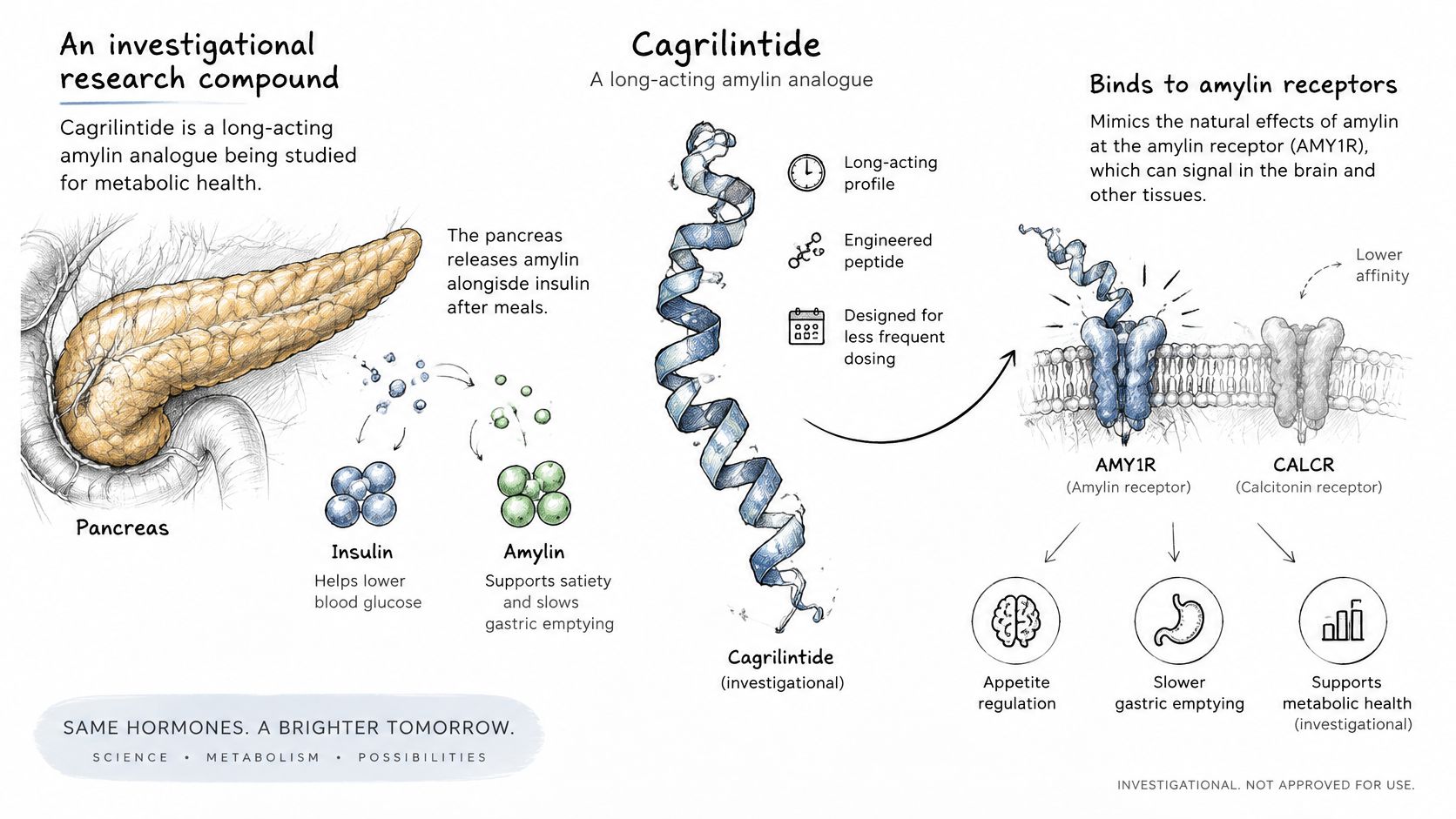
Amylin-pathway activity is distinct from GLP-1 activity. Semaglutide acts mainly through GLP-1 receptors, while cagrilintide activates amylin-related pathways. Researchers have studied them together as CagriSema, and cagrilintide alone is also evaluated separately. Their different targets make parallel assays useful: a shared effect on appetite does not make the compounds interchangeable.
Amylin-related research examines appetite regulation, gastric emptying, and post-meal glucose control. These are separate questions for laboratory models. Researchers can ask whether a measured response tracks with receptor activity, changes in gastric emptying, or glucose handling, rather than assuming one outcome explains the others.
Cagrilintide is a long-acting synthetic analogue of amylin, studied as an investigational research compound and not as an approved medicine.
For laboratory work, materials fall under a research use only policy. The development candidate, compound 23, was advanced into clinical development; that history describes investigation, not routine clinical supply.
Molecular Identity at a Glance
What should match before a cagrilintide sample enters an assay? Start with its name, sequence, formula, and lot documentation. These are separate checks: a correct label does not by itself confirm the material's molecular identity.
| Property | Reported value | How a lab verifies it |
|---|---|---|
| Common name | Cagrilintide | Match against the lot COA |
| Alternate designations | AM833; NNC0174-0833 | Cross-check the supplier name against both codes |
| Compound class | Long-acting acylated amylin analogue (synthetic peptide) | Confirm class on the technical data sheet |
| Molecular formula | C194H312N54O59S2 | Compare with high-resolution mass spectrometry |
| Peptide sequence | XKCNTATCATQRLAEFLRHSSNNFGPILPPTNVGSNTP | Compare by MS/MS with the lot documentation |
| Primary receptor targets | Amylin receptor complexes and the calcitonin receptor | Use receptor-specific in-vitro assays |
PubChem lists the formula C194H312N54O59S2 and sequence XKCNTATCATQRLAEFLRHSSNNFGPILPPTNVGSNTP. The formula gives a target for mass comparison; the sequence specifies the amino-acid order. The leading X appears in the listed sequence, but its identity is not defined there. Treat it as unresolved and check the lot's batch-specific certificate of analysis (COA), rather than assigning it a residue.
What the modification changes
Cagrilintide is described as a long-acting, acylated synthetic peptide. That class description matters when deciding whether a test material matches the intended compound. The sequence shown in PubChem does not, on its own, establish the chemical identity of the leading X or provide details for resolving it. For those questions, use the batch-specific COA documentation for the lot, alongside the supplier's technical information.
Keep three checks in the arrival log. Each answers a different question: does the measured mass fit the formula, does the sequence match the reference, and do the compound names point to the same lot?
- Mass confirmation: Compare the observed mass with C194H312N54O59S2.
- Sequence confirmation: Compare MS/MS results with the listed amino-acid order, while recording the leading X as unresolved unless the lot documentation specifies it.
- Name match: Confirm that cagrilintide, AM833, and NNC0174-0833 refer to the same lot record.
The compound research library can help locate compound information; use the lot-specific COA to confirm identity values for the material in hand.
How Cagrilintide Acts in Research Models
How does an amylin signal differ from a GLP-1 signal? Cagrilintide acts on amylin-receptor pathways, which gives researchers a distinct set of mechanisms to examine rather than treating it as another appetite compound.
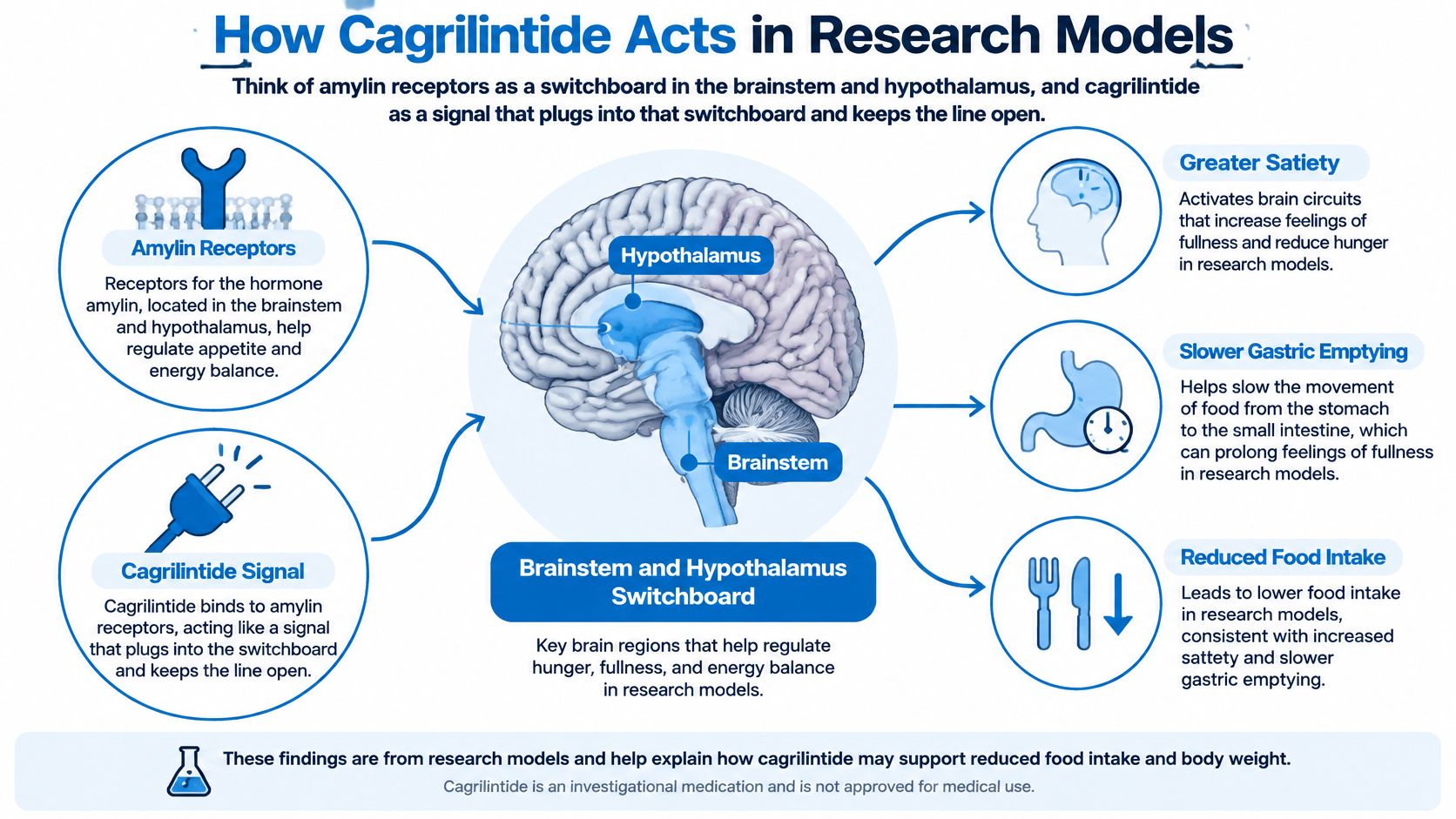
Amylin receptors form when the calcitonin receptor pairs with receptor-activity-modifying proteins. Cagrilintide activates these receptor complexes and also acts at the calcitonin receptor itself. A preclinical and pharmacological review describes this receptor profile as distinct from incretin agonism.
Four effects, and the study type behind each
Each proposed effect calls for a matching measurement. A single endpoint cannot show which part of the pathway changed.
- Reduced food intake: Feeding assays can test whether intake changes in preclinical models.
- Delayed gastric emptying: Measure emptying directly, rather than relying on body weight as a substitute.
- Suppressed postprandial glucagon: Collect samples after a nutrient challenge to assess this post-meal hormone response.
- Enhanced satiety: Testing a brainstem or hypothalamic circuit hypothesis calls for a receptor-specific readout, not food intake alone.
Brain amylin-receptor signaling, including AMY1R and AMY3R, is a plausible contributor to appetite suppression in preclinical models. Researchers can test that hypothesis by asking whether changes in these pathways track with feeding and body-weight outcomes. The distinction matters: an appetite-related mechanism is different from simple caloric malabsorption, and body weight alone cannot identify which mechanism is involved.
Native amylin aggregates and clears quickly. Cagrilintide's acylation and sequence engineering extend exposure relative to the native peptide. For laboratory studies, exposure duration is therefore a variable to record alongside the formulation. This describes a research property, not a human-use instruction.
Assay choices that follow
Suppose a rodent study compares an amylin analogue with an incretin control. Matching only final body weight would leave the mechanisms unclear. The measurements should separate food intake, gastric emptying, and glucagon response.
- Separate specific signaling from nonspecific peptide effects with receptor-matched controls.
- Record aggregation state, since clumping can affect the observed activity.
- Log concentration and exposure duration, along with formulation and storage temperature.
These mechanisms remain hypotheses to test with receptor assays and preclinical models. A short visual walk-through of the receptor distinction is below.
Receptor Potency Benchmarks From In-Vitro Assays
Four supplier-reported in-vitro values are the current bench benchmarks. They are not peer-reviewed figures, and they are not independently verified here.
| Receptor target | Reported value | Assay type |
|---|---|---|
| Human AMY3 receptor | 170 pM | Receptor binding |
| Human calcitonin receptor | 223 pM | Receptor binding |
| Human AMY3 receptor | 49 pM | Cell-based reporter activation |
| Human calcitonin receptor | 62 pM | Cell-based reporter activation |
A binding IC50 is the concentration that displaces a reference ligand by half. A reporter EC50 is the concentration that produces half-maximal receptor activation in a cell-based signaling assay. They answer different questions. One is occupancy. The other is the signal the cell sends after occupancy.
How to read the picomolar cluster
A Cayman Chemical technical data sheet reports binding half-maximal inhibitory concentrations of 170 pM at the human amylin 3 receptor and 223 pM at the human calcitonin receptor. In reporter assays, the half-maximal effective concentrations were 49 pM for human AMY3 and 62 pM for the human calcitonin receptor. Both targets sit in a low-picomolar range, and the paired values sit close to each other. That pattern fits activity at both receptors. It does not rank one receptor as the only target.
Don't line up 49 pM against 170 pM and call one "stronger." Binding and reporter numbers come from different assay systems. A lower number is not automatically a better compound when the formats differ.
Practical rule: Quote a picomolar value only with its assay format, cell background, and control peptide in the same note.
A short checklist keeps a new run comparable.
- Matched cell lines that express the receptor you name.
- Native amylin as a positive control in the same plate.
- Identical buffer conditions across the comparison.
- A stated assay format beside every value you report.
These are research endpoints for receptor pharmacology. They are not human parameters, and they don't show that any laboratory sample is suitable for clinical purposes.
Clinical Findings Researchers Should Know
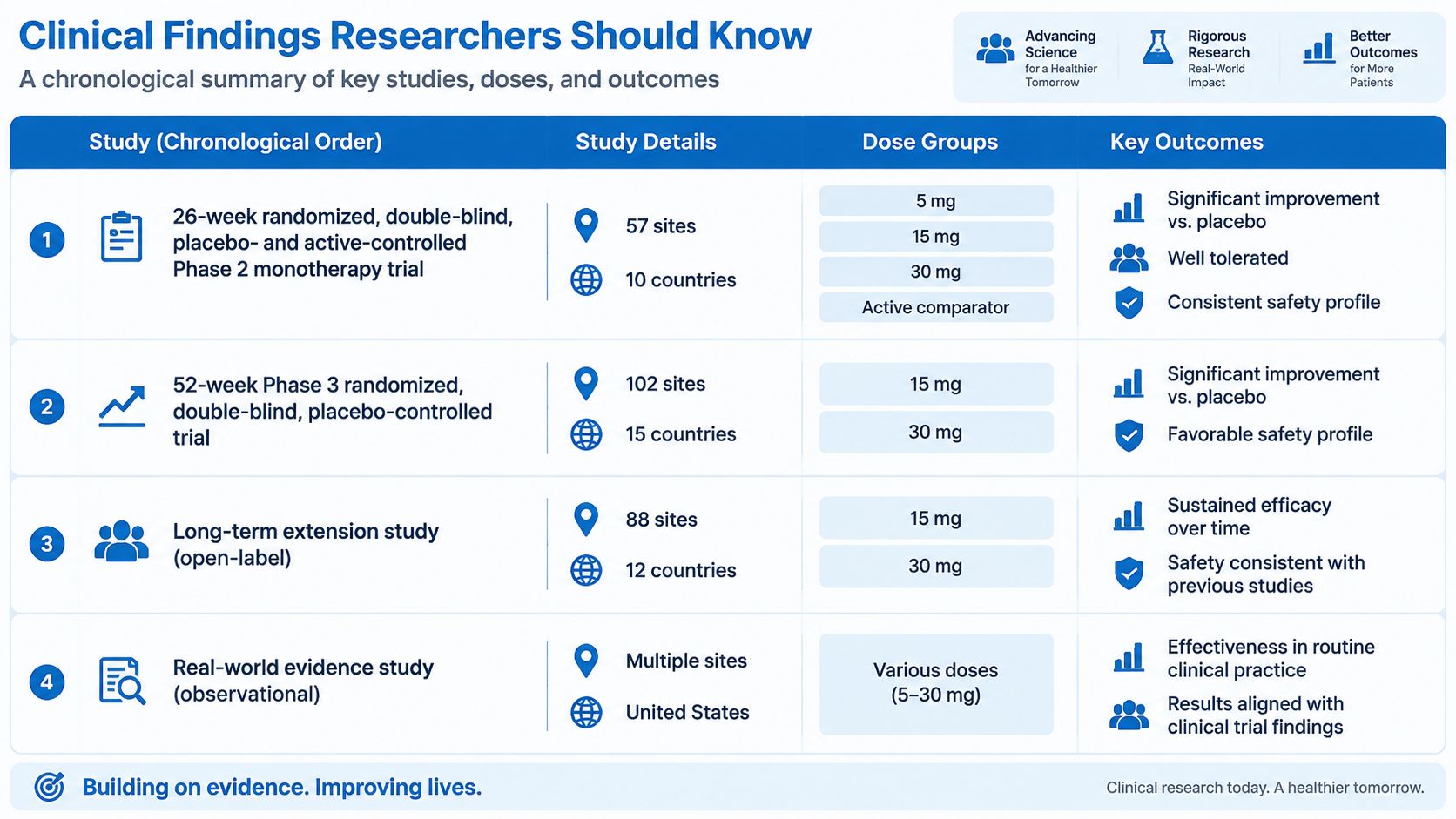
Headline weight change is the number people quote. It is a weak stand-in for a lab result. The trials below are ordered from the earlier monotherapy study to later combination work.
| Study | Design | Population | Reported result |
|---|---|---|---|
| Phase 2 monotherapy (26 weeks) | Randomized, double-blind, placebo- and active-controlled; 57 sites in 10 countries; liraglutide 3.0 mg comparator | Adults with overweight or obesity | Mean body-weight change about 6.0% to 10.8% across cagrilintide arms vs 3.0% placebo |
| REDEFINE 1 Phase 3 (68 weeks) | 3,417 participants; treatment-policy and efficacy analyses | Adults with overweight or obesity, without type 2 diabetes | 11.5% with cagrilintide 2.4 mg vs 3.0% placebo (treatment-policy); 11.8% vs 2.3% (efficacy) |
| REDEFINE 1, responder threshold | Proportion reaching at least 25% weight loss at 68 weeks | Same population as REDEFINE 1 | 6.0% with cagrilintide 2.4 mg vs 0.9% placebo |
| Phase 3a combination trial (2025) | 1,206 participants; cagrilintide and semaglutide 2.4 mg each once weekly | Adults with overweight or obesity and type 2 diabetes | 13.7% weight loss vs 3.4% placebo |
Where each figure comes from
The Lancet phase 2 report01751-7/abstract) describes a 26-week, multicentre, randomized, double-blind, placebo- and active-controlled trial at 57 sites across 10 countries. Adults received assigned amounts of 0.3, 0.6, 1.2, 2.4, or 4.5 mg, with placebo or liraglutide 3.0 mg as comparators. Mean body-weight reductions ran about 6.0% to 10.8% versus 3.0% with placebo, and the upper amount corresponded to about 11.5 kg versus 3.3 kg with placebo.
In Novo Nordisk's account of REDEFINE 1, 3,417 adults without type 2 diabetes were randomized, and the treatment-policy analysis showed 11.5% average reduction with cagrilintide 2.4 mg versus 3.0% with placebo. The efficacy analysis, which assumes adherence, showed 11.8% versus 2.3%. A Patient Care Online report on REDEFINE 1 stated that 6.0% of participants on cagrilintide 2.4 mg reached at least 25% weight loss at 68 weeks, versus 0.9% on placebo.
A PubMed record of 2025 phase 3a combination work reported 13.7% weight loss versus 3.4% with placebo in adults with type 2 diabetes, and, in a separate trial of adults without diabetes, 20.4% versus 3.0%, with gastrointestinal adverse events in 79.6% of combination-treated participants versus 39.9% on placebo. A separate New England Journal of Medicine trial record randomized 1,206 adults with overweight or obesity and type 2 diabetes, with combination participants assigned 2.4 mg of each compound.
Three reasons the headline is not a potency curve
Clinical outcomes mix adherence, diet, baseline body mass, tolerability, and pharmacokinetics. A smooth step from 6% to about 11% across assigned amounts supports exposure-dependent activity. It is not a laboratory concentration-response curve.
Gastrointestinal adverse events were the predominant tolerability signal in the clinical summaries, and the combination figures above show how large that gap versus placebo can be. A weight percentage that ignores who stayed in the study answers a different question from one that assumes full adherence.
Body weight alone does not establish a glycaemic effect. Each paper's glucose endpoints need their own review. Preclinical follow-up should compare this amylin-pathway agonist with incretin controls over matched exposure periods, using food intake, gastric emptying, and receptor-specific readouts rather than weight alone.
Handling and Lot Verification Before Use
Sample prep is a lab procedure. It is not a use instruction. ProTecPep does not provide dosing, administration, reconstitution, treatment, or medical-use guidance, and the laboratory SOP governs preparation.
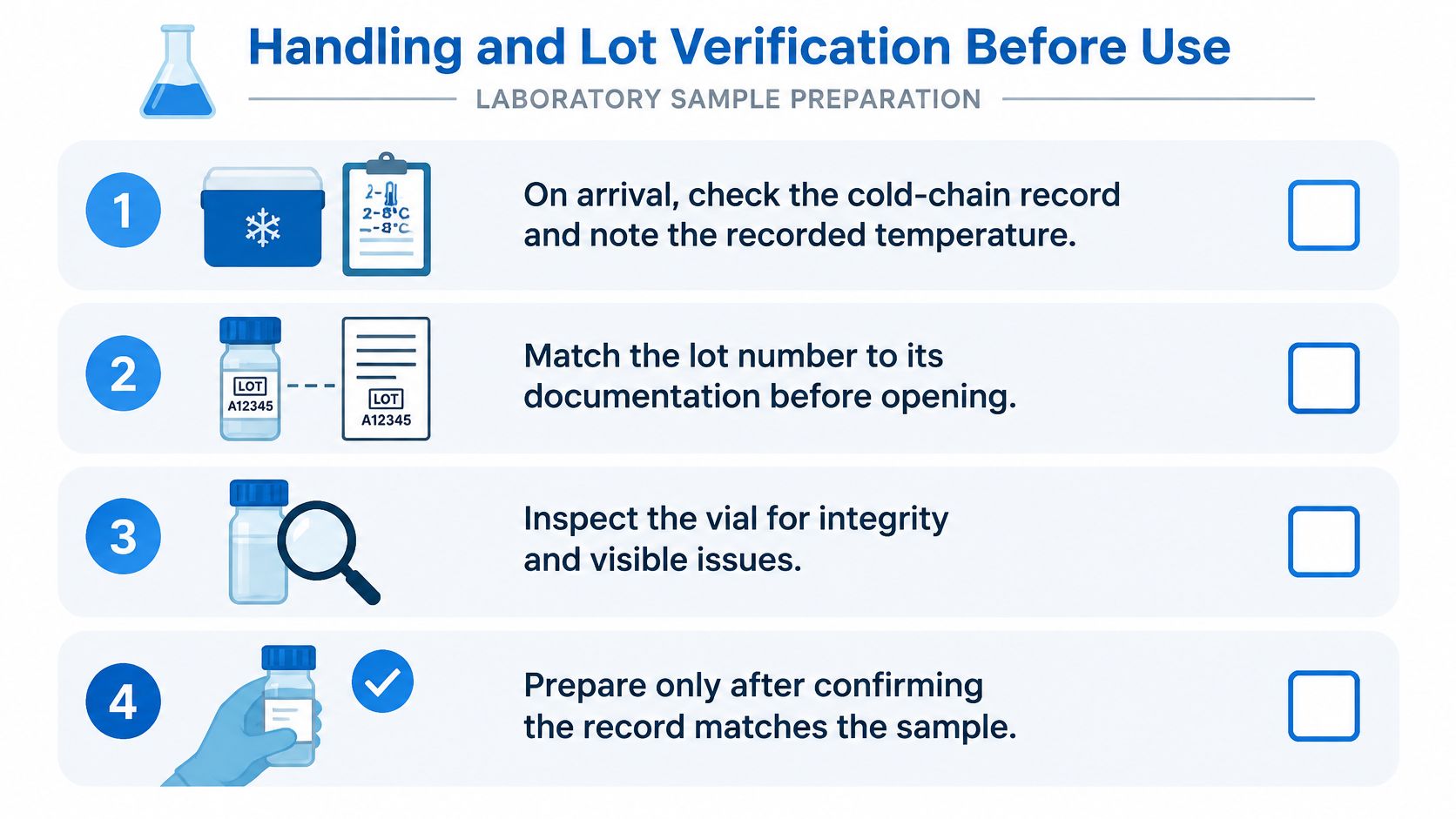
- On arrival, check the cold-chain record and note the recorded temperature.
- Match the lot number to its batch-specific COA. Confirm identity, declared purity, net content, and the test panel the certificate lists.
- Record the storage temperature stated for that lot and follow it. The lot file governs, not a generic peptide habit.
- Record solubility and solvent from the COA. Don't assume the solid dissolves in water.
- Aliquot so the same tube is not thawed over and over.
- Prepare a stock with documented concentration, solvent, and date.
- Document aggregation state before any assay. Clumps change how a result should be read.
Boundaries before anyone writes a protocol
ProTecPep is a specialized chemical supplier and is not a compounding pharmacy, chemical compounding facility, or outsourcing facility under the Federal Food, Drug, and Cosmetic Act. Cagrilintide in this setting is an investigational research compound. It is not validated human-use material, and it is not a drug, food, or cosmetic.
What to confirm before ordering
Cagrilintide is listed in the shop at $64.99. Price does not replace paperwork. Before an order, confirm that the lot has its own COA, that sequence, formula, and mass match the reference values already set out for this peptide, and that purity is declared on that certificate. Also confirm whether temperature-controlled shipping is available, and whether institutional procurement requires a research-use-only policy.
Third-party batch testing is the practical check on identity, purity, and the rest of the panel tied to that lot. File the COA with the study protocol before any assay begins. A product page linked from this kind of guide has to carry the research-use disclaimer in full, not a shortened version.
For laboratory research use only. Not for human or veterinary use. Not a drug, food, or cosmetic. Not evaluated by the FDA. Not intended to diagnose, treat, cure, or prevent any disease. By purchasing, you certify you are a qualified researcher and agree to use this product solely for in-vitro laboratory research.
Pro Tec Pep supplies research-use-only cagrilintide for laboratory identity checks, receptor work, and formulation studies, with batch documentation instead of medical guidance. A group comparing amylin-pathway material with incretin controls can review the listing, the lot COA, and the storage notes before a protocol is written. Visit Pro Tec Pep to see the current research catalog and confirm the lot record before you order.