What Does Processing an Order Mean in Research Fulfillment
What does processing an order mean in research peptide fulfillment? Learn the stages, documentation, timelines, and quality checks that protect your samples.
Processing an order means completing the internal checks between a confirmed purchase and carrier handoff, including verification, batch allocation, COA linking, packaging, and cold-chain preparation. For Pro Tec Pep, the stated processing window is 24 hours, and that window is separate from carrier transit time.
A researcher may place an order before a Friday assay, see the status change from “Confirmed” to “Processing,” and wonder whether the cell preparation schedule can proceed. The status doesn't mean the parcel is already moving through a carrier network. It means the supplier is converting an approved request into a shipment that can be identified, documented, packed, and released without avoidable errors.
What Processing an Order Actually Means for Your Lab
At a consumer retailer, “processing” may sound like a payment confirmation followed by warehouse packing. A research-compound order carries more control points. Staff may need to confirm the requested compound, quantity, formulation, destination, research-use eligibility, available inventory, assigned lot, batch documentation, storage requirements, and shipping method before the parcel leaves the facility.
The workflow begins when the order is received and recorded. It continues through payment or purchase-order review, fraud screening, inventory allocation, picking, documentation, packaging, shipping-label creation, and carrier handoff. This broader definition places order processing between purchase capture and fulfillment release, rather than treating it as a synonym for delivery. The order-processing definition from Oxapay describes the same bridge between customer demand and physical fulfillment.
The status is a checkpoint, not a location
“Processing” usually describes work happening inside the supplier's operation. It doesn't necessarily indicate that a carrier has scanned the parcel, and it doesn't provide a delivery date by itself. Processing time ends at dispatch or carrier handoff. Shipping time begins after that handoff.
For a laboratory, the distinction protects planning accuracy. A team can prepare receiving space and documentation while an order is under review, but it shouldn't schedule an experiment solely from a “Processing” label. The material still needs a matched lot, usable batch records, suitable packaging, and a confirmed dispatch milestone.
A research supplier also has a responsibility that a general retailer may not. The vial should be linked to the exact Certificate of Analysis, the lot number should agree across the order record and packing documents, and any temperature-sensitive handling should be planned before the parcel is sealed. Batch-linked documentation is more useful than a generic product sheet because it connects the material received at the bench with the analytical information for that specific lot.
Practical rule: A processing status is complete only when the order is verified, documented, packed, and released to the carrier. A printed label alone isn't proof that those controls are finished.
For Pro Tec Pep, the stated 24-hour processing target should therefore be read as an internal preparation and validation window, not a promise that the carrier will deliver within 24 hours. The following checkpoints show what the laboratory gains from each stage.
The Core Stages of the Order Processing Workflow
A useful analogy is a laboratory kitchen line. Payment or purchase approval is the ticket, inventory staff are the prep team, quality review checks the ingredients, packaging assembles the finished order, and the carrier acts as the expediter who moves the sealed order out of the kitchen. If one ticket contains the wrong item or missing instructions, speed won't correct the underlying problem.
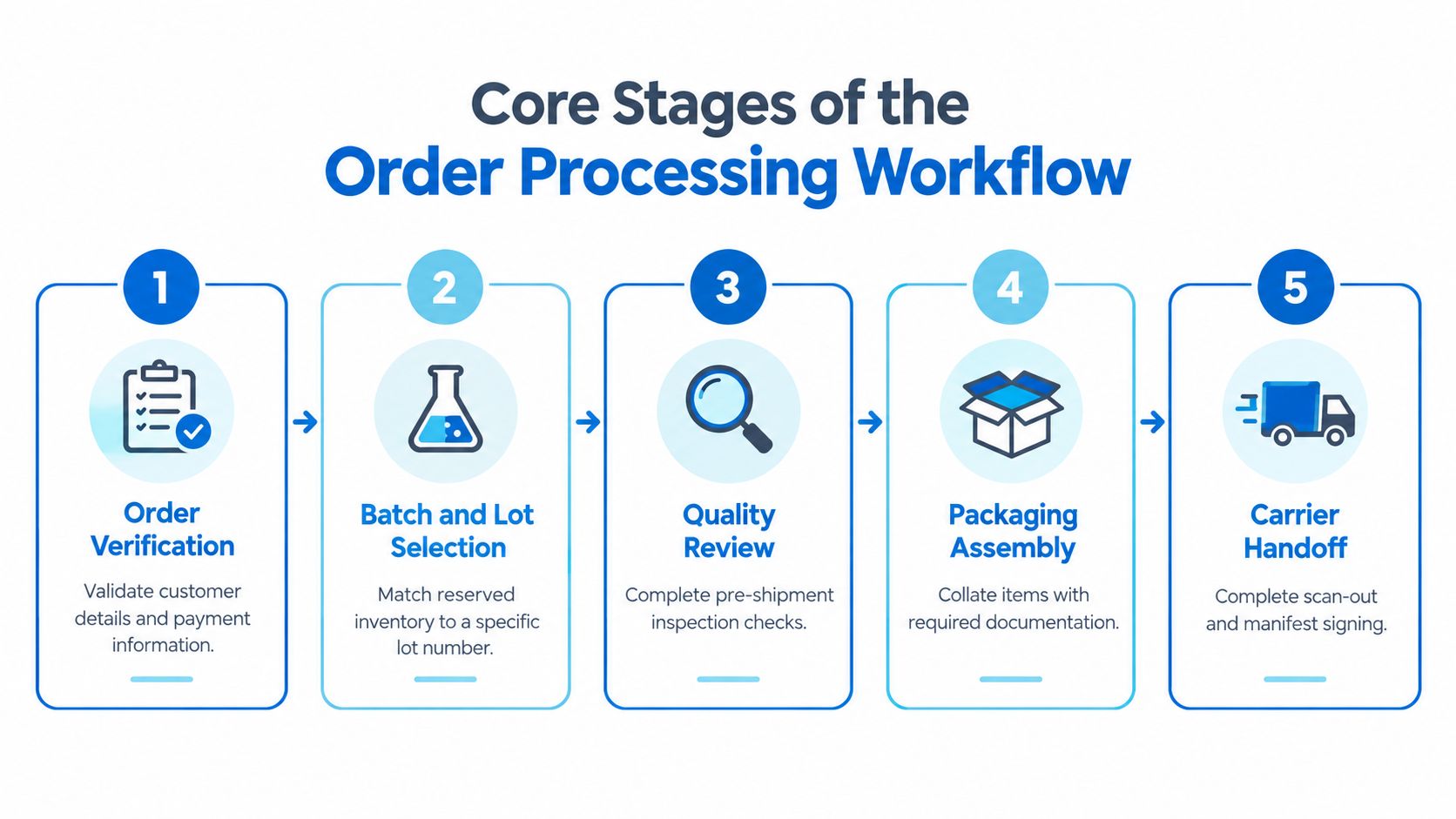
Five checkpoints inside the status
Order verification confirms customer details, payment or purchase-order authorization, delivery information, and research-use eligibility. The lab-side output is an approved order record rather than an unreviewed checkout.
Batch and lot selection matches the requested SKU and quantity to physical inventory. Staff assign the material to a specific lot, creating the basis for a matching COA and a traceable receiving record.
Quality review checks the selected item, label, container, documentation, and any special handling requirement before sealing. A mismatch can be found here before it reaches an experiment.
Packaging assembly brings together the vial, packing record, COA access, protective materials, and any required temperature-control components. For a cold-chain shipment, the package must support the labeled storage range and the intended route.
Carrier handoff records the scan-out, manifest entry, and tracking number. The parcel has now moved from internal processing into carrier transit, giving the laboratory a new milestone to monitor.
A supplier's order-management workflow may also include exception handling. Missing address details, account approval, purchase-order numbers, credit terms, custom pricing, stock discrepancies, or special documentation can pause an order even after payment appears to be complete. Research teams can review the order record through the Pro Tec Pep checkout page and contact support when the displayed status doesn't match the expected milestone.
The timing language matters. Industry logistics summaries place average e-commerce fulfillment at approximately 2.1 days in 2023, compared with roughly 3.2 days in 2020, and associate digital workflows with a reported 40% reduction in processing time over the 2020 to 2023 period. Those figures describe broader logistics activity, not a guarantee for a particular laboratory order. They do show why cycle time is measured as a chain of coordinated tasks rather than one warehouse action. Industry logistics estimates also distinguish manual picking at approximately 45 seconds per item from automated picking at about 12 seconds per item, illustrating how task design can affect the overall process.
Verification, Eligibility, and Batch Documentation
The first internal review answers a practical question: Can this exact order be released, and can the supplier prove what will be released? Payment capture and fraud screening confirm that the transaction is authorized. A purchase order may require institutional details, account approval, or other procurement information before staff can move forward.
Eligibility review is separate from payment. Research-use-only materials require clear research-use controls and labeling. FDA guidance says products in the laboratory research phase that aren't represented as effective in-vitro diagnostic products should carry the prominent statement “For Research Use Only. Not for use in diagnostic procedures.” That distinction keeps research labeling separate from clinical or patient-management claims. The FDA guidance on research-use-only products supports treating eligibility and labeling checks as compliance controls.
The lot is the identity of the shipment
Inventory confirmation alone isn't enough. Staff need to reconcile the requested product and quantity with a physical unit, assign the lot that will be shipped, and retrieve the documentation for that lot. If the system shows stock that cannot be located physically, the result is phantom availability, a status that looks ready while the order cannot be picked.
A COA should be more than a generic specification page. Depending on the material and testing program, useful batch-linked documentation can identify the lot, identity, purity or assigned value, uncertainty where applicable, analytical method, standards used, certification period, and samples evaluated. NIST's reference-material procedures describe batch identification, analytical data, impurity data, and documented batch records, which explains why an exact lot link matters for reproducibility and audit response. Details on batch-linked analytical documentation from NIST show the difference between material-specific evidence and a general product description.
| Checkpoint | Lab benefit |
|---|---|
| Payment or purchase-order authorization | Establishes that the request is approved for fulfillment |
| Research-use eligibility | Keeps procurement records aligned with the product's stated research status |
| SKU and quantity reconciliation | Reduces the risk of an incorrect item or quantity reaching the bench |
| Lot assignment | Identifies the specific material that should arrive |
| COA retrieval | Provides batch-linked evidence for receiving, protocol records, and audits |
| Destination validation | Reduces address exceptions and supports appropriate shipping decisions |
A laboratory can review available testing and batch records through the Pro Tec Pep testing information. The key operational question isn't whether a COA exists somewhere on a website. It is whether the COA is tied to the same lot number printed on the vial and packing record.
Packaging and Cold-Chain Preparation Step by Step
Packaging is a quality-control activity, not a box-and-go task. Staff first inspect the vial and container, then compare the label against the selected lot and documentation. Secondary containment, protective materials, desiccant where appropriate, insulation, coolant, and monitoring equipment are assembled according to the material's handling requirements.
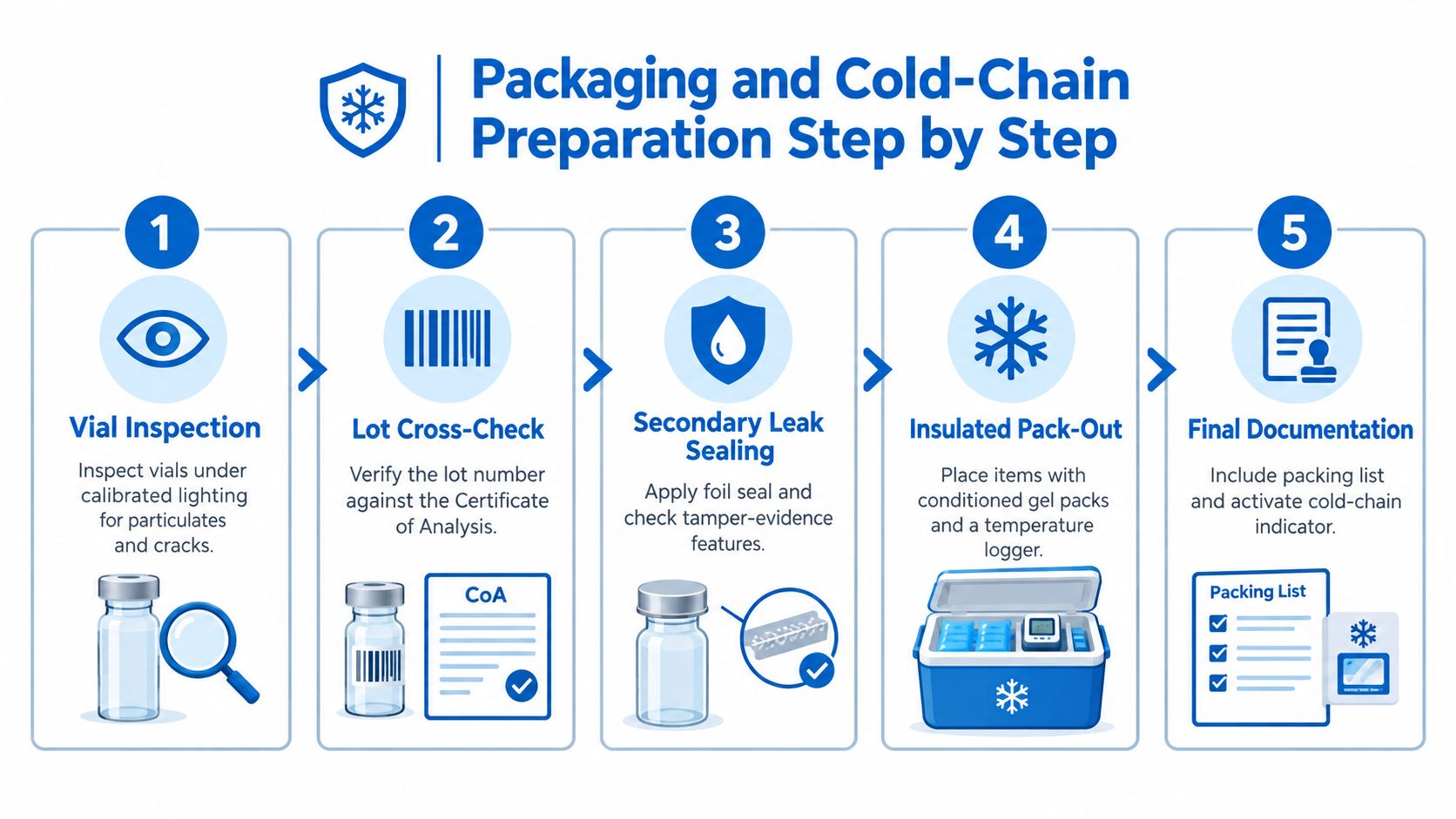
What the pack-out must control
For temperature-sensitive research materials, the team needs to classify the labeled storage range and stability limits, select qualified packaging and refrigerant capacity, define monitoring points, assign the lot, and dispatch within the validated handling window. WHO guidance states that transport temperature must meet applicable requirements and that stability data should establish acceptable excursion time. It also describes temperature-controlled systems with sensor accuracy of approximately ±0.5 °C and calibration against a certified, traceable reference standard at least annually unless another interval is justified. These requirements are described in the WHO transport guidance.
The practical sequence looks like this:
- Vial inspection: Staff check the container under suitable lighting for visible damage, cracks, or unwanted particulate matter.
- Lot cross-check: The vial label, order record, packing record, and COA are reconciled before the item enters the shipper.
- Secondary containment: The primary container receives appropriate leak protection and tamper-evident handling.
- Insulated pack-out: Conditioned coolant and insulation are positioned for the route, season, and labeled storage requirement.
- Monitoring and timestamps: A temperature logger or indicator is activated, and the handling record captures the relevant packing and dispatch events.
The reason for this discipline is simple. A short uncontrolled temperature excursion may not be visible when the parcel arrives, yet it can affect material integrity. Guidance on validated cold-chain packaging describes maintaining designated temperature ranges during transportation and storage, with conditions monitored and recorded throughout distribution.
A sealed container carries more than a vial. It carries the chain of custody for the laboratory's next experiment.
The packaging process can be reviewed in the following visual demonstration.
Shipping instructions, delivery exceptions, and return conditions should be confirmed before dispatch through the Pro Tec Pep shipping and returns information.
Realistic Timelines From Checkout to Carrier Handoff
A useful internal timeline starts at the moment payment or purchase-order authorization is recorded. Verification enters the queue first, followed by inventory and lot reconciliation, COA attachment, packaging preparation, quality sign-off, label creation, and carrier handoff. The supplier's stated 24-hour processing window applies to this internal sequence, while the carrier controls the next part of the journey.
The sequence can be understood without treating every order as identical. A straightforward order may move continuously through the queue. An order with a missing institutional detail, a destination exception, a stock discrepancy, a documentation question, or a temperature-sensitive requirement may need additional review before release.
| Stage | Time from checkout | Owner |
|---|---|---|
| Payment or purchase-order authorization | Start of processing | Payment or procurement team |
| Customer, destination, and eligibility review | Early internal queue | Order-management team |
| Inventory, SKU, quantity, and lot reconciliation | During processing | Inventory and fulfillment staff |
| COA retrieval and document linking | Before pack-out | Quality or documentation staff |
| Packaging and cold-chain preparation | Before release | Fulfillment and shipping staff |
| Final review and label creation | End of internal processing | Quality and shipping staff |
| Carrier scan and handoff | Processing complete | Carrier and shipping team |
| Transit to destination | After handoff | Carrier |
Processing time is measured from the confirmed request through dispatch. Transit time begins when the parcel is packed and transferred to the carrier. A tracking number may be created during the final internal stage, but the shipment hasn't necessarily entered carrier transit until a scan or handoff confirms movement.
For assay planning, the receiving milestone matters more than the label-creation event. A team can prepare the receiving area and review the storage instructions while the order is processing, but any schedule dependent on the material should account for carrier movement and the condition of the parcel on arrival.
When a Long Processing Status Is Normal and When to Act
A long processing status isn't automatically a service failure. It can represent a deliberate hold while staff reconcile a COA, investigate an inbound temperature excursion, confirm a replacement lot, correct an address, or complete an eligibility review. In these cases, waiting protects the laboratory from receiving an item that cannot be confidently identified or documented.
The more serious problem is an unexplained status. Buyers need to know whether the order is awaiting payment review, stock allocation, documentation, packaging, or carrier pickup. Fulfillment research highlights the value of visibility, with 94% of surveyed brands providing tracking information but only 6% offering real-time tracking, while 56% of consumers preferred SMS updates and only 12% of brands met that preference. Those figures come from the 2025 fulfillment visibility study, and they help explain why a clear milestone can matter as much as raw speed.
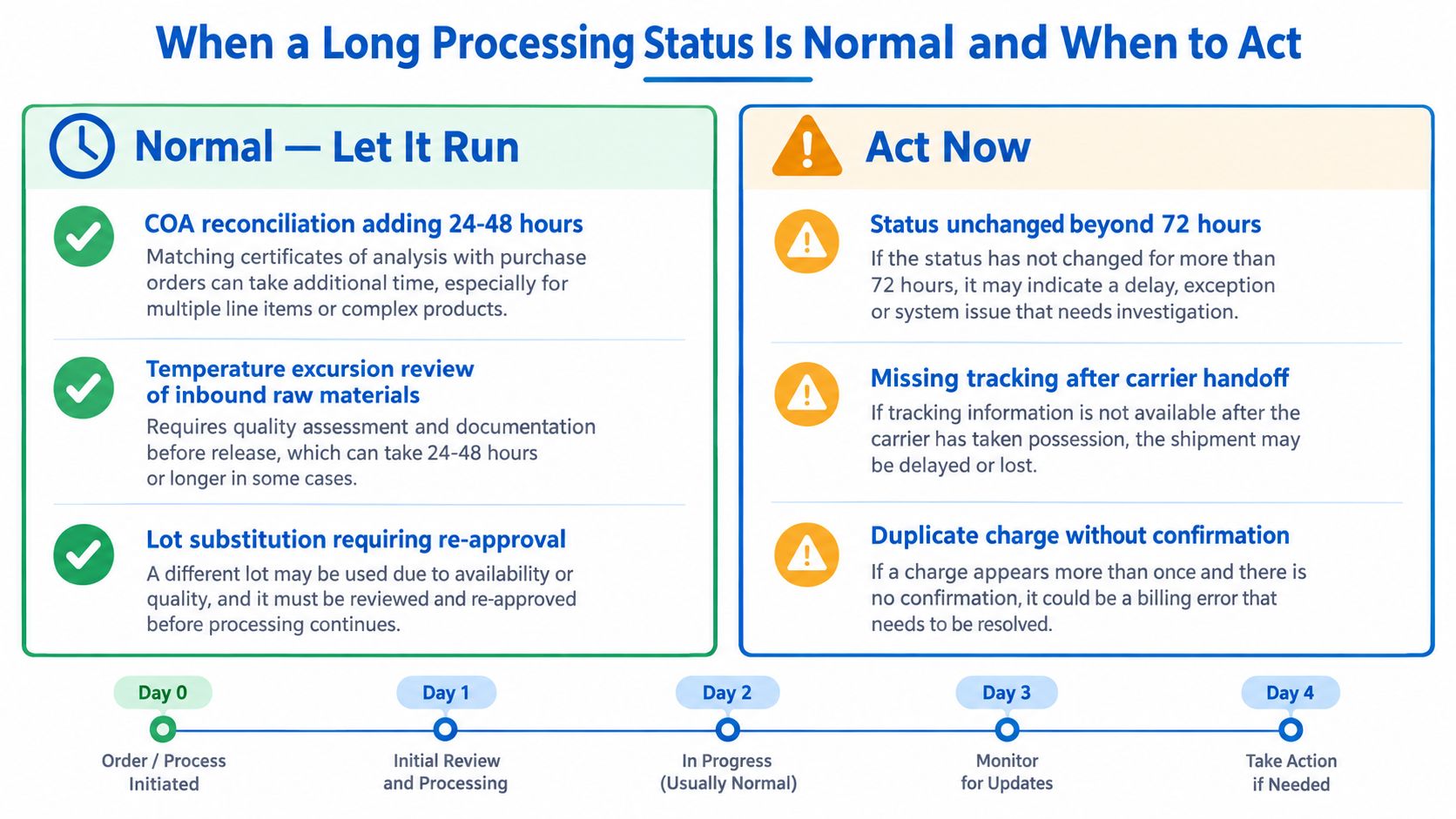
A practical escalation rule
The status should be treated as normal when the supplier can identify the active checkpoint and provide a realistic next milestone. Support should be contacted when the order passes the seller's published processing window, when payment is captured but no fulfillment milestone appears, or when a temperature-sensitive shipment may face avoidable delay.
The support request should include the order number, product name, destination, and any lot identifier already shown in the customer record. That information allows staff to locate the relevant audit trail without asking the laboratory to repeat the entire procurement history.
A protective hold has a reason. A stalled status has no explanation. The first calls for patience, the second calls for documentation.
A research team can plan calmly when the supplier distinguishes “order received,” “processing,” “ready to ship,” “shipped,” and “delivered.” The status becomes useful when each label corresponds to a completed checkpoint rather than a vague promise.
What to Verify on Receipt Before You Start an Experiment
The receiving inspection should begin as soon as the parcel arrives, before the material is moved into an experiment workflow. The laboratory should confirm four visible signals:
- Container integrity: The primary and secondary containers are sealed, intact, and tamper-evident.
- Lot identity: The vial label matches the printed or QR-accessible COA and the packing record.
- Cold-chain condition: The temperature indicator or logger shows no triggered excursion, when supplied.
- Documentation and labeling: The packing slip includes the research-use statement and any relevant storage or hazard pictograms.
Each check points back to an earlier processing stage. A missing COA may indicate a documentation or batch-linking failure. A mismatched lot points to inventory allocation or pack-out reconciliation. A triggered temperature indicator requires review of packaging preparation, monitoring records, and carrier handling rather than immediate incorporation into an experiment.
For temperature-sensitive materials, WHO guidance supports retaining evidence of time and temperature exposure and investigating excursions before release to laboratory work. The receiving team should quarantine a questionable parcel according to institutional procedures, record the condition, and contact the supplier while the order record and shipment documentation are available.
This final inspection closes the loop from checkout to bench. It confirms that the processing checkpoints produced a material with an identifiable lot, usable documentation, intact packaging, and a condition appropriate for the laboratory's documented handling workflow.
Pro Tec Pep offers research-use-only compounds with batch-linked documentation, order processing targeted within 24 hours, and optional cold-chain handling for temperature-sensitive materials. Research teams can review the fulfillment and documentation approach, then visit Pro Tec Pep before placing the next laboratory order.