What Are Research Peptides and How Labs Source Them
What are research peptides? Learn how labs define, verify, and source research-use-only peptides, including COAs, purity testing, and compliance basics.

Research peptides are synthetic, laboratory-grade peptide chains used as analytical standards or investigational reagents. They aren't approved for human use and are sold strictly for in-vitro research, generally under Research Use Only, or RUO, labeling.
So, what are research peptides when a supplier's product page makes a strong purity claim but provides no lot-specific evidence? The practical answer is that the label alone isn't enough. A peptide becomes a defensible laboratory reagent only when the receiving lab can connect the material to a defined sequence, a documented batch, suitable analytical testing, and handling conditions that preserve its identity before the first assay.
Peptide research also sits inside a mature therapeutic field. Insulin became the first FDA-approved peptide drug in 1923, and the field had grown to more than 100 globally approved peptide-based drugs by 2026, according to a peer-reviewed review of peptide therapeutics. That history gives research laboratories a substantial scientific foundation, but it doesn't turn every catalog peptide into a medicine.
Defining Research Peptides for Laboratory Use
A research peptide is a short, synthetic chain of amino acids manufactured under controlled conditions for a defined laboratory purpose. Common applications include analytical calibration, antibody validation, receptor-binding experiments, cell-based assays, structural studies, and method development. The material is a reagent, not a consumer product.
Most catalog peptides contain roughly 2 to 50 amino acids, while longer chains are generally treated as proteins rather than peptides, as described in this peptide classification overview. A full-length recombinant protein may require folding, disulfide-bond formation, glycosylation, or other post-translational features. A synthetic peptide may represent only a short epitope or signaling sequence from that larger biological system.
What a peptide does at the bench
A postdoctoral researcher might order a peptide for several unrelated reasons:
- Antibody validation: A sequence matching an antibody epitope can help determine whether binding depends on the intended region.
- Mass-spectrometry calibration: A defined peptide can provide a reference signal during assay development and instrument qualification.
- Receptor studies: A synthetic ligand can help characterize binding, competition, or downstream signaling in an in-vitro system.
- Method development: A peptide can serve as a test analyte for chromatography, extraction, or quantification workflows.
Those applications require different specifications. A peptide intended for mass spectrometry may need a well-characterized mass and sequence. A cell assay may require additional attention to counter-ions, endotoxin, sterility, solvent compatibility, and aggregation.
“Research grade” is therefore best treated as a procurement and documentation designation, not proof that a compound will produce a desired biological response. A supplier may provide a high reported chromatographic purity while the receiving lab still needs to confirm sequence, content, solubility, and suitability for its model.
Practical rule: The lab purchasing the material remains responsible for deciding whether the documentation supports the planned experiment.
Research peptides aren't dietary supplements, cosmetics, or approved therapeutics. They are supplied for laboratory research, and RUO language sets a boundary around intended use. That distinction matters especially for compounds whose names also appear in clinical or consumer discussions. A catalog entry can describe a molecule's research history without establishing approval, human safety, or therapeutic effectiveness.
Major Categories of Research Peptides and Related Compounds
A procurement list becomes easier to audit when the compounds are sorted by molecular structure rather than by catalog marketing language. Linear peptides have an open chain, while cyclic peptides contain a ring formed through a bond between termini, side chains, or other structural points. Cyclization can alter conformation, stability, solubility, and receptor interaction, so the structure must match the experimental design.
Modified peptides add a deliberate chemical feature. Biotinylated peptides support capture or detection workflows, fluorescently labeled peptides help track localization or binding, and PEGylated variants alter physical behavior and may change circulation or aggregation characteristics in relevant models. A fluorescently tagged cell-penetrating peptide isn't analytically equivalent to the same sequence supplied without the dye. The attached label changes molecular mass and can affect uptake, charge, and assay background.
Peptide mimetics are related but aren't necessarily peptides in the strict structural sense. They may reproduce a peptide's binding geometry or functional motif using altered backbones, non-standard residues, or small-molecule scaffolds. A supplier may place them in a peptide catalog because they target the same receptor or support the same research program.
Adjacent compounds need separate treatment
Catalogs often group chemically different materials together for convenience. HCG is a hormone, not a peptide, while NAD+ is a coenzyme, not a peptide. Steroid hormones, nucleoside analogs, and non-peptidic receptor ligands may appear beside peptide products because they belong to the same biological pathway, not because they share the same molecular class.
Oxytocin, by contrast, is a true nonapeptide, meaning it contains nine amino acids. A steroid hormone has a different chemical framework, so its solubility, storage, assay preparation, and analytical methods won't follow the same assumptions. A small-molecule dye conjugate also differs from a peptide carrying a covalently attached fluorescent label, even if both are used in imaging.
| Category | Typical Structure | Common Modifications | Primary Lab Use |
|---|---|---|---|
| Linear peptide | Open amino acid chain | Terminal caps, non-standard residues | Binding assays, standards, epitope studies |
| Cyclic peptide | Ring-shaped or conformationally constrained chain | Head-to-tail closure, side-chain linkage | Receptor studies, structure and stability work |
| Modified peptide | Peptide backbone with an attached chemical group | Biotin, fluorophore, PEG, lipid | Detection, capture, localization, delivery studies |
| Peptide mimetic | Peptide-like scaffold or altered backbone | Non-standard backbones, constrained analogs | Structure-activity and ligand research |
| Related hormone | Non-peptidic or peptide hormone, depending on molecule | Salt forms, conjugates | Endocrine and receptor pathway studies |
| Coenzyme or small molecule | Non-peptide molecular framework | Salt forms, isotopic labels | Metabolism, enzymology, analytical controls |
Before an order is approved, the researcher should check the formal chemical identity, sequence, molecular formula, molecular weight, CAS number, and formulation state. That simple taxonomy prevents a common procurement error, ordering a biologically related molecule while assuming it will behave like the peptide named in the protocol.
Reading COAs, Sequences, and CAS Numbers
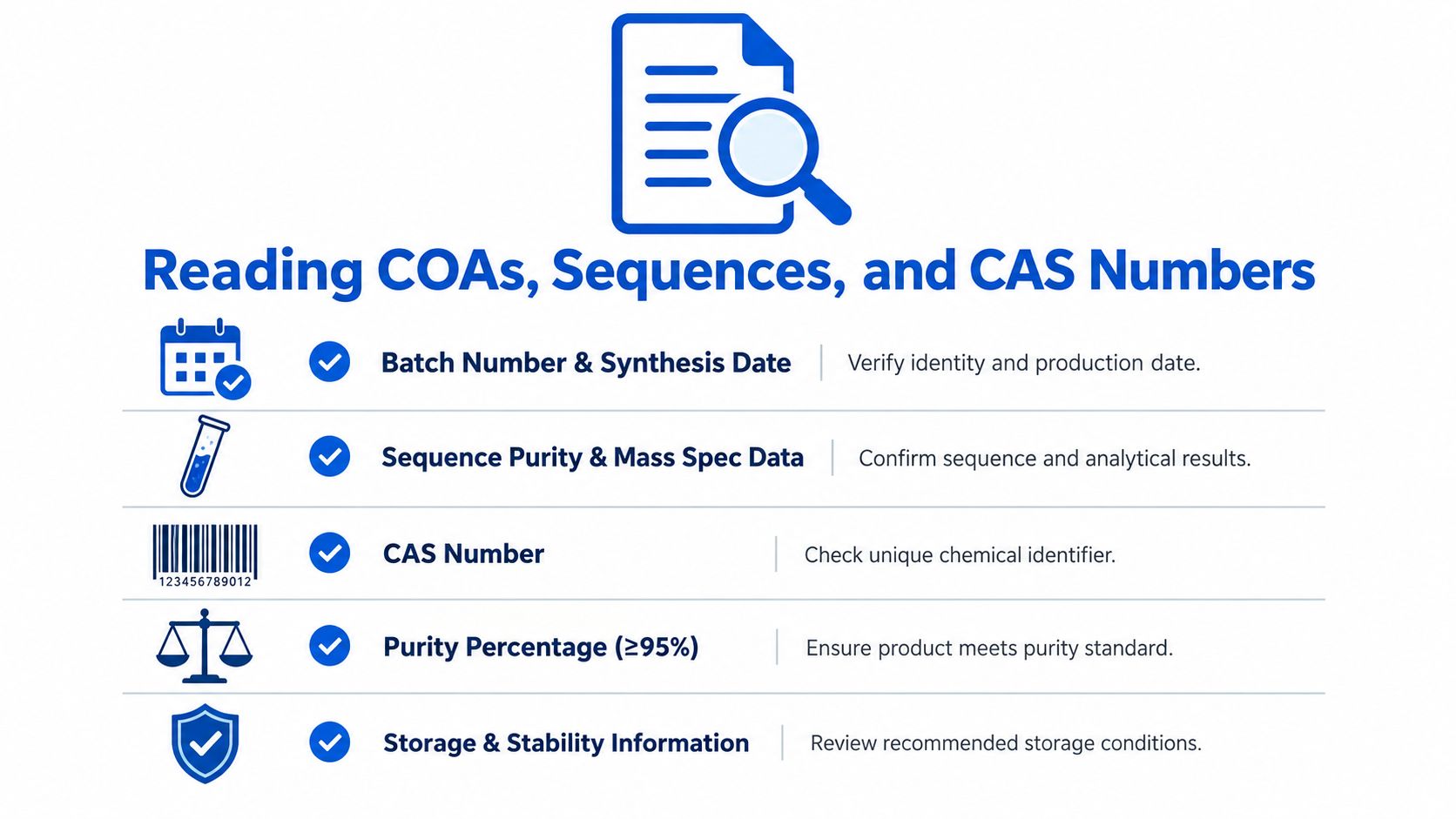
A credible shipment should arrive with documentation tied to the actual material, not a generic example from an earlier production run. A batch-specific Certificate of Analysis, or CoA, should identify a unique lot or batch number, testing date, analytical method, and result. Batch verification guidance specifically distinguishes lot-linked records from “sample COA” or “typical result” documents.
The first check is administrative. The lot number on the vial, packing record, and CoA should match exactly. The record should also show the synthesis date or testing date, formulation state, counter-ion, net peptide content, gross weight, and storage conditions. Gross weight includes the peptide plus salts, water, residual solvents, or other material. Net peptide content is the figure that matters when preparing a concentration for an assay.
Match the molecular specification
The sequence on the CoA should match the purchase specification character by character. Terminal amidation, acetylation, phosphorylation, lipidation, disulfide formation, and non-standard residues aren't cosmetic details. Each can change molecular mass, charge, conformation, solubility, and biological interaction.
A CAS number adds another identity check, but it shouldn't replace sequence review. The number should resolve to the same molecular entity in a public chemical database such as PubChem or ChemSpider. If the CAS record points to a different salt, stereoisomer, or unrelated compound, the discrepancy should be resolved before the lot enters an assay.
Documentation rule: A CoA is a snapshot of one batch. It isn't a blanket guarantee covering every lot the supplier has sold.
The analytical section deserves close reading. RP-HPLC commonly estimates chromatographic purity, often with UV detection at 214 or 220 nm, while mass spectrometry helps confirm molecular mass and supports identity assessment, as explained in this research peptide analytical quality-control guide. Missing chromatograms, purity values without method details, and CAS numbers that resolve to another molecule are all reasons to pause.
The receiving lab should archive the CoA, sequence, raw chromatograms when available, mass data, order record, and storage instructions. That file supports internal audits, repeat experiments, and publication supplements. It also gives the lab a defensible record if a later result appears inconsistent with an earlier lot.
How Labs Evaluate Peptide Purity and Identity
Purity and identity answer different questions. HPLC purity asks how much of the detected chromatographic material appears in the expected peak pattern. It doesn't prove that the sequence is correct, and it doesn't establish the amount of actual peptide in the vial. A separate identity method and a content measurement are necessary.
A credible supplier typically supplies batch-specific chromatograms and mass-spectrometry confirmation. A questionable record may show only a bold purity statement, with no chromatogram, no retention-time information, no detector details, and no explanation of whether the value refers to gross material or net peptide.
Three measurements, three purposes
- RP-HPLC: Separates the main peptide from related sequences, deletion products, oxidation products, and other chromatographically distinct material.
- Mass spectrometry: Checks whether the measured molecular mass aligns with the specified sequence and modifications.
- Amino acid analysis or content testing: Helps quantify the actual peptide amount rather than relying only on the mass of the entire vial contents.
The counter-ion also matters. TFA and acetate salts can affect mass calculations, pH, conductivity, solubility, and the behavior of cell-based systems. A result that looks acceptable by chromatographic percentage may still require adjustment if the material contains a counter-ion that influences the planned assay.
| Documentation Element | Credible Supplier | Questionable Supplier |
|---|---|---|
| Batch identity | Unique lot number appears on the vial and CoA | Generic document with no matching lot |
| Purity evidence | Batch chromatogram with method and detector details | Purity claim without raw or supporting data |
| Identity evidence | Mass-spectrometry result linked to the same lot | Sequence listed without analytical confirmation |
| Content | Net peptide content distinguished from gross weight | Total vial weight presented as peptide amount |
| Counter-ion | TFA, acetate, or another salt form clearly stated | Formulation omitted |
| Retention data | Expected and observed retention information available | No retention-time context |
| Orthogonal testing | Multiple methods support the same identity | One unqualified purity value carries the entire claim |
The receiving scientist should compare the sequence, expected mass, observed mass, HPLC profile, and content result as one evidence set. No single number can substitute for that cross-check. A defensible lot approval process records the decision, the reviewer, the date, and any deviations accepted for the specific experiment.
Storage, Reconstitution, and Cold-Chain Realities
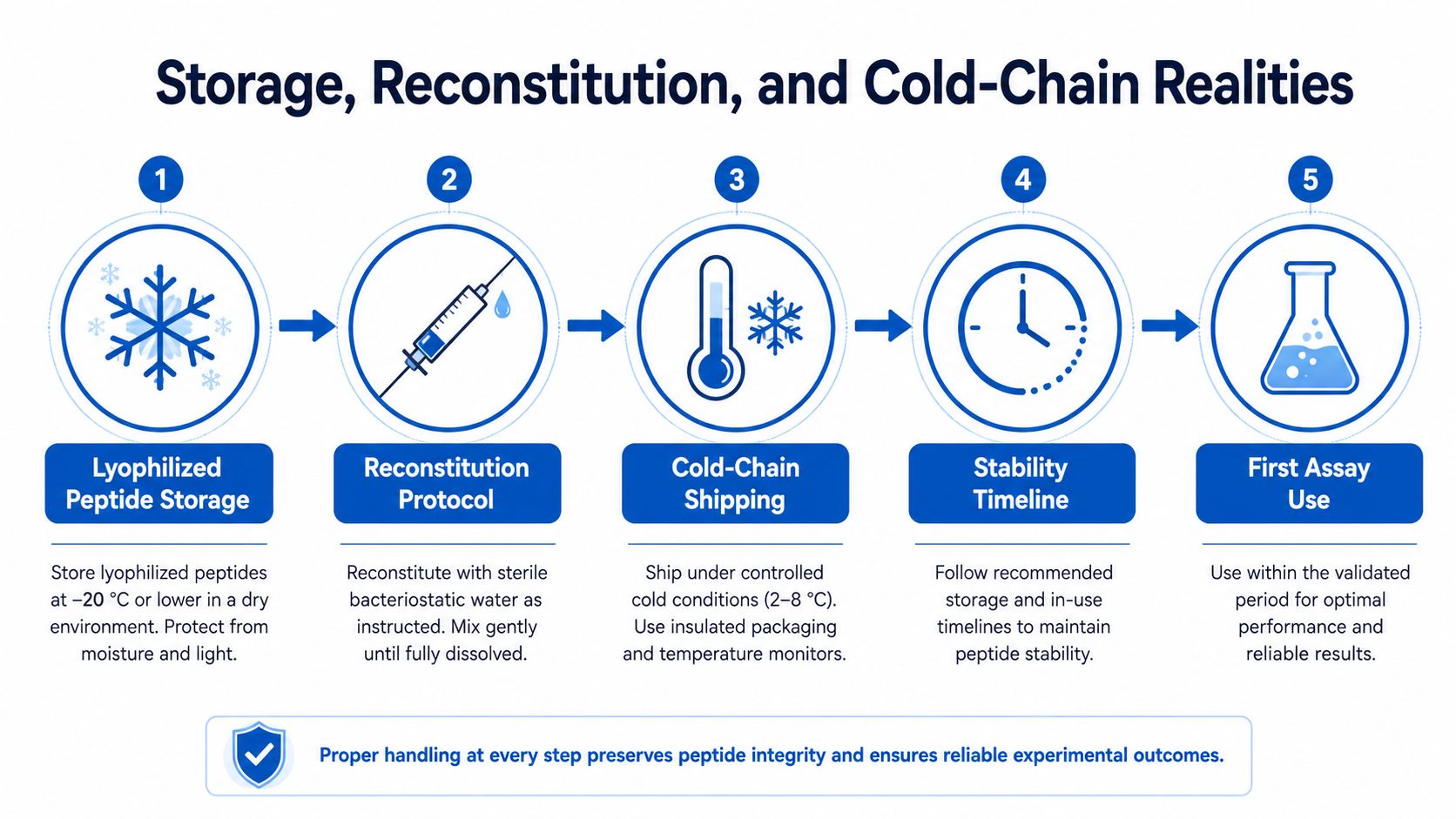
Peptide stability often depends more on moisture and temperature exposure than on a short period of ambient transit. Dry, sealed lyophilized powders can often tolerate weeks at room temperature, while longer-term storage is commonly assigned to 2 to 8°C for short-term work and approximately −20°C for archival storage, according to cold-chain and peptide shipping guidance.
A second storage reference recommends frozen handling near −20°C, with −80°C reserved for longer archival storage of sensitive sequences. Once a peptide is reconstituted for laboratory sample preparation, solutions are generally kept at 2 to 8°C, protected from light and contamination, as described in this peptide storage and stability guide.
Handling decisions affect assay quality
The lab should inspect the vial on arrival, confirm that the seal and label are intact, and record the received condition before moving the material into assigned storage. Desiccation is important because moisture can accelerate degradation in a dry powder. Oxygen and light also matter for oxidation-sensitive residues such as methionine, cysteine, and tryptophan.
Reconstitution is sample preparation, not an administration procedure. The solvent should match the peptide's chemistry and the downstream assay. Hydrophobic sequences may require a compatible organic cosolvent before dilution, while charged or water-soluble sequences may behave differently. The final concentration should be calculated from verified net peptide content, not gross vial weight.
Repeated freeze-thaw cycling can reduce reproducibility in reconstituted solutions. Smaller working aliquots, limited handling, clear labeling, and a recorded preparation date help the lab maintain a consistent stability timeline. Supplier packaging, desiccant, sealed vials, and temperature-controlled shipping all reduce exposure risk, but receiving staff still need to document the handoff.
A short visual guide to the workflow appears below.
The first assay should occur only after the lot, storage history, preparation details, and acceptance criteria have been recorded. If a result is unexpected, the handling record gives the laboratory a way to distinguish biological variation from degradation or preparation error.
Research Use Only Labeling and Regulatory Boundaries
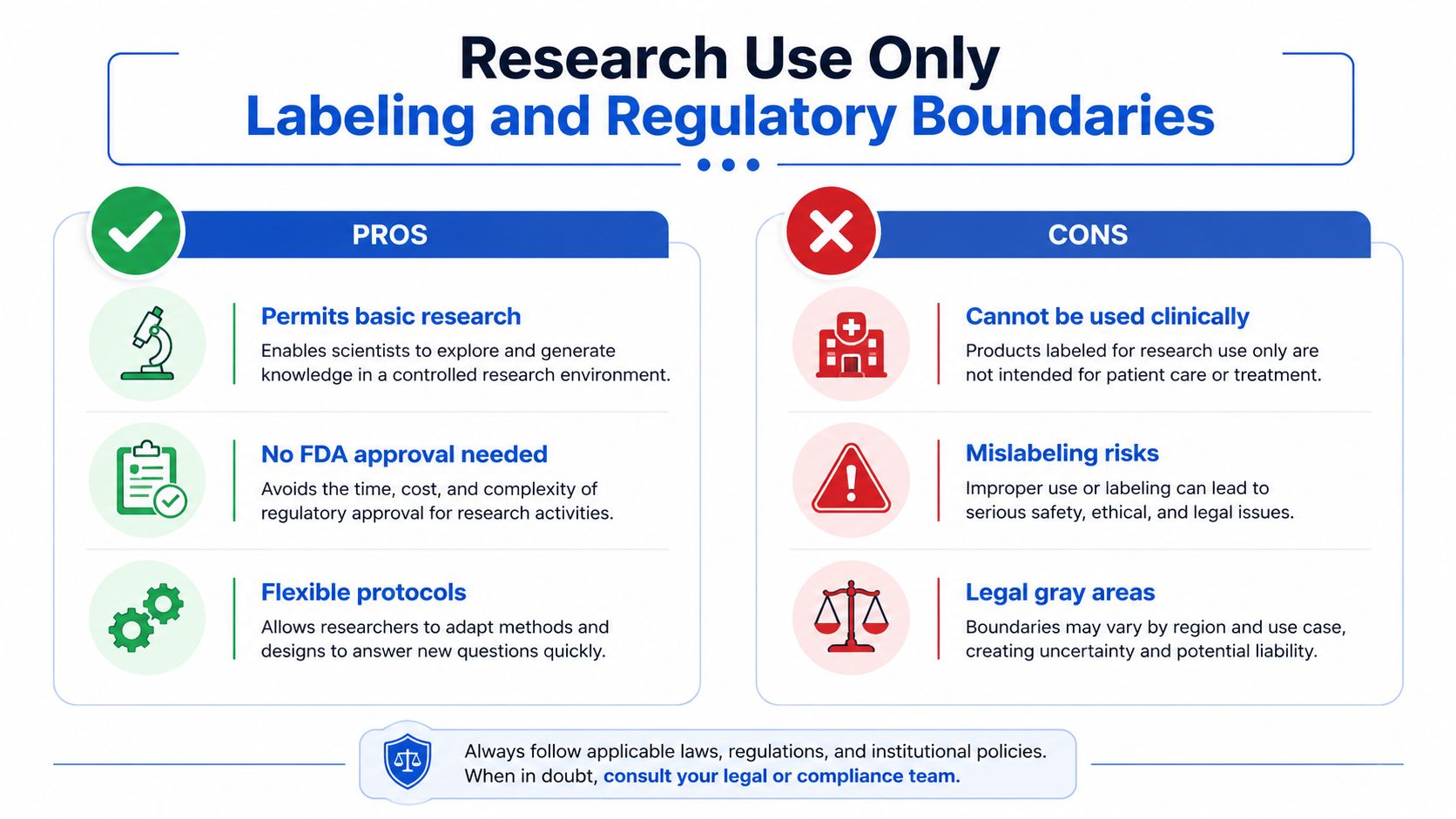
What does an RUO label tell a laboratory? It defines intended use. A research-use-only material is not approved, cleared, or intended for human diagnostic or therapeutic use. The institution that purchases it remains responsible for procurement, storage, records, and approved laboratory work.
Research peptides lack FDA approval for human use and may have limited human safety evidence. Their regulatory treatment can depend on intended use and promotional claims, not only on the wording printed on the vial. Laboratories should review current agency notices and applicable institutional requirements rather than rely on a commercial summary of the US peptide regulatory framework. The linked overview can provide context, but it should not substitute for an authoritative regulatory record.
The label doesn't override the marketing
A supplier may discuss receptor activity, assay applications, or published research while keeping a compound within a laboratory-only designation. Marketing creates a compliance concern when it implies clinical outcomes, gives administration instructions, uses testimonials, or makes disease claims. Those messages can conflict with the RUO label and affect how the product is understood and used.
Purchasing teams should send uncertain orders to the appropriate compliance office, biosafety review process, or institutional authority. The exact workflow differs by organization, but these checks remain useful:
- Intended use: Is the material limited to an approved in-vitro or analytical workflow?
- Documentation: Does the lot have a matching CoA and defined molecular identity?
- Communication: Does the supplier avoid human-use instructions and therapeutic claims?
- Recordkeeping: Can the lab retain order, storage, testing, and disposal records?
“Research peptide” covers products with different documentation and quality standards. RUO status marks a compliance boundary. It does not verify batch identity, purity, sterility, biological activity, or human safety. Those properties require separate analytical evidence and documented review.
Choosing a Credible Research Peptide Supplier
How can a laboratory tell whether a peptide supplier supports reproducible work rather than offering a low price? Start with records tied to the specific batch. The file should include a batch-specific CoA, complete sequence, CAS number, formulation state, storage guidance, and analytical methods that an experienced reviewer can assess. It should also separate net peptide content from total vial weight and show how identity and purity were established.
A practical procurement screen
Use the following checks before placing an order:
- Lot traceability: The CoA identifies the exact batch being shipped.
- Analytical support: HPLC and mass-spectrometry results are available for that lot.
- Chemical clarity: Sequence, modifications, counter-ion, CAS number, and molecular formula agree across the records.
- Contamination controls: The quality panel addresses relevant risks, including sterility, endotoxin, heavy metals, and residual process impurities.
- Logistics: Packaging, desiccation, temperature handling, and solution or lyophilized format suit the material's stability requirements.
- Service records: The lab records response time, document retrieval, shipping updates, and correction procedures as part of supplier evaluation.
A receiving lab should verify the material independently when the assay warrants it. One practical workflow is to order a small qualification batch, run an in-house HPLC or mass-spectrometry check, compare the observed data with the supplier's records, and document whether the lot meets predefined acceptance criteria. The goal is not to repeat every supplier assay. It is to confirm that the material performs as specified in the laboratory's workflow.
A multi-parameter testing framework covering purity, identity, and contaminants from an independent peptide program describes testing for purity, net peptide content, identity, appearance, fentanyl, heavy metals, sterility, and endotoxin. Other panels may focus on identity, purity, residual solvents, and endotoxin. The appropriate scope depends on the assay. A single purity percentage cannot establish batch suitability by itself.
Pro Tec Pep offers research-use-only synthetic peptides and related molecules, with product specifications, batch-linked CoAs, third-party testing for identity, purity, net content, sterility, endotoxins, heavy metals, and conformity, as well as optional cold-chain shipping for temperature-sensitive materials. Labs can compare these records with their qualification criteria and institutional purchasing requirements.
Lot-to-lot consistency usually matters more than the lowest price per milligram. Traceable documents and dependable logistics support repeat assays, troubleshooting, audits, and accurate publication reporting.
Laboratories seeking batch-verified research compounds, accessible documentation, and logistics suited to bench workflows can review the catalog and qualification information from Pro Tec Pep. Before ordering, match the lot's sequence, analytical record, storage requirements, and RUO status to the institution's approved protocol.