Water Purity Test Levels: Lab Grades for Research
Master water purity test levels for lab research. Learn ASTM Type I, II, III specs and how resistivity and TOC impact peptide assays.
What level of water purity is necessary for a research peptide workflow, and what does a “pure” result leave unmeasured? A drinking-water test may indicate that water meets a public-health requirement, yet still provide too little information for reagent preparation, peptide reconstitution, trace analysis, or cell-culture-adjacent work.
Laboratories need to match water purity test levels to the sensitivity of the experiment. The right question isn't whether water is clean. It's whether the water has controlled ionic, organic, microbial, particulate, and contaminant characteristics for the specific assay.
Understanding Water Purity Test Levels
Water purity test levels describe measurable properties of water against a defined grade or application standard. They don't represent one universal scale. A water sample can perform well in a microbiological test while still containing ions, organic carbon, metals, or particulates that matter in analytical research.
The modern regulatory history helps explain this distinction. In the United States, drinking-water purity testing began to standardize federally in 1914, when the U.S. Public Health Service established bacteriological standards. The framework expanded through the Safe Drinking Water Act in 1974, interim national standards in 1975, and national primary standards in 1985, moving from simple bacterial limits toward broader microbiological, chemical, and treatment-performance criteria, as described in the EPA historical summary of drinking-water standards.
The three primary laboratory grades
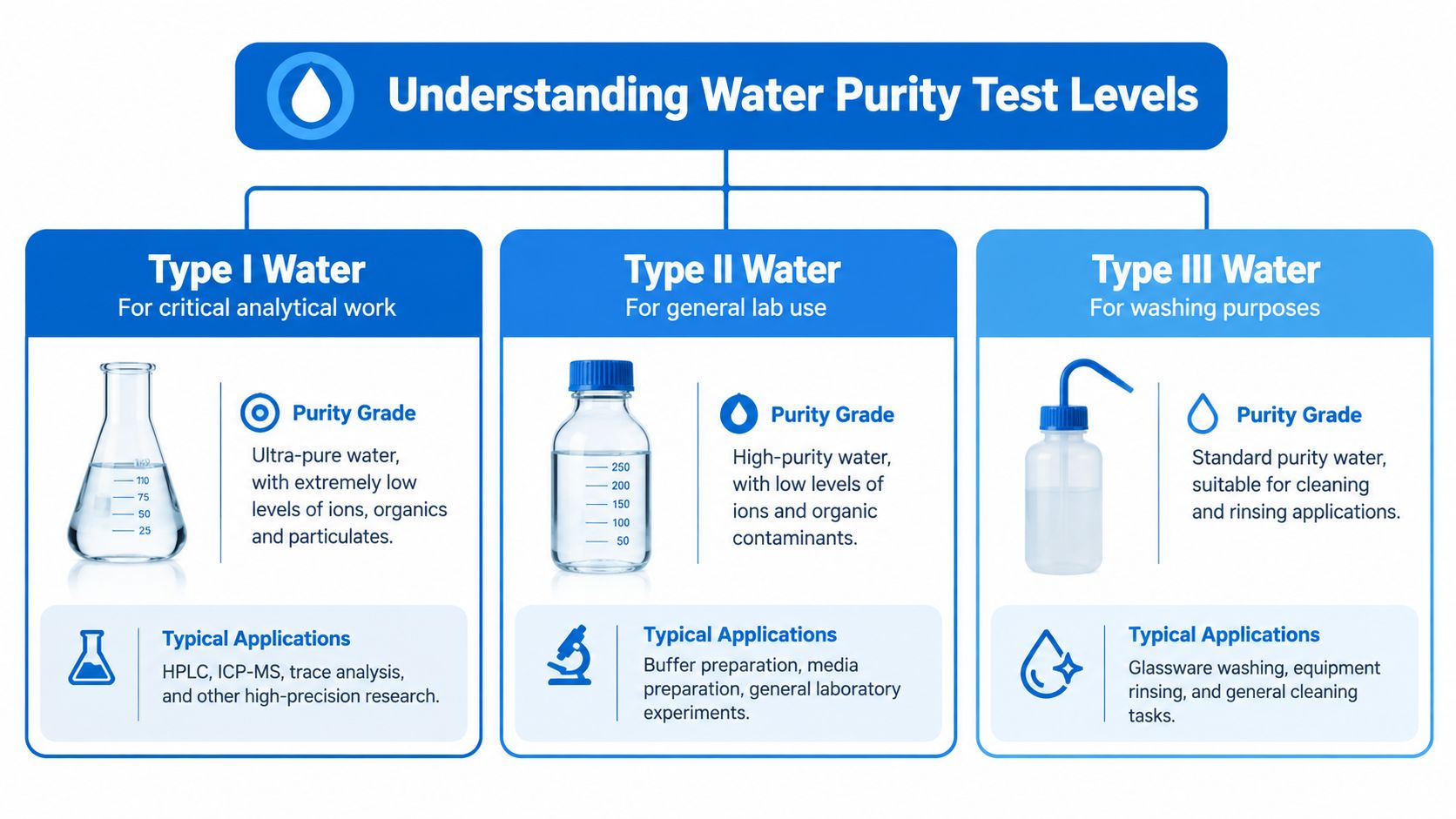
Type I water is intended for the most contamination-sensitive work. It's the reference grade for trace analytical procedures, reagent preparation, and workflows where low ionic or organic background is important.
Type II water provides a lower purity level for general laboratory operations. It can be appropriate when the procedure isn't highly sensitive to trace contaminants, but the specific method should determine whether its characteristics are acceptable.
Type III water is a practical utility grade for activities such as preliminary washing, rinsing, and other tasks where the water doesn't become a critical reagent.
The choice should follow the downstream risk. Over-specifying Type I water for every task increases operating burden and may waste a tightly controlled resource. Under-specifying water for a sensitive assay can introduce unexplained variation that later appears to be a peptide, instrument, or protocol problem.
Laboratories can document the intended grade, confirm the supplier's specifications, and review the water record before preparing critical solutions. Researchers evaluating compound documentation and laboratory materials can also consult the research testing information as part of a broader quality-control process.
ASTM Type I Water Specifications
How do you know Type I water is suitable for peptide research rather than merely clean enough for routine laboratory use? The answer requires more than one reading. Resistivity, conductivity, and total organic carbon describe different contamination risks, so none should be treated as a complete purity assessment.
ASTM D1193 Type I water is typically specified at a minimum resistivity of 18 MΩ·cm at 25 °C, maximum conductivity of 0.056 µS/cm, and maximum TOC of 50 µg/L. These limits are documented in the laboratory water guidance from NIST.
| Parameter | Limit |
|---|---|
| Resistivity | ≥18 MΩ·cm at 25 °C |
| Conductivity | ≤0.056 µS/cm at 25 °C |
| Total organic carbon | ≤50 µg/L |
What the measurements reveal
Resistivity and conductivity track ionic contamination from opposite directions. As dissolved ions increase, conductivity rises while resistivity falls. Conductivity therefore provides a practical, continuous signal for detecting changes in ionic purity, particularly at a point-of-use system.
TOC measures a different problem. Organic compounds may contribute little ionization, allowing water to show an acceptable conductivity reading while still carrying organic material. That distinction matters in peptide work, where water becomes part of buffers, standards, diluents, or assay mixtures. The CASRAI summary of ASTM D1193 Type I water notes that resistivity does not detect organic contamination, bacteria, endotoxin, or particulates. ASTM Type I specifications also include controls for substances such as sodium, chloride, and silica.
Thermo Fisher describes ultrapure water using resistivity greater than 18.18 MΩ·cm at 25 °C and conductivity of 0.055 µS/cm at 25 °C, values associated with the thermodynamic ceiling for pure water, as stated in its conductivity measurement guidance. These figures provide useful reference points, but resistivity alone cannot establish suitability for peptide preparation or an assay.
Production matters as much as the label
Type I water usually comes from a treatment train that may combine reverse osmosis, deionization, ultraviolet treatment, ultrafiltration, and final point-of-use filtration. Each stage targets a different impurity class, and the final grade depends on the system and its operating condition.
For peptide research, review the grade specification alongside current readings, maintenance records, storage conditions, and sampling practice. A bottle or reservoir can meet its production specification and later become compromised through repeated opening or contact with unclean equipment.
Practical rule: A Type I label sets the target. Current resistivity, conductivity, TOC, filtration, storage, and sampling records show whether the water is suitable at the moment of use.
Comparing Type II and Type III Grades
Which water grade fits the operation, and when does a lower grade create avoidable risk? Type I water is not the right choice for every laboratory task. Type II and Type III grades provide controlled water for work that does not require ultrapure production, allowing laboratories to match water quality with actual experimental needs.
The NIST summary of reagent-water grades describes Type I conductivity of 0.056 µS/cm maximum and resistivity of 18 MΩ·cm minimum at 25 °C as ultrapure reference values. Type II and Type III allow broader specifications. Those grades can be appropriate, but the method must define the acceptable impurity background.
Matching the grade to the operation
Type II suits general laboratory work when trace ions and organic residues are unlikely to control the result. Typical uses include preparing noncritical solutions and some microbiological procedures. For peptide research, check whether the water enters a buffer, diluent, standard, blank, or sample preparation. If it does, the method's validation requirements should determine whether Type II is acceptable.
Type III functions primarily as utility water. It can support initial glassware washing, preliminary rinsing before a higher-purity rinse, and other support tasks where water does not become part of the assay. It should not be used for trace-sensitive peptide preparation unless the procedure specifically permits it.
Drinking-water tests do not answer these laboratory questions. They may address suitability for consumption, but they do not establish whether water will introduce a tolerable ionic, organic, particulate, or microbial background into a reagent or peptide assay.
| Grade | Relative purity | Typical decision |
|---|---|---|
| Type I | Highest laboratory purity | Critical analytical work and contamination-sensitive reagent preparation |
| Type II | Intermediate purity | General laboratory operations where the method permits broader limits |
| Type III | Utility grade | Washing, preliminary rinsing, and noncritical support tasks |
Using Type I for every wash can increase treatment and maintenance demands without improving the experiment. Using Type III in a sensitive preparation can add background variation that is difficult to trace.
Start purchasing decisions with a written application map. Each method should specify the minimum water grade, monitoring data, and conditions requiring replacement or requalification.
Impact on Peptide Preparation and Assays
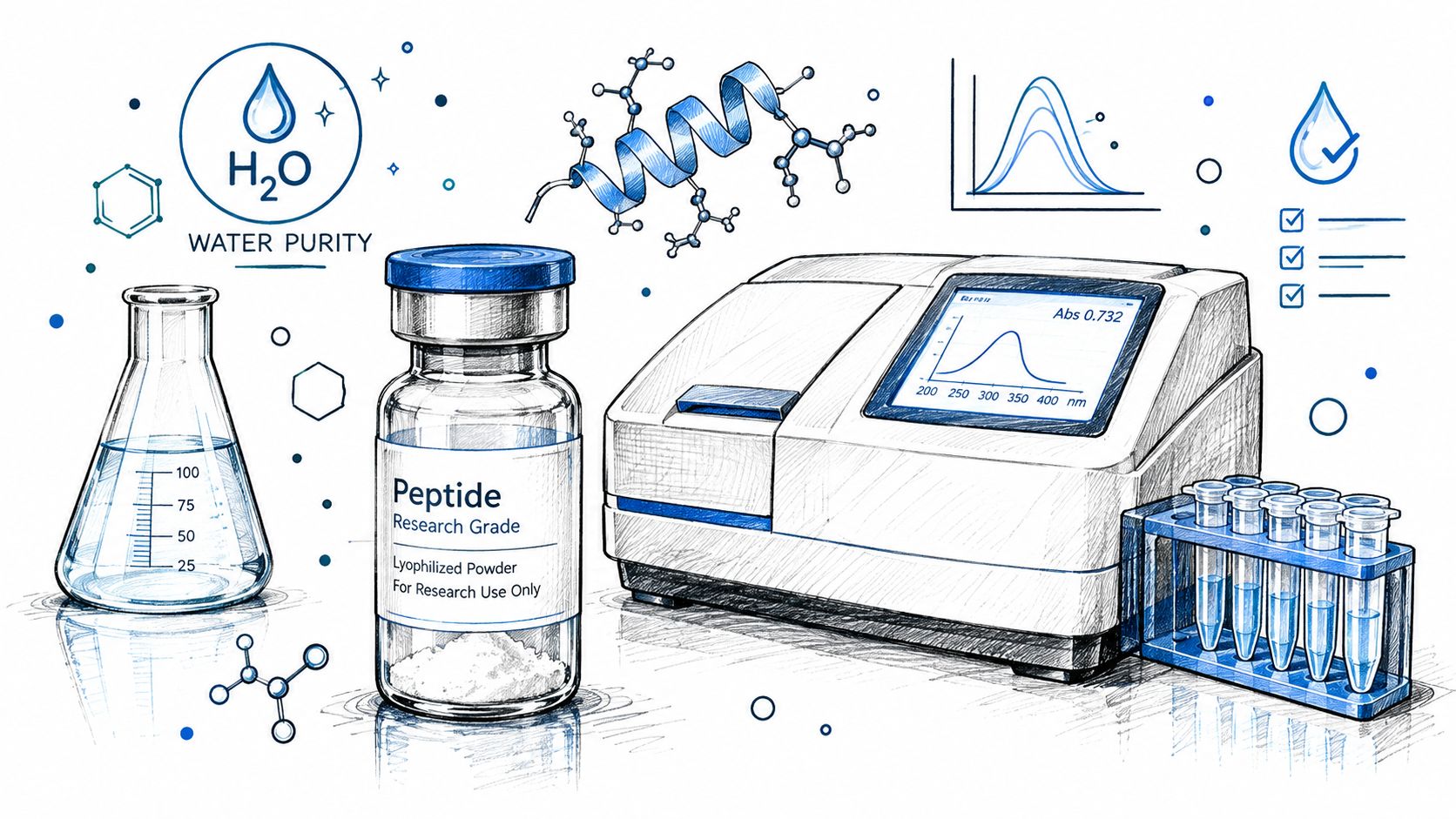
Peptide research makes water quality a control variable, not a housekeeping detail. Water enters buffers, diluents, standards, blanks, rinse solutions, and sample-preparation steps. Any uncontrolled contribution can affect the interpretation of a result, particularly when the assay measures low concentrations or relies on mass spectrometry, chromatography, or cell-based readouts.
Where contamination enters the workflow
Ionic contamination can change buffer conditions and contribute to unstable baselines or unexpected interactions with analytical systems. Organic contamination can increase background signals, complicate blank interpretation, or interfere with detection when the target material is present at a low level.
Microbial contamination presents a separate concern. Bacteria, particulates, and related residues can affect cell-culture-adjacent work and can compromise a preparation even when conductivity appears acceptable. Many laboratory-water guides associate Type I water with 0.2 µm final filtration, a control intended to reduce microbial particulates in low-background applications, as discussed in guidance on laboratory water grades.
The same principle applies to research compounds such as BPC-157 or Retatrutide. The material's identity and purity don't eliminate the need to control the water used in sample preparation. If the water contributes ions, organics, particulates, or microbial residues, a later assay may reflect the preparation environment rather than the compound alone.
A laboratory should therefore treat water as a documented reagent. Records can include the system reading at collection, TOC results where relevant, container identity, collection date, storage conditions, and the analyst responsible for preparation.
The practical value of this approach becomes clearer when researchers review compound identity, purity, and handling information alongside water controls. A research compound library can help organize material-specific information, but it doesn't replace method-specific water qualification.
The following video provides visual context for laboratory water purification and analytical control:
What works and what doesn't
A reliable workflow uses the highest practical grade at the points where water directly affects the assay. It doesn't assume that every water contact requires the same specification.
What doesn't work is treating “distilled,” “filtered,” or “clear” as complete quality descriptions. Those labels may describe a production step or visual condition, not the full ionic, organic, microbial, and particulate profile needed for a sensitive peptide experiment.
Why Standard Tests Are Not Enough
A single water test answers a narrow question. A bacteria test doesn't rule out lead, and a lead result doesn't reveal nitrate. TDS and pH can provide useful operational context, but they can't establish the absence of microbial contamination, metals, PFAS, pesticides, volatile organic compounds, or other untested hazards, according to independent water-testing guidance.
That limitation matters because “pass” and “fail” language can hide the analyte-specific nature of water quality. A sample may pass one test while remaining unsuitable for a particular laboratory application. The meaningful question is always which contaminant class was measured, from which sample type, with what detection limit, and against which standard.
Drinking-water compliance has a different purpose
WHO guidance uses microbiological absence as a central benchmark. E. coli or thermotolerant coliform bacteria must not be detectable in any 100 mL sample, and the guidance recommends a free chlorine residual of at least 0.5 mg/L after 30 minutes of contact time at pH below 8.0, with at least 0.2 mg/L at the point of delivery, as described in the WHO drinking-water guidance.
Those criteria are designed to manage drinking-water risk across distribution systems. They don't define the low-organic, low-ionic, low-particulate requirements of reagent water. Chlorine residual, for example, may support public-health disinfection while being unsuitable for a preparation that requires ultrapure water.
A drinking-water result can be reassuring for its intended purpose and still be inadequate for a sensitive laboratory method.
Researchers should avoid replacing a water-grade specification with a general-purpose test. The test panel needs to follow the assay risk, not the convenience of the meter or strip already available in the laboratory.
Emerging Contaminants and Lab Standards
Water-quality criteria continue to change because monitoring programs identify contaminants that older standards didn't address. Pennsylvania environmental guidance states that contaminants of emerging concern often lack associated water-quality criteria, making them difficult to limit, as explained by the Pennsylvania Department of Environmental Protection.
For laboratories, the issue isn't limited to drinking-water compliance. A source can meet an established specification while still requiring additional controls for a method sensitive to a newer or poorly characterized contaminant class. PFAS, manganese, cyanotoxins, nitrate, arsenic, and bacteria may appear within expanded monitoring programs, but no single panel provides universal coverage.
EPA PFAS limits were finalized in 2024 and retained with a compliance deadline extension to 2031, according to the Pennsylvania environmental guidance cited above. That timeline shows why some water purity questions concern a moving regulatory target rather than a permanent definition of “safe.”
A better qualification process
A laboratory can reduce uncertainty by separating source qualification from point-of-use monitoring:
- Define the application: Identify whether water becomes a reagent, a blank, a rinse, or a noncritical utility.
- Specify the analytes: Choose controls for ions, TOC, particulates, microbes, endotoxins, metals, or emerging contaminants according to the method.
- Review batch records: Check current certificates, production specifications, and any third-party results tied to the exact water lot or system output.
- Control the container: Use clean, compatible vessels and avoid prolonged storage when the method requires freshly produced water.
- Requalify after changes: Review the water again after filter replacement, system maintenance, source-water changes, or unexplained assay drift.
Supplier documentation can support material traceability, but it doesn't turn a generic water test into a complete laboratory qualification. The laboratory still needs to define what “fit for purpose” means for each procedure.
Selecting the Right Water System
The choice between bottled Type I water and an on-site system depends on volume, continuity, maintenance capacity, and the consequences of a failed preparation. Bottled water can simplify installation and provide a defined product specification, but storage, opening practices, transport, and lot changes still require control.
An on-site reverse-osmosis and polishing system can provide a continuous source for laboratories with recurring demand. The trade-off is operational responsibility. Filters, deionization cartridges, ultraviolet components, ultrafilters, reservoirs, and monitoring instruments need scheduled maintenance and documented acceptance criteria.
A practical decision frame
Low or irregular demand: Bottled Type I water may be practical when critical preparations are occasional and storage can be tightly controlled.
Regular peptide and analytical work: A dedicated Type I system may offer better continuity when the laboratory repeatedly prepares sensitive solutions, standards, blanks, or assay buffers.
High contamination sensitivity: Systems with polishing, UV treatment, ultrafiltration, and point-of-use filtration provide multiple controls, but each component should be included in maintenance and verification records.
The laboratory should compare cost per liter, service requirements, downtime risk, storage exposure, and the monitoring data available at the point of collection. No system removes the need for clean containers and disciplined handling.
The final selection should be tied to method validation. If a lower grade produces equivalent results for a defined noncritical procedure, it may be the rational choice. If water quality contributes to unexplained variability, the laboratory should upgrade the control at the preparation point rather than assume the compound or instrument is at fault.
Quick Reference Checklist for Researchers
Before a sensitive peptide or analytical preparation, researchers can use this short review:
- Confirm the grade: Verify that the planned water grade matches the method, rather than relying on “filtered” or “distilled” wording.
- Check current readings: Review resistivity and conductivity logs for Type I water before collection.
- Review TOC: Confirm TOC data for critical preparations when organic background could affect detection or stability.
- Inspect the system: Check filter status, maintenance records, reservoir condition, and point-of-use components.
- Use clean vessels: Prevent soap, oils, residues, and particulates from entering the sample.
- Document the preparation: Record the water source, collection point, lot or production record, date, and analyst.
- Separate grades: Keep utility water away from vessels and equipment reserved for critical reagent preparation.
- Control storage: Limit exposure to air, light, repeated opening, and unsuitable temperatures according to the method.
- Investigate drift: If blanks, baselines, solubility observations, or assay results change, review water data before changing the peptide protocol.
- Check supplier records: Use the researcher FAQ resource when documentation or handling requirements need clarification.
Water purity test levels are useful only when the laboratory connects each result to a contaminant class and an experimental purpose. The most reproducible workflow is not the one that selects the most expensive grade for every task. It's the one that defines the risk, verifies the relevant measurements, and prevents re-contamination after purification.
Pro Tec Pep provides research-use-only compounds with batch-specific documentation and testing information covering identity, purity, net content, conformity, sterility, endotoxins, and heavy metals. Researchers can review the available materials and connect compound documentation with their own water-quality controls by visiting Pro Tec Pep.