Third Party Testing CDL: What Drivers Must Know in 2026
Third Party Testing CDL explained: who can test, what the examiner checks and how the skills test affects your license. Get the facts before you book.
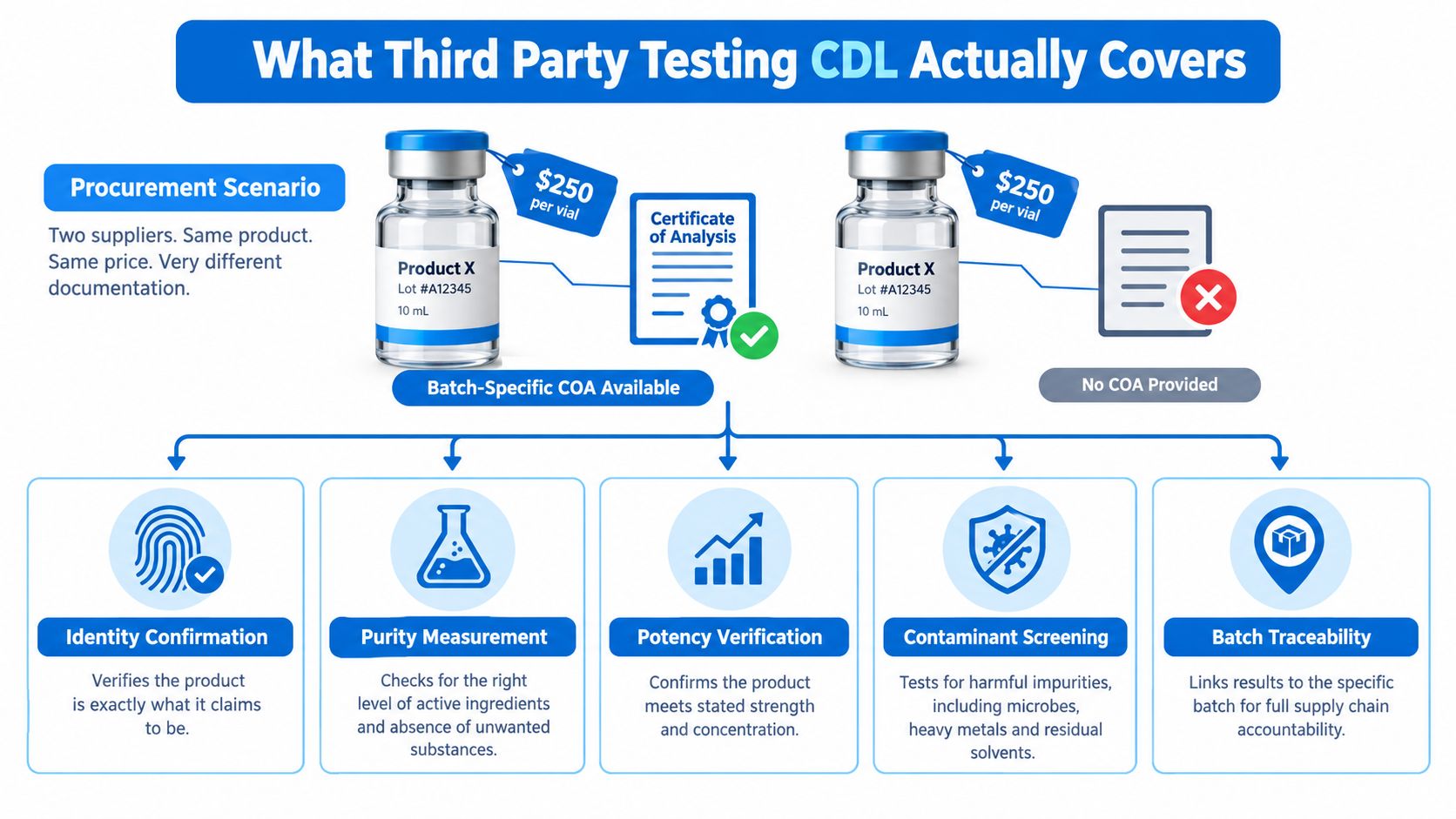
A procurement officer receives two vials of the same research compound. The labels match, the price tags match, and both suppliers describe the material as high purity. One shipment includes a batch-specific Certificate of Analysis, while the other offers only a generic document. The difference may look administrative, but it determines whether the laboratory can connect an experimental result to a defined lot, analytical method, and testing record.
The phrase third party testing CDL usually points to commercial driver licensing and transportation safety. Yet its central quality principle also applies to research compounds: an independent laboratory, defined methods, controlled documentation, and traceable results provide stronger evidence than an in-house statement alone. The two fields aren't interchangeable, but their documentation logic is remarkably similar.
What Third Party Testing CDL Actually Covers
In a CDL program, independent testing concerns the driver's specimen and the controls around collection, analysis, review, and reporting. In a research laboratory, the same broad idea concerns the material in the vial. A third party tests the sample rather than relying only on the manufacturer's internal certificate, then links the findings to a specific lot.
That distinction matters when two lots carry identical labels. A purity value without a lot number may describe a product family, not the vial on the researcher's bench. A batch-specific COA can connect the shipped material to identity testing, purity measurement, contaminant screening, and other defined checks.
Three service layers often share one phrase
Analytical testing is the laboratory work. It may address identity, purity, net content, sterility, endotoxins, heavy metals, and conformity. Each category answers a different question, so a single purity result can't stand in for the entire quality record.
A third-party administrator, or C/TPA, coordinates parts of a motor carrier's DOT drug-and-alcohol program. The administrator may handle enrollment, random selection, scheduling, documentation, and applicable Clearinghouse reporting. For owner-operators, participation in a consortium is required in practice because they can't self-administer the program. FMCSA describes this role in its guidance on owner-operators and commercial motor vehicle testing.
A third-party examiner is different again. A skills examiner evaluates practical driving ability under state and federal controls, while a knowledge examiner may administer written testing under a state framework that can be less prescriptive. The phrase therefore describes independent verification in several settings, not one universal service.
Practical rule: A trustworthy result needs more than an attractive number. It needs a defined method, an identifiable laboratory, and a record that connects the result to the exact specimen or lot.
For a research purchaser, the key question is simple: can the supplier show what was tested, who tested it, how it was tested, and which shipped batch the report covers? If the answer is unclear, the document may be marketing material rather than an auditable quality record.
How Federal Rules Shaped Modern Third Party Testing
Modern CDL testing grew from transportation safety concerns involving drugs and alcohol. Federal transportation drug-testing rules were first issued in 1988, covering safety-sensitive workers in motor carrier, aviation, rail, transit, maritime, and pipeline operations, according to FMCSA's overview of drug and alcohol rules.
Congress expanded the framework through the Omnibus Transportation Employee Testing Act of 1991. The law directed the Department of Transportation to require alcohol and controlled-substance testing for safety-sensitive transportation employees. For motor carriers, a Federal Highway Administration predecessor to FMCSA established the core CDL program in 1994 under 49 CFR Part 382.
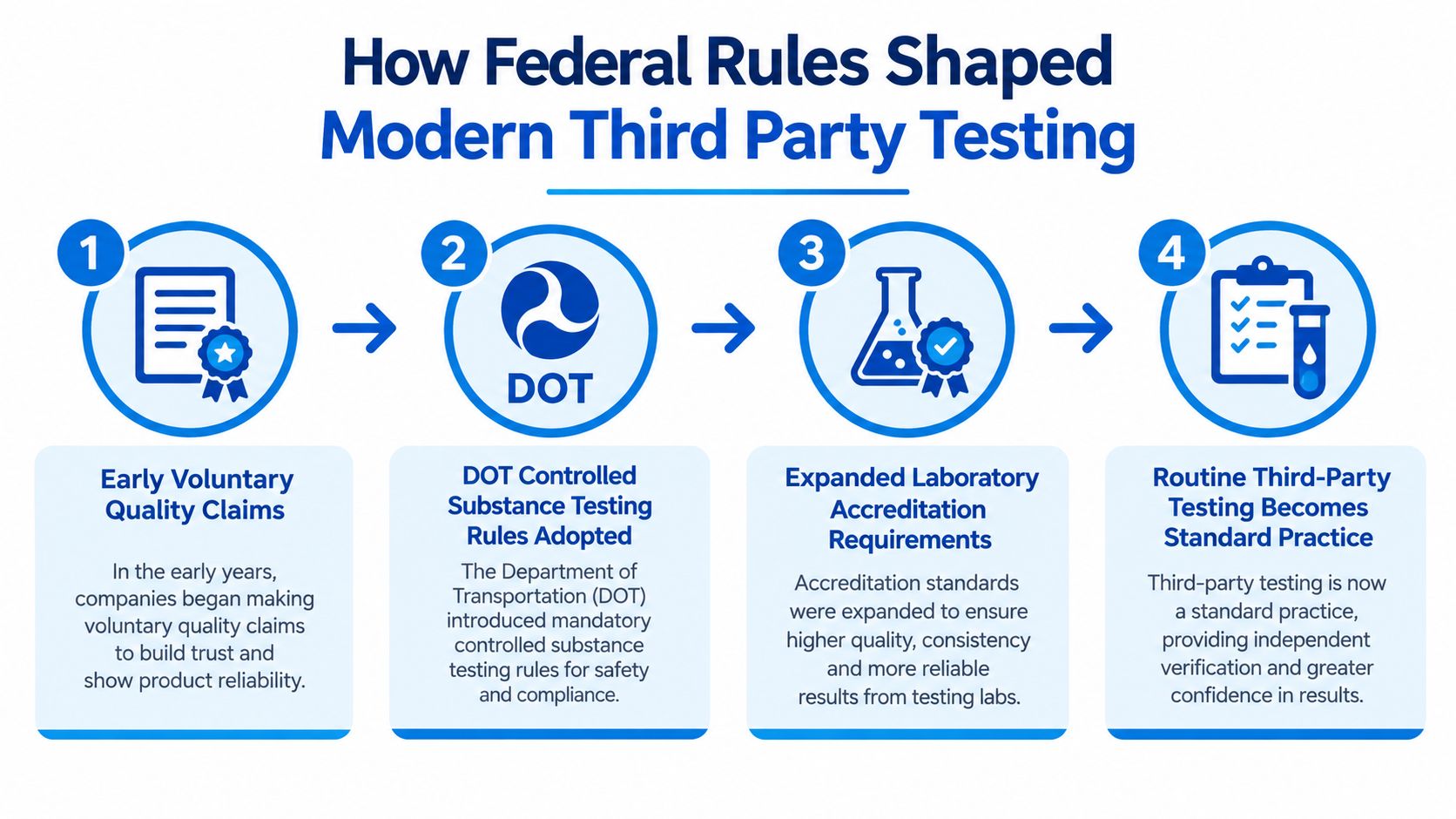
Why the chain matters
The system depends on several separate controls:
- Collection controls establish how the specimen is obtained and documented.
- Certified laboratories perform the analytical work under applicable certification requirements.
- Medical Review Officers review verified results and consider the required medical context.
- Split specimens preserve a second container so a driver can request testing at another certified laboratory when the primary laboratory reports a verified positive, adulterated, or substituted result.
- Reporting systems carry applicable results into the employer's compliance workflow and, where required, the Clearinghouse.
The chain is deliberately distributed. The carrier doesn't control every stage, and the laboratory isn't the final decision-maker on every result. That separation reduces the risk that one party can alter, suppress, or reinterpret the record without detection.
FMCSA survey data illustrates the scale of the program. During 2016, carriers were required to conduct random testing of 10% of CDL drivers for alcohol and 25% for drugs, as reported in the FMCSA 2016 Drug and Alcohol Testing Survey. The estimated controlled-substance positive rate was 0.7%, with a 95% confidence interval of 0.6% to 0.8%, while the estimated alcohol-use rate at or above a blood-alcohol concentration of 0.04 was 0.03%. Approximately 89% of subject motor carriers had random programs, covering about 88% of CDL drivers in the survey.
A research laboratory can borrow the documentation lesson without confusing the two systems. The useful mental model is carrier to C/TPA to certified laboratory to MRO to reporting system. In compound procurement, the analogous path is supplier to independent laboratory to analytical report to purchasing and laboratory records.
Organizations evaluating research materials should also maintain a clear research-use-only policy that separates laboratory investigation from human or veterinary use. The policy doesn't replace analytical evidence, but it clarifies how the material may be handled and documented.
The Seven Analytical Categories Behind a Real COA
A COA becomes useful when each result answers a defined question. A seven-category framework separates those questions instead of allowing one attractive purity number to represent the entire lot.
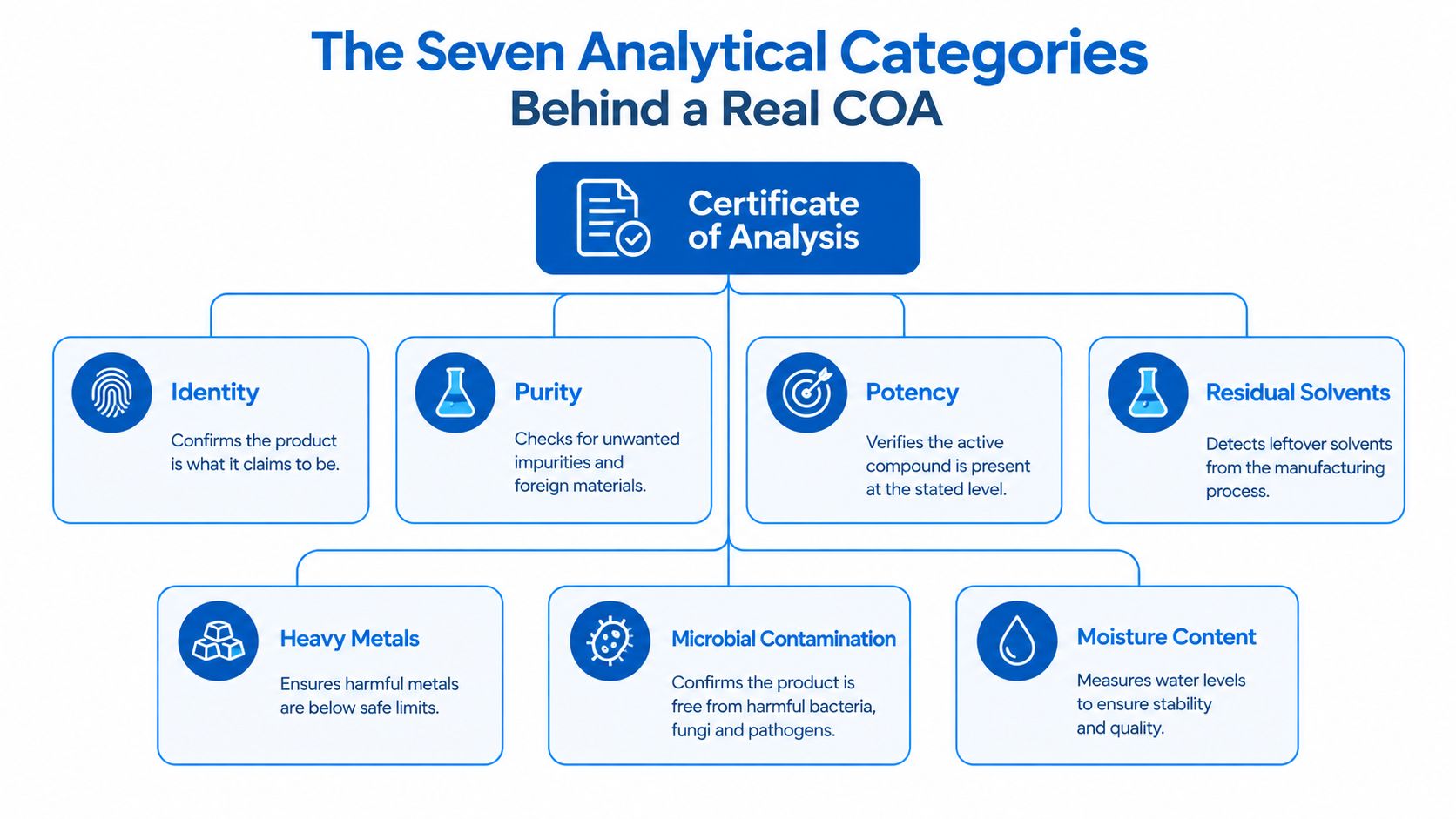
Seven questions, seven analytical roles
- Identity: Does the material correspond to the labeled compound? Laboratories may use LC-MS or MALDI-TOF to compare observed molecular mass or spectral characteristics with the expected target.
- Purity: How much of the measured sample is the target relative to detected impurities or degradation products? Reverse-phase HPLC is a common approach.
- Net content: Does the vial contain the reported quantity? Laboratories may use gravimetric or HPLC-based methods, depending on the material and specification.
- Sterility: Does testing detect viable bacterial or fungal growth? USP <71>-style approaches commonly use direct inoculation or membrane filtration.
- Endotoxins: Does the sample contain pyrogenic lipopolysaccharide-associated material? The Limulus Amebocyte Lysate, or LAL, assay addresses this separate question.
- Heavy metals: Are elemental contaminants present? ICP-MS can screen for metals including lead, cadmium, mercury, and arsenic.
- Conformity: Do the reported findings belong to the exact lot that was shipped? This category links the analytical record to the product, lot number, and shipment.
These categories don't all measure the same property. Identity can support the conclusion that the labeled compound is present, while purity describes the relative chromatographic composition. Sterility addresses viable organisms, whereas endotoxin testing addresses a non-living pyrogenic component that can remain after organisms are removed or killed.
Why the lot number belongs on every page
A report without a visible lot number is difficult to defend during an investigation. If a researcher observes an unexpected assay result, the lot identifier allows the team to compare the vial with the supplier's report, storage record, receiving documentation, and any retained sample.
The research testing framework should therefore be read as a linked record, not a collection of isolated claims. A laboratory should ask whether the method, result, acceptance criterion, and lot reference appear together. If the COA lists only a product name and a broad purity statement, important questions remain unanswered.
Purity and Identity Are Not the Same Answer
A high purity value doesn't prove that a vial contains the labeled compound. Purity and identity describe different analytical properties, and a reliable COA should make the distinction visible.

Reverse-phase HPLC separates components as they move through a chromatographic system. With ultraviolet detection around 210 to 220 nanometers, the resulting chromatogram can show how much material appears in a dominant peak relative to other detected peaks. That supports a purity calculation, but it doesn't independently establish molecular identity.
Mass spectrometry asks a different question. It compares the observed molecular mass with the expected mass for the target compound or sequence. A sample can produce a major chromatographic peak and still require mass spectrometry to investigate substitution, degradation, or mislabeling.
One independent methodology describes 98% as a commonly used minimum purity floor, while a product-specific specification of at least 98% remains an acceptance criterion rather than proof that every other quality attribute was tested. Those values should be interpreted alongside the method, sample preparation, instrument information, and identity result, not as a standalone guarantee. The methodology distinction is described in independent peptide quality testing guidance.
The practical reading habit
A researcher scanning a COA should look for at least two method names:
- HPLC, to support the purity assessment.
- Mass spectrometry, to support identity.
- Additional methods, where the project requires evidence about contamination, net content, or elemental impurities.
A certificate that reports “purity” without naming the analytical method gives the reader too little information to judge the result. A certificate that includes HPLC but no identity method leaves open the possibility that the dominant material is not the labeled target.
The distinction becomes particularly important when comparing lots from different suppliers. Similar formatting, identical wording, or the same stated purity threshold doesn't make two reports equivalent. The method details and lot linkage determine how much confidence the document deserves.
A short visual explanation can help new researchers recognize the difference between a chromatographic purity result and an orthogonal identity result.
Sterility and Endotoxins Answer Different Questions
Sterility and endotoxin testing are often placed beside each other on a COA, but they don't measure the same contamination mechanism. Treating one as evidence for the other creates a blind spot in cell-based and biochemical workflows.
USP <71>-style sterility testing is designed to detect viable bacterial or fungal growth, commonly using direct inoculation or membrane filtration with incubation over as long as 14 days, while endotoxin testing detects lipopolysaccharide-associated pyrogenic material using the Limulus Amebocyte Lysate method, with results commonly expressed in endotoxin units per milligram or milliliter. This distinction is described in laboratory testing methodology guidance.
A simple mental model
Sterility asks whether viable organisms grow under the specified test conditions. Endotoxin testing asks whether bacterial lipopolysaccharide-associated material is present, even when no viable organisms remain.
That difference explains why a negative sterility result doesn't demonstrate a low endotoxin burden. Organisms may have been removed or killed while their pyrogenic components remain in the material. A cell assay can therefore react to a reagent that passed a sterility test but was never evaluated for endotoxins.
| Attribute | Sterility Testing | Endotoxin Testing |
|---|---|---|
| Primary question | Are viable bacteria or fungi detected? | Is pyrogenic lipopolysaccharide-associated material detected? |
| Typical approach | Direct inoculation or membrane filtration | Limulus Amebocyte Lysate assay |
| What the result describes | Microbial growth under defined conditions | Endotoxin burden |
| Common reporting context | Growth or no growth after incubation | Endotoxin units per milligram or milliliter |
| Why it matters | Detects viable contamination | Detects a non-living pyrogenic contaminant |
Laboratory reading rule: A negative sterility result answers a viable-growth question. It doesn't answer the endotoxin question.
A complete COA should keep both results distinct. Researchers should also confirm whether the methods were appropriate for the material, whether the report is lot-specific, and whether any result is presented as a general product claim rather than a test on the shipped batch.
A Practical Checklist for Reading Any Research COA
A researcher doesn't need to become a laboratory auditor to identify weak documentation. A consistent review sequence can expose missing links before a compound enters an experiment.
Start with the document identity
The first pass should establish whether the report belongs to the material received.
- Match the lot: Compare the lot number on the vial, packing record, and COA.
- Check the date: Look for the testing or issuance date and assess whether the document appears tied to the shipment.
- Identify the laboratory: Confirm that the testing organization is named rather than hidden behind a generic supplier header.
- Review the analyst record: Look for an identifiable signature, approval, or issuing analyst designation.
- Confirm the product description: Check the formal name, formulation, and other identifiers against the purchase record.
A generic certificate can still contain technically correct information, but it doesn't establish that the shipped vial produced those results. The lot connection is the central control.
Read methods before reading the headline result
Researchers often notice the largest bold number first. A better approach is to locate the method, specification, result, and unit together.
The HPLC entry should identify the purity method and acceptance criterion. The mass-spectrometry entry should show how identity was assessed. Net content should appear in units that make sense for the labeled material, while heavy-metal and endotoxin results should identify their respective analytical approaches or reporting conventions.
A strong COA lets a second researcher reconstruct what was tested without asking the supplier to translate every line.
Ask targeted supplier questions
A supplier should be able to answer practical questions without substituting promotional language for evidence:
- Is the COA specific to the batch being shipped?
- Is the laboratory independent of the manufacturer?
- Which analytes and methods were included?
- Does the report cover identity separately from purity?
- Are sterility, endotoxins, net content, and heavy metals reported?
- What chain-of-custody records exist?
- Is there a specimen or retained-sample policy where applicable?
- What happens if a stored vial produces an unexpected later result?
- Does the supplier distinguish DOT-related documentation from non-DOT research documentation when discussing third-party testing?
The final question prevents category confusion. A CDL testing provider, a compound-testing laboratory, and a licensing examiner may all be called third parties, but they perform different functions under different controls.
Bringing It All Together for Repeatable Research
The strongest connection between CDL testing and research-compound procurement is not the substance being tested. It is the discipline of preserving an independent, traceable record.
In a transportation program, certified laboratories, specimen controls, MRO review, split specimens, and reporting procedures protect the integrity of a safety-sensitive decision. In a research workflow, batch-linked identity, purity, contamination, and conformity records protect the connection between a reagent and an experimental result.
A batch-specific COA should remain active throughout the project. It can help a laboratory investigate an unexpected assay outcome, compare material received at different times, document a lot in a methods section, and decide whether a repeat experiment used the same or a different analytical starting point.
Reproducibility begins before the experiment
A research team should retain more than the PDF. The receiving record, lot number, storage condition, shipment notes, method details, and internal sample identifier create a practical chain of custody. If a result later appears inconsistent, the team can ask whether the issue arose from the compound, storage, preparation, instrument performance, or experimental design.
Supplier size doesn't resolve that question. A large catalog can still provide weak lot documentation, while a smaller supplier can provide a clearer analytical record. The evaluation checklist remains useful across vendors because it focuses on evidence rather than presentation.
Researchers can use a compound research library to organize compound-specific information, but the COA still needs independent review. Catalog data supports planning, while batch documentation supports the particular material that enters the laboratory.
Final takeaway: Treat the COA the way an auditor treats a chain-of-custody record. Reproducibility then becomes a documented practice rather than a hopeful assumption.
Pro Tec Pep offers research-use-only compounds with batch-specific documentation and a laboratory-focused catalog for teams evaluating identity, purity, and related quality records. Visit Pro Tec Pep to review available research materials, documentation, and research-use-only policies before making a procurement decision.