Tesamorelin with Ipamorelin: A Research Context Guide
Tesamorelin with ipamorelin explored in a research context — co-administration considerations, stability notes, and documentation to verify when sourcing both
No controlled human study has evaluated tesamorelin with ipamorelin together, so any combination effect remains unproven. Tesamorelin has validated human evidence at 2 mg subcutaneously once daily, while ipamorelin's best-characterized human pharmacology includes an approximately 2-hour terminal half-life, making the pairing an exploratory research question rather than an established protocol.
The popular advice says that two growth-hormone-axis secretagogues should naturally produce a stronger result than either compound alone. That conclusion moves faster than the evidence. Tesamorelin and ipamorelin act through different receptors, but they converge on the same endocrine output, and biological plausibility isn't proof of additive or synergistic activity.
For a laboratory audience, the useful question isn't which peptide is “better.” It's whether a controlled experiment can show that combined pathway engagement produces a reproducible signal beyond tesamorelin monotherapy, ipamorelin monotherapy, or appropriate vehicle controls. The current literature supports tesamorelin as the evidence-backed anchor and ipamorelin as an experimental modulator with limited human outcome data. Any combination work should preserve that distinction.
Why the Combination Question Matters
Stacking two compounds that stimulate growth hormone secretion can sound self-evidently additive. That assumption is incomplete because both signals ultimately depend on pituitary somatotroph capacity, pulse timing, receptor engagement, feedback regulation, and downstream IGF-1 responses. Two inputs can produce an additive signal, a redundant signal, a ceiling effect, or a pattern that changes pulse shape without improving the selected endpoint.
Tesamorelin has a substantial regulatory history. On November 10, 2010, the FDA approved tesamorelin as Egrifta for reducing excess abdominal visceral fat in adults with HIV-associated lipodystrophy. The approval relied on two multicenter, randomized, double-blind, placebo-controlled studies, and the product label described it as the first U.S. approval for that specific indication. The FDA later approved a supplemental biologics license application for a new tesamorelin formulation in March 2025, showing continued clinical relevance for the compound. These details appear in the FDA tesamorelin prescribing information.
Ipamorelin has a different evidentiary profile. Its human record includes pharmacokinetic and pharmacodynamic investigation, but its clinical outcome program is far less established. The available literature doesn't provide a registered controlled human study in which tesamorelin and ipamorelin were administered together, so forum discussions shouldn't be treated as evidence that the combination is established practice.
The key distinction for researchers
A combination hypothesis becomes defensible when the experiment can distinguish among competing explanations:
- Additive activity: each pathway contributes an independent component to the measured response.
- Synergy: the combined response exceeds the effect predicted from the individual compounds.
- Redundancy: both signals converge on a limiting step, producing little additional output.
- Antagonism: combined exposure alters feedback or timing in a way that reduces the expected response.
Practical rule: A mechanistically plausible stack is a hypothesis, not a validated protocol.
The FDA clinical pharmacology review supports tesamorelin as the evidence-backed reference compound for visceral adipose tissue reduction. It doesn't establish a tesamorelin plus ipamorelin combination benchmark. That gap should shape study registration, control selection, assay timing, and how results are described.
Two Pathways, One Axis
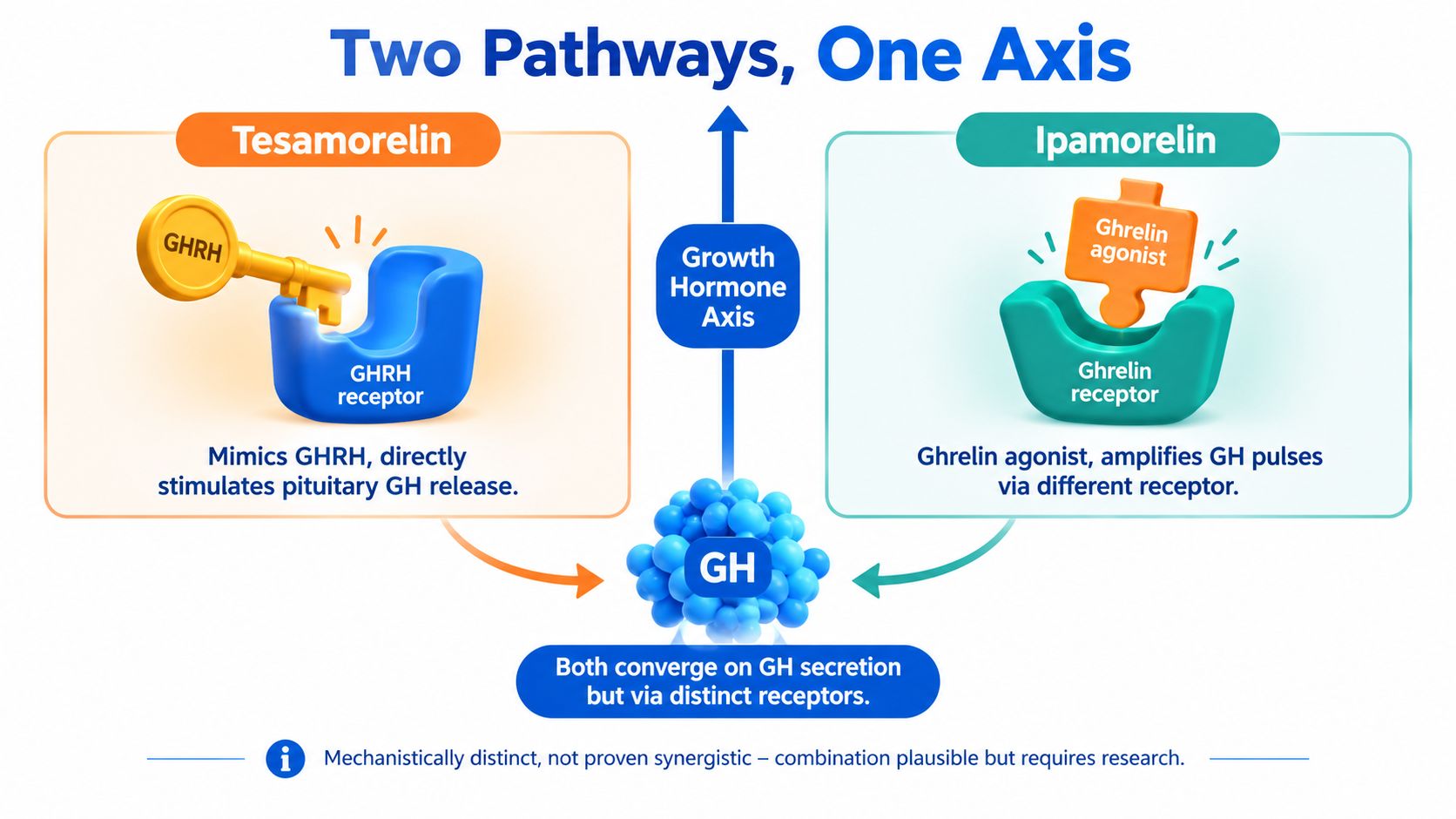
Tesamorelin and ipamorelin stimulate the growth hormone axis through different receptor systems. A simple analogy helps. Tesamorelin acts like a signal delivered through the GHRH route, while ipamorelin acts through the ghrelin receptor route. Both routes influence pituitary growth hormone secretion, but they aren't the same molecular instruction.
Tesamorelin and the GHRH pathway
Tesamorelin is a synthetic GHRH analogue that acts on the anterior pituitary to stimulate endogenous growth hormone secretion. The molecule is based on synthetic human GHRH(1-44) and contains an N-terminal trans-3-hexenoic acid modification that increases resistance to DPP-4 cleavage, a structural feature described in tesamorelin peptide chemistry documentation.
That modification matters in research because molecular stability affects exposure and interpretation. A compound that persists sufficiently for receptor engagement can influence pulsatile growth hormone release and downstream IGF-1 measurements, but the observed signal still depends on the biological system, sampling schedule, and assay characteristics.
Ipamorelin and the ghrelin receptor route
Ipamorelin is characterized as a selective growth hormone secretagogue and ghrelin-receptor agonist. Early receptor-profiling work described growth hormone stimulation through a GHRP-like receptor rather than a GHRH receptor, consistent with activity at GHSR-1a, the ghrelin receptor. The receptor distinction is documented in the early ipamorelin pharmacology literature.
The two pathways therefore provide a plausible reason to investigate co-exposure. Tesamorelin could provide a GHRH-mediated drive, while ipamorelin could provide a separate GHSR-1a-mediated signal. But both signals still converge on somatotroph output. If the pituitary response is already near a physiological or experimental ceiling, the second signal may alter pulse timing rather than create a proportionally larger response.
A later ipamorelin clinical study examined the compound in a postoperative ileus setting, while preclinical rodent work evaluated gastrointestinal transit. Those studies help define the research history, but they don't establish synergy with tesamorelin.
Evidence Base Asymmetry
The two compounds shouldn't be presented as if they have equal clinical maturity. Tesamorelin has controlled human evidence tied to a defined indication, a regulatory review, and a validated downstream effect. Ipamorelin has useful human pharmacology, but its evidence is primarily pharmacodynamic and doesn't provide a comparable clinical outcome foundation.
In randomized trials, tesamorelin was evaluated as a once-daily 2 mg subcutaneous GHRH analogue regimen, and the clearest validated downstream effect was visceral adipose tissue reduction versus placebo. A clinical-trial summary reports visceral-fat reductions of about 18% over 52 weeks in the studied HIV-associated lipodystrophy context, as described in the tesamorelin randomized trial publication.
Ipamorelin's strongest technical human evidence comes from a dose-escalation pharmacokinetic and pharmacodynamic study in healthy men. That work characterized exposure, clearance, distribution, and growth hormone release, but it doesn't supply a validated combination endpoint. A later phase 2 postoperative ileus trial failed to show a significant efficacy benefit over placebo, reinforcing the difference between pharmacodynamic activity and proven clinical outcomes.
Evidence Base Comparison: Tesamorelin vs Ipamorelin
| Dimension | Tesamorelin | Ipamorelin |
|---|---|---|
| Molecular class | Synthetic GHRH analogue | Selective growth hormone secretagogue and ghrelin-receptor agonist |
| Human evidence | FDA-reviewed randomized controlled trials | Human PK/PD research and limited clinical investigations |
| Validated signal | Visceral adipose tissue reduction in HIV-associated lipodystrophy | Growth hormone release and pharmacokinetic characterization |
| Regulatory history | FDA approval as Egrifta on November 10, 2010 | No comparable pivotal approval program identified in the supplied evidence |
| Combination evidence | No controlled human study with ipamorelin | No controlled human study with tesamorelin |
| Research role | Evidence-backed anchor compound | Exploratory pathway modulator |
For study planning, this asymmetry affects controls and interpretation. Tesamorelin can provide the reference arm against which a combination is judged, while ipamorelin requires careful justification of endpoints because its human evidence doesn't establish a validated body-composition or metabolic benchmark.
Pharmacokinetic Profiles Compared
Pharmacokinetics answers how a compound enters, distributes through, and leaves an experimental system. Pharmacodynamics answers what biological signal follows. For tesamorelin with ipamorelin, separating those questions is essential because a short-lived GH pulse may not align with a later IGF-1 measurement.
Ipamorelin has the more explicitly documented human PK profile in the supplied evidence. In a dose-escalation study of healthy men, the terminal half-life was about 2 hours, clearance was 0.078 L/h/kg, and the steady-state volume of distribution was 0.22 L/kg. Growth hormone appeared as a discrete pulse that peaked at roughly 0.67 hours after infusion, and the study reported dose-proportional kinetics, an SC50 of 214 nmol/L, and a maximal growth hormone production rate of 694 mIU/L/h. These values come from the ipamorelin PK/PD study.
Pharmacokinetic parameters: tesamorelin vs. ipamorelin
| Parameter | Tesamorelin | Ipamorelin |
|---|---|---|
| Primary pharmacological route | GHRH receptor pathway | GHSR-1a, the ghrelin receptor pathway |
| Human regimen characterized in pivotal trials | 2 mg subcutaneous once daily | Dose-escalation PK/PD research |
| Terminal half-life | The supplied regulatory material establishes clinical exposure but doesn't provide a single value for this comparison | About 2 hours |
| Clearance | Not specified in the supplied verified data | 0.078 L/h/kg |
| Volume of distribution at steady state | Not specified in the supplied verified data | 0.22 L/kg |
| GH response timing | Downstream GH and IGF-1 interpretation depends on sampling design | Discrete GH pulse peaking at roughly 0.67 hours after infusion |
| Key interpretation | Validated clinical signal for visceral adipose tissue reduction | Pharmacodynamic signal without a comparable validated outcome program |
Tesamorelin's downstream IGF-1 response should be treated as a separate readout from immediate growth hormone pulsatility. A single late sample can miss a transient GH event, while a single early sample may not represent downstream endocrine exposure. Ipamorelin's rapid GH pulse makes dense time-resolved sampling especially important if the experiment seeks to identify pathway-specific contributions.
Sampling principle: If both compounds are evaluated in one assay, the design should capture immediate GH dynamics and later downstream markers rather than treating one time point as the entire response.
The absence of a controlled co-exposure PK comparison creates a practical limitation. Researchers can't assume that simultaneous exposure will make each compound analytically distinguishable or biologically separable. Simultaneous, staggered, and sequential designs may answer different questions, but each requires predefined timing and compound-specific analytical methods.
Stability and Laboratory Handling Notes
Sample preparation should begin with the identity and formulation state of each material, not with assumptions about how one peptide behaves beside another. Tesamorelin's structural modification affects resistance to DPP-4 cleavage, while ipamorelin's human PK profile doesn't by itself establish how the peptide behaves in every buffer, container, or co-spiked assay matrix.
The supplied verified evidence doesn't provide validated shelf-life values for refrigerated or frozen tesamorelin and ipamorelin preparations. It also doesn't establish a published co-formulation procedure, a universal reconstitution solvent, or a confirmed compatibility window for the two compounds in one vial. Those gaps should be recorded as unknowns rather than filled with generic peptide-handling claims.
Build the sample-prep record first
A defensible laboratory record should identify:
- Material identity: Record the exact compound name, sequence or structural designation, lot number, formulation state, and analytical documentation.
- Buffer conditions: Document solvent composition, pH, ionic strength, concentration, and the time between preparation and assay.
- Container controls: Track vial material, closure type, light exposure, storage location, and the number of freeze-thaw events.
- Stability endpoints: Use a stability-indicating method to assess identity, purity, aggregation, and degradation products rather than relying on appearance alone.
Tesamorelin's acid-sensitive behavior can't be assumed from the supplied data without a validated method and defined conditions. Likewise, oxidative degradation of dilute ipamorelin solutions should be treated as a laboratory hypothesis requiring verification, not as a universal numerical rule.
Co-spiking requires its own validation
Mixing the compounds in a common solution creates an additional variable. A changed assay signal could reflect biological interaction, adsorption to the container, precipitation, degradation, altered recovery, or interference between analytical peaks. Without a stability-indicating comparison, the experiment can't confidently attribute a changed response to receptor biology.
Aliquoting can reduce repeated handling and help preserve a consistent sample history, but the appropriate storage temperature and allowable holding time must come from compound-specific validation or supplier documentation. Research teams should retain preparation records alongside chromatograms and mass-spectrometry results so that any combined-exposure finding can be traced back to the actual sample state.
Designing an Exploratory Combination Study
A defensible study begins with a prior question, not a preferred conclusion. The central question is whether tesamorelin and ipamorelin produce additive, synergistic, redundant, or antagonistic effects when compared with their respective monotherapies and vehicle.
The minimum design should include vehicle, tesamorelin alone, ipamorelin alone, and the combination. If the research question includes concentration dependence, matched and escalated combination conditions can be added, but each condition needs a clear rationale and independent analytical confirmation.
Separate immediate and downstream endpoints
Growth hormone is pulsatile, so endpoint selection should reflect both timing and biology. A useful panel can include:
- Pulsatile GH output: Collect sufficiently resolved samples to identify pulse amplitude, timing, and duration rather than relying only on an integrated endpoint.
- IGF-1 response: Treat IGF-1 as a downstream marker with its own temporal behavior, not as a direct substitute for GH sampling.
- Signaling markers: Measure pathway-relevant intracellular or transcriptional markers selected for the experimental model.
- Off-target activity: Include markers that can detect unintended endocrine or cellular responses relevant to the system under study.
Design rule: A combination claim needs a prespecified model of synergy. “Higher than vehicle” isn't enough because both monotherapies may already elevate the same endpoint.
The pharmacokinetic evidence supports careful consideration of simultaneous versus staggered exposure. Simultaneous exposure can test concurrent pathway engagement, while staggered exposure can help deconvolute whether one signal changes the response to the other. Sequential exposure may be useful when the hypothesis concerns priming, desensitization, or feedback, but the sequence must be chosen before results are observed.
Statistical planning matters
Researchers should define the primary endpoint before measuring a broad panel of GH, IGF-1, signaling, and off-target markers. Multiple comparisons can create apparently positive findings by chance, so the analysis plan should specify multiplicity correction, treatment contrasts, handling of below-quantification values, and the model used for repeated measurements.
A factorial framework can be useful when the study is designed to estimate main effects and interaction effects. The interaction term carries the key information for synergy, but it requires adequate replication and realistic variance assumptions. Because the combination has no established benchmark, pilot work should estimate assay variability without presenting the pilot as evidence of clinical efficacy.
Documentation to Verify When Sourcing Both Compounds
Procurement should create a paper trail that another researcher can audit. Price, packaging, and delivery speed describe logistics. They do not establish identity, purity, traceability, or suitability for a defined laboratory investigation. For tesamorelin and ipamorelin, evaluate the records for each material using the same criteria.
Four documents should be reviewed before either compound enters the study:
- Batch-specific Certificate of Analysis: The CoA should identify the exact lot and list the analytical methods used for purity and identity, including HPLC and mass spectrometry where applicable.
- Independent third-party report: A separate laboratory report offers an external check on the supplier's results. Compare it with the CoA rather than filing both documents without reconciliation.
- Lot traceability: The lot number should connect the vial with synthesis records, release testing, and any deviation or rework documentation.
- Material Safety Data Sheet: The SDS should identify research-use classification and describe handling, hazards, storage, and spill response relevant to the laboratory.
Match documents to the physical material
The vial label, CoA, analytical report, and purchase record should show the same compound and lot number. Any mismatch can undermine later interpretation because the tested material may differ from the material described in the study file.
Purity also requires careful interpretation. HPLC purity addresses the proportion of detected chromatographic material, while mass spectrometry supports molecular identity. Neither result alone establishes sterility, endotoxin status, residual-solvent control, or stability in the assay matrix. Record which properties were tested and which remain unverified.
Chain-of-custody rule: Store supplier records with the sample inventory, preparation log, chromatograms, and assay results for the exact lot.
Pro Tec Pep supplies tesamorelin and ipamorelin for laboratory investigations involving peptide chemistry, receptor research, and structural analysis, with batch-linked documentation available through its research-use catalog. Researchers evaluating that option can review the Pro Tec Pep research compounds catalog and retain the relevant lot records with the study file.
Documentation gaps can affect the whole paired experiment. If one compound lacks traceable release records, results from the combination may be difficult to interpret even when the other material is well documented. The procurement review should therefore apply identical acceptance criteria to both compounds and record unresolved gaps before the study begins.
What the Literature Does Not Yet Show
The central gap is direct: no controlled human study has evaluated tesamorelin with ipamorelin together. The available evidence supports tesamorelin's controlled human signal for visceral adipose tissue reduction and ipamorelin's pharmacodynamic characterization, but it doesn't establish that combining the compounds produces a superior or distinct outcome.
Several related questions remain open:
- Co-administered PK: No supplied evidence establishes how the compounds' exposure profiles behave when evaluated together.
- Head-to-head timing: No validated comparison shows whether simultaneous, staggered, or sequential exposure best distinguishes their contributions.
- Combination dose-response: No published response surface maps the interaction across compound concentrations.
- Synergy assay: No universally validated panel separates additive, redundant, and synergistic GH-axis signaling.
- Downstream endpoints: The literature doesn't establish whether the combination changes IGF-1 exposure, glucose homeostasis, or hepatic fat in a manner that justifies broader combination studies.
The unanswered biological question is specific. Does a GHRH analogue paired with a GHSR-1a agonist produce a meaningfully different pattern of pulsatile GH or IGF-1 output than either compound alone under matched experimental conditions? That answer requires primary data, validated assays, transparent controls, and a statistical model that tests interaction rather than comparing the combination with vehicle.
Researchers should therefore describe tesamorelin as the evidence-backed anchor compound and ipamorelin as an exploratory modulator. Combination findings should be labeled hypothesis-generating until independent work confirms them, and any unverified claim should be disclosed clearly when either compound is cited.
Pro Tec Pep offers research-use-only tesamorelin and ipamorelin with batch-linked documentation for laboratory investigations involving peptide chemistry, receptor interactions, and structural analysis. Researchers can review the available materials and documentation at Pro Tec Pep before planning a controlled combination study.
For laboratory research use only. Not for human or veterinary use. Not a drug, food, or cosmetic. Not evaluated by the FDA. Not intended to diagnose, treat, cure, or prevent any disease. By purchasing, you certify you are a qualified researcher and agree to use this product solely for in-vitro laboratory research.