Tesamorelin vs Ipamorelin Research Comparison Guide
Tesamorelin vs ipamorelin compared for researchers — class, mechanism, applications, handling and COA documentation in one clear guide.
Which compound should a laboratory select when both are described as growth hormone secretagogues, but neither occupies the same point in the signaling pathway or carries the same level of human evidence? The answer depends less on the label “GH peptide” than on the experimental endpoint, receptor model, evidence tier, and documentation available for the exact material being tested.
Tesamorelin and ipamorelin are therefore best compared as distinct research tools. One is a 44-amino-acid GHRH analog with an FDA-approved indication and replicated clinical data for a narrowly defined population. The other is a synthetic pentapeptide that activates the ghrelin receptor pathway and remains investigational, with human evidence concentrated in early pharmacokinetic and pharmacodynamic work.
Introduction to Tesamorelin vs Ipamorelin for Research
Which documentation should support a tesamorelin or ipamorelin experiment? The answer depends on three linked decisions: the receptor class being modeled, the evidence tier behind the endpoint, and whether the tested material can be reproduced from its records.
Use five lenses before selecting a compound:
- Chemical class and receptor target, identifying its position in the growth hormone axis.
- Mechanism and selectivity, separating upstream GHRH signaling from ghrelin-receptor activation.
- Research application and evidence tier, distinguishing clinical endpoints from early pharmacodynamic observations.
- Stability and laboratory preparation, covering formulation, storage, reconstitution, and handling records.
- Documentation and procurement, including batch-specific identity, purity, and conformity data.
These lenses function like an assay acceptance plan. They prevent a clean receptor result from being treated as evidence for a phenotype that the model did not measure.
Tesamorelin has a stronger regulatory and efficacy foundation, but its clinical record is narrow. It concerns adults with HIV-associated lipodystrophy and visceral abdominal fat, rather than every body-composition or aging model. The FDA summary and clinical history of tesamorelin describes the best-established outcome within that defined population.
Ipamorelin requires a different evidence interpretation. Early human studies examined pharmacokinetic and pharmacodynamic behavior, including the timing of growth hormone release. Those findings do not establish body-composition efficacy or a regulatory pathway comparable to tesamorelin, as outlined in this comparative research overview of tesamorelin and ipamorelin.
A measurable GH pulse is therefore one observation, not proof of a downstream phenotype. Receptor assays, pituitary-cell models, animal experiments, and clinical trials answer different questions. Combinations require the same discipline: a joint effect has not been established merely because each compound affects the growth hormone axis separately.
Overview of Tesamorelin and Ipamorelin as Research Compounds
How should a laboratory document tesamorelin and ipamorelin before comparing results? Start with receptor class, evidence tier, and material records. These controls prevent a receptor-level observation from being interpreted as proof of an unmeasured physiological outcome.
Tesamorelin is a 44-amino-acid analog of growth hormone-releasing hormone, or GHRH. It signals through the growth-hormone-releasing hormone receptor, placing the compound on the upstream side of pituitary somatotroph activation. A tesamorelin experiment therefore models GHRH-receptor stimulation, not direct activation of the ghrelin receptor.
Ipamorelin is a synthetic pentapeptide growth hormone secretagogue. It acts at the ghrelin receptor, also called GHS-R1a, on pituitary somatotrophs. Its receptor-mediated GH release is described through GHS-R1a rather than the GHRH receptor in this research summary on ipamorelin receptor signaling.
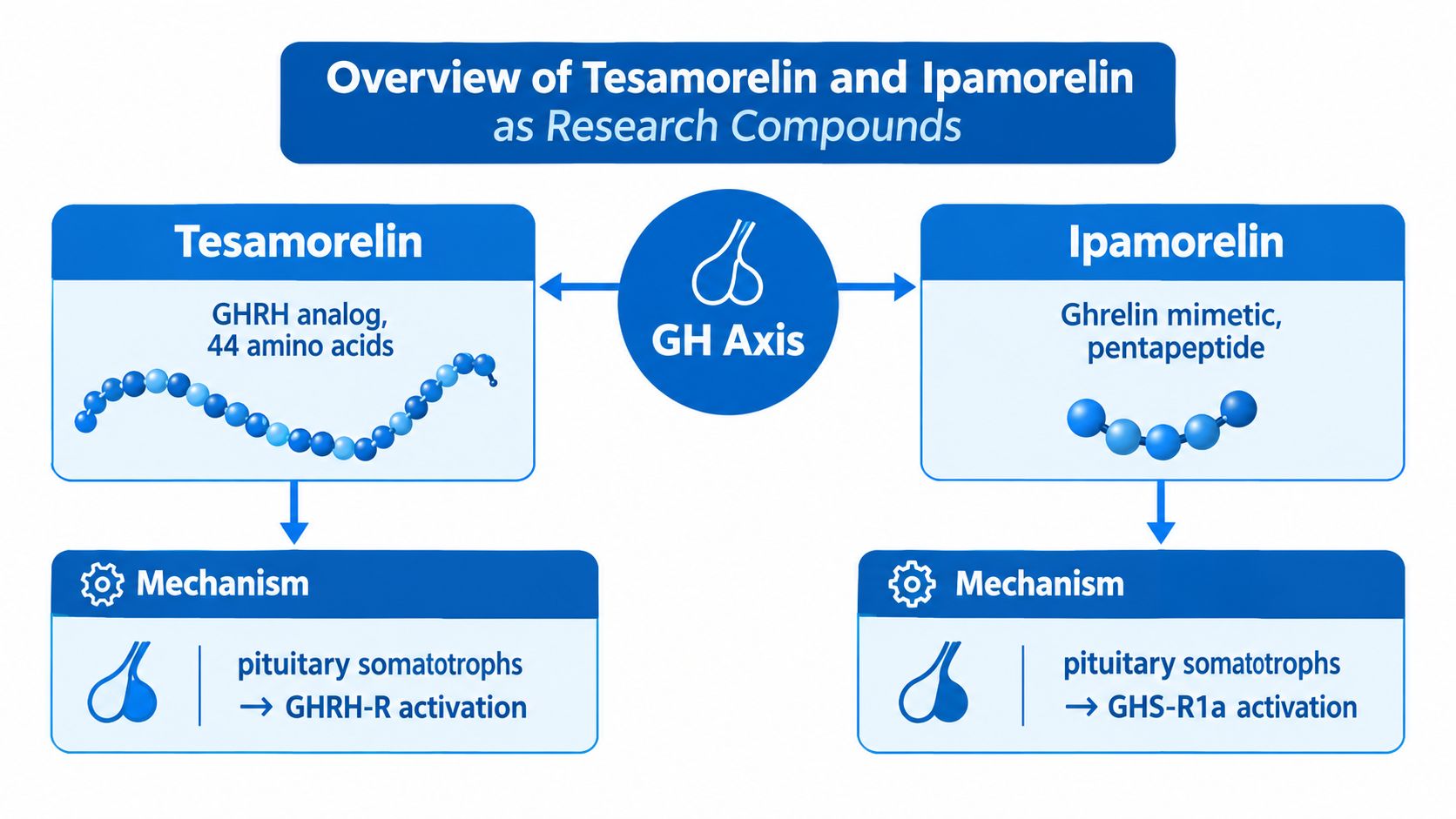
The receptor distinction is an operational boundary. Tesamorelin is a 44-amino-acid GHRH analog acting through the growth-hormone-releasing hormone receptor, whereas ipamorelin is a synthetic pentapeptide acting at ghrelin receptor GHS-R1a (receptor comparison). Calling both “GH secretagogues” does not make their assay outputs interchangeable.
Classifying the material correctly
Classification also affects documentation. HCG is a hormone, not a peptide, while NAD+ is a coenzyme, not a peptide. Their presence in a catalog alongside peptide research compounds does not assign them a peptide mechanism.
KLOW and BBG70 present a related issue. They are blend names, not standard single-compound research peptides. Laboratories should identify each declared component, cite evidence at the component level, and test the mixture rather than assign it an unsupported unified mechanism.
A reproducible workflow records four items:
- Identify the molecule: Confirm formal name, sequence, receptor target, and formulation state.
- Define the model: Specify whether the endpoint is receptor binding, pituitary signaling, GH release, body composition, or another measure.
- Separate evidence tiers: Keep in-vitro, in-vivo, animal, PK/PD, and clinical findings distinct.
- Document the lot: Record batch identity, COA, preparation conditions, and storage history.
Laboratories may consult the tesamorelin research product information for product-level documentation, then independently verify identity, purity, handling, and the limits of the available evidence. No combination mechanism should be assumed from separate single-compound findings.
Head to Head Mechanism and Selectivity Comparison
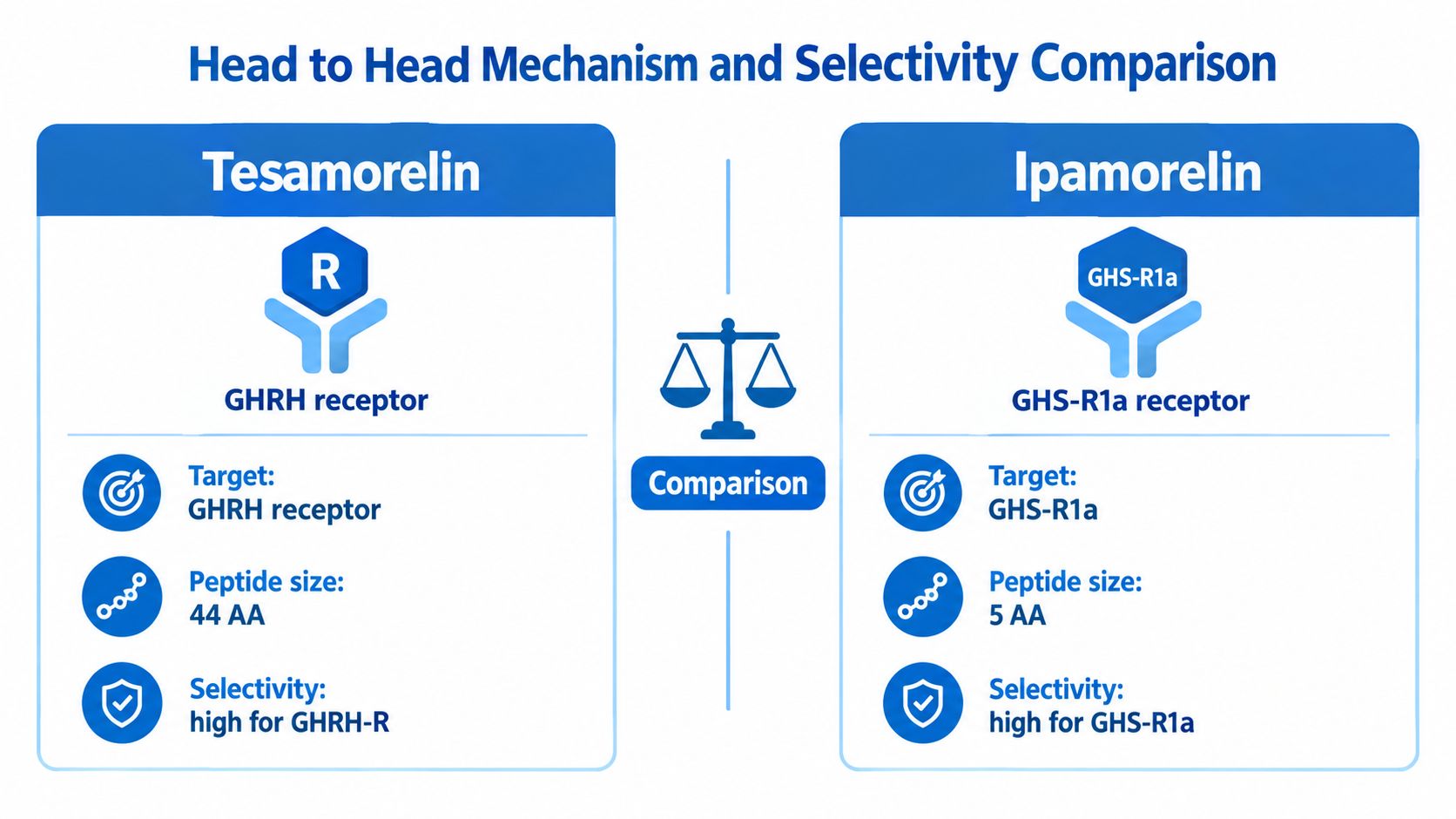
Which receptor is the assay testing? That question determines the controls, readouts, and interpretation. Tesamorelin and ipamorelin occupy different positions in the GH axis, so their results should not be treated as interchangeable, even when both produce a GH-related signal.
For tesamorelin, include the GHRH receptor as the intended upstream target and consider the GHRH-R antagonist JV-1-36 as a pharmacological control. For ipamorelin, evaluate GHS-R1a, the ghrelin receptor, with JMV2959 as a receptor antagonist control. These controls help distinguish receptor-dependent activity from nonspecific effects or assay artifacts.
| Assay decision | Tesamorelin | Ipamorelin |
|---|---|---|
| Receptor control | GHRH-R antagonist JV-1-36 | GHS-R1a antagonist JMV2959 |
| Signal to measure | GHRH-pathway pituitary signaling | GHS-R1a-mediated GH release |
| Off-target panel | Match the panel to the model | Include cortisol, prolactin, and ACTH multiplex |
| Interpretation | Test dependence on the upstream receptor | Test selectivity alongside GH output |
| Documentation focus | Identity, formulation, and receptor activity | Identity, purity, concentration, and receptor activity |
What selectivity changes in the assay
Ipamorelin is described as selective for GHS-R1a, with reported GH release without clinically relevant increases in cortisol, prolactin, or ACTH in the cited summaries (selectivity discussion). A pituitary-cell study should therefore measure those hormones rather than infer selectivity from GH alone. A multiplex panel provides a clearer separation between the intended signal and endocrine off-target activity.
Tesamorelin needs a different control scheme. JV-1-36, receptor-expression controls, and a matched vehicle condition can test whether the response depends on the intended GHRH receptor. GH release, downstream IGF-1, and body-composition endpoints represent different biological layers, so they should not be interpreted as equivalent evidence of receptor activation.
Sequence size also affects material qualification, although it does not determine biological value. Tesamorelin's larger sequence makes identity confirmation, aggregation assessment, formulation, and analytical testing important. Ipamorelin's compact structure may simplify some chemistry workflows, but concentration, purity, identity, and receptor-specific activity still require verification.
Laboratories can review the ipamorelin research product documentation when qualifying a lot. That record supports, rather than replaces, antagonist controls, orthogonal measurements, and documented handling conditions. Findings from either peptide alone also do not establish a mechanism for a combined treatment.
Research Applications and Evidence Strength Compared
Which compound is more useful for a research program depends first on the evidence tier being required, then on whether the study can reproduce the material and endpoint. Tesamorelin has the stronger regulatory and clinical record. The U.S. FDA approved it in 2010 as Egrifta for reducing excess visceral abdominal fat in adults with HIV-associated lipodystrophy. In the two 26-week Phase 3 trials, tesamorelin 2 mg once daily reduced CT-measured visceral adipose tissue by roughly 15% to 18%, compared with about 0% to 1% with placebo, according to the FDA summary review (FDA and Phase 3 summary).
The endpoint is narrowly defined. CT-based VAT measurement answers a different question from body weight, subjective appearance, or a single hormone result. The NIH and NCBI clinical review describes significantly greater VAT reduction than placebo across all three trials evaluated, placing tesamorelin in a human clinical evidence tier rather than a purely preclinical one (NIH and NCBI review).
Evidence tier matters more than endocrine activity
Ipamorelin occupies a less mature evidence tier. Human findings are concentrated in early PK/PD volunteer studies and a completed Phase II postoperative ileus trial whose development was discontinued without approval. One research summary reports a GH peak about 30 to 40 minutes after injection in a 1999 PK/PD study, while another describes a peak at about 40 minutes after IV infusion in a small Phase 1 study (ipamorelin study summary).
That record can support a pharmacodynamic time-course experiment. It does not establish efficacy for growth hormone deficiency, body composition, anti-aging applications, or healthy-adult combinations. A detectable endocrine response is an intermediate assay result, not a validated clinical endpoint. For reproducibility, the protocol should therefore state the evidence tier, receptor question, sampling schedule, assay method, and lot-specific COA requirements before results are compared. A comparative evidence summary can help frame the distinction between the two research compounds (comparative evidence summary).
The combination question remains open
No controlled human study has shown that adding ipamorelin improves tesamorelin outcomes, and no published controlled combination study was identified in humans, animals, or in-vitro systems (combination evidence review). Receptor complementarity is a hypothesis, not evidence of additive efficacy.
A combination experiment should include each single compound, the combination, vehicle, and endpoint-specific controls. Depending on the model, relevant outcomes may include VAT, liver fat, triglycerides, GH pulse characteristics, IGF-1, cortisol, prolactin, and ACTH. Without these comparisons, a stronger GH signal cannot establish greater translational value. The study record should also document handling and analytical qualification, so an apparent combination effect can be separated from material or assay variability.
Stability Handling and Laboratory Preparation Differences
What must be controlled before comparing tesamorelin and ipamorelin in an assay? Receptor biology is only one part of the answer. Formulation state, container, solvent, temperature history, preparation interval, and freeze-thaw exposure can change the material delivered to the assay.
Tesamorelin is a larger 44-amino-acid GHRH analog, whereas ipamorelin is a compact pentapeptide. Their size and structure may affect solubility, surface adsorption, aggregation, and analytical recovery. Those differences support a documented, compound-specific procedure, not a universal peptide protocol. Each lot should have a preparation record tied to its product documentation.
Preparation records are assay metadata
The record should include:
- Starting state: State whether the material arrived as lyophilized powder or another formulation.
- Solvent and volume: Record the laboratory solvent, preparation volume, mixing method, and calculated final concentration.
- Timing: Record the interval from reconstitution to assay placement.
- Temperature history: Record shipping conditions, storage conditions, and any excursions.
- Integrity checks: Apply an appropriate analytical method for identity, concentration, and degradation when required by the study.
The Egrifta WR package insert gives a product-specific example. It states that reconstituted tesamorelin should be stored at room temperature, 20°C to 25°C, or 68°F to 77°F, rather than refrigerated after reconstitution (Egrifta WR storage information). This instruction shows why a generic assumption about peptide storage can introduce an avoidable protocol deviation.
A label is not a preparation record. Supplier pages, infographics, and catalog entries may summarize handling differently from an approved package insert or lot-specific certificate. Resolve any conflict by checking the exact formulation, product record, and primary documentation before the assay begins.
Shipping conditions also require documentation. Cold-chain handling may apply to temperature-sensitive material, and prompt processing can limit transit exposure. Neither replaces post-arrival inspection or recorded receipt conditions. For a tesamorelin versus ipamorelin comparison, use parallel qualification procedures where the design permits, then retain the handling record with the analytical results.
Documentation COA and Procurement Considerations
How can a laboratory show that the material tested was the material purchased? The answer begins with a lot-specific certificate of analysis, or COA. A generic certificate, undated summary, or document with a mismatched lot number breaks the evidence chain between procurement and assay result.
Review the COA as an assay document, not as a catalog description. Check these categories:
- Identity: Confirms that the material corresponds to the named compound.
- Purity: States the analytical result and method used.
- Net content: Compares the delivered amount with the specification.
- Sterility: Provides microbiological information when relevant to the workflow.
- Endotoxins: Addresses bacterial endotoxin burden when the assay requires that control.
- Heavy metals: Reports specified elemental contaminants.
- Conformity: Confirms alignment with the stated product specification.
What the product record should contain
The product record should list the formal name, synonyms, CAS number, peptide sequence, molecular formula, molecular weight, formulation state, solubility guidance, storage requirements, and stability timeframe. These fields connect procurement records to protocol writing, method selection, inventory control, and repeat experiments.
The testing and documentation information from Pro Tec Pep describes batch-level COAs and third-party testing across identity, purity, net content, sterility, endotoxins, heavy metals, and conformity. Pro Tec Pep lists tesamorelin and ipamorelin as research-use-only materials, with product information for laboratory investigations such as peptide chemistry, receptor research, and structural analysis.
Audit rule: A compound name identifies a category. A batch-specific COA identifies the material that entered the experiment.
Documentation should also match the evidence tier. Tesamorelin's human evidence supports careful endpoint definition, but a clinical benchmark does not establish identical behavior across every research lot, formulation, or assay system. Ipamorelin's thinner human evidence places greater weight on mechanistic controls. Early GH-axis activity should not be treated as proof of broader efficacy, and no combination claim should be inferred unless the combination itself has been tested.
Procurement records should capture the supplier, product name, lot number, COA location, receipt date, shipping condition, storage assignment, and preparation record. Together, these fields let the laboratory separate biological variation from material variation when results fail to replicate. For tesamorelin versus ipamorelin studies, retain the same documentation fields for both compounds so comparison is based on traceable inputs rather than labels alone.
Choosing Between Tesamorelin and Ipamorelin for Your Research
Which compound matches the endpoint, evidence tier, and documentation standard your experiment requires?
Choose tesamorelin when the primary endpoint requires a CT-measured VAT benchmark with regulatory precedent. That benchmark comes from a defined clinical context and should not be transferred automatically to healthy-adult models, unrelated indications, or different formulations. Its value for a new study is therefore comparative: it can anchor a protocol when the model and endpoint resemble the established context, but it does not validate every research lot or assay system.
Choose ipamorelin when the study centers on selective GH-axis pharmacodynamics. Its target is GHS-R1a, making GH release, cortisol, prolactin, and ACTH useful components of a selectivity panel. Human evidence remains limited, so body-composition findings should remain exploratory. Treat the evidence tier like a calibration standard: a related hormonal signal can guide assay design, but it cannot substitute for direct endpoint evidence.
Use the following checklist before ordering or dosing:
- Endpoint: VAT, liver fat, triglycerides, GH pulse timing, receptor activation, or endocrine selectivity?
- Model: In vitro, in vivo, animal, PK/PD, or clinical?
- Controls: Vehicle, single-compound, receptor-specific, and combination controls?
- Evidence: Direct support for the endpoint, or only a related hormonal signal?
- Material: Lot-level identity, purity, content, sterility, endotoxin, heavy-metal, and conformity data?
- Handling: Formulation, storage, preparation time, and temperature history recorded?
- Compliance: Lawful laboratory use, antidoping considerations, and investigational-status requirements addressed?
A GH pulse does not answer a body-composition question, while a clinical VAT benchmark does not answer receptor selectivity. No controlled study has demonstrated an additive benefit from combining tesamorelin and ipamorelin. Any combination therefore remains an unvalidated experimental condition.
Pro Tec Pep provides research-use-only tesamorelin and ipamorelin with batch-specific COAs and product documentation. Researchers can review available materials at Pro Tec Pep and match the selected lot to the assay and handling record.
"For laboratory research use only. Not for human or veterinary use. Not a drug, food, or cosmetic. Not evaluated by the FDA. Not intended to diagnose, treat, cure, or prevent any disease. By purchasing, you certify you are a qualified researcher and agree to use this product solely for in-vitro laboratory research."