Tesamorelin Reconstitution 5mg for Laboratory Sample Prep
Plan tesamorelin reconstitution 5mg for lab research with solvent, concentration, storage, and COA checks. A documentation-first guide for researchers.
A 5 mg tesamorelin vial has no universal reconstitution volume. Online examples cannot establish the appropriate concentration, compatible diluent, or stability conditions for a particular research lot. Record those decisions before preparation, supported by lot documentation and the downstream assay's requirements.
Tesamorelin is a synthetic analogue of growth hormone-releasing factor studied in research on growth-hormone-axis signaling. Its pharmaceutical history provides context, not a protocol for preparing research material. The FDA approved a specific pharmaceutical presentation in 2010 to reduce excess abdominal fat in adults with HIV-associated lipodystrophy, an indication distinct from general weight loss. A research vial labeled 5 mg should not be assumed equivalent to that presentation.
For the lab record, the useful question is which concentration and final volume the lot and experiment support. The vial's nominal mass alone cannot establish either. Document the material's form, lot-specific records, proposed diluent, concentration calculation, storage evidence, and supplier documentation before opening the vial. Arithmetic can show the concentration implied by a stated mass and volume, but it cannot verify the material's composition, compatibility, or stability. Keep the research-use boundary clear by following Pro Tec Pep's research-use policy.
Why a 5 mg Tesamorelin Vial Calls for a Documented Prep Plan
A 5 mg label does not specify a preparation method. Copying a water volume from an online example assumes each vial has the same formulation and composition, although nominal mass alone does not establish salt content, assay value, moisture level, container characteristics, or solvent compatibility. Those details affect what concentration can be documented and whether the preparation suits the planned analysis.
Tesamorelin's clinical history provides context, not a protocol for a research vial. The clinical program studied a defined 2 mg regimen, and the earlier labeled product came as 1 mg lyophilized vials with a supplied diluent. Those pharmaceutical details do not establish how to handle a separate research-use-only 5 mg vial. The product's research-only boundary is set out in Pro Tec Pep's research-use policy.
The decision starts with the lot, not the online example
Before selecting a solvent or volume, connect the proposed preparation to the exact batch record. Confirm whether the vial contains lyophilized material or a solution, how the supplier defines net content, and what the lot documentation states about composition and storage. If those records are incomplete, arithmetic cannot supply the missing information.
That distinction anchors tesamorelin reconstitution 5mg planning. Added volume yields a nominal concentration only when the material's identity and mass basis are understood. The calculation does not independently establish sterility, stability, or suitability for an assay.
Lab manager's checkpoint: Keep the diluent volume out of the batch record until the lab has confirmed the vial's contents and identified the documentation that applies to its lot.
Record the intended downstream assay, target concentration, lot-specific evidence supporting the target, and handling conditions the lab can validate. This replaces a memorized volume with a decision another researcher can trace and reproduce. If results differ between lots, the record also gives the team a basis for reviewing whether preparation choices contributed. A concentration calculation can make the chosen volume transparent; it cannot turn undocumented material properties into verified facts.
Reading Lot Documentation and Form Before You Mix
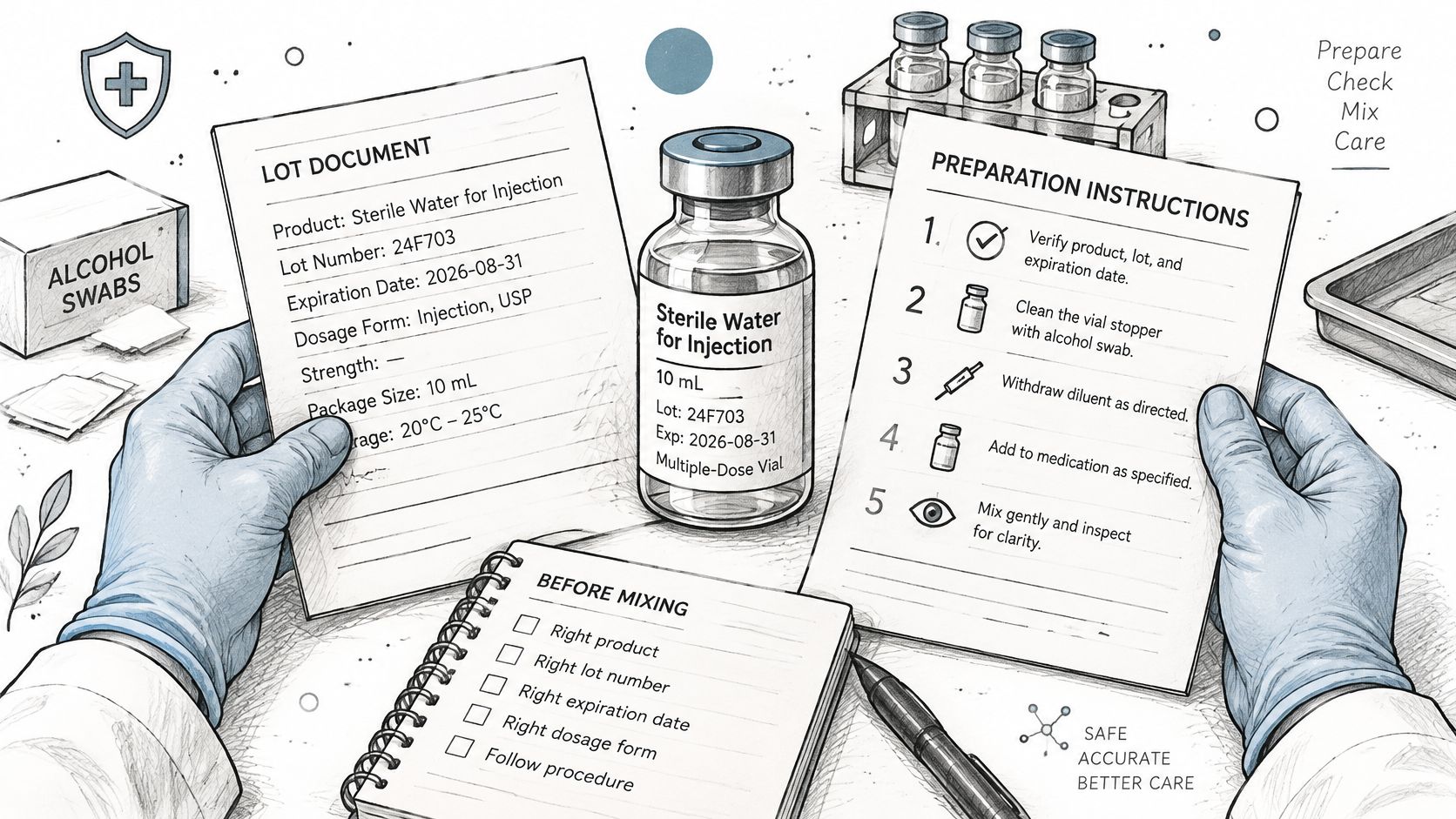
A 5 mg label does not determine a preparation method. The plan depends on what the vial contains and what the specific lot record establishes. Lyophilized powder and ready-to-use solution require different handling and calculations. For powder, confirm the permitted diluent and how the intended final volume is defined. For a solution, record its existing concentration and storage conditions. Review the batch-specific certificate of analysis (COA) alongside the product documentation, since the label may not provide these details.
Build the record around the actual lot
Start with the vial and its matching paperwork. Record the formulation state, stated net content, salt form, and any lot-specific purity or assay value. Check whether identity details, such as sequence information, are documented, and look for supplier instructions on diluent, handling, and storage. If the lot record does not specify a diluent, do not infer one from a different presentation.
Historical pharmaceutical labeling shows why presentation matters. The earlier Egrifta product was supplied as lyophilized powder at 1 mg per vial, with sterile water provided separately. Its labeled 2 mg daily regimen used two 1 mg vials. The directions called for adding 2.2 mL of the supplied diluent and gently rolling the vial in the hands for 30 seconds, rather than shaking it vigorously. Those directions apply to that historical labeled product, not automatically to a 5 mg research vial.
Use the batch record to connect the evidence to the experiment:
- Material identity: Enter the product name, lot number, physical form, and relevant identity documentation.
- Mass basis: Record the stated net content, salt form, and lot-specific assay or purity information.
- Handling evidence: Cite the supplier's storage conditions and any lot-specific solvent or preparation guidance.
- Experiment link: Name the downstream assay and the target concentration it requires.
Keep the exact COA with the record; a generic supplier sheet cannot substitute for lot-specific evidence. A research compound library may help locate product documents, but the record for the vial received must support the preparation decision. If a needed specification is missing, pause and seek clarification. Arithmetic can relate a stated mass to a chosen volume, but it cannot establish identity, composition, or suitable handling conditions.
Choosing a Diluent Volume for Your Target Concentration
A diluent volume is a concentration choice, not a universal property of a 5 mg vial. Online guides commonly mention 1 mL, 2 mL, 2.2 mL, or 2.5 mL, but those figures produce different nominal concentrations and measurement volumes. The available public guidance also reflects the central limitation: there's no single volume that can be assumed correct for every formulation, lot, or assay (Tesamorelin preparation calculator and guidance).
| Diluent volume | Nominal concentration from 5 mg |
|---|---|
| 1 mL | 5 mg/mL |
| 2 mL | 2.5 mg/mL |
| 2.2 mL | Approximately 2.27 mg/mL |
| 2.5 mL | 2 mg/mL |
These are arithmetic examples, not validated preparation instructions. The calculation divides nominal material mass by the selected volume. It doesn't account for a lot's assay value, moisture, salt-form basis, actual final volume, dissolution behavior, or compatibility with the downstream assay.
Compare the measurement trade-offs
A more dilute preparation can make a target quantity correspond to a larger measured volume, which may help when the lab's validated pipetting range performs better at that volume. The same choice can increase the number of withdrawals or the amount of solution handled. A more concentrated preparation reduces the total liquid volume but makes small differences in measurement proportionally more consequential.
Concentration also affects assay planning. It determines the volume needed for each measurement, the theoretical number of aliquots available, and the sensitivity of the result to pipetting error. A very small transfer can be harder to measure reliably with a given instrument; a larger transfer may be easier to quantify but could consume more sample or require additional handling. Those considerations belong alongside assay volume requirements and the lab's own pipette performance data.
A concentration calculation answers “how much material per unit volume, on the stated mass basis?” It doesn't answer “is this solvent suitable?” or “how long will this preparation remain acceptable?”
The final decision should be tied to the experiment and the lot. Record why the selected target concentration fits the assay, which calculation was used, what mass basis it assumes, and which lot documentation supports the input values. If the supplier's instructions, institutional procedure, or assay validation doesn't support a proposed volume, the arithmetic alone isn't a reason to proceed.
Calculating Concentration From Salt Form and Mass
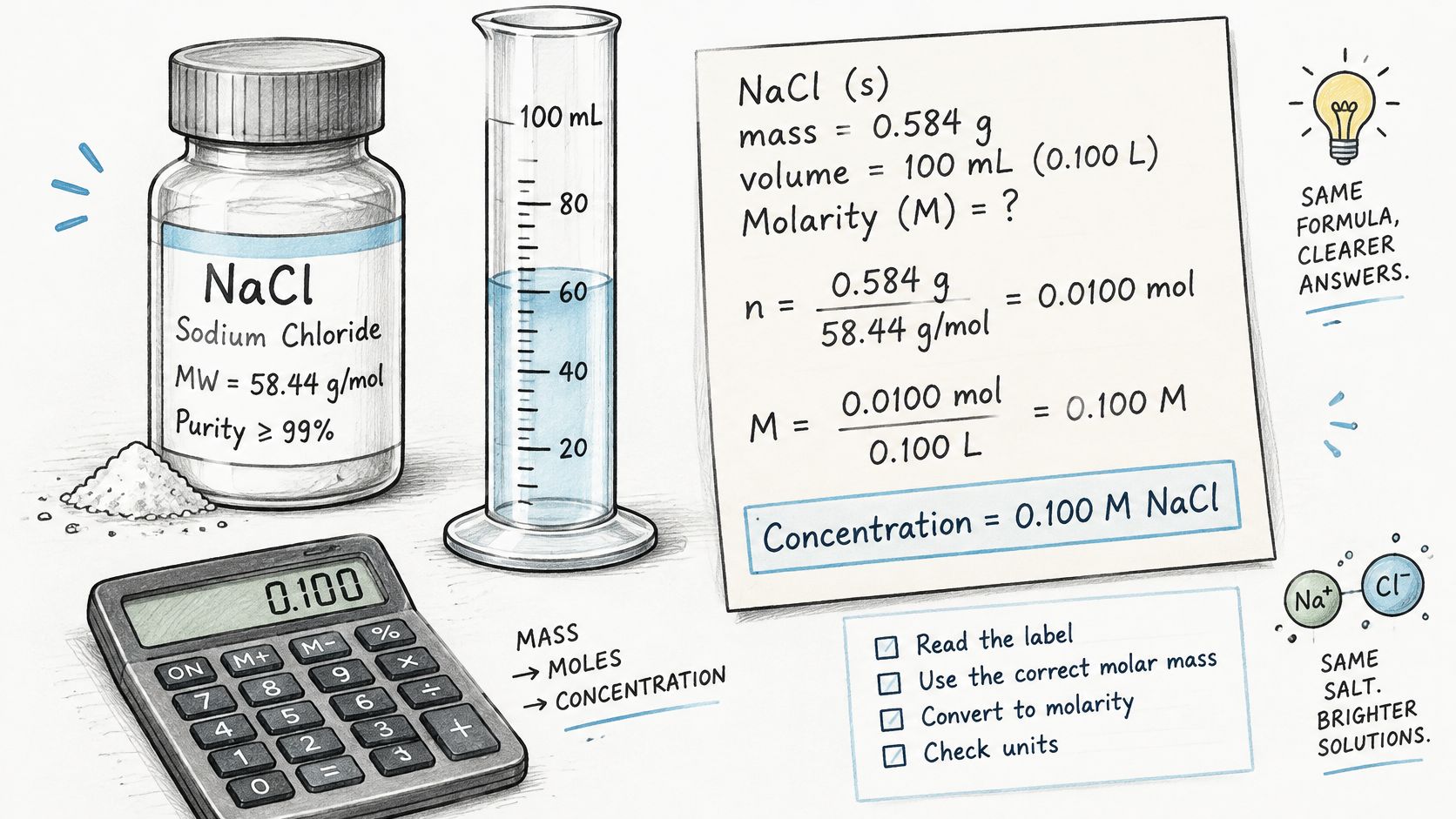
The number printed on a vial isn't always enough to define the molecular concentration precisely. Tesamorelin is a synthetic analogue of human growth hormone-releasing factor, with the 44-amino-acid GRF sequence and a hexenoyl moiety attached to the N-terminal tyrosine. The FDA identifies tesamorelin acetate with a formula that includes acetate equivalents and reports a free-base-equivalent molecular weight of 5,135.9 Da (FDA drug label).
Keep salt mass and free-base mass distinct
A nominal 5 mg amount may refer to the material as supplied, while a theoretical molar calculation may require a free-base-equivalent basis. Those values shouldn't be treated as interchangeable. The acetate salt form and its associated mass can affect the number of tesamorelin molecules represented by a stated mass, so a theoretical molarity based only on the vial label may not match a calculation using the free-base-equivalent molecular weight.
For a defensible calculation, the record should identify the mass input, the basis used, the molecular-weight value applied, and any lot-specific assay information used to adjust the estimate. If the COA reports an assay value or moisture data, those values should be considered according to the lab's validated calculation procedure. Without that lot-specific evidence, the result should be labeled as nominal or theoretical rather than presented as a measured concentration.
In-vitro pharmacology has reported that tesamorelin binds and stimulates human GRF receptors with potency similar to endogenous GRF, which supports laboratory investigation of growth-hormone-axis signaling (FDA drug label). That mechanism doesn't validate a reconstituted research preparation for a clinical purpose, and it doesn't resolve the vial's mass basis or handling conditions.
The distinction is useful in practice: arithmetic estimates composition under stated assumptions; validation establishes whether the preparation meets a defined laboratory requirement. A concentration calculation can't establish sterility, stability, container compatibility, or suitability for a downstream assay. Those are separate questions that need their own lot documentation, method validation, or acceptance criteria.
The video below provides additional context for chemical calculation. It should be treated as educational material, not as a substitute for the lot record or an approved laboratory procedure.
Storage, Stability, and Aliquot Planning
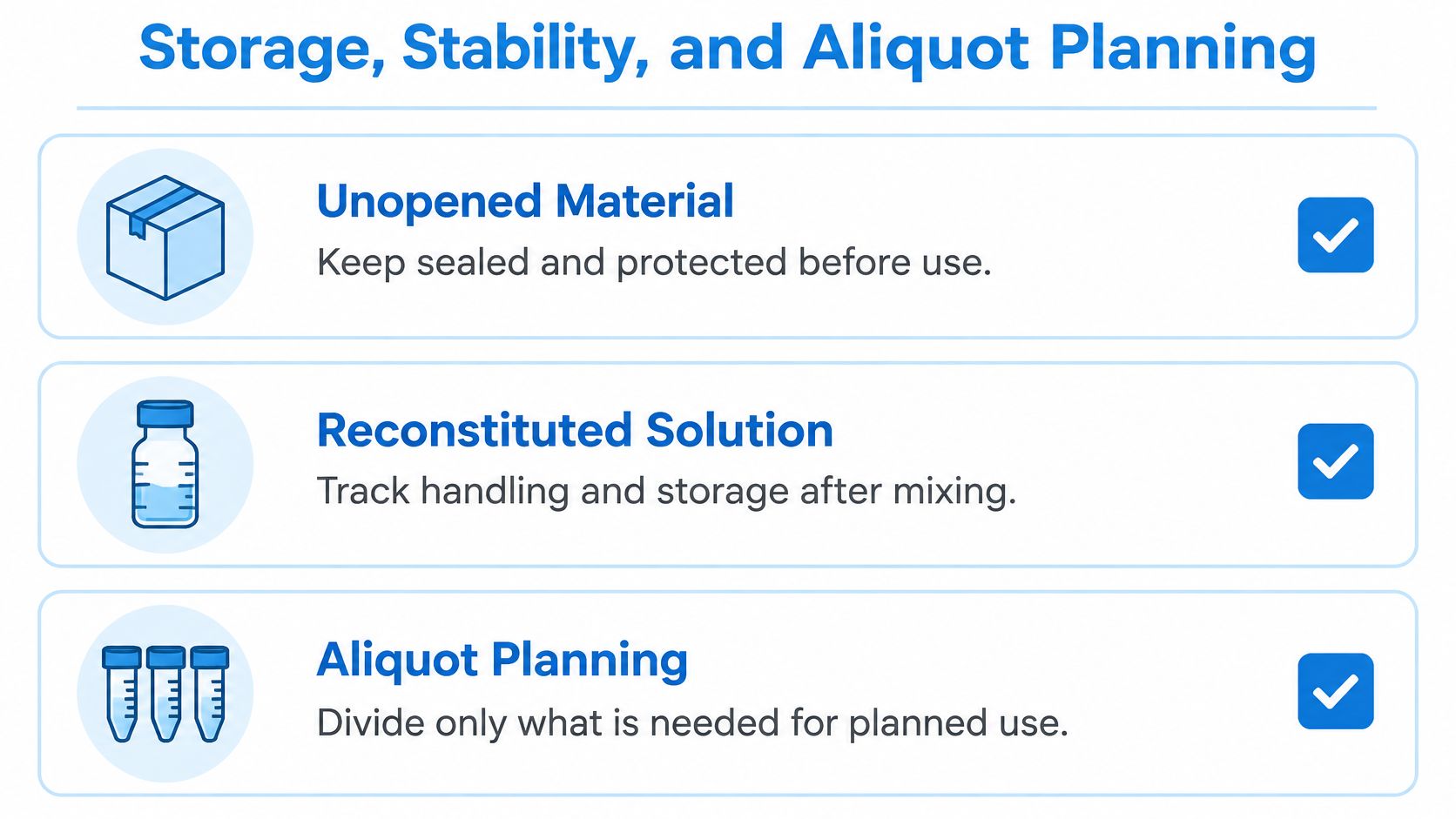
Storage planning should separate unopened material from reconstituted solution. A supplier's conditions for a sealed vial don't automatically establish the conditions or usable period after a solvent has been added. The lab should record the evidence that applies to each state and avoid converting general online advice into a lot-specific expiry rule.
Treat public timeframes as questions, not limits
Public guidance varies, with claims ranging from approximately 14 days to 21 or 30 days after reconstitution and some advice recommending 2–8 °C refrigeration. Those ranges don't establish a validated in-use stability period for a particular research lot. Commercial product information and research-use materials may differ in formulation and presentation, so storage details for one shouldn't be applied automatically to the other (tesamorelin 5 mg mixing guidance).
Chemical stability and microbiological suitability are separate claims. A preparation may retain measurable peptide content while failing a lab's sterility or endotoxin requirements after repeated punctures. A stability decision should therefore account for the container closure, frequency of withdrawal, light exposure, temperature history, freeze-thaw history, sterility controls, and the assay acceptance criteria used to decide whether material remains fit for the experiment.
Aliquoting can reduce repeated withdrawals from one container, but it doesn't create stability evidence by itself. The lab should decide whether separate aliquots are compatible with the assay and containers, and define how each aliquot will be stored and assessed. Each record should carry the lot number, calculated concentration and mass basis, preparation date, storage condition, and a retest plan tied to the experiment's acceptance criteria.
Storage decision: Set separate limits for unopened material, the prepared solution, and any aliquots. If the lot documentation doesn't support a limit, mark it as unresolved rather than borrowing a generic timeframe.
A phase I crossover study reportedly found a more concentrated, smaller-volume formulation bioequivalent to the original in 36 healthy adults, illustrating that presentation can change handling without necessarily changing pharmacokinetic exposure (FDA drug label). That clinical finding doesn't validate storage for a 5 mg research vial. Its practical lesson is narrower: formulation and volume matter, and laboratory handling decisions need evidence specific to the material being prepared.
Comparing Supplier Documentation and Verification Options
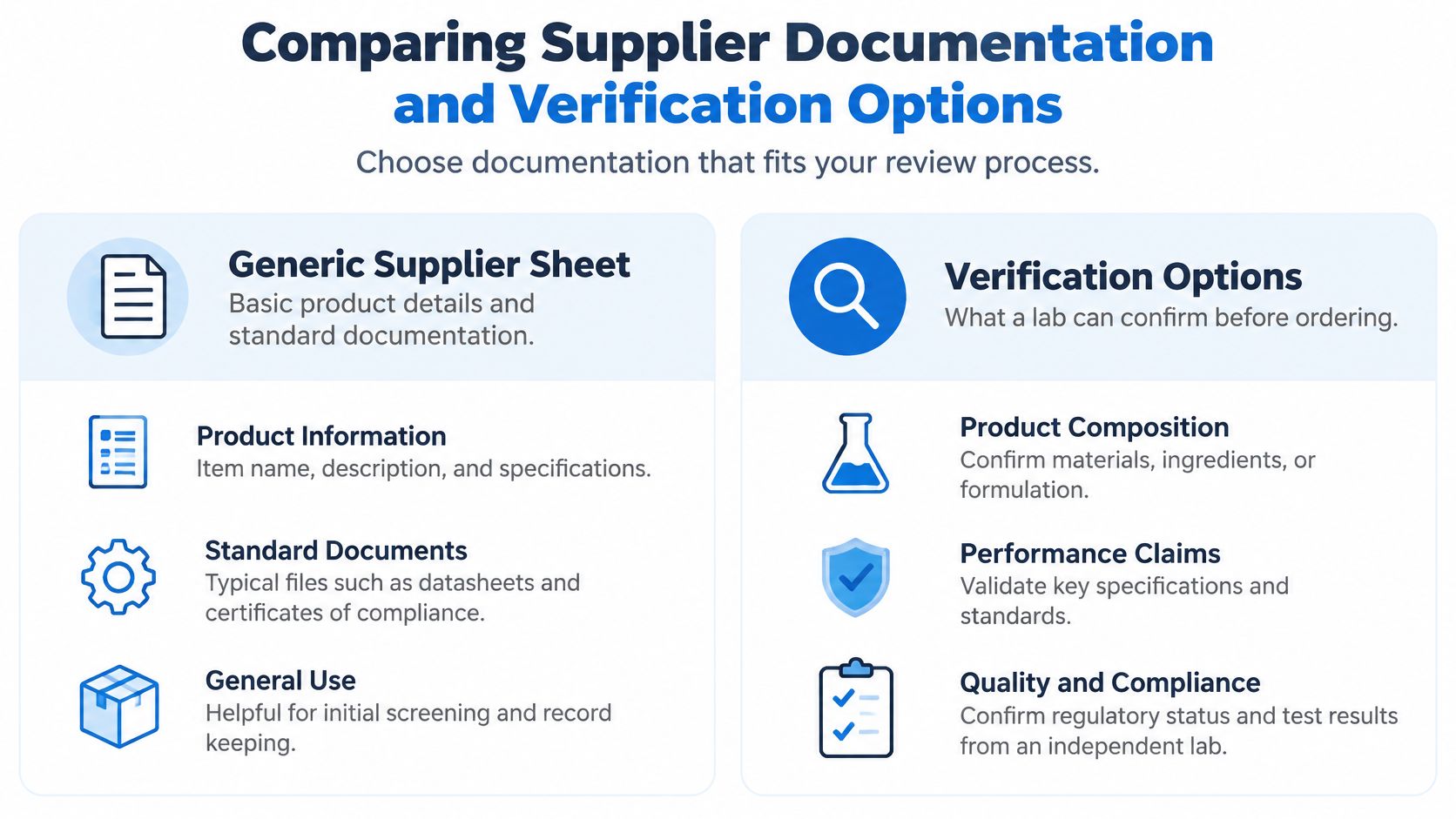
Supplier documentation varies in what it lets a laboratory verify. A generic product sheet may identify a compound and provide general specifications, while a batch-specific COA connects test results to the lot being considered or received. A broad site-level quality statement can provide context, but it doesn't replace the records needed for a particular batch or an institutional procurement review.
Compare what can be confirmed
| Documentation feature | Generic supplier sheet | Batch-specific verification |
|---|---|---|
| Identity and composition | May provide general product details | Can connect reported results to a named lot |
| Purity or assay | May state a general specification | Can show the result reported for the specific batch |
| Net content and formulation | May describe the listed product | Can support review of the supplied lot's attributes |
| Handling and procurement | May summarize general service terms | Can be checked against the receiving lab's requirements |
Useful product records may include formal name, sequence, CAS number, molecular formula, formula weight, formulation state, solubility guidance, and storage conditions. The lab should also determine whether the supplier's stated purity specification and testing scope match the institution's audit needs. A COA should be reviewed for the lot number, reported methods and results, and any limits that affect the experiment.
Pro Tec Pep describes itself as a research-use-only supplier, links batch-specific COAs at product level, and states that each batch receives third-party testing across seven categories: identity, purity, net content, sterility, endotoxins, heavy metals, and conformity. It also offers optional cold-chain shipping and 24-hour order processing. Those are supplier-described practices, so procurement staff should verify the documents and shipping options that apply to the particular lot and order. The supplier's testing information can be compared with institutional requirements, but it doesn't replace the lab's own qualification process.
The practical comparison is not “generic versus perfect.” It's whether the available evidence answers the questions posed by the lab's assay, safety controls, and purchasing procedures. A batch-specific document is more useful for traceability than an unlinked general claim, yet the laboratory still needs to confirm that the stated test categories, results, and methods satisfy its own acceptance criteria.
Next Steps for Your Lab Documentation File
A lab can turn the preparation decision into a concise file this week. First, retrieve the COA for the exact lot and confirm the physical form, mass basis, and applicable handling documentation. Then select a target concentration based on the downstream assay, record the calculation with its salt-form assumptions, and define storage, aliquot, and retest criteria that the laboratory can support.
Keep the supporting records together: product specification, lot-specific COA, calculation worksheet, preparation record, and the applicable assay acceptance criteria. The file should let another researcher understand why the concentration was selected without relying on memory or an online example. If documentation is difficult to locate or shipping conditions need review, supplier support can clarify the available records and order options.
Tesamorelin research material is for laboratory research only, not for human or veterinary use. A documented sample-preparation decision preserves that boundary while making the experimental record clearer and more reproducible.
For a tesamorelin lot under review, Pro Tec Pep provides batch-specific COAs and describes third-party testing across identity, purity, net content, sterility, endotoxins, heavy metals, and conformity. Review the applicable lot documentation and research-only product information at Pro Tec Pep before finalizing the lab's sample-preparation record.