Tesamorelin Peptide vs Sermorelin: Research Comparison Guide
Compare tesamorelin peptide vs sermorelin in research settings. Examine sequences, mechanisms, stability, and study applications for laboratory workflows.
The sharpest contrast in the tesamorelin peptide vs sermorelin comparison is not potency in the abstract, it's evidence shape. Tesamorelin reached FDA approval on November 10, 2010 for reducing excess visceral adipose tissue in adults with HIV-associated lipodystrophy, and that program was backed by two Phase 3 randomized, placebo-controlled trials with about 816 HIV-positive adults in total, including a 26-week study of 412 participants that showed visceral adipose tissue fell by about 15.2% with tesamorelin 2 mg daily while placebo rose by 4.8% (Drugs.com history of Egrifta). Sermorelin has a much older and narrower record, with FDA approval in 1997 for pediatric growth hormone deficiency and adult studies that were far smaller and shorter (Clinical Peptide comparison summary).
| Comparison Point | Tesamorelin | Sermorelin |
|---|---|---|
| Core research identity | Stabilized GHRH analog | N-terminal GHRH fragment |
| Regulatory anchor | Adult HIV-associated lipodystrophy | Pediatric growth hormone deficiency |
| Human evidence shape | Large, modern Phase 3 trials | Smaller historical pediatric and adult studies |
| Best-fit research lens | Sustained metabolic endpoint work | Pulsatile GH and receptor-response work |
| Practical caution | Strong indication specificity | Thinner adult body-composition evidence |
Setting the Stage for a Tesamorelin vs Sermorelin Comparison
Tesamorelin and sermorelin sit in the same broader GHRH analog class, but they were built for different questions. A clean comparison starts with structure, then moves to receptor behavior, then to the kind of human data each compound earned. That order matters because a peptide can look “stronger” on paper and still be the wrong tool for a narrow assay.
In bench terms, the issue is not whether one peptide sounds more modern. It's whether the compound matches the endpoint, the sampling window, and the biological system under study. Tesamorelin has the more recent and larger clinical record, while sermorelin remains useful when the experiment depends on pulsatile growth hormone release rather than a sustained metabolic signal.
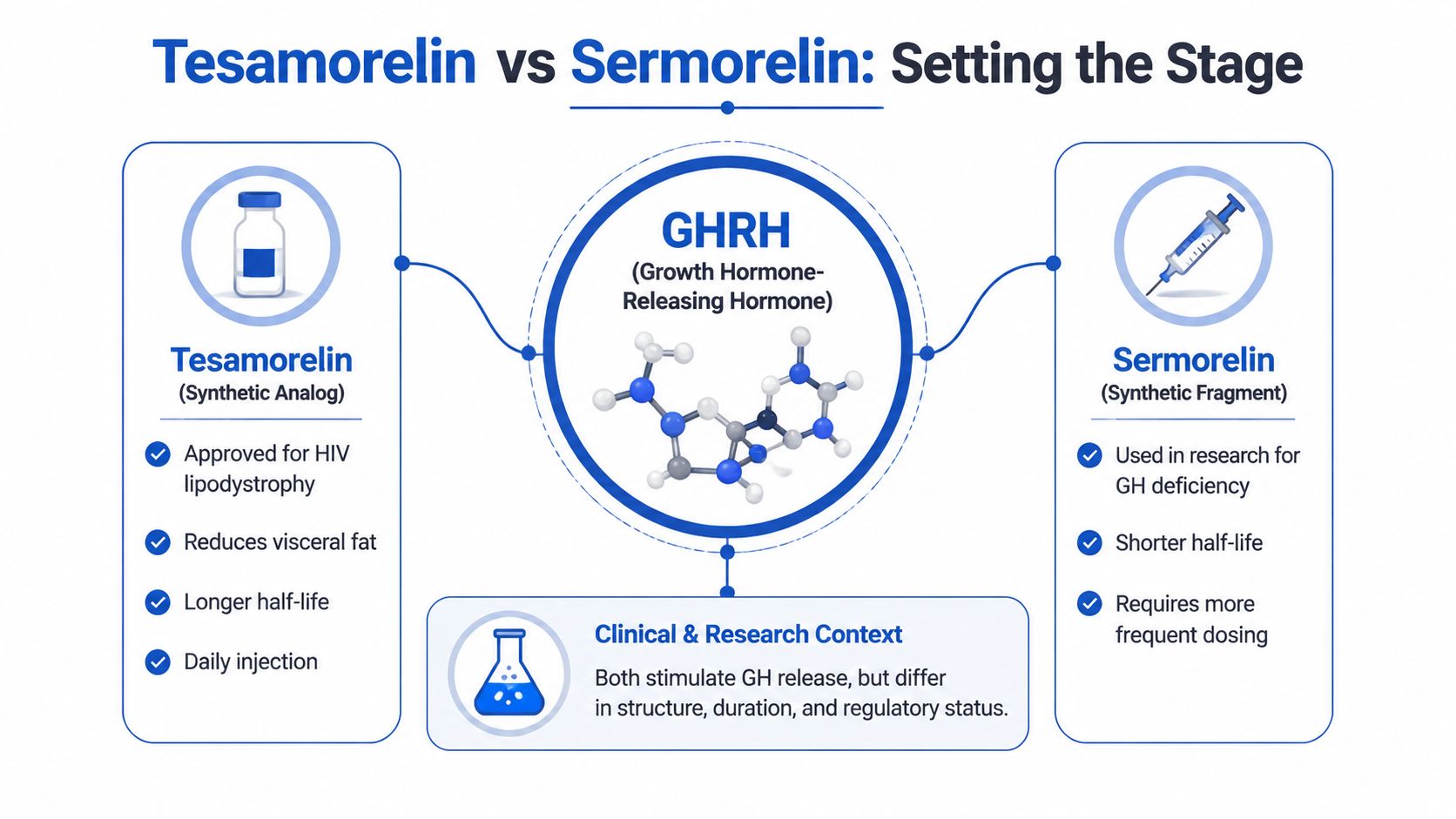
Practical rule: choose the peptide after defining the assay endpoint, not before. A receptor-binding experiment, a pituitary perfusion study, and a body-composition trial do not ask the same question.
The shared language also needs to stay precise. Both compounds act through the growth hormone-releasing hormone receptor, but they do not behave identically in time or in regulatory context. Tesamorelin has the stronger modern human trial base, yet no direct head-to-head randomized trial against sermorelin exists, so any comparison has to rest on mechanistic and indication-specific evidence rather than a fake universal ranking.
Shared vocabulary that avoids confusion
Researchers usually compare these peptides across four variables:
- Sequence class, because the structural fragment determines receptor interaction and stability.
- Signal duration, because GH pulsatility is not the same as prolonged endocrine exposure.
- Human trial footprint, because the label history tells you what endpoint was validated.
- Assay fit, because some studies need a brief stimulation pulse while others need a longer metabolic window.
A useful way to read the literature is to ask which outcome was directly measured. Tesamorelin's approval sits on visceral adipose tissue reduction in adults with HIV-associated lipodystrophy, while sermorelin's historical approval sits on pediatric growth hormone deficiency. Those are not interchangeable research aims, and the evidence should never be treated as if they were.
Structural and Mechanistic Profiles of Tesamorelin and Sermorelin
Tesamorelin is the more engineered molecule. The FDA label describes it as a 44-amino-acid synthetic analog of growth hormone-releasing hormone, and in vitro it binds and stimulates human GRF receptors with potency similar to endogenous GRF (FDA label). That structure matters because it preserves receptor agonism while changing how the peptide survives enzymatic degradation.
Sermorelin is simpler by design. Historical clinical labeling identifies it as the N-terminal 1–29 fragment of human growth hormone-releasing hormone, and PubMed-indexed literature describes it as acting through the pituitary GHRH receptor to stimulate endogenous growth hormone release (FDA historical label). In other words, it is a shorter fragment that behaves like a physiological probe rather than a stabilized metabolic agent.
What the receptor sees
Both molecules engage the same receptor class, but the resulting signaling window differs. Tesamorelin's structural modifications extend receptor activation, which is why it is the better fit for studies that need a longer GH-axis readout. Sermorelin, by contrast, produces a sharper but briefer pulse, which is exactly why it stays useful in temporal mapping work.
That difference shows up in the way investigators design assays. A short receptor pulse is valuable when the question is how the pituitary responds to a brief GHRH-like stimulus. A longer pulse matters when the readout is downstream and slower, such as IGF-1 induction or metabolic change.
Why sequence length changes the experiment
The practical consequence is not abstract chemistry. It affects what can be measured cleanly.
- Tesamorelin supports assays that tolerate a sustained endocrine window, especially those focused on downstream metabolic endpoints.
- Sermorelin supports experiments that need a narrow stimulation event, where timing resolution matters more than persistence.
- Neither peptide should be treated as interchangeable with native GHRH, because structural truncation and stabilization change the pharmacodynamic profile.
A classic human study of sermorelin in older adults reported that 20 to 40 microgram/kg increased nocturnal growth hormone secretion and IGF-1, showing that even the shorter fragment can produce a measurable endocrine effect in clinical research (UAE Wellness Lab summary of the study). That doesn't make it a metabolic analog on par with tesamorelin, it just confirms receptor-mediated activity in humans.
Stability, Half-Life, and Pharmacodynamic Duration
Stability is where the two compounds separate most cleanly at the bench. Sermorelin is the shorter GHRH(1-29) fragment and is rapidly cleared, so its pharmacodynamic window is brief. Tesamorelin is engineered to resist DPP-IV cleavage, which extends exposure and lengthens the GH-release window.
That difference is not cosmetic. It changes how long receptor activation persists, how often sampling has to occur, and how downstream markers like IGF-1 should be read. A peptide that clears quickly can be useful for pulse mapping. A longer-acting analog fits repeated-dosing metabolic work better.
Assay design follows the clock, not the label
A short half-life helps when investigators want high-temporal-resolution GH pulsatility data. Repeated-sampling protocols, superfusion systems, and diagnostic-style stimulation assays all benefit from a compound that rises and falls fast.
Tesamorelin fits the other end of the spectrum. Its longer exposure window is more compatible with longer-interval readouts, especially when the endpoint is not the immediate pulse but the downstream endocrine cascade. That fits the broader way tesamorelin has been developed and studied, and it explains why it is usually discussed in metabolic terms rather than stimulation-testing terms.
A human sermorelin study in older adults reported increased nocturnal growth hormone secretion and IGF-1 with dosing in the 20 to 40 microgram/kg range. That finding shows receptor-mediated activity in humans, but it does not make sermorelin a direct metabolic analogue of tesamorelin. The more useful conclusion is narrower. Sermorelin can generate a measurable pulse, while tesamorelin is built to sustain a longer signal.
Bench insight: if the protocol depends on distinguishing individual GH pulses, a longer-acting analog can blur the signal. If the protocol depends on sustained receptor engagement, a short pulse can undercut the readout.
Storage matters too, even though publication quality varies. Both peptides are handled as research materials that depend on cold-chain discipline, low-thaw cycling, and clean reconstitution practice. In assay terms, instability is not a side note. It is a source of variance that can blur the difference between a true receptor effect and a degraded sample.
Why half-life affects interpretation
Longer pharmacodynamic duration can make a peptide appear more active because it remains present longer. That helps when the question is metabolic exposure, but it can confound attempts to compare pure receptor kinetics. Sermorelin's shorter clearance gives a cleaner pulse profile, which is why it remains the better probe when the experiment is about timing rather than breadth of response.
Comparing the Human Efficacy Evidence Base
Tesamorelin has the larger and more modern human dataset, and that changes the confidence level for specific endpoints. Its FDA approval was backed by two Phase 3 randomized, placebo-controlled trials enrolling about 816 HIV-positive adults, with a best-known 26-week trial of 412 participants showing a measurable reduction in visceral adipose tissue (Drugs.com history of Egrifta). That is a defined metabolic endpoint in a clearly specified population.
Sermorelin's clinical record is older and much narrower. Historical summaries cite pediatric evidence built around 110 previously untreated prepubertal children with growth hormone deficiency, while adult studies were often only 19 to 30 subjects and short in duration (Clinical Peptide comparison summary). That makes sermorelin a legitimate research tool, but not one with the same kind of adult metabolic validation.
Why the endpoint matters more than the headline
A larger trial is not automatically better for every question. Tesamorelin's trial record is strongest where the endpoint is visceral adipose tissue in adults with HIV-associated lipodystrophy. Sermorelin's older studies are more relevant where the question is growth-axis stimulation, especially in pediatric or diagnostic contexts.
The absence of a direct head-to-head randomized trial is the key limitation. There is no clean way to claim one is superior across all research settings, because they were not validated against one another on the same endpoint. Any attempt to compare them by a single “effect size” would flatten two different evidence architectures into one misleading number.
The literature footprint is different by design
Tesamorelin's record is dominated by Phase 3 adult trials with imaging-based visceral fat readouts. Sermorelin's record is dominated by smaller stimulation and deficiency-focused studies. That means the data are not just unequal in size, they are unequal in purpose.
Tesamorelin answers a metabolic question well. Sermorelin answers a pulsatility question more cleanly. Those are different scientific jobs, and the literature reflects that split.
The practical consequence is simple. If the objective is to replicate a validated adult visceral fat endpoint, tesamorelin has the stronger human evidence. If the objective is to study GH secretion dynamics in a narrower experimental frame, sermorelin's leaner record can be easier to interpret.
| Attribute | Tesamorelin | Sermorelin |
|---|---|---|
| Approval history | FDA-approved in 2010 for HIV-associated lipodystrophy | FDA-approved in 1997 for pediatric growth hormone deficiency |
| Pivotal human support | Two Phase 3 randomized, placebo-controlled trials | Historical pediatric and small adult studies |
| Best-defined endpoint | Visceral adipose tissue reduction | Growth hormone stimulation |
| Adult body-composition evidence | Larger and modern | Much thinner |
| Direct comparison trial | None | None |
When a Stronger Approval Does Not Equal a Better Research Probe
Approval strength can mislead bench scientists if the question is experimental rather than clinical. Tesamorelin's FDA history is strong, but an approval for HIV-associated lipodystrophy does not make it the best probe for a generic GHRH receptor assay or a pituitary superfusion model. Its validation was tied to a specific metabolic endpoint, which defines both its utility and its limits.
Three mismatches matter. Clinical protocols can target exposure ranges that sit outside what a characterization assay needs for receptor occupancy. Adult safety monitoring, including IGF-1 oversight, introduces variables that do not belong in vitro. Population-restricted endpoints can also hide how a peptide behaves in a controlled preparation where receptor pharmacology is the only readout that should matter.
Better approval, narrower use case
Sermorelin can be the cleaner mechanistic probe in some designs because its evidence base is narrower. That narrower record is less useful for adult metabolic claims, but its shorter action fits questions about how a GHRH fragment drives a pulse.
Tesamorelin's clinical value is linked to a specific metabolic use case, not to every GH-axis experiment. It is the stronger choice for visceral adipose tissue work, yet that does not make it the better tool for receptor characterization, pulse-frequency analysis, or short-window pituitary testing. The correct peptide is the one that matches the readout, not the one with the broader label.
| Attribute | Tesamorelin | Sermorelin |
|---|---|---|
| Approval history | FDA-approved in 2010 for HIV-associated lipodystrophy | FDA-approved in 1997 for pediatric growth hormone deficiency |
| Core human evidence | Two Phase 3 randomized, placebo-controlled trials | Historical pediatric and small adult studies |
| Best-defined endpoint | Visceral adipose tissue reduction | Growth hormone stimulation |
| Adult body-composition evidence | Larger and modern | Much thinner |
| Direct comparison trial | None | None |
A decision rule that avoids category error
Researchers usually get better data when they ask:
- Is the endpoint metabolic or pulsatile?
- Does the assay need sustained exposure or a brief spike?
- Does the human literature match the model system, or only the receptor class?
Those questions help prevent category errors. A peptide approved for one adult condition can still be the wrong instrument for a different assay, especially when timing, clearance, and readout sensitivity all affect the result.
Formulation, Storage, and Purity Verification in the Lab
Formulation details affect reproducibility before the first assay begins. Tesamorelin is commonly distributed as a lyophilized acetate form, and sermorelin is also commonly handled as an acetate salt in research settings. The shared shipping format simplifies handling, but it does not remove differences in acceptance criteria or downstream preparation.
Purity and identity checks should come first. Reversed-phase HPLC area-percent purity gives a fast screen, LC-MS confirms identity, and LAL testing matters when cell-based or ex vivo systems could respond to endotoxin contamination. If a lot fails any of these checks, the issue is practical, not theoretical, because sample quality can shift the receptor readout.
Handling rules that protect the sample
The cleanest workflow is straightforward.
- Keep lyophilized material cold, with -20 °C used for long-term storage when the material is not in immediate use.
- Store reconstituted aliquots at 2 to 8 °C for short holding windows.
- Limit freeze-thaw cycles because repeated cycling can change apparent potency in repeated runs.
- Use clean aliquoting so a single vial does not become the source of cross-run contamination.
These are basic controls, yet they are where comparison studies often diverge. If tesamorelin is reported at ≥97% HPLC purity in one workflow and sermorelin is accepted under a different reference standard, the compounds are not being compared on identical material quality. The Pro Tec Pep product documentation framework is one example of the kind of batch-level documentation that helps researchers interpret that gap.
Why product-level documentation matters
Batch-linked documentation helps researchers tie a result to a specific lot, not just to a compound name. For lab teams comparing peptides over time, that is often more useful than a broad marketing claim. Tesamorelin and sermorelin can both support clean assay work, but only if purity, mass confirmation, and endotoxin status are checked before the run.
| Parameter | Tesamorelin | Sermorelin |
|---|---|---|
| Common research form | Lyophilized acetate | Lyophilized acetate salt |
| Cold storage for stock material | -20 °C | -20 °C |
| Short holding after reconstitution | 2 to 8 °C | 2 to 8 °C |
| Identity confirmation | LC-MS | LC-MS |
| Purity screen | Reversed-phase HPLC | Reversed-phase HPLC |
| Contamination check | LAL when applicable | LAL when applicable |
Choosing the Right GHRH Analog for Your Research Application
The choice is mostly about assay design. Sermorelin fits experiments that need a brief GH pulse, tighter timing resolution, or a diagnostic-style stimulation pattern. Tesamorelin fits protocols that depend on sustained IGF-1 exposure, visceral adipose tissue work, or replication of the adult metabolic literature.
That difference matters because the two peptides do not answer the same question. Sermorelin's shorter duration supports pituitary signaling studies where the timing profile is the readout. Tesamorelin's stabilized profile supports work that needs a longer endocrine window and a validated adult metabolic endpoint.
Match the probe to the assay
A simple decision matrix usually works.
- Pulsatile GH-release assays favor sermorelin because the short signal is easier to resolve.
- Visceral adipose tissue experiments favor tesamorelin because that is where the human evidence is strongest.
- Growth-axis modeling with narrow timing windows usually fits sermorelin better.
- Longer-window endocrine studies usually fit tesamorelin better.
For labs that need documented batch traceability, lot-specific COAs, cold-chain handling, and explicit research-use documentation reduce setup friction. Pro Tec Pep is one supplier that lists both compounds for laboratory work and provides batch-level documentation, which helps when procurement has to match assay planning.
The decision should not be generic
The right question is, which peptide matches the endpoint already defined by the protocol. That framing avoids overclaiming and keeps interpretation anchored to the literature rather than to a broad strength comparison.
Selection rule: use tesamorelin when the assay needs validated metabolic context, and use sermorelin when the assay needs a shorter, cleaner GH pulse.
For laboratories standardizing GHRH analog workflows, the most useful next step is to compare documented purity, mass identity, and storage conditions against the planned assay window before ordering. Researchers who want a supplier that provides batch-linked documentation and research-only fulfillment can review Pro Tec Pep alongside their internal QC requirements.