TB 500 Peptide vs BPC 157: A Research Comparison
A side-by-side tb 500 peptide vs bpc 157 comparison covering mechanism, preclinical data, stability, and COA considerations for laboratory research.
Both BPC-157 and TB-500 remain research-use-only compounds, with no FDA approval and no EMA marketing authorisation. In a 2026 rat Achilles tendon study, the strongest efficacy signal was a TB-500 biomechanical edge, with maximum load to failure reaching statistical significance at p < 0.05, alongside shared early histopathology gains (PubMed-indexed study).
That result changes how an R&D team should approach TB-500 peptide vs BPC-157. The comparison isn't about which compound appears more promising. It depends on whether the protocol prioritises tissue appearance, collagen organisation, vascular signalling, cell migration, tensile strength, or translational precedent. The published record remains primarily preclinical, and the strongest evidence comes from animal models rather than completed human efficacy trials (2026 peer-reviewed review).
| Research question | BPC-157 | TB-500 |
|---|---|---|
| Chemical identity | Synthetic 15-amino-acid pentadecapeptide | Synthetic fragment associated with thymosin beta-4 |
| Main mechanistic emphasis | Vascular, endothelial, nitric oxide, and repair signalling | G-actin sequestration, cell migration, and cytoskeletal remodelling |
| Achilles model signal | Improved early histology and increased maximum load versus controls | Improved early histology and stronger biomechanical signal versus controls |
| Human evidence | Small pilot studies and case-series evidence, with no completed randomised controlled musculoskeletal trials | Parent thymosin beta-4 reached Phase II development in non-musculoskeletal indications |
| Regulatory position | No FDA approval or EMA marketing authorisation, Category 2 status reported | No FDA approval or EMA marketing authorisation, Category 2 status reported |
| Best research fit | Angiogenesis, mucosal repair, and vascular signalling protocols | Tensile-strength, actin-cytoskeleton, and cell-migration protocols |
Why TB-500 and BPC-157 Are Compared at All
Two preclinical repair compounds, two different biological hypotheses. BPC-157, or Body Protection Compound 157, is a synthetic gastric-derived sequence studied in models of vascular signalling, mucosal integrity, wound repair, and musculoskeletal tissue. TB-500 is a synthetic fragment associated with thymosin beta-4 biology, with research focused on cell movement, actin regulation, and tissue architecture.
The comparison is useful because the compounds are often tested against different endpoints. BPC-157 research commonly emphasises tissue appearance, vascular responses, and repair signalling. TB-500 research more directly raises questions about cell migration, cytoskeletal remodelling, and mechanical performance. These are related outcomes, not interchangeable measures.
The available human evidence remains limited, with no completed orthopaedic human efficacy record for TB-4 or TB-500, and both compounds remain prohibited in sport according to the peer-reviewed injectable peptide primer. Their regulatory position should be treated as a separate decision point and examined in the dedicated 2026 FDA 503A review section.
For an R&D team, three questions should remain separate:
- Does a compound produce a signal in an animal model?
- Which endpoint detects that signal?
- Does the evidence support controlled human research?
The key asymmetry is histology versus biomechanics. Histological improvement may indicate better organisation or cellular appearance, but it does not establish greater load-bearing capacity. A tendon may appear more organised under microscopy while still requiring tensile testing to determine whether its mechanical function improved.
Practical rule: Treat histology and biomechanics as complementary endpoints, not interchangeable proof of the same outcome.
The comparison is therefore an evidence map, not a consumer buying guide. BPC-157 may fit protocols centred on vascular and repair-signalling hypotheses, while TB-500 may fit studies examining actin-dependent migration or tensile strength. Neither compound can be identified as a universal winner from the current preclinical record.
Chemical Identity and Mechanism in Plain Terms
The two compounds differ in origin, sequence identity, and proposed biological role. Those differences should shape assay selection before a laboratory compares outcomes.
| Attribute | BPC-157 | TB-500 |
|---|---|---|
| Research identity | Synthetic pentadecapeptide derived from the gastric protein BPC | Synthetic fragment associated with thymosin beta-4 |
| Sequence | GEPPPGKPADDAGLV | Commonly described through the Ac-SDKP or Ac-LKKTET-linked thymosin beta-4 fragment lineage |
| CAS information | CAS 137525-51-0 | CAS 77591-33-4 for the thymosin beta-4 parent |
| Approximate molecular weight | Approximately 1419 Da | Approximately 4963 Da |
| Proposed signalling emphasis | Vascular and endothelial nitric oxide pathways, angiogenic signalling, VEGFR2, and growth-factor upregulation | Monomeric G-actin sequestration, cell migration, and cytoskeletal remodelling |
| Research interpretation | Upstream repair and vascular-signalling hypothesis | Downstream cell-movement and tissue-architecture hypothesis |
BPC-157 is described as a 15-amino-acid sequence, which makes it a compact synthetic pentadecapeptide rather than the full parent protein from which some biological discussions originate. Preclinical literature has associated it with endothelial and nitric oxide system modulation, angiogenic signalling through VEGFR2, and changes in growth-factor expression. These mechanisms are hypotheses supported by experimental work, not approved clinical indications.
TB-500 is associated with thymosin beta-4, a peptide involved in actin biology. A recent research summary describes thymosin beta-4-related activity through binding to monomeric G-actin, a mechanism that can influence cell migration and cytoskeletal organisation (mechanism summary). This makes TB-500 relevant to studies that measure how cells move, reorganise their internal architecture, or contribute to tissue repair.
The most useful contrast is functional. BPC-157 is generally investigated as an upstream repair-signalling candidate, particularly where vascular or endothelial behaviour matters. TB-500 is investigated closer to the cell-migration and actin-architecture layer, where cytoskeletal dynamics may influence how cells populate and remodel damaged tissue.
That distinction doesn't establish that one compound is stronger overall. It establishes that the compounds may be better matched to different experimental questions. A laboratory measuring angiogenic signalling shouldn't rely only on load-to-failure data, while a tendon-mechanics study shouldn't treat vascular markers as a substitute for mechanical testing.
Preclinical Evidence and the Achilles Tendon Data
The clearest direct comparison comes from a 2026 rat Achilles tendon study involving BPC-157, TB-500, their combination, and controls in a complete tendon-transection model. Researchers used Sprague-Dawley rats and a 14-day peptide dosing window, as shown in the supplied study visual.
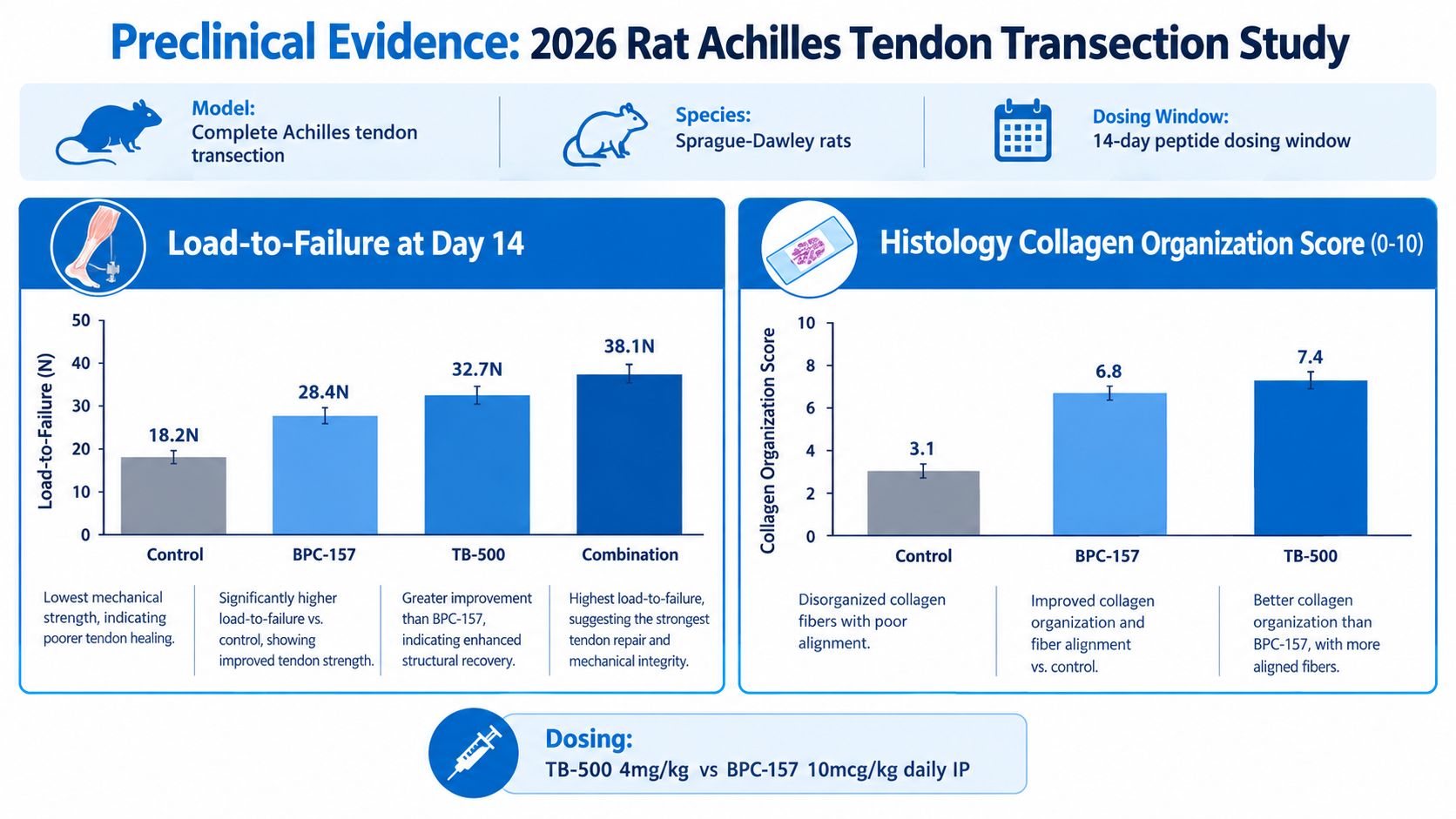
The comparison depends on separating histopathology from biomechanics. Histology scores microscopic tissue structure, cell density, and collagen organisation. In this study, Bonar and Movin scores, tenocyte density, and collagen-fibre alignment all contributed to the assessment. BPC-157 and TB-500 each improved early histopathological features relative to saline controls, with broadly similar signals of early tissue organisation.
The reported statistics support that reading. TB-500 produced a lower total Bonar score than controls, with p = 0.016. The BPC-157 plus TB-500 group produced a lower total Movin score, with p = 0.017, and the combination also showed a lower Movin score in another comparison, with p = 0.040 (2026 Achilles tendon study).
The mechanical endpoint changes the comparison
The separation becomes clearer in biomechanical testing. Maximum load to failure was higher in both peptide groups than in controls, but statistical significance was reported for TB-500 at p < 0.05. A separate summary of the same rat Achilles transection model describes a measurable biomechanical advantage for TB-500 over BPC-157 alone at four weeks (full-text tendon study).
This does not establish superiority across every endpoint. It identifies tensile-strength recovery as the more informative differentiator in this model. A lower histological score indicates improved tissue organisation, while load-to-failure testing asks whether the repaired tendon can withstand greater force.
A lower histology score can support improved tissue organisation. It can't, by itself, establish that the repaired tendon withstands greater force.
For R&D planning, the asymmetry matters. BPC-157 remains relevant to experiments centred on vascular or repair-signalling hypotheses. TB-500 warrants closer attention when the endpoint is mechanical competence rather than tissue appearance alone. The study supports further preclinical work, but its rat model, short dosing window, and endpoint set do not establish human efficacy.
Stability, Storage, and Handling in the Lab
Storage and sample preparation affect reproducibility as much as compound selection. A research team comparing BPC-157 and TB-500 should define the material state, storage conditions, diluent choice, light exposure, and freeze-thaw handling before the first assay begins.
| Parameter | TB-500, thymosin beta-4 fragment | BPC-157, BPC fragment |
|---|---|---|
| Long-term material state | Lyophilised material | Lyophilised material |
| Documented cold storage | -20°C with desiccation | -20°C with desiccation |
| Short-term prepared-sample handling | 2 to 8°C for short-term laboratory windows | 2 to 8°C for short-term laboratory windows |
| Solubility consideration | Higher aqueous solubility is commonly documented | More careful diluent selection is required |
| Main degradation risks | Light exposure, elevated temperature, and repeated freeze-thaw handling | Light exposure, elevated temperature, and repeated freeze-thaw handling |
| Preparation context | Laboratory sample preparation for in-vitro or in-vivo model work | Laboratory sample preparation for in-vitro or in-vivo model work |
The storage figures above should be treated as documentation-grade handling parameters, not as instructions for human administration. Reconstitution belongs inside a controlled laboratory workflow, where the research team records the solvent, preparation date, concentration, container type, and storage history.
TB-500's comparatively higher aqueous solubility can simplify sample preparation in some laboratory systems. BPC-157 may require more deliberate diluent selection because formulation conditions can affect clarity, stability, and downstream assay interpretation. Neither observation replaces a batch-specific specification sheet or validation in the laboratory's own assay matrix.
A practical handling record should capture:
- Material state: Whether the vial remains lyophilised or has been prepared as a laboratory sample.
- Temperature history: Whether the material remained at the documented cold-storage range.
- Light exposure: Whether preparation and storage occurred under conditions that limit avoidable photodegradation.
- Freeze-thaw history: Whether the documented supplier limit was respected.
- Assay compatibility: Whether the prepared material was tested for precipitation, adsorption, or matrix interference.
A storage condition can preserve a compound's nominal identity without guaranteeing that every downstream assay will behave identically. Research teams should therefore treat supplier documentation as a starting specification and maintain their own chain-of-custody record.
Translational Track Record and the Human Evidence Gap
Human evidence is asymmetric, but the relevant distinction is between TB-500's preclinical endpoint profile and the clinical record of related thymosin beta-4 research. BPC-157 remains predominantly exploratory, supported mainly by rodent studies and a small number of pilot or case-series reports. No completed randomised controlled trial has established its efficacy for musculoskeletal injury. Thymosin beta-4, the parent-protein lineage associated with TB-500, has progressed further in human development for non-musculoskeletal indications, including dry eye and venous ulcer healing (2026 review of translational evidence).
The endpoint asymmetry matters. BPC-157's preclinical rationale is often built around histology, vascular markers, and tissue-repair signalling. TB-500-related work is more relevant to a translational precedent, but parent-protein findings do not establish the biomechanics, functional recovery, or clinical performance of the TB-500 fragment.
The two materials are not automatically interchangeable in sequence, pharmacology, formulation, manufacturing, or evidence. Human Phase II development involving thymosin beta-4 therefore informs development planning, rather than proving that TB-500 has reproduced those results.
What the asymmetry means for development planning
For a translational team, the thymosin beta-4 lineage provides a stronger human development precedent. That history can inform manufacturing controls, analytical characterisation, clinical formulation questions, and the broader CMC narrative. It does not resolve the absence of completed human musculoskeletal efficacy trials for TB-500.
BPC-157 supports a different development rationale. Proposed vascular, endothelial, and repair-signalling mechanisms may justify studies centred on angiogenesis or mucosal biology. Its clinical foundation is thinner, however, leaving a larger gap between preclinical histological signals and a defensible human study rationale.
No completed Phase III efficacy data support either compound for a human indication. Neither holds FDA approval or EMA marketing authorisation. The most defensible conclusion is conditional: TB-500 has the more advanced translational lineage, while BPC-157 remains more dependent on preclinical mechanistic and histological evidence than on demonstrated human functional outcomes.
Regulatory Status After the 2026 FDA 503A Review
Regulatory status is jurisdiction-specific, and online availability does not establish an approved pathway. The 2026 regulatory summaries classify both BPC-157 and TB-500 as Category 2 bulk substances within the relevant 503A framework, which bars pharmacy compounding under that framework. They also report no FDA approval or EMA marketing authorisation for either compound. These are regulatory classifications, not findings that either material is safe or effective for a human indication.
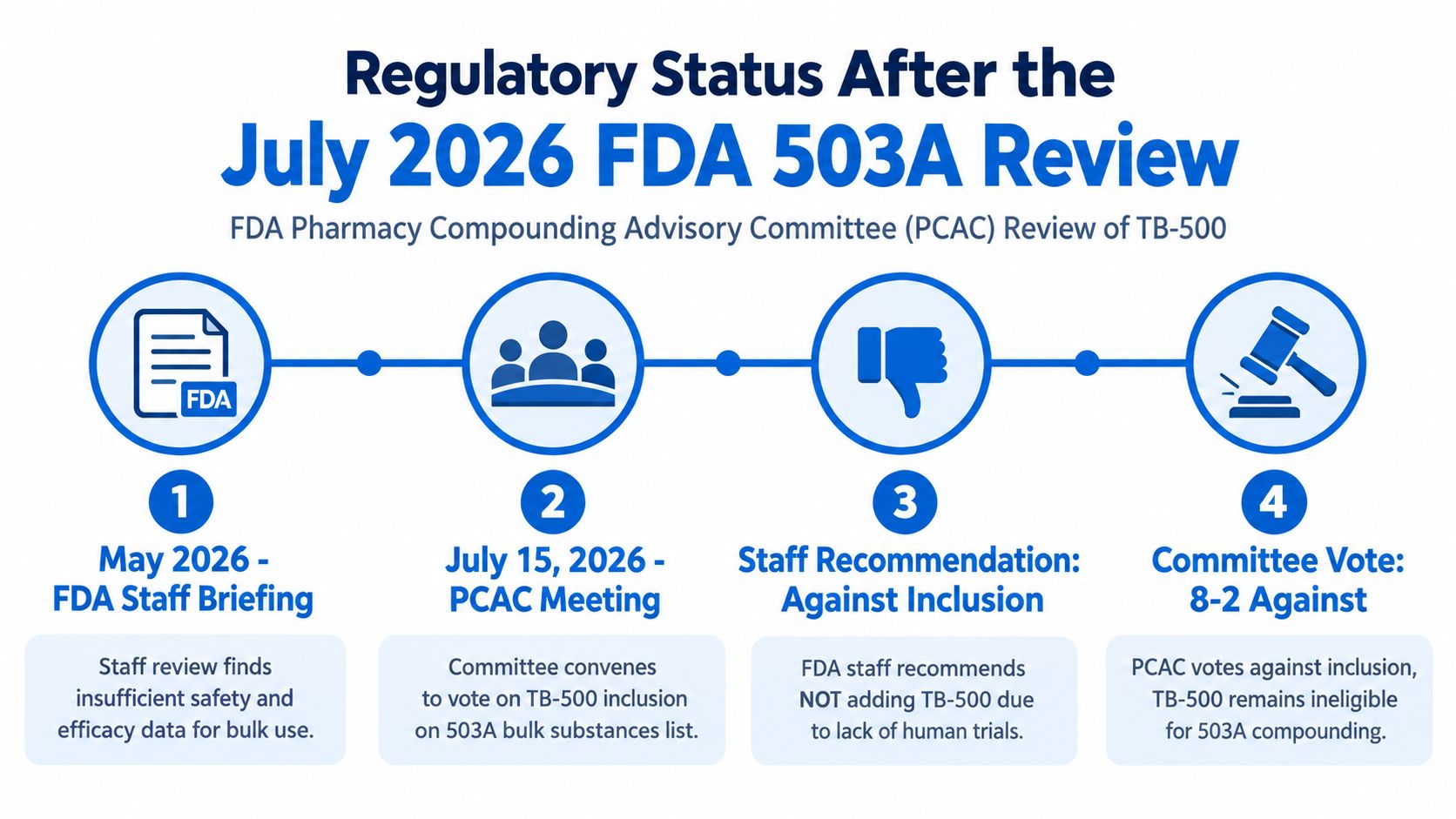
The July 2026 FDA Pharmacy Compounding Advisory Committee review narrowed the TB-500 question further. FDA staff recommended against adding TB-500 to the 503A bulk drug substances list, citing its limited safety and efficacy record and the absence of human trials. Coverage of the review describes an unsettled process, so the outcome should be treated as a constraint on compounding eligibility rather than as a clinical verdict (July 2026 FDA 503A review summary).
Why the 503A distinction matters
Section 503A governs when pharmacies may compound preparations from bulk drug substances. It does not approve a research compound, establish an approved indication, or convert a Category 2 substance into a therapy. A committee recommendation therefore cannot substitute for human efficacy data or marketing authorisation.
BPC-157 appeared in a separate regulatory category rather than the same TB-500 docket. That separation reflects differences in evidence packages, proposed mechanisms, and development histories. A broad statement that “peptides are legal” is operationally incomplete. The relevant questions concern the specific compound, jurisdiction, formulation, intended activity, and applicable institutional controls.
Regulatory reading: A committee process signals uncertainty, not permission.
For R&D planning, teams should document the intended research activity, confirm institutional requirements, review current jurisdiction-specific rules, and keep supplier access separate from regulatory clearance. Reassess the position when agencies publish new materials or committee outcomes.
Reading a COA for Research Peptide Batches
A Certificate of Analysis is useful only when it identifies the exact batch and explains how each result was generated. A generic PDF with a compound name and a purity figure doesn't provide enough information for reproducibility.
Identity and composition checks
The first review should confirm that the certificate belongs to the material under consideration. Researchers should compare the lot number, product name, testing date, and issuing laboratory against the vial label and purchase record.
The identity section should show a defensible analytical method, such as mass spectrometry or HPLC retention-time comparison. A purity percentage has meaning only when the certificate states the method threshold and relevant test conditions. “Purity” without method context can conceal whether the result reflects area percentage, mass balance, or another calculation.
The certificate should also distinguish net peptide content from gross vial weight. Gross weight can include excipients, residual moisture, counterions, or other non-peptide material. For assay preparation, that distinction affects how researchers calculate the material entering a controlled experiment.
Contaminant and microbiological review
The next pass should cover:
- Residual solvents: The report should identify tested solvents and show whether traces were detected or below the applicable reporting threshold.
- Trifluoroacetate: If the product is supplied in a TFA-associated form, the certificate should disclose relevant counterion or residual-trace information.
- Endotoxins: Results should be expressed in EU/mg, with the laboratory's stated limit and method.
- Sterility and microbial testing: These results matter where the supplier makes a sterility or microbial-control claim, but they shouldn't be assumed from a purity result.
- Heavy metals: The panel should identify tested elements and reporting limits rather than state “passes.”
Batch control: A COA supports traceability only when the document, vial, invoice, and laboratory record all point to the same lot.
Missing method parameters, mismatched lot numbers, unverifiable third-party testing, and certificates that appear copied across products are immediate red flags. COAs also don't establish full research reproducibility by themselves. Synthesis records, purification documentation, formulation details, and storage history provide the context needed to interpret a batch result.
Choosing Between TB-500 and BPC-157 for Your Study
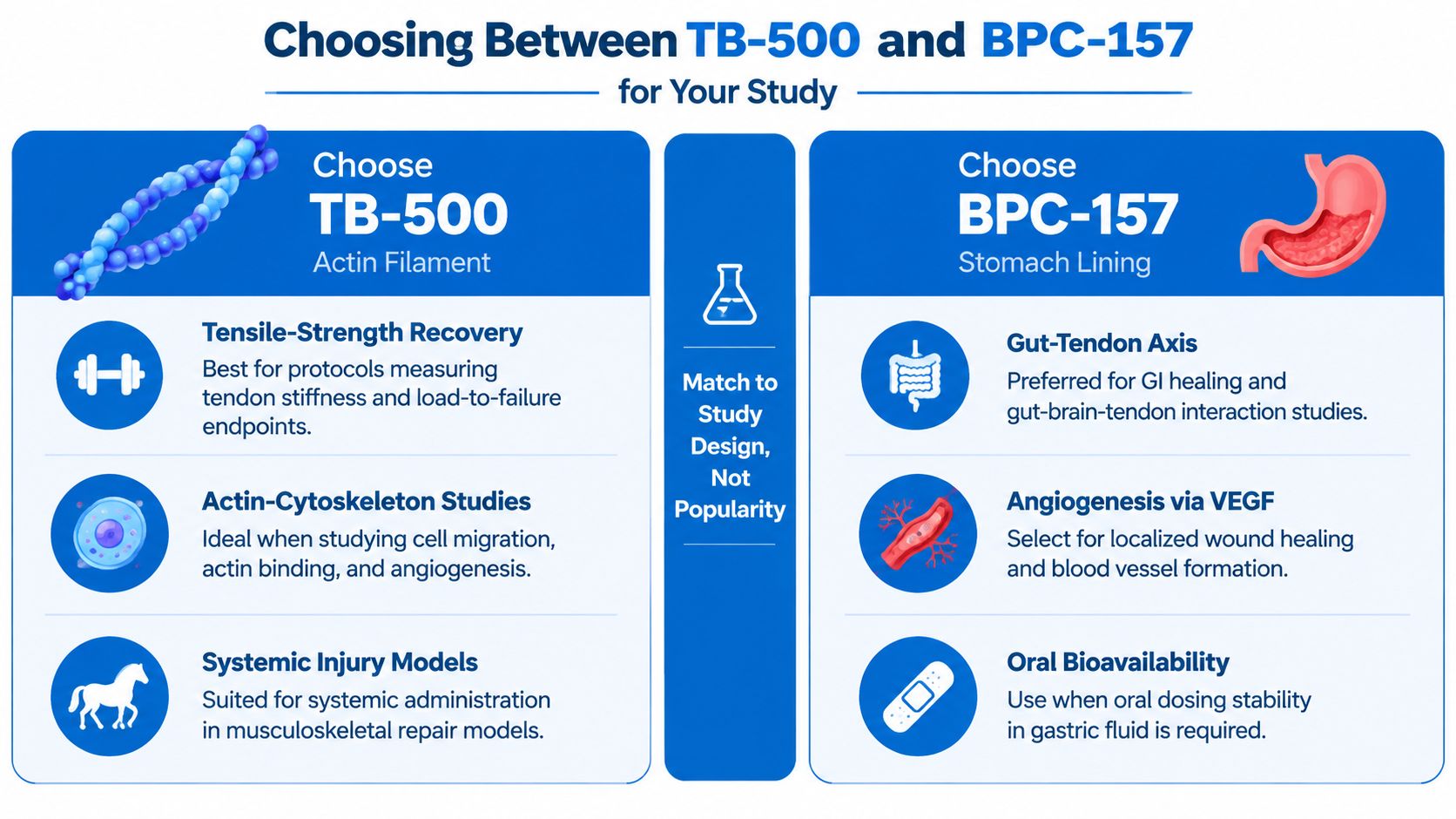
Compound selection should follow the endpoint, not online popularity. The available Achilles data place TB-500 closer to protocols that measure tensile strength, load to failure, and mechanical recovery, while BPC-157 remains more directly aligned with investigations of vascular signalling, mucosal repair, and nitric oxide-related biology.
A study team can make the decision through three filters:
Define the primary endpoint. If the protocol's central readout is load-to-failure, stiffness, or work-to-failure, TB-500's preclinical mechanical signal gives it closer endpoint alignment. If the primary readout is angiogenesis, endothelial response, mucosal repair, or nitric oxide modulation, BPC-157 offers the more direct mechanistic fit.
Separate the pathway from the outcome. TB-500's actin and cell-migration biology doesn't prove superior tendon healing across models. BPC-157's vascular-signalling profile doesn't establish mechanical restoration. Each compound needs an assay panel capable of testing its proposed mechanism rather than relying on a single surrogate.
Audit operational fit. Documentation depth, supply continuity, storage conditions, diluent compatibility, and batch-level analytical support can determine whether a protocol is reproducible. A theoretically attractive compound becomes a weak choice if the laboratory can't verify identity, maintain material integrity, or repeat the preparation process.
Neither compound wins across every endpoint. The stronger conclusion is narrower and more useful: TB-500 is the better-aligned candidate for mechanical and actin-focused studies, while BPC-157 is the better-aligned candidate for vascular, mucosal, and repair-signalling studies. Researchers should still test both where the scientific question requires a head-to-head comparison.
Pro Tec Pep provides research-use-only BPC-157 and TB-500 materials with batch-linked documentation, product specifications, and optional cold-chain logistics for laboratory workflows. Research teams comparing these compounds can visit Pro Tec Pep to review the Compound Research Library and locate the documentation needed for controlled procurement.
For laboratory research use only. Not for human or veterinary use. Not a drug, food, or cosmetic. Not evaluated by the FDA. Not intended to diagnose, treat, cure, or prevent any disease. By purchasing, you certify you are a qualified researcher and agree to use this product solely for in-vitro laboratory research.