TB 500 Peptide for Sale: A Buyer's Research-Use Guide
Buying TB 500 peptide for sale for the lab? Learn what to verify on COAs, purity checks, storage, and RUO compliance before you order.
A lab technician can reach checkout with the vial selected, the purchase order ready, and one unanswered question blocking the order: what should the certificate of analysis prove? A generic PDF may list purity, but it may not identify the purchased lot, explain the salt form, or show how the laboratory confirmed identity. That gap turns a routine purchase into a documentation problem.
Searches for TB-500 peptide for sale often return consumer-facing pages that blur research material, prohibited sports substances, and unapproved human products. A laboratory buyer needs a different standard. The decision should rest on identity, batch evidence, storage control, shipping integrity, and research-use compliance, not on wellness language or a large purity figure.
Ordering TB-500 Without a Game Plan
The technician pauses at a vendor's COA upload field and opens the document. Seven fields appear, but the report doesn't show a matching lot number. The purity result looks attractive, yet the file could apply to any batch. The technician now has two choices, approve an undocumented purchase or stop the order and ask better questions.
Stopping is the correct choice. Procurement without a written checklist creates inconsistent inventory, weakens the laboratory audit trail, and makes later assay troubleshooting harder. A sound buyer doesn't evaluate a TB-500 listing as a retail product. The buyer evaluates a defined research reagent attached to verifiable records.
Three failures that happen at checkout
A generic COA replaces a lot-specific COA. A vendor may upload one representative report for an entire product page. That document doesn't establish that the vial being purchased has the same identity, purity, content, or contaminant profile. The lot number on the report should match the lot number on the vial and packing documentation.
Ambient shipping gets selected by default. Lyophilized material can tolerate limited transit conditions, but heat, humidity, and repeated temperature changes still create avoidable risk. The procurement record should reflect the vendor's stated storage requirements, the material's formulation state, transit duration, and the receiving laboratory's ability to inspect the shipment.
The RUO disclaimer gets treated as decoration. A research-use-only statement supports the laboratory's intended-use record. It should appear on the product page, order documentation, packing slip, and product label, not disappear in a footer that purchasing staff may never review.
Practical rule: A product shouldn't clear procurement until the exact lot, identity documentation, shipping method, and intended-use language are recorded together.
TB-500 also has a regulatory distinction that buyers must keep separate from scientific identity. The FDA listed “thymosin beta-4, fragment (LKKTETQ), also known as TB-500” in Category 2 under its interim section 503A bulk-substances policy in September 2023. Sources report that the nomination was withdrawn and the substance removed from Category 2 in April 2026, but it wasn't added to the section 503A bulks list, so the status remained unresolved rather than approved, as summarized by this TB-500 regulatory overview. TB-500 has no FDA-approved human indication, and a research page should never frame it as an authorized therapy.
The missing document isn't another marketing page. It's a repeatable purchasing checklist that the technician, principal investigator, receiving team, and compliance office can all interpret the same way.
What TB-500 Actually Is at the Bench
TB-500 is a synthetic seven-amino-acid fragment, Ac-LKKTETQ, corresponding to residues 17 through 23 of thymosin beta-4. The parent molecule is a 43-amino-acid endogenous peptide involved in actin regulation, while TB-500 is the shorter defined fragment. A 2012 analytical study formally characterized the fragment, giving the material a clearer structural identity after years of looser marketplace naming, according to this TB-500 structural guide.
That distinction matters at the bench. A vial labeled “thymosin beta-4” may refer to the full-length parent peptide, whereas “TB-500 acetate” identifies the fragment and its counter-ion form. A buyer who treats those names as interchangeable can create errors in method development, inventory records, mass calculations, and literature interpretation.
The identity checks that belong on the product page
A product page should state the sequence, acetylation state, molecular identity, salt form, and batch documentation. The fragment is often supplied as a lyophilized material, but the gross vial mass isn't automatically the same as net peptide content. Water, counter-ions, residual processing materials, and formulation components can affect the mass presented on a label or report.
The free-base form is commonly associated with a molecular weight around 889 Da, while the parent thymosin beta-4 has an approximate molecular weight of 4963 g/mol, as described in this thymosin beta-4 identity reference. Buyers should still reconcile the stated formula and salt form against the lot-specific analytical report rather than copying a number from a generic catalog page.
| Marker | What It Confirms | Acceptable Disclosure |
|---|---|---|
| Sequence | The actual peptide identity | Ac-LKKTETQ, with the N-terminal acetylation stated |
| Fragment relationship | Distinguishes TB-500 from the parent molecule | Residues 17 through 23 of thymosin beta-4 |
| Molecular weight | Supports analytical comparison and cataloging | Free-base value stated with the relevant formula |
| CAS reference | Provides a catalog and documentation identifier | CAS reference shown and tied to the exact material |
| Salt form | Identifies counter-ion accounting | Acetate, trifluoroacetate, or free base stated explicitly |
| Formulation state | Clarifies handling and mass reconciliation | Lyophilized or another state identified |
| Batch record | Connects identity to the purchased material | Lot number appears on the product page or linked COA |
The strongest mechanistic description also belongs in research language. TB-500 is associated with the LKKTETQ actin-binding motif, which sequesters monomeric G-actin in a 1:1 complex and changes the available actin pool for F-actin assembly. Researchers study those dynamics in cellular migration and cytoskeletal assays, including scratch-wound, endothelial migration, and fibroblast models, as outlined in this TB-500 mechanism guide.
That mechanism doesn't establish a consumer outcome or a therapeutic indication. It tells a laboratory what molecular interaction the reagent is being selected to investigate.
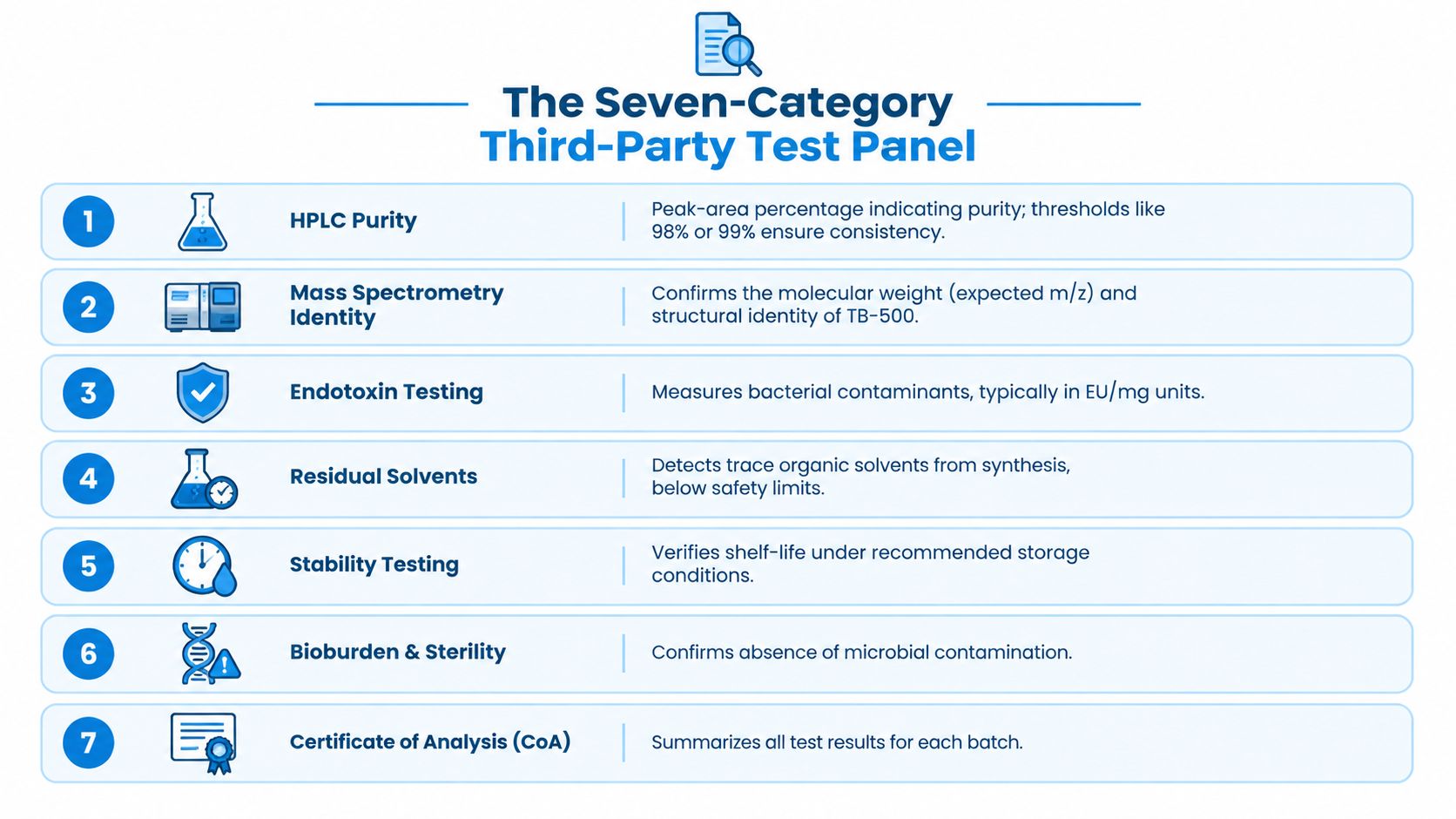
The Seven-Category Third-Party Test Panel
A credible third-party test panel should answer different questions with different methods. HPLC can describe chromatographic purity, but it can't establish every aspect of identity, contamination, or formulation. Buyers should read the report as a set of independent controls rather than as one headline result.
What each category should show
HPLC purity reports the proportion of detected chromatographic peak area assigned to the principal material. A result without the chromatogram, method conditions, acceptance criterion, or lot identifier is weak evidence. A vendor that supplies only a vague “high purity” statement hasn't given purchasing staff enough information to approve the batch.
Mass spectrometry identity confirmation should show the observed mass or expected m/z and explain the relationship to the declared TB-500 form. This method helps distinguish the intended peptide from unrelated or truncated material, but the interpretation must account for acetylation and the stated counter-ion.
Amino acid analysis supports composition and net peptide content. It helps a buyer separate the actual peptide amount from gross material that includes salt or other mass contributors. If the report lists vial weight but not peptide content, inventory reconciliation remains incomplete.
Endotoxin testing measures bacterial contaminant burden, commonly in EU/mg. This matters for laboratory work involving cells or animal models because endotoxin can confound biological readouts. A missing result should block work that depends on controlled endotoxin exposure.
Residual-solvent screening should address process solvents such as trifluoroacetic acid and acetonitrile where relevant to the declared synthesis and purification process. A purity figure doesn't replace solvent testing. If the report says “passes” without analytes, units, method, or limit, the buyer should request clarification before approval.
Heavy-metals testing should identify the panel and report results for contaminants such as lead and arsenic. “Heavy metals compliant” without the tested elements, reporting units, and detection limits is a documentation weakness, particularly for labs with formal quality systems.
Moisture content is commonly assessed with Karl Fischer analysis. Residual water can affect stability, handling, and mass reconciliation in lyophilized material. An absent moisture result doesn't always prove that the product is unsuitable, but it should trigger a request for the vendor's specification and stability rationale.
A non-accredited laboratory stamp isn't automatically disqualifying, but it demands more scrutiny. The report should identify the testing laboratory, method, sample description, date, analyst or authorization, and acceptance criteria. If several categories are absent, if every batch carries identical values, or if the vendor refuses the underlying report, the purchase should be paused.
The research peptide testing discussion also highlights the need for metabolite-focused analytical work in human plasma or serum and microsomal fractions. That matters to laboratories planning LC-MS or peptide-screening workflows, where reference standards, lot verification, and low-temperature storage need to be planned together.
Reading a Batch-Specific Certificate of Analysis
The COA is the purchase decision artifact, not a decorative marketing attachment. A buyer should be able to take the report away from the product page and still determine what material was tested, which laboratory tested it, when testing occurred, and whether the result supports the intended research workflow.
Start with the lot
The lot number on the COA must match the vial label, invoice, packing slip, and receiving record. The report should also state manufacture and expiration dates, or the vendor's equivalent release and retest information, alongside the storage condition applied during testing. A report that describes “TB-500” but omits the formulation state or salt form leaves an identity gap.
The testing laboratory should be named with its address and accreditation information where applicable. A logo alone isn't enough. The report should include an authorized signature or electronic approval, report date, sample description, and method references.
The core result set should include:
- Peptide content: Amino acid analysis or another stated quantitative method should distinguish net peptide from total vial mass.
- Chromatographic purity: HPLC should identify the method, principal peak, acceptance criterion, and lot-specific result.
- Molecular identity: Mass spectrometry should show the observed result and expected m/z relationship for the declared form.
- Counter-ion accounting: The report should state trifluoroacetate or acetate content when that form is present.
- Residual solvents: The report should name analytes, limits, units, and results rather than using a bare “pass.”
- Endotoxin: The report should state the method, units, result, and applicable acceptance criterion.
- Moisture and contaminants: Karl Fischer data, heavy-metals results, and other relevant release tests should be visible or explained.
“Acceptable” isn't a universal number that can be copied across every laboratory. The result needs to meet the vendor's declared specification and the receiving laboratory's protocol requirements. A high HPLC result can still coexist with an unresolved counter-ion, solvent, moisture, or endotoxin question.
Detecting a template COA
Template-filling leaves recognizable clues. Unrelated lots may show exactly the same purity, content, moisture, and solvent values. The chromatogram may be missing, the signature may be absent, or the document may be a scan that prevents searching, copying, or verifying the lot number.
A COA that cannot be matched to the vial is not batch evidence. It's an advertisement in PDF form.
A two-minute screening check should ask whether the lot matches, the salt form is named, the dates are present, the laboratory is identifiable, the methods are stated, and the key contaminant results are reported. If any answer is no, the buyer should request a corrected document before issuing approval.
Shipping Options for Temperature-Sensitive Material
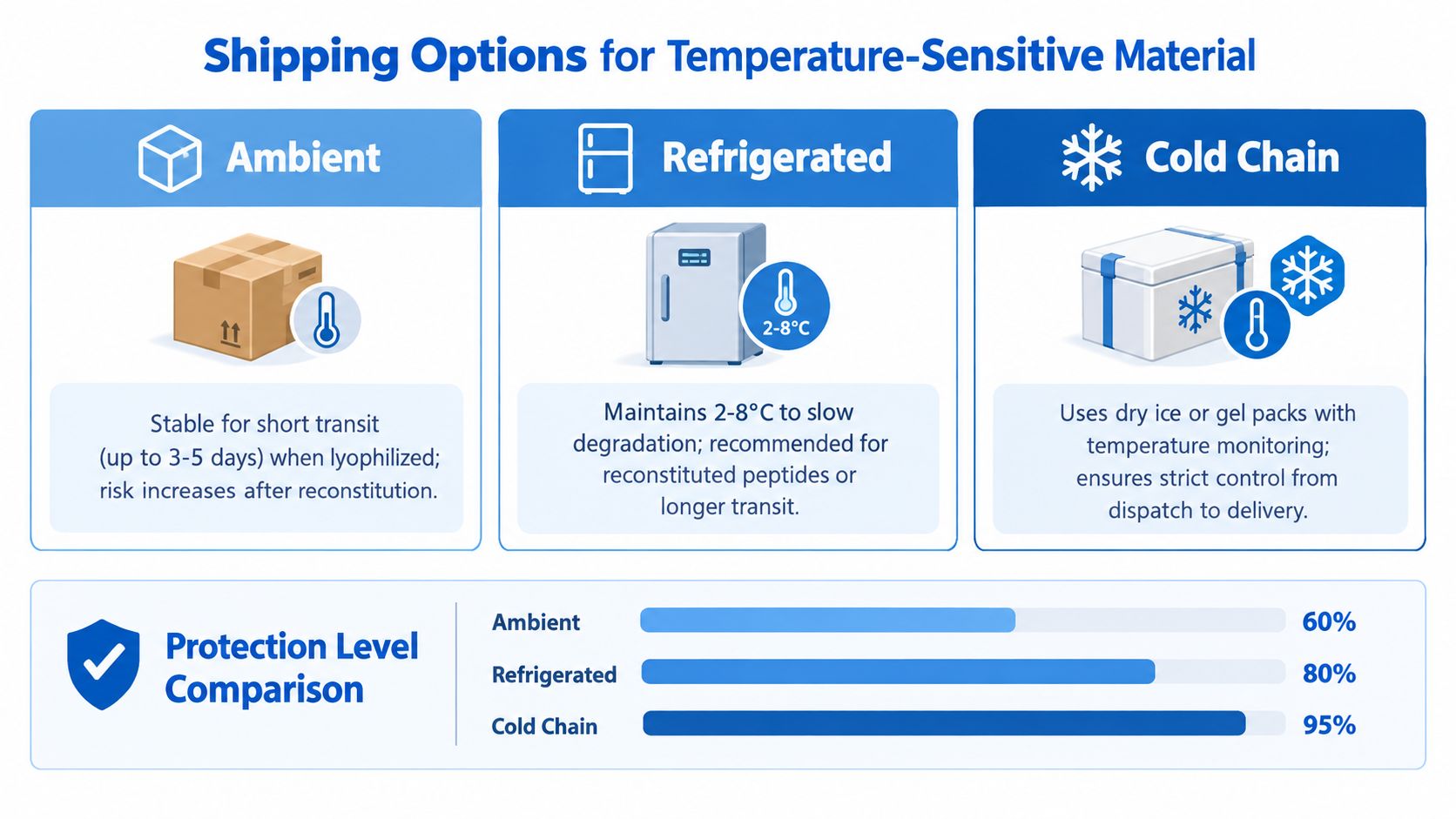
Shipping decisions should follow the material's state and the laboratory's receiving controls. A lyophilized vial is not handled the same way as material exposed to humidity or a reconstituted laboratory sample, and a short domestic transit isn't equivalent to a delayed international shipment.
Comparing the three routes
Ambient shipping is the simplest and least protective option. It may be reasonable for a short, controlled transit window when the material is lyophilized and the vendor's documentation supports that choice. It becomes a poor decision when summer heat, carrier delays, humidity, or uncertain handoff conditions are likely.
Refrigerated shipping adds control through insulated packaging and gel packs. The buyer should confirm the vendor's stated temperature range and whether the shipment includes a temperature indicator. Refrigeration is especially relevant when the receiving lab has a validated cold-storage process and the shipment will not move directly into controlled storage.
Cold-chain shipping provides the strongest control for bulk orders, multi-day routes, international delivery, or periods when carrier delays are plausible. Dry ice or monitored gel packs increase cost and handling complexity, but the added control can be justified when a failed shipment would compromise several planned assays.
The buyer shouldn't select dry ice automatically for every vial. A small order to a nearby domestic laboratory may not need the most intensive option if the material remains lyophilized and transit is tightly controlled. A larger or international order deserves a stronger presumption in favor of monitored cold-chain handling.
Receiving the shipment
The receiving team should inspect the outer packaging, cold packs, vial condition, lot label, and accompanying documents immediately. Any suspected temperature excursion, damaged seal, wet packaging, or mismatch between vial and COA should be photographed and logged before the material enters active inventory.
The vendor's handling notes should also address low-temperature storage to limit degradation during transport and repeated freeze-thaw exposure. The receiving record should preserve the shipment method, arrival condition, inspection time, and disposition decision.
Research-Use Compliance Signals Worth Checking
Research-use-only compliance protects the buyer's records as much as it protects the supplier's position. A laboratory needs to demonstrate that the material was purchased for a documented scientific purpose, not merely rely on a disclaimer discovered after an audit or incident review.
Signals that support an institutional record
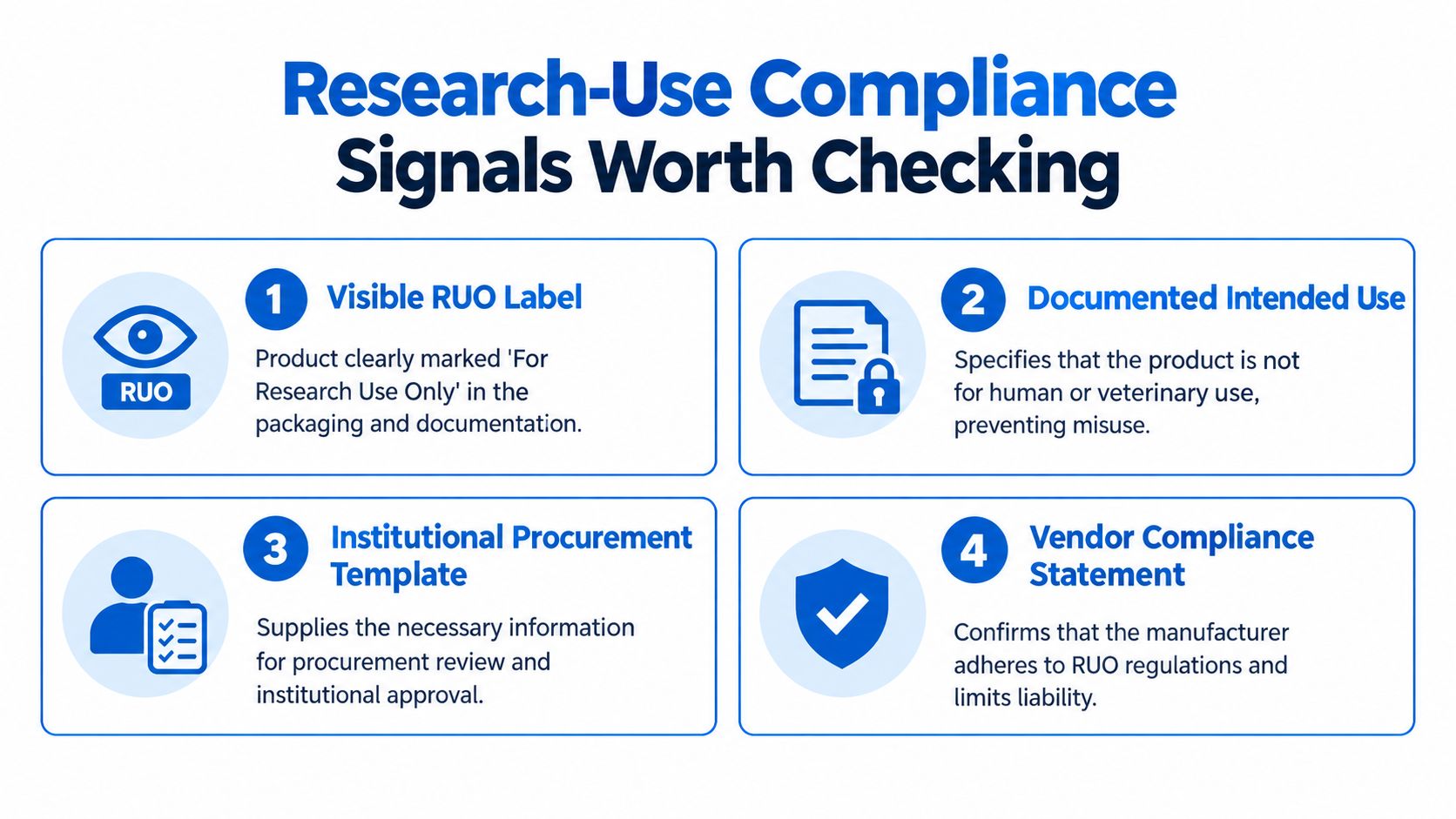
A visible RUO label should appear on the product page, invoice, packing slip, and package. “Not for human or veterinary use” should be explicit. If the restriction appears only in a footer, the purchasing record can become ambiguous when documents are separated.
A documented intended-use statement should identify laboratory analysis, in-vitro work, cell culture, or another legitimate research context. It shouldn't describe personal recovery, wellness, treatment, or performance outcomes.
An institutional procurement workflow may include age verification, organizational details, purchaser confirmation, or an internal approval step. These controls don't replace scientific review, but they show that the vendor expects a qualified research buyer rather than an unrestricted consumer transaction.
A vendor compliance statement should explain the research-only boundary and provide accessible terms, shipping conditions, and returns information. The vendor's wording should be consistent across the product page, checkout, invoice, and physical packaging.
These signals matter during audit preparation, IACUC review, biosafety documentation, and grant-related purchasing review. A sound material with poor labeling can still create downstream questions about why it was acquired, how it was classified, and whether its stated purpose matched the approved work.
The procurement file should retain:
- Product identity: Name, sequence, salt form, formulation state, and catalog record.
- Batch evidence: Lot-specific COA and matching vial documentation.
- Intended use: Protocol, project, assay, or laboratory analysis reference.
- Receipt record: Shipment method, arrival inspection, storage placement, and any excursion note.
- Vendor record: RUO policy, terms, and compliance language in force at purchase.
A listing that omits these elements should not be normalized just because the material is inexpensive or readily available.
Why Purity Numbers Alone Are Not Enough
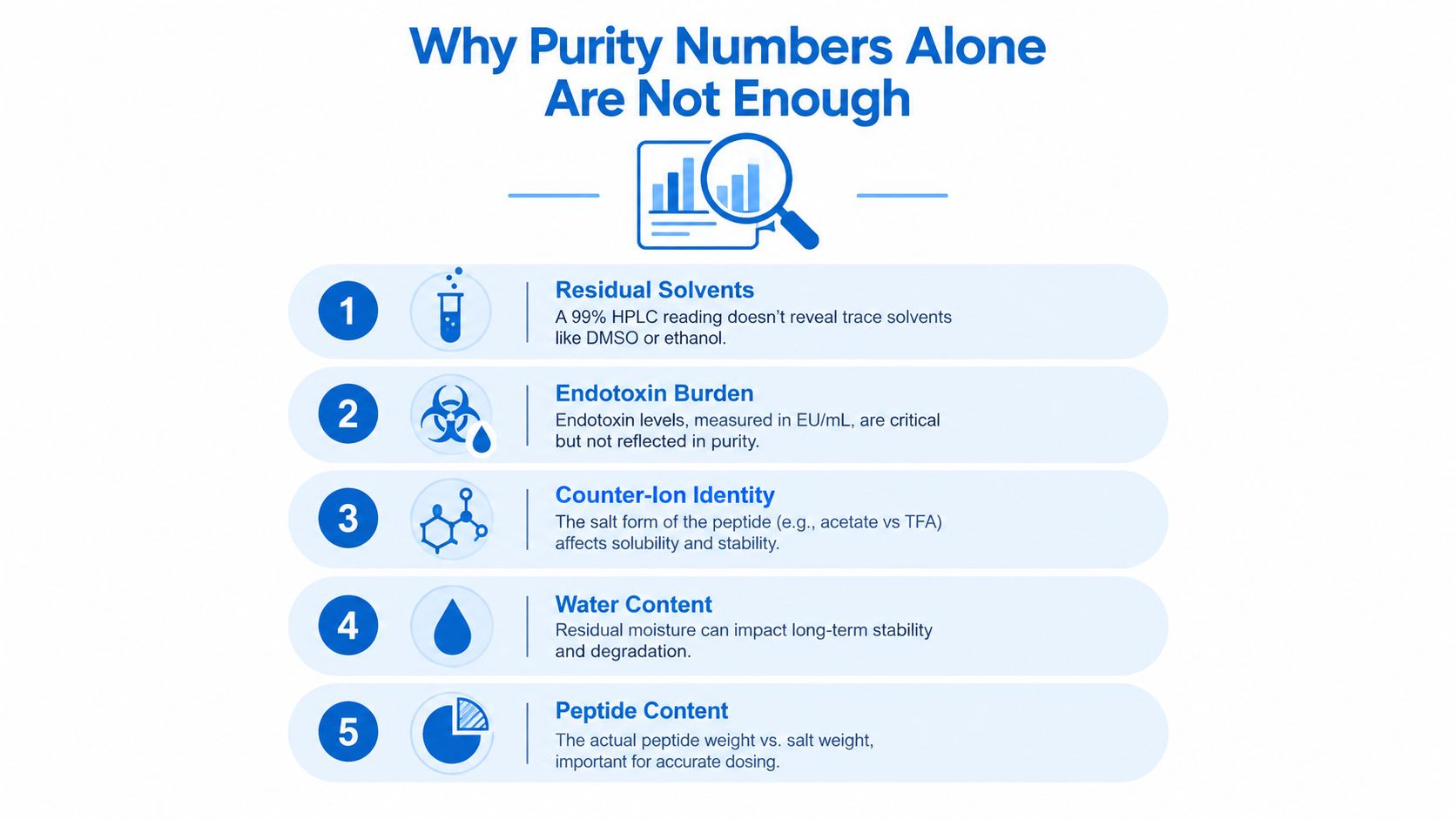
A listed HPLC purity figure answers one narrow question. It doesn't establish that the vial contains the declared amount of peptide, that the correct salt form was supplied, or that the material is free from relevant solvent, endotoxin, heavy-metal, and moisture concerns.
What a headline result can hide
Two lots can display the same purity figure and still differ in research usefulness. One may have a documented molecular mass, verified net peptide content, controlled moisture, and clear endotoxin data. The other may have a single chromatographic number with no supporting evidence.
A principal peak can also conceal truncated or oxidized species that co-elute under a particular method. That's why a careful buyer layers orthogonal testing rather than treating HPLC as a complete identity package.
- Mass spectrometry checks whether the measured mass aligns with the declared fragment and formulation.
- Amino acid analysis supports composition and net content reconciliation.
- Residual-solvent testing addresses process chemicals that HPLC purity doesn't quantify.
- Endotoxin and bioburden data address biological contaminants outside chemical purity.
- Moisture and counter-ion results clarify stability and actual material composition.
A template COA is especially easy to spot when every lot carries the same purity figure and identical supporting values, yet no lot-specific chromatogram or raw result appears. The buyer should ask for the report tied to the exact batch, not accept a replacement marketing sheet.
The strongest decision rule is simple: purity is one release attribute, not a substitute for identity, content, and contaminant testing. A vendor that understands laboratory procurement should be able to explain each test category and provide records that connect the result to the material being shipped.
Putting the Buyer Checklist to Work
The next order should run through one standing workflow, not a series of improvised emails. The buyer first confirms that the vendor clearly identifies the material as RUO and states the intended laboratory boundary. The product record should then be checked for the Ac-LKKTETQ sequence, fragment relationship, formulation state, and declared salt form.
Before checkout, purchasing should request the batch-specific COA and verify that the lot is tied to the vial or the vendor's release record. HPLC should be reviewed alongside mass spectrometry and, where supplied, amino acid analysis. Missing solvent, endotoxin, moisture, heavy-metals, or net-content information should trigger a documentation request rather than a guess.
A repeatable receiving sequence
- Confirm documentation before approval: Save the COA, product record, RUO terms, and order reference in the procurement file.
- Match the shipping method to the material: Check whether ambient, refrigerated, or cold-chain transport fits the formulation and route.
- Log the lot at receipt: Record the lot number, package condition, arrival inspection, and storage placement.
- Quarantine pending review: Keep the material separate from active inventory until the receiving team confirms the vial, COA, and shipment record agree.
- Escalate deviations: Document damaged packaging, temperature concerns, missing records, or mismatched labels before laboratory release.
Pro Tec Pep lists research-use-only compounds with product-level identity information, batch-linked COAs, seven-category third-party testing, and optional cold-chain handling. Laboratories evaluating a TB-500 peptide for sale should compare those records against the same checklist applied to every other supplier, then visit Pro Tec Pep to review the available TB-500 documentation and fulfillment options.
The checklist should remain part of the laboratory SOP. It needs review whenever a vendor changes formulation, source material, testing laboratory, packaging, or shipping partner, because a familiar product name doesn't guarantee an unchanged procurement profile.
"For laboratory research use only. Not for human or veterinary use. Not a drug, food, or cosmetic. Not evaluated by the FDA. Not intended to diagnose, treat, cure, or prevent any disease. By purchasing, you certify you are a qualified researcher and agree to use this product solely for in-vitro laboratory research."