TB 500 Peptide: A Research Guide to Sequence and Stability
Explore the TB 500 peptide, its sequence, stability, and scientific evidence in this comprehensive research guide.

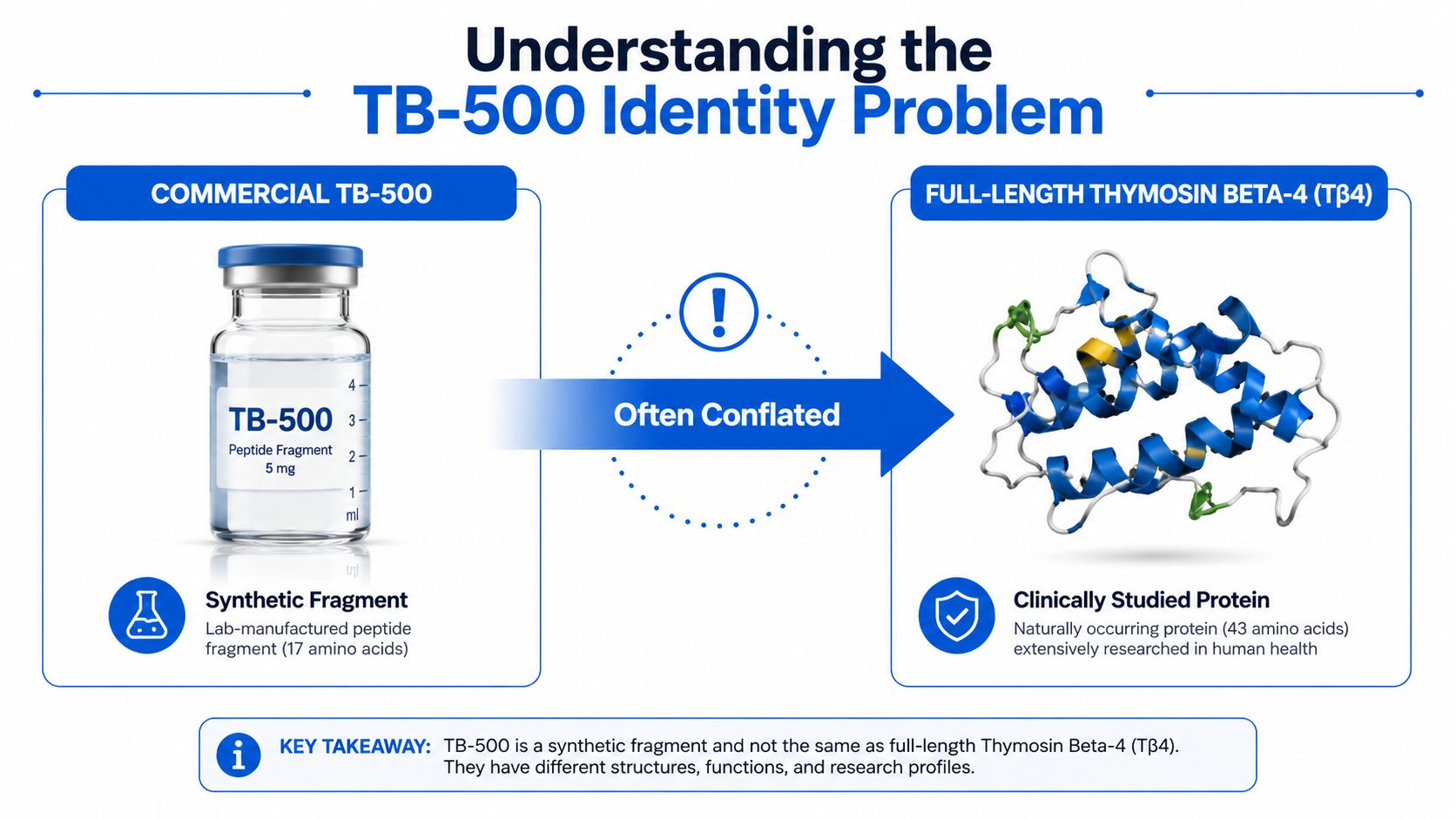
Most product pages blur TB-500 and thymosin beta-4 into a single story, but the literature doesn't support treating them as interchangeable. TB-500 is a synthetic fragment, while the parent protein is a 43-amino-acid peptide with a much broader research history, first isolated and sequenced from bovine calf thymus in 1981 (history of TB-500 and thymosin beta-4). That distinction matters for procurement, assay design, and for reading papers without overclaiming what a fragment can tell you about a full-length protein.
Researchers who need a tb 500 peptide reference should start with identity, not marketing language. The most useful question isn't whether the compound is associated with wound repair biology, it's whether the exact fragment in hand has direct evidence behind it, because the human literature sits with the parent molecule, not the fragment itself (clinical evidence review). The result is a compound that belongs in a research workflow, not in a therapeutic assumption set.
Understanding the TB-500 Identity Problem
The common assumption is that TB-500 and thymosin beta-4 are interchangeable names for the same thing. They aren't. TB-500 is commonly used as a market label for a synthetic fragment related to thymosin beta-4, while thymosin beta-4 itself is the parent protein that has been studied for decades in wound repair, angiogenesis, and cell migration biology (historical review).
Fragment versus parent protein
The fragment most often called TB-500 is described as the synthetic acetylated heptapeptide Ac-Lys-Lys-Thr-Glu-Thr-Gln, commonly written as Ac-LKKTETQ. The key point for a procurement committee is that the peer-reviewed human literature is on full-length thymosin beta-4, not on the fragment itself (molecular review). That makes many catalog claims technically plausible but not directly demonstrated for the specific reagent.
The historical lineage matters because it shows why the fragment gets discussed at all. In preclinical work, a 1999 rat wound-healing study reported that thymosin beta-4 accelerated re-epithelialization by 42–61% versus controls, which helped establish the broader research interest that later supported TB-500's presence in the peptide market (historical review). That result belongs to the parent molecule, but it often gets mentally transferred to the fragment without enough scrutiny.
Practical rule: if a paper says thymosin beta-4, it is not automatically evidence for commercial TB-500.
The distinction is especially important because human evidence for the parent molecule is limited and route-specific. One NIH-indexed dry-eye trial enrolled 72 subjects, randomized 36 to 0.1% thymosin beta-4 ophthalmic solution and 36 to placebo, and 69 participants completed the study (NIH-indexed trial summary). That trial shows real clinical development, but it also shows how far topical ophthalmic research sits from the injected fragment sold in research markets.
For lab planning, the safe assumption is narrow. TB-500 should be treated as a thymosin beta-4-derived research fragment, not as a stand-in for the full protein and not as a validated therapeutic surrogate.
Molecular Structure and Actin-Binding Mechanism
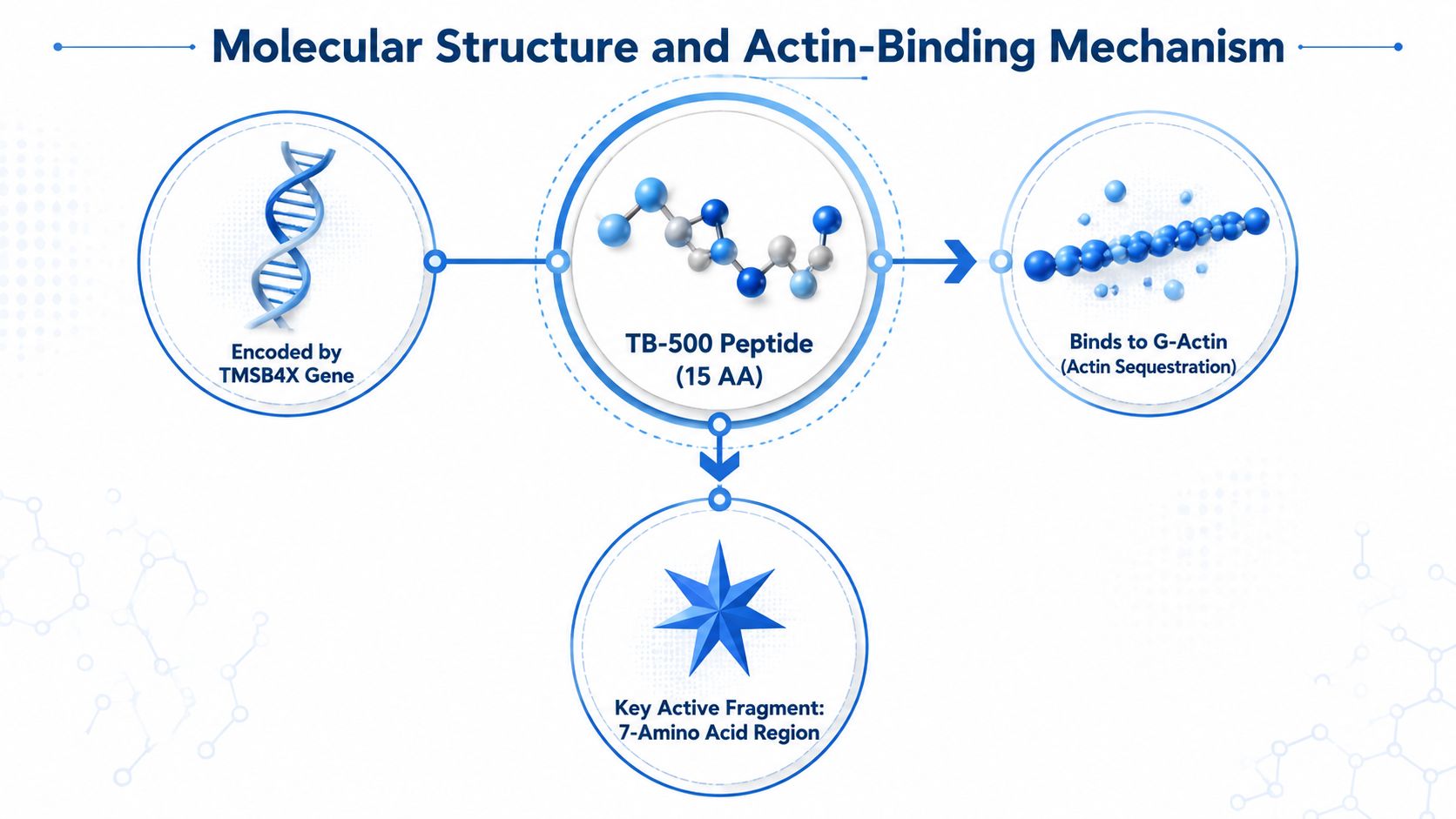
The mechanistic core of thymosin beta-4 is actin sequestration. It binds G-actin stoichiometrically and maintains a large monomeric actin pool in cells, so the relevant biology is cytoskeletal regulation, migration, and polymerization dynamics, not vague claims about “recovery” (actin biology review).
What the structure supports
Structural work shows thymosin beta-4 binds actin in an extended conformation and blocks actin polymerization sterically at the barbed end (structural study). NMR-based analysis also found that the peptide folds on binding, forming a central extended region flanked by two helices. That detail matters for interpreting binding assays and for setting biochemical controls.
A separate mutational mapping study identified a seven-amino-acid actin-binding motif as necessary for thymosin beta-4's angiogenic activity in experimental systems (motif mapping). For in-vitro work, that sequence-level result is more useful than broad healing language because it gives researchers a defined structural target.
| Structural endpoint | What it tells researchers | Why it matters in assay design |
|---|---|---|
| Actin binding | The peptide has a specific cytoskeletal target | Purified actin systems can test binding directly |
| Extended bound conformation | Binding changes fold state | Conformation-sensitive readouts matter |
| Seven-amino-acid motif | A small region is functionally important | Fragment mapping can separate active from inactive analogs |
Quantitative binding data add another layer. One study measured an equilibrium dissociation constant of about 1.1 μM under its assay conditions, and other work found thymosin beta-4 can alter the actin critical concentration and form a ternary complex with actin and profilin (binding and complex formation). Those are hard endpoints, not marketing language, and they belong in purified-protein or cell-free systems.
The practical implication is narrow. If a lab plans to test TB-500 peptide, the work should focus on actin-dependent endpoints, not on assuming full biological equivalence with the parent protein. That keeps the experiment aligned with what the molecular data support.
Storage Protocols and Stability Considerations
Peptide handling affects reproducibility, and TB-500 is no exception. For lyophilized material, the usual laboratory expectation is cold storage, protected from light, moisture, and temperature cycling. The practical question for a purchasing committee is less about convenience and more about whether the supply chain can preserve the material until it reaches the bench.
Sample prep and cold-chain discipline
A working protocol should start with inspection of the vial, label, and lot documentation before any reconstitution step. If the material arrives outside its expected temperature window, the batch should be flagged for review rather than assumed to be intact. Shipping notes matter because degradation risk rises when temperature-sensitive peptides sit in transit too long or are exposed to repeated warming.
After reconstitution, the sample should be aliquoted so the same vial isn't thawed repeatedly. Repeated freeze-thaw cycles are a common source of variability in peptide work, especially when the same material is used across multiple pilot assays. Short-term working storage is usually handled in refrigerated conditions, while longer-term retention belongs in a freezer.
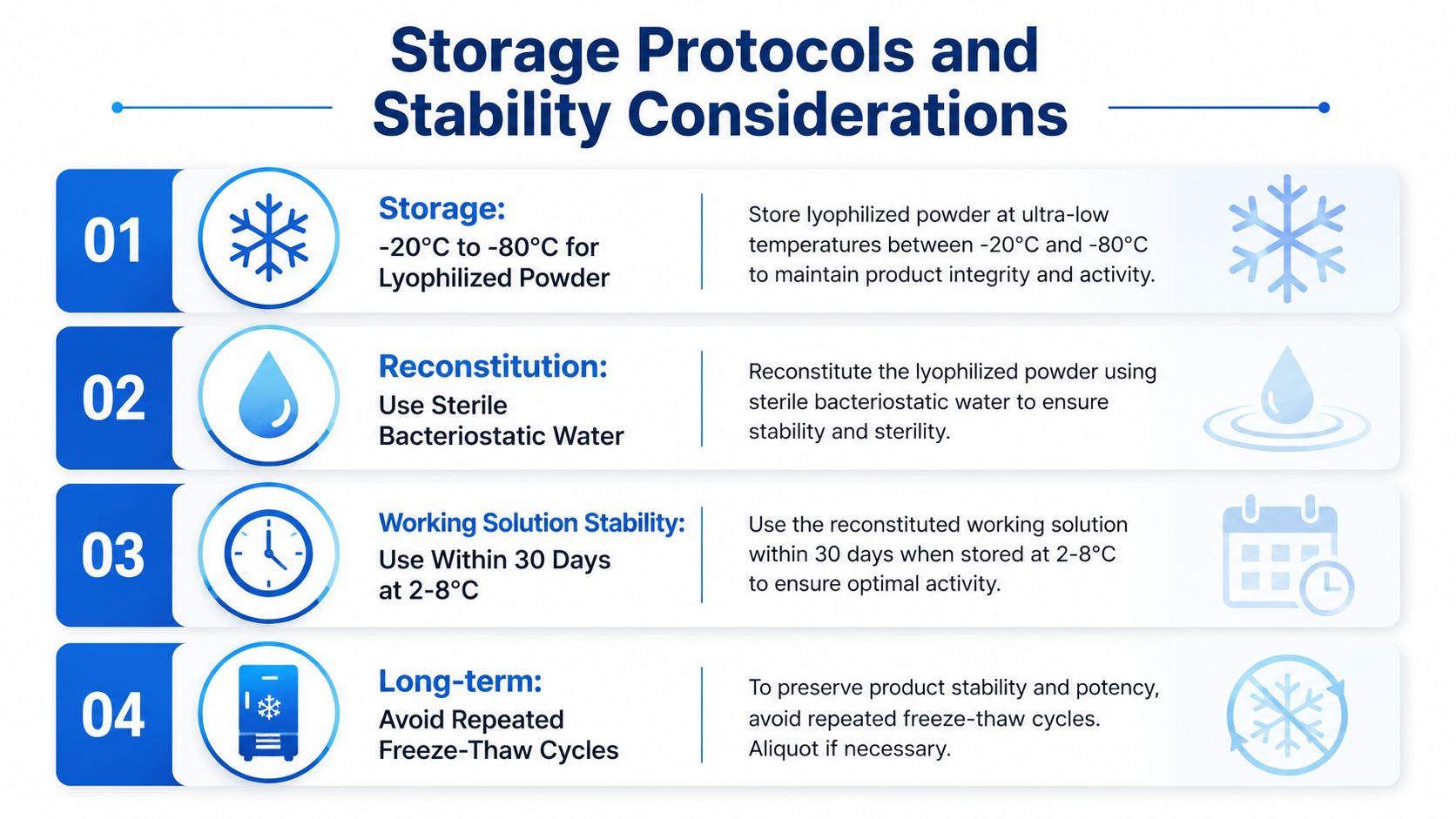
The following guidance is commonly used for research workflows:
- Cold storage for lyophilized powder: keep material frozen at -20°C to -80°C to limit hydrolytic and handling-related degradation.
- Reconstitution: use sterile bacteriostatic water only as a lab sample-prep medium when that solvent is appropriate for the assay.
- Working solution stability: plan to use within 30 days at 2-8°C if the formulation and protocol allow refrigerated holding.
- Freeze-thaw control: avoid repeated cycles by aliquoting into small test volumes.
Practical rule: if the chain of custody can't show temperature control, the batch should be treated as a new analytical question, not as a settled reagent.
Documentation should travel with the vial. A defensible lab record includes the lot number, date received, storage condition, and any thaw events tied to the working aliquot. That record doesn't prove activity, but it does protect the experiment from preventable ambiguity.
Evaluating Certificates of Analysis and Purity Claims
A Certificate of Analysis is only useful when it is batch-specific and complete. Generic purity language doesn't tell a lab much about the exact vial in hand, and for a fragment like TB-500, lot-level traceability is often the difference between a credible procurement decision and a guess.
What a strong COA should show
The most useful reports include identity, purity, net content, sterility, endotoxins, heavy metals, and conformity. Those categories map to the main failure modes in unregulated peptide procurement, which means a COA should answer whether the material is really the stated fragment, whether it contains the expected amount, and whether contamination risk has been addressed.
| Testing Category | What It Verifies | Acceptable Standards |
|---|---|---|
| Identity | The vial contains the stated peptide | Sequence or mass confirmation tied to the lot |
| Purity | The main component dominates the sample | Batch-level purity specification and method disclosure |
| Net content | The actual amount present | Quantity matches labeled fill when tested |
| Sterility | Microbial contamination isn't present | Method and result reported for the lot |
| Endotoxins | Pyrogenic contamination is controlled | Reported with lot-specific values or pass/fail |
| Heavy metals | Inorganic contamination is assessed | Test result tied to the exact batch |
| Conformity | The batch meets declared specifications | Clear pass/fail against stated criteria |
The difference between a real COA and a brochure claim is traceability. Product pages can say a peptide is “high purity,” but the lab only benefits when the report ties that statement to the exact lot delivered. That's especially relevant for TB-500, where the evidence gap already makes experimental control important.
Purity percentages need context. A number on its own says little unless the analytical method is visible, the lot number matches the vial, and the test panel is broad enough to detect obvious failure modes. That is why batch-level documentation is more valuable than a polished product summary.
The most useful internal comparison point is the testing process itself. A good lab supplier should be able to show the exact lot documentation, and the procurement team should be able to verify whether the report supports the intended assay design, not just whether it looks professional (testing framework).
Preclinical Evidence and Research Applications
The strongest evidence for thymosin beta-4 still lives in preclinical systems, not in direct human validation of the fragment sold as TB-500. In animal models and cell-based work, the parent molecule accelerated wound healing by promoting keratinocyte and endothelial cell migration, increasing angiogenesis, and reducing inflammation (molecular review). Those mechanisms explain why the compound keeps appearing in tissue-repair discussions.
What the human data do and don't show
Human evidence for the parent molecule is measurable but narrow. The dry-eye trial with 72 enrolled subjects and 69 completers shows that thymosin beta-4 has been taken into clinical development, but it does not close the loop for TB-500 as a fragment (NIH-indexed trial summary). The leap from topical ophthalmic investigation to the commercial fragment is too large to treat as established translational proof.
The evidence gap is the main technical limitation for procurement teams. Independent reviews state that published human efficacy and pharmacokinetic data for the synthetic fragment are lacking, and that no completed, published human randomized trials have evaluated TB-500 for musculoskeletal or tissue-repair indications (clinical evidence review). That means the reagent belongs in preclinical validation, not in assumed efficacy claims.
A research lab that wants to study TB-500 should frame the project around the biology supported:
- Cell migration assays: useful when testing actin-linked movement.
- Angiogenesis models: relevant because the parent protein's activity maps to vascular behavior.
- Wound-healing or scratch assays: appropriate only when the model system is clearly defined.
- Comparative fragment analysis: essential if the question is whether TB-500 behaves like the parent sequence or not.
The contrarian point is simple. A large part of the positive interest comes from thymosin beta-4 research, but extrapolating that activity to the synthetic fragment remains scientifically shaky when direct TB-500 human evidence is sparse. For a laboratory, that makes the compound interesting precisely because the translational question is still open.
Regulatory Status and Compliance in 2026
The regulatory story changed in 2026, and that shift matters more than generic “not approved” language. In April 2026, FDA materials placed TB-500 on a Category 2 do-not-compound list and then removed it effective April 22, 2026. In July 2026, the FDA Pharmacy Compounding Advisory Committee reviewed whether broader compounding access might be restored, while media coverage reported the advisory panel's vote to ease access despite agency scientists warning that safety and effectiveness haven't been shown (2026 compounding report).
What compliance teams need to track
That sequence creates a real procurement problem. A page that stops at “not FDA approved” misses the more current question, which is how compounding status, research procurement, and institutional policy are changing at the same time. For a lab, the practical answer is to keep the material in a research-use-only framework and to treat shifting compounding discussions as separate from actual evidence of safety or efficacy.
The anti-doping side hasn't changed. WADA still lists thymosin-beta-4 and its derivatives, including TB-500, as prohibited in sport under S2, so athletic and military compliance risk remains distinct from compounding policy debate (2026 compounding report). That split is important because buyers often collapse legal, regulatory, and sporting rules into one category when they're not the same thing.
TB-500's regulatory status is therefore best understood as layered:
- FDA approval status: still not approved for human use.
- Compounding status: under active review and discussion in 2026.
- Sporting status: prohibited under WADA-aligned rules.
- Research status: still a fragment with limited direct human evidence.
The compliance takeaway is narrow and strict. Procurement records should clearly state that the material is being acquired for laboratory research only, with documentation tied to lot-specific testing and the institution's internal policy. For teams building a file, the appropriate anchor is the formal research-use posture rather than a public-facing product narrative (research-use policy).
Decision Framework for Laboratory Procurement
A good procurement decision starts with the experimental question, not with the catalog name. For TB-500, the right question is whether the lab needs a thymosin beta-4-derived fragment for controlled in-vitro or preclinical work, or whether the project requires the full parent protein because the published evidence sits there instead. That distinction avoids a common mismatch between assay intent and reagent identity.
A practical screening sequence
First, verify the sequence, lot, and purity method. If the vendor cannot tie the vial to batch-specific documentation, the sample isn't ready for a serious assay. Second, decide whether the available evidence is strong enough for the study design. In this case, the direct human data gap means the fragment should be treated as an exploratory reagent, not as a surrogate therapeutic.
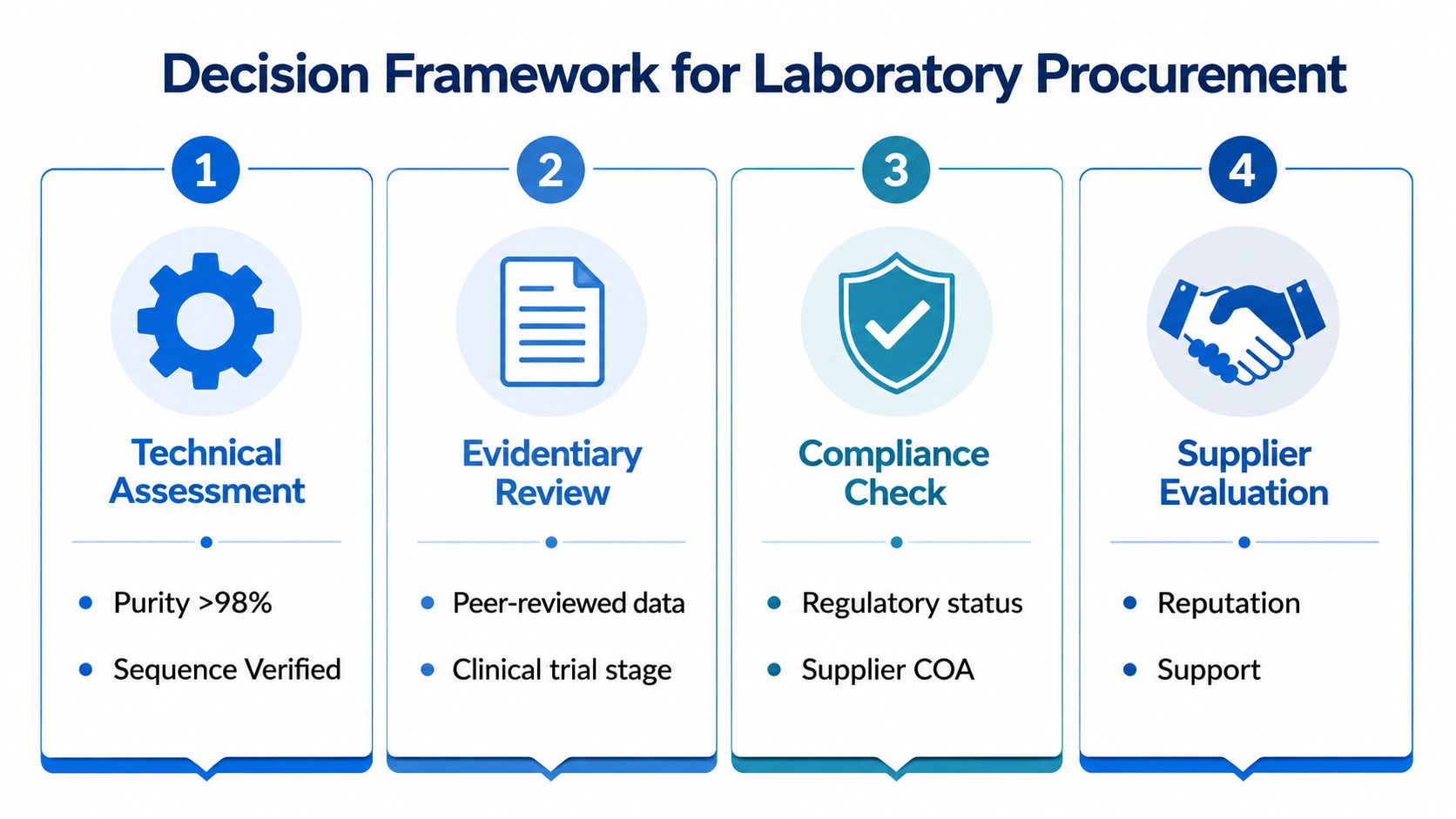
Third, document compliance before purchase approval. The 2026 regulatory situation is still evolving, but the practical position for a laboratory remains clear, research-only handling with no assumption of clinical equivalence. Fourth, compare suppliers on documentation quality, lot traceability, and logistics support, because a temperature-sensitive peptide with weak paperwork is a poor fit for reproducible work.
Decision rule: if the vendor can't show batch-specific testing and the assay can't tolerate identity uncertainty, the safest choice is to pass.
The strongest vendors make evaluation easier by providing sequence data, storage guidance, and lot-linked COAs without making the buyer infer the rest. That doesn't replace scientific judgment, but it does reduce the chance that procurement becomes a guess. For this compound, transparency is part of the reagent.
Pro Tec Pep supplies research-use-only compounds with batch-verified documentation, including lot-linked COAs, sequence details, and storage guidance that fit laboratory workflows. For teams evaluating TB-500 or other research peptides, Pro Tec Pep is built around documentation, cold-chain handling, and compliance-focused fulfillment, which makes it a relevant place to review when the purchase decision depends on traceability as much as the compound itself.
Crafted with Outrank tool