Syn Ake Serum
Syn ake serum. Syn-Ake serum breaks down what this synthetic tripeptide is, how formulations differ, and what researchers should know about sourcing versus
Syn-Ake serum sits in an unusual position in cosmetic science. Its molecular story is specific enough to support a plausible receptor mechanism, yet the public human evidence remains much thinner than the marketing language suggests. A review of the ingredient's history notes no name-matched human efficacy trial in PubMed, alongside only sparse indexed literature and no FDA approval, even though cosmetic adoption has been substantial (historical overview of Syn-Ake).
That contrast matters for researchers. A serum containing Syn-Ake may produce measurable changes as a finished formulation, but those changes cannot automatically be assigned to Syn-Ake alone. The useful question isn't whether the peptide has an interesting origin story. It's what the molecule is, how its proposed mechanism could work, and which claims the available evidence can support.
What Syn-Ake Is and Why It Is Called a Neuro-Cosmetic
Syn-Ake is the common commercial name associated with dipeptide diaminobutyroyl benzylamide diacetate, a synthetic cosmetic peptide developed by Pentapharm in the early 2000s and introduced to the cosmetics market in 2005 (historical overview of Syn-Ake). Researchers may encounter the INCI-related designation rather than the trade name, so both labels matter when reviewing a serum formula or raw-material specification.
The word “neuro-cosmetic” describes the proposed biological target. Traditional cosmetic actives often work through hydration, exfoliation, antioxidant activity, or support of the skin barrier. Syn-Ake is instead positioned around a neuromuscular signalling pathway, specifically the interaction between acetylcholine and muscle-type nicotinic receptors. That doesn't make it a therapeutic drug. It places the ingredient in a cosmetic category built around a neuroactive design concept.
What the label does and doesn't reveal
An ingredient list can confirm that a named peptide-related material is present, but it usually can't establish:
- The actual peptide concentration: The INCI list doesn't by itself identify the percentage supplied to the finished formula.
- The raw-material batch: A consumer serum may disclose neither the Syn-Ake lot nor the associated analytical documentation.
- The independent contribution: Other ingredients may affect hydration, optical smoothness, elasticity measurements, or wrinkle appearance.
- The tissue exposure: Presence in a bottle doesn't demonstrate that the peptide reaches a relevant receptor in facial muscle.
Syn-Ake's market history also shows why commercial popularity and scientific certainty must be separated. The ingredient began in European cosmetics and later expanded into Asian beauty markets during the mid-2010s, while the independent, peer-reviewed human evidence remained limited. For formulators, that means Syn-Ake is best treated as a mechanistically interesting cosmetic active, not as a clinically established neuromodulator.
Research rule: A trade name identifies a commercial ingredient concept. It doesn't replace identity testing, formulation disclosure, or controlled human evidence.
The Origin Story from Temple Viper Venom to Cosmetic Shelf
Syn-Ake began with waglerin-1, a 22-amino-acid venom peptide found in the temple viper, Tropidolaemus wagleri. Its relevance to cosmetic research comes from proposed activity at muscle-type nicotinic acetylcholine receptors, which help transmit signals between nerves and muscle.
Pentapharm developed Syn-Ake as a synthetic mimic of waglerin-1. The design objective was to reproduce a snake-venom-inspired neuromuscular concept in a topical cosmetic. Syn-Ake is not temple-viper venom extracted into a serum. It is a sequence-defined synthetic material built around a particular activity concept. That distinction gives suppliers a more consistent raw material than a complex biological secretion and allows cosmetic formulators to work with a defined ingredient.
The route from molecular inspiration to shelf product follows a recognizable sequence. A naturally occurring molecule supplies the biological idea. Chemists create a synthetic analogue, suppliers prepare a cosmetic raw material with formulation information, and skincare companies add it to creams or serums. Marketing then compresses the mechanism into a consumer story about expression lines.
Syn-Ake became associated with Pentapharm and later with DSM supply arrangements before appearing in European and Asian skincare products. Its commercial adoption shows how quickly an ingredient can move from supplier research into finished cosmetics, even while independent human trials remain limited. The origin story therefore explains the design rationale, not clinical proof.
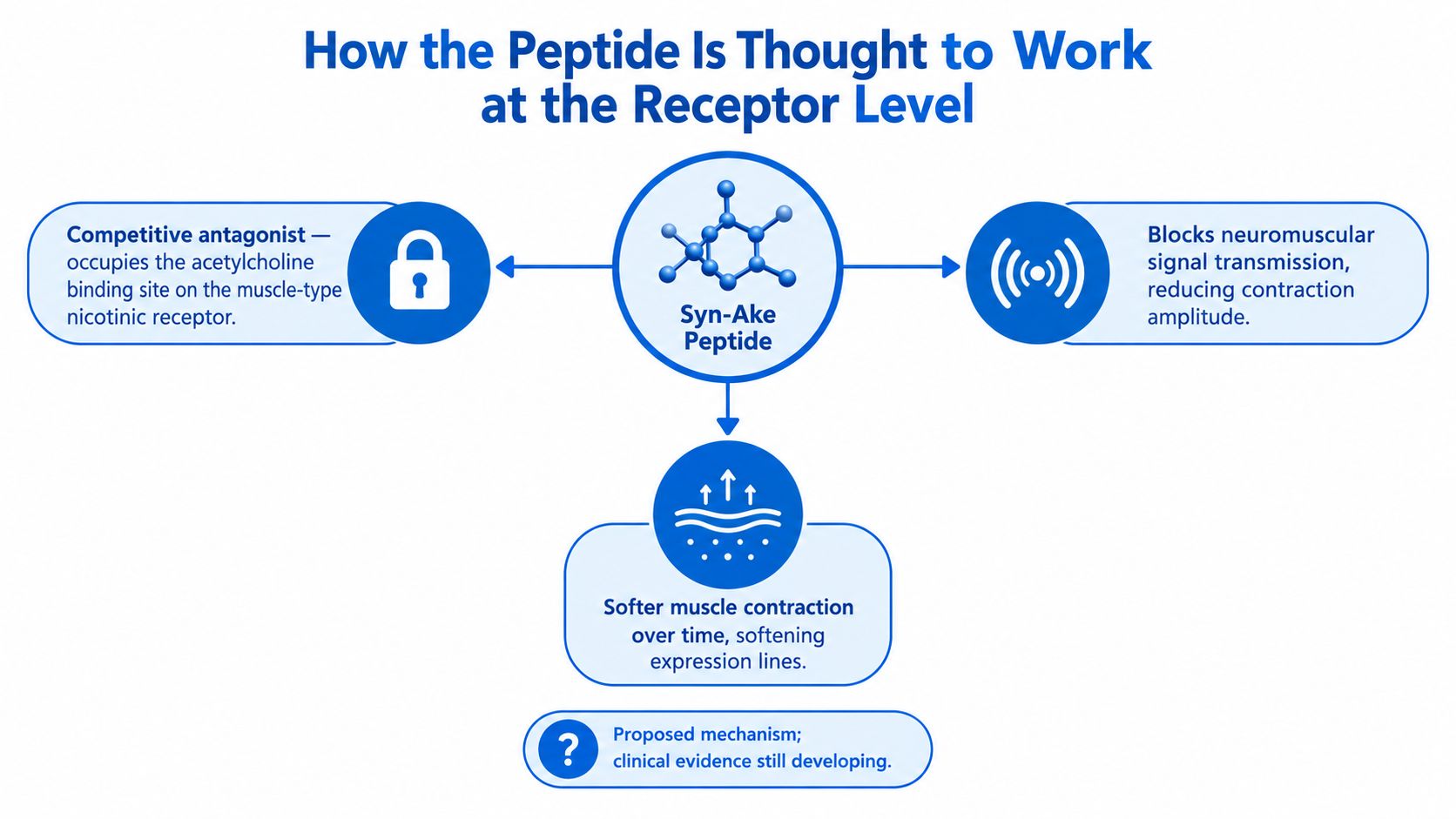
The proposed sequence is easier to show than to validate:
A short educational video offers further context for the receptor-level hypothesis:
Syn-Ake's presence on the cosmetic shelf demonstrates successful commercial translation. It does not establish medical validation or show that a finished serum delivers the peptide to facial muscle. That boundary should remain clear when venom-inspired design becomes a promise of smoother expression lines.
How the Peptide Is Thought to Work at the Receptor Level
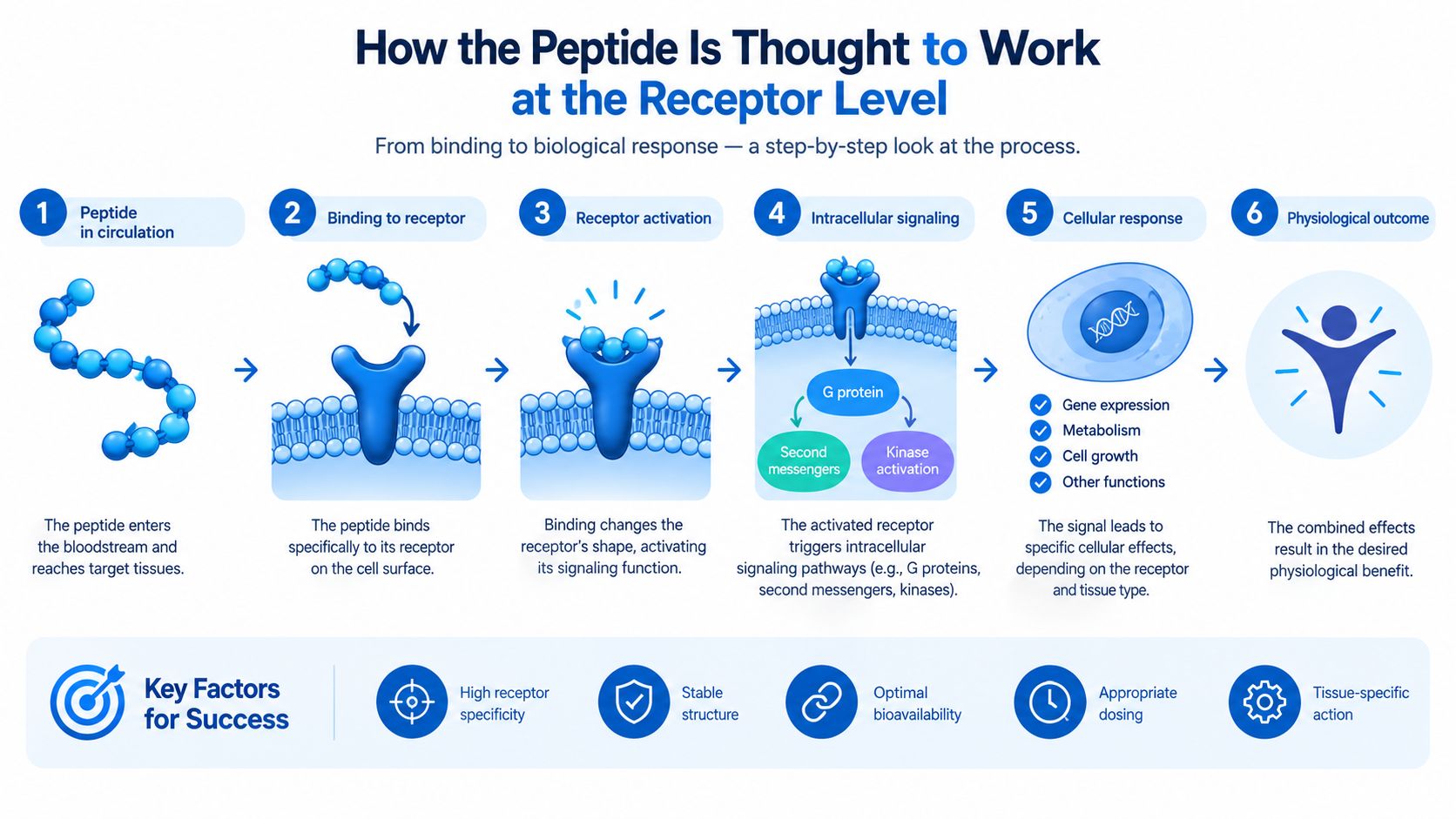
The proposed mechanism starts at the muscle-type nicotinic acetylcholine receptor. Under the model used for Syn-Ake, the peptide interacts with the receptor region involved in acetylcholine binding. If that interaction reduces receptor activation, the neuromuscular signal could produce a smaller muscle contraction.
The chain of reasoning is straightforward:
- A nerve releases acetylcholine near a muscle cell.
- Acetylcholine normally activates a nicotinic receptor.
- Receptor activation supports ion movement across the muscle-cell membrane.
- That electrical change contributes to muscle contraction.
- A competitive antagonist could reduce signalling when it occupies the relevant binding region.
- Repeatedly reduced contraction might lessen the visual reinforcement of expression lines.
This is a mechanistic hypothesis, supported mainly by receptor-level and laboratory reasoning rather than by a broad body of independent human trials isolating Syn-Ake in a finished serum. The technical literature therefore supports a plausible biological route, but it doesn't establish that a leave-on cosmetic serum reliably delivers enough intact peptide to the relevant facial muscle target.
Mechanism is not the same as tissue exposure
A receptor assay can demonstrate that a molecule interacts with a target under controlled conditions. A topical product introduces additional variables, including the vehicle, skin-barrier passage, peptide stability, surface residence, and the distance between the application site and the proposed receptor.
The concentration required to produce an effect in a pharmacological assay may not correspond to the concentration that reaches facial neuromuscular tissue from a cosmetic serum. That gap is central to interpretation. Without direct human tissue-exposure data, the receptor diagram should be read as a proposed pathway, not as proof of clinical performance.
A comparison with established injectable neuromodulation can clarify the boundary without treating the products as interchangeable. Injectable botulinum neurotoxin has a clinically validated pharmacological pathway involving enzymatic disruption of nerve-terminal signalling. Syn-Ake serum is a topical cosmetic formulation built around a reversible receptor-antagonist hypothesis. Similar language about expression lines doesn't make the two interventions equivalent.
Reading the Wrinkle-Improvement Numbers Behind the Claims
The reported wrinkle percentages describe finished cosmetic formulas, not Syn-Ake in isolation. That distinction changes how the numbers should be read. The available results come from small cosmetic evaluations and multi-ingredient serum studies rather than large independent clinical programs.
One cited 12-week evaluation tested a serum containing dipeptide diaminobutyroyl benzylamide diacetate, acetyl hexapeptide-8, and gluconolactone. It reported mean improvements of 35% to 69% in static wrinkles and 10% to 13% in dynamic wrinkles, along with changes in smoothness, radiance, pore appearance, elasticity, and firmness (summary of the multi-ingredient evaluation). These are product-level outcomes. They cannot show which ingredient produced them.
A separate cosmetic study summary reported approximately a 52% reduction in crow's-feet wrinkle depth after a 4-week consumer test involving n=45 (study summary and evidence discussion). The result is specific enough to discuss, but its interpretation remains limited by the study design and formulation context.
Read the formula before reading the percentage
The multi-ingredient serum combined Syn-Ake with acetyl hexapeptide-8, gluconolactone, niacinamide, and laminaria extract. A useful analogy is a recipe: an improvement in the finished dish cannot be assigned to one ingredient without testing that ingredient separately. Hydration, barrier changes, exfoliation-related effects, optical smoothing, and other formula behaviours may all affect the appearance or measurement of wrinkles.
The key questions are:
- Was there a placebo control? A vehicle-only comparator helps separate peptide-related effects from the base formula.
- Was the study blinded? Blinding can reduce bias in visual grading.
- Was Syn-Ake tested alone? Without a single-active arm, ingredient attribution remains uncertain.
- How were wrinkles measured? Topography, photography, grading scales, and participant perception assess different endpoints.
- Was the result independently replicated? Supplier-generated findings carry different evidentiary weight from independent replication.
| Reported Result | Formulation Context | Sample Size & Duration | Evidence Source |
|---|---|---|---|
| 35% to 69% improvement in static wrinkles | Syn-Ake with acetyl hexapeptide-8, gluconolactone, niacinamide, and laminaria extract | 12-week evaluation | Multi-ingredient serum summary |
| 10% to 13% reduction in dynamic wrinkles | Same blended serum context | 12-week evaluation | Multi-ingredient serum summary |
| About 52% reduction in crow's-feet wrinkle depth | Cosmetic serum consumer test | n=45 over 4 weeks | Evidence summary |
The defensible conclusion is narrow. These findings justify further study of peptide-containing cosmetic formulas, while leaving the Syn-Ake-specific effect unresolved. A blended serum may be commercially useful, yet still unsuitable for attributing a measured change to one peptide.
Research-Grade Sourcing versus Consumer Serum Products
A research-grade Syn-Ake material and a consumer serum answer different questions. A laboratory needs to establish what arrived, which production lot it came from, how its identity was confirmed, and whether the reported purity applies to that lot. A finished serum is a cosmetic system, with a vehicle, preservatives, and other functional ingredients. The distinction resembles comparing a labeled reagent with a complete formulated product: both may contain the peptide, but only one is defined for analytical work.
Documentation expected in a laboratory workflow
A batch-specific certificate of analysis should identify the production lot and connect the reported results to the testing laboratory and analytical methods, as described in Pro Tec Pep's third-party testing overview. Guidance on COA practice states that each production lot is analysed before release and that the certificate should remain traceable to the exact lot (batch-specific COA expectations).
For a research compound, useful records commonly include:
- Identity confirmation: Data supporting the declared compound identity.
- Purity measurement: HPLC or another stated method tied to that batch.
- Mass spectrometry confirmation: Evidence consistent with the expected molecular identity.
- Unique batch identifiers: A clear connection among the container, certificate, and production record.
- Composition information: Data showing what the reported material contains.
A COA documentation guide for research compounds describes batch-linked HPLC purity, mass spectrometry confirmation, and unique identifiers as common elements of this record.
Why a serum label cannot answer every laboratory question
A consumer syn ake serum may list the cosmetic ingredient name without stating the peptide load, raw-material lot, assay method, or complete supplier certificate. Its other ingredients also introduce experimental variables, including pH, viscosity, preservatives, fragrance, emulsifiers, and additional actives. Those variables can affect stability, delivery, and assay interpretation.
Shipping creates another distinction. Temperature-sensitive research materials should move through a validated, continuously monitored range, with temperature records, chain-of-custody information, and packing records matched to the receiving SOP (cold-chain shipping requirements). A retail serum's transport specification may instead address finished-product stability, not analytical reproducibility.
Practical rule: A cosmetic serum can serve as the test article for a formulation study. It is not automatically a substitute for a defined research material.
Why Botox-Style Marketing Overshoots the Actual Evidence
“Topical Botox” makes Syn-Ake easy to recognize, yet it also compresses several scientific questions into one memorable label. The comparison has a limited basis: both are discussed in relation to visible changes associated with repeated facial muscle activity. Botox is an injected clinical intervention, while Syn-Ake is a peptide placed in a topical cosmetic formula. Their routes of delivery, exposure, and evidence standards are different.
Syn-Ake was designed as a synthetic mimic of waglerin-1. Its proposed interaction with muscle nicotinic acetylcholine receptors gives the ingredient a coherent mechanistic rationale for expression-line products. That rationale is a starting point for investigation. It does not show that a serum delivers enough intact peptide to the relevant site, or that the exposure produces a clinically meaningful outcome.
The delivery problem is easy to miss. A serum begins on the skin surface, whereas the proposed receptor functions in a neuromuscular signalling context beneath it. Formulation properties and biological barriers sit between those locations. A receptor assay can test whether a molecule interacts with a target under defined conditions, but it does not recreate topical application, penetration, degradation, or the finished product's full environment.
Marketing language also tends to outrun the human evidence. Public summaries contain sparse name-matched human literature, and the most visible wrinkle figures come from small or non-independent cosmetic studies. A neutral evidence review describes a field weighted toward mechanistic research and multi-ingredient testing, with little independent placebo-controlled human research isolating Syn-Ake.
A careful reading keeps three claims separate:
- The molecule has a proposed receptor mechanism.
- A serum containing the molecule may show changes in cosmetic measurements.
- Syn-Ake alone has been proven to reproduce injection-style neuromodulation in humans.
The first is biologically plausible. The second depends on the formula, exposure, comparator, and study design. The third remains unestablished.
A research-use-only policy draws a practical boundary between laboratory investigation, human administration, and consumer treatment claims. That boundary matters because a mechanistic research material, a finished cosmetic, and a clinically validated intervention represent different kinds of evidence. Treating them as interchangeable is the step that turns a receptor hypothesis into Botox-style marketing.
The State of Syn-Ake Science and Open Questions
Syn-Ake has a clearer mechanistic identity than it has a clinical identity. The design is linked to waglerin-1, the proposed target is a muscle nicotinic acetylcholine receptor, and cosmetic formulations have generated wrinkle-related measurements. Yet independent human evidence isolating Syn-Ake remains thin, and the public record is weighted toward supplier-associated summaries, laboratory mechanisms, and blended-product evaluations.
That evidence profile supports cautious investigation rather than a binary verdict. Calling the ingredient “proven” goes beyond the data. Calling it biologically meaningless also ignores the receptor rationale that motivated its development.
Questions that remain unresolved
Several research questions would materially improve interpretation:
- Concentration-response behaviour: What concentration range produces a reproducible receptor-level effect, and how does that compare with the concentration available in a topical formula?
- Cutaneous penetration: Does intact Syn-Ake cross the relevant barriers, and where does it remain after application?
- Barrier-impaired skin: Does altered barrier function change peptide retention, penetration, or degradation?
- Formula dependence: How do pH, vehicle composition, preservatives, and companion actives affect stability and delivery?
- Peptide comparisons: Do other neuromodulating cosmetic peptides show distinct or overlapping receptor behaviour?
- Durability: Do observed cosmetic changes persist, plateau, or disappear after the tested product is withdrawn?
The strongest next studies would isolate variables rather than add more marketing language. A controlled split-face design could compare an active formula with a matched vehicle. Separate arms could test Syn-Ake alone, the companion peptide alone, and the combined formula. Wrinkle measurement, blinded assessment, stability testing, and documented product composition would make the findings easier to interpret.
Biopsy-based receptor studies could address whether the proposed target is reached in human skin and underlying tissue. Those studies would be more informative than repeating an uncontrolled consumer perception test, because they connect formulation exposure with biological location.
Researchers assessing specifications, sequence information, storage data, and analytical records can consult a compound research library before planning assays. The central conclusion remains measured: Syn-Ake is a plausible cosmetic research subject, but mechanism does not equal demonstrated real-world efficacy.
Pro Tec Pep provides research-use-only compounds with batch-specific documentation, analytical records, and logistics designed for laboratory workflows, including cold-chain options for temperature-sensitive materials. Researchers evaluating Syn-Ake or related compounds can visit Pro Tec Pep to review compound information and sourcing support.