Snap 8 Peptide How to Use
Snap 8 peptide how to use. Learn how laboratories handle SNAP-8 peptide, from reconstitution and storage to assay setup. Practical research guidance

The most common answer to “SNAP-8 peptide how to use” is “apply it twice daily.” That advice skips the harder laboratory question: does acetyl octapeptide-3 remain intact, available, and measurable in the chosen vehicle and assay? For research teams, the useful workflow starts with identity, solvent selection, stability controls, and a mechanism-matched endpoint, not consumer application instructions.
SNAP-8 is a topical cosmetic-research ingredient with a small evidence base dominated by manufacturer-sponsored data. It shouldn't be treated as a validated clinical protocol, an injectable material, or a finished-formula active whose performance can be assumed from a supplier headline. The practical standard is narrower and more useful: prepare a traceable sample, control the variables, and verify activity in the exact system under investigation.
What SNAP-8 Actually Is in a Research Context
SNAP-8, also called acetyl octapeptide-3, is a synthetic linear octapeptide. Its reported sequence is Ac-Glu-Glu-Met-Gln-Arg-Arg-Ala-Asp-NH2, with an N-terminal acetyl group and a C-terminal amide. Those terminal modifications are part of the molecule's design and are described as stabilizing features in technical peptide documentation (Peptala Labs' SNAP-8 profile).
The peptide was developed by Spanish biotechnology company Lipotec in the early 2000s as a second-generation cosmetic peptide built on the earlier Argireline platform. Lipotec was later acquired by Lubrizol in 2012. In research and cosmetic literature, SNAP-8 is positioned as a topical ingredient studied for its effect on the appearance of facial expression lines, not as a clinically established replacement for a medical intervention (Peptide Journal's technical profile).
The proposed molecular model
SNAP-8 is structurally modeled on a segment of SNAP-25, a core component of the SNARE complex. The SNARE complex helps mediate neurotransmitter vesicle fusion at the neuromuscular junction. Published mechanistic descriptions frame SNAP-8 as a competitive inhibitor in in-vitro SNARE-assembly assays. Rather than cleaving SNARE proteins, it competes with endogenous SNAP-25 for binding positions, potentially destabilizing complex formation and reducing vesicle-fusion efficiency (Cenexa Labs' mechanism summary).
That mechanism is relevant to expression-line research because neurotransmitter release affects muscle-contraction signaling. However, the complete topical pathway remains unresolved. A mechanistic result in a cell-free system doesn't establish skin penetration, delivery to a neuromuscular junction, or equivalent activity in a finished cosmetic vehicle.
For laboratories building a reference file, the Pro Tec Pep compound research library can sit alongside the supplier COA, sequence confirmation, and the original assay documentation. The important distinction is between molecular identity, proposed mechanism, and demonstrated performance in a specific formulation. Those are separate questions and should remain separate in the batch record.
What the Published Evidence Does and Does Not Show
The practical question is not just how often to apply SNAP-8. It is whether the formulation, exposure conditions, and assay design can support the conclusion being drawn. The evidence base is small, and its strongest quantitative findings come from manufacturer-sponsored in-vivo studies rather than broad independent clinical replication.
One reported study applied a 10% SNAP-8 solution twice daily for 28 days and reported a 34.98% reduction in wrinkle depth in one study arm (Peptide Journal's evidence summary). A separate summary of Lipotec data cites reductions of up to 63% in selected participants (FormBlends' SNAP-8 results summary). These figures should remain tied to their specific cohorts, endpoints, formulations, and analysis populations.
The same FormBlends summary describes a manufacturer-sponsored study using a formulation at about 10 ppm, with roughly 52% wrinkle-volume reduction and about 17% wrinkle-depth reduction after 28 days of twice-daily application. Those results should not be merged with the 10% solution findings into one expected performance range. Different vehicles, concentrations, endpoints, populations, and reporting conventions may account for the separation.
Read the study type before reading the result
Mechanistic work answers a different question from an in-vivo appearance study. A peer-reviewed review reports that 1.5 mM SNAP-8 produced 43% inhibition in an in-vitro assay evaluating modulation of muscle-contraction-related signaling (the peer-reviewed review in PMC). That result supports concentration-dependent laboratory activity. It does not establish the concentration reaching a target site in skin or validate a finished product.
| Study type | Common readout | Confidence |
|---|---|---|
| Cell-free mechanistic assay | SNARE-complex assembly or competitive binding | Useful for mechanism, limited for delivery |
| Cell-based or ex-vivo assay | Vesicle release, signaling, or tissue response | Context-dependent and vehicle-sensitive |
| Manufacturer-sponsored in-vivo study | Measured wrinkle depth or volume | Suggestive, but limited by small sponsored datasets |
| Independent clinical replication | Repeated endpoint confirmation across formulations | Sparse for SNAP-8 |
The defensible conclusion is narrow: SNAP-8 has a plausible biochemical rationale and reported cosmetic signals, while independent replication and finished-formula stability remain thin. Treat formulation stability and assay design as primary controls. Verify identity, concentration, vehicle compatibility, exposure time, and response criteria before interpreting a result. A promotional application protocol cannot substitute for those controls.
Receiving, Inspecting, and Storing Lyophilized SNAP-8
A receiving record is the first part of the experiment. Before opening a vial, the laboratory should log the supplier lot, COA reference, stated net peptide mass, formulation state, and any salt or counter-ion information. The sequence, molecular description, and storage recommendation should match the purchase documentation, not merely the product name on the outer packaging.
Inspect the vial before opening
Lyophilized acetyl octapeptide-3 should be assessed visually while still sealed. A dry, intact cake or powder is expected. A collapsed, wet-looking, melted, or unusually discolored material warrants quarantine and supplier review because it may indicate moisture exposure or a disrupted cold chain. Visual inspection can't establish purity, but it can prevent an obviously compromised vial from entering an assay.
The stated mass should also be checked against the received record where the laboratory's equipment and procedure allow. The measured value isn't a purity result. It is a reconciliation point that can reveal packaging or documentation discrepancies before solvent is added.
Practical rule: Treat the unopened vial, COA, shipping record, and temperature history as one evidence package. If one element is missing, record the gap before proceeding.
Build storage discipline into the workflow
For short-term research handling, laboratories commonly place lyophilized peptide material at approximately minus 20 degrees Celsius, while longer archival storage is commonly associated with approximately minus 80 degrees Celsius. These temperatures are operational guidance for research storage, not a substitute for the supplier's lot-specific instructions.
Protect the vial from light and moisture, use desiccation where appropriate, and minimize freeze-thaw exposure. A separate research-use aliquot can reduce repeated access to the parent vial. Each aliquot should carry the lot number, material identity, storage location, and opening or preparation date.
The parent vial should be opened only when the required mass or working plan is clear. Repeatedly warming and reopening the same container creates more opportunities for condensation, handling contamination, and undocumented exposure. A controlled aliquoting record is more valuable than a vague note that the material was “stored cold.”
Reconstitution and Solvent Choices at the Bench
Cayman Chemical's technical insert describes acetyl octapeptide-3 as suitable for preparation as an organic-solvent-free aqueous solution by directly dissolving the solid in aqueous buffers (Cayman Chemical's technical insert). That makes an aqueous carrier the practical default for bench-scale sample preparation, provided the target concentration and assay matrix support it.
A disciplined sequence reduces avoidable variability:
- Equilibrate the sealed vial. Allow it to reach room temperature before opening. This limits condensation forming on cold material or inside the vial.
- Select the aqueous vehicle. Sterile water for laboratory sample preparation or a phosphate buffer near pH 5.5 to 7.0 is a common starting point for research work.
- Add the vehicle slowly. Direct the liquid down the vial wall rather than forcing it onto the dry cake. Gentle swirling can help wet the material evenly.
- Confirm appearance and concentration. The solution should be assessed for visible particles, unexpected turbidity, and the calculated stock concentration before dilution.
- Filter when the assay requires it. A 0.22 micrometre membrane may be appropriate for cell-based workflows when the filter material is compatible with the peptide and vehicle.
- Aliquot promptly. Label every tube with lot number, concentration, solvent, preparation date, and analyst initials.
Choosing a co-solvent
DMSO, ethanol, or dilute acetic acid may be considered when the target stock is difficult to prepare in water or when dilution into serum-containing medium creates precipitation. The co-solvent must be matched in every vehicle control, and cell tolerance must be established in the actual assay rather than assumed.
| Solvent | Typical stock range | Cell assay compatible? | Practical note |
|---|---|---|---|
| Aqueous buffer | 1 to 5 mg/mL | Often the most practical starting point | Confirm pH, clarity, and downstream matrix compatibility |
| Sterile water | Method-dependent | Depends on assay and osmolarity controls | Useful for simple aqueous preparation |
| DMSO | Method-dependent | Only after cell-specific tolerance testing | Match the final vehicle in controls |
| Ethanol | Method-dependent | Only at validated low residual levels | Can affect membranes and assay readouts |
| Acetic acid solution | Method-dependent | Depends on final dilution and pH | Recheck pH after dilution into the assay medium |
Sonication is rarely necessary. Gentle swirling or a brief, controlled vortex can be sufficient, while aggressive agitation should be avoided when the solution will later enter a surfactant-containing formulation where foaming can complicate filling and sampling.
Formulation Compatibility and Stability Considerations
The difficult part of SNAP-8 peptide how to use research isn't selecting a broad application frequency. It is proving that the peptide survives the finished vehicle. The indexed literature summary found no independently reviewed stability study, forced-degradation profile, or formulation paper for acetyl octapeptide-3, leaving laboratories without a validated universal recipe (Pryma Lab's formulation discussion).
A working formulation screen may begin around pH 4.5 to 7.0, but that range is a starting boundary, not a stability claim. Outside a controlled window, hydrolysis or deamidation may become more likely. Final pH must be measured in the complete formula because the water phase, humectants, buffers, preservatives, electrolytes, and packaging can shift the environment.
Separate compatible excipients from proven compatibility
Glycerin, propanediol, butylene glycol, niacinamide, and panthenol are reasonable candidates for compatibility screening because they are common cosmetic excipients. Phenoxyethanol and other standard preservative systems also require testing in the complete formula. Their widespread cosmetic use doesn't prove that they preserve SNAP-8 integrity.
Higher-risk combinations include strong oxidizers, certain aldehyde-based preservatives, and high-electrolyte systems that may promote aggregation. The correct response isn't to declare every such pairing unsuitable. It is to compare the peptide against a vehicle blank, a freshly prepared control, and an aged sample using a suitable analytical method.
A focused stability plan can include:
- Analytical identity: Use HPLC or LC-MS to track the parent peptide and any relevant degradation products.
- Temperature points: Examine samples at 4 degrees Celsius, 25 degrees Celsius, and 40 degrees Celsius.
- Observation window: A short-term study may run for 4 to 12 weeks, with sampling intervals defined before the study begins.
- Stress challenge: Include freeze-thaw exposure where the intended logistics or storage path makes it relevant.
- Formulation variables: Record pH, water activity where available, preservative system, emulsifier, container, fill volume, light exposure, and headspace.
The active has to survive the vehicle before the vehicle can be credited with the active's activity.
A cosmetic testing workflow from Pro Tec Pep may be considered alongside the laboratory's own stability method, but no supplier document replaces formulation-specific verification. The final decision should depend on measured recovery, chromatographic profile, physical appearance, and assay activity together.
Designing In-Vitro Assays Around the Mechanism
The proposed competitive interaction with the SNARE complex gives the laboratory a logical assay ladder. The first question is whether SNAP-8 changes the target biochemical event under controlled conditions. The next is whether the response appears in a relevant cell model. Only after those steps should a team interpret tissue or finished-formula findings.
Use a tiered test strategy
A cell-free reporter assay can examine peptide competition during SNARE-complex assembly. A neuron-derived or neurosecretory cell model can then assess vesicle-fusion or neurotransmitter-release readouts. Fibroblast and keratinocyte systems may add information about downstream expression markers, but they shouldn't be presented as direct proof of neuromuscular-junction delivery.
Potential readouts include ELISA, western blot, qPCR, and imaging-based contraction analysis in a three-dimensional skin-equivalent model. Procollagen, elastin, matrix metalloproteinases, SNAP-25-related signals, and contraction morphology can be useful endpoints when their biological relevance and validation are established in the chosen model.
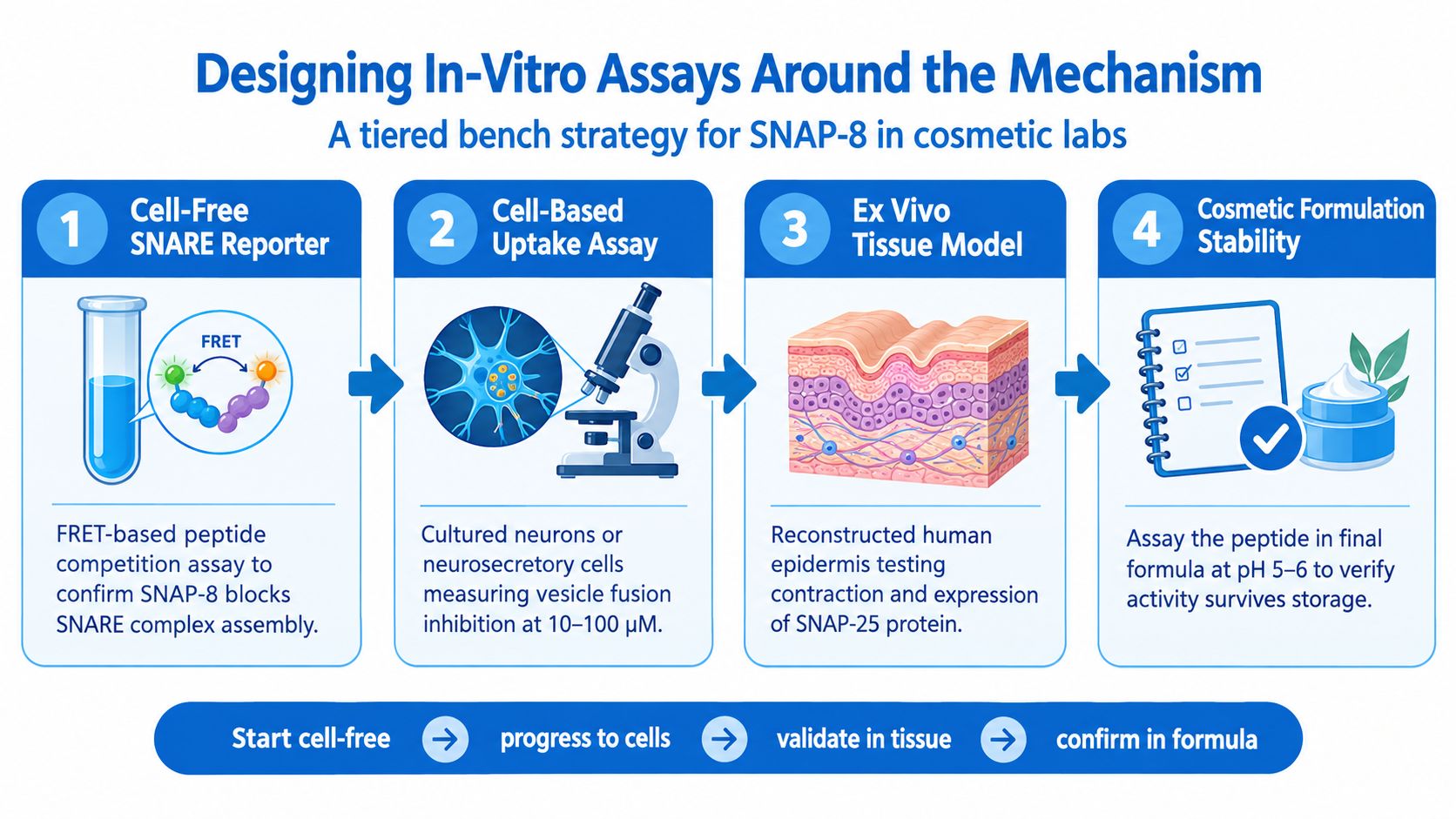
A reported peer-reviewed in-vitro result used 1.5 mM SNAP-8 and measured 43% inhibition in an assay related to muscle-contraction signaling (the PMC review discussing the result). That concentration should not be copied into a cosmetic cell experiment without considering model, exposure, vehicle, and cytotoxicity.
Control the interpretation
A screening design may explore approximately 0.1 to 10 micromolar in a cell-based system, while the infographic's neurosecretory-cell step depicts 10 to 100 micromolar as an illustrative assay range. These are research ranges, not human administration instructions, and each requires a viability and vehicle-tolerance check.
Controls should include a matched vehicle, untreated cells, and a positive comparator such as a benchmark peptide or reference neuromodulator where scientifically appropriate. A sound design uses at least three biological replicates with technical triplicates, blinded image analysis for subjective morphology scoring, and predefined acceptance criteria. Ex-vivo skin explant results can add translational context, but sponsor-funded findings should remain clearly separated from independently replicated evidence.
Documentation, Batch Records, and Research-Use Closure
A reliable result should be traceable back to the vial. The batch record needs enough detail for another analyst to reconstruct the material history without relying on memory or informal messages.
Record the material path
At minimum, capture:
- Identity and provenance: Supplier lot, COA reference, sequence or formal identity, received mass, and stated shipped mass.
- Container condition: Vial integrity, cake or powder appearance, label condition, and any shipping concern.
- Storage history: Freezer location, temperature log, light protection, and any exposure outside storage.
- Preparation details: Reconstitution date, solvent lot, buffer composition, pH, calculated stock concentration, and working aliquot volumes.
- Personnel traceability: Analyst initials, preparation record, deviation notes, and approval status.
Before a run, confirm the visual condition, final pH, target concentration, and any required identity or concentration measurement. After the run, record remaining volume, aliquot disposition, updated freezer location, future-use status, and disposal or return path. The record should also identify whether the sample entered a cell-free assay, cell-based study, tissue model, or formulation stability test.
A batch record is part of the result, not an administrative attachment.
All work should remain within a lawful cosmetic research or laboratory-study context. No clinical or topical-use dosing guidance is supported here, and no human or veterinary administration should be inferred from a reconstitution or assay procedure. Internal findings should remain qualified until independent analytical, biological, peer-reviewed, or regulatory evidence supports a broader claim.
The Pro Tec Pep Research Use Only Policy provides a compliance reference for handling research materials. SNAP-8 should be treated as a research ingredient, not as an approved medicine, personal-use product, or validated clinical intervention. Downstream claims require evidence beyond an in-house assay, especially when the original efficacy data are limited and sponsor-associated.
For laboratory research use only. Not for human or veterinary use. Not a drug, food, or cosmetic. Not evaluated by the FDA. Not intended to diagnose, treat, cure, or prevent any disease. By purchasing, you certify you are a qualified researcher and agree to use this product solely for in-vitro laboratory research.
Pro Tec Pep supplies research-use-only compounds with batch-linked documentation, including COAs and product details that support identity, storage, and assay planning. Laboratories evaluating SNAP-8 can review the available research materials and documentation through Pro Tec Pep before planning procurement.