Sermorelin and Ipamorelin: A Comparative Research Guide
Explore sermorelin and ipamorelin together — mechanisms, comparative research notes, stability, and what to check on COAs for laboratory work.

Popular advice often asks which peptide is “stronger.” That framing is too narrow for laboratory work. Sermorelin and ipamorelin are complementary upstream signals that reach the growth hormone axis through different receptors, with different kinetics and very different documentation histories. The useful question is which pathway, exposure profile, and measurable endpoint fit the assay.
For a new lab member, the distinction matters immediately. A growth hormone result can reflect receptor activation, sampling time, peptide stability, pituitary responsiveness, or downstream feedback. A clean comparison therefore requires more than placing two names side by side. It requires separating mechanism from outcome, and plausible biology from evidence that has been measured.
Why Researchers Study Sermorelin and Ipamorelin Together
Sermorelin and ipamorelin converge on pituitary growth hormone release, but they don't send the same upstream message. Sermorelin is a GHRH analog, while ipamorelin is a selective growth hormone secretagogue receptor agonist. That receptor split makes a paired study useful when a team wants to distinguish pituitary priming from secretagogue-driven stimulation rather than treating both compounds as interchangeable GH triggers.
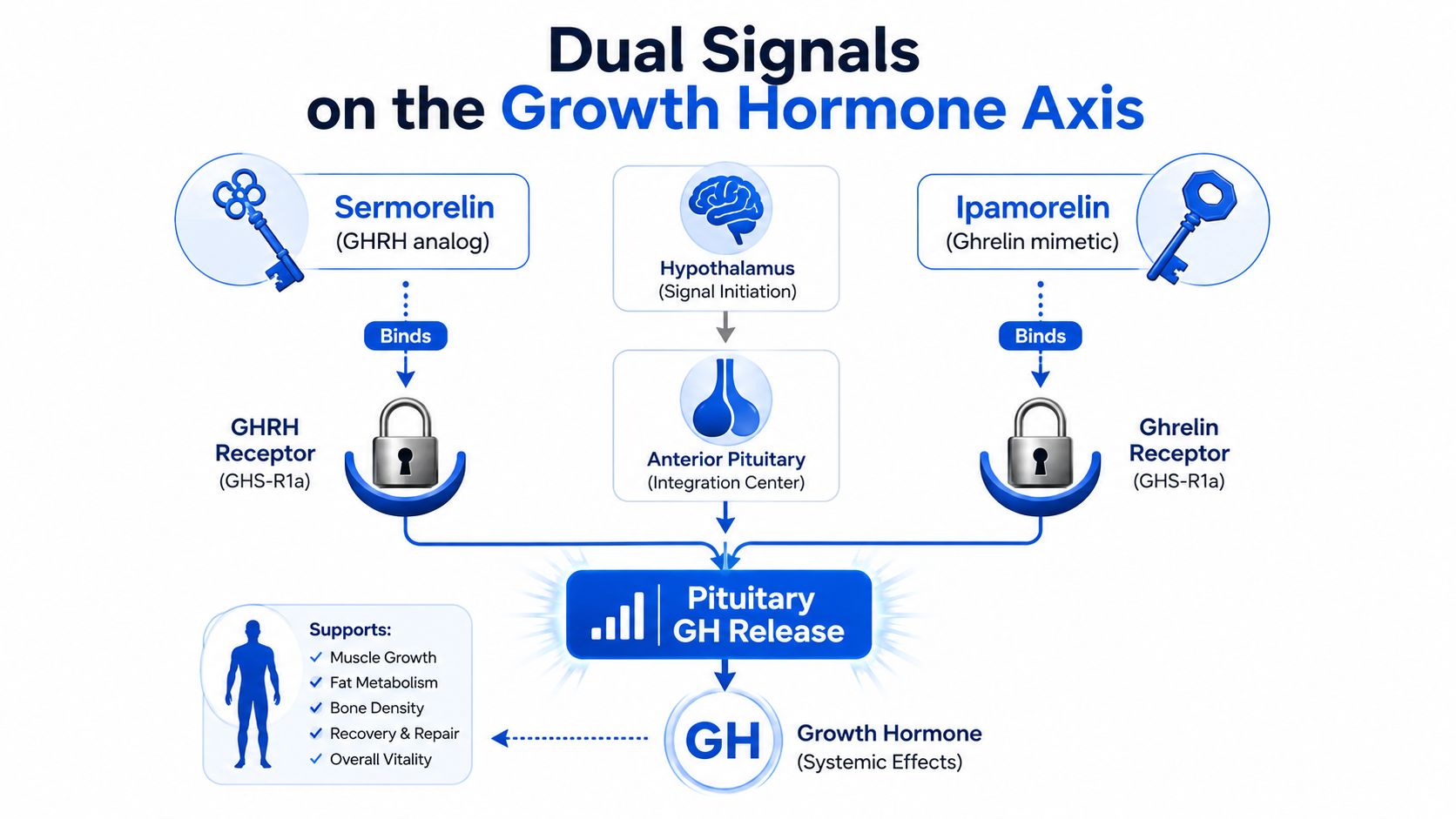
A practical bench model is to treat the axis as an amplifier with two input dials. Sermorelin engages the GHRH receptor on pituitary somatotrophs and activates a cAMP/PKA route. Ipamorelin engages GHSR-1a, the receptor associated with ghrelin signaling, and activates a distinct PLC/PKC/Ca2+ route for GH vesicle exocytosis. The mechanistic review in PubMed Central describes this receptor separation and its relevance to downstream GH and IGF-1 experiments.
The research value of a paired design
A combined design can help isolate whether an observed signal comes from:
- GHRH receptor activation, assessed through sermorelin-responsive pituitary signaling.
- GHSR-1a activation, assessed through ipamorelin-responsive secretagogue signaling.
- Convergent GH release, measured through a time-resolved GH curve.
- Downstream endocrine response, including IGF-1 where the model and assay support that endpoint.
- Secondary pathway effects, such as appetite-related markers or other pituitary hormones, only when those readouts are prespecified.
The design shouldn't assume synergy before testing it. A paired condition, each single-agent condition, and a vehicle control allow the analysis to distinguish additive behavior from pathway-specific effects. The same logic applies to in-vitro pituitary systems, ex-vivo tissue work, and in-vivo animal models.
Practical rule: A receptor hypothesis is not an outcome claim. The assay must show which biological endpoint changed, when it changed, and whether the change persisted beyond the initial GH pulse.
The comparison also has a documentation dimension. Sermorelin's United States regulatory history gives researchers a deeper historical record, while ipamorelin's literature is more strongly associated with pharmacological profiling and preclinical work. That difference affects interpretation, reference selection, and the confidence with which a new result can be compared with earlier studies.
How the Two Peptides Activate the Growth Hormone Axis
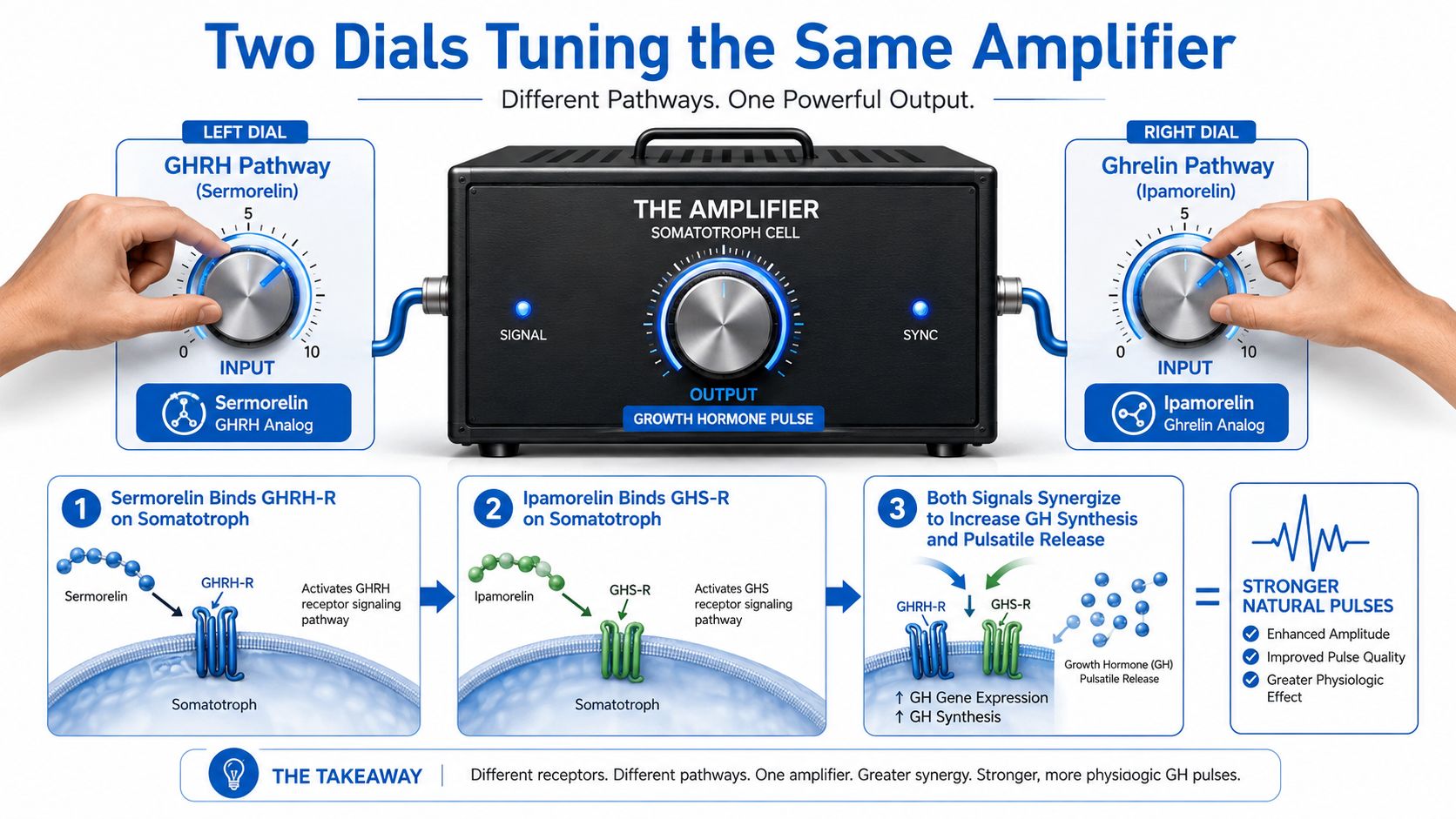
A useful analogy is two control dials connected to one amplifier. The amplifier is the somatotroph's GH secretory machinery. The first dial is the GHRH route, represented by sermorelin. The second is the ghrelin-sensitive GHSR route, represented by ipamorelin.
Step one, follow sermorelin
Sermorelin is a synthetic GHRH fragment with a sequence identical to the N-terminal 29 amino acids of natural hypothalamic GHRH(1–44). Published work reports retained in-vitro bioactivity and near-equivalent ability to elicit endogenous GH secretion in vivo, as described in the PubMed-indexed sequence and activity study.
At the cell surface, sermorelin activates the GHRH receptor on pituitary somatotrophs. The resulting cAMP/PKA signaling supports GH synthesis and release, producing a response that is useful for studying a GHRH-like input to the pituitary. A time-course assay can therefore examine pulse amplitude, duration, and downstream IGF-1 behavior rather than relying on a single late sample.
Step two, follow ipamorelin
Ipamorelin acts through GHSR-1a, the receptor linked to ghrelin signaling. The original pharmacological profiling paper identified ipamorelin as the first selective growth hormone secretagogue, supporting its classification as a GHRP-like receptor agonist rather than a GHRH analog. The PubMed record for that study provides the primary reference.
The pathway uses PLC/PKC/Ca2+ signaling and supports GH vesicle exocytosis. Its selectivity makes ipamorelin useful in experiments designed to examine secretagogue-driven GH release while tracking whether other pituitary outputs change in the same model. Cortisol and prolactin can be included as secondary readouts when the study is designed to test endocrine selectivity, not assumed to be unaffected.
Step three, compare the inputs
Combining the compounds isn't equivalent to increasing either one in isolation. A higher signal through one receptor can reveal receptor saturation, desensitization, or pathway-specific limits. Two receptor inputs can instead test whether the pituitary integrates cAMP/PKA and PLC/PKC/Ca2+ signaling in a distinct way.
That distinction affects endpoint selection. GH pulse amplitude is an immediate readout, GH area under the curve captures exposure over the sampling window, and IGF-1 represents a slower downstream endpoint. A protocol that measures only one time point can miss the difference between a sharp secretagogue response and a broader GHRH-linked response.
The strongest interpretation comes from matching receptor biology to the assay. A pituitary slice experiment may emphasize secretion kinetics, while an in-vivo model may add plasma exposure, tissue endpoints, and feedback regulation. Neither compound should be described as moving a downstream endpoint unless that endpoint has been measured in the relevant model.
Regulatory and Documentation History of Sermorelin
Sermorelin has a comparatively clear United States regulatory record. It was first approved by the FDA in December 1990 as a diagnostic growth-hormone-releasing hormone product. It was approved again in September 1997 under the brand Geref for treatment of pediatric growth hormone deficiency.
The product was voluntarily discontinued in December 2008, and the FDA formally withdrew the approval in 2009. The 2020 review of sermorelin's regulatory history summarizes the sequence as a compound that was approved by the FDA and then discontinued. The review also explains that the withdrawal wasn't based on a finding that the product had been removed for safety or efficacy reasons.
Why the timeline matters at the bench
The history gives sermorelin a documentation footprint spanning nearly two decades of commercial and regulatory use. That doesn't turn every current research lot into an approved product, and it doesn't establish adult wellness outcomes. It does provide historical context for interpreting pharmacology, diagnostic use, pediatric therapeutic labeling, and later market discontinuation.
For a lab, documentation depth changes the starting point for protocol development:
- Historical clinical context: Sermorelin has records connected to diagnostic and pediatric therapeutic applications.
- Mechanistic clarity: Its identity as a GHRH(1–29) analog aligns with a defined receptor pathway.
- Interpretive limits: Regulatory history doesn't resolve unanswered questions in healthy adults.
- Comparison value: Ipamorelin can be evaluated against a shorter and more preclinical documentation record.
Ipamorelin's early literature established its selective secretagogue profile, but that record shouldn't be treated as equivalent to sermorelin's broader historical regulatory documentation. The difference is itself a variable in evidence appraisal. A familiar compound may have more historical context without having strong evidence for every endpoint a modern assay team wants to investigate.
Discontinuation is not the same as scientific invalidation
A product leaving the market doesn't automatically mean the mechanism failed. In sermorelin's case, the documented sequence includes approval, commercial discontinuation, and later formal withdrawal. Researchers should keep those events separate from questions about peptide identity, current lot quality, experimental validity, and human-use claims.
Documentation discipline: Separate regulatory status, published evidence, and batch quality. They answer different questions and shouldn't be collapsed into one label.
Comparing Pharmacokinetics and Exposure Profiles
Kinetics often decide whether a comparison is interpretable. Sermorelin produces a short-lived plasma exposure but can support a longer GH response, while ipamorelin remains in circulation longer and reaches its GH peak earlier in the reported profile. The comparative pharmacokinetic discussion summarizes these differences.
| Parameter | Sermorelin | Ipamorelin |
|---|---|---|
| Primary receptor route | GHRH receptor | GHSR-1a |
| Reported human plasma half-life | Roughly 10 to 15 minutes | About 2 hours |
| Key disposition feature | Rapid clearance consistent with DPP-IV cleavage | Longer terminal exposure |
| Reported GH timing | GH rise can persist for about 3 hours after administration | Rapid GH peak around 0.67 hours after dosing |
| Experimental fit | Brief, physiologic-style pulsatility | Longer secretagogue exposure |
| Main sampling concern | Missing the early plasma window while still capturing a later GH response | Timing strongly affects measured GH AUC and apparent potency |
Sermorelin's short plasma half-life doesn't mean the biological experiment ends when plasma peptide falls. Receptor engagement and downstream pituitary signaling can outlast direct circulation time. A protocol focused on the initial peptide concentration should therefore differ from one focused on the GH response.
Ipamorelin's longer terminal half-life creates a wider exposure window, but that convenience has an analytical cost. Sparse sampling can make a longer exposure look more potent just because the collection window captures more of the GH response. Sampling intervals should be chosen before the experiment, with the primary endpoint and expected peak timing stated in the protocol.
Matching the window to the question
A short bolus-oriented study may suit a question about rapid receptor-triggered secretion. A longer observation window may suit exposure-response modeling or downstream endocrine readouts. Continuous exposure designs require additional controls because they can blur the distinction between a discrete pulse and sustained stimulation.
The study plan should also define recovery periods between experimental conditions. Without a documented washout rationale, residual peptide or lingering endocrine effects can contaminate the next time course. The correct interval depends on the model, matrix, assay sensitivity, and endpoint, not on convenience.
What the Outcome Studies Show
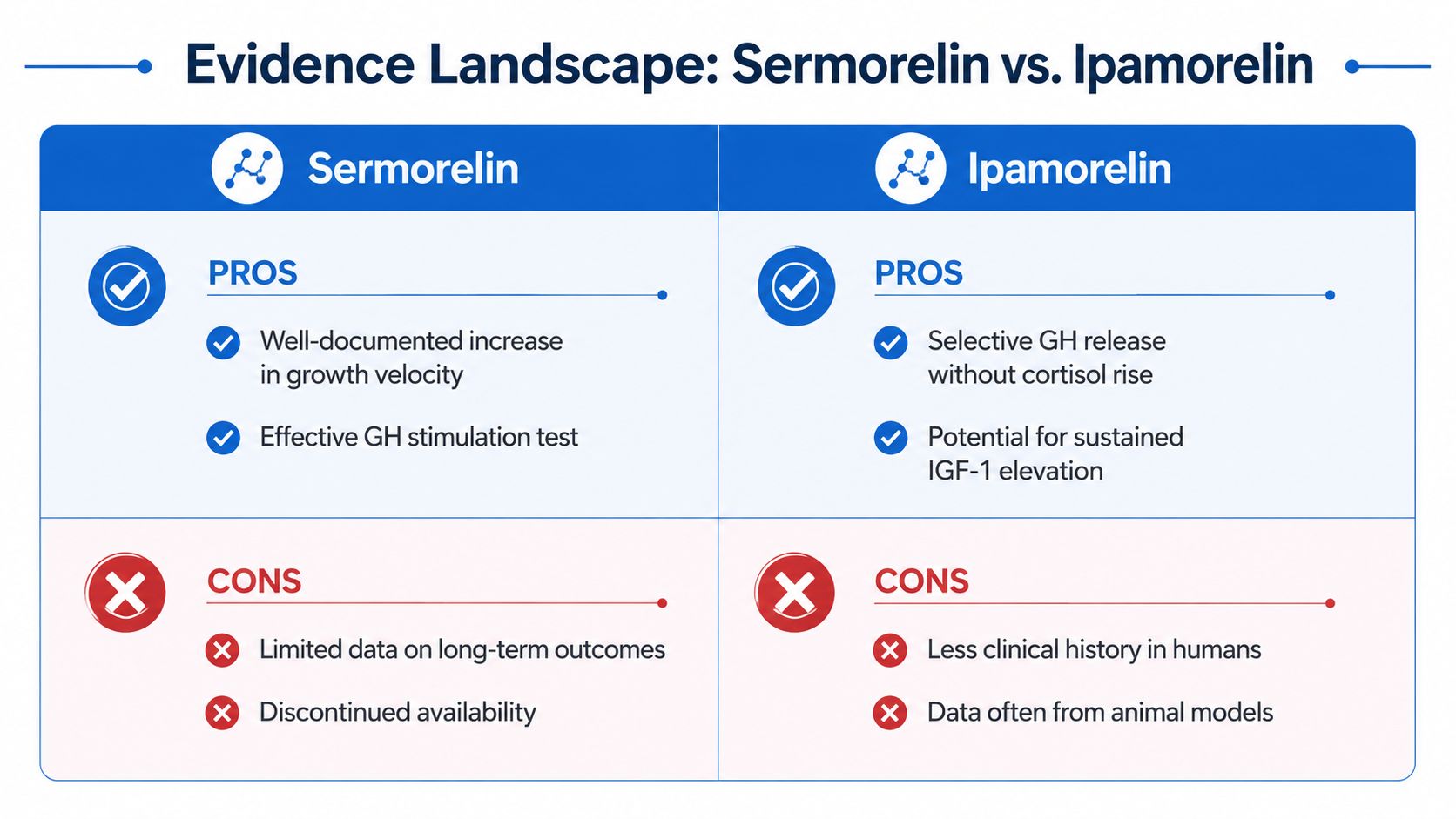
Outcome literature is uneven, so assay design should reflect that rather than hide the differences behind “synergy.” Sermorelin has the longer clinical record, yet adult outcome studies remain limited in size and duration. Ipamorelin has less direct human evidence for adult wellness endpoints, with important observations coming from pharmacological experiments and animal models. The more useful comparison treats the peptides as upstream signals with different receptor pathways and documentation footprints, then asks which measurable endpoint each one moves.
A review-style comparison describes a six-week study in 11 healthy older men in which sermorelin increased nocturnal GH release but did not change IGF-1, lipids, glucose metabolism, body composition, or muscle histology. The review discussing those endpoint findings helps separate a measurable GH pulse from broader biological outcomes.
Endpoints with a clearer signal
Sermorelin has been examined in GH provocation and growth-related research, especially in pediatric settings associated with growth hormone deficiency. These findings support assays of pituitary responsiveness and GH release. They do not establish changes in body composition or cognition in healthy adults.
Ipamorelin literature includes pituitary-slice experiments, perioperative recovery research, and gastric-emptying studies. In a rat model of glucocorticoid-induced catabolism, co-administration preserved muscle- and bone-related endpoints. The study reported a significant increase in maximum tetanic tension and a four-fold increase in periosteal bone formation rate versus glucocorticoid alone, as described in the PubMed-indexed animal study.
Endpoints that remain uncertain
A GH increase does not demonstrate a durable downstream phenotype. The available evidence does not justify assuming that either peptide changes body composition, muscle gain, fat loss, cognition, or long-term endocrine remodeling in healthy adults. A 2026 evidence summary reports that adequately powered randomized trials supporting those claims in healthy adults are absent.
A practical assay hierarchy starts with endpoints nearest to the mechanism:
- Immediate: GH peak, pulse duration, and area under the curve.
- Intermediate: IGF-1 and other prespecified endocrine markers.
- Model-specific: Gastric motility, visceral sensitivity, muscle tension, or bone formation in validated systems.
- Exploratory: Body composition, cognition, or broad wellness composites, only when the design can support them.
This order keeps the measurement question aligned with the biology. An experiment focused on receptor signaling should not depend on a soft composite score that cannot distinguish pituitary secretion from downstream adaptation.
Stability and Handling Considerations in the Lab
Laboratory sample preparation begins with the material's physical state and the assay's sensitivity. Lyophilized peptide should remain in the storage conditions specified for the exact lot, commonly refrigerated or frozen according to the supplier's documentation. A general temperature assumption isn't a substitute for a product-specific stability statement.
Low-protein-binding vials can reduce losses caused by adsorption to container surfaces, especially when working concentrations are low. Aliquot volumes should match the planned thaw cycle so that a working portion can be removed without repeatedly exposing the parent material to temperature changes.
Reconstitution as a controlled variable
Reconstitution solvent selection belongs in the method record. Sterile water and bacteriostatic water aren't interchangeable from a formulation or stability perspective, and the chosen solvent should match the intended in-vitro or ex-vivo workflow. The laboratory record should capture solvent identity, lot, reconstitution time, appearance, and any visible particulate matter.
A useful preparation sequence is:
- Inspect the vial: Record cake appearance, labeling, lot identity, and any visible defect.
- Select the solvent: Follow the batch documentation and validated assay method.
- Add solvent gently: Avoid vigorous agitation that can increase foaming and aggregation.
- Allow dissolution: Confirm that the solution is clear or matches the method's defined acceptance criteria.
- Aliquot promptly: Reduce repeated freeze-thaw exposure and label each working portion.
- Record the clock: Working-solution age matters when the endpoint is sensitive to degradation.
Degradation signatures and assay impact
Peptide degradation can appear as oxidation, deamidation, aggregation, or a broader impurity pattern. Methionine and tryptophan residues are common oxidation-sensitive sites, while deamidation can alter charge and chromatographic behavior. Aggregation may reduce soluble peptide availability and create apparent loss of potency even when total measured material looks acceptable.
Bench-side check: Stability should be judged against the assay's readout, not appearance alone. A clear solution can still contain modified species that shift receptor activity or immunoassay response.
Short-term bench handling and refrigerated working-solution storage should follow documented stability windows rather than optimistic assumptions. If the vendor provides no validated timeframe, a pilot stability check using HPLC or LC-MS can establish whether the working solution remains suitable for the intended experiment.
What to Verify on a Certificate of Analysis
A certificate of analysis should be treated as a batch-specific evidence record, not a decorative file. The lot number on the vial should match the lot number on the COA, and every identity, purity, and handling field should connect to the experiment's documentation.
Identity and composition
Identity confirmation should include HPLC retention time and a mass spectrum that matches the expected reference material. LC-MS or UPLC can strengthen the identity assessment, but a purity percentage without identity data doesn't establish that the material is the intended peptide.
Net peptide content requires attention to counter-ions, residual moisture, and formulation state. A reported mass of powder isn't automatically equivalent to the mass of active peptide. Researchers should request clarification when the COA doesn't explain whether the result is an as-is value, a dry-basis value, or an adjusted content estimate.
Purity and contamination controls
Purity is commonly stated at ≥95% by HPLC, with UPLC or LC-MS used as supporting methods. That threshold is a specification point, not proof that every impurity is biologically irrelevant. The chromatogram, method description, and integration approach should be available when the experiment depends on a narrow impurity profile.
For research materials that could be associated with injectable workflows, sterility and endotoxin fields still deserve review, even though this article addresses laboratory research rather than human administration. Common endotoxin specifications include less than 5 EU/kg or less than 1 EU/mg, depending on intended use. Those limits should be interpreted against the actual research model and institutional requirements, not copied into a protocol without context.
A verification checklist can include:
- Identity: HPLC retention time and MS spectrum agree with the reference.
- Purity: The stated threshold is supported by chromatographic data.
- Net content: Counter-ions and residual moisture are addressed.
- Sterility: The method and result are reported where relevant to the research workflow.
- Endotoxins: The limit and testing method are clearly identified.
- Heavy metals: Results are compared with applicable ICH Q3D expectations.
- Conformity: Synthesis date, packaging, storage conditions, and lot identity are traceable.
A missing result isn't automatically a failed batch, but it is a documentation gap. The appropriate response is to request the underlying report, a retest, or a different lot before the material enters a critical assay.
Framing the Research Question Around These Peptides
The cleanest protocol starts with the endpoint, not the product label. Sermorelin fits experiments that need a GHRH-receptor input and a GH response with physiologic-style pulsatility. Ipamorelin fits experiments that isolate GHSR-1a signaling and secretagogue-driven secretion with less GHRH-pathway involvement.
Single-agent designs are best for pathway isolation. A sermorelin-only condition can test GHRH receptor responsiveness, while an ipamorelin-only condition can test the GHSR route. A combined condition becomes informative when the assay can resolve additive or interacting effects on GH pulse amplitude, GH area under the curve, or a downstream marker such as IGF-1.
Define what the evidence cannot support
The literature doesn't currently justify treating either compound as a proven route to broad healthy-adult changes in body composition, muscle gain, fat loss, or cognition. Long-duration outcome studies, chronic-exposure safety readouts, and well-powered head-to-head dose-response curves remain important gaps. Those limitations should appear in the protocol's rationale and final report.
A reproducible workflow should also preserve the chain of evidence:
- Retain the batch-specific COA with the raw data.
- Record lot, reconstitution conditions, aliquot identity, and storage history.
- Limit freeze-thaw exposure through planned working portions.
- Prespecify the analytical endpoint and sampling window.
- Include vehicle, single-pathway, and combined conditions where the question requires them.
- Distinguish exploratory secondary markers from the primary outcome.
The comparison becomes most useful when the lab can answer a narrow question such as whether a GHRH signal changes the shape of a GHSR-mediated GH response in a defined model. That question is more reproducible than asking which peptide is generally stronger.
Pro Tec Pep lists Sermorelin for laboratory research and provides product-level specifications, batch-linked COAs, and logistics that can support temperature-sensitive research workflows. Laboratories comparing sermorelin and ipamorelin can review the available documentation and research-use materials at Pro Tec Pep, then match the selected lot to the protocol's identity, purity, storage, and traceability requirements.
For laboratory research use only. Not for human or veterinary use. Not a drug, food, or cosmetic. Not evaluated by the FDA. Not intended to diagnose, treat, cure, or prevent any disease. By purchasing, you certify you are a qualified researcher and agree to use this product solely for in-vitro laboratory research.