Semaglutide Peptide for Sale: A Research Buyer's Guide
Looking for semaglutide peptide for sale? Learn how researchers verify identity, COAs, and storage before ordering research-grade material in 2026.
The popular advice is simple: find the cheapest listing, check the purity number, and place the order. That advice is outdated and risky. For a laboratory buyer searching for semaglutide peptide for sale, availability is only the first filter. The material must also be lawful for the intended research context, traceable to a specific lot, supported by credible analytical records, and shipped in a way that preserves sample integrity.
Semaglutide became a reference compound because its biological activity is unusually well characterized. In the STEP 1 obesity trial, once-weekly semaglutide 2.4 mg produced mean weight loss of 14.9% at 68 weeks, compared with 2.4% with placebo, while 86.4% of treated participants achieved at least 5% body-weight loss, compared with 31.5% on placebo, as reported in the published STEP program review. That reproducible translational signal explains the demand. It doesn't excuse weak procurement.
Why Most Semaglutide Listings Are Asking the Wrong Question
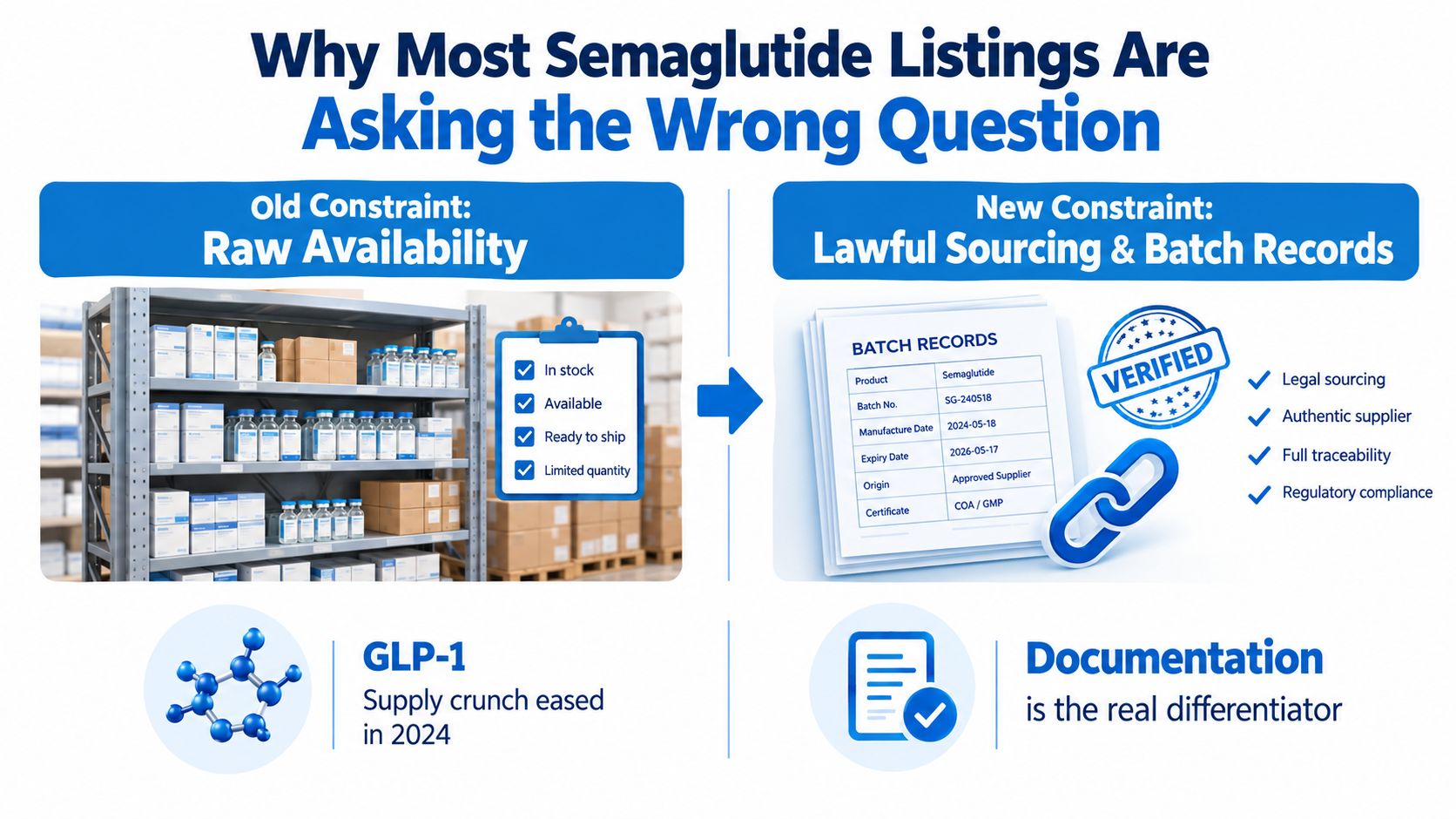
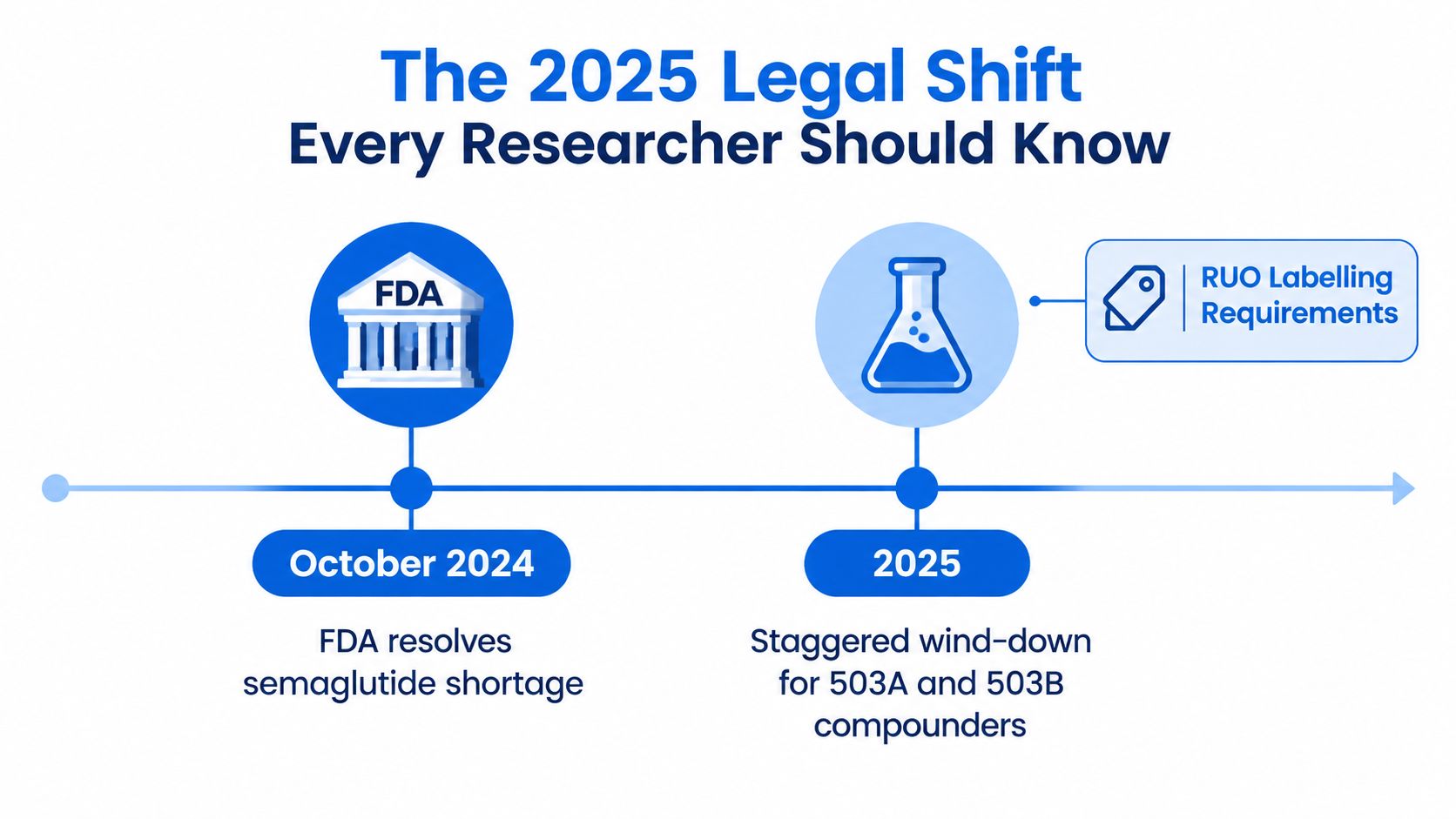
The wrong question is, “Who has semaglutide in stock?” The better question is, “Which supplier can document the exact material, lot, analytical method, and lawful research-use pathway?” The FDA determined that the semaglutide injection shortage had been resolved in 2025 and established short wind-down periods for compounders, ending April 22, 2025 for many 503A pharmacies and May 22, 2025 for 503B outsourcing facilities, as described in the FDA policy clarification for compounders.
That change matters to procurement teams. A shortage may once have been treated as a reason to investigate alternative supply channels. After the regulatory shift, the central issue is whether a listing is appropriate, documented, and lawful for its stated purpose. A low vial price doesn't compensate for a missing lot record, an unclear product identity, or a shipment that arrives without a defensible chain of custody.
Availability is not the same as procurement readiness
A buyer focused only on price usually sees a vial, a purity claim, and a checkout button. A procurement-ready buyer asks for the batch-specific Certificate of Analysis, confirms that the lot number on the document matches the vial, checks the Research Use Only language, and confirms how the package will be handled in transit.
That second workflow prevents avoidable costs. A questionable lot can trigger identity testing, repeat assays, protocol delays, disposal, or an internal quality investigation. A shipment with inadequate documentation may also create problems for institutional purchasing, customs review, or audit records.
Practical rule: A semaglutide listing isn't ready for a laboratory purchase order until the documentation is ready for the laboratory record.
This discipline transfers to other research peptides and related molecules. The vendor's stock page is a lead, not evidence. The evidence is the lot record, analytical support, storage information, shipping record, and a supplier willing to answer technical questions before payment.
What Semaglutide Actually Is at the Bench
Semaglutide is a 31-amino-acid GLP-1 receptor agonist analogue with a reported average molecular weight of 4113.58 g/mol and molecular formula C187H291N45O59, according to the European Medicines Agency assessment report for Rybelsus. Its structure was engineered to solve three problems that limit native GLP-1, rapid enzymatic cleavage, rapid clearance, and short exposure.
The first modification replaces alanine at position 8 with Aib, or alpha-aminoisobutyric acid. This substitution helps resist DPP-4 cleavage. The second attaches a C18 fatty diacid linker at Lys26, which promotes reversible albumin binding. Albumin acts as a circulating carrier and reduces renal clearance. The third changes Lys34 to Arg, preventing unwanted acylation at that position.
These changes aren't cosmetic. They determine how the compound behaves in receptor assays, solution handling, pharmacokinetic studies, and stability testing. FDA labeling identifies albumin binding as the principal mechanism that prolongs semaglutide's half-life by reducing renal clearance and protecting the molecule from metabolic degradation, as detailed in the FDA prescribing information.
Structural changes and laboratory consequences
| Modification | Structural Change | Bench Implication |
|---|---|---|
| DPP-4 resistance | Ala8 replaced by Aib | Supports longer persistence in biological assay systems than an unmodified, DPP-4-sensitive sequence |
| Albumin association | C18 fatty diacid attached through Lys26 | Makes carrier protein, surface adsorption, aggregation, and solvent compatibility important variables |
| Proteolytic protection | Lys34 replaced by Arg | Reduces an additional cleavage or modification pathway and supports identity confirmation by mass spectrometry |
The molecule selectively binds and activates the GLP-1 receptor. FDA labeling describes glucose-dependent stimulation of insulin secretion, suppression of glucagon secretion, and a minor early postprandial delay in gastric emptying as components of its pharmacology, summarized in the NCBI pharmacology reference.
For laboratory teams, the practical conclusion is clear. Semaglutide isn't just a short peptide with a high purity number. The fatty-acid architecture affects dissolution, adsorption to surfaces, protein association, and response to temperature cycling. Any product page that treats it like an interchangeable generic powder is leaving out the part that most affects reproducibility.
The 2025 Legal Shift Every Researcher Should Know
The FDA's resolution of the semaglutide injection shortage changed the procurement environment. The agency's 2025 clarification gave many 503A pharmacies until April 22, 2025 and 503B outsourcing facilities until May 22, 2025 to wind down activities connected to the shortage, according to the FDA's published clarification.
That timeline doesn't turn every research listing into a regulated medicine, and it doesn't make an unapproved product suitable for human administration. It does mean that buyers should stop treating shortage language as a blanket justification for alternative sourcing. A laboratory product needs a clear Research Use Only position, accurate labeling, lot traceability, and documentation consistent with the intended in-vitro or preclinical work.
Listing language is a procurement signal
A credible research listing should identify the compound accurately and state its intended use plainly. It shouldn't blur the difference between an approved medicine, a compounded product, and a research material. The product page should also give the buyer a route to the relevant lot record before or alongside purchase.
The following documents should be treated as minimum procurement evidence:
- RUO statement: The page and product documentation should make the research-only purpose unmistakable.
- Lot identification: The vial, invoice, packing record, and COA should refer to the same batch.
- Analytical documentation: The supplier should identify the methods and testing laboratory rather than provide only a marketing purity claim.
- Shipping records: Temperature-sensitive materials need a documented transit approach and clear arrival instructions.
A vendor's willingness to provide records matters as much as the wording on the page. If the supplier won't produce the underlying paperwork before an order is approved, the listing has already failed the buyer's most basic audit.
Reading a Semaglutide COA Like a Sourcing Document
A COA isn't a reassurance sticker. It is a decision document that should let a laboratory determine whether a specific lot is suitable for a defined protocol. The record should identify the supplier, product, batch, test dates, methods, results, acceptance criteria, and laboratory responsible for the work.
The seven categories below cover the practical checks most relevant to identity, purity, contamination, and reproducibility. A laboratory may require additional testing for a particular assay, but a sparse one-line certificate shouldn't be accepted as a complete quality record.
Seven fields that deserve scrutiny
HPLC purity shows the chromatographic profile and the proportion assigned to the target material. A reported 98% or higher target is commonly used by research suppliers, but the number has little value without the chromatogram, method conditions, and lot reference.
Peptide content by amino acid analysis addresses how much peptide is present rather than how clean the chromatographic peak appears. This distinction matters when a protocol depends on accurate molar preparation.
Residual solvents should address relevant process solvents, including acetonitrile and TFA. A blank line or generic “passes” statement doesn't tell the laboratory what was tested or how the result was interpreted.
Endotoxin testing should identify an LAL or rFC method and provide a result tied to the batch. Cell-based work can be sensitive to contaminants that don't appear in a basic purity trace.
Mass spectrometry should confirm the semaglutide parent ion around 4,113.64 Da, with the result linked to the same lot and an identifiable analytical method. That identity check is especially important for a modified peptide with a lipid-linked structure.
Water content by Karl Fischer helps assess residual moisture in lyophilized material. Excess moisture can affect appearance, stability, and reconstitution behavior.
Microbial limits provide a separate contamination check. They shouldn't be replaced by an unsupported claim that the vial is “sterile” or “GMP.”
| Test Category | Acceptable Result | Red Flag |
|---|---|---|
| HPLC purity | Defined result with chromatogram and method | Purity number without raw trace |
| Amino acid analysis | Peptide content tied to the lot | No content measurement |
| Residual solvents | Named solvents and reported findings | “Pass” without method or analytes |
| Endotoxin | LAL or rFC result with units and lot | No assay name or result |
| Mass spectrometry | Parent-ion confirmation near 4,113.64 Da | Identity asserted without spectrum |
| Karl Fischer | Reported water result | No moisture method |
| Microbial limits | Defined test and batch result | Sterility language without evidence |
The shortcuts that expose weak paperwork
A missing lot number is an immediate stop, especially when the vial label carries a number that doesn't appear on the COA. A test date older than six months should trigger a direct question about current stock and whether the document applies to the material being shipped. A methodology line that says only “in-house” is weaker than a named, contactable third-party laboratory with an identified method.
COAs are batch-specific records, not universal certificates that apply to every future vial. That lot-level principle is also described in batch-specific COA guidance for research peptides. If the supplier can't connect the certificate to the exact stock, the document doesn't support reproducibility.
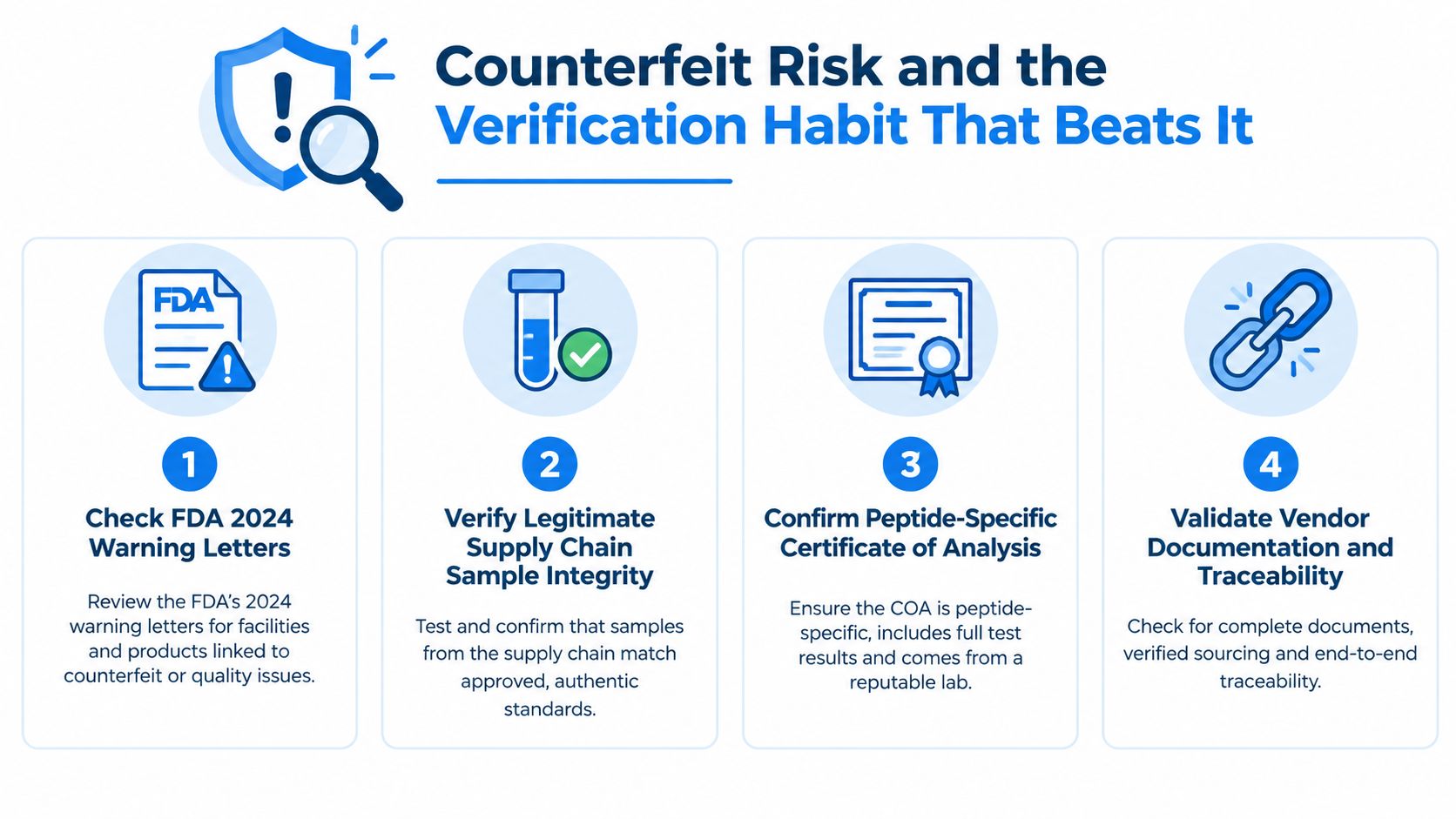
Counterfeit Risk and the Verification Habit That Beats It
A professional-looking vial isn't proof of authenticity. FDA has warned that counterfeit semaglutide products can enter the U.S. supply chain and may contain the wrong or harmful ingredients, as explained in the FDA warning on unapproved GLP-1 drugs. A 2024 analytical study also found that test-purchased semaglutide samples were all substandard, falsified, or counterfeit, which makes visual inspection an inadequate quality-control method.
Counterfeits can look convincing because packaging is easy to copy. Vial dimensions, labels, batch numbers, and lyophilized cakes can resemble legitimate material. A copied batch number may even be taken from a genuine COA, so the existence of a plausible-looking document doesn't establish that the vial in hand belongs to that lot.
Verification must connect three records
The strongest habit is simple: cross-reference the vial, COA, and independent laboratory report. Each should identify the same product and lot. The testing laboratory should be contactable, and its claimed ISO/IEC 17025 accreditation should be verifiable through the relevant accreditation body.
Request the raw chromatogram rather than accepting a summary purity figure. Review the analytical method, retention profile, mass spectrometry confirmation, and test date. If the vendor refuses to share the underlying record, the buyer has no reliable way to distinguish a tested lot from a copied document.
A copied label can imitate appearance. It can't establish chain of custody.
The following signals justify rejecting a listing before a purchase order is drafted:
- Price far below comparable listings: A low price isn't proof of fraud, but it raises the burden of proof.
- No physical business address: A contact form alone makes escalation and verification difficult.
- No lot-specific COA: Generic certificates don't establish what is inside the vial.
- Pressure-only payment methods: Payment restrictions that remove normal purchasing controls are a procurement risk.
- Unclear product identity: Vague references to “GLP-1 powder” don't substitute for a defined compound record.
The decision standard should be evidence, not confidence. A supplier that provides transparent records before payment is easier to evaluate than one that asks the laboratory to trust packaging after delivery.
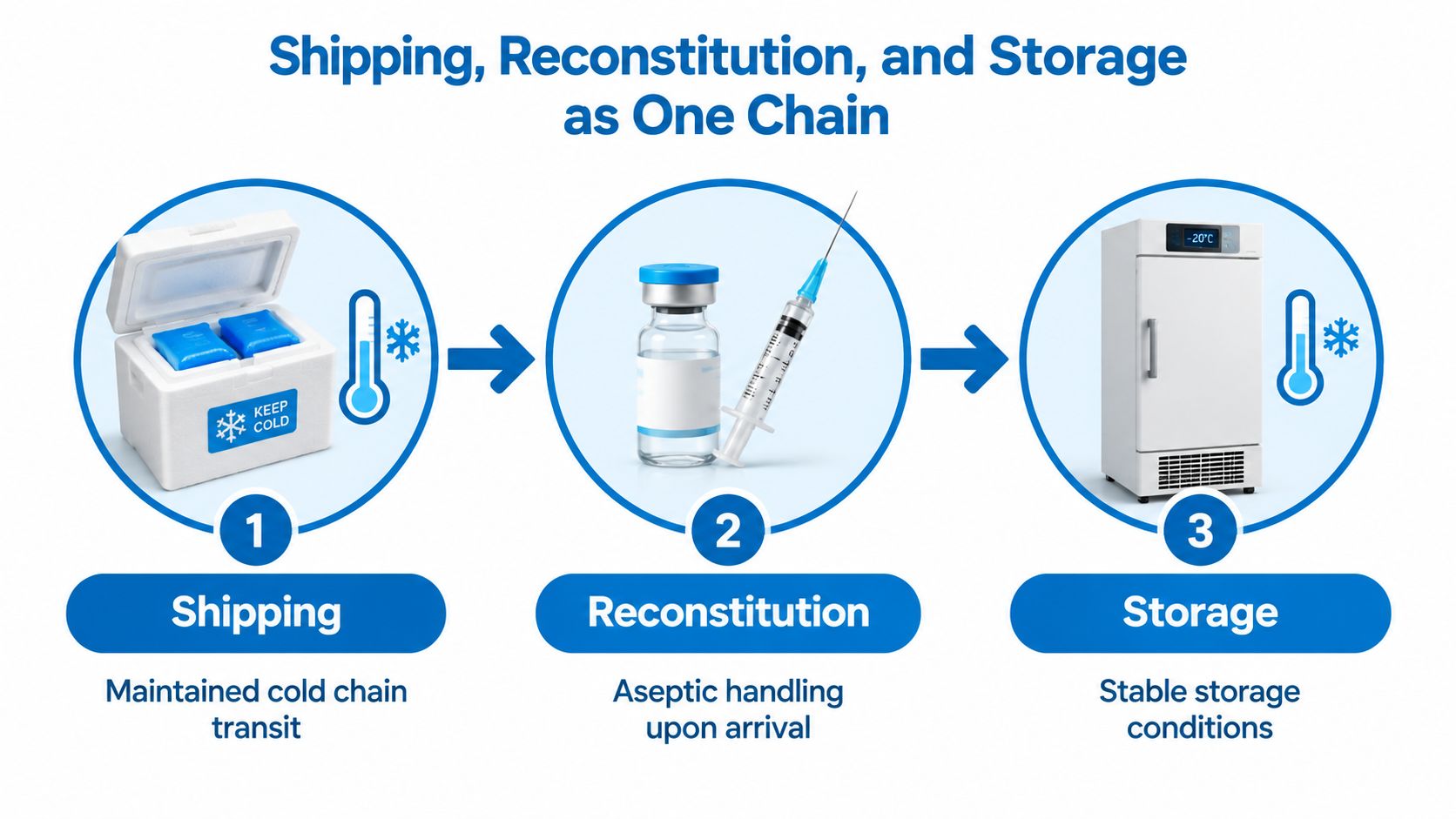
Shipping, Reconstitution, and Storage as One Chain
Cold-chain responsibility doesn't begin when the vial reaches the laboratory. It starts with the supplier's packing decision and continues through transit, receipt, sample preparation, aliquoting, and storage. A temperature-sensitive research material can arrive with perfect paperwork and still produce weak data if the shipment sat in uncontrolled conditions.
A reasonable shipping package should include insulated protection, gel packs or dry ice selected for the ambient forecast, and a temperature logger where the material's stability requirements justify it. Shipping earlier in the working week reduces the chance of a parcel sitting through a courier hold, but the receiving laboratory still needs an arrival procedure.
Receiving and preparing the sample
The receiving technician should inspect the external package, confirm the lot number against the purchase record, and review the logger before accepting the material into inventory. The vial should remain protected while the shipping container equilibrates, and the receipt date, package condition, lot, and temperature record should be entered into the laboratory system.
Reconstitution is a laboratory sample-preparation step, not a human administration instruction. The bench protocol should specify the validated diluent, aseptic handling, slow addition down the vial wall, and gentle swirling rather than vigorous vortexing. The exact vehicle depends on the assay and supplier data. Independent laboratory guidance reports that reconstituted semaglutide solutions are most stable at 2 to 8 °C, with accelerated-stability HPLC work supporting refrigerated potency retention for at least six weeks, as described in the GLP-1 peptide storage guidance.
Storage decisions should follow the validation record
Lyophilized stock is commonly maintained under refrigerated or frozen conditions according to the supplier's validated specification. Reconstituted material should be kept at 2 to 8 °C when that condition is supported by the relevant stability record, and aliquots should be prepared when repeated opening or temperature cycling could affect the experiment.
Repeated freeze-thaw cycles deserve special attention. Semaglutide's C18 lipid anchor can promote aggregation during thermal cycling, so repeated freezing and thawing can change the material's physical state and assay behavior. The laboratory should record every preparation event and avoid treating a general storage claim as a substitute for lot-specific stability information.
A Practical Checklist Before You Order
A purchase order should pass every gate below. If one gate fails, the correct response is to pause or walk away, regardless of price.
- Vendor identity: Confirm a verifiable business identity, contact route, and purchasing documentation.
- Research-use positioning: Require clear RUO labeling that matches the laboratory's intended work.
- Batch-specific COA: Demand a certificate tied to the exact lot, not a generic master document.
- Seven-category testing: Check for HPLC purity, amino acid content, residual solvents, endotoxin, mass spectrometry, water content, and microbial limits.
- Lot match: Compare the vial, COA, invoice, and packing record before the material enters inventory.
- Independent laboratory: Require the testing laboratory's name, method information, and verifiable accreditation details.
- Current documentation: Question any certificate whose test date is older than six months, particularly when the supplier claims current stock.
- Remaining shelf life: Require an expiry date with at least twelve months remaining when that is the laboratory's purchasing standard.
- Cold-chain shipment: Confirm insulation, suitable coolant, and a temperature data logger when required by the material specification.
- Tamper evidence: Inspect sterile packaging and seals on arrival, then record any discrepancy.
- Storage instructions: Require transparent powder and reconstituted-sample conditions supported by the lot documentation.
- Supplier responsiveness: If the vendor can't produce a requested record before purchase, reject the listing.
A passing checklist is the only honest signal that a research lot is procurement-ready. Product-page language, polished images, and low prices are secondary. Pro Tec Pep offers research-use-only compounds including semaglutide, batch-specific COA access, product documentation, optional cold-chain shipping, and order support for laboratory procurement workflows. Laboratories evaluating a semaglutide peptide for sale should visit Pro Tec Pep and review the lot documentation, storage details, and fulfillment terms before submitting a purchase order.