Research Lab Peptides: Categories, Handling, and Procurement
Practical reference for research lab peptides covering categories, sequences, storage, COA testing, and compliant procurement for laboratory workflows.
You can tell a peptide order is about to become a tracking problem the moment the vial lands and someone asks, “Which lot is this, what was tested, and can we trust it for this assay?” That's the day-to-day issue with research lab peptides. The catalog choice matters, but the bigger risk is usually documentation drift, handling mistakes, and a COA that looks fine until the experiment needs reproducibility.
What This Reference Covers and Who It Is For
Laboratory teams usually do better with a working reference than with a product list. That means treating research lab peptides as materials that need category routing, lot control, storage discipline, and assay-specific verification, not as a shopping exercise. The focus here is strictly in vitro and non-clinical, with the same research-only framing used by RUO suppliers and institutional buyers.
The people who need this most are the ones who touch the material at different points in the chain. Lab managers need a framework for intake and audit readiness, bench scientists need a stable way to prep samples without losing lot traceability, intake technicians need a receipt checklist, and procurement officers need to know what documentation should arrive with the shipment.
Practical rule: If the lot number, COA, and vial label do not agree, the material is not ready for the bench.
The structure below follows the order that usually prevents mistakes. It starts with category grouping, then moves into reference-entry format, sample preparation, COA reading, purity matching, procurement gating, and a compact lookup table for daily use. The goal is simple, keep the paper trail as solid as the chemistry.
For teams that maintain internal libraries, a category map can also help route incoming materials to the right SOP. A compound used in signaling assays should not be processed like a structural study reagent, and a modified analogue should not be handled like a plain linear sequence. A useful starting point for that kind of routing is a compound library such as Pro Tec Pep's compound research library, but the actual test is still the same: does the documentation support the intended workflow?
Major Categories of Research Lab Peptides
The fastest way to make sense of peptide inventory is to group it by study function, not alphabetically. That approach helps the lab assign the right storage, reconstitution, and verification rules before the first aliquot is made. It also makes it easier to spot when a single sequence belongs to more than one research line.
Functional families
Metabolic and incretin-mimetic sequences usually show up in receptor signaling, pathway mapping, and assay development. Regenerative and tissue-modeling compounds are more often routed into cell-culture or wound-response models. Neuropeptide analogues belong in receptor-binding, signaling, and neurobiology workflows, while signaling fragments and motif-derived sequences are often used to isolate a pathway effect without the noise of a full-length parent molecule.
Antimicrobial and host-defense peptides sit closer to microbiology and membrane-interaction studies. Modified analogues are a separate category because the alteration itself often changes the handling profile, solubility, or assay behavior more than the base sequence does. That's why a truncated fragment, an acetylated sequence, or a disulfide-containing analogue should never be treated as a generic peptide on intake.
Naming is not always stable
Catalog aliases can be messy. A peptide may appear under a formal name, an abbreviation, a vendor shorthand, or a database-style identifier, and those labels do not always line up across suppliers. For that reason, the internal routing standard should depend on the exact sequence identity and the COA, not on the shortest name in the cart.
Category discipline prevents downstream confusion here. A receptor ligand can also be a signaling tool, and a modified fragment can serve as both a screening reagent and a reproducibility challenge. The lab should route the material based on the experiment it will support, then require the matching documentation tier before it ever reaches a plate.
Standard Reference Entries for Lab Compounds
A reliable reference entry should answer five questions immediately, what is it called, what else is it called, what is the sequence, what is the expected mass, and what kind of study is it being tied to. That format matters because procurement, intake, and bench work all depend on the same identity chain. A clean entry reduces the chance that a vendor synonym or a truncated analogue gets treated like the parent sequence.
What a usable entry looks like
For a receptor-focused peptide, the formal name should appear first, followed by common aliases and the exact sequence or modified structure. The molecular weight belongs beside the sequence because that is what lets the lab compare the expected mass to MS data on the COA. If the sequence includes an amidated C-terminus, an acetylated N-terminus, a disulfide bridge, or non-standard residues, that modification should be called out because it can alter both solubility and expected analytical behavior.
Take Tesamorelin as a practical example. It is a modified GHRH analogue used in pathway studies, so the entry should emphasize the receptor context, the modified nature of the sequence, and the mass-based confirmation on receipt. The same logic applies to CJC-1295, which is commonly discussed as a GH-axis research reagent, but the entry still needs lot-specific analytical support rather than a generic catalog summary.
Why parent and truncated sequences cannot be blended
Some materials are ordered as full-length parent sequences, while others are truncated or modified analogues used for screening. Those are not interchangeable just because the names look related. A truncated fragment may be useful for a narrow assay, but it can't be assumed to reproduce the behavior of the parent compound in a broader pathway study.
BPC-157 is a good example of why the distinction matters. It is frequently discussed in regenerative and tissue-modeling contexts, but the record that matters at intake is not the marketing shorthand, it's the exact sequence, the reported mass, and the analytical evidence tying the vial to that batch. The same discipline applies to TB-500 (Thymosin Beta-4 Acetate), where the modified form is the thing being studied, not just the familiar name.
A compact entry structure
- Formal name, the controlled label used in inventory and COA matching.
- Common aliases, the names likely to appear in vendor systems or paper records.
- Sequence or modification pattern, the identity anchor for analytical work.
- Expected molecular weight, the comparator for MS confirmation.
- Study context, the receptor, pathway, or assay frame that justifies procurement.
The sequence is the identity. The name is only the label attached to it.
Storage, Solubility, and Sample Preparation
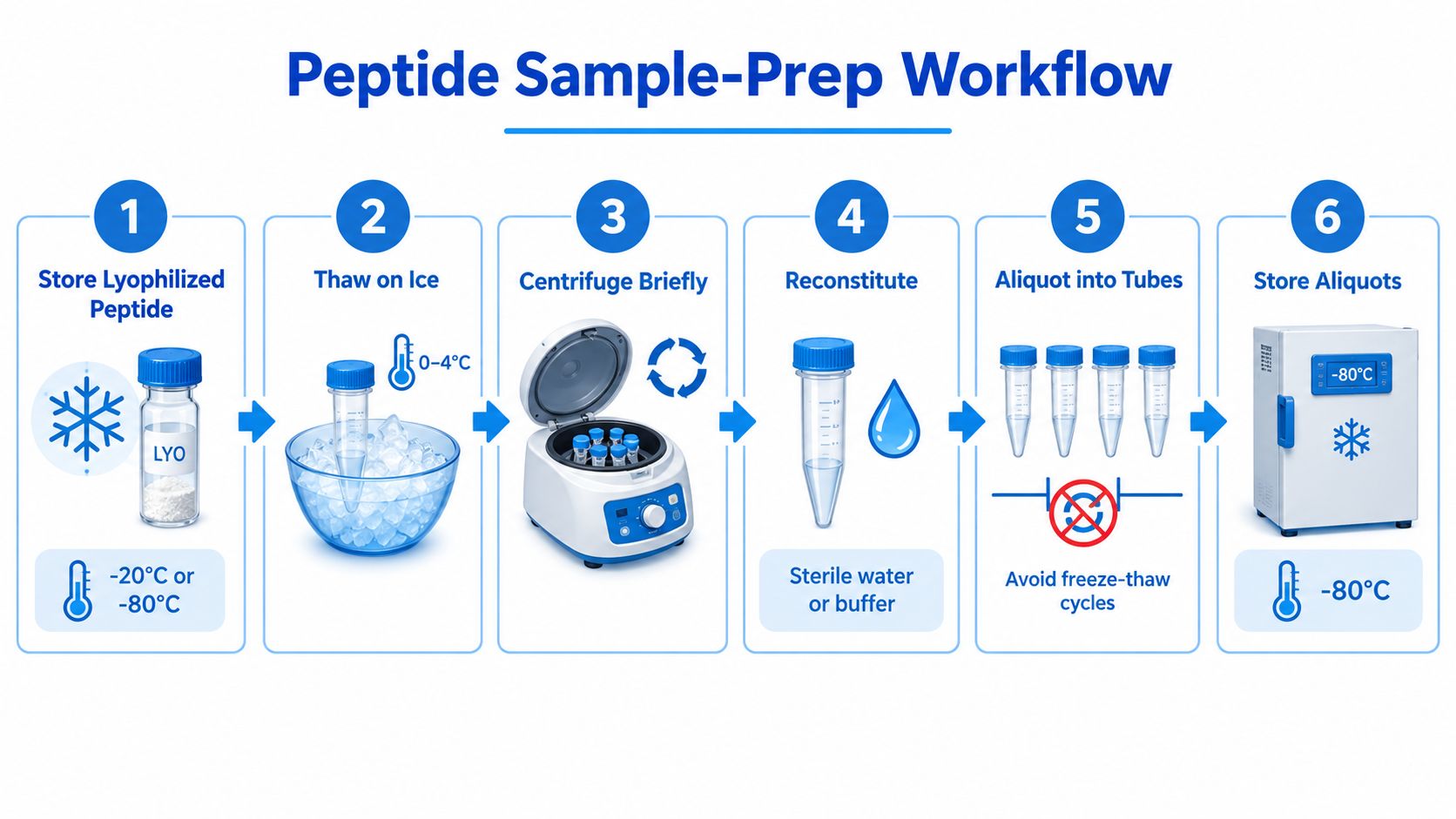
The first storage decision happens at receipt, not after the first failed assay. Lyophilized peptides should stay frozen for long-term retention, and laboratory handling should minimize exposure to moisture, light, and repeated temperature cycling. For transit-sensitive materials, cold-chain control matters because a temperature excursion can shorten usable lifetime before the vial ever reaches the bench.
Reconstitution choices should follow the sequence
Solvent choice depends on hydrophobicity and assay intent. Sterile water or buffer works for many sequences, dilute acetic acid is often used when solubility needs a gentle acidic push, and DMSO is reserved for sequences that resist aqueous solution but are compatible with the downstream assay design. The point is not convenience, it's preserving sample integrity without introducing an incompatible solvent effect.
After reconstitution, the lab should calculate the working concentration from the net peptide content, not from wishful label reading. That distinction matters when the vial contains salts, counterions, or other formulation components. A quick visual pH check before aliquoting can catch a bad prep early, especially when the sequence is known to be finicky in solution.
Aliquoting should protect the lot
Single-use aliquots are the easiest way to control freeze-thaw damage. Short-term working material belongs around -20 C, while longer storage should move to -80 C for sequences prone to oxidation or aggregation, which is consistent with standard peptide handling guidance and broader biologics shipping practice at 2°C to 8°C during transit (Sigma-Aldrich peptide handling and storage guidance, peer-reviewed biologics shipping review). Light-sensitive residues should go into amber vials, and every aliquot should carry the source lot number so the tube still means something after it leaves the rack.
Handling rules that save material
- Keep lyophilized stock frozen, because solution storage shortens stability windows.
- Avoid repeated thawing, because freeze-thaw cycles create avoidable variability.
- Label every aliquot, because unlabeled tubes become unusable inventory.
- Limit bench time, because solution exposure increases the chance of adsorption and degradation.
Reading a Certificate of Analysis Correctly
A useful COA is a lot-specific identity record, not a marketing sheet. The first thing to check is whether the document belongs to the vial in hand. If the lot number, vial label, and COA do not match, the purity number is almost irrelevant.
What a defensible COA should contain
The strongest documentation links a specific lot to orthogonal identity and quality evidence. HPLC is used to measure chromatographic purity, MS is used to confirm the molecular identity, and reference-material guidance recommends documenting purity alongside structure-confirming analytical evidence so impurity burden can be read in context of the intended experiment (peer-reviewed peptide characterization guidance). For contamination-sensitive work, the COA should also carry the relevant limits for endotoxin and, where applicable, other quality checks.
The lab should also watch for documentation gaps that are common in retail material. A missing lot number, a purity percentage with no chromatogram, or a single-method claim without orthogonal support all weaken traceability. Batch-specific evidence beats generic product-page language every time.
Why purity numbers need interpretation
A purity percentage on a COA does not mean the same thing as net peptide content, and it does not automatically predict assay performance. A 98% main-peak area is not the same as 98% peptide by mass, because method choice, wavelength, integration rules, and formulation details can change what the number means. That's why lot specificity matters more than the headline number.
| Analytical Method | Required COA Element | Common Gap | Reviewer Check |
|---|---|---|---|
| HPLC | Chromatogram with main peak and impurity profile | Purity number listed without trace | Confirm the method and wavelength match the lot |
| MS | Observed mass aligned with theoretical mass | Mass listed without spectrum context | Check that the reported mass supports identity |
| AAA | Net peptide content or compositional evidence | Assay absent on retail COA | Compare claimed content against working concentration |
| Endotoxin | Quantified result for cell-based work | No contamination data for culture use | Verify the application actually needs this data |
For teams comparing vendors, a documentation review page such as Pro Tec Pep's testing overview can help frame what a complete lot package should look like, but the laboratory still has to retain the actual batch record in its own files. The standard should be simple, if a future auditor cannot reconstruct the exact lot from the paperwork, the record is not complete.
Matching Purity Class to Assay Sensitivity
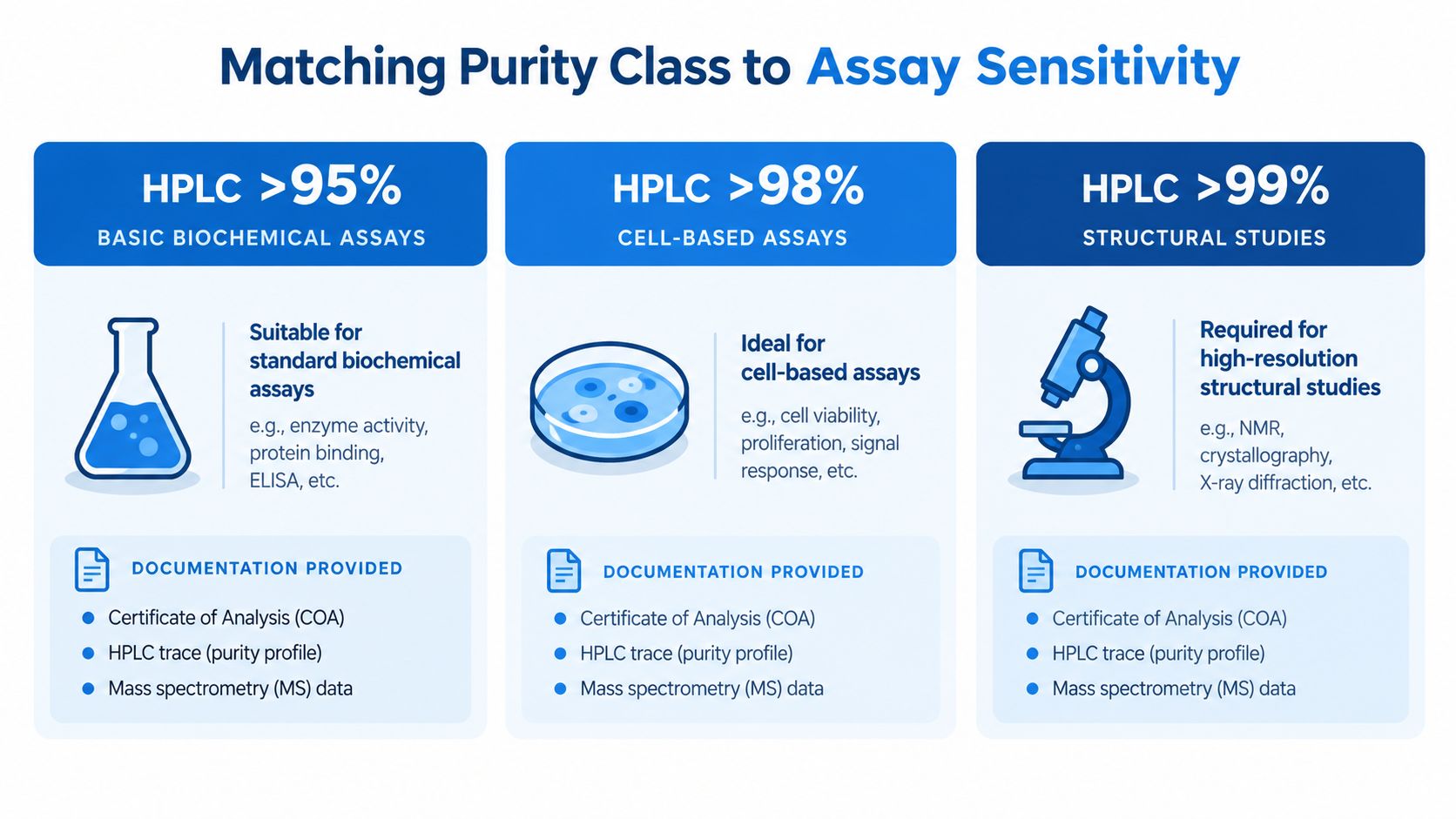
Purity class should follow the assay, not the other way around. Screening work can tolerate more analytical noise than a publication-grade affinity study, and a structural method can demand a cleaner package than a simple bind-or-not screen. That's why procurement should start with the sensitivity of the downstream experiment.
Three working tiers
Screening-grade material belongs in binding panels, dose-response triage, and early assay development. Reproducibility-grade material belongs in publication-ready dose curves, receptor-affinity work, and cell-signaling experiments where impurity-driven shifts can alter the readout. Orthogonal-verified material is the right choice for methods such as SPR, ITC, NMR, and crystallography, where the package has to support tighter identity confidence.
The documentation burden rises with the sensitivity of the assay. A single HPLC result may be enough for a rough screen, but higher-confidence work should carry HPLC plus MS, and the most demanding studies often need a fuller package, including content and contamination evidence. That's not paperwork for its own sake, it's the cost of cleaner interpretation.
Common failure modes
Trace truncated peptides can distort affinity readouts. Heavy-metal residues can suppress cell-based reporter assays. Salt content can also shift concentration calculations enough to make two labs think they are running the same condition when they are not.
Decision rule: If the result will be published, compared across sites, or used to support a mechanistic claim, order the highest documentation tier that matches the assay sensitivity.
Procurement, Compliance, and Research-Only Gating
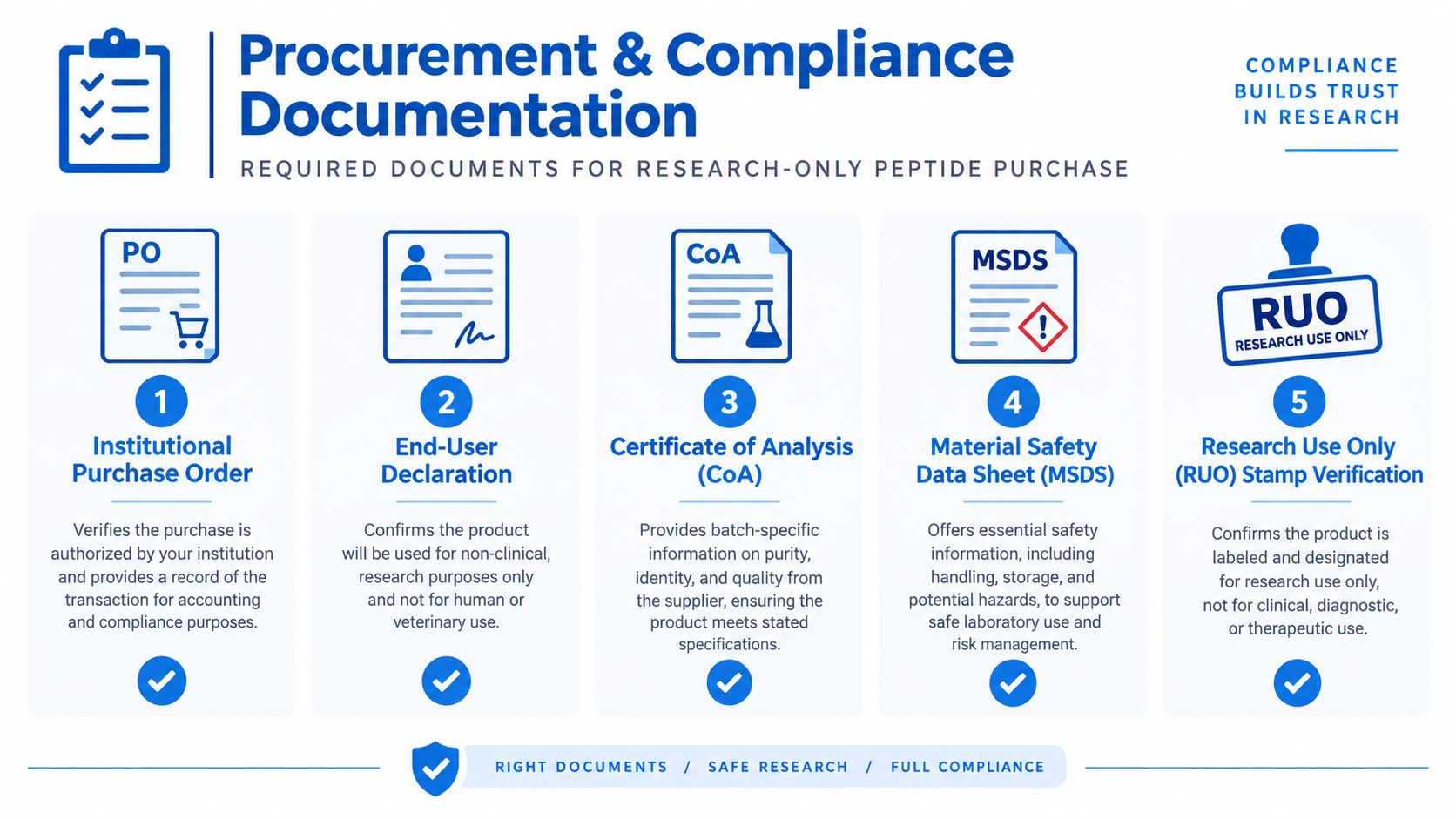
Research-only procurement is a documentation workflow before it is a shipping workflow. The supplier should know who the buyer is, the institution should know what was ordered, and the lab should be able to show that the material was bought for non-clinical research. Age verification and identity checks belong in the onboarding path because they support controlled access and help keep the purchase within the intended research lane.
What should arrive with the shipment
The lab should expect a lot-traceable COA, a safety data sheet, and chain-of-custody records when the supplier provides them. On receipt, intake should verify the vial seal, compare the lot number on the label against the paperwork, confirm whether the shipment stayed within the expected temperature window, and log the material into inventory before it reaches bench stock. That sequence sounds basic, but it's where most traceability problems are either prevented or created.
Open-market listings deserve extra scrutiny. Missing lot numbers, COAs dated before the stated manufacturing run, or vague product pages without batch-linked evidence are all red flags. A vetted catalog supplier is not immune to mistakes, but the better ones make the batch record easy to find and hard to confuse.
Compliance artifacts worth retaining
- Purchase order and end-user declaration, because procurement needs a paper trail.
- Research-use statement, because intended use has to stay in the RUO lane.
- COA and SDS, because analytical identity and hazard information are part of the record.
- Receipt log, because inbound inspection should be auditable later.
For labs building a procurement policy, an RUO framework such as Pro Tec Pep's research use only policy can be used as a reference point for the kind of vendor-side controls that should accompany research materials. It should still be paired with the institution's own rules, because the lab owns the downstream record.
Quick Reference Table for Catalog Entries
A quick-reference table is useful only if it helps the team choose the right documentation tier and storage posture without flattening the chemistry. The table below groups the catalog by study function, then pairs each group with the storage expectation and the verification artifact that should be on file. The exact sequence, lot number, and batch-specific analytical data stay on the supplier COA, where they belong.
| Category | Recommended Storage | Key Verification Artifact | Purity Class |
|---|---|---|---|
| Metabolic and incretin-mimetic peptides | Frozen storage, with aliquots kept cold and protected from repeated thawing | Lot-specific COA with HPLC and identity evidence | Reproducibility-grade or orthogonal-verified, depending on assay |
| Regenerative and tissue-modeling peptides | Frozen storage, long-term lyophilized retention preferred | COA plus batch-linked receipt record | Reproducibility-grade |
| Neuropeptide analogues | Frozen storage, with light-sensitive handling if needed | COA with sequence-linked identity confirmation | Screening-grade for early work, reproducibility-grade for receptor studies |
| Signaling fragments and motif-derived sequences | Frozen storage, aliquoted for single-use prep | HPLC trace tied to the exact lot | Screening-grade or reproducibility-grade |
| Antimicrobial and host-defense peptides | Frozen storage, with contamination-sensitive handling | COA plus endotoxin or sterility data where relevant | Reproducibility-grade |
| Modified analogues | Frozen storage, with careful solvent choice and tight lot traceability | HPLC, MS, and modification-specific annotation | Orthogonal-verified |
| Structural study reagents | -80 C is the safer long-term posture for sensitive lots | Full batch package with identity and content evidence | Orthogonal-verified |
The point of the table is not to turn every item into a rigid checklist. It is to stop the lab from buying a material with one level of documentation and then expecting it to behave like another. When procurement, intake, and assay design all use the same classification, the peptide stops being a mystery vial and becomes a controlled research reagent.
Pro Tec Pep supplies research-use-only compounds with batch-linked documentation, and that matters when peptide work depends on lot traceability instead of catalog shorthand. If your lab is comparing documentation, storage expectations, or COA content for research lab peptides, visit Pro Tec Pep to review how its product pages and batch records are organized for research workflows.