Polar Amino Acids: A Guide to Structure and Function
Learn what polar amino acids are, how they are classified, and why their side chains matter for peptide structure, solubility, and laboratory research
Why can a residue be called polar in one classification, behave almost hydrophobically in a protein environment, and still form a critical internal hydrogen bond? The answer is that polarity isn't a simple water-solubility label. It describes overlapping chemical properties shaped by side-chain atoms, charge, pH, solvent exposure, neighboring residues, and molecular structure.
For researchers working with peptides and proteins, that distinction matters. A polar amino acid can influence folding, secondary-structure formation, active-site geometry, transport, modification, and aqueous sample preparation. The most useful approach treats polarity as a context-dependent chemical gradient rather than a fixed yes-or-no category.
What Polar Amino Acids Are and Why the Label Can Mislead
An amino acid contains a common backbone and a variable R-group, or side chain. The side chain determines much of the residue's chemical behavior, including polarity, charge, hydrogen bonding, and interactions with surrounding molecules. In the study of polar amino acids, the side chain deserves primary attention because the peptide backbone itself contains polar amide groups regardless of which residue is present.
A side chain is generally considered polar when it contains heteroatoms such as oxygen, nitrogen, or sulfur that can participate in hydrogen bonding or strong dipole interactions. Serine and threonine contain hydroxyl groups. Asparagine and glutamine contain amide groups. Lysine and arginine contain nitrogen-rich groups that can become positively charged, while aspartate and glutamate contain carboxylate groups that can become negatively charged. Cysteine and tyrosine contain sulfur and oxygen functionality, respectively, which is why their classification can vary.
Polarity exists on a continuum:
- Partially polar groups may have both hydrophilic and hydrophobic regions.
- Uncharged polar groups can form hydrogen bonds without carrying a persistent formal charge.
- Ionizable groups may change charge state as pH changes.
- Charged groups interact strongly with water and other electrostatic environments.
A residue's apparent behavior can also shift inside a protein. A hydroxyl group exposed to solvent has different interactions from the same group buried near aromatic or aliphatic residues. A histidine side chain can participate in hydrogen bonding in one microenvironment and carry a positive charge in another. The historical discussion of amino-acid polarity classification highlights why the category has never been entirely uniform across scales and classification systems.
Practical rule: A polarity label should start an analysis, not finish it. Side-chain chemistry, protonation state, solvent exposure, and neighboring residues all need consideration.
This distinction also prevents a common mistake. Researchers shouldn't assume that every polar residue increases solubility to the same extent or that every nonpolar residue behaves identically. A short peptide containing serine may still aggregate if hydrophobic residues dominate its sequence, while a peptide containing charged residues may show strong pH dependence. Polarity describes interaction potential, not a guaranteed experimental outcome.
How the Twenty Standard Amino Acids Split by Polarity
How should a researcher divide the twenty standard amino acids when polarity depends on more than simple water affinity? One commonly used biochemical framework identifies 10 polar amino acids. The set includes aspartate, glutamate, histidine, lysine, arginine, asparagine, glutamine, serine, threonine, and tyrosine, represented by the one-letter codes D, E, H, K, R, N, Q, S, T, and Y. The IMGT amino-acid reference separates these into 5 charged polar residues, D, E, H, K, and R, and 5 uncharged polar residues, N, Q, S, T, and Y.
Charged polar residues
Aspartate and glutamate contain carboxyl-containing side chains. When those groups are deprotonated, the residues carry negative charge and can interact electrostatically with positively charged groups, metal ions, and surrounding solvent.
Lysine and arginine have basic side chains that are commonly protonated in biological environments. Their positive charge supports salt bridges, contacts with acidic residues, and strong hydration. Histidine requires more careful interpretation. Its imidazole group can change protonation state with pH and local surroundings, so its classification depends partly on the environment in which the residue is measured.
For peptide work, this distinction affects buffer selection and formulation. A pH shift can change the ionization state of a side chain, altering net charge, intermolecular association, and apparent solubility. A peptide containing lysine may therefore behave differently from the same sequence measured under another buffer condition.
Uncharged polar residues
Asparagine, glutamine, serine, and threonine are clear examples of neutral polar residues. Their side chains can donate or accept hydrogen bonds without generally behaving like permanently charged groups. Tyrosine is often included because its phenolic hydroxyl can form hydrogen bonds and can ionize under suitable conditions.
The boundary changes with the classification system. An earlier scheme published in July 1965 listed 12 polar residues, R, S, K, N, Q, H, W, C, Y, G, E, and D, while placing apolar residues in a separate group. The 1965 classification update shows how category boundaries shift when researchers emphasize different structural properties.
Cysteine may be counted as polar because of its thiol group, yet ionization and disulfide formation can strongly influence its behavior. Tyrosine combines an aromatic ring, which contributes hydrophobic character, with a polar hydroxyl. These residues sit near category boundaries rather than fitting a universal yes-or-no label.
For a peptide-design or computational workflow, record the classification and its basis. A standard polar set may be suitable for one analysis, while another may require explicit values for charge, hydrogen-bond capacity, solvent accessibility, and hydropathy. That record helps connect a residue label to the experimental decision it is meant to support.
Side-Chain Chemistry of the Uncharged Polar Residues
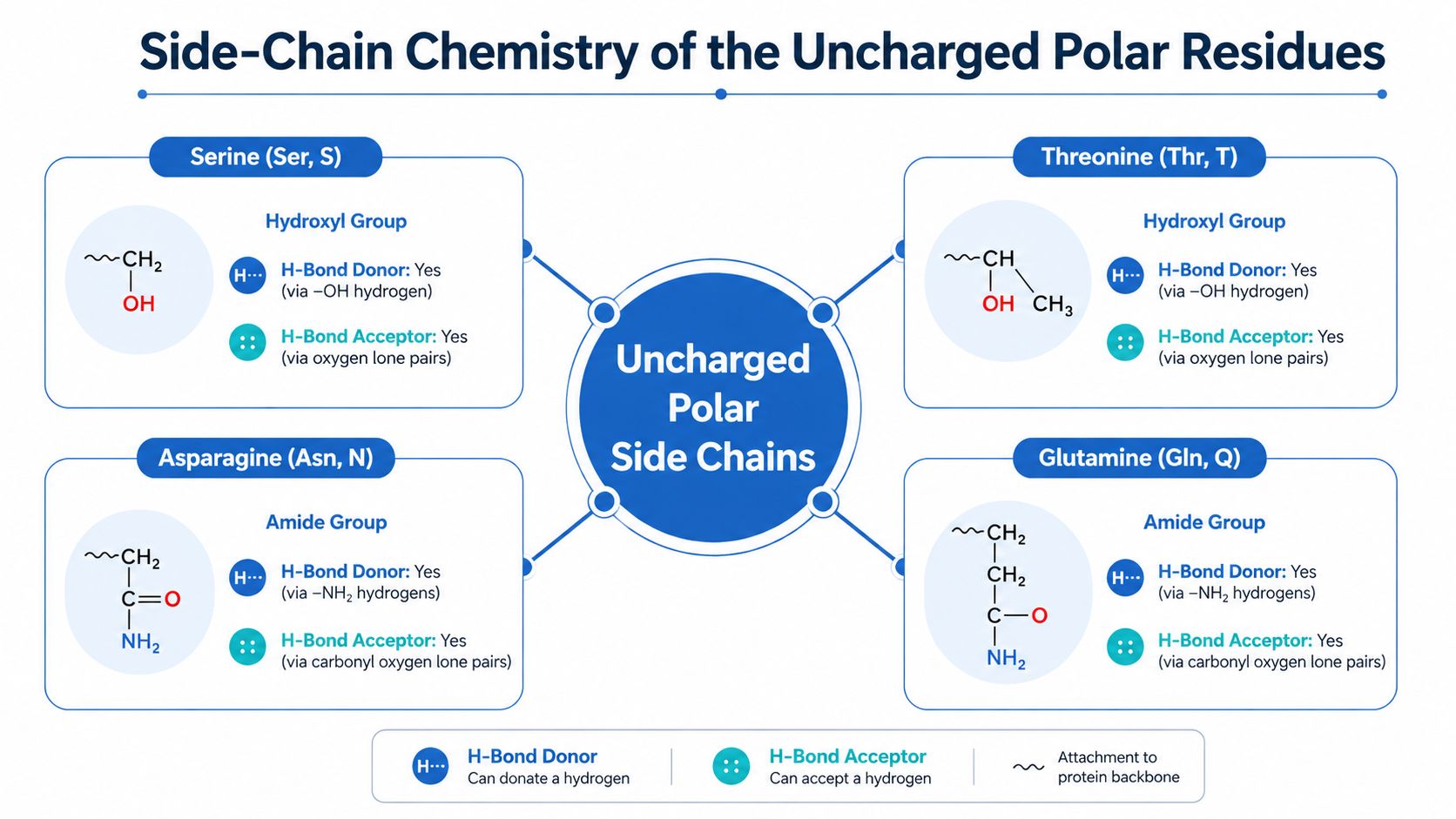
Serine, threonine, asparagine, and glutamine provide a useful laboratory set because each is neutral under many common conditions while retaining clear hydrogen-bonding functionality. Their side chains don't merely make a peptide “water-loving.” They create specific geometric contacts that can influence turns, helix boundaries, strand alignment, and active-site organization.
Hydroxyl-containing side chains
Serine has a short side chain ending in a hydroxyl group. The hydroxyl oxygen can accept a hydrogen bond, while the attached hydrogen can donate one. That dual behavior allows serine to interact with water, backbone atoms, neighboring side chains, and catalytic groups.
Threonine has the same hydroxyl functionality but also includes a methyl substituent. The methyl adds steric bulk and a hydrophobic component, so threonine isn't chemically identical to serine even though both are uncharged polar residues. In a beta turn or at a helix boundary, that difference can affect packing and side-chain orientation.
Serine and threonine can support local hydrogen-bond networks at secondary-structure edges. Their hydroxyl groups may contact backbone carbonyls or amide hydrogens, helping stabilize geometries where a regular secondary-structure pattern begins or changes.
Amide-containing side chains
Asparagine and glutamine contain amide groups. The carbonyl oxygen acts as a hydrogen-bond acceptor, while the amide nitrogen can donate hydrogen bonds. The amide nitrogen isn't generally an effective acceptor because its electron pair is delocalized into the carbonyl system.
Asparagine has the shorter side chain, while glutamine adds one methylene group. That extra length gives glutamine greater reach and conformational flexibility, which can change whether it contacts the backbone, another side chain, or solvent.
These residues often contribute to beta-turn stabilization, helix capping, and inter-strand hydrogen-bond bridges. The laboratory amino-acid reference from Colorado State University describes serine, threonine, glutamine, and asparagine as neutral polar residues whose side chains can form multiple hydrogen bonds and frequently orient toward aqueous environments.
The structural lesson is direct. Hydrogen-bond geometry matters as much as polarity classification. A serine hydroxyl or glutamine amide can stabilize a precise local arrangement only when its donor and acceptor groups align with suitable partners.
Where Polar Residues Sit and What They Do in Folded Proteins
Folded globular proteins generally show a surface-to-core pattern. Polar and charged side chains tend to be enriched at solvent-exposed surfaces, where they can interact with water, while hydrophobic residues more often pack into the interior. This partitioning reflects the energetic cost of exposing nonpolar groups and the favorable hydration of polar or charged groups, as described in research on solvent accessibility and residue hydrophobicity.
The trend doesn't mean polar amino acids are surface-only. A buried polar side chain can be highly important when its hydrogen-bonding capacity offsets the energetic cost of removing it from solvent. Researchers often find conserved polar groups in protein cores because those residues create internal networks that support folding, catalysis, ligand recognition, or conformational control.
Surface exposure and internal exceptions
Serine, threonine, asparagine, and glutamine may orient toward solvent when their side-chain hydrogen bonds aren't satisfied internally. Inside a folded structure, however, the same residues can contact backbone atoms or other side chains. Tyrosine can combine aromatic packing with a hydroxyl-mediated hydrogen bond, making it particularly useful at interfaces between hydrophobic and polar regions.
A peer-reviewed analysis of conserved hydrogen bonds involving polar side chains shows that polar side chains can interact with main-chain atoms inside protein cores. Such contacts demonstrate that polarity is a structural design feature, not merely a solubility descriptor.
The requested distribution table below is best read qualitatively. The supplied evidence establishes surface enrichment and core partitioning, but it doesn't provide residue-specific frequency percentages. Reporting invented frequency values would make the table misleading.
| Residue | Surface Frequency (%) | Core Frequency (%) | Typical Structural Role |
|---|---|---|---|
| Serine | Not specified in the cited data | Not specified in the cited data | Hydrogen bonding, turns, helix boundaries |
| Threonine | Not specified in the cited data | Not specified in the cited data | Hydrogen bonding with added methyl-group packing |
| Asparagine | Not specified in the cited data | Not specified in the cited data | Side-chain amide networks, turns, active sites |
| Glutamine | Not specified in the cited data | Not specified in the cited data | Longer-range amide contacts and solvent interaction |
| Tyrosine | Not specified in the cited data | Not specified in the cited data | Aromatic packing plus hydroxyl hydrogen bonding |
A buried polar residue should therefore trigger a structural question, not an automatic annotation error. The relevant issue is whether its donors and acceptors have suitable partners and whether the resulting network supports the folded state.
Polarity and the Practical Side of Peptide Solubility
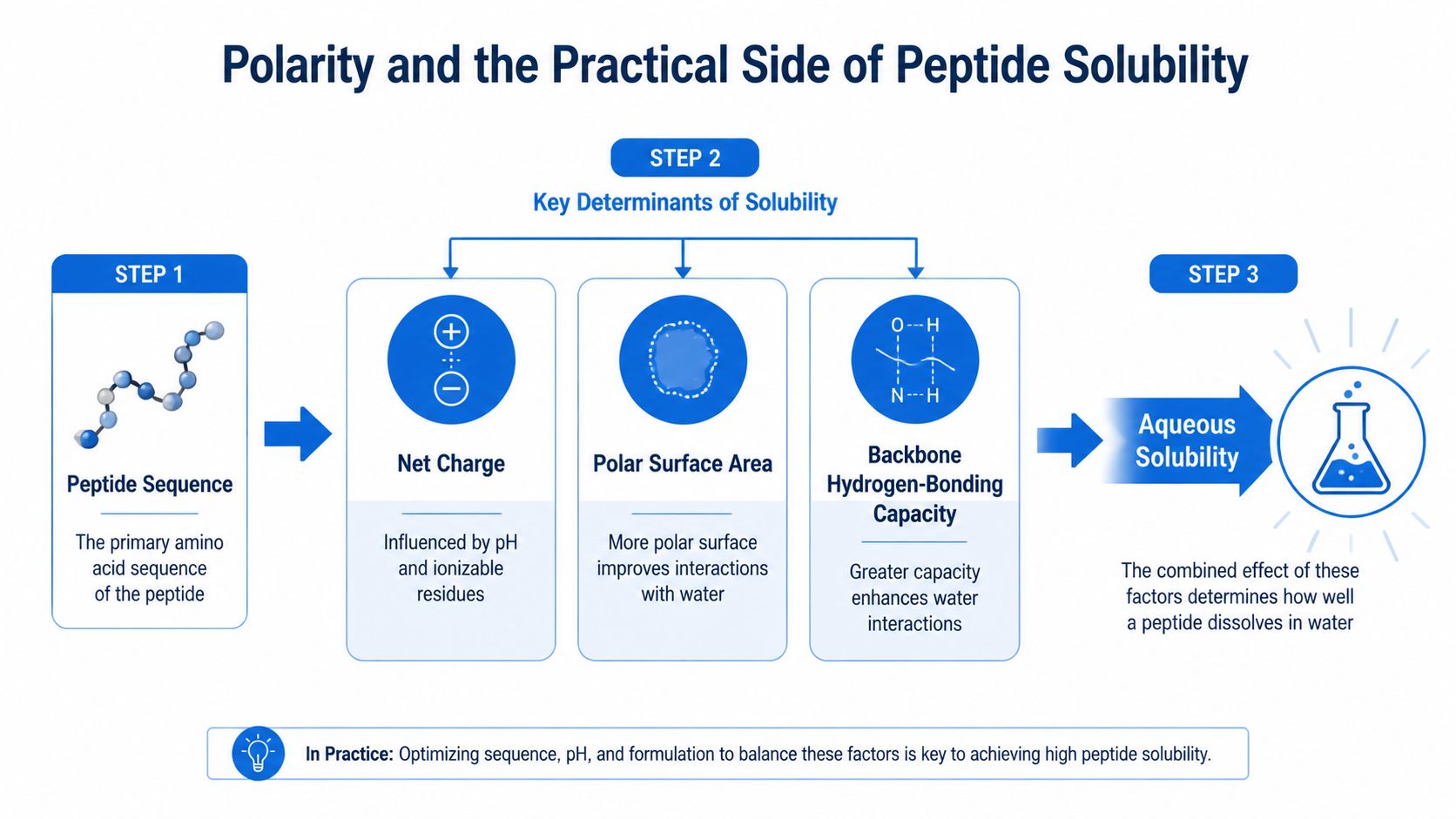
Peptide solubility in an aqueous laboratory buffer depends on more than the count of polar amino acids. Researchers need to consider net charge, polar surface area, backbone hydrogen-bonding capacity, sequence arrangement, pH, and aggregation tendency together.
Serine and threonine add hydroxyl groups. Asparagine and glutamine add amide donors and acceptors. Lysine, arginine, histidine, aspartate, and glutamate contribute ionizable groups whose charge state can dominate interactions with water. A peptide containing several neutral polar residues may still show limited solubility if a hydrophobic segment drives association, while a charged sequence may behave differently after a buffer adjustment.
A sample-preparation decision path
A practical laboratory assessment starts with the sequence. Researchers can then examine:
- Net charge: Estimate how ionizable residues behave at the selected buffer pH.
- Polar surface area: Consider whether side-chain groups are accessible or hidden within an aggregate.
- Hydrogen bonding: Evaluate both side-chain contacts and backbone interactions.
- Hydrophobic stretches: Flag sequences that may collapse or associate in water.
- Aggregation behavior: Monitor clarity, precipitation, and assay-to-assay consistency rather than assuming that a residue label predicts the result.
Peptides rich in glutamine or asparagine may form hydrogen-bonded beta-sheet assemblies under some conditions. Long hydrophobic stretches can also promote aggregation-prone conformations. These are formulation problems that require empirical testing, not a universal solvent prescription.
For laboratory sample preparation, researchers may compare acidic and basic diluents, evaluate chaotropes or co-solvents such as acetonitrile-water mixtures, and verify the expected concentration by UV absorbance at 280 nm for the target sequence. The absorbance step requires sequence-specific interpretation because aromatic residues, including tyrosine and tryptophan, contribute differently to the signal.
A formulation screen should record buffer composition, pH, solvent fraction, mixing order, temperature, appearance, and time-dependent changes. Those records help distinguish poor initial dissolution from later aggregation.
The following video offers an additional visual explanation related to peptide solubility and laboratory handling:
Sample-preparation note: Reconstitution conditions belong to the validated protocol for the specific peptide, formulation, and assay. A general polarity rule can't replace supplier documentation or an experimentally qualified method.
Beyond the Surface and Polarity in Transport and Modern Frameworks
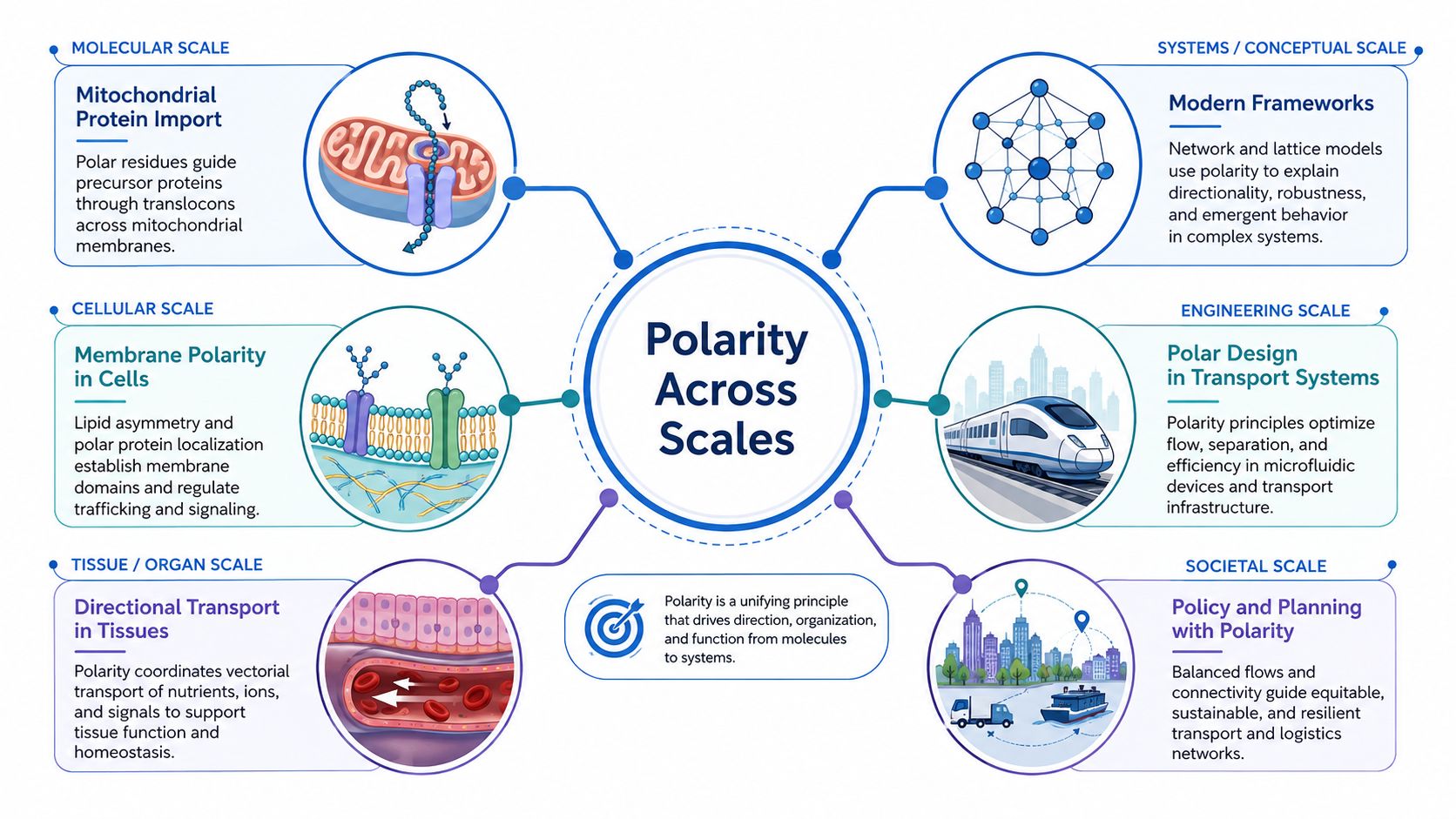
Polarity also matters beyond a folded protein's solvent-exposed surface. In cellular systems, polar neutral amino acids and related metabolites participate in transport processes, including mitochondrial trafficking. Recent work on sideroflexins describes mitochondrial transport involving polar neutral compounds such as serine-related metabolites, taurine, hypotaurine, beta-alanine, and GABA, expanding the discussion from protein folding to intracellular movement. The preprint on sideroflexin-associated mitochondrial transport also reflects a broader shift toward data-rich descriptions of amino-acid properties.
That perspective challenges the assumption that polar residues are only “outside” residues. A polar group can contribute to recognition during transport, define an interaction interface, participate in a membrane-adjacent environment, or remain buried within a functional protein core.
From binary labels to layered environments
Modern polarity frameworks increasingly treat the molecular environment as layered rather than binary. A residue may be considered in relation to:
- Atomic neighborhood, including hydrogen-bond partners and nearby charge.
- Folded-protein location, such as core, surface, or interface.
- Membrane proximity, where dielectric conditions differ from bulk water.
- Cellular compartment, where transport and modification alter the relevant context.
Researchers also need to account for chemical modification. Tyrosine phosphorylation changes the chemistry around its phenolic group. Serine hydroxyl modification alters its hydrogen-bonding and charge environment. Asparagine glycosylation attaches a larger carbohydrate structure that can transform solvent exposure and interaction patterns.
The result is a more useful research model. A residue shouldn't be assigned one permanent polarity identity and then treated as chemically finished. Its measured behavior emerges from side-chain functionality plus location, protonation, modification, and molecular partners.
For peptide researchers, this multi-scale view improves interpretation of sequence changes. Replacing serine with threonine preserves a hydroxyl group but changes steric volume. Replacing glutamine with asparagine preserves an amide but shortens the side chain. Those substitutions may retain broad polarity while changing geometry, reach, flexibility, and local packing.
Why Polarity Needs Context Rather Than a Yes or No Bucket
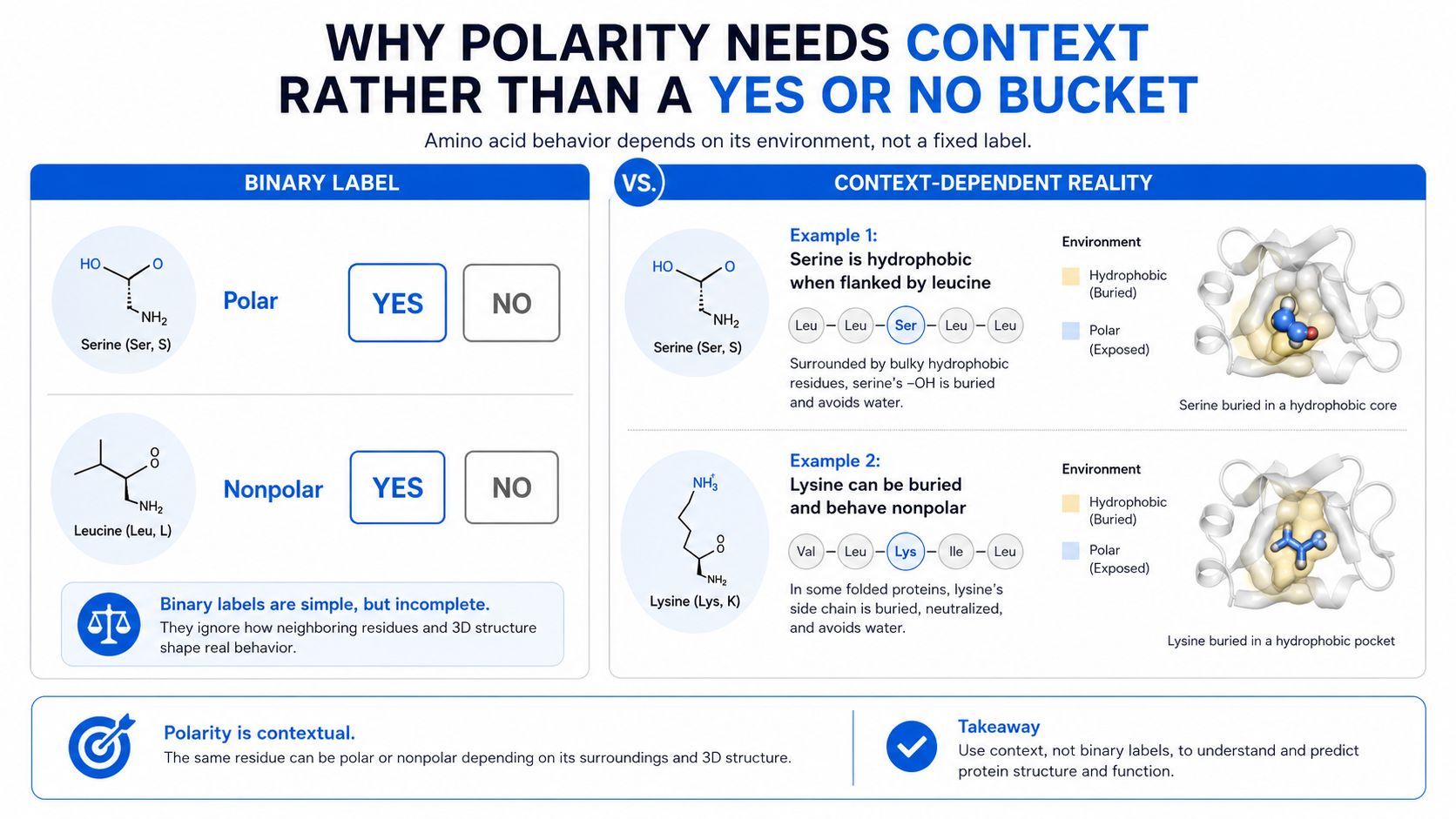
Could a residue remain chemically polar while behaving differently in a peptide? Yes. A binary polar-versus-nonpolar label helps organize teaching, but it compresses several properties into one bucket. Serine illustrates the problem. Its hydroxyl group can donate and accept hydrogen bonds, yet neighboring leucine residues may create a locally hydrophobic setting. The hydroxyl remains present; solvent exposure, packing, and nearby side chains change the observed behavior.
Histidine adds protonation to the analysis. Its imidazole group can shift charge near a pKa of about 6.0, so hydrogen bonding and electrostatic interactions depend on pH and local surroundings. An exposed histidine in an acidic solution can interact differently from one buried in a neutral or basic protein microenvironment.
Lysine combines two contrasting features. Its terminal amino group is strongly polar and often charged, while its long aliphatic segment contains hydrophobic character. That arrangement lets the side chain bridge different environments, with the charged end favoring solvent or acidic groups and the hydrocarbon portion fitting less polar regions.
A better interpretation model
For peptide sequence analysis, examine several overlapping scales:
- Which functional groups are present? Serine contributes a hydroxyl, whereas asparagine contributes an amide with a different donor and acceptor arrangement.
- What charge state is expected at the assay pH? Histidine, lysine, aspartate, and glutamate require a protonation check.
- Which residues surround the site? Leucine, isoleucine, valine, and aromatic residues can alter packing, spacing, and local solvent access.
- Where is the group located? An exposed side chain can contact water, while a buried or interfacial group may form selective internal or partner-mediated interactions.
A hydropathy plot summarizes broad sequence tendencies, but it does not replace structural analysis. Amino-acid classification uses multiple related scales, as described in the review of amino-acid scale classification. Researchers should therefore treat polarity as a set of partially overlapping measurements, including hydrogen bonding, charge, aromaticity, hydrophobicity, and accessibility.
A residue's label is an annotation. Its local environment is the mechanism.
The distinction affects mutation design, aggregation assessment, computational interpretation, and assay troubleshooting. Two sequences may contain similar numbers of polar residues yet differ in solubility or folding because charge distribution, side-chain spacing, and local packing place those residues in different chemical contexts. These distinctions guide choices about peptide sequence, buffer conditions, and formulation screening.
Key Takeaways for Peptide Research and Laboratory Work
Polar amino acids are best understood as a family of related side-chain chemistries, not as a uniform hydrophilic bucket. Serine and threonine use hydroxyl groups, asparagine and glutamine use amide groups, and charged residues rely heavily on protonation state and electrostatic interactions.
Three laboratory principles follow:
- Treat polarity as a gradient: Record hydrogen-bond donors, acceptors, ionizable groups, aromatic character, and hydrophobic segments rather than relying on one class label.
- Inspect local geometry: Uncharged polar residues can shape turns, helix boundaries, strand contacts, and internal hydrogen-bond networks.
- Evaluate the whole sequence: Solubility depends on net charge, polar surface area, backbone interactions, sequence context, and aggregation behavior.
Sample preparation should remain tied to the exact compound and assay. Researchers should consult sequence-specific documentation, test compatible laboratory conditions, and record observations such as dissolution, precipitation, clarity, and stability. Polarity analysis can guide formulation screening, but it doesn't replace validated protocol instructions or supplier-specific storage and handling information.
Pro Tec Pep provides research compounds with product-level information such as amino-acid sequences, formal names, formulation details, solubility guidance, storage information, and batch-linked documentation. Researchers evaluating synthetic peptides can visit Pro Tec Pep to review materials and documentation relevant to sequence-based laboratory investigations.
For laboratory research use only. Not for human or veterinary use. Not a drug, food, or cosmetic. Not evaluated by the FDA. Not intended to diagnose, treat, cure, or prevent any disease. By purchasing, you certify you are a qualified researcher and agree to use this product solely for in-vitro laboratory research.