Peptide Vial Storage Case Guide for Research Labs
Choose the right peptide vial storage case for cold-chain transit, freezer archives, and bench organization. Lab-focused guidance

A shipment arrives, the box is dry, the labels match, and the vials are still lyophilized. The question is what happens next, because the difference between a workable peptide vial storage case and a generic organizer shows up in that handoff from transit packing to bench storage. If the case slows heat ingress, protects closures, and keeps lot records straight, the material lands in the freezer or fridge ready for controlled work, not for damage control.
Why the Right Peptide Vial Storage Case Matters in the Lab
A receiving bench can look orderly and still be poorly managed. A courier handoff ends, the outer shipper is opened, and someone has to decide whether the vials go straight into archive storage, active refrigerator stock, or a temporary holding position while paperwork is checked. That is where a peptide vial storage case stops being “just a box” and becomes part of sample-management infrastructure.

The receiving problem is bigger than storage
The market already shows that this category is real and specialized, not a vague accessory bucket. One marketplace listing displayed 713+ items for “peptide vial storage case,” while product pages ranged from a 60-slot 3 mL vial holder to organizers that hold 200 to 300 vials in a single mega-organizer, with prices spanning roughly $10.39 to over $200 Etsy marketplace listing. That spread tells procurement teams something practical. Buyers are not choosing between identical boxes, they're choosing between different levels of capacity, protection, and workflow fit.
The important point is not novelty, it's function. Specialized cases now target fridge, freezer, and travel use, which means they've moved beyond simple bench storage and into cold-chain handling and collection management Etsy marketplace listing. In a lab, that matters because the case often becomes the first physical control point after receipt. It's where vials are sorted, matched to paperwork, and positioned for the next storage step.
The trade-offs show up immediately
A small case is easy to move and easy to fit in limited freezer space, but it fills fast. A larger organizer creates breathing room for growth, but it can become a dead volume problem if the layout doesn't match current inventory. The best choice depends on whether the lab is building short-term bench access, long-term archive stock, or a transit-ready handoff station.
Practical rule: if a case makes receiving slower, it usually costs more in workflow friction than it saves in convenience.
The rest of the buying decision sits in three tensions, insulation versus access, capacity versus footprint, and convenience versus container-closure integrity. If those aren't balanced, the case may look organized while weakening reproducibility, audit readiness, and sample condition before any assay starts.
Thermal Buffering and Mechanical Protection Explained
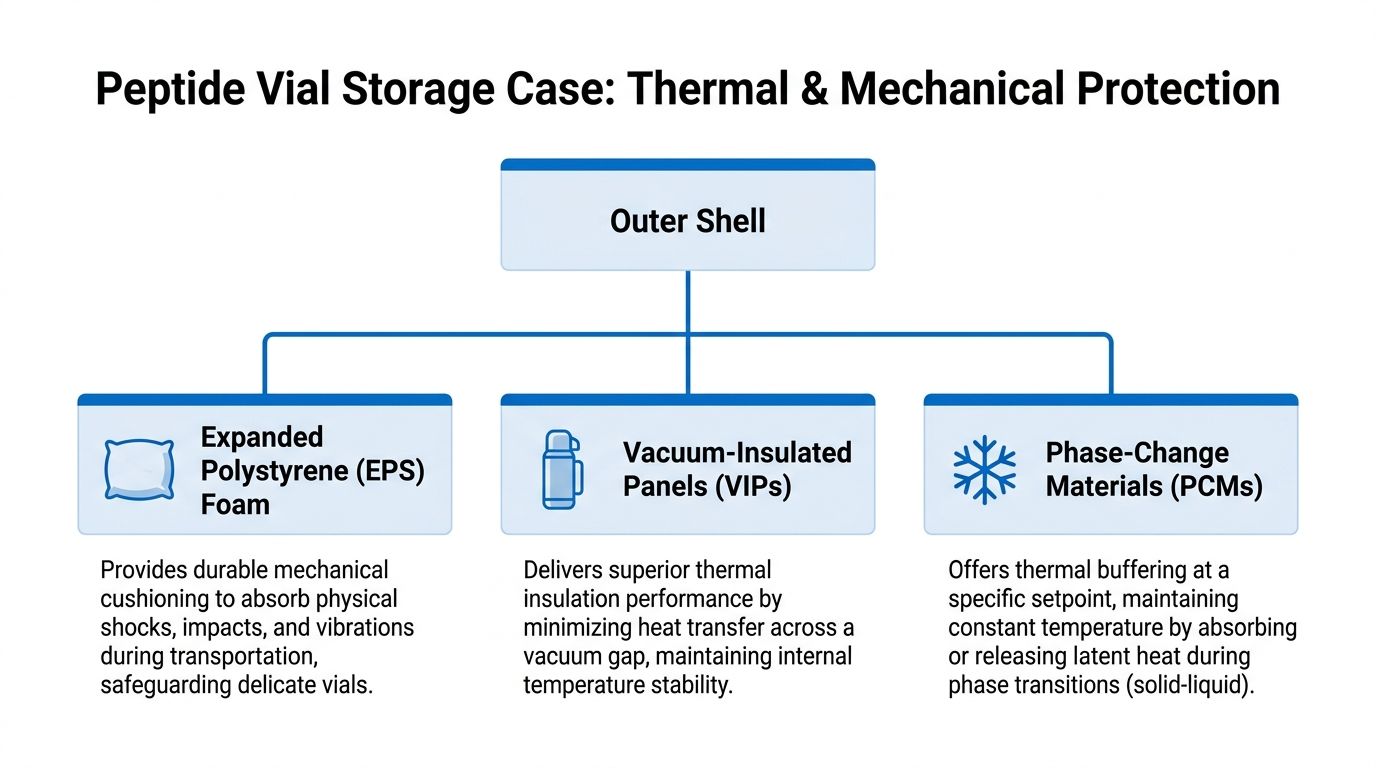
A credible peptide vial storage case does two jobs at once. It buffers temperature enough to buy time during transit, and it protects glass vials from the mechanical damage that comes with movement, vibration, and drops. If either side is weak, the case turns into decorative packaging rather than sample protection.
What real thermal buffering looks like
Insulated containers built with expanded polystyrene foam, vacuum-insulated panels, or phase-change materials are designed to keep contents in the 2–8°C cold-chain range during transit cold-chain shipping guidance. Practical performance is often described at roughly 48–96 hours, depending on ambient conditions and package design cold-chain shipping guidance. That window matters because lyophilized peptides can tolerate brief room-temperature exposure, but once temperatures drift outside the stable transit envelope, the risk of oxidation, moisture uptake, and potency drift rises.
That's why vendor copy that only says “insulated” is too vague for procurement. A real evaluation asks what material is doing the work, how the shell resists heat ingress, and whether the design is meant for short transfer or extended cold retention. A case that only delays warming for a short period may still be useful for an internal move from receiving to freezer, but it's not the same as a validated transit container.
Mechanical protection is not optional
The second half of the design is structural. Laboratory guidance describes vial cases as rigid-shell-plus-foam systems that prevent glass-to-glass contact and absorb shock from drops and vibration packaging guidance. Precision-cut inserts or molded cradles keep each vial isolated, which lowers breakage risk and protects seals. That matters because a cracked vial, a disturbed stopper, or a compromised cap can break the moisture barrier even if the contents never left the cold chain.
Desiccant and sealed secondary packaging belong inside the case, not as an afterthought packaging guidance. Humidity cycling during transport or bench handling can degrade quality even when the vial remains physically intact. For procurement, the useful question is simple. Does the case defend both temperature and closure condition, or only the outside surface of the glass?
Matching Case Design to Freezer, Fridge, and Transit Workflows
Different storage states call for different case behavior. A freezer-reserve vial that stays dry and dark at about -20°C belongs in a different workflow from reconstituted material held at 2–8°C, and neither should be treated the same way as a vial that's moving between buildings peptide storage guidance. The best peptide vial storage case is the one matched to dwell time and access frequency, not the one with the broadest catalog description.
Three workflows, three design priorities
| Workflow | Typical Temperature Band | Vial State | Case Priorities |
|---|---|---|---|
| Freezer archive | About -20°C for long-term peptide storage | Lyophilized, dry, dark storage | Tight fit, low-access layout, freezer compatibility |
| Active fridge stock | 2–8°C for refrigerated handling | Reconstituted or ready-to-access material | Fast retrieval, upright organization, short open-close time |
| Transit | Validated cold-chain band, often 2–8°C for refrigerated shipments | Material moving between controlled spaces | Thermal buffering, shock protection, seal security |
The practical point is that one universal organizer rarely serves all three roles well. A freezer archive case can prioritize dense organization because access is infrequent. A fridge-stock case needs faster picking and a layout that survives repeated open-close cycles. Transit cases need the strongest thermal and mechanical defense because they're the most exposed to temperature swings and handling stress.
Cold-chain expectations should stay realistic
Real-world sample transport doesn't sit in a perfect laboratory bubble. A public-health logistics report found laboratory sample transports averaged 3.9 °C, which is close to target but still variable enough to matter for sensitive materials sample transport report. That makes a simple rule useful, the more uncertain the route, the more the case has to compensate.
Useful distinction: archive cases protect inventory, fridge cases protect access, and transit cases protect the move.
The most common failure is trying to make one case do all three jobs at once. That usually creates clutter, longer door-open times, and a higher chance of handling errors. A tiered system is cleaner, freezer-reserve stock in one case type, active fridge stock in another, and a separate transit-oriented case for shipping or site transfers.
Sizing, Capacity, and Packaging Standards for Research Vials
Fit comes before branding. If the foam wells don't support the vial shoulder correctly, the closure takes unnecessary stress and the case becomes a pinch point instead of a support system. Standard lab practice still centers on 1.5 mL and 2 mL vial formats, and a 2025 purchasing guide notes that many labs standardize on 2 mL vials that are about 12 mm in outer diameter vial storage guide.
Start with vial geometry, not case volume
The key design point in foam insertion is shoulder support. A well-made case uses foam wells sized to hold the vial without stressing the cap, which lowers movement without transferring force into the closure vial storage guide. That same guide recommends a case 20 to 30% larger than current needs so the lab has room for future growth vial storage guide.
Peptide-oriented vendors have already moved beyond the older small-vial norm and now market cases for 3 mL, 5 mL, and 10 mL formats vial storage guide. That matters for procurement because a case that fits the legacy 2 mL format might still be the wrong answer for current peptide packaging. The purchasing team should check both present inventory and the likely next two purchasing cycles.
Capacity numbers need context
Market listings also show how far the category has scaled. A 60-slot 3 mL vial holder supports a different workflow than a mega-organizer holding 200 to 300 vials Etsy marketplace listing. The first works for an active bench or project shelf. The second fits collection management, larger freezer stocks, or grouped lot tracking.
A good rule is to align capacity with handling frequency. Dense, high-count organizers make sense when access is infrequent and inventory control is the priority. Lower-density cases are easier to pull, scan, and restock when people are reaching into them every day.
Container-Closure Integrity Beyond the Foam Insert
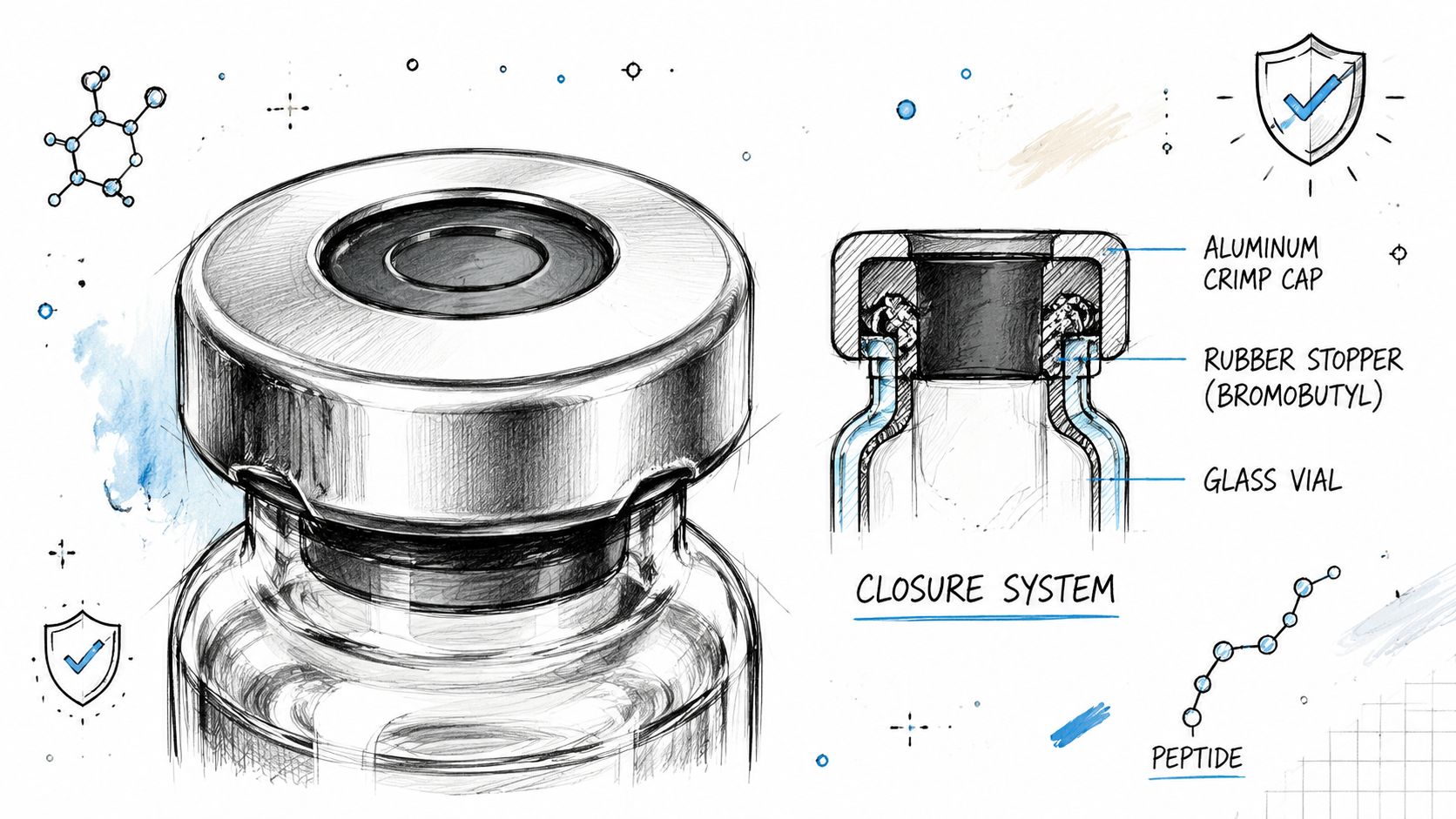
Temperature control is only one part of the risk profile. A vial can stay cold and still fail its job if the container-closure integrity is weak, because leakage, headspace changes, and seal failure undermine sample integrity even when the outer case performed well. That's why the right question is not just which case is sturdy, but which case preserves closure condition under real transit and storage conditions.
The closure system deserves the same attention as the shell
A 2025 cold-chain packaging paper argues that risk control has to include the vial closure system, primary packaging design, and qualification of sealing and assembly processes cold-chain packaging paper. That is a useful correction to the way many storage-case pages are written. They focus on upright slots and temperature targets, but they don't explain how stopper compatibility, pressure changes during transit, or repeated open-close cycles affect the vial itself.
The case interacts with that closure system every time a vial is removed or returned. If the organizer makes handling awkward, people spend more time working around the package. If the insert is too loose, movement increases. If the slot geometry encourages pressure on the cap, the risk shifts from convenience to integrity.
Vendor evaluation should ask different questions
Procurement teams get better answers when they ask about process, not just materials. The most defensible evaluation looks for evidence that the case works with qualified sealing and assembly practices, not just that the shell survived a drop test. That's especially relevant for research labs handling temperature-sensitive parenteral-style vials, where packaging performance is broader than “keep it cold” cold-chain packaging paper.
A strong case doesn't fix a weak closure system, but a weak case can expose a good one.
The practical takeaway is that repeated access and transit both create stress. A good case reduces those stressors instead of amplifying them. If the design makes the user fight the foam, the closure eventually pays the price.
Linking Storage Cases to Batch Verification and Receiving
The first time a vial touches the lab bench, it should also touch the documentation workflow. Batch-specific certificates of analysis, lot-number matching, and third-party testing belong in the same receiving motion as physical placement into a storage case, because the case is where lot reconciliation usually starts. A peptide vial storage case with clear slots, labeling discipline, and logical grouping helps prevent batch mixing before anyone opens a spreadsheet.
The physical and paper records have to match
A batch-specific CoA is tied to one identifiable production lot and normally includes a lot or batch number plus a date of analysis batch-specific CoA guide. Best-practice verification says the batch number on the vial should match the CoA exactly, and if it doesn't, the document should be treated as invalid for that specific batch batch-matched verification guide. That matching step is easier when the case layout keeps lots separated instead of letting them pool in one loose organizer.
A defensible batch-specific CoA for peptide materials should document identity confirmation, purity, residual solvent or TFA quantification, endotoxin testing, and an independent third-party signature third-party testing guide. That level of documentation only helps if the receiving process can connect the paper to the exact vial in hand. The storage case is the physical bridge.
Good organization lowers audit friction
Well-planned cases reduce the odds that a technician slides a new lot next to an older one by mistake. They also make audits less painful because the inventory state is visible at a glance. When the case is arranged by batch and purpose, the lab can tell the difference between freezer archive, active fridge stock, and transit-ready material without opening every vial.
Practical rule: if the case makes lot reconciliation hard, the case is failing a quality function, even if the foam looks premium.
The broader quality system depends on that simplicity. A case that supports clean receiving helps protect reproducibility, shortens the time between delivery and controlled storage, and lowers the odds that the wrong material gets pulled for the wrong work order.
A Practical Procurement and Receiving Checklist
The fastest way to buy the wrong peptide vial storage case is to start with price alone. A better process starts with the workflow, then moves to fit, protection, and documentation. That order keeps the case tied to actual lab operations instead of catalog language.
Procurement checklist
- Define the primary workflow. Decide whether the case is for freezer archive, active fridge stock, or transit. Each one has different demands on access speed, thermal buffering, and layout.
- Verify insulation and protection. Look for a rigid shell, foam or molded inserts, and a design that supports cold-chain handling instead of just bench organization.
- Match vial geometry. Check the common vial format first, then confirm the foam well supports the shoulder without stressing the cap.
- Plan for growth. A case sized with room beyond current inventory avoids rapid obsolescence and supports expansion into larger vial formats.
- Check closure compatibility. Ask how the design affects stopper stability, cap pressure, and repeated open-close cycles.
- Integrate paperwork into the case layout. Separate lots clearly so receiving staff can reconcile vials against batch-specific CoAs without mixing inventory.
A case should be rejected if it fails any of those core points. Weak insulation, poor fit, or confusing layout creates more risk than it removes. The best purchase is the one that makes the receiving bench calmer, not busier.
Pro Tec Pep supports research teams that need batch-verified materials, clear documentation, and cold-chain-aware fulfillment for laboratory workflows. If your lab is building a cleaner receiving process around vial integrity and lot control, visit Pro Tec Pep to review how its research-use-only sourcing and documentation practices fit that need.