Peptide Storage Temperature Guide for Laboratory Research
Master peptide storage temperature protocols for lyophilized and reconstituted samples. Learn stability timeframes, degradation factors, and best handling
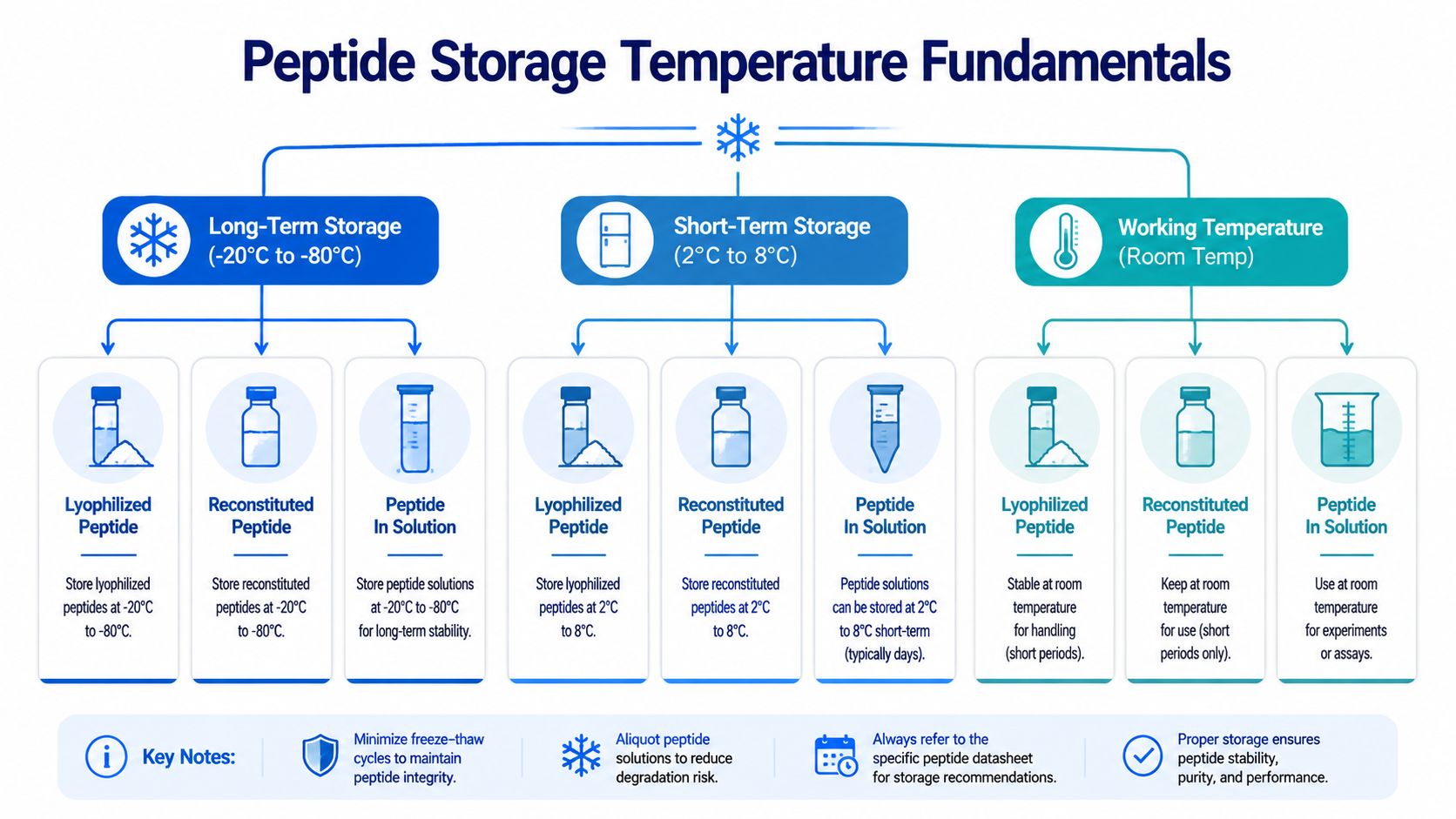
Lyophilized peptides are typically stored at −20°C for 12 to 24 months or −80°C for archival storage, while reconstituted solutions should be kept at 2°C to 8°C and used within 28 to 30 days to avoid degradation.
A new researcher opens a freezer and finds a vial that looked fine last month, but now the sample is clumped, cloudy, or just no longer behaves the same in assay. That kind of problem usually starts with peptide storage temperature, not with the assay itself. The fix begins with knowing whether the material is still dry powder, already reconstituted, or sitting in a working aliquot.
Understanding Peptide Storage Temperature Fundamentals
A common mistake in the lab is treating every peptide vial the same way. A lyophilized powder, a reconstituted stock, and a working aliquot all live under different stability rules, and those rules start with temperature. The safest storage plan depends on formulation state first, then on the temperature range that matches that state.
Start with the physical form
Dry peptide in a sealed vial behaves very differently from peptide already dissolved in water or buffer. The comparative storage study that tested room temperature, 4°C, −20°C, and −80°C across dried, re-suspended in ultra-pure water, and re-suspended in 0.1% TFA conditions for eight weeks found that 0.1% TFA at 4°C to −80°C slowed degradation the most (PMC study). That result matters because it shows the sample's solvent and dryness state can change the outcome just as much as temperature does.
Practical rule: start by asking whether the peptide is dry, reconstituted, or already split into working aliquots. That single check prevents most storage errors.
For lyophilized material, consensus guidance in the literature points to −20°C to −80°C for long-term storage, with −80°C offering the lowest molecular mobility and the strongest archival margin (Zurich Biotech guidance). For peptides in solution, the practical pattern shifts toward 2°C to 8°C for short-term holding, while repeated freeze-thaw cycling should be avoided because it drives degradation and purity loss (Sigma-Aldrich handling guide).
Match temperature to storage horizon
The best temperature depends on how long the vial needs to remain untouched. Lyophilized peptides meant for long-term use are commonly held at −20°C to −80°C, and independent guidance describes −20°C as the default condition for peptides not needed within a few weeks (FormBlends guide). That same operational logic makes −20°C the workhorse setting in many labs, while −80°C is reserved for higher-confidence archival storage and more fragile sequences (Peptide California).
Room temperature has a narrow role. Short exposure during handling or transfer can be acceptable for lyophilized material, but sustained ambient storage increases degradation risk and shouldn't be treated as a routine condition (Durham Peptides storage guide). The principle is simple, lower temperature slows chemical change, and that includes hydrolysis, oxidation, and deamidation.
Degradation Mechanisms That Temperature Controls
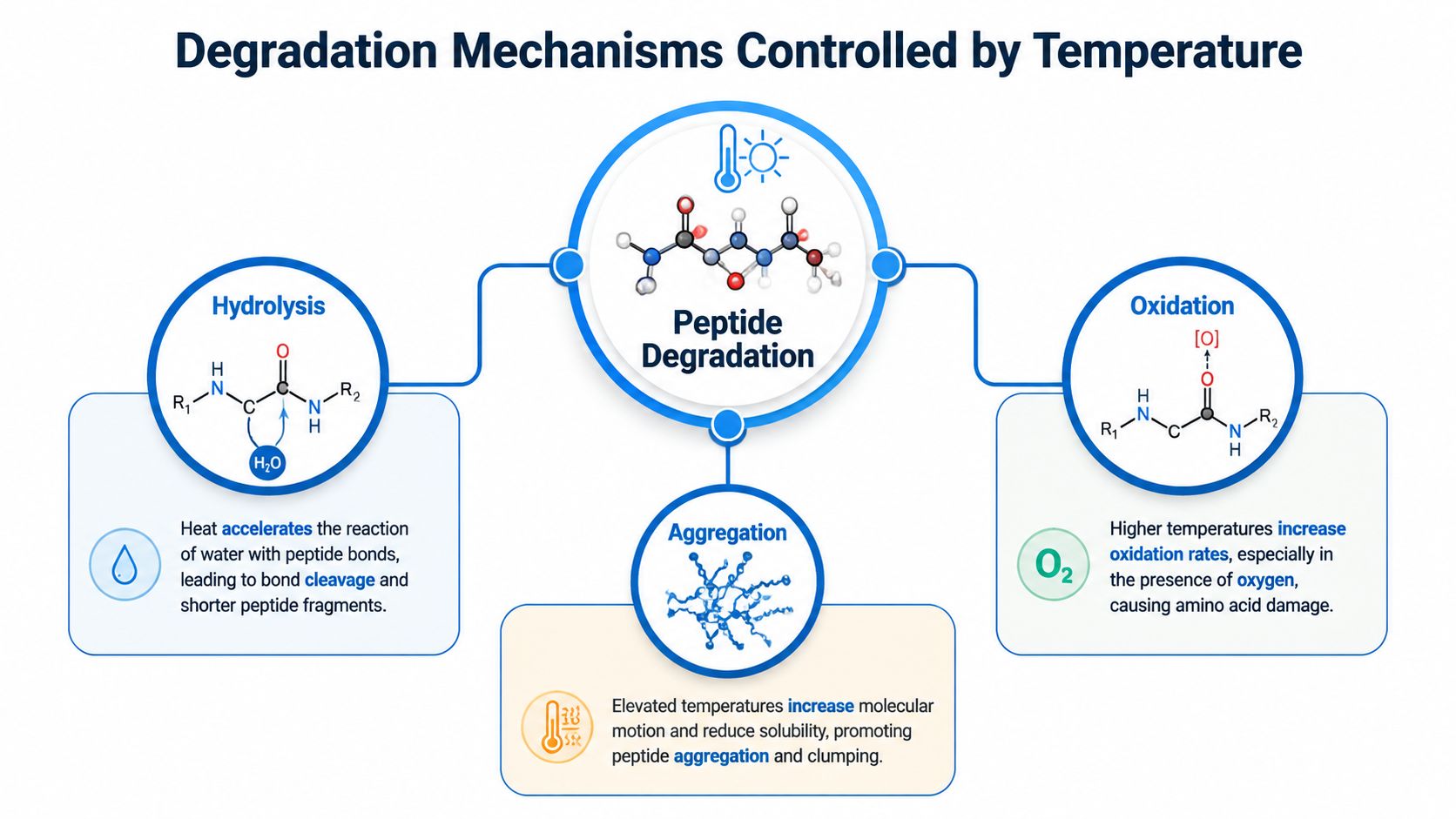
Temperature isn't just about keeping a vial cold. It changes the speed of the chemical reactions that slowly erode a peptide's identity and purity. In practice, the main threats are hydrolysis, oxidation, and deamidation, and all three become more troublesome as storage conditions move away from cold, stable, and dry.
Hydrolysis, oxidation, and deamidation
Hydrolysis is the clearest reason dry storage beats solution storage. Once a peptide is dissolved, water can participate in reactions that gradually break or alter the molecule, especially if the sample sits for too long at a warmer temperature. That's why solution-phase material is treated as much more time-sensitive than lyophilized powder in routine laboratory workflows (Durham Peptides storage guide).
Oxidation is another concern, particularly for sequences containing residues that are chemically sensitive to oxygen and environmental exposure. The same source notes that light and repeated handling can also worsen instability, which is why packaging, container choice, and freezer discipline matter alongside the temperature setting. The message for bench work is blunt, cold helps, but it doesn't fully compensate for poor handling.
Deamidation can be slower than the other two pathways, but it still matters over routine storage windows. The Zurich Biotech guidance states that at −20°C, practical stability is typically 12 to 24 months for most research peptides, although susceptible sequences can show measurable deamidation within that period (Zurich Biotech guidance). That makes sequence awareness part of storage planning, not just an analytical detail.
Why lower temperatures still win
The strongest benchmark in the available guidance is −80°C, where molecular mobility is described as near zero and well-formulated preparations can remain stable for several years (Zurich Biotech guidance). That doesn't mean every vial needs the coldest freezer available. It does mean that if a sequence is especially labile, or if a sample needs to serve as archive stock, −80°C is the safer choice.
Cold slows the chemistry, but it doesn't erase the chemistry. The sample's form, solvent, and packaging still decide how much protection that cold actually delivers.
The comparative study also supports that idea by showing the same peptide material behaved differently across dried, water, and 0.1% TFA conditions over a defined 56-day window (PMC study). That matters because routine lab storage isn't just about setting a freezer dial, it's about understanding which preparation state the vial is in.
Lyophilized Versus Reconstituted Peptide Storage Protocols
Dry peptide and reconstituted peptide belong in different storage lanes. The biggest operational mistake is moving a dissolved sample back into the same storage logic as the original powder. Once the material is in solution, the practical window narrows and the handling rules get stricter.
Dry powder can stay cold for the long haul
Lyophilized peptides are usually the easiest form to manage because the absence of water slows the reactions that degrade the molecule. Guidance from multiple sources converges on −20°C as the standard long-term setting for unopened or sealed dry material, with −80°C used when the goal is archival protection or extra margin for labile sequences (Sigma-Aldrich, Peptide California). One reference guide describes a typical shelf life of 2 to 5 years in a sealed vial protected from moisture and light (Path to Peptides).
Reconstituted material needs tighter control
Once a peptide is reconstituted, the stable window gets much shorter. Practical handling guidance commonly keeps reconstituted peptides at 2°C to 8°C and treats them as materials to be used within about 28 to 30 days (FormBlends guide). That pattern makes sense because solution-phase peptide is more vulnerable to hydrolysis, oxidation, and aggregation than the same peptide in dry form.
| Peptide State | Storage Temperature | Stability Timeframe | Notes |
|---|---|---|---|
| Lyophilized peptide | −20°C | 12 to 24 months | Common operational standard for long-term storage; sealed and desiccated conditions help protect integrity (Zurich Biotech, Peptide California) |
| Lyophilized peptide | −80°C | Several years | Best for archival storage and particularly labile sequences (Zurich Biotech) |
| Reconstituted peptide | 2°C to 8°C | About 28 to 30 days | Short-term refrigerated holding is the usual benchmark (FormBlends guide) |
| Reconstituted peptide | Frozen storage | Not the default choice | Freezing can help only in specific aliquoted workflows, and repeated freeze-thaw cycling should be avoided (Sigma-Aldrich) |
Short room temperature exposure has a narrow role
Brief ambient handling is not the same as ambient storage. A vial being weighed, opened, or transferred for a short period may tolerate that exposure, but that doesn't justify leaving solution-phase material out on the bench. The same storage guide notes that sustained ambient conditions accelerate degradation substantially, while brief exposure over hours is far less concerning for lyophilized material (Durham Peptides storage guide).
Aliquoting Strategies to Prevent Freeze-Thaw Damage
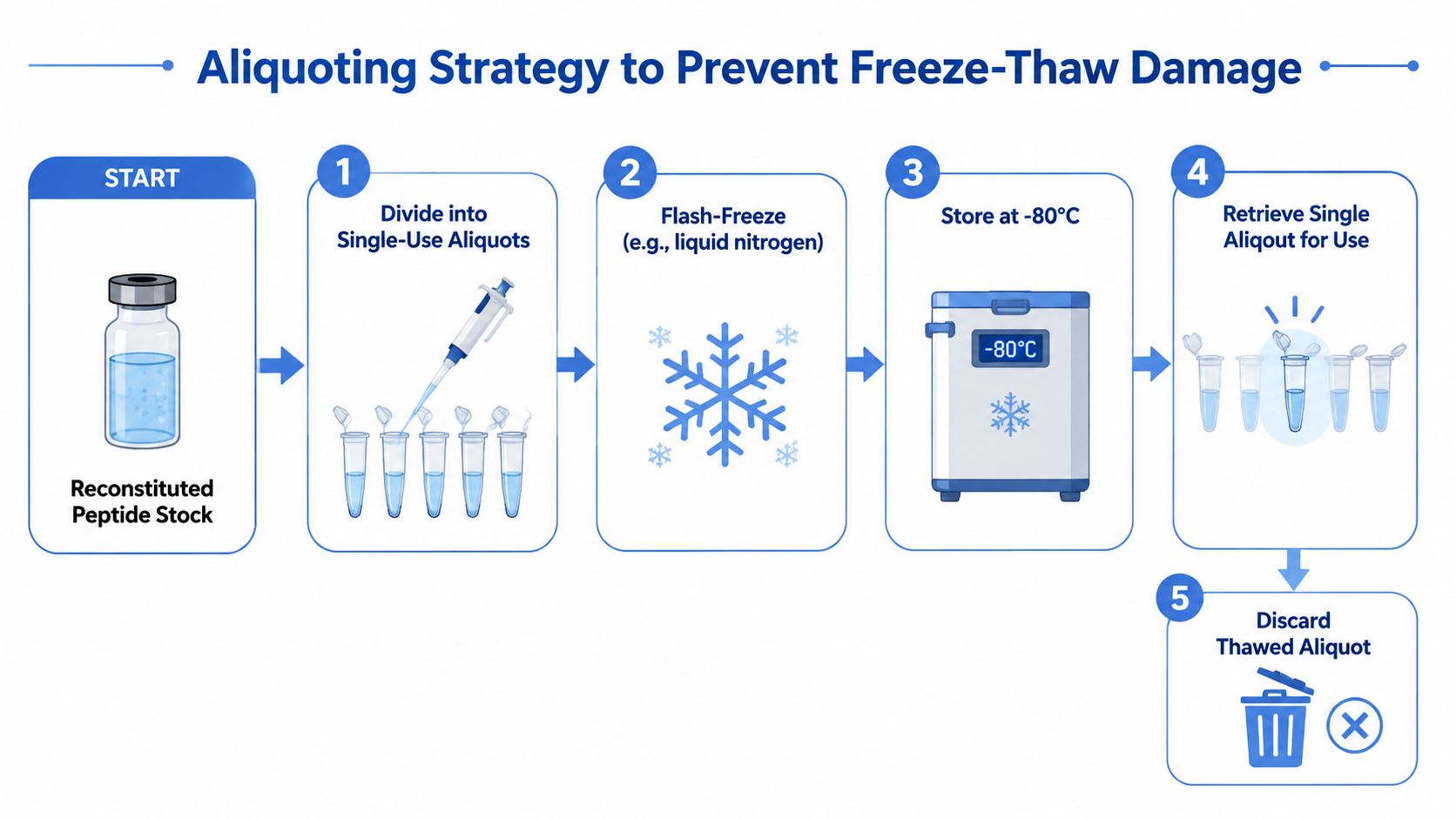
A thawed stock vial is where many storage plans unravel. Each freeze-thaw cycle adds stress, and the damage isn't just theoretical. Repeated cycling increases denaturation and aggregation risk, which is why lab teams should split material into single-use portions before freezing whenever later access is expected.
The safest approach is straightforward. After reconstitution, divide the stock into single-use aliquots, label each one clearly with identity, concentration, date, and buffer, and freeze only the portions that won't be needed immediately. That way, the thawed material is used once instead of being opened, warmed, refrozen, and opened again.
Working rule: if a vial will be accessed more than once, it probably should've been aliquoted before the first freeze.
Build aliquots around the assay, not around convenience
Aliquot volume should match the smallest practical working need in the lab. A stock that repeatedly gets split by eye usually ends up with unnecessary leftovers, and leftovers are what tempt people to refreeze material. Single-use portions reduce that pressure and preserve potency better than repeated opening of the same vial (FormBlends guide).
The freezer location matters too. Keep aliquots in a stable interior position, not in a door bin that swings through temperature changes every time the door opens. The Durham guidance also warns against storing material in temperature-unstable zones and against untracked inventory, because once receipt date and lot identity are lost, the condition of the sample becomes harder to judge (Durham Peptides storage guide).
Discard the thawed aliquot after planned retrieval
A thawed aliquot should be treated as a working portion, not as a refillable stock bottle. Re-freezing the same sample invites cumulative stress from ice crystal formation, concentration shifts, and pH changes during thawing. That's why a disciplined aliquot-and-discard workflow is usually better than trying to save every last microliter.
The decision is simple in practice. If the sample is likely to be used more than once, freeze smaller portions. If it's already thawed, finish that portion and retire it.
Video support for this workflow can be reviewed here:
Buffer Chemistry and Formulation Effects on Stability
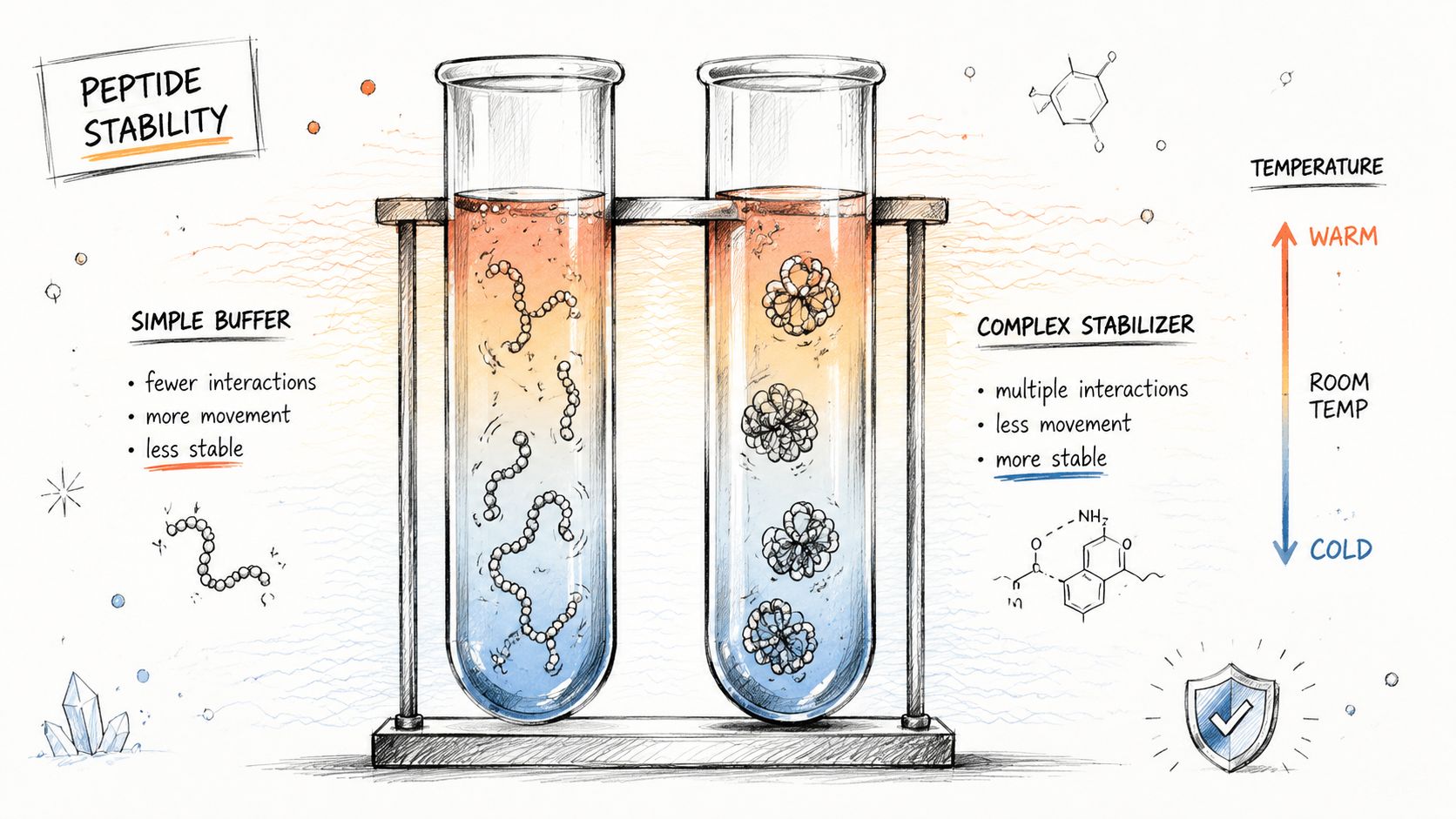
A freezer won't rescue a weak formulation. The same peptide can behave differently depending on whether it's dry, in water, or in a buffer that changes how fast degradation starts. That's why temperature and formulation have to be read together, not as separate decisions.
Solvent choice changes the outcome
The comparative peptide-storage study tested four temperatures across three storage conditions, and found that 0.1% TFA slowed degradation the most from 4°C to −80°C (PMC study). That result is useful because it shows solvent chemistry can materially change stability, even when the temperature range stays the same.
In other words, a peptide isn't protected by cold alone. Dryness, reconstitution solvent, and storage chemistry all contribute to how long a sample remains analytically useful. That's why generic advice like “store cold” can be too vague to support serious laboratory work.
Why labs need a formulation-aware decision
Some peptides go into simple aqueous solutions for short-term work. Others need a buffer condition that slows degradation or supports the assay design. The point isn't to chase one universal solvent, it's to document the one that matches the molecule and the experimental timeline.
Best practice: choose the storage format first, then match the buffer to that format. Reversing that order often leads to avoidable loss of integrity.
The literature-based guidance also converges on the same broad split. Lyophilized peptides are commonly kept at −20°C for long-term use, while solutions are usually held at 2°C to 8°C and should avoid repeated freeze-thaw cycles (Sigma-Aldrich, FormBlends guide). That split reflects chemistry, not convenience.
Cold-Chain Shipping and Receiving Quality Checks
A shipment can arrive well-packed and still deserve a full inspection. Receiving is where a lot of later trouble gets prevented, because a vial that was compromised in transit should be documented before it gets blended into the rest of the freezer inventory. The first pass should be visual, procedural, and fast.
Check the shipment before the sample goes into storage
Start with the outside package. Look for signs that the cold chain was interrupted, such as damaged packaging, wet insulation, loose caps, or anything else that suggests the vial moved around during transit. Then inspect the vial itself for seal integrity, cracks, cloudiness, or unexpected clumping, and record the batch or lot number immediately.
Batch-specific documentation matters because the exact lot is the only lot that matters for that experiment. Pro Tec Pep's product-level documentation approach reflects this larger research norm, where batch-linked Certificates of Analysis help verify identity and purity for the exact material received. That kind of paper trail is especially important when the sample will sit in storage before the first assay.
Document deviations instead of guessing
If the package arrives warm, delayed, or visibly compromised, document the condition before making a storage decision. The note should include the carrier, the date, the time received, the appearance of the packaging, and any visible change to the vial or contents. That record helps with replacement requests and keeps the receiving log honest.
The same logic applies to cold-chain shipping services. Optional cold-chain handling helps reduce risk for temperature-sensitive materials in transit, and rapid order processing shortens the time the sample spends outside stable storage. Those logistics don't replace good receiving checks, they support them.
Receiving standard: if the vial looks unusual, pause and log the issue first. Storage should follow documentation, not guesswork.
A final check should confirm the material matches the purchase order and the product documentation. If anything doesn't line up, the safest move is to hold the vial separately until the discrepancy is resolved.
Common Storage Misconceptions and How to Avoid Them
The most common storage errors come from oversimplified advice. Many researchers hear “store cold” and assume that sentence covers every peptide in every form. It doesn't, and that's why confusion around frozen reconstituted samples keeps coming up.
Freezing isn't automatically the answer
Whether a reconstituted peptide can be frozen has a nuanced answer. Public guidance is often inconsistent, but reference-style sources converge on a split, lyophilized peptides are typically stored at −20°C for long-term use, while reconstituted solutions are usually kept at 2°C to 8°C and should avoid repeated freeze-thaw cycles because each cycle can increase denaturation or aggregation risk (MypeptideBible protocol, Sigma-Aldrich). Freezing can help in an aliquoted workflow, but it can also harm if the same vial gets cycled repeatedly.
A decision tree beats vague instructions
The cleanest decision tree separates powder, first-thaw stock, and working aliquots. Powder usually goes back to −20°C or −80°C, first-thaw stock is managed as a short-lived refrigerated or aliquoted working material, and working aliquots are opened once and then retired after use. That structure prevents the lab from treating all peptide containers like interchangeable inventory.
Vague storage notes like “keep cold” are risky because they leave out the state of the sample, the buffer chemistry, and the expected holding time. The result is predictable, one person stores a dry vial correctly, another stores a dissolved vial the same way, and the second sample loses integrity faster than expected. A more precise protocol avoids that mismatch.
Store the sample for what it is, not for what the label shorthand suggests.
For labs managing multiple peptide formats, the takeaway is simple. Write the storage rule for the actual state in the vial, then train everyone to follow that rule the same way every time.
Pro Tec Pep supports research teams that need batch-verified materials, clear documentation, and logistics built around sample integrity. For labs tightening their peptide storage temperature workflow, Pro Tec Pep can help provide the product-level details, COAs, and cold-chain handling that make storage decisions easier to document and defend.