Peptide Research Supply: A Lab Buyer's Sourcing Guide
Navigate peptide research supply with confidence. Learn supplier due diligence, COA verification, purity testing, cold-chain logistics, and RUO compliance
The popular advice is simple: choose the peptide research supplier with the highest purity number and the lowest price. That shortcut fails in real laboratory procurement. A material can arrive with an impressive specification and still create problems if the certificate doesn't match the lot, the identity method isn't shown, the testing laboratory isn't named, or temperature exposure during transit isn't documented.
Research-grade sourcing is therefore a verification and logistics decision, not a catalog comparison. The practical question is whether a supplier can provide enough evidence for assay development, quality-control review, inventory traceability, and an institutional audit. Purity matters, but it has to sit inside a wider evidence package.
Why Purity Claims Alone Are Not Enough
A headline purity value answers only one question: how much of the tested material met the supplier's stated purity criterion under a particular method. It doesn't, by itself, establish that the vial received by a laboratory is the same batch that was tested, that the labeled sequence is correct, or that contaminants relevant to the planned assay were assessed.
That distinction matters because purity is method-dependent. HPLC can indicate chromatographic purity, while mass spectrometry can support molecular identity. Neither result replaces the other. A product page that displays a percentage but omits the method, testing date, laboratory identity, and lot number leaves the buyer with a marketing statement rather than a complete quality record. Guidance for research-peptide buyers specifically emphasizes exact-lot documentation, HPLC and mass-spectrometry evidence, testing-laboratory identification, and microbial or endotoxin reporting when relevant in the research peptide third-party testing guide.
What a strong claim has to prove
A procurement team should ask whether the evidence connects four things:
- The material: The product name, sequence or formal identity, formulation, and net content should describe what the laboratory ordered.
- The batch: The lot number on the vial, packing record, and COA should match exactly.
- The method: The document should identify how purity and identity were assessed, rather than presenting an unexplained result.
- The risk profile: The testing package should address contaminants that could affect the planned work, including endotoxins, microbial concerns, or heavy metals where relevant.
Generic certificates create a particularly difficult failure point. A supplier may provide a document for a representative batch, an old production run, or a product family rather than the exact lot shipped. That document can look polished while offering no defensible evidence about the received material.
Practical rule: A purity number without a matching lot, named method, and identifiable testing record is a starting point for questions, not a release decision.
The research workflow determines how much documentation is necessary. An analytical chemistry group may focus first on identity, purity, and net content. A cell-culture project may require closer attention to endotoxin and microbial reporting. A CRO supporting regulated or sponsor-reviewed work needs a record that another reviewer can inspect without relying on informal supplier explanations.
Price also deserves careful treatment. High production cost and purification complexity remain recognized constraints in peptide supply, so a low quote may reflect a narrower testing package, a different material specification, or weaker logistics rather than purchasing efficiency. The strongest buyer evaluates the total evidence package, including the records needed after the shipment arrives.
The Evolution of Peptide Synthesis and Supply Chains
Modern peptide research supply rests on a manufacturing breakthrough that changed how laboratories could obtain complex sequences. Bruce Merrifield introduced solid-phase peptide synthesis in 1963, creating a method in which the growing chain remains attached to a solid support during assembly. Historical accounts describe early protein-synthesis work that required 369 chemical reactions and 11 separate purifications, illustrating why the solid-phase approach improved efficiency and scalability for research-peptide production. Merrifield's contribution was later recognized with the 1984 Nobel Prize in Chemistry, as documented in this history of peptide synthesis and market overview.
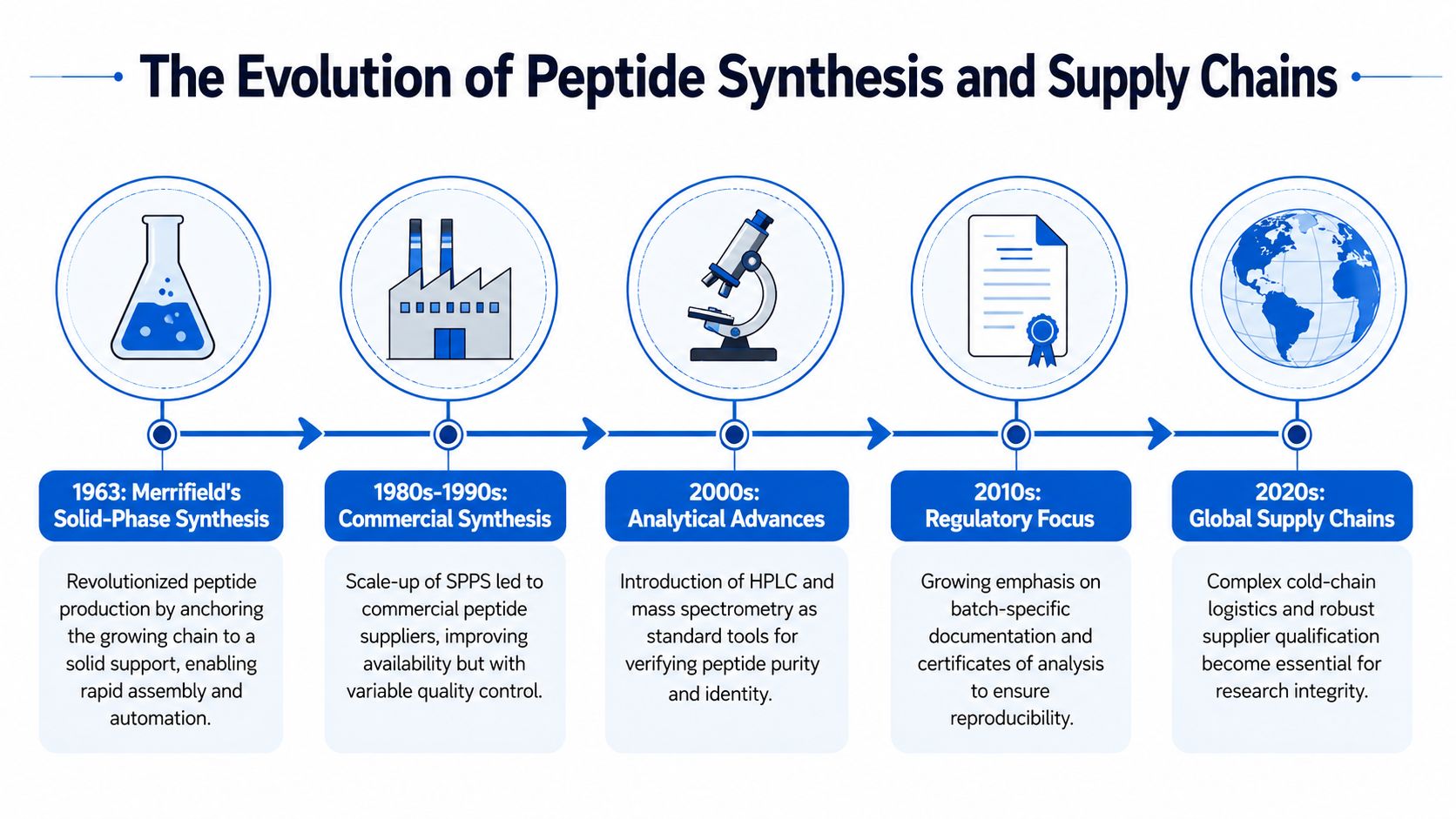
SPPS made automation and commercial scale more practical, but it didn't remove manufacturing risk. Longer or more complex sequences can require difficult coupling, repeated purification, careful handling, and specialized analytical confirmation. Production also depends on raw materials, skilled labor, fill-finish capacity, and capital-intensive equipment. Industry coverage of peptide manufacturing constraints notes that contract capacity can be committed well ahead of a laboratory's purchasing window, which makes supplier lead-time claims worth testing rather than accepting at face value. The analysis of peptide manufacturing and supply-chain challenges provides relevant context.
Market scale creates procurement pressure
The commercial market now supports a broad ecosystem of synthesis providers, analytical laboratories, distributors, and specialist logistics partners. One 2025 market estimate valued global peptide synthesis at USD 746.7 million, with North America representing 48.59% of that share, according to the cited market account. A separate 2025 estimate placed the market at USD 0.91 billion and projected growth to USD 1.54 billion by 2031 at a 9.5% CAGR, showing why research and biopharma demand continues to attract supply-chain investment. These estimates cover different scopes, so they shouldn't be treated as interchangeable totals. The figures are reported in the PubMed-indexed market reference.
Growth can improve availability while making qualification more important. More vendors don't necessarily mean more transparent vendors. A laboratory still needs to determine who synthesized the material, who tested it, how the lot was released, and whether the product can move through the required storage and shipping conditions.
For procurement managers, historical context explains why documentation and logistics are part of product quality. SPPS can support scale, but each batch still depends on process control, purification, identity testing, packaging, and transport. A supplier's claimed lead time is credible only when its manufacturing and fulfillment process can support the sequence, documentation, and handling requirements of the order.
Reading a Batch-Specific Certificate of Analysis
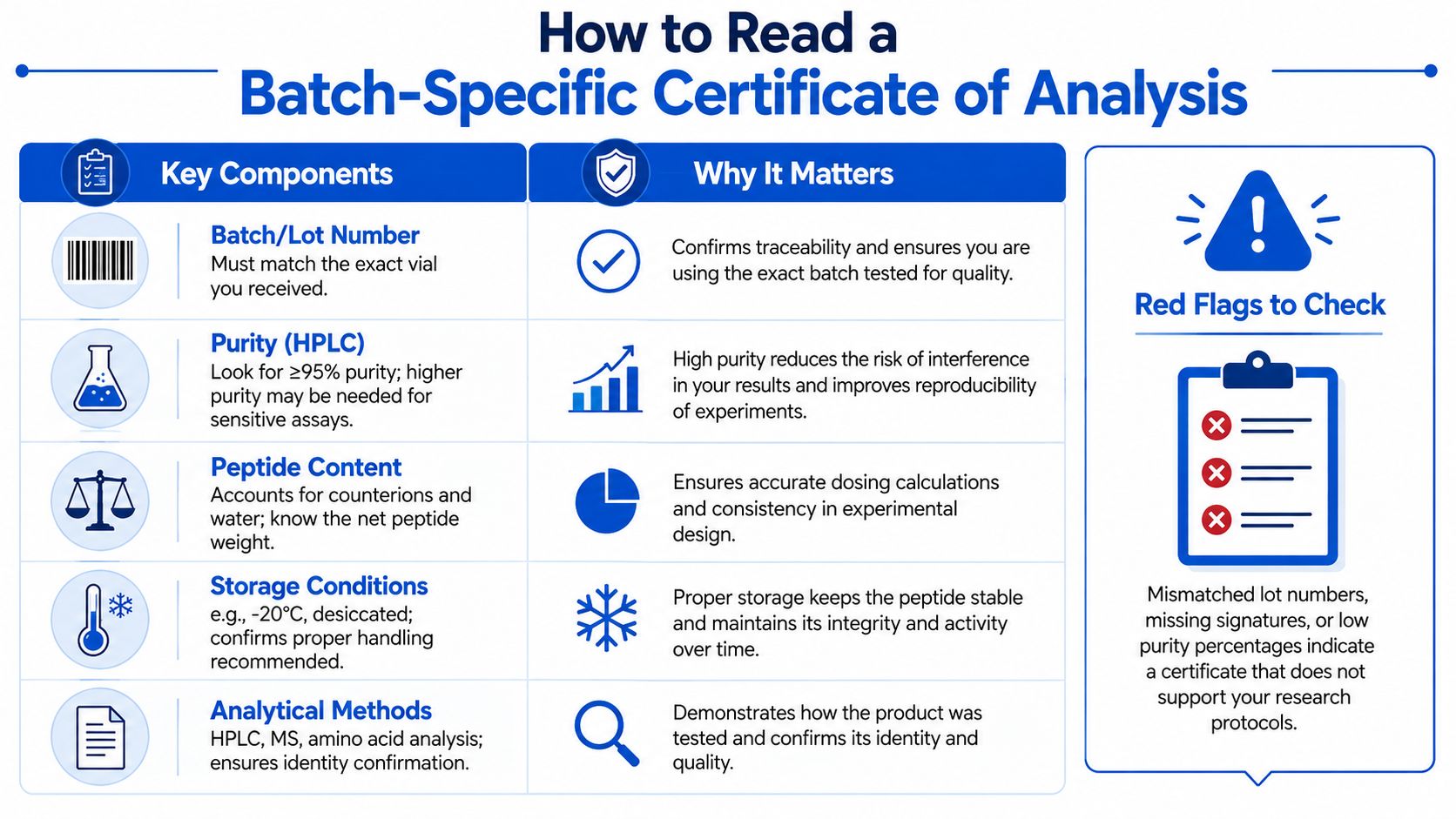
A Certificate of Analysis earns trust only when it connects the material tested to the material received. Check whether the product name, batch or lot number, analysis date, testing laboratory, methods, and results form one traceable record. A specification sheet describes an intended product. It does not verify the condition or identity of a particular vial.
Start with lot identity
Compare the COA with the physical shipment before releasing material into inventory. Batch-linked COAs commonly list the product name, lot number, date of analysis, and test method, as explained in this guide to peptide certificates of analysis. The lot number should match the vial label, order record, packing documentation, and internal inventory entry.
The analysis date helps establish whether the record belongs to the supplied material and meets the laboratory's document-control requirements. Confirm that the testing laboratory is identified clearly. A signature or approval field supports document control, but it does not replace named methods, results, or acceptance criteria.
Then examine the analytical evidence
HPLC reporting should identify the purity result and the method used to obtain it. Mass spectrometry should provide identity evidence consistent with the labeled compound. Review net content, formulation details, and storage conditions when they affect concentration calculations, reconstitution, or inventory handling.
Some workflows require more than identity and purity. Endotoxin and microbial reporting matter most when contamination could interfere with cell-based work or other sensitive biological systems. Heavy-metal data can matter when trace contaminants may alter experimental outcomes. Batch information, methods, purity, testing date, laboratory identification, identity, content, contaminants, and vial-level traceability are among the items covered in this COA explanation for peptide purity documentation.
Use a simple release decision:
- Accept: The lot matches across the shipment and records, methods are named, identity and purity evidence are present, and risk-relevant endpoints are documented.
- Hold: A COA exists, but a lot mismatch, missing method, unclear testing laboratory, or incomplete contaminant data requires clarification.
- Reject or escalate: The supplier cannot provide a batch-specific record or explain a material discrepancy.
The COA should support the protocol, not merely satisfy a website checkbox. A defensible procurement file should show which lot entered an assay and what evidence supported its identity. If that trail is missing, pause release until the supplier closes the documentation gap.
Seven-Category Testing and What Each Endpoint Reveals
A testing package should answer different questions about the same material. Identity asks whether the compound matches its label. Purity measures the proportion of the desired component under a stated analytical method. Net content shows how much peptide is present after formulation factors, including counterions and residual water, are considered.
The other categories address risks that purity alone cannot show. Sterility and endotoxin results matter when microbial contamination could affect biological workflows. Heavy-metal screening can identify trace contamination that changes enzyme, cell, or toxicity-related results. Conformity checks whether the received material and its records match the declared specification.
| Test Category | What It Measures | Critical For |
|---|---|---|
| Identity | Whether the molecular material matches the labeled compound, commonly supported by mass spectrometry or another identity method | Sequence confirmation, receptor studies, molecular analysis, and any assay where the wrong compound would invalidate interpretation |
| Purity | The measured proportion of the desired component under the stated analytical method | Biochemistry, enzyme assays, binding work, and experiments sensitive to related impurities |
| Net content | The amount of peptide material in the vial, including the effect of counterions or residual water | Concentration calculations, repeat experiments, and comparisons between lots |
| Sterility | Whether viable microbial contamination is detected under the stated test | Workflows where microbial contamination can compromise samples or facilities |
| Endotoxins | Evidence of bacterial endotoxin contamination | Cell culture and in-vivo animal research where endotoxin can confound biological observations |
| Heavy metals | Trace metal contamination | Sensitive biochemical systems, toxicology-oriented studies, and experiments affected by metal ions |
| Conformity | Whether the material and documentation meet the declared product specification | Quality release, sponsor review, institutional audits, and controlled inventory |
No endpoint has the same priority in every project. A purified peptide for a binding assay may need a different evidence threshold from material used in a complex preclinical workflow. Treating one specification as a substitute for risk assessment leaves important failure modes unexamined.
Match testing to the experiment
Tie the panel to how the assay could fail. A biochemistry laboratory may place identity and purity first during method development, then rely more heavily on net content when comparing responses across lots. A cell-based group should review endotoxin and microbial information before assigning an unexpected response to receptor biology.
The test panel should also match the decision being made. If a result will support release, the file needs enough evidence for another reviewer to verify the decision. If the material is being screened for exploratory work, missing endpoints may be acceptable only when the limitation is recorded and the assay risk is low.
CROs and university procurement teams need administrative completeness as well as analytical results. A document covering identity, purity, net content, sterility, endotoxins, heavy metals, and conformity gives reviewers specific endpoints to assess instead of a general quality statement. Record the method, result, lot relationship, and any qualification or limitation attached to each endpoint.
For assay development, the right question isn't “What purity does the supplier advertise?” It is “Which documented failure modes could still change the result?”
Cold-Chain Logistics and Material Integrity in Transit
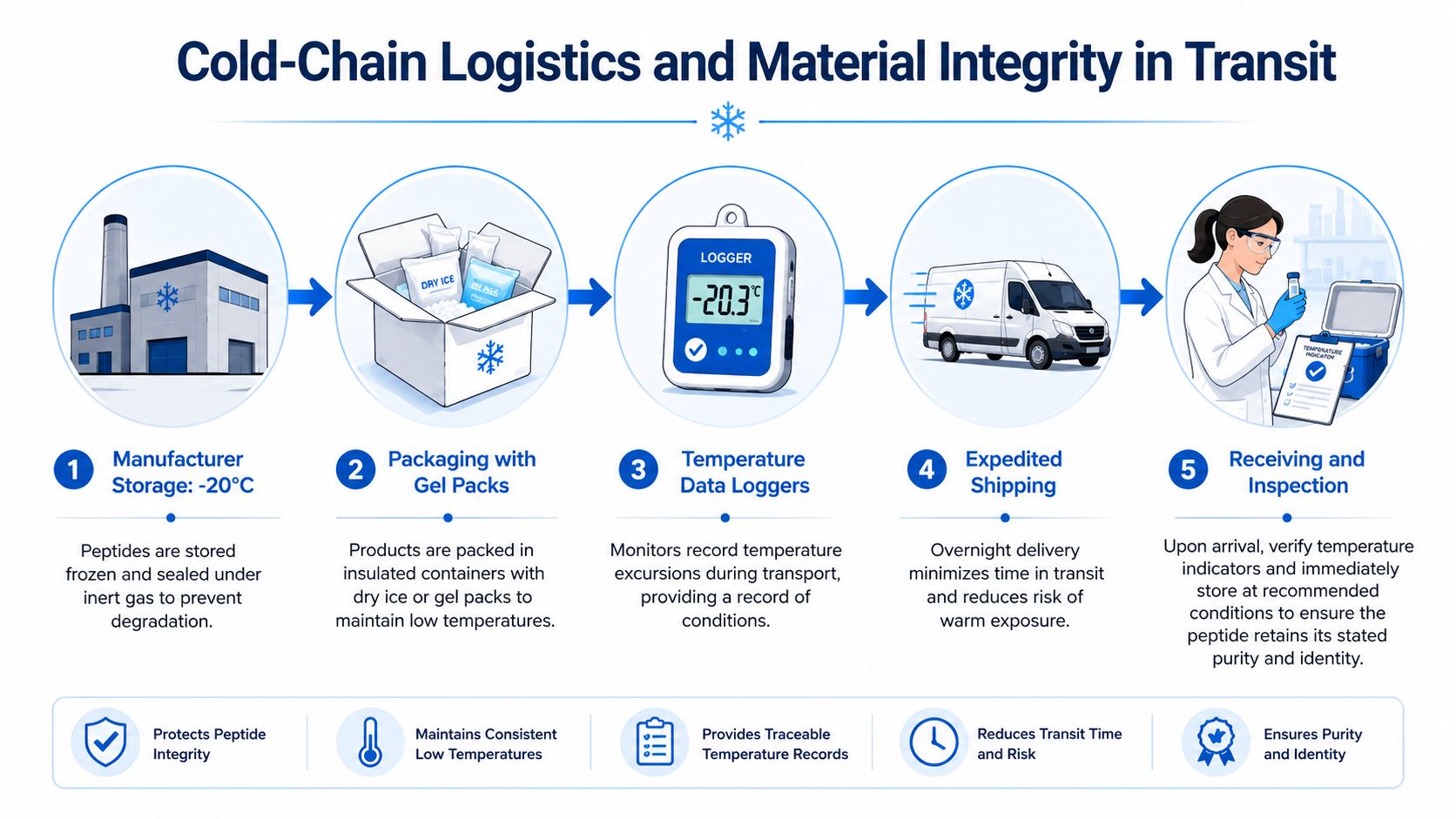
A peptide can leave a controlled facility in acceptable condition and arrive with an unresolved stability question. Transit introduces time, temperature variation, packaging stress, handling delays, and receiving errors. Fast shipping is not the same as controlled shipping.
For temperature-sensitive biologic materials, refrigerated transport commonly centers on 2°C to 8°C, while frozen products may require -20°C or colder, depending on the material. NIH-hosted literature discussed in this cold-chain logistics overview notes that biologic package inserts typically don't allow excursions outside 2°C to 8°C. The supplier should therefore explain the expected range, packaging design, monitoring approach, and receiving instructions.
Evaluate evidence, not speed language
A credible logistics review asks:
- Packaging: Is the shipment insulated and matched to the required temperature range?
- Monitoring: Does a temperature indicator or data logger create a record of transit conditions?
- Dispatch timing: Does the supplier avoid releasing temperature-sensitive material before a delivery window that can support controlled receipt?
- Receiving: Does the laboratory know what to inspect and where to store the material immediately?
- Excursion handling: Is there a documented process for reviewing a warm arrival, damaged seal, or delayed delivery?
The appropriate balance depends on the compound, the formulation, the destination, and the laboratory's storage capacity. A low-cost shipment may be reasonable for a material with appropriate stability evidence, but it isn't automatically prudent for a temperature-sensitive compound with a narrow handling range.
The supply-chain discussion around more complex peptide modalities also highlights constraints involving synthesis, fill-finish, raw materials, labor, and capital. Those constraints make transit stability and fulfillment reliability procurement variables rather than courier details. A laboratory that plans an assay around an uncertain arrival condition may create avoidable rework.
A receiving team should record package condition, lot number, temperature evidence, and storage placement. If the temperature history is unavailable, the material shouldn't be treated as fully verified merely because the outer package arrived intact.
Building a Compliant Ordering Workflow
A controlled order begins before checkout. The laboratory should identify the compound, intended research application, required documentation, storage capability, and receiving owner. That preparation prevents a common failure mode, where a material is purchased first and its suitability is investigated only after delivery.
Pre-order controls
A repeatable workflow can follow this sequence:
- Define the material record. Record the formal compound name, relevant synonym, formulation state, required quantity, and any sequence or identity information needed for the protocol.
- Review the documentation. Confirm that the supplier can provide the exact-lot COA and that it includes methods, identity, purity, and risk-relevant endpoints.
- Check laboratory capability. Compare the stated storage conditions with available freezer, refrigerator, desiccation, and inventory controls.
- Confirm RUO status. The product page, order flow, and supplier policies should consistently frame the material as laboratory research material, not as a product for diagnosis, treatment, or patient use.
- Assign accountability. Name the purchaser, receiving contact, and scientist responsible for reviewing the lot before it enters working inventory.
The order record should preserve the quote, purchase approval, product page or specification, COA, shipping details, and any supplier clarification. That file gives purchasing and quality teams a shared record instead of forcing them to reconstruct the transaction from email threads.
Receiving controls
On arrival, the receiving team should inspect seals, vial labels, packaging, temperature indicators, and visible condition. The lot number must match the COA and purchase record before the material is released to the laboratory.
A material can be placed on hold when the vial is mislabeled, the package is damaged, the documentation is missing, or the temperature record raises a question. The hold decision protects the experiment and creates a clear escalation point. Inventory software or a controlled spreadsheet should record receipt, storage location, lot, review status, and disposition.
This workflow is more demanding than ordinary e-commerce, but it reduces the chance that an unverified vial enters a time-sensitive assay. It also gives institutional procurement a defensible audit trail.
Research-Use-Only Compliance as a Procurement Advantage
Research-use-only labeling works best when it reflects the entire purchasing environment, not just a sentence printed on a product page. FDA guidance states that an in-vitro diagnostic product labeled RUO must remain in the laboratory research phase, must not be represented as an effective IVD, and must prominently display “For Research Use Only. Not for use in diagnostic procedures.” The FDA guidance on in-vitro diagnostic device labeling requirements provides the governing framework for that language.
For peptide research supply, the same discipline means keeping product descriptions clinical and laboratory-facing. Pages for Retatrutide, BPC-157, TB-500, Tesamorelin, GHK-Cu, MOTS-c, Ipamorelin, IGF-1LR3, AOD9604, CJC-1295, Tirzepatide, SS-31, Sermorelin Acetate, Semax, Selank, Epithalon, DSIP, and 5-Amino-1MQ should describe what each compound has been studied for and identify the study type where supported, such as in-vitro research, animal models, or clinical research literature. They shouldn't provide human administration instructions or imply treatment outcomes.
The same accuracy applies to non-peptide materials. HCG is a hormone, not a peptide, and NAD+ is a coenzyme, not a peptide. KLOW and BBG70 should be described through their individual component compounds, because proprietary blend names aren't standard single-compound research peptides and shouldn't be assigned a unified mechanism without direct evidence.
Compliance strengthens purchasing
Clear RUO gating, age verification, explicit disclaimers, and accessible documentation help a supplier show that it understands laboratory procurement. They also give universities, CROs, and biotech teams language they can carry into purchase approvals, inventory records, and internal reviews.
A supplier such as Pro Tec Pep presents batch-linked COAs, seven-category testing records, product specifications, and optional cold-chain handling for research compounds. Those features don't remove the buyer's responsibility to qualify each lot, but they give the laboratory concrete records to review before release.
The correct standard is simple: materials must remain within lawful laboratory research use, and product pages must not imply diagnosis, treatment, prevention, or human or veterinary administration. A buyer who visits Pro Tec Pep can review its research-use-only catalog, batch documentation, and fulfillment options, then compare those records against the laboratory's protocol and procurement requirements. For the next order, request the exact-lot COA before approval, confirm the required storage and shipping conditions, and document the receiving review when the material arrives.
For laboratory research use only. Not for human or veterinary use. Not a drug, food, or cosmetic. Not evaluated by the FDA. Not intended to diagnose, treat, cure, or prevent any disease. By purchasing, you certify you are a qualified researcher and agree to use this product solely for in-vitro laboratory research.