Peptide Labs USA: How to Verify Quality Before You Buy
Evaluating peptide labs USA researchers trust? Learn what separates reliable suppliers, from COAs and third-party testing to cold-chain handling and RUO
For U.S. research buyers, the defensible choice is a supplier that provides batch-specific documentation and orthogonal identity testing, not just a purity percentage. In 2017, peptide-related products accounted for six of the FDA's 46 new-drug approvals, a reminder that peptide research depends on reliable characterization, not marketing shorthand.
The popular advice to compare peptide labs in the USA by the highest HPLC purity figure misses the point. A chromatographic result is one piece of evidence, not proof that a vial contains the correct peptide, the stated amount, or material suitable for a particular assay. A serious buyer asks what was tested, by which method, against what criteria, and on the exact lot being purchased.
Why Purity Percentage Is Not the Whole Story
An HPLC purity result generally reports the target peak's area relative to the detected chromatographic peaks. It doesn't, by itself, establish the peptide's net content by mass, confirm its sequence, or show that every impurity has been detected. Counterions, water, residual solvents, some degradation products, and co-eluting impurities can complicate interpretation.
That distinction matters in research. A lot can show a strong main peak yet still vary in composition or contain an amount of target peptide that differs from the nominal quantity. A single figure also doesn't tell a researcher whether the analytical method could separate relevant impurities in that sample. USP materials describe complementary approaches, including mass spectrometry, relative-retention-time HPLC, amino-acid analysis, NMR, LC-MS/MS, and peptide mapping. The appropriate combination depends on the material and the question being asked (USP peptide CMC guidance).
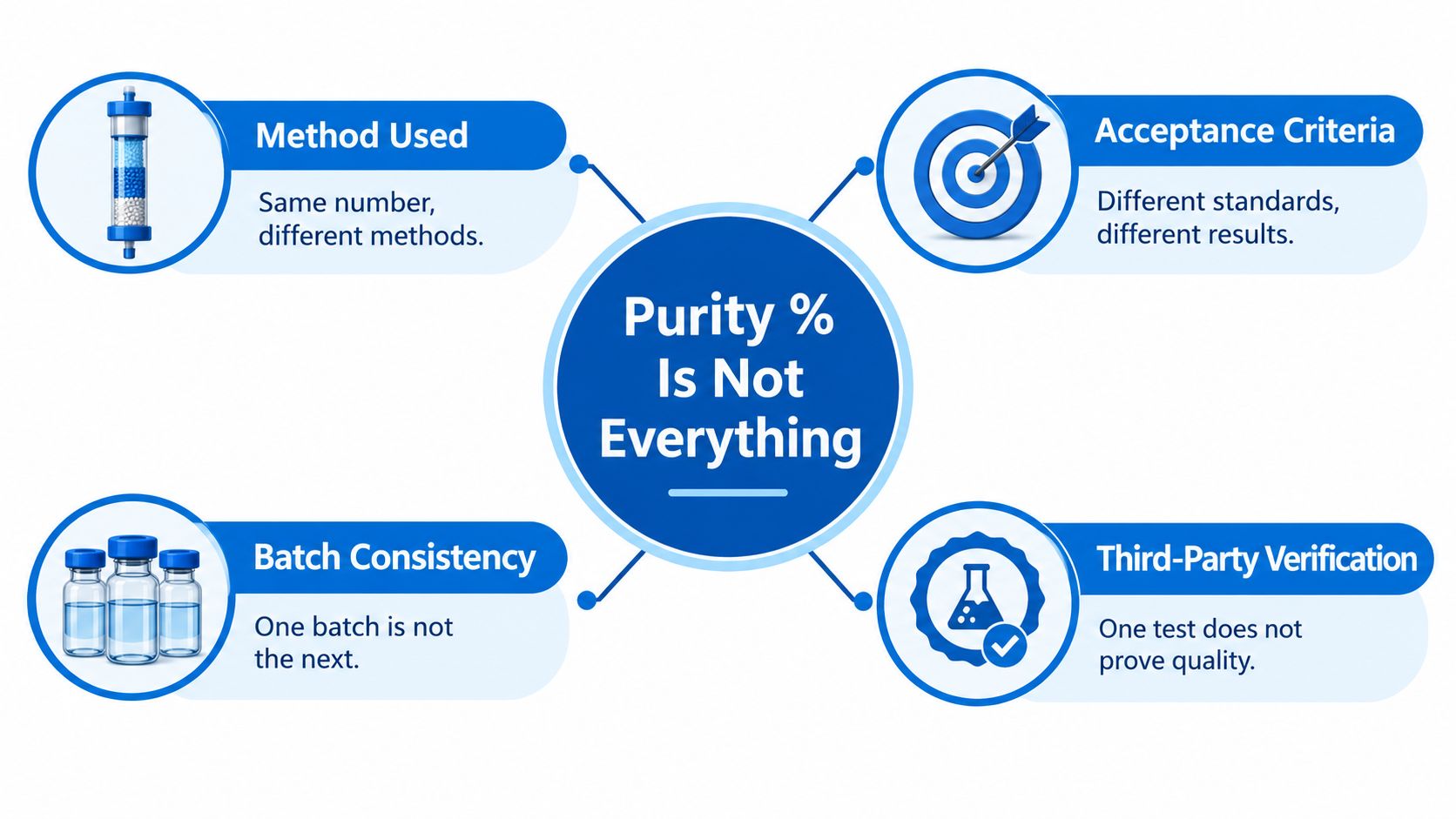
The right question isn't “How high is the purity?” It's “What does this result establish, and what remains untested?” Reference-standard guidance recommends orthogonal identity testing and separates chromatographic purity from absolute peptide content. It also notes that one chromatographic method may not resolve co-eluting peptide-related impurities (reference-standard guidance for peptide analysis).
Practical rule: Treat a purity percentage as a method-specific result, not a complete quality verdict.
The historical record makes the value of rigorous peptide characterization clear. A review describes the FDA's 2017 approvals and the breadth of established peptide drug products, placing today's research materials in a field that spans multiple molecular classes and therapeutic areas (review of peptide drug development).
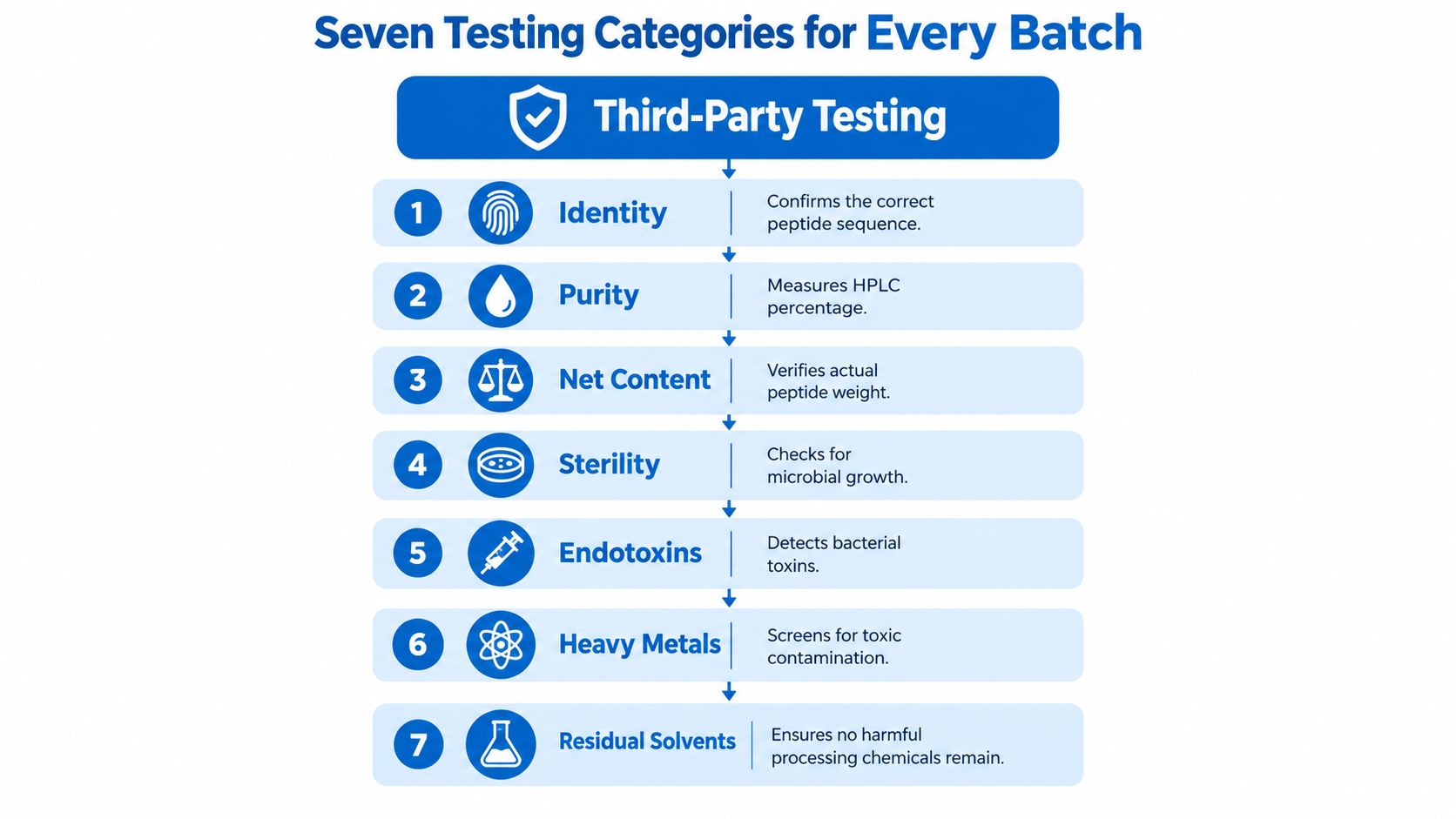
Seven Testing Categories That Defensible Labs Run on Every Batch
A supplier's quality page should distinguish tests performed on each lot from general claims about its testing program. Seven useful categories give procurement teams a structured way to ask what the evidence covers. No single category substitutes for the others.
Identity. Mass spectrometry can support molecular-mass confirmation; LC-MS/MS, peptide mapping, amino-acid analysis, or other complementary methods can provide additional identity evidence. A mass match alone doesn't necessarily establish the full sequence or exclude every isomer.
Purity. Chromatographic analysis estimates the relative amount of the principal peak among detected components. Ask for the method and, when the assay warrants it, the chromatogram. A reported percentage doesn't establish net peptide content.
Net content. Quantitative amino-acid analysis, nitrogen analysis, UV spectroscopy, or quantitative NMR can help assess absolute peptide content. This result addresses how much target peptide is present, not whether every impurity is harmless.
Sterility. A microbiological test assesses microbial growth under the test conditions. It doesn't establish that a material is clinical grade or suitable for any particular experimental system.
Endotoxins. Endotoxin testing addresses bacterial toxins that can affect sensitive laboratory work. The result applies to the tested sample and method, not to untested lots.
Heavy metals. Elemental-impurity screening can identify specified contaminants. Request the method and analytes rather than accepting an unqualified “tested” claim.
Residual solvents and other conformity checks. Solvent testing looks for specified manufacturing residues. Conformity compares the batch with declared specifications, but the supplier should state which attributes were assessed.
USP materials also identify water content, counterion content, bacterial endotoxins, and microbial limits as relevant quality attributes. A buyer should not assume these were tested because a certificate lists purity. For examples of how suppliers describe testing programs, compare the stated methods and lot coverage on Pro Tec Pep's testing page.
How to Read a Certificate of Analysis Without Getting Lost
A useful Certificate of Analysis (COA) connects a defined batch to named tests and reported results. Start with the identifiers. The product name, lot number, and any relevant chemical identifier should match the label and purchase record. If a document covers an unspecified batch, it can't verify the vial in hand.
Next, check the method column. “HPLC” or “mass spec” is a start, not a full description. A stronger record names the method or technique clearly enough for a qualified reader to understand what was measured. Look for acceptance criteria alongside actual results. Without criteria, a number can't be judged against the supplier's stated specification.
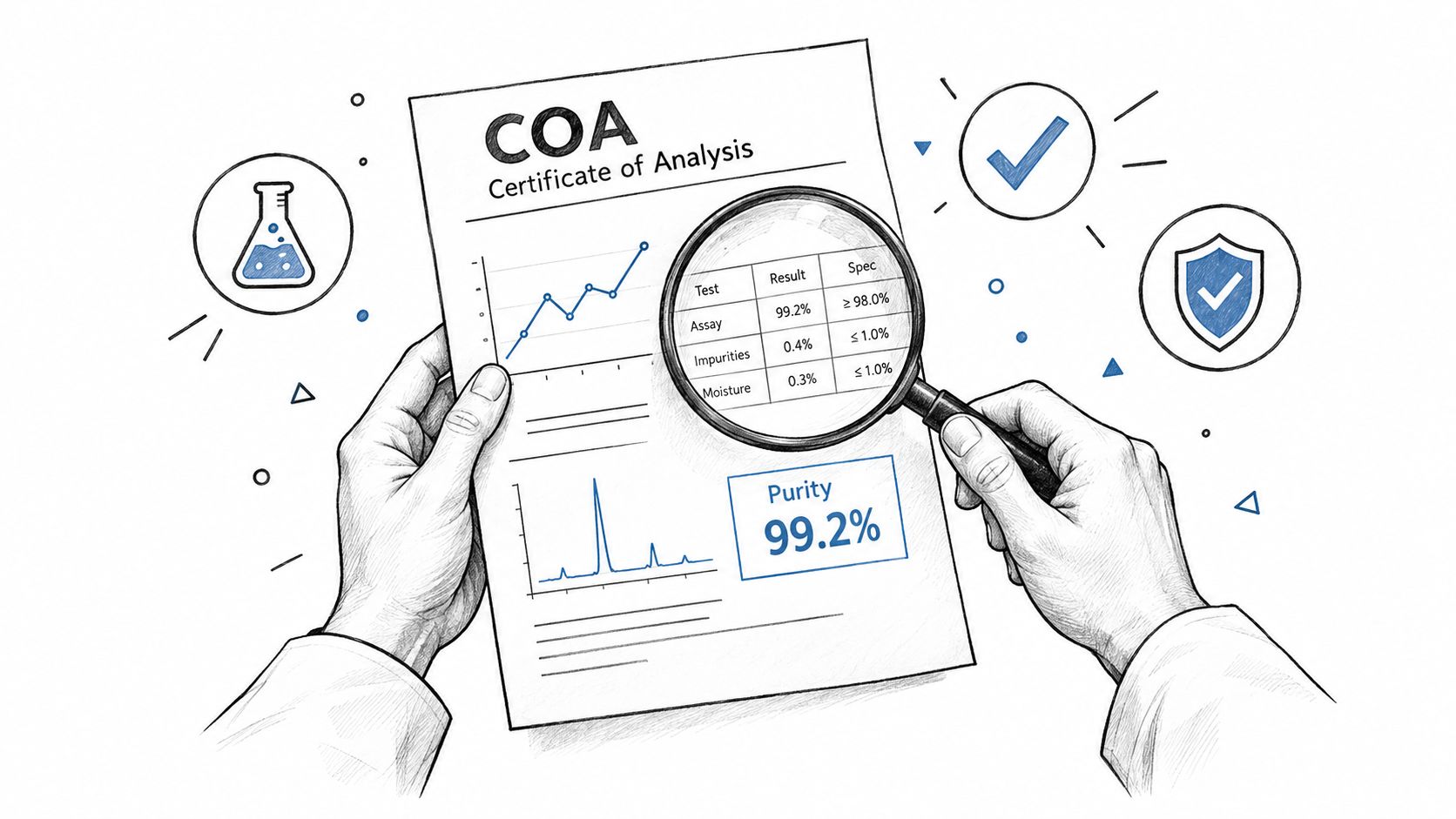
Then separate identity, chromatographic purity, and net peptide content. They answer different questions. A purity result shouldn't be presented as though it also confirms the amount of target peptide in the material. If identity is supported only by a single measurement, ask whether a complementary method is available.
A practical COA review checks:
- Batch traceability: The lot number matches the product supplied.
- Method and criteria: Test names and acceptance ranges are stated.
- Results: Each reported result corresponds to a specific test.
- Document control: A date and responsible laboratory or analyst are identifiable.
- Supporting data: Raw chromatograms or spectra can be requested when relevant.
A COA isn't proof that a material suits every protocol. It documents test results within the scope of the methods used. The receiving lab still has to judge whether that evidence answers its research question.
Batch-Linked Documentation Versus Catalog Claims
A catalog specification describes what a supplier says a product should meet. A batch-linked COA records results for a particular lot. Those documents aren't interchangeable. A general statement such as “high purity” may help identify a product line, but it can't establish the composition of a specific delivery.
The difference becomes obvious when a study needs repeating. If results shift between lots, researchers need the records to compare the materials and investigate possible causes. Without lot identifiers, named methods, and reported results, method transfer and deviation investigations become guesswork. A generic catalog claim also gives procurement and quality teams little to assess during an audit.
Ask the supplier to make the current lot's COA accessible before purchase or to confirm that it can be provided with the shipment. Request raw chromatograms or spectra when the assay is sensitive to identity or impurity differences. Clarify retest or expiry status, storage requirements, and whether the COA's purity figure excludes water, counterions, or residual solvents.
A catalog page can describe a product. Only lot-linked records can document the tested batch.
Market growth doesn't lower the documentation bar. A U.S. market estimate puts peptide-synthesis revenue at approximately USD 320.7 million in 2024, with a projection of about USD 604.1 million by 2033. The projected expansion makes reliable characterization and traceability more, not less, relevant to procurement (U.S. peptide-synthesis market outlook).
Building a Research-Use-Only Procurement Checklist
Research-use-only (RUO) labeling restricts represented intended use. It doesn't authorize clinical application, and it doesn't remove the receiving laboratory's responsibility to qualify materials for its own work. FDA guidance also emphasizes that labeling and other representations must be consistent with the intended use of a product. A lab should reject language that presents a research compound as a treatment or suggests personal administration.
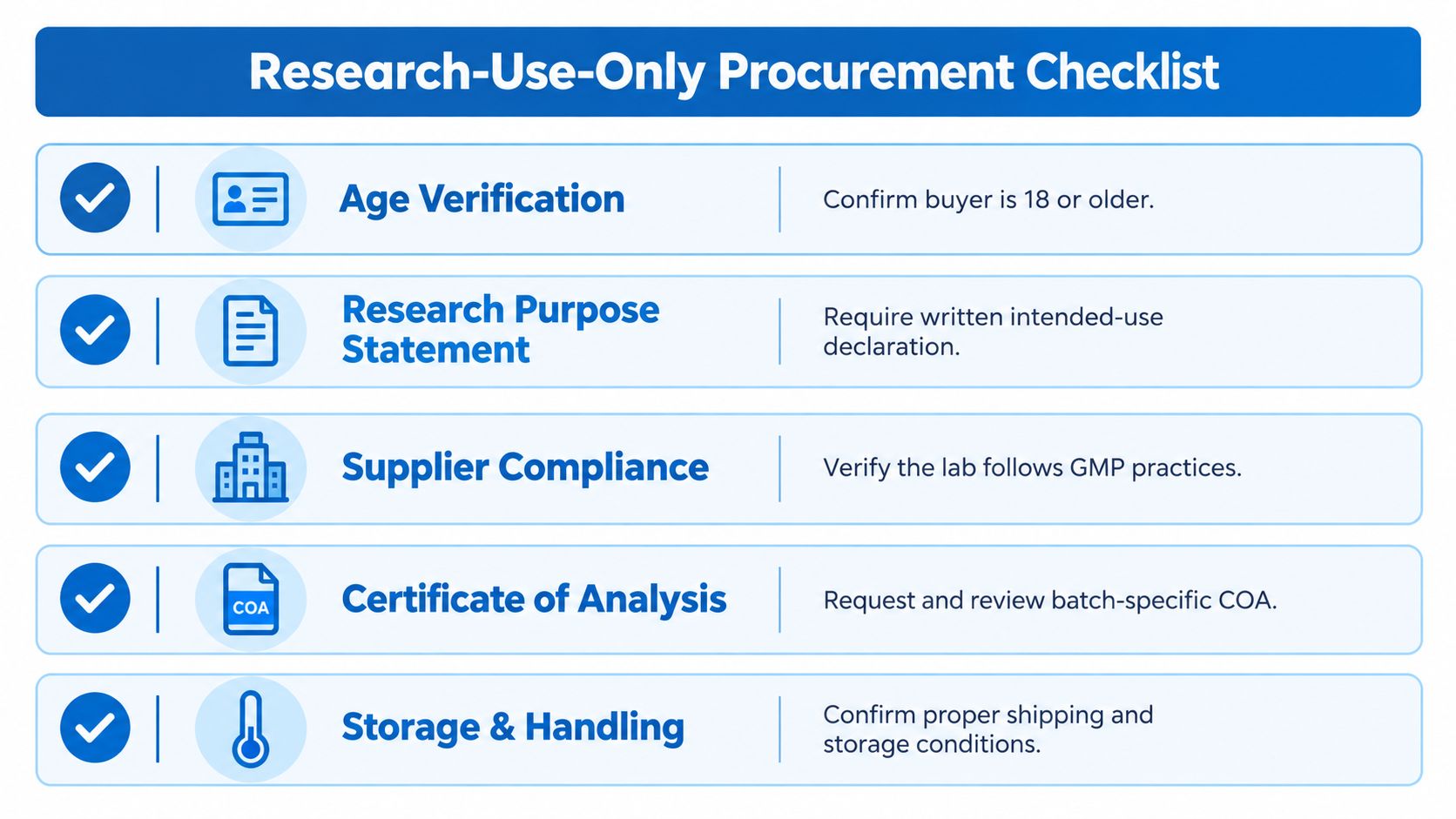
Before opening a purchase order, procurement teams can verify the following:
- Eligibility and intended purpose: Confirm the supplier's age-verification requirements and obtain any required written research-purpose declaration. Pro Tec Pep states that access requires age verification for buyers aged 21 or older.
- Research-only language: Check product pages, terms, and sales materials for clear non-clinical boundaries. The FDA's RUO and laboratory-developed test guidance explains that an RUO component incorporated into a laboratory-developed test must be qualified by the laboratory within that test system.
- Institutional fit: Review the supplier's terms of service, privacy policy, and shipping and returns information. Confirm that the institution's purchasing rules permit the transaction.
- Material records: Request the batch-specific COA, storage guidance, and instructions for laboratory sample preparation.
- Receipt controls: Record the lot, package condition, receipt temperature where cold-chain shipping applies, and the storage location.
FDA guidance states that RUO labeling is not a general authorization for clinical diagnosis or patient management. Laboratories should therefore keep procurement records and material qualification separate from any assumption that a supplier's disclaimer makes a product suitable for a clinical workflow. Buyers can review a supplier's stated boundaries in its research-use-only policy.
Cold-Chain Logistics and Temperature-Sensitive Compounds
Storage and shipping decisions should follow compound-specific information, not a blanket promise that every peptide needs the same handling. Published handling recommendations describe long-term storage for lyophilized peptides at -20°C to -80°C when storage exceeds six months. They also advise avoiding repeated freeze-thaw cycles, which can increase degradation risk (peptide handling and storage recommendations).
For concentrated liquid solutions, the same recommendations describe short-term handling at 4°C for up to three months, while stressing that stability depends on the peptide. They also discuss an idealized stability target of at least 30 days in solution at 4°C and three years at -20°C. Those figures aren't universal guarantees and shouldn't replace compound-specific stability data.
The buying decision should account for the material's supplied form, documented storage conditions, transit time, and expected receipt procedure. A lyophilized product and a prepared solution don't necessarily have the same shipping needs. Where the supplier offers temperature-controlled shipping, ask what conditions are maintained and how shipment integrity is documented. Consider that option when the compound's stability profile or transit conditions make temperature exposure a meaningful risk.
On arrival, document the package condition, lot, receipt temperature when relevant, and time to appropriate storage. Check the supplier's stated shipping and returns information before ordering, especially when a protocol depends on a temperature-sensitive material.
Purity, Net Content, Sterility, and Endotoxin Defined
These terms describe separate properties, so a supplier shouldn't use one as a substitute for another.
Chromatographic purity is the relative area of the target peak among peaks detected by the stated method. It doesn't tell the lab how much target peptide is present by mass or whether the method resolves every relevant impurity.
Net peptide content estimates the fraction of material that is the target peptide, rather than water, counterions, residual solvents, or other components. It's important when researchers need to prepare solutions by actual peptide content instead of relying only on nominal vial mass.
Sterility concerns microbial contamination under the conditions of the test. Endotoxin testing addresses bacterial toxins, which can interfere with sensitive laboratory assays even when a material is not intended for clinical use. Neither result should be inferred from a purity figure.
Heavy-metals screening assesses specified elemental contaminants that may affect downstream measurements. Conformity indicates whether the tested material meets declared specifications, but the supplier needs to say which specifications and tests were included.
A report that says “purity” without naming the method or explaining what the result represents leaves key questions unanswered. Ask what the test detects, what it can miss, and whether the result applies to the exact lot.
Verifying a Batch Before It Touches Your Protocol
Verification starts before purchase. Request the lot-specific COA and compare its product and batch identifiers with the proposed order. If those details aren't available, ask when the batch record will be supplied and don't treat a catalog specification as a substitute.
The next step is matching evidence to assay sensitivity. A routine buffer-preparation task may not warrant the same independent confirmation as an experiment where sequence identity or impurity profile could change the interpretation. For a binding-affinity study, for example, a lab may decide that confirmatory LC-MS or another orthogonal check is justified. That's a risk-based decision, not a universal rule.
Use this short verification sequence:
- Check methods and criteria. Confirm the COA names the analytical techniques and reports acceptance criteria as well as results.
- Request supporting data. Ask for raw chromatograms or mass spectra when the result depends on impurity resolution or identity confirmation.
- Confirm status. Contact supplier support about retest status and any storage or stability updates for the lot.
- Document receipt. Record lot identifiers, packaging condition, and required storage after arrival.
- Escalate when warranted. Run an independent identity or purity check when the consequence of an incorrect or variable lot is significant to the study.
A supplier's documentation supports qualification; it doesn't make the lab's suitability decision. FDA's RUO guidance places responsibility on a laboratory that incorporates an RUO component into its own test system. That makes the lab's intended use and qualification records part of the procurement decision, not an afterthought.
Turnaround Time as a Quality and Stability Signal
Fast dispatch is useful only when the supplier can explain what happens between order acceptance and delivery. Shorter warehouse dwell time may reduce opportunities for mix-ups or unnecessary exposure, but speed alone doesn't establish material quality. Buyers should assess processing alongside packaging, shipment tracking, and handling instructions.
Ask when the order is expected to leave the facility, how the product is identified during packing, and whether temperature control is available when the material's storage profile calls for it. Check that the package and accompanying records let receiving staff match the delivery to the purchase order and COA. If a shipment arrives with damaged packaging or unclear lot identification, quarantine it under the lab's receiving procedure until the discrepancy is resolved.
Institutional purchase orders can specify documentation and fulfillment expectations without promising a particular scientific outcome. For example, the order can require batch-linked records, clear lot labeling, shipment tracking, and notice of any fulfillment delay. A stated 24-hour processing option is useful only if the supplier confirms what it means and whether it applies to the item and shipping method ordered.
Treat logistics as part of material control. A well-documented lot can still be compromised by poor handling, and rapid processing can't make an inadequately characterized batch acceptable.
A One-Page Evaluation Framework for Research Buyers
Procurement teams can compare suppliers on evidence rather than impressions. Use the matrix below as a worksheet, then assign each criterion a weight based on the assay's sensitivity and the institution's requirements. A “not provided” answer should remain visible; it should not be treated as a pass.
| Criterion | What to verify | Weight |
|---|---|---|
| Batch documentation | Lot-specific COA, product match, and traceability | High |
| Analytical methods | Named identity and purity methods, with criteria | High |
| Net content | Separate result or clear explanation of whether it is measured | High |
| Testing breadth | Which of the seven categories were tested on the batch | High |
| Supporting evidence | Raw chromatograms, spectra, or other data available when needed | Medium |
| Storage and shipping | Compound-specific guidance, packaging, tracking, and cold-chain options | Medium |
| Processing | Dispatch expectations and delay communication | Medium |
| RUO controls | Clear research-only labeling and accessible procurement policies | High |
A simple internal scoring approach can use “meets,” “partly meets,” and “not demonstrated,” with written evidence beside each rating. The point isn't to create a universal supplier ranking. It's to ensure that two vendors are assessed against the same requirements and that a missing record doesn't disappear inside a persuasive product page.
Common Buyer Questions About Peptide Labs USA
What minimum documentation should a research supplier provide? At minimum, request a batch-linked COA with product and lot identifiers, named methods, acceptance criteria, and actual results. Identity, purity, and net content should be clearly distinguished, with storage and handling information available.
What does third-party testing prove? It documents results for the tested sample under the stated methods. It doesn't prove that the material suits every assay, that untested attributes meet a specification, or that the result applies to a different lot.
How does RUO material differ from clinical-grade or compounded material? RUO labeling identifies a research-only intended use; it doesn't make a product clinical grade or authorize patient use. A laboratory remains responsible for qualifying an RUO component within its research system and must not infer clinical suitability from a COA.
When should a lab request independent confirmation? When identity or impurity differences could materially affect the study's interpretation, or when supplier documentation doesn't answer the method-specific question. For lower-sensitivity work, a complete and relevant lot-specific COA may be adequate under the lab's own qualification procedures.
Pro Tec Pep provides research-use-only compounds with batch-specific COAs, product documentation, and optional cold-chain handling for laboratory procurement. Research teams can review its documentation and fulfillment information, then visit Pro Tec Pep to evaluate whether its materials meet their protocols and institutional requirements.