N Acetyl Selank Amidate Explained for Lab Research
Learn what N acetyl selank amidate is, how acetylation and amidation improve stability, specs, solubility, storage and COA checks for lab research.
A researcher can know the parent peptide's sequence, mechanism, and literature history, yet still misunderstand what changes when both termini are chemically capped. N-acetyl Selank amidate isn't Selank under a different label. It's a modified molecule whose main design principle is stability engineering, while its specific evidence base remains limited.
This guide treats the compound strictly as a research-use-only peptide for laboratory investigation. It moves from molecular identity and terminal chemistry to physicochemical specifications, sample preparation, storage, and batch documentation. The emphasis is practical but not promotional, with parent Selank findings kept separate from evidence about the amidated analogue itself.
Introduction to N Acetyl Selank Amidate in Research Context
A new lab colleague might begin with a straightforward question: why would a protocol specify N-acetyl Selank amidate instead of Selank? The answer starts with chemistry, not with a new therapeutic category. The analogue is designed to place protective groups at both ends of the peptide chain, reducing the opportunities for exopeptidases to remove terminal residues during experimental exposure.
That distinction matters during protocol planning. The parent compound has a documented research history, including human and molecular studies, while the exact acetylated-amidated analogue has a much narrower published record. A material specification, therefore, shouldn't be treated as proof that the modified molecule reproduces every result reported for unmodified Selank.
Practical rule: Treat the analogue as its own test article, even when parent Selank literature supplies the mechanistic context.
The compound is commonly represented as Ac-Thr-Lys-Pro-Arg-Pro-Gly-Pro-NH₂, or Ac-TKPRPGP-NH₂. The N-terminal acetyl group and C-terminal amide are the two defining changes. Their purpose is to improve resistance to degradation in experimental systems, not to establish a separate pharmacology class. This structural rationale is described in supplier and research-oriented technical material from Patriot Peptides and NHOV.
For a laboratory evaluating a product listing from Pro Tec Pep or another research supplier, the useful questions are concrete:
- Does the stated sequence match the intended analogue?
- Does the batch documentation identify the material clearly?
- Are formula weight, purity, storage, and formulation details consistent?
- Does the planned assay distinguish parent Selank from the modified form?
Those questions prevent a common error, namely treating a stability modification as if it automatically supplied new clinical evidence.
What Selank Is and Why a Modified Analog Exists
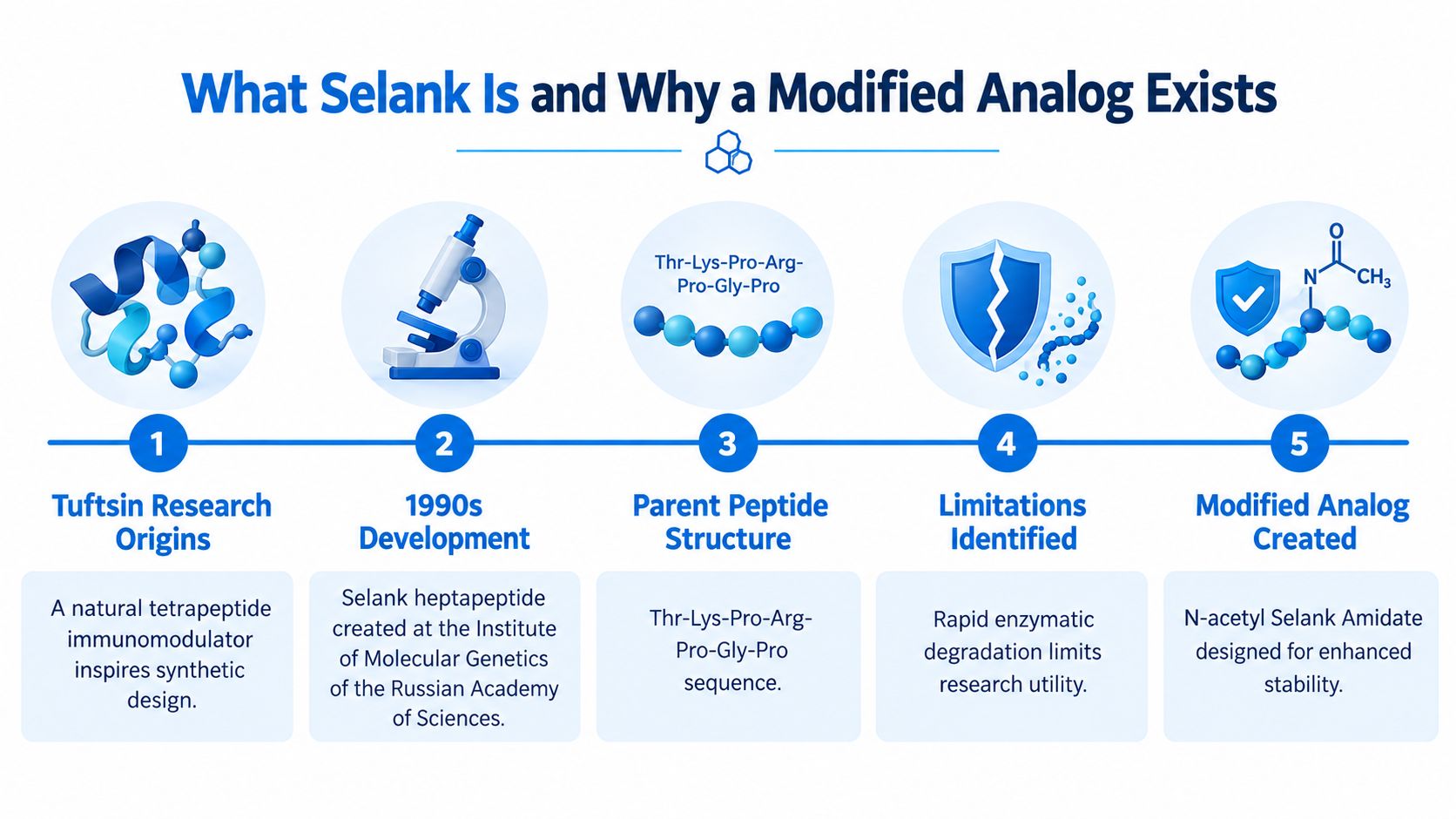
Selank is a synthetic heptapeptide associated with research on tuftsin, a naturally occurring immunomodulatory peptide fragment. The parent molecule was developed in the 1990s at the Institute of Molecular Genetics of the Russian Academy of Sciences, according to the documented background summarized by MediBact's Selank amidate guide. Its core sequence is Thr-Lys-Pro-Arg-Pro-Gly-Pro, extending the Thr-Lys-Pro-Arg portion associated with tuftsin research.
A useful analogy is a cord with exposed ends. Enzymes that act from the ends can begin trimming the cord even when the central sequence remains intact. A peptide chemist can place a protective cap over each end, making that initial attack more difficult. In N-acetyl Selank amidate, acetylation caps the N-terminus and amidation changes the C-terminal chemical group.
The parent and analogue should be kept in separate evidence categories. Selank has a broader literature base, including clinical and molecular research, while the exact phrase “N-acetyl selank” reportedly returns zero PubMed records and the analogue has no registered clinical trials, as summarized in the N-acetyl Selank amidate review. That doesn't make the chemistry meaningless. It means the analogue's stability rationale shouldn't be mistaken for a completed clinical evidence program.
The parent evidence provides context, not substitution
One human study in the parent Selank literature included 62 patients, divided between 30 patients receiving Selank and 32 receiving medazepam. The report found similar anxiolytic effects, while also describing antiasthenic and psychostimulant effects for Selank, as reported in MediBact's discussion of the Selank family. Those findings belong to the parent compound and shouldn't be transferred automatically to the amidated analogue.
The same caution applies to molecular work. A transcriptome study reported significant changes in the expression of 36 genes associated with neurotransmitter signaling, including serotonin, dopamine, and GABA pathways. That result helps explain why Selank is studied mechanistically, but it doesn't establish that N-acetyl Selank amidate produces an identical transcriptomic profile.
How Acetylation and Amidation Change the Peptide
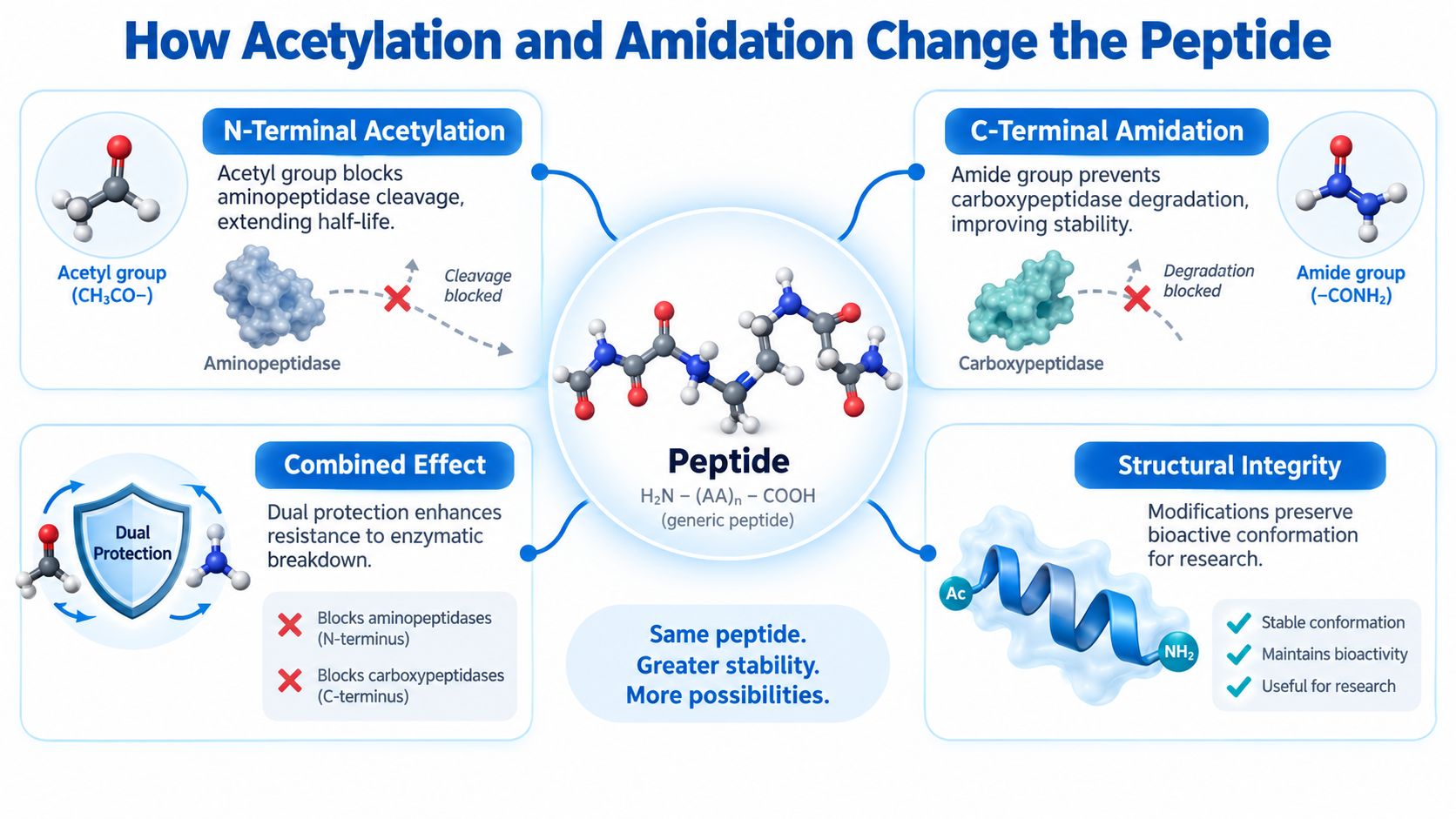
What changes when both ends of the Selank chain are capped? The sequence remains the same seven-residue core, but its terminal chemistry is redesigned. Parent Selank has a free N-terminal amino group and a free C-terminal carboxyl group. N-acetyl Selank amidate changes those positions to produce Ac-Thr-Lys-Pro-Arg-Pro-Gly-Pro-NH₂.
N-terminal acetylation attaches an acetyl group to the amino end. This can reduce recognition by aminopeptidases because the enzyme no longer encounters the same free terminal structure. C-terminal amidation converts the terminal carboxyl group into an amide, which can reduce access by carboxypeptidases at the opposite end. The modification logic is illustrated in Patriot Peptides.
Reading the structure correctly
The notation records three separate details:
- Ac- marks the N-terminal acetyl group.
- Thr-Lys-Pro-Arg-Pro-Gly-Pro identifies the seven-residue Selank core.
- -NH₂ marks the C-terminal amide.
- Ac-TKPRPGP-NH₂ is the compact representation used in product and research descriptions.
The amino-acid order therefore stays recognizable, while the terminal groups alter enzyme access and may influence persistence, distribution, solubility behavior, and assay readouts. The analogue should be verified as its own chemical identity rather than labeled only by reference to the parent peptide.
These changes also affect analytical handling. In reversed-phase HPLC, adding an acetyl group can shift retention relative to the unmodified parent because terminal polarity and ionization have changed. In mass spectrometry, the observed molecular mass should match the modified species, not the parent. A discrepancy may reflect an incorrect terminal modification, a salt or counterion, residual solvent, or another compositional issue requiring investigation.
Stability engineering in laboratory interpretation
The most useful research framing is a stability-optimized Selank derivative. The Luxara Labs' research guide summarizes pharmacology reported for the Selank family, but those parent-compound findings do not establish an identical profile for the analogue.
For laboratory work, the practical question is whether the modified molecule remains intact during the planned assay window. Greater resistance to enzymatic breakdown may help preserve analyte signal, yet it can also change the concentration-time profile. Confirm integrity with appropriate chromatographic and mass-spectrometric checks, then interpret degradation, receptor-signaling, or transcriptomic results for the analogue itself.
Core Identity and Physicochemical Specifications
A product page becomes more useful when its specification fields are read as a connected identity profile. N-acetyl Selank amidate is commonly described as a high-molecular-weight peptide with the formula C35H60N12O9, a molecular weight near 794 Da, and a reported net charge of +2 at physiological pH. These values are summarized in the technical specification material from Pure Health Peptides.
The charge gives the molecule a cationic character consistent with a tuftsin-derived peptide. In aqueous laboratory systems, that character supports the expectation of water and buffer compatibility, although actual solubility still depends on concentration, pH, ionic strength, counterions, container surface, and the specific lot. A specification sheet can establish an identity target, but it can't replace an assay-specific solubility check.
The molecular weight also matters for analytical planning. Mass spectrometry should be configured around the modified molecular identity rather than the parent Selank mass. A mismatch may indicate an incorrect terminal modification, a salt or counterion contribution, residual solvent, or another compositional issue that requires investigation.
Specification snapshot
| Specification | Typical Value or Guidance |
|---|---|
| Chemical identity | N-acetyl Selank amidate |
| Sequence representation | Ac-Thr-Lys-Pro-Arg-Pro-Gly-Pro-NH₂, or Ac-TKPRPGP-NH₂ |
| Molecular formula | Commonly listed around C35H60N12O9 |
| Molecular weight | Near 794 Da |
| Net charge | Reported as +2 at physiological pH |
| Physical form | Lyophilized research peptide |
| Aqueous behavior | Expected to remain compatible with aqueous buffers, subject to assay conditions |
| Storage principle | Cold, dry, moisture-protected storage |
What the fields mean in practice
The formula and formula weight help a lab compare the supplier's identity claim with mass spectrometry results. The sequence confirms that the material is the intended heptapeptide core, while the terminal notation confirms that both stability modifications are present. The reported charge offers a starting point for buffer selection, but it shouldn't be treated as a universal guarantee of solubility.
A high-MW peptide also deserves careful attention during transfer and preparation. Adsorption to vessel surfaces, incomplete dissolution, and concentration errors can create apparent biological variability that has nothing to do with receptor pharmacology. Good records should therefore preserve the supplier's formal name, sequence, formula, formula weight, lot number, and observed preparation conditions.
Solubility Storage and Laboratory Sample Preparation
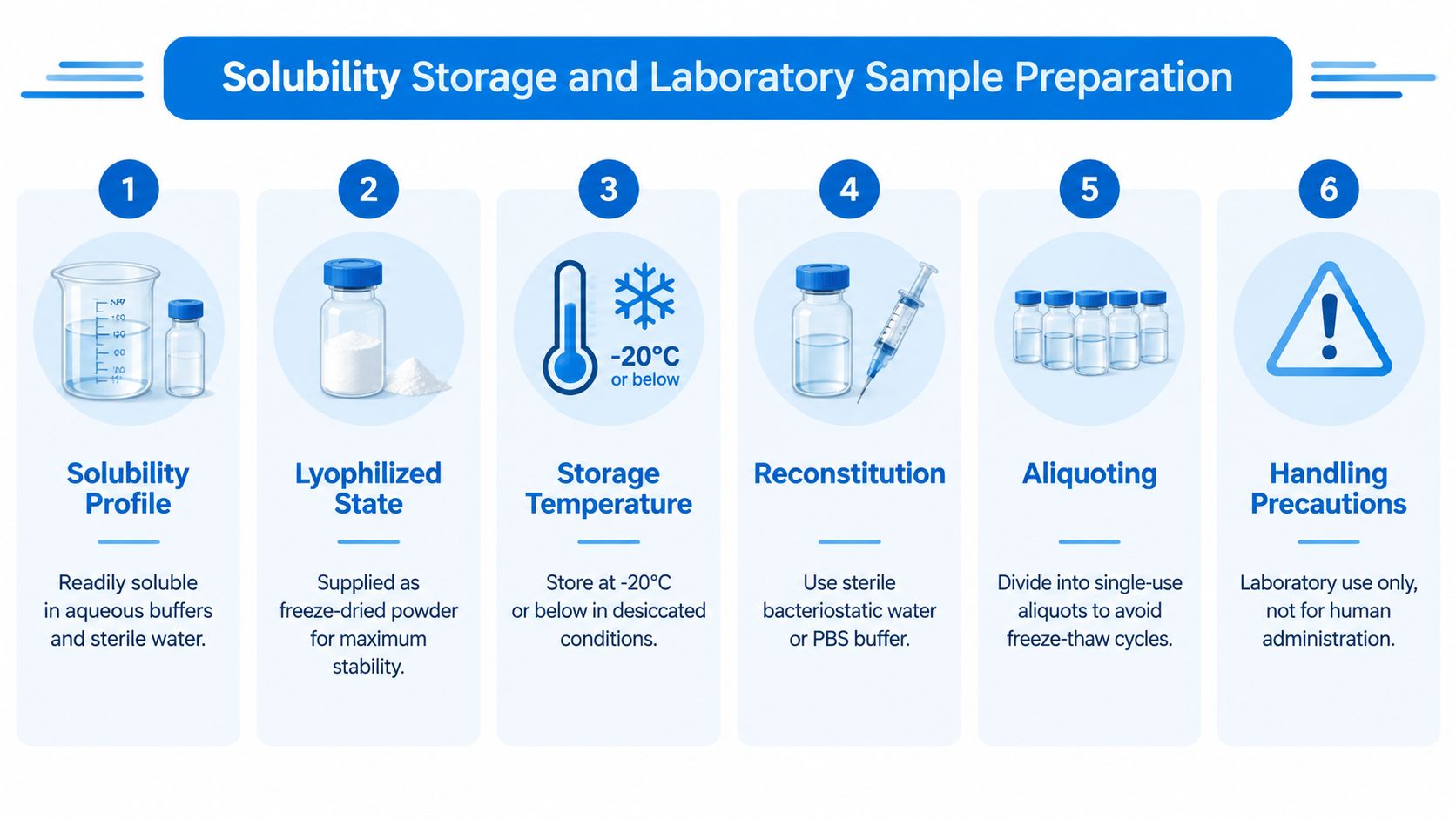
Laboratory sample preparation should begin with the material's physical state. N-acetyl Selank amidate is generally handled as a lyophilized research peptide, and supplier specifications describe it as compatible with aqueous buffers and sterile water. That description is a starting point, not a substitute for a small-scale preparation check under the exact pH and ionic conditions required by the assay.
A practical workflow separates identity confirmation from solution preparation. First, the receiving scientist records the vial condition, lot number, declared content, and storage instructions. Next, the material remains protected from moisture and unnecessary temperature exposure until preparation. Only then should the lab select a compatible aqueous medium and document the observed dissolution behavior.
A preparation checklist for assay work
Review the lot record. Confirm the identity, formula weight, declared purity, and storage requirements against the batch-specific documentation.
Select the buffer deliberately. Sterile water or PBS may be appropriate starting media for laboratory preparation, but the final choice should reflect the assay's pH, salt, protein, and compatibility requirements.
Allow controlled dissolution. Gentle mixing can reduce foaming and surface losses. A clear solution shouldn't be assumed to prove chemical integrity, so analytical confirmation remains important for sensitive experiments.
Create documented aliquots. Dividing prepared material into suitable aliquots can reduce repeated freeze-thaw exposure and make repeated assays more consistent.
Protect against moisture and heat. Lyophilized material should remain in cold, dry, desiccated conditions. Technical product guidance commonly specifies storage at -20°C or below, as described by Pure Health Peptides.
Record every condition. The preparation record should include buffer identity, pH where relevant, preparation date, observed appearance, storage location, and any deviations.
Transit and stability decisions
Optional cold-chain shipping can reduce temperature stress during transit, while rapid processing can shorten the time material spends outside controlled storage. Pro Tec Pep describes 24-hour order processing and optional cold-chain logistics for research workflows in its publisher information, but a laboratory should still inspect each shipment on arrival and reconcile it with its receiving procedure.
Sample-prep principle: The preparation record is part of the experiment, not an administrative afterthought.
The exact stability timeframe after preparation depends on formulation and conditions. A laboratory shouldn't assign a universal post-preparation window without lot-specific documentation or internal stability testing. When an assay depends on intact peptide, an analytical check after storage is more informative than relying on appearance alone.
Understanding COA Verification and Research Documentation
A Certificate of Analysis becomes valuable when it is matched to the exact vial rather than treated as a generic product brochure. For N-acetyl Selank amidate, the first check is the lot number. The lot printed on the vial, packing documentation, and COA should agree before the material enters an assay workflow.
The second check is identity. The declared sequence should read Ac-Thr-Lys-Pro-Arg-Pro-Gly-Pro-NH₂, and the formula weight should be consistent with the modified molecule. Mass spectrometry is especially important because it can distinguish the intended analogue from parent Selank or an incompletely modified product.
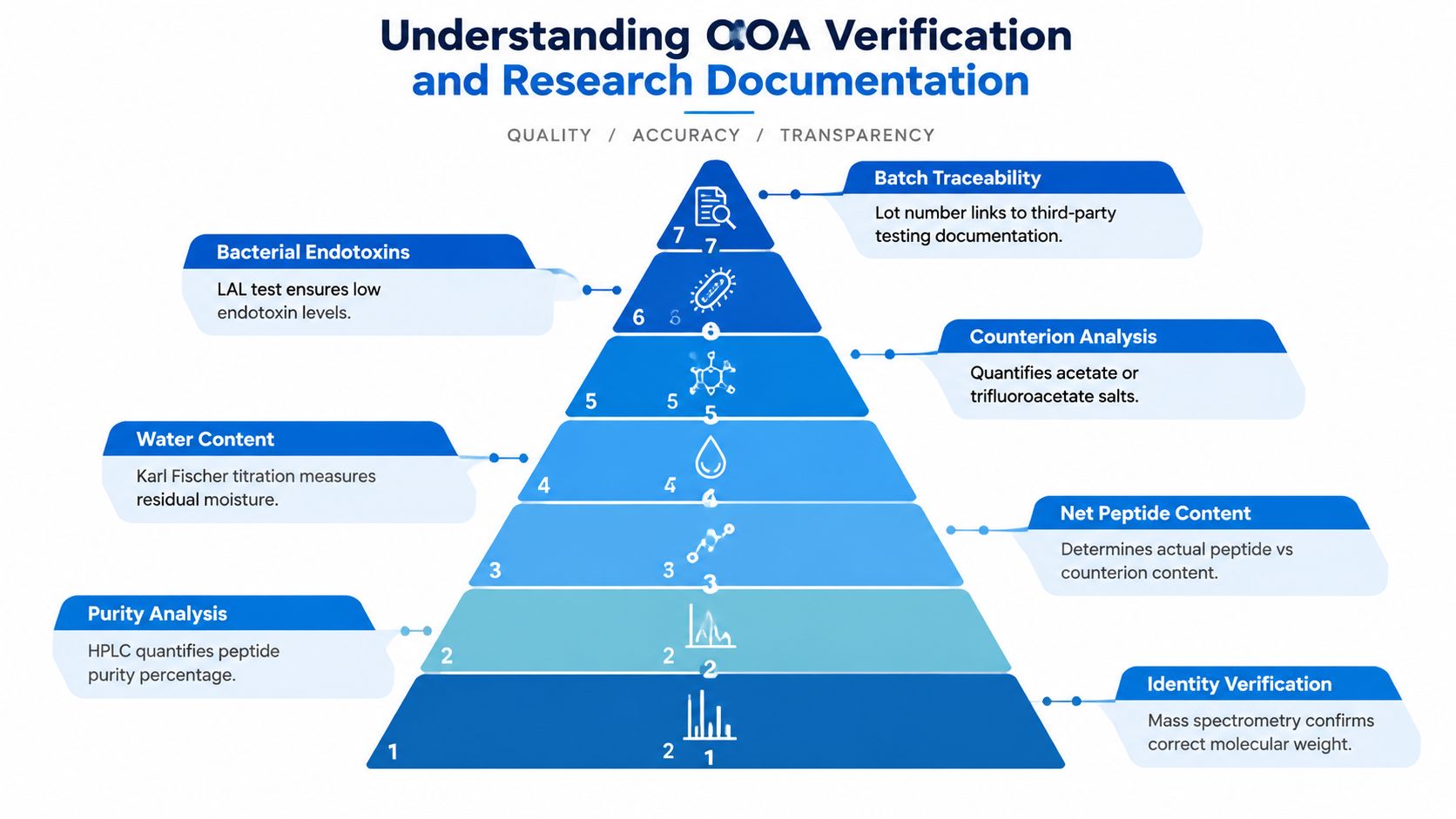
Seven categories for batch review
A review considers the following categories:
- Identity verification: Mass spectrometry should support the stated molecular identity and expected molecular weight.
- Purity analysis: HPLC should quantify peptide purity. If a product declares a minimum of ≥98%, the batch result should be checked against that stated threshold.
- Net peptide content: The report should clarify how much material is peptide rather than counterion, water, or other residual content.
- Water content: Karl Fischer analysis can document residual moisture, which matters for a lyophilized peptide.
- Counterion analysis: Acetate or trifluoroacetate may affect the reported mass and net content, so the documentation should identify relevant salt forms.
- Bacterial endotoxins: An LAL result provides a documented endotoxin assessment for the research material.
- Batch traceability: The lot number should connect the vial to the complete third-party testing record.
Documentation that supports reproducibility
The COA should be stored alongside the experiment record, not in a separate purchasing folder that later becomes difficult to retrieve. The record should preserve the supplier name, product name, lot, sequence, formula, formula weight, purity result, storage conditions, preparation medium, and assay date.
This level of documentation is particularly important because the exact amidated analogue has limited clinical-trial records. Parent Selank findings can inform hypothesis formation, but they don't remove the need to verify the analogue's identity and behavior in the laboratory. A batch-specific document therefore supports both scientific reproducibility and institutional review.
Documentation rule: If a later scientist can't connect the assay result to the exact lot and preparation record, the result is harder to reproduce.
Key Takeaways for Planning Studies With This Analog
N-acetyl Selank amidate is best understood as a dual-terminally modified Selank analogue. Its defining engineering decision is the combination of N-terminal acetylation and C-terminal amidation, intended to reduce aminopeptidase and carboxypeptidase cleavage. That design may improve persistence in experimental systems, but it doesn't create a separate clinical evidence base.
Parent Selank supplies most of the available mechanistic context. Research descriptions associate the family with nonclassical GABA-A receptor modulation, BDNF induction, monoaminergic signaling, tuftsin-like immunomodulatory activity, and enkephalinase inhibition. The parent literature also includes a human study involving 62 patients and a transcriptome result involving 36 genes, but those data shouldn't be presented as direct evidence for the amidated analogue. The distinction is summarized in MediBact's technical guide.
A sensible study-planning workflow is compact:
- Define the test article using the complete modified sequence, not only the word Selank.
- Verify the batch through identity, purity, content, moisture, counterion, endotoxin, and traceability records.
- Prepare samples under documented conditions, with buffer, appearance, timing, and storage recorded.
- Control temperature and moisture, especially for lyophilized material and prepared aliquots.
- Interpret parent literature cautiously, using it to frame hypotheses rather than to claim analogue-specific outcomes.
- Measure the analogue directly whenever stability, degradation, receptor activity, or downstream signaling is central to the experiment.
The compound remains within a research-only setting. It isn't established here as safe or effective for diagnosing, treating, curing, or preventing any condition, and no human administration guidance belongs in a laboratory product evaluation.
"For laboratory research use only. Not for human or veterinary use. Not a drug, food, or cosmetic. Not evaluated by the FDA. Not intended to diagnose, treat, cure, or prevent any disease. By purchasing, you certify you are a qualified researcher and agree to use this product solely for in-vitro laboratory research."
Pro Tec Pep offers research-use-only Selank-related compounds, batch-specific Certificates of Analysis, formal identity and storage information, and logistics designed around laboratory workflows. Researchers planning work with N-acetyl Selank amidate can visit Pro Tec Pep to review available documentation and research compound options.