MT1 vs MT2 Peptide: Melatonin Receptor Differences
MT1 vs MT2 peptide searches: compare melatonin receptor subtypes, ligands, signaling and assay controls for research labs.
The most common advice about “MT1 vs MT2 peptide” starts from the wrong premise. MT1 and MT2 aren't peptides at all: they're melatonin receptors, and an experiment that uses melatonin alone can't establish which receptor produced an effect.
For a laboratory team, the useful comparison isn't a simple ranking of which subtype is stronger. It's a question of which ligand, assay context, and controls can support a subtype-specific conclusion. Confusing these receptors with Melanotan I and Melanotan II, which are different compounds acting on a different receptor family, can send a study toward the wrong mechanism.
What MT1 and MT2 Are and Why They Are Not Peptides
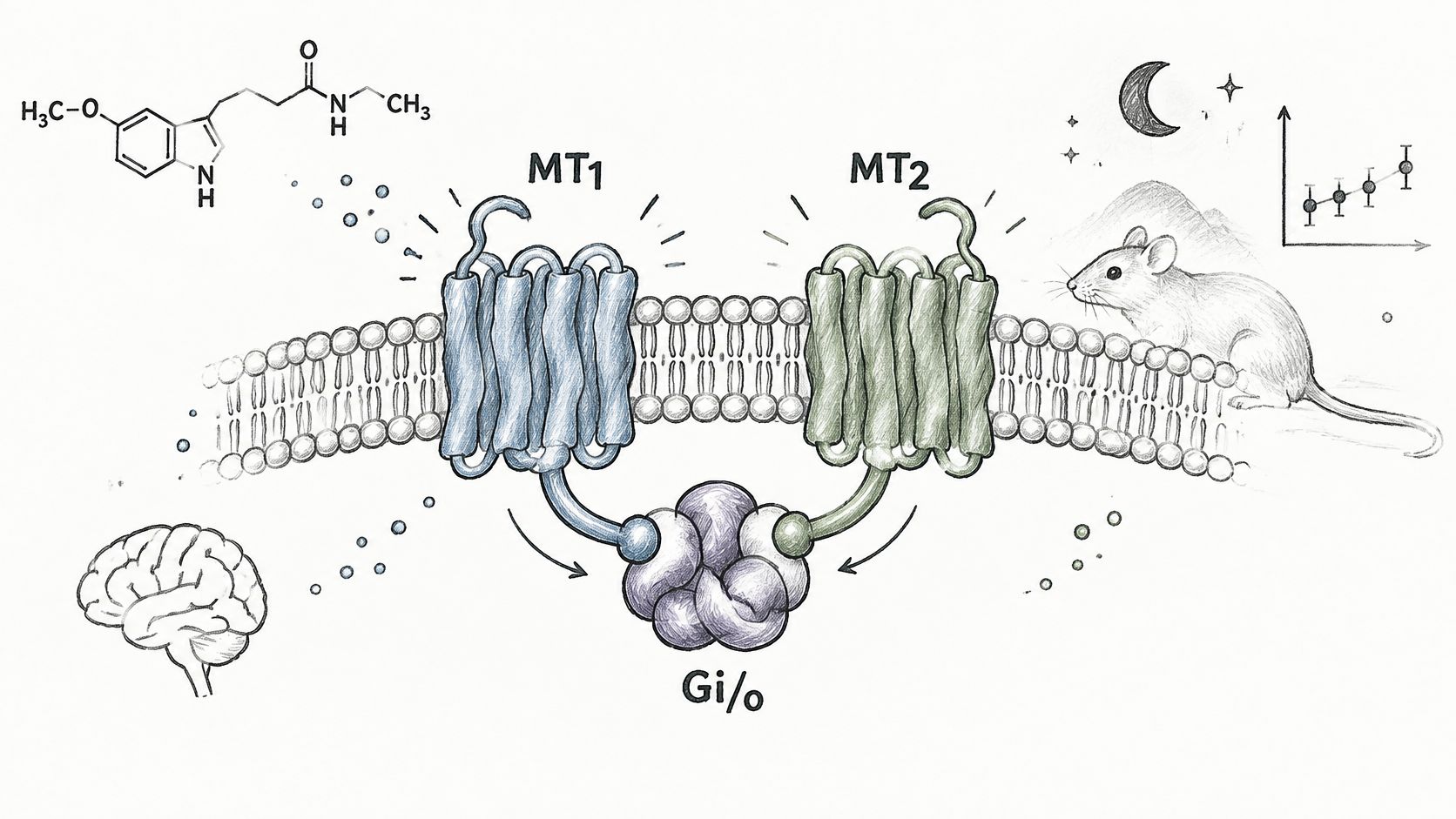
MT1 and MT2 are G-protein-coupled receptor subtypes, not peptide compounds. They're encoded by separate genes, MTNR1A and MTNR1B, and respond to melatonin, an indoleamine hormone rather than a peptide.
The similar names create a common source of confusion. Melanotan I and Melanotan II are melanocortin-peptide analogues, not melatonin-receptor ligands. Melanotan I, also known as afamelanotide, was designed around α-melanocyte-stimulating hormone activity, with an emphasis on MC1R. Melanotan II also acts at MC1R and has broader melanocortin-receptor activity, including MC4R. Those receptors belong to a different family from MT1 and MT2, so melanocortin findings shouldn't be carried over as evidence about melatonin receptors.
The names MT1 and MT2 reflect a history of receptor identification and classification. Radioactive 2-[125I]iodomelatonin binding sites were localized in rat brain in 1987. The first mammalian melatonin receptor, originally named Mel1a and now called MT1, was cloned in 1994; the second, Mel1b, now called MT2, was cloned in 1995. MT1 was subsequently confirmed in the suprachiasmatic nucleus (SCN) and the pituitary pars tuberalis, regions involved in circadian and seasonal signaling, as summarized in the peer-reviewed receptor comparison.
Lab implication: A readout labeled “melatonin-receptor response” does not identify a subtype. That assignment requires experimental evidence that separates MT1 from MT2.
MT1 and MT2 Compared Side by Side
The side-by-side table is less dramatic than the names suggest. MT1 and MT2 separate mainly through probe choice, expression site and control design; melatonin alone does a poor job of assigning a response to one subtype.
MT1 vs MT2 at a glance
| Criterion | MT1 | MT2 |
|---|---|---|
| Gene symbol | MTNR1A | MTNR1B |
| Original name | Mel1a | Mel1b |
| Year cloned | 1994 | 1995 |
| Melatonin binding, human recombinant | High affinity | High affinity |
| Tissue markers reported | Suprachiasmatic nucleus, pituitary pars tuberalis | Suprachiasmatic nucleus, retina |
| Subtype-leaning probe | 2-iodomelatonin | 6-chloromelatonin |
Human recombinant-receptor comparisons place melatonin in the same high-affinity range at both subtypes, with MT1 only marginally ahead. A gap that small can shift a binding curve, but it cannot make melatonin a subtype-isolating ligand when both receptors may be present.
The wider agonist set points the same way: potency order is broadly conserved across MT1 and MT2, so one melatonin concentration can produce overlapping occupancy. Apparent separation improves when the ligand is changed. 2-iodomelatonin is the MT1-leaning probe in this set, while 6-chloromelatonin leans toward MT2; either one still needs subtype controls because leaning toward a receptor is not the same as acting at it alone.
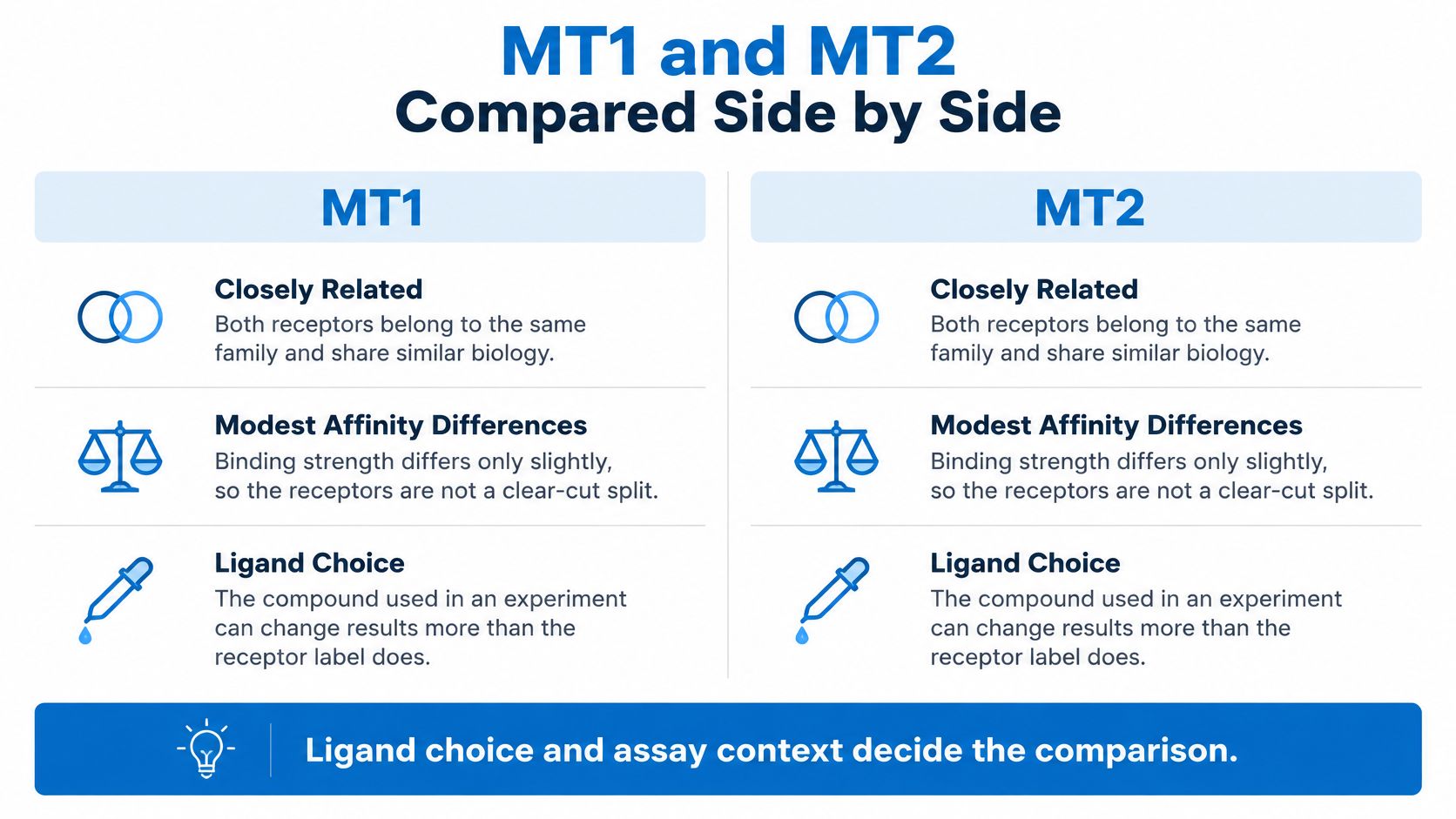
Use the table as a map, then test the circuit in front of you. Receptor expression, cellular background and ligand lot can move a readout that looks clean on paper. Subtype assignment comes from controls that isolate MT1 or MT2, not from melatonin affinity.
Downstream Signaling and Knockout Benchmarks by Receptor
Ligand binding is only the input. In cellular and SCN-slice experiments, MT1 activation is associated with inhibition of neuronal firing, while MT2 activation is associated with circadian phase shifts. Which signal dominates depends on the circuit being measured, so the same melatonin exposure can read as an MT1 effect in one preparation and an MT2 effect in another.
Receptor expression, the available G-protein complement, and cellular background all shape what a downstream readout captures. A team that measures one generalized response without controlling those variables risks mistaking an assay-system difference for a subtype-specific one.
The attribution problem starts before any ligand is chosen.
Knockout benchmarks for MT1 and MT2 studies
| Genotype (mouse) | REM-sleep endpoint | NREM-sleep endpoint | Benchmark to run |
|---|---|---|---|
| MT1 knockout | Decreased REM | Increased NREM | SCN firing response to an MT1 agonist |
| MT2 knockout | Not established | Decreased NREM | Phase-response curve to an MT2 agonist |
| MT1 and MT2 double knockout | Minimal change over the light-dark cycle | Minimal change over the light-dark cycle | Compensatory-pathway check |
The knockout phenotypes support a division of emphasis, not an exclusive assignment. MT1 deletion is associated with reduced REM sleep, particularly during the light or inactive phase, while MT2 deletion is associated with reduced NREM sleep during that phase. Removing both receptors produces minimal changes in total REM and NREM duration across the full light-dark cycle. That result points to compensatory or parallel pathways, and cautions against treating each receptor as an isolated contributor. These preclinical findings are summarized in the mouse sleep and circadian review.
For study planning, an MT1-focused arm should include REM quantity and architecture alongside SCN neuronal firing, while an MT2-focused arm should include NREM measures and circadian phase-response curves. Those endpoints make a receptor hypothesis testable. They do not convert mouse findings into predictions of human performance.
Clinical data sharpens the same limit. A 2026 systematic review of melatonin and migraine prophylaxis pooling 9 randomized controlled trials and 788 participants evaluated melatonin exposure, but exposure alone cannot identify which receptor mediates an observed effect. Assigning that effect to MT1 or MT2 requires selective ligands, circuit-appropriate readouts, and subtype controls, the same design variables that separate the receptors in preclinical work.
Ligands and Controls That Separate MT1 from MT2
Affinity will not separate these two receptors. MT1 and MT2 are closely related seven-transmembrane receptors with overlapping ligand pharmacology: both bind melatonin and 2-iodomelatonin at subnanomolar affinity, and the typical affinity order is 2-iodomelatonin > melatonin > 6-hydroxymelatonin >> N-acetylserotonin >> prazosin, as described in the melatonin receptor pharmacology study.
The binding pockets reflect that overlap. The two receptors share conserved ligand-contacting residues across their transmembrane regions, so a single agonist tends to engage both subtypes in a similar way. Subtype separation has to be built into the experiment through three levers: the ligands chosen, the circuit or output measured, and the controls run alongside each arm.
Research tools for MT1 and MT2 assignment
| Tool | Class | Selectivity note | Role in study design |
|---|---|---|---|
| 2-iodomelatonin | Melatonin analogue, agonist | About 5× higher affinity for MT1 | MT1-leaning probe, paired with an MT2 arm |
| 6-chloromelatonin | Melatonin analogue, agonist | About 5× higher affinity for MT2 | MT2-leaning probe, paired with an MT1 arm |
| Melatonin | Endogenous indoleamine hormone | Near-equal subnanomolar affinity at both | Reference agonist; cannot isolate a subtype |
| 4-P-PDOT | Antagonist | Reported MT2-preferring | Blocks MT2 to test MT2 dependence |
| Luzindole | Antagonist | Non-selective across MT1 and MT2 | Broad blockade; leaves subtype unresolved |
| MT1-null or MT2-null tissue | Genetic control | Receptor absent | Strongest subtype check |
| Peptide ligand marketed as subtype-selective | Unverified ligand class | No established MT1- or MT2-selective peptide | Identity and selectivity must be confirmed before use |
Two patterns stand out in this panel. The agonists lean rather than select: a fivefold preference shifts the concentration window where one subtype dominates, and nothing more. And no peptide ligand with confirmed MT1 or MT2 selectivity is established, so a peptide sold under an "MT1" or "MT2" label carries an unverified claim until its binding at both receptors is measured. A catalog description states intended use; a competition binding experiment states selectivity.
A control sequence for subtype assignment
Include a receptor-null or knockdown arm for each subtype. If an effect persists when the proposed receptor is absent or suppressed, a simple receptor-dependent interpretation fails.
Run both affinity-leaning probes. Test 2-iodomelatonin and 6-chloromelatonin in the relevant receptor preparations. Their opposing preferences give a directional check, which the genetic control then has to confirm.
Add an antagonist-only arm. This reveals whether baseline signaling shifts when receptor activity is blocked, including any constitutive activity in the preparation.
Include melatonin at a matched reference concentration. It anchors comparison across arms and across studies; the assignment itself rests on the probes and the null tissue.
Match vehicle conditions. Keep solvent identity and percentage consistent across comparison arms so vehicle effects cannot masquerade as ligand effects.
Use a concentration series around the measured receptor affinity. A series spanning at least three log units around each receptor's pKD shows whether an apparent preference holds across concentrations or appears at only one point.
Report the assay context. Receptor expression level, G-protein complement, cellular background, and ligand concentration all shape the response to the same nominal ligand. Document them for every preparation.
Separate functional endpoints. For sleep experiments, score REM and NREM independently rather than collapsing them into one readout. For circuit experiments, measure SCN firing or circadian phase response as distinct outputs, since one can shift while the other stays flat.
The expected pattern runs in both directions. The affinity-leaning probes should separate in the anticipated direction, and the effect attributed to a receptor should disappear in the corresponding receptor-null preparation. Loss-of-function sleep and circuit findings supply the preclinical benchmarks for that comparison, as summarized in the peer-reviewed receptor knockout review. A melatonin-only readout, by contrast, carries no subtype information at all, however cleanly the signal resolves.
Interpretation rule: A ligand response without a receptor-specific control describes that assay system. Subtype assignment requires the control.
For teams assembling a compound panel or comparing research materials, the compound research library is a starting point for checking which compounds are listed; the study still needs its own identity and selectivity verification before any ligand enters an assay.
Sourcing and Handling Ligands Before Your Assay
Paperwork should be checked before a ligand enters an assay. The record should identify the formal compound name, CAS number, molecular formula and weight, and the specific lot. A generic product sheet cannot establish what is in a particular batch.
Review the lot-specific certificate of analysis against the assay's acceptance criteria. The relevant checks include identity confirmation, stated purity and its minimum specification, net content, sterility, endotoxin and heavy-metal testing, and conformity to specification.
These documents answer one question only: what is in the vial. They say nothing about whether the compound will separate MT1 from MT2 in your system, because subtype assignment depends on ligand choice and control design rather than on supplier paperwork. Two lots with identical certificates can still produce different apparent selectivity if the assay lacks a receptor-null control.
The supplier information describes third-party, seven-category testing and batch-specific certificates of analysis linked at the product level. Those documents should be treated as records to inspect, not as evidence of assay suitability. Before procurement, confirm the current catalog listing and the lot-specific documentation for the exact material you need. The supplier's testing information describes the verification categories to check.
Laboratory sample preparation
Follow the lot specification for storage. Use the stated temperature and stability conditions for the material. A supplier may specify −20°C for certain peptides, but that example should not be generalized to every ligand.
Protect light-sensitive indole ligands. Melatonin analogues should be shielded from light during preparation and storage when the material specification calls for it.
Prepare single-use aliquots. Aliquoting reduces repeated freeze-thaw exposure and helps keep experimental handling consistent.
Record preparation conditions. Document solvent, final concentration, and observed solubility for each preparation. Those details make a failed or inconsistent response easier to investigate.
Track the stability window. Link each preparation to the lot record and its stated stability timeframe, and discard material outside that period.
A certificate of analysis can help assess identity and batch documentation. Receptor selectivity still has to be demonstrated by controls run in the actual assay.
Choosing an MT1-Focused or MT2-Focused Study Design
Neither subtype is better in general. The research question determines the design. Select the receptor hypothesis from the endpoint first, then pick a ligand and control pair capable of testing it. Affinity alone rarely separates these receptors; ligand choice, circuit context, and control design do the work.
Study design by research question
| Research question | Primary tool | Required control | Readout |
|---|---|---|---|
| Does a compound act through MT1 on REM architecture? | MT1-leaning probe such as 2-iodomelatonin | MT1-null tissue | REM and NREM architecture plus SCN firing |
| Does a compound shift circadian phase through MT2? | 6-chloromelatonin | 4-P-PDOT blockade and MT2-null tissue | Phase-response curve |
| Is an effect receptor-independent? | Melatonin reference at matched concentration | Both knockouts or antagonist blockade | Comparison with double-knockout benchmark |
| Is any melatonin-receptor activity present? | Melatonin reference | Luzindole broad blockade | Reported as melatonin-receptor activity, subtype unassigned |
An MT1-focused study fits endpoints such as REM architecture or SCN firing. Interpretation should be tested against MT1-null tissue, with REM and NREM reported separately rather than pooled into a single sleep score. An MT2-focused study fits circadian phase or NREM questions. A 6-chloromelatonin arm paired with 4-P-PDOT blockade and MT2-null tissue gives a narrower test than melatonin exposure alone, because melatonin engages both subtypes at once.
That last point limits what a melatonin-only screen can conclude. It can detect activity associated with melatonin receptors, but it cannot tell the team which subtype produced the response. The result stays melatonin-receptor activity with no subtype assigned until a receptor-specific control supports a narrower claim.
The practical sequence: confirm ligand identity and lot documentation, run paired subtype arms in a pilot with the full control set, and scale only after the relevant endpoints separate in the expected direction. If the assay cannot distinguish the candidate response from a receptor-null or blockade condition, the subtype claim fails. Researchers checking procurement requirements can consult the research-use-only policy alongside their institution's own purchasing and laboratory rules.
Decision rule: if an endpoint cannot be assigned to one receptor with a control, report it as melatonin-receptor activity rather than MT1 or MT2 activity.
Pro Tec Pep offers research-use-only compounds with batch-specific documentation and testing information for laboratory purchasing review. Before purchasing any compound for an assay, review the supplier's research-use-only terms and the lot-specific certificate of analysis for the exact material being ordered.