Molecular Weight vs Formula Weight: Key Lab Research Guide
Learn molecular weight vs formula weight terminology, calculation methods, and documentation standards for peptide and compound prep.

Molecular weight and formula weight produce the same numerical value for a given chemical formula, but molecular weight applies to discrete molecules while formula weight is the correct term for ionic compounds and other non-molecular substances. That sounds simple until you're reading a certificate of analysis, comparing supplier specs, or writing a methods section and realizing the label on the page can change how the compound should be described.
Researchers usually get tripped up because the arithmetic doesn't change. The terminology does, and that difference matters when you document a peptide, a salt, or a hydrate in a way another lab can interpret without guessing.
| Characteristic | Molecular Weight | Formula Weight |
|---|---|---|
| Best fit for | Discrete molecules, including many peptides and small organic compounds | Ionic compounds, salts, hydrates, coordination compounds, and other non-molecular substances |
| What it describes | One molecule | One formula unit or empirical formula |
| Numerical result | Often the same as formula weight for a given chemical formula | Often the same as molecular weight for a given chemical formula |
| Practical lab use | Common in peptide and small-molecule documentation | More precise for salts and lattice-based materials |
| Common reporting unit context | Often paired with daltons or g/mol depending on field | Often paired with g/mol in practical reporting |
Why Molecular Weight and Formula Weight Confuse Researchers
The confusion starts because the number usually stays the same while the label changes. For many compounds, the calculation is identical, so the wording can seem interchangeable in lab notes, supplier documents, and certificates of analysis. The problem is not the arithmetic. It is the meaning attached to the number.
A molecule is a discrete particle, one chemically defined entity. A formula unit is the smallest whole-number expression of an ionic lattice or other repeating structure. Sodium chloride is described by a formula weight because it does not exist as isolated NaCl molecules in the same way water exists as H₂O molecules. That difference matters when a method sheet, a COA, or a reconstitution note must be read without guessing how the material is being treated.
The real distinction is structural
The terminology follows structure, not convenience. Molecular weight fits discrete molecules, while formula weight fits ionic compounds, salts, hydrates, and other non-molecular substances. In practical lab writing, the label should match the species you are handling.
Practical rule: if the material is described by a repeating ionic lattice or empirical formula, write formula weight. If it is a discrete molecule, write molecular weight.
That distinction matters in peptide documentation because peptides are usually treated as discrete molecular species, so the molecular term is the clearer choice in sample prep records and methods sections. Buffer components and inorganic reagents often belong under formula weight, especially when you are checking a COA or calculating how much material to weigh out. If the label is wrong, another lab can still see the mass, but they may misread what form of the substance you meant.
How to Calculate Molecular Weight and Formula Weight
The calculation is the same in both cases. You add the standard atomic weights of every atom in the formula, then report the result using the term that matches the compound type. Britannica states that this is the basis of formula weight, and that the same arithmetic applies to molecular substances (Britannica).
Start with the formula, not the label
For a molecular compound, count each atom in the molecular formula and sum their atomic masses. For a non-molecular compound, do the same thing, but interpret the result as a formula unit rather than a single molecule. NIST's SI guidance defines relative molecular mass as a ratio to 1/12 of the mass of carbon-12, which makes the quantity dimensionless, and it recommends avoiding the older “weight” wording in formal metrology (NIST).
Water, carbon dioxide, and sodium chloride show the pattern clearly. Water has a molecular mass of about 18.015, carbon dioxide about 44.009, and sodium chloride has a formula weight near 58.44 (Britannica). The arithmetic step is the same in each case, but only the first two are best treated as discrete molecules.
Peptide chemistry follows the molecular pattern. A peptide chain is a defined molecular species, so the value belongs in the molecular weight or, more modernly, molar mass framing, depending on the report style. The key is to match the term to the structure, not to the convenience of the spreadsheet.
A simple workflow helps:
- Write the exact chemical formula.
- Sum the atomic masses of every element present.
- Decide whether the substance is molecular or non-molecular.
- Label the result accordingly.
For a compact visual walk-through, the process flow in this educational infographic is useful.
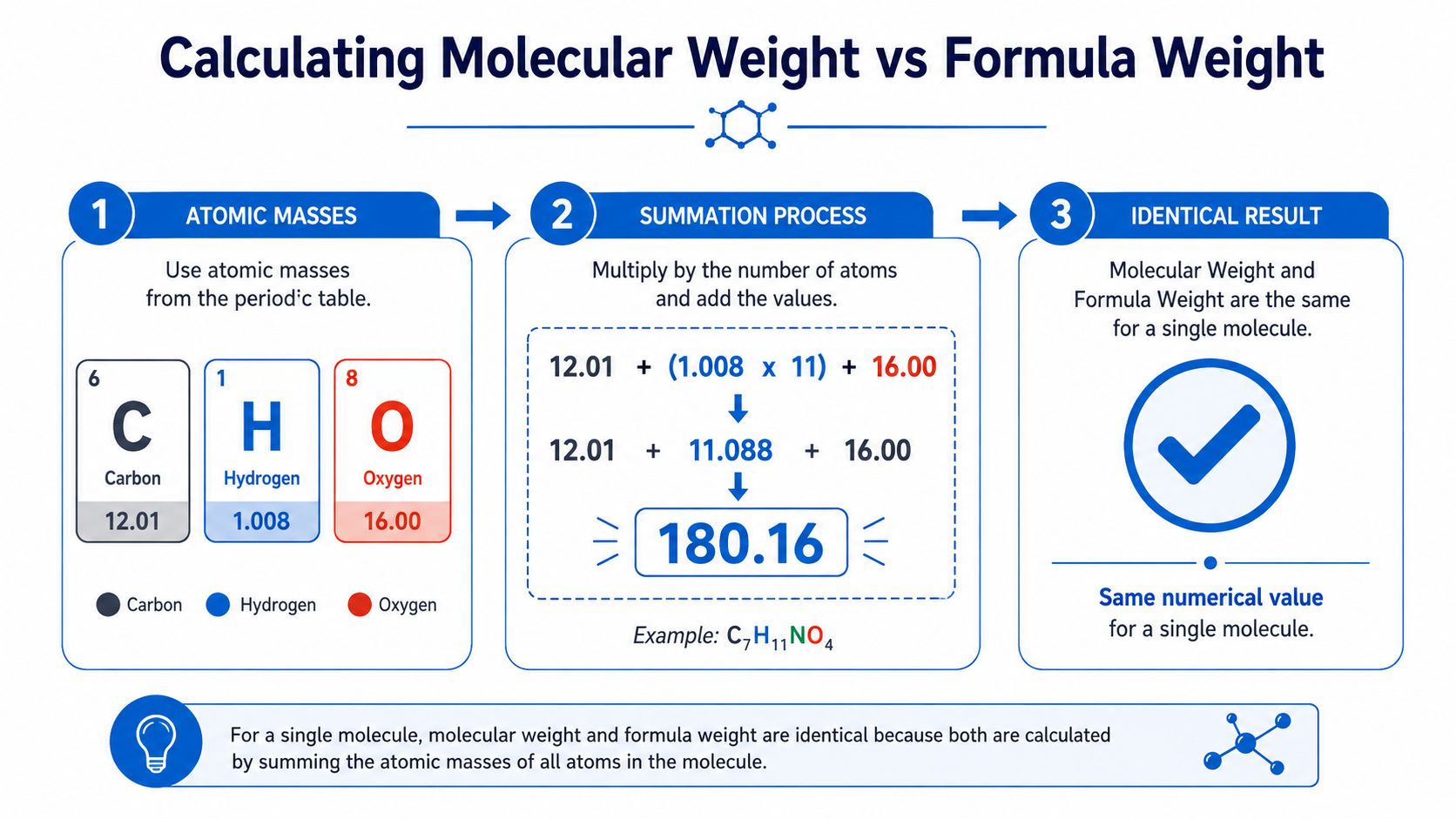
That same arithmetic is also why peptide vendors and lab teams can compare values across documentation so long as the compound form hasn't changed. A helpful technical overview of research compound documentation can be found in the compound research library.
If you want to see the calculation logic in motion, the embedded video below walks through the same type of reasoning used in lab reporting.
When to Use Molecular Weight vs Formula Weight in Research
The cleanest way to decide is to ask what kind of substance you have. If the material exists as a discrete molecule, molecular weight is the term researchers expect to see. If it exists as a salt, hydrate, coordination compound, or ionic lattice, formula weight is usually the more precise label.
Side-by-side decision criteria
For peptides, antibodies, and most small organic molecules, the molecule itself is the unit of interest. That makes molecular weight standard in biochemistry, peptide procurement, and sequence-based documentation. For sodium salts, hydrochlorides, phosphates, and other inorganic or ionic forms, the repeating formula unit is what you're counting, so formula weight is the better term.
The number won't change just because the label does. What changes is whether you're describing a single molecule or a repeating unit in a non-molecular solid.
That distinction becomes especially important when a compound has more than one common form. A free-base peptide and its salt form can share the same core sequence, but the recorded mass basis may differ once counterions or waters of hydration are part of the material description. The same logic applies to reagents written as empirical formulas rather than isolated molecular entities.
The practical test is simple. If the supplier documentation describes a sequence or a molecular structure, molecular weight is likely the right term. If it describes a formula unit or ionic composition, formula weight fits better. That's why researchers should read the form of matter first, then the number.
A focused comparison table helps keep the choice straight.
| Characteristic | Molecular Weight | Formula Weight |
|---|---|---|
| Preferred context | Discrete molecules, including peptides and small organics | Ionic compounds, salts, hydrates, coordination compounds |
| Structural assumption | One molecule exists as a defined entity | No single isolated molecule is implied |
| Typical lab language | Common in peptide and molecular biology workflows | Common in inorganic, analytical, and formulation workflows |
| Interpretation on paper | Mass of the molecule | Mass of the formula unit |
| Numeric calculation | Sum of atomic weights | Sum of atomic weights |
The rule isn't about being pedantic. It's about making sure the compound description matches the physical reality of the sample on your bench.
Impact on Laboratory Documentation and Sample Preparation
This distinction shows up first in certificates of analysis. If a supplier lists a peptide with a molecular weight, that figure is meant to support identity checks, concentration planning, and consistency across lots. If a buffer salt or inorganic reagent is listed by formula weight, the same number still supports calculations, but the label tells you the sample is being treated as a formula unit, not a discrete molecule.

That matters when you're checking whether the value on the COA matches the exact form you ordered. A hydrated salt, an anhydrous salt, or a different counterion can all change the documentation basis even if the core analyte looks familiar. The same caution applies when you cross-check vendor pages, lot-specific COAs, and internal inventory records.
Sample prep depends on the right compound form
Molarity calculations rely on the mass value you trust, but the compound form determines whether that value represents a molecule or a formula unit. For peptide sample prep, the reported molecular weight helps you translate mass into moles. For salts and inorganic reagents, formula weight does the same job, but only after you've confirmed the correct hydrate or ionic form.
The practical risk is mismatching the document to the bottle. A researcher may prep a solution based on the wrong label basis, then spend time debugging an assay that was never the problem. Good documentation prevents that. So does a habit of checking the product page, lot-specific COA, and storage note together before any solution is prepared.
For broader vendor documentation practices, the testing page is a useful example of how batch-linked data should be organized in a research workflow.
Modern Terminology Standards and Historical Context
Older literature often uses weight language where newer standards prefer mass language. NIST states that the terms atomic weight and molecular weight are obsolete and should be avoided, and it recommends relative atomic mass and relative molecular mass instead (NIST). That shift reflects the broader metrology move away from loose “weight” terminology and toward definitions grounded in measurement ratios.
Why both conventions still appear
The literature didn't switch overnight. Older journal articles, textbooks, and supplier catalogs still use the traditional wording, while modern standards documents lean toward mass-based terms. Britannica and LibreTexts preserve the practical chemistry distinction because working scientists still need a usable label for both molecular substances and ionic compounds (Britannica, LibreTexts).
That leaves researchers reading across time periods with two simultaneous tasks. They need to understand the older language without copying it blindly into modern records, and they need to know when a label is being used conventionally rather than strictly. In practice, most lab teams can read both if they keep the compound structure in view.
NIST's definition of relative molecular mass is also useful because it shows why the quantity is dimensionless. It's a ratio to the carbon-12 reference basis, not a force or a weighed object (NIST). That is part of why modern authors often prefer molar mass when they want a value with units.
What to write in a lab record
For a current notebook or methods section, keep the wording aligned with the substance and the audience. If the material is a peptide, molecular language is usually fine, but molar mass is safer when you want a unit-bearing term that fits modern style. If the material is an ionic reagent, formula weight is clearer than molecular weight because it avoids implying a discrete molecule that doesn't exist.
That approach keeps older terminology understandable without making your documentation look outdated.
Molar Mass Reporting and Unit Conventions
How should you write the same mass value so a method, a COA, and a peptide prep note all mean the same thing?
Molar mass is the cleanest modern term for bridging molecular weight and formula weight in reporting. The number stays the same, but the unit tells the reader how to use it. In routine lab work, g/mol fits solution preparation and stoichiometry, while daltons can appear in molecular biology or peptide contexts when the discussion is about single-particle size. Use the unit that matches the task, then keep it consistent in that document. (Wikipedia)
Pick the unit style that matches the audience
In analytical chemistry, g/mol is the safer default because it points directly to molar calculations. In peptide and protein work, daltons may be the more familiar label because the audience is reading size at the molecule level. The key is to avoid switching labels casually inside the same record.
If the value will be used in a calculation, state the unit. If the value is being used as a structural label, state the compound form too.
That keeps a notebook entry readable and auditable. A methods section describing solution preparation should use g/mol, because it shows how the concentration was derived. A figure legend describing a protein's size can use daltons, while a formulation note for an ionic salt should use formula weight to avoid implying a discrete molecule that is not there.
Keep the same basis across notebook entries, COA summaries, and manuscript methods. If a supplier writes molecular weight and your lab prefers molar mass, translate the term once and then use one convention throughout the document. That helps when a coworker checks a peptide reconstitution calculation or compares a salt batch against a certificate of analysis.
Consistent wording also makes later recalculation easier. Nobody has to guess whether the number refers to a molecular species, a formula unit, or an older naming convention.
Best Practices for Research Documentation and Communication
A good lab record reads like a chain of custody for terminology. Start with the compound identity, note whether it's molecular or non-molecular, then record the mass basis in the same language the structure calls for. That small habit prevents a lot of friction when a coworker, reviewer, or purchasing manager tries to reconcile a COA with a protocol.
If you're ordering materials, confirm the exact form before you compare any mass values. A salt, hydrate, or counterion change can make the wrong label look reasonable until you try to prepare the solution. The safest workflow is to match the product page, the lot-specific COA, and the notation in your notebook before the compound ever reaches the bench.
For broader policy language on research-only handling and documentation, see the research use only policy.
Best habit: write the compound form first, then attach the number. That's the easiest way to keep formula weight, molecular weight, and molar mass from drifting into one another.
When you communicate with collaborators, keep the same terminology in your email, spreadsheet, and methods draft. If someone in the group prefers formula weight for a salt or molar mass for a peptide, use the exact same basis in all three places so there's no silent conversion later. That's how you avoid the classic hydration mistake, the counterion mismatch, and the accidental substitution of empirical and molecular formulas.
If you need batch-specific documentation, compound identity checks, or research-focused product records that make terminology easier to verify, visit Pro Tec Pep and review the lot-level details before you plan your next peptide, salt, or buffer prep. Their research-use-only catalog is built around the kind of documentation discipline that keeps molecular weight vs formula weight decisions clean from procurement through reporting.
Authored using the Outrank tool