Mod GRF 129 Explained: Sequence, Uses, and COA Verification
Learn what mod grf 129 is, how it differs from related analogs, and what to verify on COAs. A practical research guide for laboratory peptide selection.

Longer half-life is often treated as an automatic advantage in peptide research. That shortcut can mislead researchers studying growth hormone release patterns. A compound that persists in circulation may be useful for sustained-exposure experiments, while a shorter-acting analogue can offer tighter control over transient signaling. Mod GRF 1-29 belongs in the second category.
The more important purchasing question isn't just what mod GRF 1-29 is supposed to do. It's what a laboratory can verify about the exact construct, its evidence base, its storage history, and the batch supplied. The distinction between mod GRF 1-29, CJC-1295 without DAC, and longer-acting CJC-1295 derivatives must remain explicit throughout protocol design.
Why Short Half-Life Is Actually an Advantage
A longer-lasting GHRH analogue is not automatically the better research tool. For experiments focused on pulsatile growth hormone signaling, extended exposure can blur the boundary between an acute receptor response and continuing stimulation. A short-acting compound gives the protocol a clearer time window.
Native GRF contains a short-lived signaling fragment, so early analogue research treated rapid degradation as a structural limitation. Work on GRF(1-29) in 1988 examined changes intended to reduce exopeptidase breakdown, including N-methylation of Tyr1 or NMeDAla2 and C-terminal amidation, as described in the historical overview of Modified GRF (1-29)). Later references place the specific modified form in the mid-2000s, while retaining the practical value of the 1-29 scaffold.

A timing problem, not a simple stability contest
The relevant question is whether an analogue provides a controllable signal. Mod GRF 1-29 was developed to improve the handling and degradation profile of the native fragment without adding the albumin-binding architecture associated with DAC-containing derivatives. Its short-acting design therefore suits experiments in which the timing of receptor stimulation matters as much as stimulation itself.
Practical rule: Choose exposure duration according to the biological question. A longer-lasting analogue may extend the signal, while a shorter-acting one can make its timing easier to define.
Human research on the underlying hGRF(1-29) scaffold describes modified derivatives as active analogues with longer plasma persistence than native hGRF(1-29). It also distinguishes them from longer-acting designs intended to prolong exposure. The PubMed record on CJC-1295 and related hGRF analogues supports this distinction between transient signaling and extended exposure.
For a pulsatility experiment, short half-life functions as a timing advantage. The research team can define an exposure window, observe the resulting response, and separate that event from later measurements. The compound is therefore judged by how clearly the protocol can verify its signal, not only by how long it remains present.
Understanding the Amino Acid Sequence and Modifications
Mod GRF 1-29 is a 29-amino-acid analogue of GHRH, rather than the complete natural hormone. Native GHRH contains 44 amino acids. The 1-29 fragment retains the receptor-active region researchers use as a scaffold for analogue development, while its smaller size makes synthesis and controlled modification more practical. Its background is summarized in the reference history of Modified GRF (1-29)).
The structural logic has three parts.
Begin with the active fragment. The 1-29 sequence is a defined functional portion of GHRH, not an arbitrary truncation. It preserves the central framework involved in receptor interaction while reducing the overall molecule size.
Reduce enzymatic breakdown. Native GRF(1-29) has a very short metabolic lifetime. Analogue research examined degradation-sensitive positions, including N-methylation involving Tyr1 or NMeDAla2, along with C-terminal amidation. These changes were intended to limit exopeptidase-mediated breakdown. The resulting sequence, however, must be confirmed from the supplier's documentation rather than inferred from a product name.
Keep activity separate from exposure time. A modification may increase resistance to degradation while preserving receptor-directed activity. It does not, by itself, establish the prolonged exposure associated with DAC. That boundary is useful when a protocol measures a transient receptor signal or attempts to resolve pulsatile signaling.
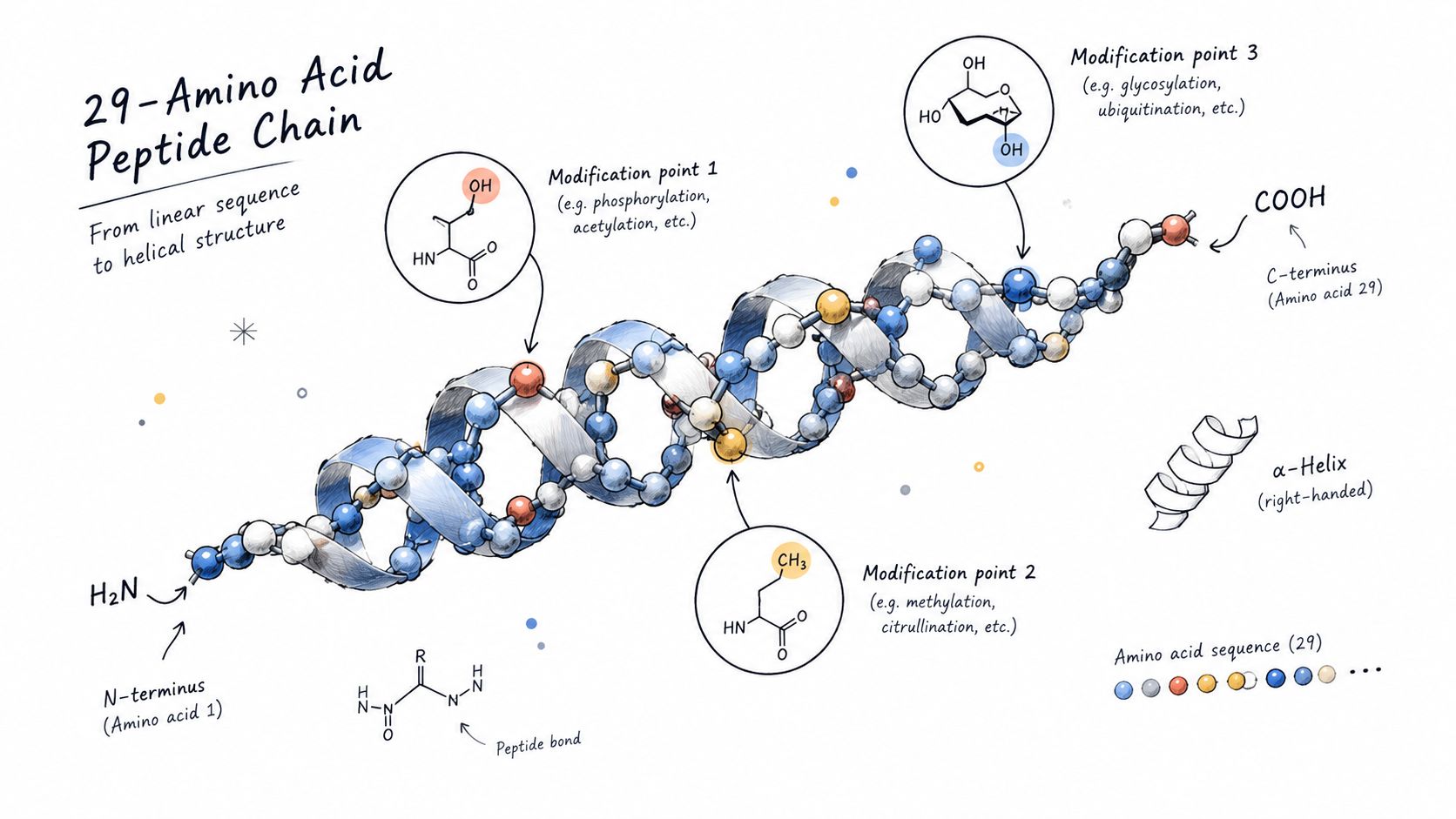
Before treating two catalogue entries as equivalent, record the exact sequence, terminal chemistry, stated synonyms, and analytical identity. The research compound library can help organize broader peptide documentation, while lot-specific supplier records determine whether the material matches the intended construct.
How Mod GRF 129 Compares to CJC-1295 and Native GRF
These names refer to related scaffolds, but they do not identify interchangeable materials. Native GRF(1-29) is the unmodified fragment and clears rapidly. Mod GRF 1-29 contains stability-oriented changes without DAC. CJC-1295 with DAC includes a Drug Affinity Complex intended to extend plasma persistence and produce longer exposure.
| Compound | Structural description | Exposure profile | Research fit |
|---|---|---|---|
| Native GRF(1-29) | Unmodified 29-amino-acid fragment | Rapid clearance | Short-lived reference responses and scaffold comparison |
| Mod GRF 1-29 | Modified GRF(1-29) without DAC | Short-acting, with improved stability relative to the native fragment | Pulsatile signaling and controlled transient exposure |
| CJC-1295 with DAC | Longer-acting derivative containing DAC | Extended plasma half-life | Sustained-exposure and longer-window studies |
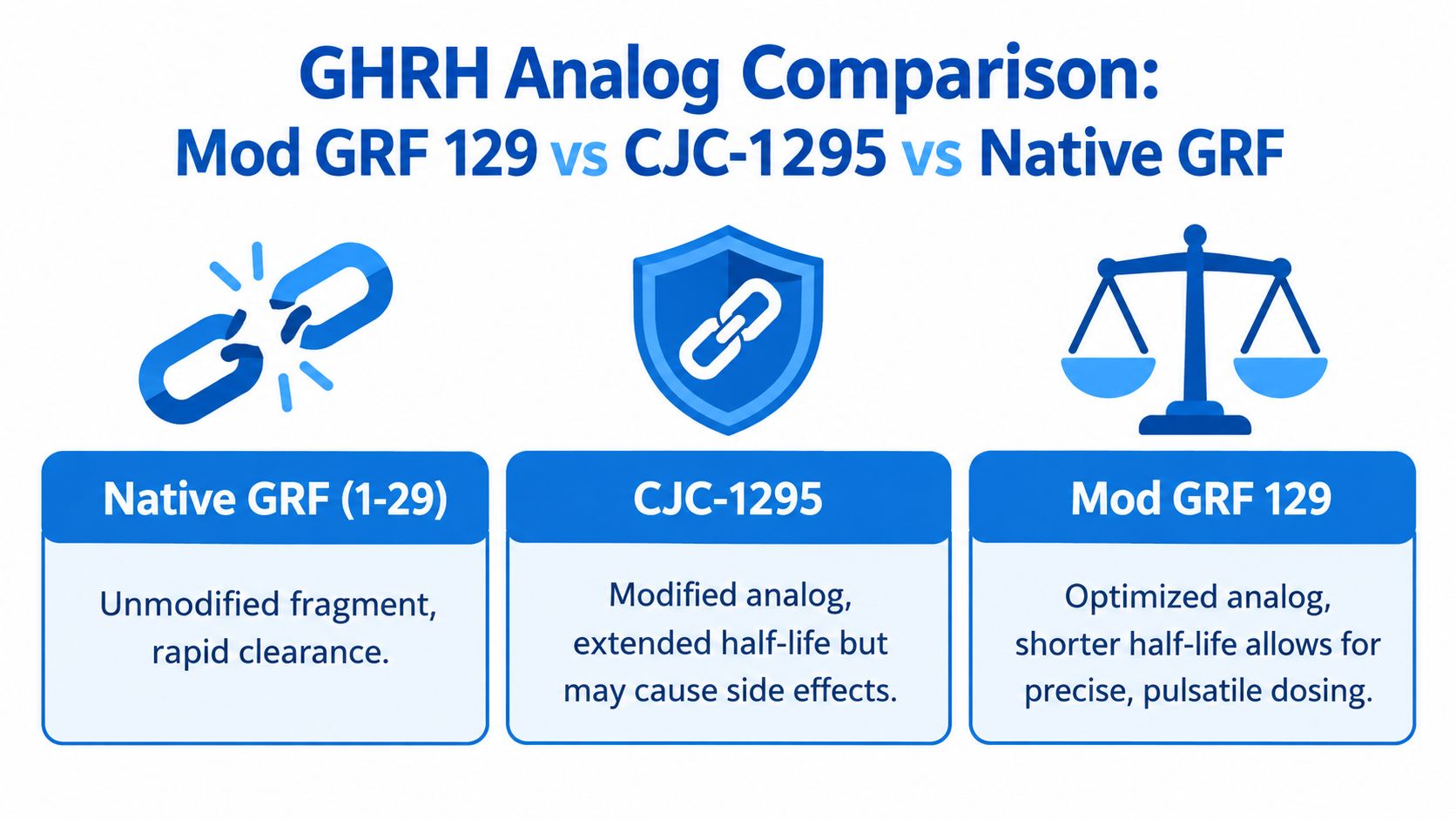
The human literature on the hGRF(1-29) scaffold describes CJC-1295 and related derivatives as active, stability-oriented analogues with longer plasma persistence than native hGRF(1-29). That supports a distinction in exposure pattern, not a universal preference. A longer signal window may suit sustained-exposure work, while a shorter window can make stimulus timing and return toward baseline easier to examine.
Choosing the exposure pattern
A receptor-binding assay may prioritize sequence identity, purity, and concentration control. A secretion-pattern experiment may instead require a short-acting construct that separates the stimulus from later measurements. A stability study can compare native and modified material to examine how residue-level or terminal changes affect degradation.
The absence of DAC is therefore an experimental feature, not a missing component. It may help researchers study transient, pulsatile signaling with less overlap between successive exposure windows. The appropriate comparison depends on the protocol, assay timing, and verified construct identity.
Researchers reviewing a CJC-1295 DAC product listing should read its formal construct description carefully. A shared synonym does not establish molecular equivalence, so sequence, terminal chemistry, and stated modifications still require confirmation in lot-specific documentation.
What the Evidence Actually Shows About Mod GRF 129
The most defensible conclusion is narrower than many product descriptions imply: Mod GRF 1-29 does not yet have a standalone human clinical evidence base. Available summaries describe a clinical evidence gap around CJC-1295 and related forms, while safety discussion is often inferred from other GHRH analogues rather than demonstrated for this exact construct. That distinction matters when a short-acting analogue is being evaluated for pulsatile GH research rather than treated as a clinically established product. See the summary of the clinical evidence gap around CJC-1295 and related forms.
The evidence should be separated by question:
- Receptor pharmacology: Mod GRF 1-29 is understood as a modified GHRH-derived analogue intended to interact with the GHRH receptor pathway.
- Analogue literature: Research on related GHRH derivatives can inform hypotheses about stability, activity, and growth hormone release kinetics. It does not prove that every derivative behaves identically.
- Standalone human evidence: No published human clinical trial has established a direct clinical profile for Mod GRF 1-29 itself.
- Laboratory evidence: In-vitro and in-vivo results depend on the model, verified construct identity, exposure window, dose conditions, and assay design.
What remains untested
A laboratory can examine receptor activity, degradation, release kinetics, and comparative analogue performance under controlled conditions. Those results can answer a defined experimental question, but they cannot establish human safety or a therapeutic profile without direct clinical evidence. Related compounds offer useful comparisons and hypotheses. They do not replace confirmation of the exact material tested.
Evidence boundary: Mechanistic plausibility supports a research question. It does not establish a clinical indication, a human safety profile, or a validated outcome for the exact analogue.
The same boundary applies to proposed combinations with GHRP-class compounds. Discussions of complementary pathways or synergy remain experimental hypotheses when strong standalone human evidence for Mod GRF 1-29 is absent. The short half-life may be useful for separating a stimulus from later measurements, but that research advantage is not evidence of a clinical benefit.
Proper Reconstitution and Storage for Laboratory Use
Preparation starts with the product record, not the vial. Before opening a lyophilized peptide, confirm its stated formulation, identity, lot number, storage requirements, and solvent compatibility. Moisture, temperature, light, and repeated freeze-thaw cycles can change sample integrity, making later assay findings harder to interpret.
Use a controlled workflow:
Review the batch documentation. Verify the material name and formulation, then connect the vial to its lot-specific certificate before choosing a solvent.
Select a compatible solvent or buffer. Sterile bacteriostatic water or a suitable laboratory buffer may fit the assay, depending on supplier documentation, pH requirements, the in-vitro or in-vivo model, and the downstream analytical method.
Plan the concentration first. Calculate the target concentration, final volume, and aliquot plan before reconstitution. Record the calculation with the vial contents and preparation details to limit unnecessary transfers.
Dissolve gently. Use gradual mixing and avoid aggressive agitation, which can create foam and add mechanical stress. A consistent handling method makes samples easier to compare.
Prepare research aliquots. Divide the solution according to the planned work. Smaller working aliquots reduce repeated opening and limit avoidable freeze-thaw exposure.
Store under documented conditions. Protect aliquots from light where required, maintain the specified temperature, and label each container clearly. Storage instructions should come from product-specific documentation when available.
The ICH Q1A(R2) stability guideline%20Guideline.pdf) describes standard long-term storage as 5°C ± 3°C for 12 months within its general stability framework. This reference does not establish stability for Mod GRF 1-29 or replace product-specific data. It shows why a storage claim needs defined conditions and a stated testing basis, rather than an informal assumption.
A complete record should identify the compound, lot, preparation date, solvent, concentration, operator, storage condition, and relevant handling notes. Those details let the team distinguish a biological result from a preparation or storage variable.
What to Verify on a Certificate of Analysis
A certificate of analysis should answer a narrower question than “is this product high quality?” It should show whether the exact batch delivered to the laboratory was tested. FDA guidance describes a COA as a record linked to testing of a representative sample from the batch intended for delivery, as explained in the FDA certificate of analysis guidance.
That batch link distinguishes a usable COA from a generic product sheet. A product page may describe a nominal Mod GRF 1-29 construct, while a COA should identify the tested lot and report results for that material. Without this connection, researchers cannot confidently compare shipments or investigate an unexpected assay result.
| COA Field | Purpose | Red Flag if Missing |
|---|---|---|
| Material name | Confirms the tested compound identity | The document may describe a different analogue |
| Batch or lot number | Maps the result to the received material | The COA may be generic rather than lot-specific |
| Date of release | Establishes when the batch entered release control | The testing timeline cannot be assessed |
| Tests performed | Shows which quality attributes were examined | The scope of verification remains unclear |
| Acceptance limits | Defines the pass criteria | A result lacks its decision context |
| Numerical results where applicable | Records the measured outcome | “Pass” alone may hide the underlying result |
Reading beyond the headline result
Compare the COA with the vial label, purchase record, and internal sample log before using the material. The compound name, lot identifier, and release date should agree across those records. A mismatch should pause the experiment until the supplier explains whether it reflects a documentation error, a relabeling issue, or a different material.
Review the methods as well as the results. A stated purity value is easier to interpret when the document identifies the test performed, acceptance limit, measured result, and batch. Supplier research testing information can support this broader document review, but it does not replace batch-specific records.
A COA earns confidence through traceability. It should be batch-linked, test-specific, and auditable, rather than accepted solely because it carries the title “certificate.”
Common Misconceptions About Naming and Identity
The names attached to mod GRF 1-29 can suggest equivalence where none has been demonstrated. CJC-1295 without DAC, modified GRF, and tetrasubstituted GRF(1-29) may appear in the same search results, yet a product page may not state whether those labels refer to the same construct. The overview of mod GRF 1-29 naming and regulatory confusion explains this broader problem.
Treat each name as a starting point for verification. A supplier might use “CJC-1295 without DAC” for mod GRF 1-29, but the wording alone does not establish matching sequence, substitutions, terminal chemistry, or formulation. “Modified GRF” is even less specific. It can describe a category of altered GRF material without identifying the exact analogue.
The short half-life also makes identity especially important. Researchers studying pulsatile signaling need to know which construct they received, because a different modification can change exposure behavior and undermine comparisons between experiments.
Identity checks that prevent substitution errors
- Read the sequence: Product documentation should state the amino acid sequence where applicable.
- Confirm the modification map: Look for named substitutions and terminal chemistry, not only a trade name.
- Check for DAC: The Drug Affinity Complex should be explicitly identified as present or absent, since it changes the expected exposure profile.
- Match the lot record: The vial, COA, and purchase record should point to the same material and batch.
No FDA-approved therapeutic label, indication, or established human safety profile exists for this exact analogue. Marketing terminology therefore cannot replace chemical identity records. Use naming to find candidate materials, then verify the construct before interpreting results or comparing studies.
Making the Right Choice for Your Research Protocol
Choose Mod GRF 1-29 when the protocol needs a short-acting GHRH analogue without DAC. Its brief exposure is useful for testing transient receptor signaling and pulsatile growth hormone release, where prolonged activity could blur timing. Native GRF(1-29) provides an unmodified reference, while a DAC-containing derivative suits sustained-exposure experiments.
Before ordering, verify that:
- Exposure duration matches the protocol.
- The construct, substitutions, and terminal chemistry are documented.
- Evidence is separated into receptor pharmacology and direct human clinical findings.
- The supplier provides a lot-specific COA and storage instructions.
This checklist supports a defensible choice based on what can be verified, rather than on synonyms or the assumption that longer persistence is better.
Pro Tec Pep offers research-use-only compounds with product documentation and batch-specific COA access. Researchers can review Pro Tec Pep before procurement.
For laboratory research use only. Not for human or veterinary use. Not a drug, food, or cosmetic. Not evaluated by the FDA. Not intended to diagnose, treat, cure, or prevent any disease.