Mod GRF 1-29 Research: Sequence, Forms, and Lab Use
Explore the Mod GRF 1-29 research guide, covering its sequence, forms, and proper laboratory handling protocols for accurate experiments.

What if the main research problem with Mod GRF 1-29 isn't its proposed mechanism, but the assumption that every vial carrying that name represents the same documented material? A peptide can have a familiar label and still raise unresolved questions about sequence, substitutions, salt form, purity, degradation, and evidence.
Mod GRF 1-29 is best approached as a research-only synthetic GHRH analogue, not as a wellness or performance shortcut. The useful questions are practical: what sequence is present, which modifications were made, how was the lot identified, and can another laboratory reproduce the result? Those questions matter because direct human evidence for the standalone no-DAC form remains limited, while much of the surrounding discussion draws from related GHRH analogues. A review of the evidence gap describes long-term safety and efficacy for the no-DAC form as unproven.
What Mod GRF 1-29 Actually Is in a Research Context
Modified GRF (1-29) is a 29-amino-acid peptide analogue of growth-hormone-releasing hormone, or GHRH. It is built from the amino-terminal portion of the native hormone, whose full sequence contains 44 amino acids. The development logic came from the finding that the first 29 amino acids retained potency comparable with the full-length hormone, creating a shorter scaffold suitable for analogue design. The documented history of Modified GRF (1-29)) traces the molecule's development to that structure and stability problem.
The word “modified” deserves careful attention. It doesn't identify one universal commercial formulation by itself. In the literature, related 29-residue analogues have included substitutions intended to reduce enzymatic breakdown, and the term tetrasubstituted GRF (1-29) appeared by 2005 for a form involving changes at positions 2, 8, 15, and 27. A laboratory therefore shouldn't rely on a product title alone. The lot-specific sequence and analytical record should control the identity decision.
Why identity comes first
A bench researcher evaluating this material should separate four questions:
- Sequence: Does the reported amino-acid order match the intended 1-29 analogue?
- Modification status: Are the stated substitutions present, and is a DAC component absent or present?
- Analytical quality: Does the certificate support identity and purity with batch-linked testing?
- Material condition: Does the vial arrive as an intact lyophilized solid without visible compromise?
The peptide is studied primarily for its interaction with the GHRH receptor and its ability to stimulate growth-hormone secretion in experimental systems. Human studies of related GHRH(1-29) analogues establish endocrine activity, but they don't automatically validate every claim made for standalone Mod GRF 1-29.
Practical rule: A label creates a purchasing lead. A sequence record, analytical result, and lot number create a usable research reagent.
That distinction helps keep bench conclusions interpretable. If an assay produces an unexpected result, the researcher needs to know whether the explanation lies in biology, experimental design, degradation, impurity, or a mismatched analogue.
How the 1-29 Backbone Compares to Full-Length GHRH
Native GHRH contains 44 amino acids, but the amino-terminal 29-residue segment retains the main functional activity needed for receptor interaction. Researchers can therefore study a shorter scaffold rather than carrying the full C-terminal tail into every analogue design. The foundational observation was that GHRH(1-29) maintained potency comparable with the full hormone, a finding that made the truncated backbone scientifically useful. The early human study indexed by PubMed reflects how this 29-residue platform moved into human dose-ranging research by the mid-1980s.
A useful analogy is a key cut from the working portion of a longer object. The discarded section may affect handling or clearance, but the central teeth still determine whether the key fits the receptor. Independent catalog information identifies residues 13-21 as contributing most to high-affinity receptor binding, while residues 24-29 appear less important for recognition. The GRF(1-29) amide binding summary gives that distribution practical significance for truncation and analogue design.
The position-2 vulnerability
The native N-terminal arrangement places Tyr at position 1 and Ala at position 2. That exposed sequence can be vulnerable to cleavage by dipeptidyl peptidase-4, also called DPP-4. Once the first residues are removed, the peptide may lose the structure needed for its intended receptor interaction.
Modification at position 2 is therefore mainly a stability decision, not a promise of a particular human outcome. Researchers alter the exposed cleavage site while retaining the 1-29 frame, then assess whether the resulting material shows improved resistance and preserved biological activity.
| Feature | Native GHRH (1-44) | Mod GRF (1-29) |
|---|---|---|
| Overall length | 44 amino acids | 29 amino acids |
| Design basis | Full native GHRH sequence | Amino-terminal GHRH scaffold |
| Receptor-relevant region | Includes the 1-29 region | Concentrates the principal active scaffold |
| Position-2 concern | Exposed site vulnerable to enzymatic cleavage | Modified analogue design addresses cleavage exposure |
| Research purpose | Study of native hormone biology | Study of a shortened, stability-oriented GHRH analogue |
The table shouldn't be read as proof that every Mod GRF preparation behaves identically. Modification identity, formulation, purity, and degradation status still need confirmation at the lot level.
Common Forms and the No-DAC Versus DAC Distinction
The phrase no-DAC identifies a major structural and experimental distinction. Contemporary research summaries describe Mod GRF 1-29 as the form associated with CJC-1295 without the albumin-binding Drug Affinity Complex. The reported material has 29 amino acids, a molecular formula of C152H252N44O42, and a molecular weight of 3,367.9 g/mol in one summary. The comparative profile of CJC-1295 with and without DAC explains why the absence of DAC changes the experimental time course.
Without the albumin-binding component, the no-DAC form is described as having a short circulating window of about 30 minutes. That short window is associated with a transient, pulsatile growth-hormone response rather than prolonged exposure. For a laboratory modeling secretory pulses, this distinction is central. A researcher examining sustained receptor activation is asking a different question and needs a different molecular form.
What DAC changes
CJC-1295 with DAC is a related long-acting analogue that incorporates an albumin-binding design. Binding to circulating albumin changes clearance and extends exposure, producing a more sustained profile. The no-DAC form, by contrast, is typically selected when the experiment needs a defined signal that rises and falls over a shorter interval.
The choice should follow the assay question rather than a marketing label:
- Pulsatile signaling studies: The no-DAC form provides a short activity window suited to transient endocrine readouts.
- Sustained-exposure studies: A DAC-containing analogue represents a different pharmacokinetic model.
- Sequence-comparison work: Both forms require explicit structural documentation because they aren't interchangeable reagents.
- Interpretation: A result from CJC-1295 with DAC cannot automatically be assigned to Mod GRF 1-29 without DAC.
| Attribute | Mod GRF (1-29) No-DAC | CJC-1295 with DAC |
|---|---|---|
| Core format | 29-residue GHRH analogue | GHRH analogue with albumin-binding modification |
| Circulating profile | Short, approximately 30-minute window | Extended exposure |
| GH pattern studied | Transient and pulsatile | More sustained |
| Best experimental fit | Pulse timing and short-response assays | Prolonged receptor-activation models |
| Interpretation risk | Can be mistaken for DAC-containing material | Can be wrongly treated as the no-DAC form |
The practical lesson is simple. “CJC-1295” alone may not be enough for a procurement record. The record should state Mod GRF 1-29, no-DAC status, sequence, formulation, and lot-specific analytical evidence.
Documented Substitutions and Their Research Rationale
The substitution pattern is where many product descriptions become unreliable. Verified historical information supports the early use of a D-alanine substitution at position 2 to reduce cleavage by DPP-4, while the tetrasubstituted terminology later referred to changes at positions 2, 8, 15, and 27. The historical account of Modified GRF (1-29)) places these changes within a broader effort to make the native fragment less vulnerable to enzymatic breakdown.
The rationale should be framed as structure and stability optimization, not as a guaranteed potency advantage. A substitution can alter cleavage susceptibility, oxidation behavior, conformational preference, synthesis behavior, or receptor contact. Those effects need to be tested with the appropriate assay rather than inferred from the name.
Reading the modification logic
The clearest interpretation is comparative:
- Position 2: A D-alanine change has been described as a way to reduce DPP-4 cleavage near the exposed N-terminus.
- Position 8: The tetrasubstituted nomenclature includes a change at this position, but the exact rationale must be tied to the sequence and analytical record for the specific material.
- Position 15: This position lies within the central region associated with receptor binding, so changes here deserve particular scrutiny in bioactivity assays.
- Position 27: This falls in a region considered less important for high-affinity recognition than residues 13-21, but it can still influence stability, synthesis, or overall conformation.
| Position | Native GHRH Residue | Common Substitution | Stated Research Rationale |
|---|---|---|---|
| 2 | Alanine | D-alanine in an early analogue | Reduce DPP-4 cleavage |
| 8 | Literature-dependent | Included in tetrasubstituted designs | Analogue stability optimization |
| 15 | Literature-dependent | Included in tetrasubstituted designs | Structural and stability optimization near a binding-relevant region |
| 27 | Literature-dependent | Included in tetrasubstituted designs | Analogue optimization outside the central binding-critical segment |
A PubMed-indexed human study administered synthetic GHRH(1-29) analogues to five normal men, with intravenous bolus amounts ranging from 0.015 to 0.5 micrograms per kilogram. The original dose-ranging report demonstrates that human endocrine experimentation occurred early, but it doesn't establish long-term efficacy or safety for modern standalone Mod GRF 1-29.
A later review described [Nle27]GHRH(1-29)-NH2 as an amidated 29-amino-acid peptide with a methionine-to-norleucine substitution at position 27. That analogue stimulated growth-hormone secretion through intravenous and subcutaneous routes without adverse effects in the cited review context, but it remains a related analogue, not automatic proof for every Mod GRF sequence.
Laboratory Handling, Reconstitution, and Storage Basics
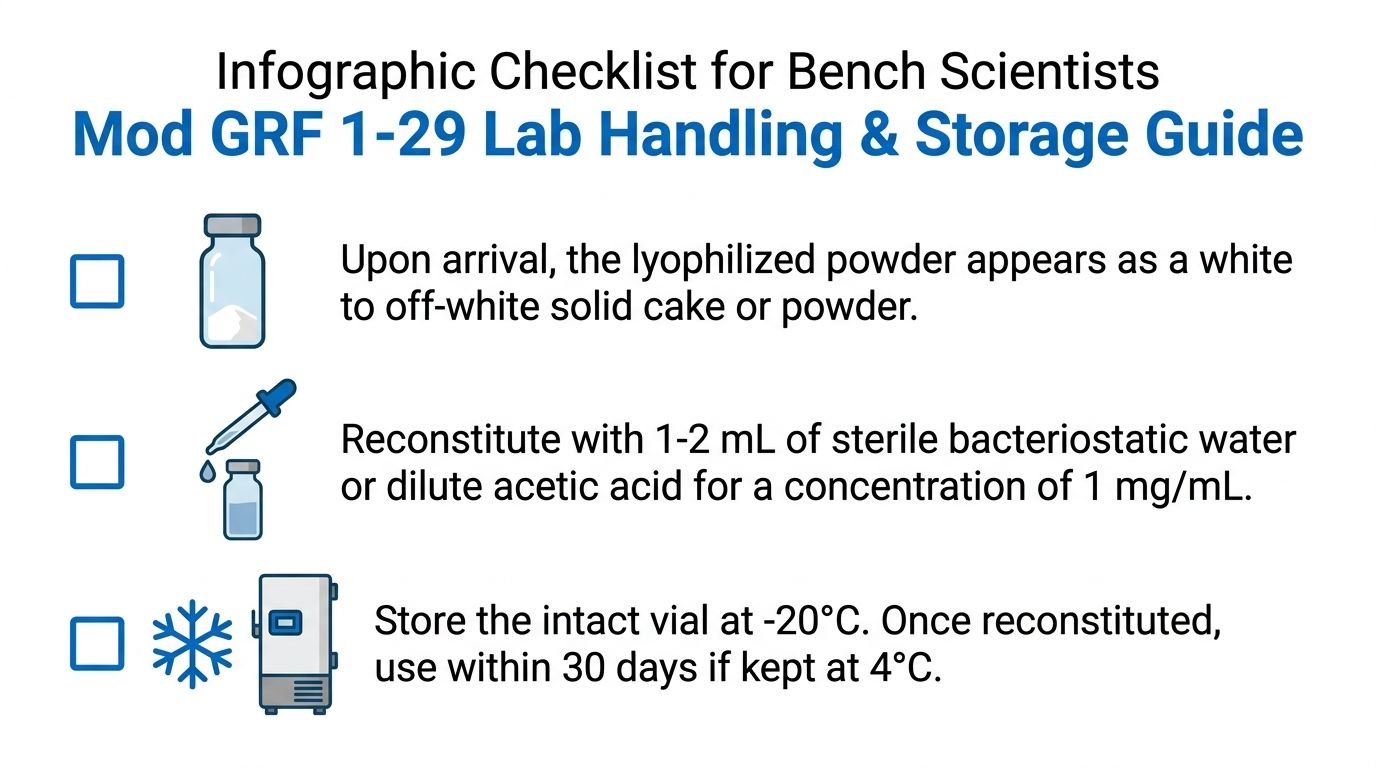
A research vial commonly arrives as a white to off-white lyophilized solid cake or powder. The appearance provides only a preliminary condition check. It doesn't confirm sequence, purity, sterility, or potency, so the visual inspection should be recorded alongside the lot number and shipping condition.
Sample preparation should follow the laboratory's validated SOP. Common research handling references describe sterile bacteriostatic water or dilute acetic acid as possible vehicles, with gentle addition along the vial wall and slow swirling rather than vortexing. The aim is to limit foaming and mechanical stress while the powder dissolves.
A basic material-integrity check
Before an assay, the researcher should document:
- Arrival condition: Record the vial, label, lot, seal, and powder appearance.
- Vehicle selection: Use the vehicle specified by the approved laboratory SOP, such as sterile bacteriostatic water or dilute acetic acid.
- Mixing method: Swirl gently. Avoid vortexing or vigorous shaking.
- Solution appearance: Check for unexpected cloudiness, visible particles, or undissolved material.
- Storage state: Keep intact lyophilized material at -20°C as the default laboratory storage condition.
- Aliquoting: After reconstitution, prepare single-use laboratory aliquots where the assay design permits, then store them at -20°C.
- Freeze-thaw control: Avoid repeated freeze-thaw cycles because they can accelerate material stress and complicate interpretation.
- Short handling windows: Keep wet samples cold on wet ice during brief bench handling, consistent with the lab's SOP.
The infographic includes a preparation example involving 1-2 mL of vehicle and a stated 1 mg/mL concentration, as well as a refrigerated time window. Those figures should be treated as the asset's supplied reference content, not as a universal protocol. Laboratories should validate concentration, container compatibility, sterility controls, and stability for the intended assay.
A related educational video can provide visual context for peptide sample handling:
These practices concern laboratory sample preparation only. They aren't instructions for human administration, and the approved institutional SOP always takes precedence.
Reading a Research-Grade Certificate of Analysis
A certificate of analysis should turn a labeled vial into a traceable research reagent. The document needs to connect the exact lot to the material tested, the methods used, and the acceptance criteria applied. A generic certificate without a matching batch identifier gives much weaker support for reproducibility.
Fields that deserve close review
| COA Field | What It Reports | Why It Matters in the Lab |
|---|---|---|
| Identity | Confirmation by mass spectrometry, HPLC, or another stated method | Helps establish that the material matches the intended peptide |
| Molecular weight | Observed mass compared with the expected structure | Can reveal sequence or modification mismatches |
| Purity | HPLC or UPLC trace and reported purity threshold | Helps researchers assess major chromatographic impurities |
| Salt or counter-ion form | Chemical form supplied with the peptide | Affects mass calculations and formulation records |
| Residual solvents | Remaining process solvents | Supports impurity assessment and assay planning |
| Endotoxins | Reported bacterial endotoxin result or limit | Relevant to cell-based and sensitive biological work |
| Lot and method version | Batch identity and analytical procedure version | Allows unexpected results to be traced to a manufacturing run |
A strong record should also state whether the material is amidated, acetylated, supplied as a salt, or linked to an additional chemical component. Those details matter because a researcher calculating molecular mass or preparing a standard curve can otherwise compare the wrong expected value with the observed result.
Third-party testing and reproducibility
Third-party seven-category testing can reduce dependence on a vendor's internal statement when it covers identity, purity, net content, sterility, endotoxins, heavy metals, and conformity. It doesn't remove the need for scientific judgment, but it creates a broader verification trail.
Batch-linked records matter most when an assay behaves unexpectedly. A lot number, analytical method version, chromatogram, mass result, and storage record allow the laboratory to ask a precise question: did the biological result change because the model changed, or because the reagent changed? Without those records, the investigation quickly becomes speculative.
Documentation standard: If a supplier can't connect the COA to the exact lot, the material may still be labeled, but its reproducibility claim remains incomplete.
Why the Evidence Base Still Has Clear Gaps
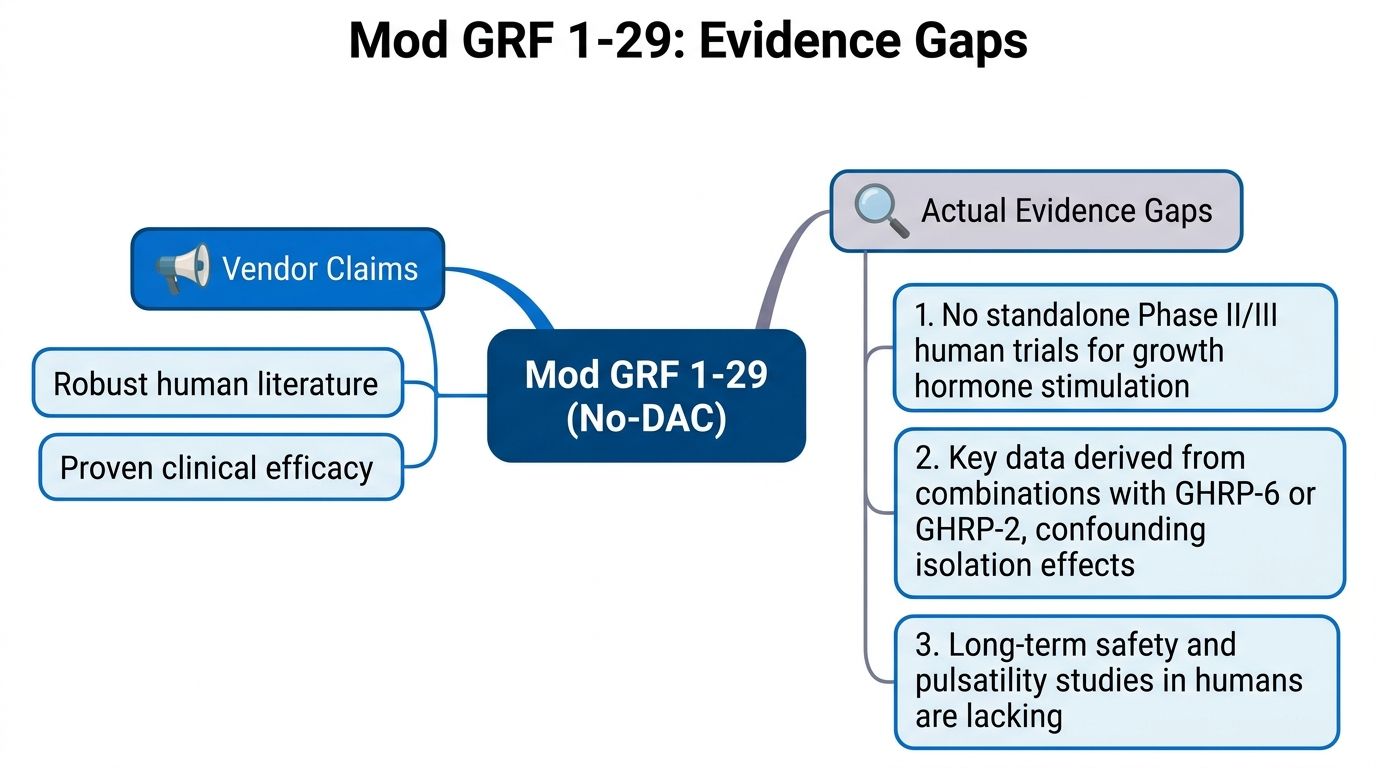
A receptor mechanism and a human outcome aren't the same type of evidence. Human studies show that GHRH(1-29) analogues can produce measurable endocrine activity, but direct standalone trials of the exact no-DAC Mod GRF 1-29 material remain sparse. The literature therefore supports a narrower conclusion than many vendor pages imply.
A controlled study in healthy older men found that subcutaneous GHRH(1-29) reversed age-related declines in growth hormone and IGF-1 over the short term, demonstrating in-vivo endocrine activity. The older-men study is relevant to the GHRH(1-29) backbone, but it doesn't answer every question about a modified, no-DAC research preparation.
A separate comparative study found that GHRH(1-29)NH2 and [Ac-D-Tyr1,D-Ala2]-GHRH(1-29)NH2 produced similar peak growth-hormone responses and similar area-under-the-curve values at a submaximal subcutaneous amount of 3 micrograms per kilogram in normal male volunteers. The comparative volunteer study supports activity of the 1-29 core and a related analogue. It still shouldn't be presented as a matched-sequence trial of every product sold as Mod GRF 1-29.
Questions a responsible review should leave open
- Which endpoints were measured in the exact sequence under evaluation?
- Were the observations made in vitro, in an animal model, or in a controlled human study?
- Did the experiment test the standalone peptide or a combination with another secretagogue?
- How long did the observed change persist?
- Were long-term safety, repeated exposure, and assay reproducibility evaluated?
Vendor statements should therefore be treated as hypotheses until matched-sequence data support them. In particular, claims about durable IGF-1 patterns, sleep architecture, body composition, or clinical efficacy require evidence that is specific to the material and endpoint, not merely related by peptide class.
Key Takeaways for the Research Bench
What should a researcher verify before treating Mod GRF 1-29 as a usable reagent? Start with identity, then connect the material's documented form to the assay design. A biological result is only as interpretable as the sequence, lot, and handling record behind it.
Use these reminders in the laboratory record:
Verify the sequence before the assay. The lot-specific COA should name the 29-residue backbone, listed substitutions, amidation or other terminal chemistry, and no-DAC status when applicable. Treat the COA like a chain-of-custody label, not a general product description.
Match the form to the research question. The no-DAC form is associated with a short, approximately 30-minute circulating window. It therefore fits designs examining transient or pulsatile activity, rather than conclusions about sustained exposure. The comparative form distinction was outlined earlier in the article.
Treat documentation as part of the reagent. Identity, purity, net content, sterility, endotoxins, heavy metals, and conformity records have greater value when linked to the exact lot and analytical method. A catalog page cannot replace batch-specific evidence.
Protect sample integrity. A practical handling framework includes intact lyophilized storage at -20°C, validated sample preparation, cold short-term handling, single-use aliquots where appropriate, and limited freeze-thaw exposure. Record preparation conditions so a later assay can be compared with the original workflow.
Keep analogue evidence in its lane. Findings from native GHRH(1-29), amidated analogues, CJC-1295 with DAC, Sermorelin, or combination studies may guide a hypothesis. They do not establish the efficacy or long-term safety of standalone Mod GRF 1-29.
Supplier review should follow the same standard. Pro Tec Pep lists research-use-only compounds with batch-linked documentation, product specifications, and optional cold-chain logistics. Researchers can consult the Pro Tec Pep research catalog and request records for sequence confirmation, procurement review, and assay traceability.
For laboratory research use only. Not for human or veterinary use. Not a drug, food, or cosmetic. Not evaluated by the FDA. Not intended to diagnose, treat, cure, or prevent any disease. By purchasing, you certify you are a qualified researcher and agree to use this product solely for in-vitro laboratory research.