Lot to Lot Verification Procedure: A Practical Guide
Learn a defensible lot to lot verification procedure for research peptides, from sampling and identity testing to OOS handling and documentation.

A new vial arrives just as the current lot is running low. The label matches the purchase order, the Certificate of Analysis reports high purity, and the next assay run is already scheduled. The practical question isn't whether the paperwork looks complete. It's whether the incoming material can replace the established lot without changing the experiment.
Why Lot to Lot Verification Matters When a New Vial Arrives
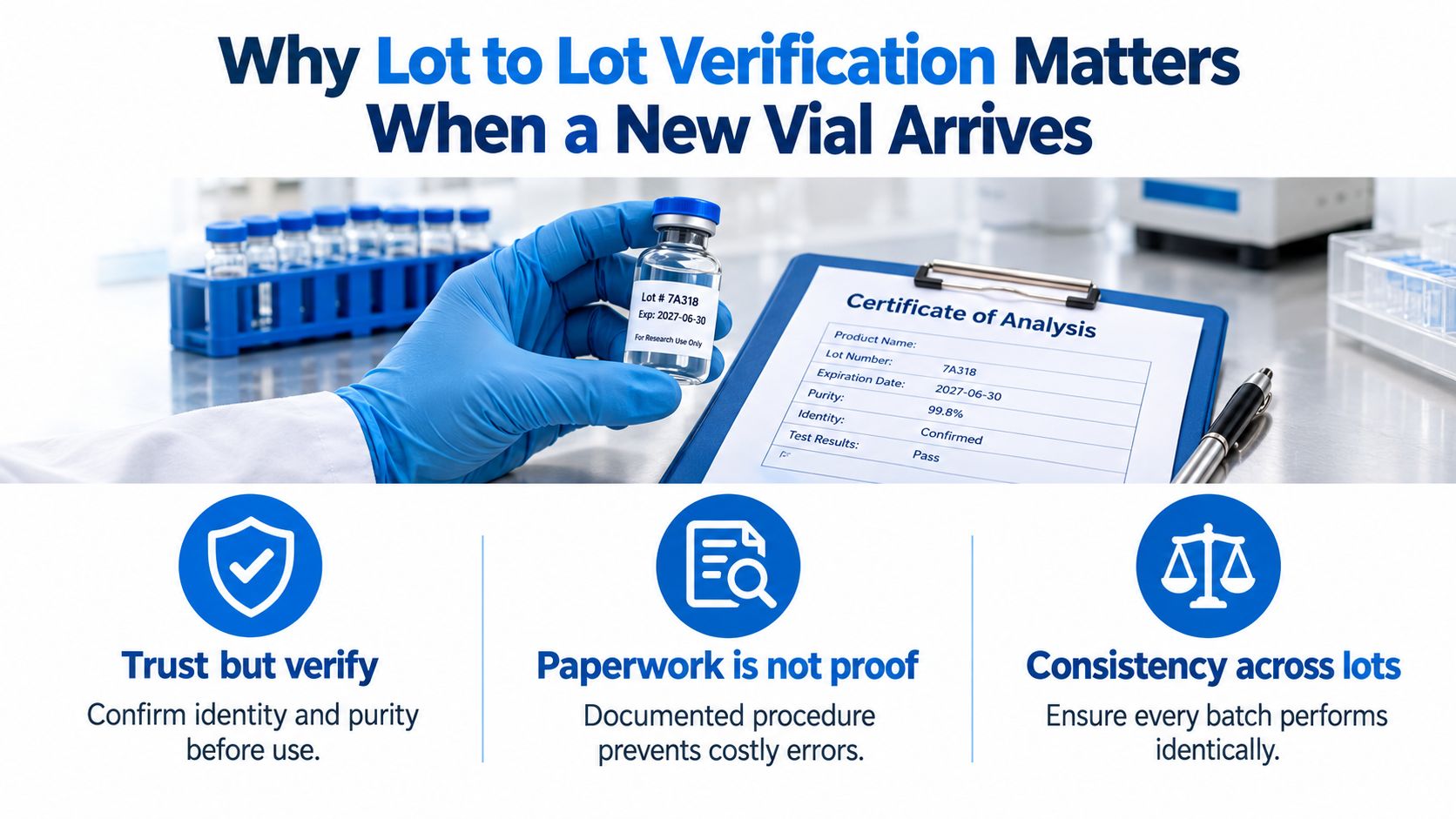
The first decision belongs at receipt: hold the new lot pending verification, rather than placing it directly into experimental stock. A defensible lot to lot verification procedure establishes what the laboratory needs to know before substitution, who reviews the evidence, and how unresolved differences are handled.
Chemical conformity and experimental comparability are related, but they aren't interchangeable. A material can satisfy its analytical specification while still requiring a separate assessment of performance in the laboratory's application.
Decide what the laboratory is releasing
The release question should identify the intended workflow. Material intended for chromatographic method development needs a different assessment from material serving as a critical reagent in an in-vitro cell-response assay. The laboratory should define that purpose before deciding which evidence is sufficient.
- Confirm the material received: Match the vial, purchase record, and exact batch documentation.
- Establish analytical conformity: Evaluate the relevant measurements against approved specifications.
- Assess application suitability: Determine whether the incoming lot needs a functional comparison before substitution.
The compound research library can support the initial review of compound information. Product-level information, however, should remain separate from the receiving laboratory's lot-specific decision.
Practical rule: A supplier's release decision establishes conformity to the supplier's specification. The receiving laboratory still needs evidence appropriate to its own experiment.
An academic laboratory might manage this through a controlled worksheet and a designated reviewer. A CRO might connect the same evidence to purchasing, inventory status, and project authorization. Neither workflow needs elaborate paperwork for its own sake, but both need an unambiguous boundary between received, under evaluation, and released for the defined application.
Building the Receipt and Documentation Record
The receipt record should connect the physical containers to the evidence used for release. A product name alone isn't enough: the laboratory needs to establish which material arrived, which manufacturing batch it belongs to, and what happened between shipment and testing.
The regulatory model is useful without implying that research compounds are approved drugs. FDA's ICH Q7A guidance, issued in August 2001, calls for at least one identity test for every material batch and permits reliance on supplier results for other testing only within a supplier-qualification system. Before reducing routine in-house testing, it calls for complete analyses of at least three batches, followed by periodic comparisons with supplier CoAs.
Capture the receipt evidence
- Manufacturer lot number and container count: Record the identifiers present on the packaging, including any mismatch with the purchase order.
- Material definition: Capture the formal name, CAS number, and peptide sequence where applicable. Record formulation state and declared salt or counter-ion information when available.
- Storage and shipment conditions: Document the stated storage requirement, packaging condition, available temperature records, and unexplained transit excursions.
- Exact batch-linked CoA: Preserve the document associated with the received lot, not a generic specification sheet or a certificate from another batch.
- Preparation history: Record laboratory reconstitution conditions, solvent identity, preparation date, storage location, and subsequent handling.
Under Q7A, an authentic CoA should identify the material, batch number, release date, required tests, acceptance limits, numerical results, and responsible manufacturer. Missing information should trigger a documented supplier query and a hold on any release decision that depends on it.
Preserve the production and handling context
Where available, batch size, manufacturing date, and production purpose strengthen traceability. FDA's analytical guidance also distinguishes purity assessment from characterization of process- and product-related impurities and requires analytical procedures to be validated for their intended use.
Handling records matter particularly for peptides. A peer-reviewed peptide laboratory guideline describes long-term storage of lyophilized material between −20 °C and −80 °C, while emphasizing that stability is peptide-dependent and repeated freeze-thaw events should be minimized. Those general recommendations don't replace compound-specific stability information; any laboratory sample-preparation record should preserve the actual conditions used.
Designing the Sampling Plan and Choosing the Right Tests
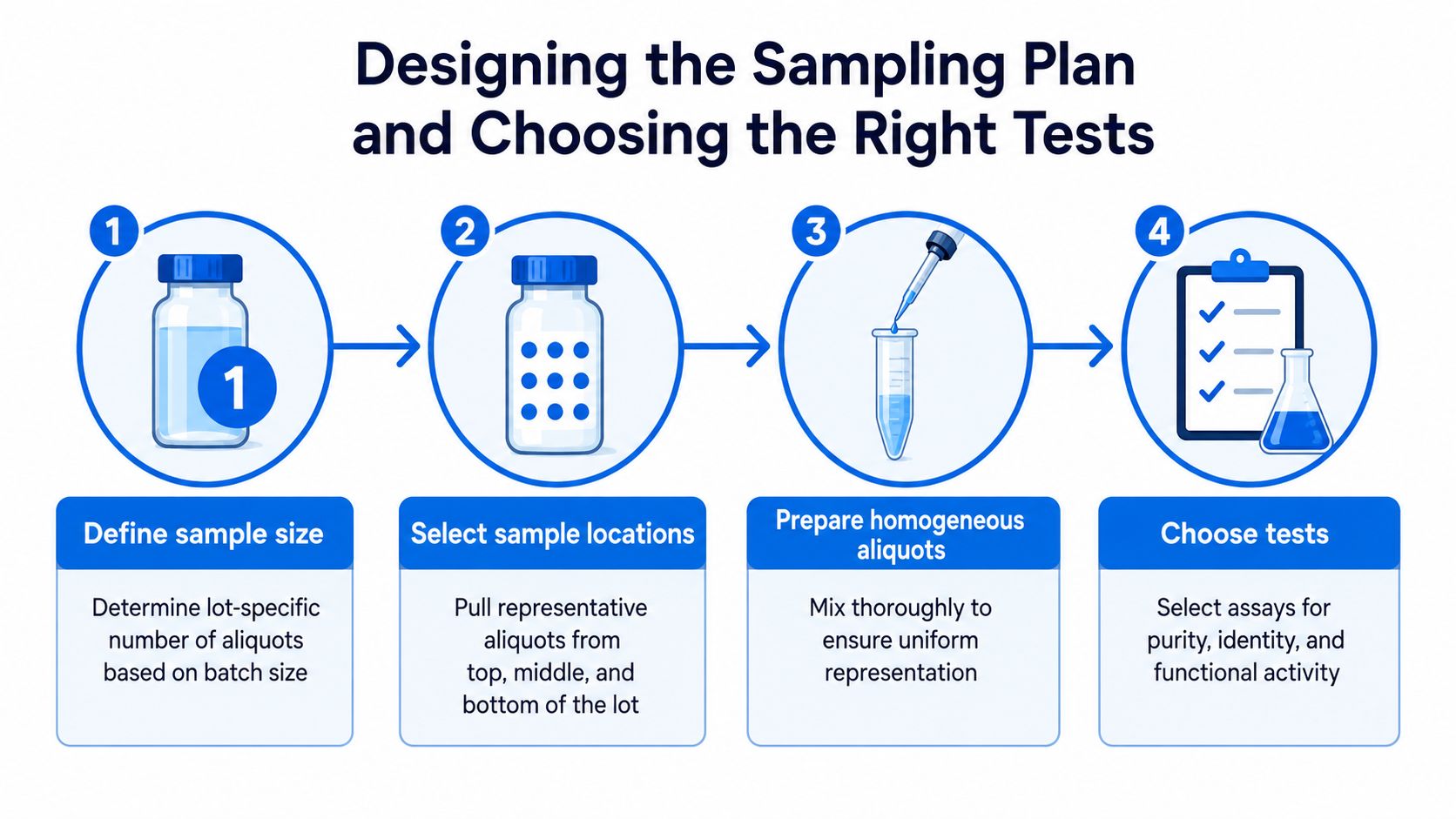
Sampling should answer a defined question: does the tested material reasonably represent the incoming lot? Selecting the most convenient vial without a rationale produces evidence about that vial, not necessarily about the shipment.
The laboratory should approve sample locations, preparation procedures, retained-sample arrangements, and test requirements before opening containers. The plan should reflect container count, formulation, suspected heterogeneity, and the consequences of an undetected difference.
Build a representative analytical sample
For separately filled vials, define which containers will be sampled and why. For bulk material, specify accessible sampling locations and any homogenization procedure suitable for the compound. Mixing should follow a documented method, not an assumption that every formulation tolerates the same handling.
Prepare independent analytical samples where precision or sampling variability matters. Repeated injections from the same prepared solution mainly evaluate system consistency; independent preparations also challenge weighing, dissolution, dilution, and sampling.
- Identity: Use molecule-specific evidence. Where a related impurity could satisfy a nonspecific signal, require orthogonal confirmation, such as chromatographic retention behavior together with mass-spectrometric molecular-mass confirmation.
- Purity and composition: Examine the principal component and relevant impurity profile rather than relying solely on a rounded summary percentage.
- Assay or net content: Establish how much target material is present using an appropriate measurement and calibration approach.
- Contamination controls: Select endotoxin, microbial burden, sterility, and heavy-metal assessments according to the intended assay and material specification.
FDA's guidance on identity, impurities, and analytical performance supports highly specific identity testing, additional complementary techniques where necessary, and impurity criteria informed by manufacturing and storage experience. It also highlights the importance of precision and method suitability in interpreting measurements.
Match the test panel to the application
A sterility claim shouldn't be inferred from an endotoxin result, and a purity result shouldn't substitute for net-content measurement. These tests answer different questions. The laboratory should review the actual methods and reported results, with the supplier's testing information serving as a starting point rather than a substitute for that review.
The practical trade-off is coverage versus effort. Repeating every possible test isn't automatically a stronger procedure. A focused panel is more defensible when each test addresses a stated failure risk, the method is suitable for the sample matrix, and the sampling plan supports the conclusion being drawn.
Setting Acceptance Criteria and Reading the Numbers
Acceptance criteria must exist before the results are available. A limit selected after examining the incoming lot is a retrospective justification, not a controlled release criterion.
The laboratory should distinguish absolute specifications from comparison limits. An absolute specification asks whether the material meets a defined requirement; a comparison limit asks whether the difference from the reference lot is acceptable for the intended workflow. Neither should be improvised from the supplier's displayed purity figure.
Define the comparison conditions
Analyze incoming and reference lots in the same run or a randomized block, using the same instrument, analyst, standards, and system-suitability criteria. That arrangement reduces avoidable differences between the measurement conditions, although it doesn't eliminate the need to estimate uncertainty.
ICH Q2(R2)_Guideline_2023_1130.pdf) treats specificity, accuracy, precision, and reportable range as core analytical performance characteristics; accuracy studies commonly involve at least nine determinations across three concentration levels, with three replicates at each level. As noted in the earlier FDA analytical guidance, common precision designs include six determinations at nominal concentration or nine across three levels.
Those designs are method-performance starting points, not universal sample counts for every lot comparison. The laboratory still needs a design appropriate to the assay's variability and the difference it must detect.
Chemical Release Tests vs Functional Checks
| Test Category | What It Confirms | Common Methods | When to Require It |
|---|---|---|---|
| Chemical identity | The measured material matches the intended molecule | Chromatographic retention and mass spectrometry | Incoming-lot identity verification |
| Purity and impurity profile | Composition meets approved analytical limits | Suitable chromatographic analysis | Chemical release and impurity-sensitive workflows |
| Assay or net content | Target-material quantity meets the declared requirement | Calibrated quantitative analysis | Experiments dependent on accurate sample concentration |
| Contamination assessment | Relevant contaminants meet defined limits | Endotoxin, microbiological, and elemental testing | Applications sensitive to the specified contaminants |
| Functional performance | The material produces an acceptable application-specific response | Binding, enzymatic, or cell-based assays | Critical reagents or workflows needing performance bridging |
| Preparation performance | Sample preparation produces comparable material availability | Recovery and aggregation assessment | Reconstitution-sensitive experiments |
Review individual results alongside the mean. Standard deviation or relative standard deviation can describe precision, but an acceptable average shouldn't conceal erratic preparations or a changing impurity pattern.
A result near a specification boundary needs an uncertainty-aware decision, not extra decimal places that imply unsupported confidence.
The protocol should define how borderline results are reviewed, whether the comparison range is concentration-dependent, and which conditions invalidate a run. Analysts shouldn't round a marginal result into compliance or replace an unsuitable comparison standard after seeing an unfavorable difference.
Proving Functional Equivalence Beyond a Purity Percentage
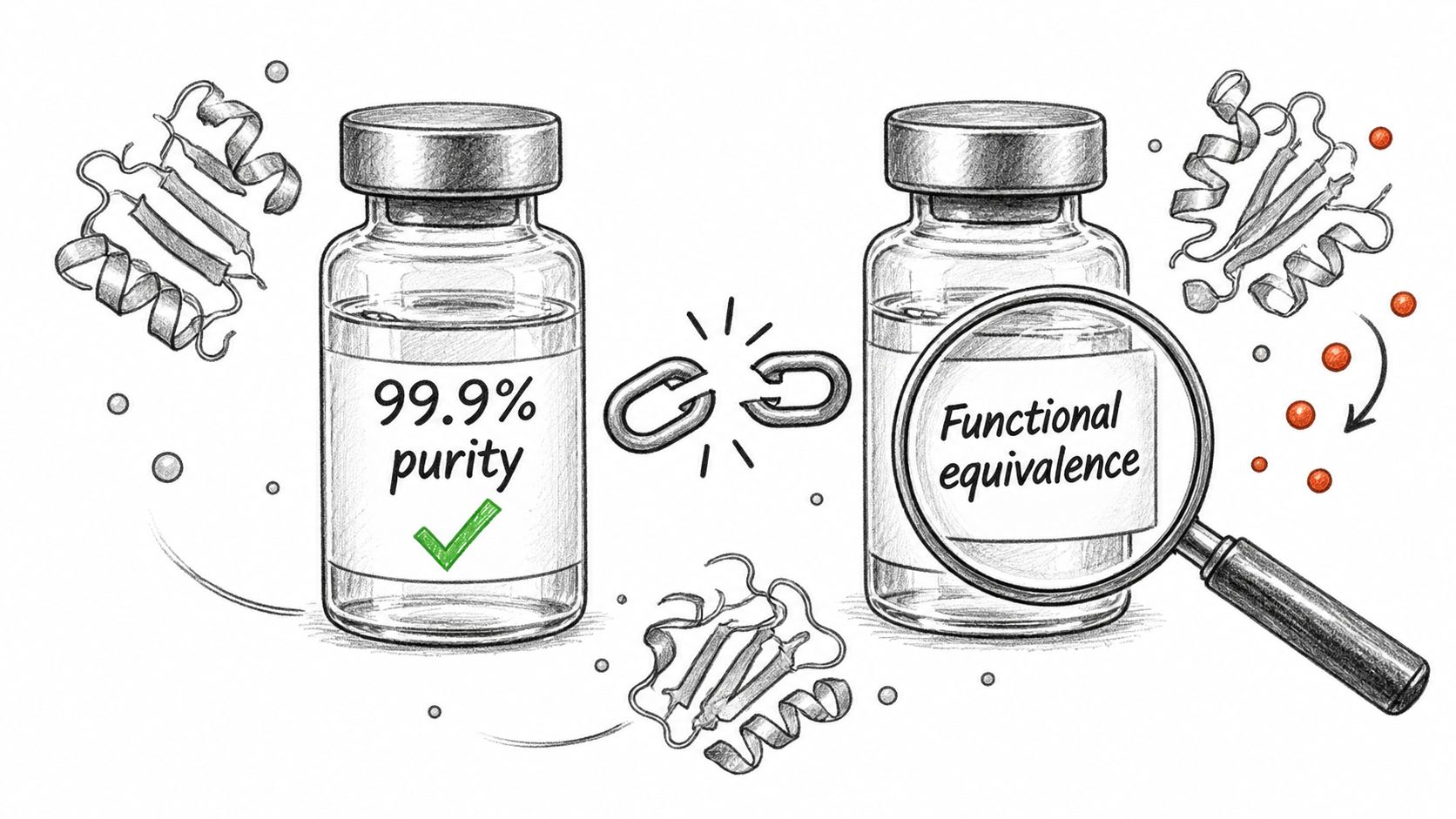
Higher chromatographic purity isn't proof of equivalent assay performance. Chemical release testing establishes important properties, but the researcher's actual concern may be binding, catalytic response, cell-based activity, or recovery following laboratory reconstitution.
The lot-comparison framework for laboratory reagents provides a useful starting point for paired evaluation. For peptide research, the bridge should explicitly address application performance because chemical purity measurements can overlook relevant differences in conformation, oxidation, aggregation, counter-ion composition, or bioactivity.
Select a reference that can support the conclusion
The reference lot should have documented acceptable performance, controlled storage, and sufficient retained material for the planned comparison. A nearly exhausted vial with uncertain handling history is a weak reference, even if it was previously associated with successful experiments.
The laboratory should also distinguish an established lot from a qualified bioassay reference standard. USP's rationale for drug-specific bioassay standards includes comparing manufacturing lots, assigning relative potency, and identifying performance drift. A retained research lot can support an internal bridge, but its suitability still needs documentation.
Choose endpoints that match the failure risk
- Binding-dependent workflows: Compare the relevant binding response over the assay's working range.
- Activity-based experiments: Evaluate enzymatic activity or an appropriate in-vitro cell-response endpoint with stable controls.
- Preparation-sensitive materials: Assess aggregation or recovery after the laboratory's defined reconstitution procedure.
- Critical assay reagents: Include the response region where a lot difference would alter interpretation, not merely the easiest region to measure.
A project involving SS-31, GHK-Cu, or IGF-1LR3 should select endpoints from its actual experimental protocol, not from the product name. KLOW and BBG70 require component-specific assessment because they're proprietary blend names, not standard single-compound peptides; no unified blend mechanism should be assumed. HCG should be described as a hormone and NAD+ as a coenzyme, rather than grouping both under peptide terminology.
Bench decision: Functional bridging belongs in the release package when analytical conformity alone cannot establish fitness for the intended assay.
Predefine the meaningful acceptance range and normalization method. If net-content differences will be corrected during sample preparation, record that explicitly; otherwise, an apparent functional shift may be difficult to separate from a concentration difference.
Handling OOS Results and Statistically Inconclusive Outcomes
A failed result and an inconclusive experiment require different conclusions. Out of specification means a result falls outside an established limit. Statistically inconclusive means the available evidence can't support the intended comparison, which may occur even when no individual measurement breaches a specification.
FDA's OOS guidance requires investigation of laboratory error, sampling, manufacturing conditions, and other assignable causes. It also requires both passing and suspect results to be considered in batch-release decisions; confirmed batch-quality failures mean the material is nonconforming and should be rejected or otherwise properly dispositioned.
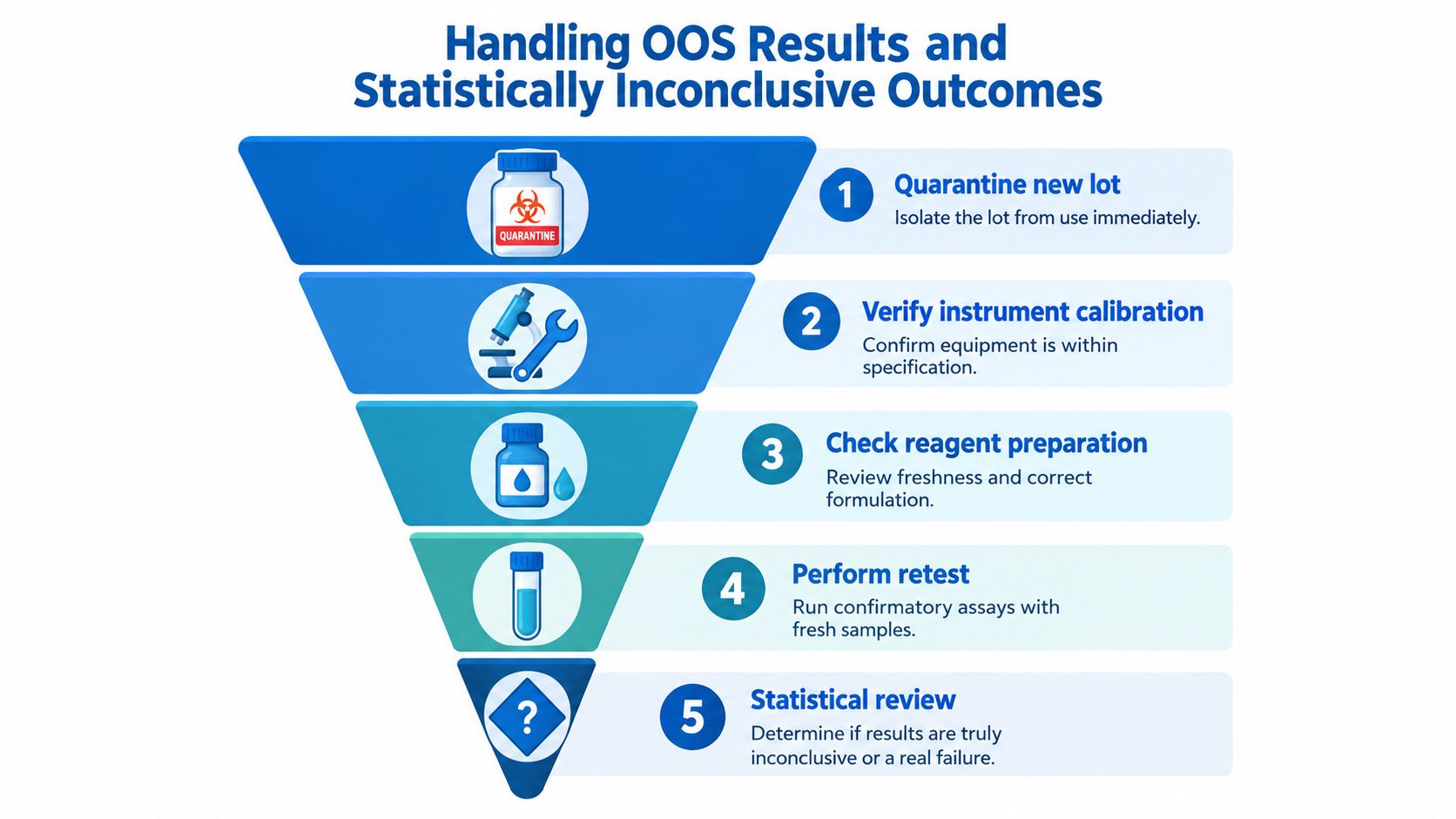
Follow an escalation path
Quarantine → Review controls and handling → Investigate assignable causes → Perform authorized additional testing → Review statistics and analytical evidence → Disposition
- Quarantine: Prevent substitution into the active workflow while preserving material for investigation.
- Review the measurement system: Check calibration, system suitability, reference standards, reagent preparation, storage records, and sample stability.
- Investigate the discrepancy: Identify whether the evidence supports laboratory error, sampling variability, deterioration, or a material-quality problem.
- Authorize additional testing: Specify independent preparations, retained-sample analysis, expanded concentration coverage, or orthogonal testing before work resumes.
- Resolve the decision: Release only when the complete evidence supports the approved criteria; otherwise continue investigation or reject.
Retesting shouldn't become a search for an acceptable value. An invalidated result needs a documented, evidence-supported reason, and the original record should remain accessible.
Separate assay noise from lot drift
A small paired experiment may have inadequate statistical power for a low-abundance, nonlinear, or matrix-sensitive assay. Published lot-verification guidance addressing comparison design discusses additional specimens or replicates when false rejection is suspected and recommends at least two target concentrations, with broader coverage improving evaluation.
For an inconclusive result, the laboratory can expand low-, mid-, and high-range testing under an approved escalation plan. Unstable controls should trigger method review before more samples are analyzed. Any protocol amendment must preserve the original criteria, explain the change, and avoid presenting a post-result adjustment as though it had been predefined.
Release Decision, Documentation, and the Next Lot Checklist
The final disposition should state what the laboratory has established. Pass means the evidence supports the approved requirements for the named application. Investigate means an unresolved question prevents release, while reject means the material cannot be accepted under the applicable criteria.
A release record should preserve raw paired results, replicate-level variation, acceptance limits, deviations, investigation outcomes, reviewer approval, and final disposition. It should also identify the scope of authorization: approval for one analytical workflow doesn't automatically establish suitability for every laboratory assay.
Printable incoming-lot checklist
- Receipt reconciled: Container labels, manufacturer lot number, container count, and purchasing records agree.
- Material definition confirmed: Applicable sequence, CAS number, formulation, and declared composition are documented.
- Batch evidence archived: The exact CoA and supporting analytical records are accessible from the laboratory's lot record.
- Handling reviewed: Shipment condition, storage history, and laboratory preparation records have been evaluated.
- Sampling approved: Sample locations, independent preparations, retained material, and method suitability are documented.
- Criteria locked: Specifications, comparison limits, run-validity requirements, and escalation rules were approved before testing.
- Required panels completed: Chemical testing and any necessary functional bridge have been reviewed together.
- Exceptions resolved: Suspect results and deviations remain visible, with investigation conclusions and supporting evidence.
- Disposition authorized: The designated reviewer records the decision and the permitted application.
- Inventory updated: Staff can distinguish held, released, and rejected material without opening separate analytical files.
Make the next comparison easier
Trend the relevant measurements across incoming lots, retaining enough context to distinguish material changes from method changes. The earlier analytical guidance supports reviewing systematic drift, sudden impurity-profile changes, and increased variance, including patterns that remain within individual specifications.
A practical trend record should connect each result to its method version, reference standard, and preparation conditions. Without that context, a plotted shift may be difficult to interpret. Where retained material permits, the laboratory can investigate the pattern before another substitution enters an active project.
Research-only procurement controls should remain separate from analytical release. The Research Use Only Policy addresses the permitted setting; the laboratory's verification record establishes whether a particular lot is acceptable for its defined experiment. Neither replaces the other.
Pro Tec Pep offers research-use-only compounds with batch-specific Certificates of Analysis and documentation that researchers can incorporate into an incoming-lot review. Researchers can visit the catalog to locate the relevant batch records, compare the reported testing with their laboratory's acceptance panel, and identify any additional functional verification needed before substitution.