Kisspeptin 10 Peptide: Sequence, Receptor and Lab Handling
Kisspeptin 10 peptide explained for laboratory research: sequence, KISS1R signaling, animal and human study findings, assays and sample storage.
A new technician has the vial in one hand and yesterday's protocol in the other. The label says kisspeptin 10 peptide, the notebook says KP-10, and the certificate of analysis uses a third name. Nobody has written down whether the last comparable run used male or female animals, which cycle day was sampled, or which lot number went into the assay. Those three gaps, sequence, biological context, and lot record, are what make two results look alike on a graph and still refuse to match.
Kisspeptin-10 (KP-10) is a 10-amino-acid peptide, the shortest biologically active C-terminal fragment of the KISS1 gene product, and it acts on the KISS1R (GPR54) receptor. A foundational 2001 report showed that KISS1 encodes a 154-amino-acid prepropeptide processed into kisspeptin-54, kisspeptin-14, kisspeptin-13, and kisspeptin-10, all sharing the same amidated C-terminal 10-amino-acid sequence, and that these peptides activate the receptor then known as an orphan G-protein-coupled receptor, according to the 2001 Journal of Biological Chemistry paper indexed on PubMed. The gene was first tied to melanoma metastasis suppression, and the 54-amino-acid product was named metastin. KP-10 isn't a random synthetic scrap. It's the minimal C-terminal sequence that still binds the receptor and acts as an agonist. That history also moved the pathway into reproductive neuroendocrinology and hypothalamic control of gonadotropin-releasing hormone.
Kisspeptin-10 Identity and Key Specifications at a Glance
Identity is a chain, not a nickname. If the sequence on the certificate doesn't match the material weighed into the assay, later hormone curves can't be compared with anyone else's.
| Property | Value | Why it matters in the lab |
|---|---|---|
| Common names | Kisspeptin-10, KP-10, metastin (45-54) | Matches literature and supplier listings |
| Length | 10 amino acids | Shortest biologically active C-terminal fragment |
| Sequence (one-letter) | YNWNSFGLRF-NH2 | Primary identity check against the COA |
| Sequence (three-letter) | Tyr-Asn-Trp-Asn-Ser-Phe-Gly-Leu-Arg-Phe-NH2 | Same sequence in literature notation |
| C-terminus | Amidated (-NH2) | Changes mass and stability; confirm on COA |
| Molecular formula | C63H83N17O14 | Mass-spectrometry confirmation |
| Molecular weight | Approx. 1,302.4 g/mol | Molar concentration calculations |
| Receptor | KISS1R (GPR54) | Target for receptor-based assays |
| Physical form | Typically lyophilized solid | Sets the sample-preparation path in the handling section |
| CAS number | Read from the lot certificate of analysis | Ties the vial to one chemical record |
Sequence is the primary identity check. One-letter and three-letter forms are the same chain written two ways, ending in the amide. Formula and molecular weight (about 1,302.4 g/mol, formula C63H83N17O14) support mass-spectrometric confirmation and molar math, and they help separate intact peptide from degradation products. The amidated C-terminus changes both mass and stability, so a free-acid analog isn't the same material even when the amino acids look right.
The CAS number isn't stated on this page. Read it from that lot's certificate of analysis. Before any sample enters an assay, the sequence, formula, and weight on the COA should match the table exactly. The lyophilized-solid row points forward to storage, solubility, and aliquoting later in this guide.
Practical rule: A result is only comparable when the sequence, the subject's sex and cycle status, and the lot record are all known.
How KISS1R Signaling Drives Reproductive Research
Think of the cell as a house. The peptide is the key, KISS1R is the doorbell button, and the internal messengers are the wiring that rings a bell in another room.
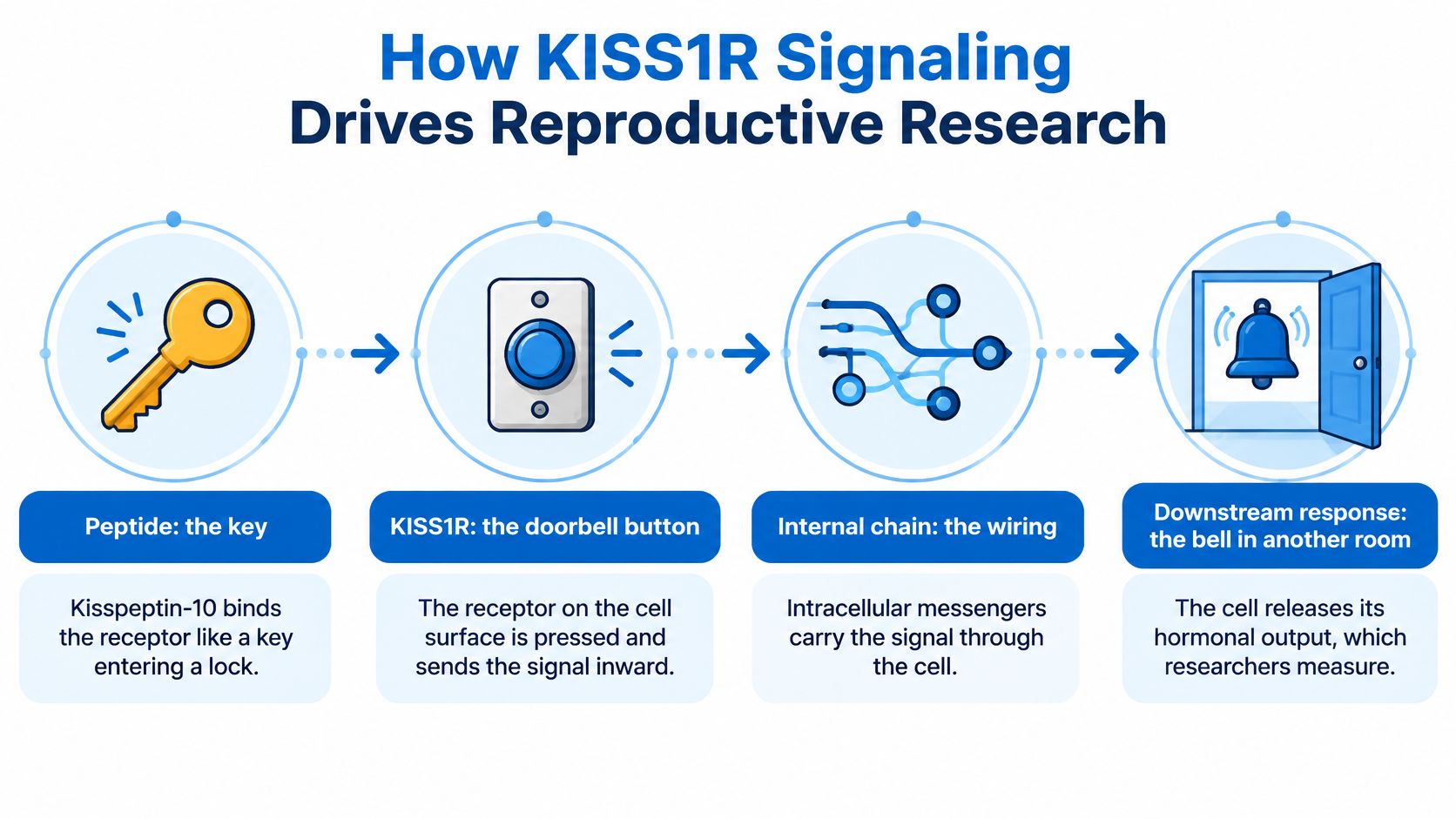
From key to doorbell
Kisspeptin-10 is a bioactive fragment of the KISS1 gene product that activates the G-protein-coupled kisspeptin receptor, called GPR54 or KISS1R, as summarized in the ScienceDirect neuroscience topic entry on kisspeptin-10. The receptor sat as an orphan until kisspeptins were linked to it. Binding is the key in the lock. It doesn't itself release luteinizing hormone.
The wiring inside the cell
Receptor activation engages phospholipase C, which hydrolyzes phosphatidylinositol 4,5-bisphosphate (PIP2). One product, inositol trisphosphate (IP3), raises calcium inside the cell. The same cascade activates ERK1/2 and p38 mitogen-activated protein kinases. In cell models, calcium and phospho-ERK are the readouts people time in minutes, because that's where the wiring is easiest to measure.
The bell in another room
In GnRH neurons, kisspeptin-10 also changes membrane excitability by closing potassium channels and opening nonselective cation conductances. The neuron fires more readily and releases gonadotropin-releasing hormone (GnRH). GnRH then drives pituitary release of luteinizing hormone (LH) and follicle-stimulating hormone (FSH). The bell isn't in the pituitary. These steps come from cellular and neuroendocrine research models, and they explain stimulation of GnRH neurons rather than a pituitary-only action.
The same receptor history started in cancer cell models, where KISS1 was studied as a metastasis suppressor. Reproductive assays and metastasis assays can share a receptor and still answer different questions. Don't treat a phospho-ERK blot from a tumor line as evidence about GnRH pulse control.
What Animal and Human Studies Have Shown
A common assumption is that any rise in LH after kisspeptin 10 peptide proves the peptide "works" as a hormone replacement. Knockout work says something narrower.
In KISS1R-knockout animal models, kisspeptin-10 failed to elicit an LH response, even though GnRH-neuron migration, GnRH synthesis, and pituitary responsiveness to GnRH stayed intact, as reviewed in a Physiological Reviews article on kisspeptin. Related animal experiments found that blocking GnRH signaling prevented kisspeptin-induced gonadotropin secretion. The in-vivo evidence supports a receptor-mediated hypothalamic mechanism: the peptide activates the GnRH network, and GnRH output drives LH and FSH. It isn't a product claim for diagnosis or treatment. A different synthetic peptide such as PT-141 is supplied for receptor-interaction chemistry and isn't interchangeable with KP-10.
What changes across reproductive state in rats
A controlled in-vivo rat study used intracerebroventricular administration and found that reproductive state reshapes the response, reported in Endocrinology.
- LH across the cycle: A 1-nmol quantity produced strong LH bursts throughout the estrous cycle, largest during estrus.
- Lower quantities: During diestrus, measurable LH responses occurred at quantities as low as 0.1 pmol.
- FSH pattern: High quantities stimulated FSH primarily during diestrus, not in lockstep with LH.
- Steroids, pregnancy, lactation: Ovarian-steroid removal didn't abolish LH or FSH secretion, but maximal responses needed estradiol and progesterone replacement. Responses remained detectable in pregnancy and lactation, with greater LH-burst magnitude and sensitivity in pregnant animals.
What a small human physiology study can and can't show
A human endocrine physiology study gave healthy men intravenous boluses from 0.01 to 3.0 micrograms per kilogram. LH rose rapidly and in a quantity-dependent way, with maximal stimulation at 1 microgram per kilogram: mean LH rose from 4.1 ± 0.4 to 12.4 ± 1.7 IU/L at 30 minutes in six participants (P < 0.001), as reported in the Journal of Clinical Endocrinology & Metabolism. Peak LH occurred by about 45 minutes. FSH also rose, but less. At 1 microgram per kilogram, mean 60-minute FSH went from 4.6 ± 1.0 to 5.3 ± 1.0 IU/L. The same report noted LH and FSH elevations in men at intravenous quantities as low as 0.3 and 1.0 nmol/kg, while preovulatory women showed elevations after 10 nmol/kg.
Small, short, narrowly selected physiology studies identify a mechanism to test. They don't establish clinical efficacy, safety of repeated exposure, or any treatment claim.
Assays and Research Applications in the Laboratory
Pick the assay for the question, then set the control and the clock. Kisspeptin-10 has been studied as a dynamic probe of hypothalamic GnRH-network function: it shows how responsive the axis is, not only its baseline. A controlled human study found the response reflects stimulation of endogenous GnRH release rather than direct pituitary replacement, and FSH rose less strongly than LH, according to a 2011 Journal of Clinical Endocrinology & Metabolism report. All such work stays inside a research use only policy.
| Assay | Study type | Readout | Question it answers |
|---|---|---|---|
| Receptor binding | In vitro, cells or membranes expressing KISS1R | Bound labeled ligand | How strongly an analog binds KISS1R |
| Calcium mobilization | In vitro, KISS1R-transfected cell line | Fluorescent intracellular Ca2+ | Agonist potency and speed of onset |
| Inositol phosphate accumulation | In vitro, Gq-pathway readout | IP1 or IP3 levels | Confirms phospholipase C coupling |
| ERK1/2 phosphorylation | In vitro, cell lysate | Phospho-ERK by Western blot or ELISA | Downstream kinase activation |
| GnRH neuron cell model | In vitro, hypothalamic cell line | Ca2+ signal or GnRH release | Neuron-level response |
| Rat intracerebroventricular challenge | In vivo, rodent model | Serial serum LH and FSH | Response across estrous cycle and steroid status |
| KISS1R-knockout comparison | In vivo, genetic model | LH response present or absent | Whether the effect depends on the receptor |
| Human bolus or infusion protocol | Clinical study, healthy participants | Serum LH, FSH and testosterone | Endocrine response profile and timing |
Controls before curves
A cell-based KISS1R assay needs a receptor-expressing line and a positive control of known identity. A receptor-dependence experiment needs a KISS1R-null comparison or a receptor antagonist. Without that arm, a calcium spike could be off-target.
Calcium and ERK move within minutes. Hormone readouts need a longer clock. In human bolus designs, LH peaks near 30 minutes, so sampling should be dense in the first hour. Longer infusions evaluate pulse frequency, pulse amplitude, and possible attenuation rather than a single peak. In that same clinical study, continuous infusion at 4 µg/kg/hour for 22.5 hours increased LH from 5.4 ± 0.7 to 20.8 ± 4.9 IU/L and testosterone from 16.6 ± 2.4 to 24.0 ± 2.5 nmol/L. Sex- and cycle-specific timing belongs in the next section, not as a universal template.
Two checks before the plate is loaded
Confirm identity by mass spectrometry. Use the COA's HPLC purity when you calculate molar concentration, because gross powder weight overstates the peptide if salts and moisture are ignored.
Study Variables That Change Results
A clean KP-10 result in one group can disappear when the subject changes. Treat population, exposure and sampling as part of the molecule's identity: the sequence says what should be present, while the study design says what the peptide did in practice.
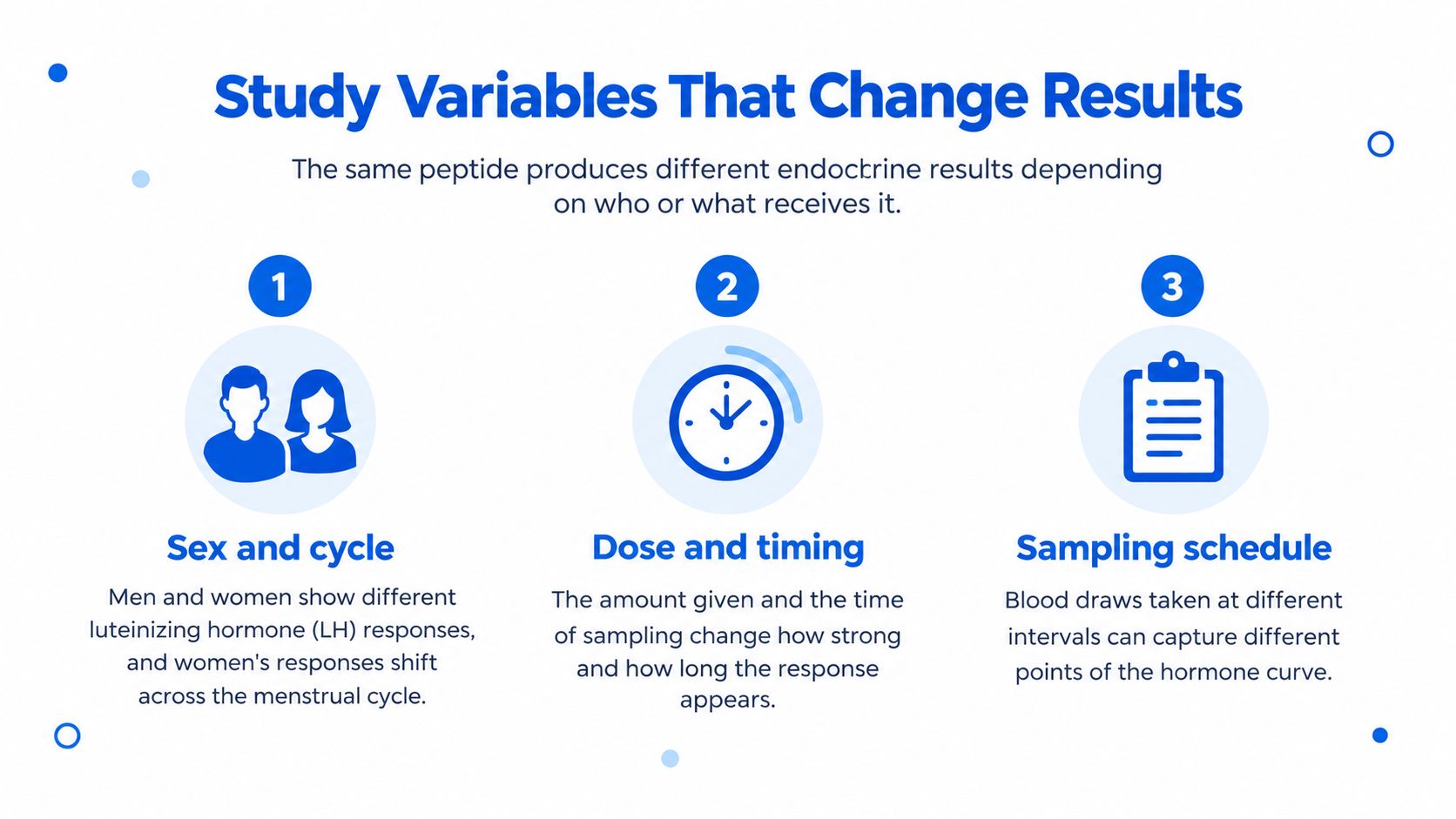
Sex and cycle aren't a footnote
The clinical work summarized in this PMC physiology paper on kisspeptin-10 responsiveness shows why a single concentration can't be generalized. In healthy men, intravenous bolus KP-10 increased LH at quantities as low as 0.3 nmol/kg, while FSH generally required about 1.0 nmol/kg; LH peaked around 30–40 minutes and moved back toward baseline by roughly 180 minutes. In women, immediate LH pulses were consistently seen in luteal and preovulatory phases, while only about half of early-follicular participants showed an unambiguous response. Raising the quantity to 0.72 nmol/kg, about 2.4 times the 0.3 nmol/kg male threshold, did not reliably overcome that variability.
A clinical study in adult men can't be read as a puberty-stage map. Developmental stage still belongs in the protocol because receptor context can differ across maturation, even when the published adult data cannot show it.
Duration changes the shape of the curve
Short bolus work measures a peak. Infusion work measures a trajectory. With extended exposure, an early LH rise can give way to attenuation, so a schedule stopped after the first hour describes only the rising limb. A lab that samples only the early rise will miss the fall.
For planning units, at a molecular weight of about 1,302.4 g/mol, 1 nmol is about 1.30 micrograms, so 0.3 nmol/kg is about 0.39 micrograms per kilogram. Write the unit you used in practice. nmol/kg and µg/kg aren't interchangeable on a spreadsheet without that conversion.
Record sex, cycle or gonadal status, baseline LH pulsatility, sampling interval, route, quantity units, and infusion duration. Keep those fields beside the confirmed sequence and the lot record; without all three, two datasets may share a peptide name and still not be comparable.
Confirm the Lot Documentation Before You Order
A clean mechanism still fails if the vial isn't the molecule the protocol names. Walk the purchase in this order.
- Match the identifiers. The name, sequence YNWNSFGLRF-NH2, formula C63H83N17O14, and molecular weight of about 1,302.4 g/mol must agree across the product page, the certificate of analysis, and the identifier table above.
- Request the lot-specific COA, not a generic sheet. Each product listed on the Research Peptide page has a COA link, and a batch certificate ties HPLC purity, mass-spectrometry identity, and net content to that vial.
- Match testing scope to the study. Cell-based work depends most on endotoxin status. Receptor-binding and hormone-release work depend most on identity and purity. ProTecPep's 7x Tested process evaluates identity, purity, net content, conformity, sterility, endotoxins, and heavy metals. Confirm the COA reports the tests the protocol needs, using the supplier's testing documentation.
- Confirm storage and shipping. Check whether cold-chain handling was used and what temperature the package arrived at.
If any item is missing for a listed lot, request it from the supplier before the vial enters the laboratory. Then write the lot number, COA date, and storage history into the study protocol so every result traces to its material.
Handling Kisspeptin-10 Samples in the Lab
Preparation here is laboratory sample prep, not a use instruction. ProTecPep doesn't provide dosing, administration, reconstitution, treatment, or medical-use guidance, and products must only be handled by qualified laboratory personnel familiar with research procedures and safety practices.
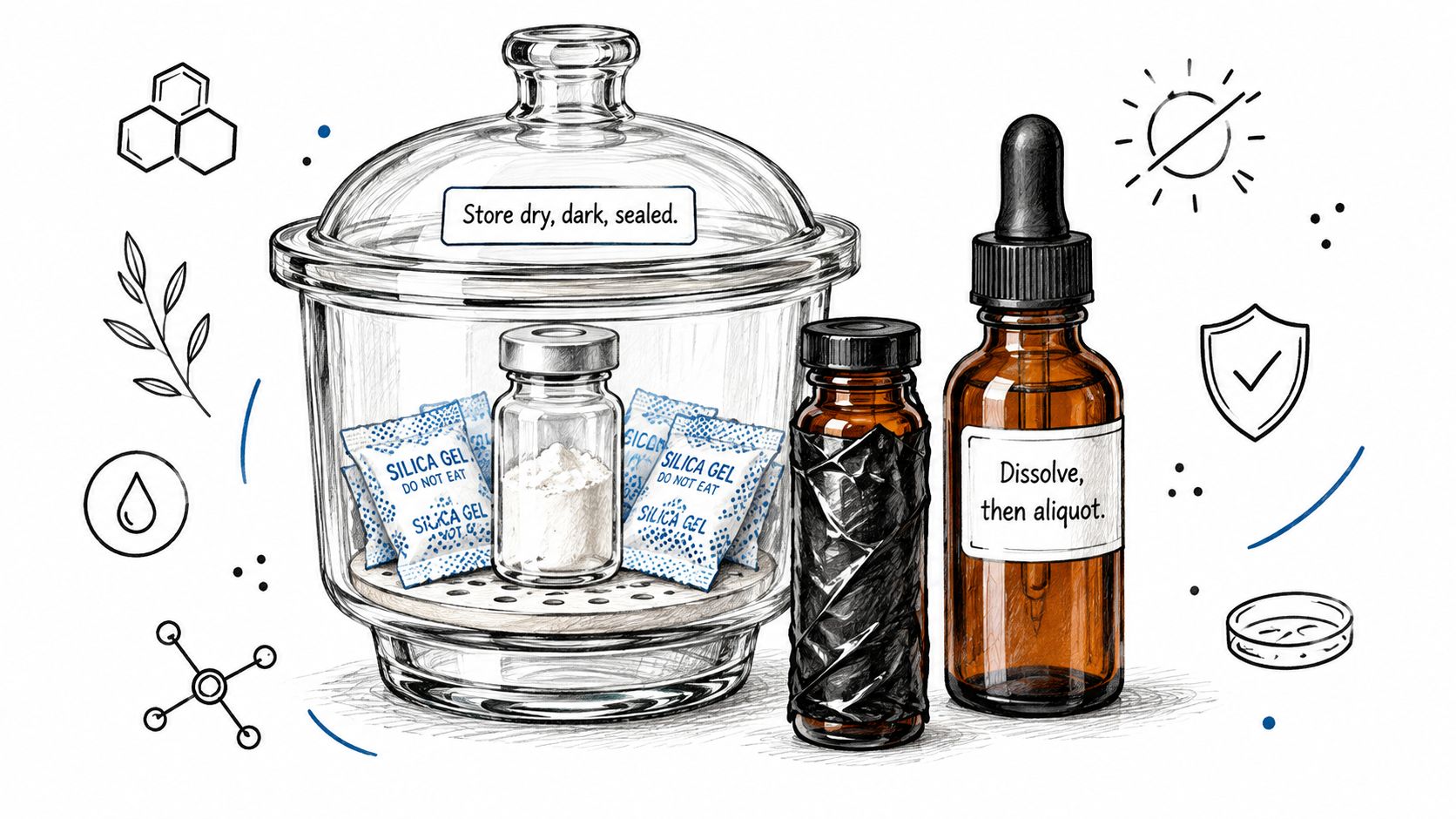
Storage
Keep the lyophilized solid sealed, desiccated, and protected from light, typically at -20°C. Confirm the storage line on the product page or COA before you choose a freezer box. Moisture and light are the usual reasons a later mass spectrum no longer matches the intact mass.
Solubility
Kisspeptin-10 carries a net positive charge at neutral pH because of its arginine residue and free N-terminus. Sterile water or dilute aqueous acid such as 0.1% acetic acid are common starting solvents. Test a small portion first and follow the solubility note on the COA. Don't assume an organic co-solvent is required just because the peptide is short.
For a short walk-through of sealed storage and desiccant practice with research peptides, this handling video is a useful visual beside the written SOP.
Aliquots, light, and the molar math
Divide prepared solution into single-use aliquots so the stock isn't thawed over and over. Log each aliquot against its lot number.
Tryptophan and tyrosine are oxidation-sensitive. Limit air and light while you dissolve and transfer.
1 mg of peptide at 1,302.4 g/mol is about 0.77 µmol (768 nmol). Dissolved in 1 mL, that is about 0.77 mM before you correct for net peptide content and HPLC purity on the COA. Skip that correction and every "concentration" in the lab book is high.
The laboratory's own standard operating procedure governs preparation. Only trained personnel should handle the material.
Pro Tec Pep supplies batch-documented research peptides, including kisspeptin 10 peptide, with lot-level certificates for identity checks before an assay starts. Qualified labs can compare sequence, purity, and storage notes against the protocol instead of guessing from a generic label. Visit Pro Tec Pep to review research-use materials and the COA linked to each listed lot.
For laboratory research use only. Not for human or veterinary use. Not a drug, food, or cosmetic. Not evaluated by the FDA. Not intended to diagnose, treat, cure, or prevent any disease. By purchasing, you certify you are a qualified researcher and agree to use this product solely for in-vitro laboratory research.