Is Bacteriostatic Water the Same as Reconstitution Solution
Is bacteriostatic water the same as reconstitution solution? Learn the real functional difference, composition rules, and lab prep implications for peptides.
The most popular answer to “is bacteriostatic water the same as reconstitution solution?” is usually a quick yes or no. That answer is too shallow for a research laboratory. The useful question is “same for what purpose, and compatible with which lyophilized product?”
A vial can be suitable for one preparation and unsuitable for another because the formulation, preservative system, pH, tonicity, route statement, and manufacturer instructions may differ. A wrong diluent may not produce an obvious failure at the bench. It can instead appear as an unexplained change in solubility, a shifted assay baseline, unexpected particulates, or a stock that no longer behaves like the previous batch.
Why the Bacteriostatic Water Question Is the Wrong Starting Point
Bacteriostatic water and reconstitution solution are related terms, but they aren't exact synonyms. “Reconstitution solution” describes a function. It means a liquid diluent or solvent is added to a powdered medication or laboratory product until a solution forms. Bacteriostatic water is a specific product class that can perform that function in appropriate circumstances.
The distinction matters because the label category doesn't determine compatibility by itself. A laboratory team evaluating a lyophilized research peptide needs to establish whether the selected vehicle matches the product's instructions, formulation requirements, and intended experimental context. A diluent that dissolves a powder visually may still be a poor choice if its preservative or ionic environment changes the working solution.
The question behind the question
A more useful bench-side sequence is:
- What does the product label specify?
- What does the diluent contain?
- Is the vehicle compatible with the intended laboratory assay and storage workflow?
- Does the resulting solution meet the required pH and tonicity conditions?
Official labeling describes bacteriostatic water as sterile, nonpyrogenic Water for Injection containing benzyl alcohol and supplied in a multiple-dose container for repeated withdrawals. The official bacteriostatic water description also makes clear that it is intended to dilute or dissolve injectable drugs according to their instructions. That wording doesn't make the product a universal solvent.
Practical rule: A diluent's ability to dissolve a powder is only the first compatibility check. The label, formulation, and assay context decide whether it belongs in the workflow.
The cost of a mismatched vehicle rarely appears in a simple yes or no comparison. It appears later, when a control behaves differently, a stock requires unexplained repeat preparation, or a result becomes difficult to reproduce. Treating the terms as interchangeable can therefore hide the actual laboratory decision.
What Bacteriostatic Water Actually Is on the Label
Bacteriostatic Water for Injection, often abbreviated BWFI, is a defined formulation rather than a generic name for any liquid used during reconstitution. FDA and DailyMed labeling describes it as sterile, nonpyrogenic Water for Injection containing 0.9% benzyl alcohol, where benzyl alcohol serves as the bacteriostatic preservative. The formulation is supplied in a multiple-dose container intended to permit repeated withdrawals, as described in the FDA labeling record for bacteriostatic water.
That composition gives the vial a specific identity. It isn't just “water for reconstitution,” and the presence of benzyl alcohol means the formulation must be evaluated against the material being dissolved.
Reading the vial in three passes
| Label Element | What It Tells You |
|---|---|
| Preservative declaration | Whether benzyl alcohol is present and at what stated concentration |
| Container designation | Whether the product is labeled for single-dose or multiple-dose handling |
| Intended-use statement | Which dilution or dissolution purposes, routes, and manufacturer instructions govern the product |
The concentration matters because benzyl alcohol is not an invisible label detail. It changes the composition of the diluent and can create restrictions for particular laboratory contexts. A product label reviewed through DailyMed's bacteriostatic water information also warns that benzyl-alcohol-containing solutions must not be used in neonates because of potential toxicity. That warning illustrates a broader point: the vehicle's ingredients matter materially to the intended context.
Why “multi-dose” doesn't mean “universally suitable”
A multiple-dose container can be convenient for a controlled laboratory workflow, but convenience doesn't override compatibility. The labeling states that bacteriostatic water is for diluting or dissolving drugs according to the manufacturer's instructions. It also requires the resulting preparation to be made approximately isotonic before use.
The label therefore answers what BWFI is, but it doesn't answer whether it is the correct vehicle for every lyophilized research product. That answer requires a separate review of the product documentation, the diluent composition, and the planned assay conditions.
What “Reconstitution Solution” Really Covers as a Category
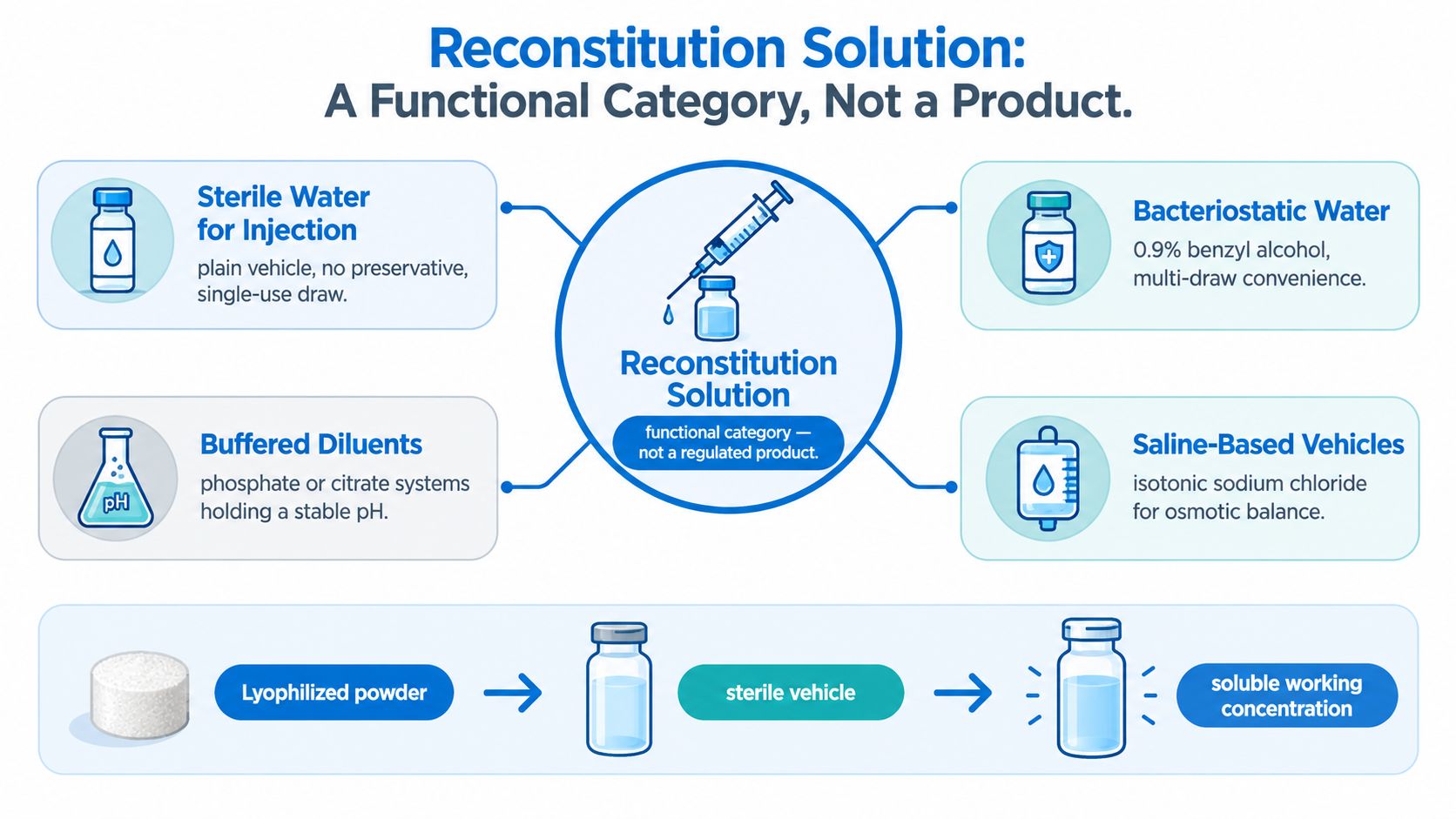
A reconstitution solution is a functional category, not one standardized formulation. The term describes a liquid selected to turn a lyophilized powder into a workable solution. Different products can fill that role while carrying different preservative systems, pH profiles, salt loads, and tonicity characteristics.
Possible members of this broad category include sterile Water for Injection, bacteriostatic water, saline-based vehicles, dilute acidic vehicles, and buffered systems. Their shared feature is their role in rehydrating or dissolving a lyophilizate. Their compositions may be substantially different.
Three questions for the formulation
Benzyl alcohol is the first variable to identify. Bacteriostatic water contains benzyl alcohol as its preservative, while another reconstitution vehicle may not. That difference can matter for sensitive materials, cell-based work, and any assay in which an added excipient could influence the result.
Tonicity is the second variable. Official labeling requires bacteriostatic water preparations to be made approximately isotonic before use. A vehicle that creates an unsuitable osmotic environment can introduce a formulation problem even when the powder appears to dissolve.
pH and buffering form the third variable. A generic reconstitution solution may contain additional ingredients or pH adjustments that plain water doesn't provide. The product instructions should therefore be treated as the controlling reference, rather than assuming that any sterile liquid is interchangeable.
A research compound library can help laboratory teams organize compound-specific information, but the final selection still depends on the documentation for the exact product and lot.
The functional category is broad because reconstitution describes an action. Bacteriostatic water is narrower because it identifies a defined sterile Water for Injection formulation with a preservative. Those terms overlap, but they don't carry the same information.
The Three Composition Variables That Decide Compatibility
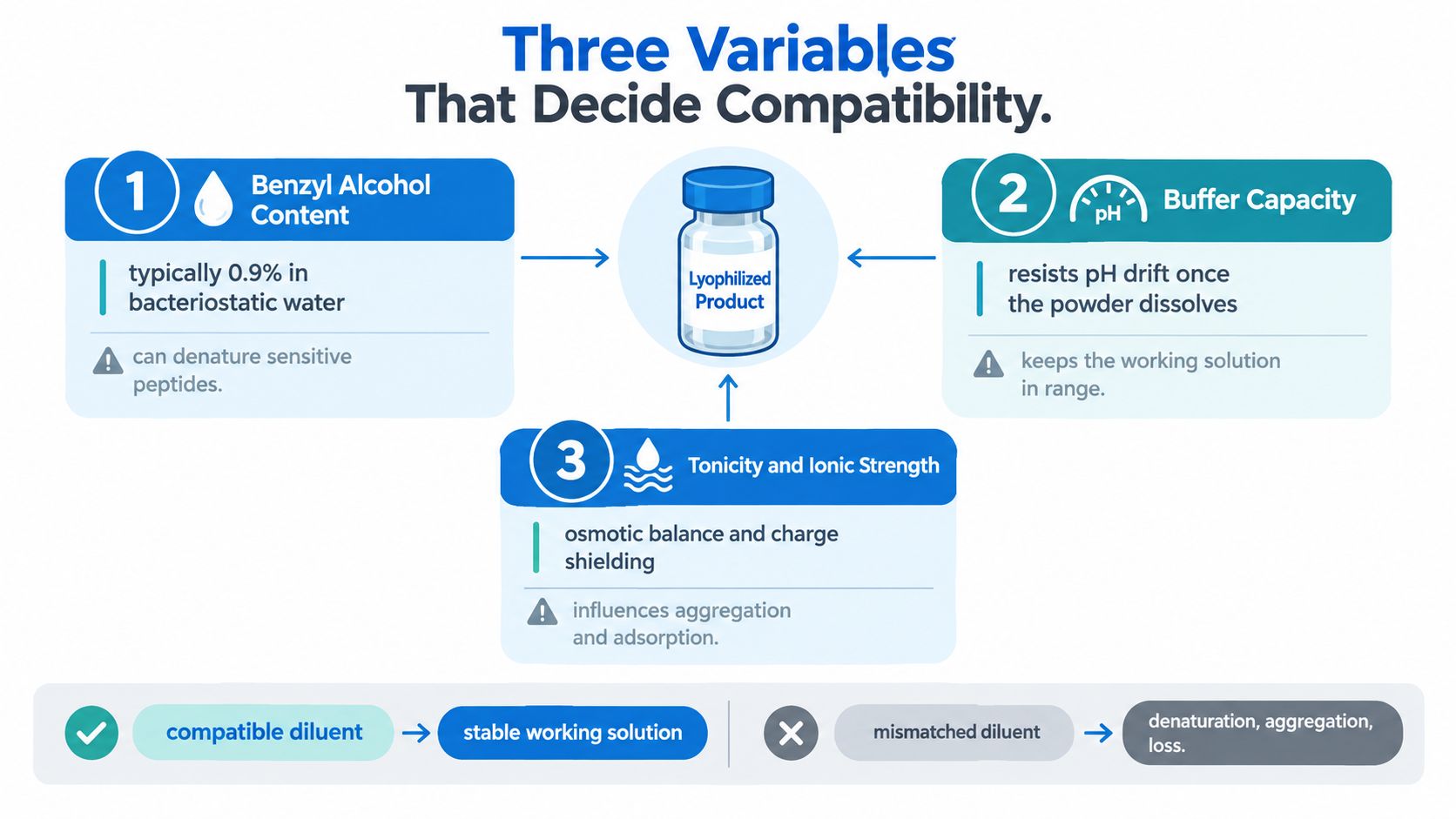
A laboratory team can reduce much of the confusion by examining three formulation variables before opening a lyophilized vial. The variables are benzyl alcohol content, buffer capacity, and tonicity. Each one can affect whether a vehicle is appropriate for a particular research preparation.
Benzyl alcohol content
The label for bacteriostatic water identifies benzyl alcohol as the preservative. The verified product description specifies 0.9%, or 9 mg/mL, for the formulation described by FDA labeling, while another official labeling description identifies formulations containing 1.1%, or 11 mg/mL, as well. That range demonstrates why a laboratory should read the exact vial rather than rely on the phrase “BAC water.”
The key question isn't whether benzyl alcohol is generally good or bad. The question is whether that excipient is permitted for the specific product and experimental system. Neonatal contexts carry an explicit warning, and cell-based or sensitive assay systems may require their own compatibility assessment.
Buffer capacity and pH
A buffered vehicle can resist pH movement after the powder enters solution. An unbuffered vehicle may behave differently once the lyophilized matrix dissolves. If the product documentation specifies a pH range or a particular solvent system, that instruction takes priority over a general preference for bacteriostatic water.
A pH shift can change the chemical environment around the material. For that reason, a laboratory record should capture the selected vehicle, any stated pH information, and the product's solubility guidance.
Tonicity and ionic strength
Tonicity describes the osmotic character of the preparation, while ionic strength reflects the presence of dissolved charged species. These properties can affect how a dissolved product behaves in a downstream assay. Official labeling's requirement for approximate isotonicity is a reminder that “it dissolved” isn't the same as “the preparation is suitable.”
Bench note: A certificate of analysis can identify the material, but it doesn't automatically authorize a different reconstitution vehicle. Product-specific instructions still govern compatibility.
The safest comparison is therefore not “bacteriostatic water versus reconstitution solution.” It is the exact labeled formulation against the exact product requirements.
Comparing Bacteriostatic Water With Other Common Lab Diluents
A practical comparison begins by separating composition from function. Bacteriostatic water provides a sterile Water for Injection formulation with benzyl alcohol. Sterile Water for Injection may serve as a plain vehicle without that preservative. Saline-based vehicles introduce sodium chloride, while acidic or buffered vehicles introduce a controlled chemical environment that may be required by a particular product.
The following table is a decision aid, not a substitute for the product label.
| Diluent | Preservative | Osmolarity | Best For | Limitation |
|---|---|---|---|---|
| Bacteriostatic water | Benzyl alcohol, as declared on the vial | Must be made approximately isotonic before use according to labeling | Products whose instructions permit the formulation and repeated controlled withdrawals | Not automatically compatible with every lyophilized product or laboratory system |
| Sterile Water for Injection | No bacteriostatic preservative in the plain vehicle | Requires assessment after product dissolution | Workflows that specify a preservative-free vehicle | Single-use and compatibility requirements still apply |
| Saline-based vehicle | Depends on the labeled formulation | Sodium chloride contributes to osmotic balance | Products whose instructions specify a saline environment | Added salt can affect an assay or the behavior of a dissolved material |
| Acidic diluent | Depends on the formulation | Depends on the final preparation | Products whose documentation specifies an acidic vehicle | The pH must be verified against the product and assay requirements |
A bench-side scenario
A laboratory receives a lyophilized research peptide and finds that its documentation permits bacteriostatic water. The vial appears to dissolve, and the working solution looks clear. That observation supports physical dissolution, but it doesn't establish that the solution is appropriate for every downstream experiment.
A second preparation uses a vehicle with a different pH or salt profile. The powder may dissolve more slowly, leave visible material, or produce a different assay response. If the team compares the two preparations without recording the vehicle, the diluent becomes a hidden experimental variable.
The same issue can arise in an analytical workflow. A research group may observe an unexpected chromatographic feature, increased blank signal, or altered aggregation pattern and initially investigate the peptide itself. The actual source may be the solvent system. Such observations should be treated as prompts for controlled comparison, not as proof that one named diluent always fails.
What the labels permit
FDA labeling identifies bacteriostatic water as a diluent for drugs used according to manufacturer instructions. It doesn't define all reconstitution solutions as equivalent, and it doesn't remove the need to assess tonicity, excipients, and compatibility. A manufacturer may specify a particular vehicle because the formulation was developed and characterized with that vehicle in mind.
For laboratory reproducibility, the notebook should record the exact diluent name, lot, stated composition, preparation date, and any visible change after dissolution. That record gives later investigators a way to distinguish a material problem from a vehicle problem.
A Reconstitution Walkthrough for a Lyophilized Research Peptide
Consider a laboratory preparing a 5 mg lyophilized model peptide for an in-vitro assay. The workflow begins with documentation, not with the diluent vial. The researcher checks the product's solubility information, confirms the permitted vehicle, and records the batch identifier before selecting bacteriostatic water or another option.
The initial preparation
If bacteriostatic water is permitted, the laboratory adds the vehicle gradually rather than directing a forceful stream onto the lyophilized cake. Slow addition reduces local concentration changes and gives the material time to wet and dissolve. The vial is then inspected for clarity, visible particles, and persistent undissolved material.
A clear appearance is useful, but it isn't a complete release criterion. The laboratory should compare the result with the product documentation and the assay's own requirements. A preparation that looks acceptable may still require analytical confirmation when the experiment is sensitive to composition or aggregation.
The same documentation approach applies when reviewing a BPC-157 research product. The product page and associated batch records should be treated as references for the material, while the diluent decision remains tied to the stated solubility and handling information.
When the workflow fractures
Suppose the peptide remains poorly soluble in the permitted aqueous vehicle. The team shouldn't improvise by treating every acidic diluent as automatically suitable. A controlled comparison may evaluate a manufacturer-specified alternative, such as a dilute acidic vehicle, while recording the substitution and its rationale.
The decision log can include:
- Material identity: Product name, lot, and formulation state.
- Vehicle identity: Exact diluent, composition, and lot.
- Visual result: Clarity, particles, color, and remaining cake.
- Analytical observation: Any change in chromatographic or assay behavior.
- Storage record: Container, temperature condition, and preparation time.
If a satellite peak appears in HPLC or the assay blank rises, the diluent becomes one variable to investigate alongside the peptide, instrument, and sample handling. The correct response is controlled troubleshooting, not an assumption that bacteriostatic water and every reconstitution solution are interchangeable.
A substitution can sometimes rescue a preparation, but it also changes the experiment. That change belongs in the record so later batches can be compared.
How Diluent Choice Affects Peptide Stability and Assay Reproducibility
A peptide can appear fully dissolved and still require closer evaluation. The diluent determines the chemical environment surrounding the material, including the presence of benzyl alcohol, the available buffering capacity, and the ionic conditions of the working solution. Those factors can influence how a preparation behaves during storage and analysis.
The risk is often gradual rather than dramatic. A laboratory may observe a modest change in a chromatographic trace, receptor-binding result, aggregation profile, or concentration estimate without immediately connecting the shift to the vehicle. Repeated experiments then inherit a hidden difference that makes results harder to compare.
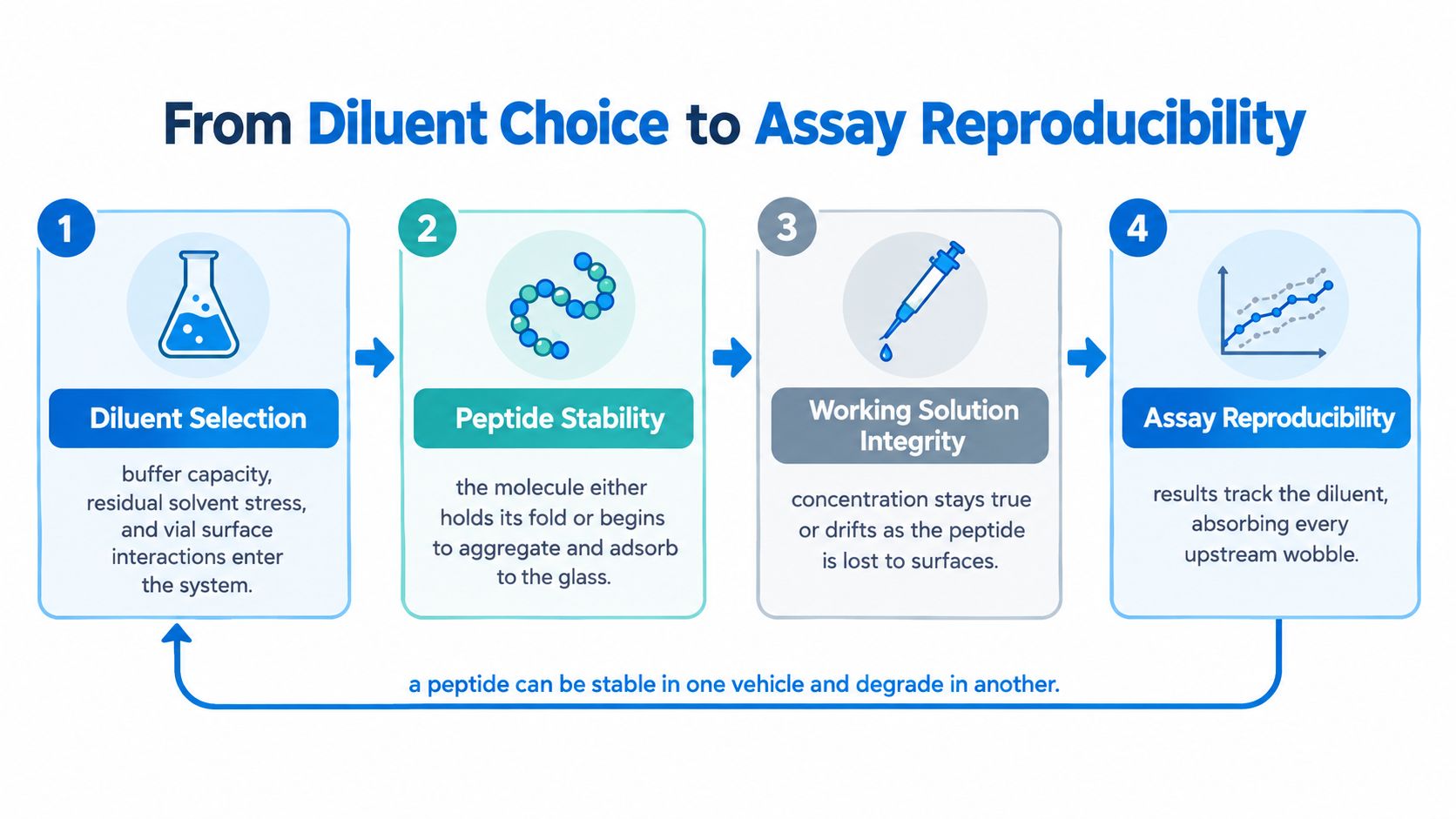
A four-point stability chain
- Vehicle selection: The preservative, pH environment, and tonicity enter the preparation with the diluent.
- Molecular behavior: The dissolved material may remain well behaved or begin interacting with surfaces and other molecules.
- Working-solution integrity: Adsorption, aggregation, or chemical change can alter the concentration available to the assay.
- Result interpretation: Replicates may drift even though the pipetting record appears consistent.
A research team evaluating storage or repeated access should distinguish the preservative's role from the peptide's own stability. Bacteriostatic water supports a multiple-withdrawal format through its labeled formulation, but it doesn't guarantee that every dissolved product remains stable under every storage condition.
Troubleshooting principle: If a preparation changes between batches, the diluent lot and composition belong in the investigation alongside the compound lot.
The peptide testing information can help a laboratory review available quality documentation, but testing cannot replace a compatibility decision. The exact product instructions still determine which vehicle belongs in the preparation.
A disciplined workflow records the diluent before the first assay, not after a result looks unusual. That single habit makes vehicle-related drift easier to detect and prevents a solvent substitution from disappearing into an otherwise complete experiment record.
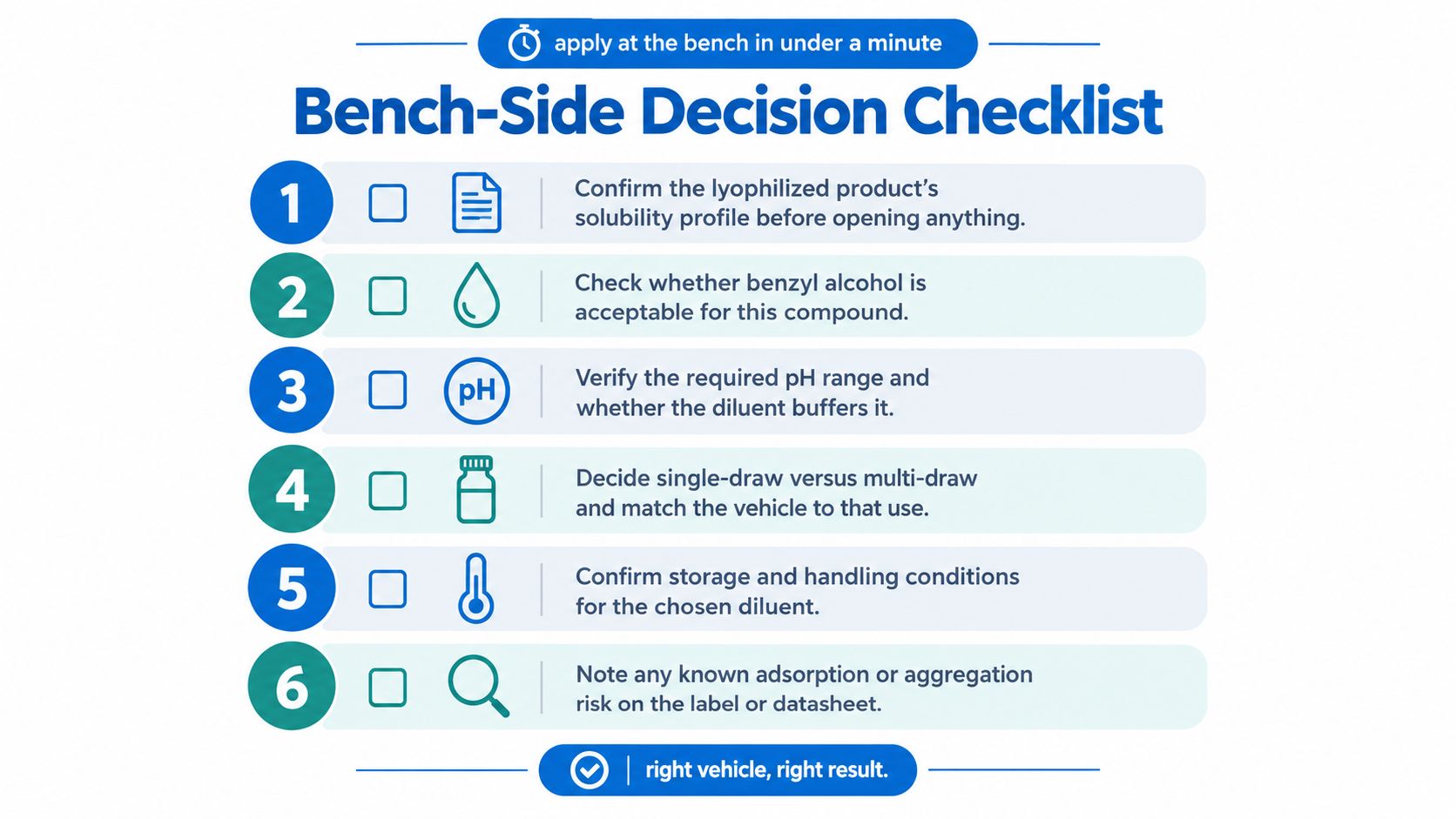
Bench-Side Checklist for Choosing the Right Reconstitution Option
The phrase “reconstitution solution” should trigger a compatibility check, not an automatic selection. A laboratory can apply the following sequence before preparing a lyophilized research product.
Confirm the solubility profile. Review the product label, certificate of analysis, and manufacturer documentation before opening the vial. Note whether the product specifies plain sterile water, bacteriostatic water, saline, an acidic vehicle, or a buffered system.
Check benzyl alcohol acceptability. Read the diluent label and determine whether the preservative is compatible with the compound, assay, storage plan, and laboratory system. The presence of benzyl alcohol is a formulation fact, not a guarantee of suitability.
Verify pH requirements. Identify the permitted pH range and determine whether the selected vehicle provides the required buffering environment. A plain aqueous vehicle and a buffered solution shouldn't be treated as equivalent.
Assess tonicity and ionic strength. Confirm whether the final preparation must be approximately isotonic or whether the assay requires a particular salt environment. Record any product-specific restriction rather than relying on a general lab habit.
Match the container workflow. Decide whether the preparation is intended for a single controlled draw or repeated withdrawals. The container designation and the product instructions must support the planned handling pattern.
Log storage and observations. Record the diluent lot, product lot, preparation time, storage condition, appearance, and any analytical deviation. That information supports traceability when a later batch behaves differently.
The most common misconception is that bacteriostatic water is just another name for any reconstitution solution. Labeling shows a narrower reality. Bacteriostatic water is a specific sterile, nonpyrogenic Water for Injection formulation with benzyl alcohol, while reconstitution solution is a broader functional category. Another misconception is that visible dissolution proves compatibility. It doesn't. A preparation must also satisfy the product's instructions and the laboratory's formulation requirements.
Pro Tec Pep provides research-use-only compounds with product documentation and batch-linked information that can support solvent selection and experimental records. Laboratory teams evaluating a reconstitution workflow can visit Pro Tec Pep to review available research materials and documentation before planning the next preparation.