Ipamorelin vs Sermorelin: A Researcher's Comparison Guide
Compare ipamorelin vs sermorelin for lab research. Explore mechanisms, sequences, purity specs, storage, and study contexts to choose the right peptide.
Most comparisons of ipamorelin vs Sermorelin stop at a simplistic question, which one raises growth hormone more. That framing misses the more useful laboratory question, which pathway is being interrogated, and what kind of evidence exists for the exact material in hand. In a bench setting, those are not small differences, they determine whether a peptide belongs in a ghrelin-pathway experiment, a GHRH-axis model, or a tightly controlled identity-verification workflow.
| Attribute | Ipamorelin | Sermorelin |
|---|---|---|
| Receptor family | Selective ghrelin receptor, GHS-R1a agonist | GHRH receptor agonist, synthetic GHRH(1-29) analog |
| Mechanistic lineage | Exploratory research compound | More established comparator with FDA approval history |
| Human evidence context | Limited, described in the literature as a research compound | More documented clinical and regulatory history |
| Peak timing cited in review | Growth hormone peak around 0.67 hours after administration, with rapid decline thereafter (PlexusDX review) | Peaks in 5 to 20 minutes after subcutaneous dosing, with adult clearance around 2.4 to 2.8 L/min and a half-life of 11 to 12 minutes (Wiley review) |
| Regulatory status | Not FDA approved | FDA approved twice, first in December 1990 for diagnostic use, then in September 1997 under Geref for pediatric growth failure, later voluntarily discontinued in 2008 for commercial reasons (PlexusDX review) |
| Best-fit research question | Ghrelin-pathway signaling, receptor selectivity, pulse isolation | Hypothalamic-pituitary axis modeling, GHRH-receptor signaling, regulatory-comparator studies |
Why These Two Peptides Are Not Direct Substitutes
The common shortcut is to treat ipamorelin vs Sermorelin as a strength contest. That's the wrong frame for a laboratory reader, because one peptide enters through the ghrelin receptor, while the other enters through the GHRH receptor, and the two pathways answer different biological questions.
Different lineage, different evidentiary weight
Sermorelin sits in a clearer regulatory lineage. It was approved by the FDA twice, first in December 1990 for diagnostic assessment of pituitary growth hormone reserve, then again in September 1997 under Geref for pediatric idiopathic growth hormone deficiency or growth failure, and that product was later voluntarily discontinued in 2008 for commercial reasons, not because of a safety or efficacy withdrawal (PlexusDX review). That history matters in a research file because it means sermorelin is easier to anchor to a defined therapeutic and analytical tradition.
Ipamorelin occupies a different place. It has not received FDA approval, and the literature still describes it as a research compound with limited human clinical evidence (PlexusDX review). For investigators, that doesn't make it uninteresting, it makes it more exploratory and more dependent on exact identity, salt form, and route-specific evidence.
Practical rule: If the question is pathway fidelity, the peptide with the clearer receptor lineage is usually the cleaner comparator.
Why workflow fit matters more than popularity
The comparison stops being abstract once the investigator asks what the assay is supposed to measure. A ghrelin-receptor agonist can be useful when the goal is to isolate GHS-R1a signaling, while a GHRH analog is better when the aim is to model pulsatile pituitary GH release. Those are not redundant tasks, even if both peptides end up increasing growth hormone in some contexts.
A skeptical reading also protects against overgeneralization. The same article that calls ipamorelin more selective also notes the review-level timing and limited human evidence, which means “newer” doesn't automatically mean “better characterized” (PlexusDX review). In a lab, that distinction should shape procurement, documentation, and assay planning before anyone starts comparing outcomes.
Mechanisms and Receptor Pathways Compared
Ipamorelin and Sermorelin do not meet the pituitary through the same door. Ipamorelin is a selective ghrelin receptor, GHS-R1a agonist, while Sermorelin is a synthetic GHRH(1-29) analog that acts through the GHRH receptor (NCI Drug Dictionary, PubChem). That basic separation is the core reason these compounds should be discussed as mechanistic complements, not simple substitutes.
Receptor entry point defines the experiment
The original ipamorelin pharmacology paper, as indexed in PubMed, reported that antagonist studies with GHRP and GHRH blockers supported a GHRP-like receptor mechanism rather than direct GHRH receptor activation (PubMed). The NCI Drug Dictionary also states the receptor-based mechanism explicitly, describing ipamorelin as a selective growth hormone secretagogue that mimics ghrelin and binds the ghrelin receptor, also called GHSR/GHS-R1a (NCI Drug Dictionary).
Sermorelin is structurally different. PubChem identifies it as the synthetic 29-amino-acid N-terminal fragment of human growth hormone-releasing hormone, while native human GHRH is a 44-amino-acid peptide (PubChem). That sequence framing matters because sermorelin is not a ghrelin-pathway tool at all, it is a GHRH-receptor agonist built to reproduce GH-stimulating activity through the hypothalamic pituitary axis.
Why the signaling gap changes interpretation
The same review that distinguishes the receptors also separates the kinetics. Ipamorelin is described as producing a single GH peak around 0.67 hours after administration with a rapid decline, while sermorelin is reported to peak in 5 to 20 minutes after subcutaneous dosing and clear rapidly, with adult clearance around 2.4 to 2.8 L/min and a 11 to 12 minute half-life (Wiley review). Those values are not just formulation trivia, they shape sampling windows and downstream interpretation.
Bench takeaway: A ghrelin receptor agonist and a GHRH analog can both change GH output, but they do so through different upstream logic, so the same readout can mean different biology.
| Attribute | Ipamorelin | Sermorelin |
|---|---|---|
| Primary receptor | GHS-R1a / ghrelin receptor | GHRH receptor |
| Mechanistic class | Growth hormone secretagogue | GHRH fragment analog |
| Experimental value | Tests ghrelin-pathway selectivity | Models hypothalamic GHRH signaling |
| Evidence anchor | PubMed-indexed antagonist work supports GHRP-like mechanism (PubMed) | PubChem and DrugBank identify GHRH-receptor agonism (PubChem) |
Side-by-Side Criteria for Laboratory Evaluation
A useful reagent comparison should start with sequence and end with documentation. For ipamorelin vs Sermorelin, the practical decision is less about which one sounds stronger and more about which one comes with a tighter analytical story for the assay being built.
Sequence length and synthesis burden
Ipamorelin is a pentapeptide, so its synthesis is shorter and the intended sequence is easier to define at the bench. Sermorelin is the 29-residue GHRH(1-29) fragment, which is longer and generally more demanding to characterize batch by batch because more residues create more opportunities for incomplete coupling, truncation, and impurity profiles. That does not make one intrinsically better, it just means the analytical burden is different.
The regulatory contrast matters here too. Sermorelin's FDA history gives it a more established comparator role, while ipamorelin's status as an unapproved research compound leaves more room for variation in how suppliers present identity, salt form, and documentation (PlexusDX review, FDA Pharmacy Compounding Advisory Committee materials).
What a credible COA should settle
A batch-specific Certificate of Analysis should answer identity questions before any biological inference is made. That means mass confirmation, purity profile, counter-ion disclosure, and enough method detail to tell whether the sample was verified orthogonally rather than by one convenient assay. This is especially important for ipamorelin, because the FDA noted in its 2024 advisory materials that there are no safety data for ipamorelin free base or ipamorelin acetate via the proposed subcutaneous route, and it also recorded two reports of non-serious adverse events tied to products containing ipamorelin, including one combined with sermorelin (FDA materials).
Analytical rule: If the COA doesn't state the exact form, the sequence confirmation method, and the impurity profile, the material should be treated as analytically incomplete.
| Criterion | Ipamorelin | Sermorelin |
|---|---|---|
| Sequence length | 5 residues | 29 residues |
| Main analytical risk | Salt-form ambiguity and limited human evidence | Longer sequence complexity, but more established comparator history |
| Regulatory lineage | Research-use compound, not FDA approved | FDA-approved history, later discontinued for commercial reasons |
| Documentation priority | Exact salt, identity, and route-specific evidence | Exact sequence, formulation, and batch impurity profile |
| Best workflow fit | Receptor-selective assay development | GHRH-axis reference work and comparator studies |
Analytical Identity Checks and Purity Specifications
Identity work should begin with the assumption that a name on a vial is not proof. For both ipamorelin and Sermorelin, the first defensible step is orthogonal verification, then a review of how the sample was made and what counter-ion accompanies it. Anything less leaves the biology open to contamination, mislabeling, or simple overconfidence.
The three checks that matter most
Mass spectrometry confirms whether the expected molecular mass is present, HPLC shows whether the sample behaves like a single dominant component, and peptide sequencing confirms whether the residue order matches the intended material. Using only one of those methods leaves blind spots, because a clean chromatogram does not prove sequence identity and a mass match does not rule out closely related truncations or counter-ion issues.
That caution is especially relevant for ipamorelin, since the FDA's compounding advisory materials explicitly highlighted the absence of safety data for certain exact forms and routes, not for some generic notion of “ipamorelin” as a category (FDA materials). The exact salt form matters in the record, not just the marketing language.
Purity thresholds are not the whole story
Suppliers often cite high purity specifications, but the number alone is not enough for a research decision. A batch at a stated purity level still needs identity confirmation, and the COA should spell out whether the material is acetate, trifluoroacetate, or another form. That is the only way to compare lots without treating chemistry as a branding exercise.
Sermorelin benefits from a more defined regulatory and structural narrative, because PubChem identifies it clearly as the GHRH(1-29) analog, while ipamorelin's literature identity depends more heavily on receptor pharmacology and limited human evidence (PubChem, NCI Drug Dictionary). For a lab manager, that difference translates into a documentation burden, not a marketing claim.
| Parameter | Ipamorelin | Sermorelin |
|---|---|---|
| Identity check | MS, HPLC, and sequencing should agree | MS, HPLC, and sequencing should agree |
| Sequence verification | Essential because of short length and salt-form ambiguity | Essential because of longer peptide structure |
| Counter-ion | Must be stated explicitly on COA | Must be stated explicitly on COA |
| Purity | Use the stated batch value only after orthogonal confirmation | Use the stated batch value only after orthogonal confirmation |
| Best practice | Review lot-specific COA before assay setup | Review lot-specific COA before assay setup |
Storage, Reconstitution, and Handling Considerations
Cold-chain handling is not an optional detail for peptide work. For ipamorelin vs Sermorelin, the question is whether the sample arrived in a state that still supports the planned assay, because temperature drift can alter the material long before the investigator sees a failed readout.
Sample integrity starts before the vial is opened
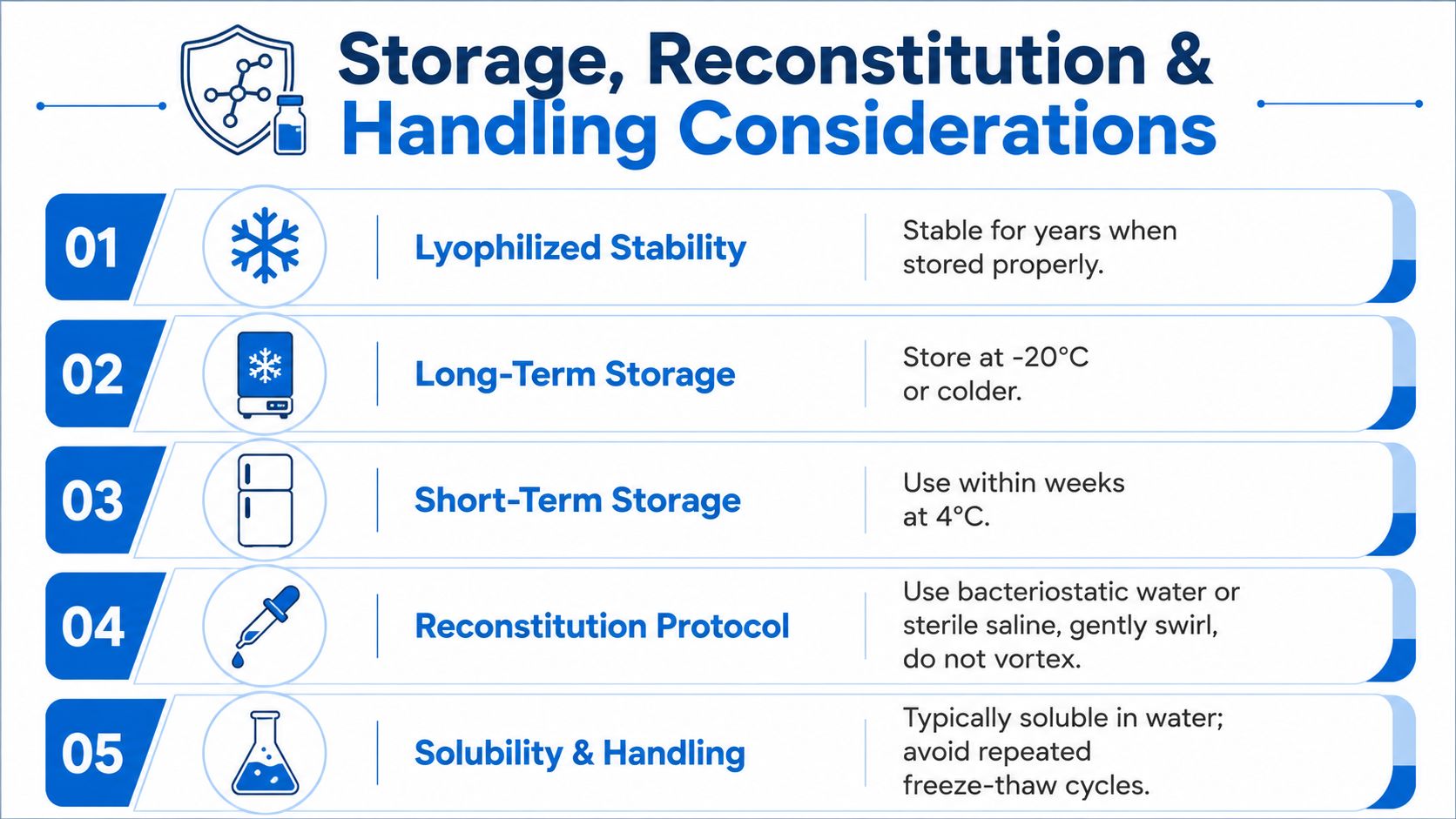
Lyophilized peptide samples are usually the most stable form for shipment and storage, but their handling still needs discipline. Long-term storage is commonly kept at -20°C or colder, while short-term holding is often handled at 4°C, and those are laboratory storage targets rather than instructions for any human administration context.
Reconstitution should be treated as sample preparation. For laboratory workflows, that means using a compatible diluent, mixing gently, and avoiding repeated freeze-thaw cycles that can stress peptide integrity and create assay noise. The key concern is not just whether the vial dissolves, but whether the recovered material remains representative of the original batch.
Why arrival conditions matter
Shipping history can matter as much as the label. If a temperature-sensitive peptide spends too long outside controlled conditions, downstream results can drift in ways that look biological but are pre-analytical. A receiving team should document the shipment state, note any deviation from cold-chain expectations, and quarantine questionable lots before they reach a plate reader or LC-MS workflow.
The same logic applies to both peptides, even though the documentation risk differs. Sermorelin benefits from a longer history of characterization, while ipamorelin's exact form and route-specific evidence deserve closer scrutiny because the FDA flagged those gaps directly in its 2024 materials (FDA materials).
| Handling point | Ipamorelin | Sermorelin |
|---|---|---|
| Long-term storage | Keep cold and protect from drift | Keep cold and protect from drift |
| Short-term storage | Minimize time at 4°C and above | Minimize time at 4°C and above |
| Reconstitution | Treat as laboratory sample prep | Treat as laboratory sample prep |
| Freeze-thaw exposure | Avoid repeated cycles | Avoid repeated cycles |
| Arrival check | Confirm temperature and lot documentation | Confirm temperature and lot documentation |
Research Applications and Study Contexts
The right way to separate ipamorelin vs Sermorelin is by study context, not by brand-style rankings. Each one is useful when the investigator wants to interrogate a specific control point in the growth hormone axis, and each one becomes less useful outside that niche.
Where ipamorelin fits
Ipamorelin is the cleaner choice when the project centers on GHS-R1a signaling, because its receptor profile is the point of the molecule. That makes it relevant for studies of ghrelin-pathway signaling, receptor selectivity, and experiments that try to isolate a secretagogue-driven GH pulse without invoking the GHRH receptor directly.
The literature also frames ipamorelin as a research compound with limited human clinical evidence, which means it is better suited to mechanistic and assay-development work than to broad claims about applied outcomes (PlexusDX review). The strongest laboratory value comes from its narrow receptor behavior, not from any expectation that it will solve every GH-axis question at once.
Where sermorelin fits
Sermorelin makes more sense when the question is closer to hypothalamic-pituitary axis modeling. Its identity as a GHRH(1-29) analog supports studies that need a defined GHRH-receptor stimulus, especially when the goal is to model or compare pulsatile GH release in a more traditional endocrine frame (PubChem).
Its older FDA lineage gives it an additional advantage in comparator work. A reagent with a documented approval history can sometimes anchor a protocol more cleanly than a newer exploratory peptide, especially when the investigator is trying to interpret results against prior endocrinology literature rather than against novelty.
Useful framing: Ipamorelin asks what happens when the ghrelin receptor is engaged. Sermorelin asks what the pituitary does when GHRH signaling is reproduced.
| Application Area | Ipamorelin | Sermorelin |
|---|---|---|
| Ghrelin-pathway signaling | Strong fit | Weak fit |
| GHRH-axis modeling | Indirect fit | Strong fit |
| GH pulse isolation | Useful for receptor-selective work | Useful for endocrine reference work |
| Comparative endocrinology | Mechanistic comparator | Historical comparator |
| Human evidence context | Limited | More established lineage |
Situational Recommendations and Open Evidence Questions
Choosing between these peptides should start with the experimental question, not the market category. If the project needs a short-duration GHS-R1a agonist, ipamorelin fits the receptor logic, while a study of pulsatile GH axis modeling aligns more naturally with sermorelin because its activity tracks the GHRH receptor pathway (NCI Drug Dictionary, PubChem).
What remains unresolved
The evidence gap is not just philosophical, it is practical. The FDA's 2024 compounding advisory materials noted two non-serious adverse event reports involving products containing ipamorelin, including one combined with sermorelin, and also stated that there are no safety data for ipamorelin free base or ipamorelin acetate via the proposed subcutaneous route (FDA materials). That means a lot of casual commentary about tolerability still rests on extrapolation rather than directly relevant evidence.
The route, salt form, and mixture matter because a generic label can hide very different materials. For researchers, the unanswered question is often not whether one peptide is “better,” but whether the exact batch has enough defensible characterization to enter a study at all.
Non-negotiable verification: Independent HPLC, MS/MS identity confirmation, and endotoxin screening should stay on the checklist regardless of which peptide is selected.
| Research Scenario | Recommended Peptide | Rationale | Open Evidence Gap |
|---|---|---|---|
| Ghrelin receptor selectivity study | Ipamorelin | Targets GHS-R1a directly | Exact salt-form evidence remains uneven |
| GHRH comparator assay | Sermorelin | Reproduces GHRH receptor signaling | Less ambiguity than ipamorelin, but batch quality still matters |
| Short-window GH pulse analysis | Ipamorelin | Aligns with receptor-specific secretagogue design | Limited human data for exact formulation context |
| Endocrine reference modeling | Sermorelin | Better anchored to clinical history | No direct head-to-head PK dataset cited here |
| Compounding-risk review | Sermorelin as comparator, ipamorelin as caution case | Sermorelin has clearer lineage, ipamorelin has more unresolved form questions | Route-specific safety data for ipamorelin remain incomplete |
Pro Tec Pep supports research teams that need batch-verified peptide materials, transparent documentation, and logistics built for laboratory workflows. For investigators comparing ipamorelin vs Sermorelin, that kind of lot-level clarity is the difference between a clean assay and a questionable one. Visit Pro Tec Pep to review research-use-only materials and documentation designed for serious bench work.