Ipamorelin and Tesamorelin Together: A Research Lab Guide
Explore ipamorelin and tesamorelin together in a research setting, covering receptor logic, co-reconstitution limits, storage, and COA verification.
Can two growth-hormone secretagogues be placed in the same research arm just because they act through different receptors? That question exposes the central mistake in discussions of ipamorelin and tesamorelin together. Mechanistic complementarity can justify a hypothesis, but it can't substitute for a controlled human combination study or a validated laboratory compatibility record.
For a research team, the combination is best treated as a new, uncharacterized combined exposure. Tesamorelin has a defined clinical development history, while ipamorelin has a much thinner human record, and no controlled human study has established that combining them produces an added effect. The practical work therefore begins at the bench, with receptor logic, stock preparation, stability planning, and batch documentation.
Why Researchers Consider Ipamorelin and Tesamorelin Together
Could two secretagogues that act at different receptor systems produce a response that is additive, redundant, or dependent on the assay? That is the working question behind studying ipamorelin and tesamorelin together. The receptor distinction gives a testable hypothesis, not a validated combined protocol.
Tesamorelin is a GHRH analog, whereas ipamorelin is a selective ghrelin receptor agonist associated with GHS-R1a signaling. Their separate entry points make the combination useful for a receptor-layer experiment. The bench task is to determine whether any observed response reflects pathway interaction, ordinary addition, or a change caused by the assay conditions.
Tesamorelin has been evaluated in separate clinical research. One Phase III study involved 412 randomized patients and assessed a 2 mg subcutaneous once-daily regimen over 26 weeks. In the relevant HIV-associated lipodystrophy population, the study reported approximately 15% to 18% reductions in CT-measured visceral adipose tissue versus placebo (historical comparison of the two peptides). Those results describe tesamorelin alone. They do not establish what happens after combined exposure.
Ipamorelin has a thinner human record. Reports describe a Phase II proof-of-concept study in postoperative bowel-resection patients, but ipamorelin has not been approved by the FDA or EMA. The available literature also does not define a validated regimen combining ipamorelin with tesamorelin (overview of ipamorelin and tesamorelin research histories).
Practical rule: A shared hypothesis does not create a shared evidence base.
What the bench scientist must decide
The experimental design should separate four decisions:
- Receptor question: Can the selected model distinguish GHRH from GHS-R1a effects?
- Chemistry question: Do both materials remain soluble and chemically stable in one vehicle?
- Sampling question: Would one vial simplify handling while hiding compound-specific concentration or degradation?
- Documentation question: Can each component be traced to a lot-specific identity, purity, and content record?
A split-vial design usually preserves interpretability. Keep each stock independently characterized, then create co-exposure only when the study arm requires it.
Mechanistic Foundations of GHRH and GHS-R1a Signaling
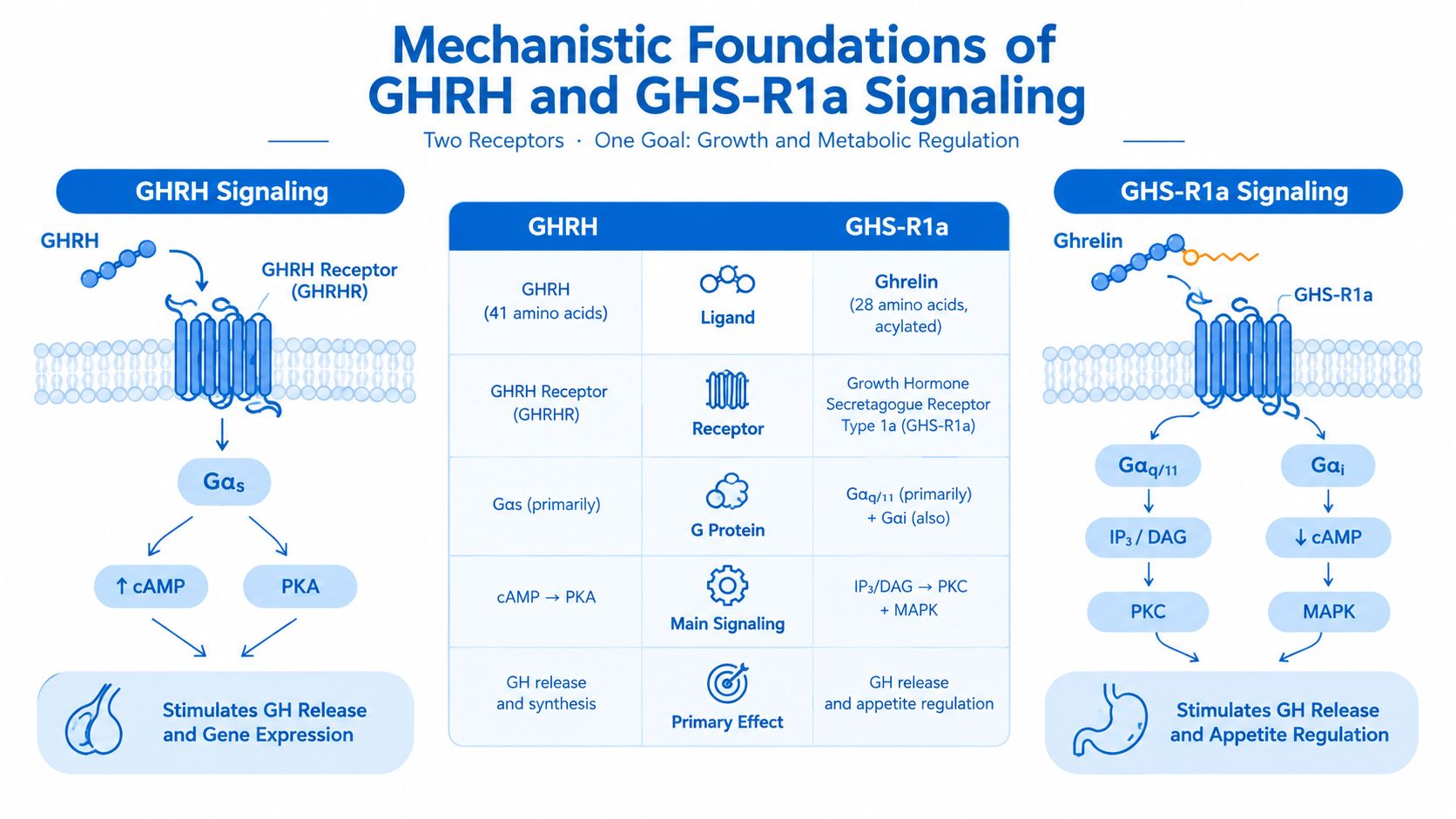
Tesamorelin and ipamorelin aren't interchangeable ligands with two brand labels. They probe different receptor systems, and that difference determines how a combined assay should be interpreted.
Tesamorelin is a GHRH analog. It activates the GHRH receptor on pituitary somatotrophs and raises intracellular cAMP, supporting growth-hormone secretory activity. Ipamorelin is a selective GHS-R1a agonist, meaning it mimics ghrelin-related signaling through a distinct receptor route. Available mechanistic summaries describe the pair as convergent but non-identical inputs into growth-hormone regulation (mechanistic comparison of GHRH and GHS-R1a signaling).
Why pathway convergence can mislead
Both pathways ultimately meet at the somatotroph, but convergence doesn't mean equivalence. A response measured only at the final growth-hormone output level may conceal receptor-specific behavior, timing effects, signal saturation, or altered pulse shape. A combined arm that produces a larger signal can't, by itself, show whether the result came from true interaction, simple addition, altered assay conditions, or stock-preparation artifacts.
A more informative design separates the layers:
- Measure each compound alone under matched matrix and vehicle conditions.
- Measure the combined exposure at independently verified concentrations.
- Include a vehicle control and, where appropriate, receptor-selective controls.
- Record both peak response and time-resolved response rather than relying on one endpoint.
Researchers developing broader peptide assays can organize compound-specific background through a research compound library. The key is to preserve the distinction between a receptor-layer hypothesis and a demonstrated biological interaction.
Co-Reconstitution Limits for Two Research Peptides
A single vial isn't automatically the right container for two peptides. The first calculation concerns total peptide mass and the intended working volume. If both materials are placed in one vial, the resulting concentration of each compound must be calculated independently, and the total solute load must remain compatible with the available solvent and assay requirements.
Solvent selection follows solubility and stability data, not convenience. Bacteriostatic water may fit standard laboratory sample preparation, while sterile water may suit a short reconstitution window. Acetonitrile or weak acetic acid can be relevant when stock concentrations approach solubility limits, but those choices must be validated against the assay matrix and each peptide's chemical behavior.
| Variable | Ipamorelin | Tesamorelin | Combined Implication |
|---|---|---|---|
| Identity | GHS-R1a agonist | GHRH analog | Each component requires independent identity confirmation |
| Solubility | Must be confirmed for the specific lot and formulation | Must be confirmed for the specific lot and formulation | A vehicle suitable for one compound may not suit the pair |
| Working concentration | Calculate from the actual net content | Calculate from the actual net content | Combined concentration affects interpretation and recovery |
| Vehicle pH | Verify against the material specification | Verify against the material specification | A shared vehicle can alter stability of one component |
| Access frequency | Repeated access can increase handling stress | Repeated access can increase handling stress | Aliquoting usually protects the study design better than repeated vial entry |
The product record for Ipamorelin research material should be read alongside the corresponding tesamorelin documentation. A supplier's stated solubility guidance doesn't prove compatibility after mixing, because the combined solution has its own concentration, pH, ionic environment, and headspace.
Treat the mixture as a new solution
The conservative laboratory rule is simple: co-reconstitution creates a new test article. It needs a stability note, a preparation timestamp, a solvent record, a concentration calculation, and a defined handling window.
Freeze-thaw cycling deserves particular caution. Repeatedly freezing and thawing one combined vial can introduce variability that looks like a biological interaction. Split stocks and single-use aliquots can reduce that confounder, especially when the assay schedule doesn't require the entire prepared volume at once.
Storage and Stability Decisions for Combined Studies
Storage should follow the assay calendar, not a generic refrigerator habit. Lyophilized material and reconstituted solution present different stability questions, and a combined vial adds uncertainty because each peptide may respond differently to the same vehicle and temperature history.
Tesamorelin's development and product documentation support a more defined cold-chain approach than exists for ipamorelin. Ipamorelin is often described as having broader reported handling tolerance, but that doesn't establish a validated stability window for a mixed solution. The moment both compounds share a vial, the more conservative component and the less-characterized interaction should shape the study plan.
Variables that control drift
Concentration is central. A dilute solution may behave differently from a concentrated stock, while a high solute load can affect clarity, adsorption, and recovery. Vehicle pH also matters because peptide charge state and aggregation behavior can shift with the chemical environment.
Vial headspace is easy to overlook. Repeated withdrawal changes the gas-liquid interface and can increase handling variability, particularly when the same vial is opened across multiple assay days. Light exposure, container material, agitation, and filtration can add further sources of drift.
| Parameter | Ipamorelin | Tesamorelin | Combined Vial Implication |
|---|---|---|---|
| Physical state | Lyophilized or reconstituted material must be documented | Lyophilized or reconstituted material must be documented | The preparation state of each component should be recorded |
| Temperature | Follow lot-specific laboratory guidance | Follow the more defined tesamorelin cold-chain guidance | Mixed material shouldn't inherit an assumption from either peptide |
| Light | Minimize unnecessary exposure | Minimize unnecessary exposure | Use consistent light protection across all study arms |
| Reconstitution window | Establish experimentally for the working solution | Establish experimentally for the working solution | The shorter validated window should govern the combined arm |
| Freeze-thaw history | Track every event | Track every event | Avoid treating a mixed vial as indefinitely reusable |
Researchers comparing product documentation can review the Tesamorelin research material record. The useful output isn't a universal storage promise. It's a study-specific decision linking preparation date, aliquot plan, sampling cadence, and analytical verification.
Handling note: If the combined solution hasn't been characterized, its stability is an open variable, not a storage fact.
Reading the Certificate of Analysis for Combined Work
A combined-exposure study can fail before the first assay if one incoming lot is poorly documented. The COA review should therefore happen before reconstitution, with each document matched to the physical vial.
Begin with identity. The reported analytical method should identify the intended compound, and the lot number on the COA must match the label. A purity value without a matching lot record isn't enough for a traceable study.
A repeatable COA sequence
- Identity: Confirm that the analyte name, lot number, and analytical result correspond to the vial being logged.
- Purity: Treat HPLC purity below 97% as a stop condition for the planned combined study. The threshold is a screening rule for this workflow, not a universal regulatory standard.
- Net peptide content: Stop and resolve the discrepancy if measured content deviates more than 10% from the label claim. That difference changes every downstream concentration calculation.
- Residual solvents: Check that reported residual solvents are identified and compatible with the assay matrix.
- Endotoxin: A result above the accepted working limit for the selected assay should halt the batch until the laboratory has resolved the risk. The acceptable limit depends on the model and institutional method.
- Sterility: Record the stated sterility result and method. A sterility field doesn't eliminate the need for controlled laboratory handling.
- Lot reconciliation: Retain the COA and record any mismatch between document, vial, and purchase record as a deviation.
The same sequence should be applied independently to ipamorelin and tesamorelin. Combining two materials doesn't average out uncertainty. It compounds the number of variables that can affect concentration, purity interpretation, and assay background.
Why net content matters more than the label
A labeled mass is a planning value. The measured net content is the value that supports a defensible stock calculation. If the two differ materially, the laboratory should either correct the calculation using verified content or exclude the lot from a study requiring quantitative comparison.
Documentation rule: No vial enters a combined arm until identity, lot, purity, content, and relevant contamination fields have been reconciled.
Limits of Mechanistic Logic Versus Validated Evidence
Could two receptor inputs produce more than either one alone? The biology makes that question reasonable, but it does not establish synergy.
Tesamorelin has an FDA-approved indication for reducing excess abdominal fat in adults with HIV-associated lipodystrophy. Ipamorelin has no FDA approval and has not undergone human clinical evaluation in the same way. That regulatory and clinical separation matters: tesamorelin's measured outcomes come from its own development program, not from co-administration with ipamorelin. A receptor-layer rationale therefore cannot be treated as evidence for the combined exposure.
Available summaries describe the pair as an evidence gap, with no identified controlled human trial, cohort study, or open-label study establishing the combination. The evidence supporting tesamorelin comes from separate trials, as outlined in this summary of the absent combination evidence base.
What remains unknown
A diagram showing GHRH and GHS-R1a signaling cannot resolve several bench questions:
- Does the combined response exceed the expected response from each compound alone?
- Does one input reach the secretory ceiling before the second ligand adds a measurable effect?
- Does exposure timing change the apparent interaction?
- Does the pair change pulse amplitude, pulse frequency, or signal duration?
- Could solvent, concentration, or handling differences create an apparent biological effect?
The experiment should separate those possibilities. Use matched single-compound arms and a vehicle control, verify each stock independently, and collect measurements over time rather than relying on one endpoint. If the aim is to assign receptor-specific contributions, include controls that distinguish GHRH receptor activity from GHS-R1a activity.
A positive combined result supports a narrow conclusion first: the tested materials produced a response under the tested conditions. Calling that response synergistic requires a prespecified interaction model, suitable controls, and reproducible results from independently prepared material. Until those conditions are met, receptor complementarity is a reason to test the pair, not evidence of added benefit.
A Pre-Experiment Checklist for Combined Peptide Studies
A short pre-experiment check can prevent a long interpretation problem. The following sequence is designed for a laboratory notebook and keeps identity, chemistry, storage, and traceability in one place.
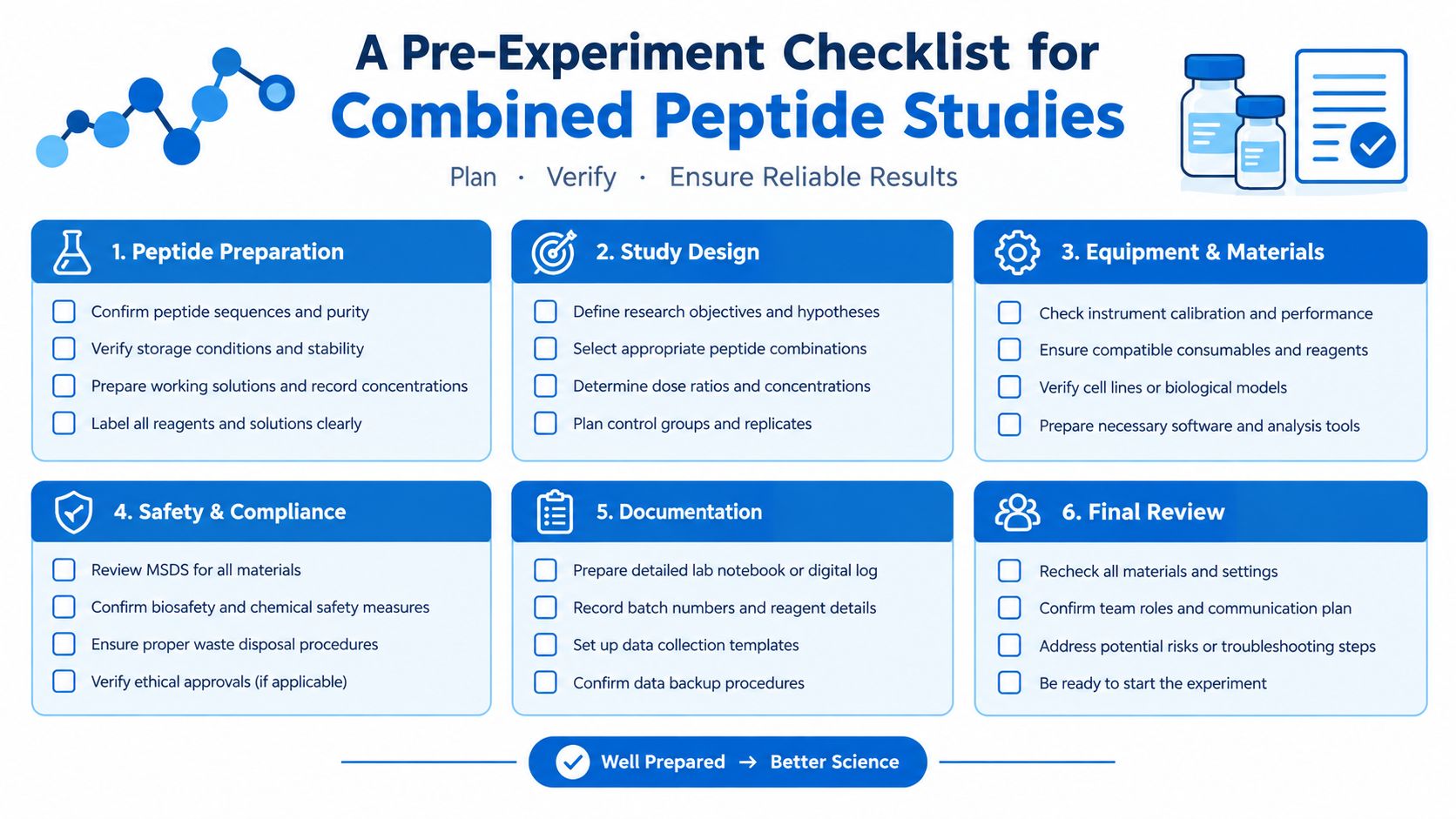
- Confirm compound identity: Record the full names, lot numbers, formulation state, and supplier documents for both materials.
- Match the COAs: Check vial labels against the COA identity, lot, purity, net content, residual-solvent, endotoxin, and sterility fields.
- Calculate independently: Convert each verified net content into its own stock concentration before calculating any combined exposure.
- Check vehicle compatibility: Record solvent, pH, expected concentration, container type, and any solubility observations.
- Choose the vial strategy: Decide whether a single combined vial is justified or whether split-vial matched pairs will preserve better analytical control.
- Define the reconstitution window: Write the preparation date, planned assay period, temperature, light conditions, and freeze-thaw limit.
- Plan aliquots: Assign aliquot identifiers before preparation so each sample has a traceable location and handling history.
- Label the freezer record: Include compound names, lot numbers, concentration, solvent, preparation timestamp, and responsible researcher.
- Set deviation rules: Document what happens if the solution turns cloudy, precipitates, changes color, or falls outside the planned analytical window.
- Retain the record: Store the calculation sheet, COAs, preparation notes, and assay results together.
A failed check shouldn't be bypassed without notice. The researcher should record the deviation, quarantine the affected material when appropriate, and resolve the issue before interpreting combined-exposure data.
Sample Study Designs That Probe the Combination
A first design can compare a single-vial co-exposure with a split-vial matched-pair. The single-vial arm tests the practical behavior of a mixture, including clarity, recovery, and stability. The split-vial arm keeps ipamorelin and tesamorelin independently prepared until the assay step, which makes it easier to identify whether an unexpected result came from biology or co-reconstitution chemistry.
A second design uses a time-course structure with three material conditions: ipamorelin alone, tesamorelin alone, and the combined exposure. Each condition should have matched vehicle handling, independently verified stock calculations, and tracked aliquots. The combined arm can then be compared with the response expected from the two single-compound arms without claiming that any difference proves clinical relevance.
A third design focuses on receptor occupancy or pathway-specific signaling. In that setting, COA-verified stock concentrations are essential because small preparation errors can be mistaken for receptor selectivity. The study should measure pathway-linked outputs separately before interpreting a downstream growth-hormone readout.
| Design Type | Primary Readout | Handling Decision | Key Limitation |
|---|---|---|---|
| Single-vial versus split-vial matched pair | Stability, recovery, and biological response | Compare co-reconstituted and independently prepared material | A mixture may introduce chemistry-driven differences |
| Three-arm time course | Response over time for each single compound and the combination | Use matched aliquots and vehicle conditions | A larger signal doesn't establish synergy |
| Receptor-layer assay | GHRH receptor and GHS-R1a pathway outputs | Use independently verified stock concentrations | Downstream convergence can obscure receptor-specific effects |
A laboratory sourcing both compounds can evaluate batch-linked COAs, identity records, net-content documentation, and storage guidance before material enters the workflow. Pro Tec Pep offers research-use-only Tesamorelin and Ipamorelin materials with product-level documentation, including batch-specific certificates where available. Researchers can review the catalog and documentation through Pro Tec Pep.
"For laboratory research use only. Not for human or veterinary use. Not a drug, food, or cosmetic. Not evaluated by the FDA. Not intended to diagnose, treat, cure, or prevent any disease. By purchasing, you certify you are a qualified researcher and agree to use this product solely for in-vitro laboratory research."