Ipamorelin and Tesamorelin: Research Peptide Guide
Explore ipamorelin and tesamorelin for lab research. Compare receptor pharmacology, clinical endpoints, and documentation for reproducible peptide studies.
If two compounds both raise growth hormone, does that make them interchangeable research tools? No. Ipamorelin and tesamorelin influence different receptor systems, have different time courses, and are supported by markedly different levels of human evidence. Treating “GH elevation” as a single outcome can turn a carefully designed experiment into an invalid comparison.
For laboratory researchers, the useful question isn't which compound sounds stronger. It's which mechanism matches the endpoint, which sampling window captures the relevant biology, and which documentation supports reproducibility. Ipamorelin is best characterized through acute pharmacokinetic and pharmacodynamic work, while tesamorelin has a more developed clinical record centered on CT-quantified visceral adipose tissue in a specific population.
Why Ipamorelin and Tesamorelin Are Often Confused
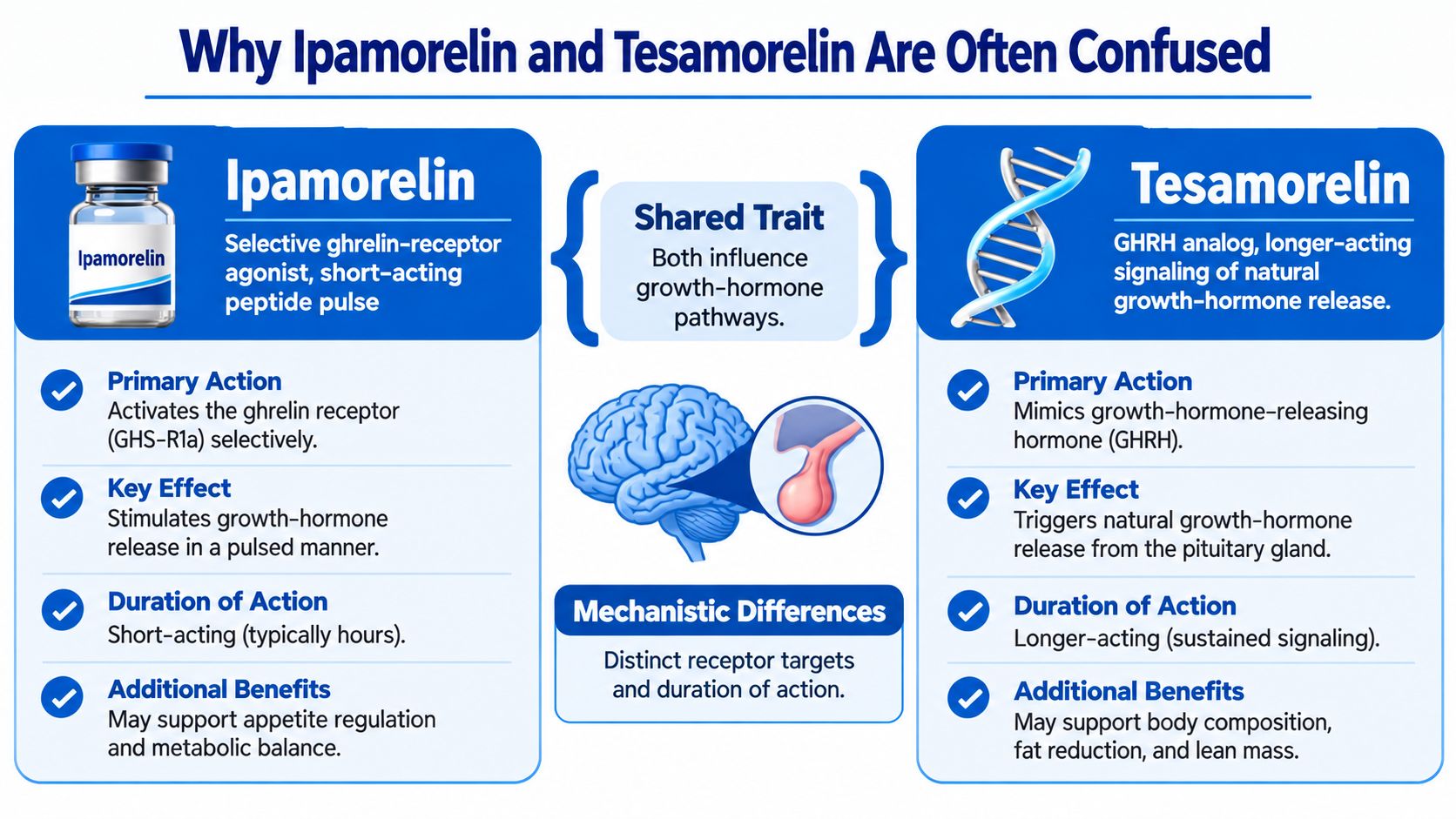
Why do two compounds associated with growth-hormone signaling get placed in the same experimental category? They converge on a familiar endocrine outcome, yet their receptor biology directs different study designs. Ipamorelin is a growth-hormone secretagogue receptor agonist associated with GHS-R1a, the ghrelin receptor. Tesamorelin is a growth-hormone-releasing hormone analog that acts at the GHRH receptor. A shared GH measurement therefore provides a common readout, while receptor engagement determines what the comparison can support.
The original characterization of ipamorelin used receptor-antagonist experiments in anesthetized rats and conscious swine. The results identified a GHRP-type receptor pathway rather than the canonical GHRH route, supporting its classification as a selective secretagogue. These animal experiments establish mechanism. They do not establish a clinical body-composition effect, so product descriptions and study records should label the evidence accordingly (original ipamorelin pharmacology).
The same axis does not mean the same experiment
Tesamorelin addresses a different research question. As a GHRH analog, it stimulates endogenous GH production, with downstream changes reported in markers such as IGF-1 and IGFBP-3. Its regulatory history centers on visceral adipose tissue in adults with HIV-associated lipodystrophy. That population and endpoint define the relevant evidence boundary for interpreting results.
The distinction affects study architecture. An acute endocrine time-course can suit ipamorelin, whereas a tesamorelin body-composition study calls for defined imaging methods and a population comparable with the published evidence. Researchers who place both compounds under a generic “GH booster” label risk comparing unlike endpoints and evidence levels.
Practical rule: Match the biomarker to the receptor pathway before assuming two compounds can share an experimental design.
A defensible comparison records four items: which receptor is engaged, how quickly the signal appears, which biomarker changes follow, and whether a clinical endpoint has been validated. Those fields keep mechanistic observations, downstream markers, and clinical outcomes analytically distinct.
How Ipamorelin Works in Laboratory Research
How should a laboratory interpret ipamorelin without treating it as interchangeable with tesamorelin? Its strongest human evidence concerns acute pharmacokinetics and GH release, so study designs should prioritize exposure timing and measurable endocrine responses rather than broad treatment claims.
Ipamorelin's clearest human evidence comes from an acute dose-escalation pharmacology study in healthy male volunteers. Researchers tested five intravenous infusion rates, 4.21, 14.02, 42.13, 84.27, and 140.45 nmol/kg over 15 minutes, with eight participants at each level (human ipamorelin pharmacokinetic and pharmacodynamic study). The study reported dose-proportional pharmacokinetics, a terminal half-life of approximately 2 hours, estimated clearance of 0.078 L/h/kg, and a steady-state volume of distribution of 0.22 L/kg.
The exposure-response pattern was brief. GH release appeared as a single transient pulse, reaching its maximum approximately 0.67 hours after exposure before declining toward negligible concentrations. Pharmacodynamic modeling estimated 214 nmol/L as the ipamorelin concentration associated with half-maximal GH stimulation and a maximum modeled GH production rate of 694 mIU/L/hour.
What the timing means for assays
A late single measurement could miss the response peak. For an acute intravenous study, a practical sampling grid would include 0, 15, 30, 45, 60, and 120 minutes. This schedule can help separate baseline, peak stimulation, and the resolution phase, although the exact grid should match the assay's sensitivity and the study objective.
Route-specific interpretation is also required. These findings came from intravenous infusion, so they should not be transferred directly to another exposure route. Absorption, bioavailability, and effective concentration may change both response magnitude and timing.
Animal results provide quantitative context without establishing human efficacy. Reported ED50 values were 80 ± 42 nmol/kg in rats and 2.3 ± 0.03 nmol/kg in conscious swine. Maximum GH responses were 1,545 ± 250 ng GH/mL in rats and 65 ± 0.2 ng/mL in swine, as described in the earlier characterization.
A defensible laboratory description can therefore focus on GHS-R1a-mediated GH release, acute exposure-response behavior, receptor pharmacology, and structural analysis. Researchers evaluating a research ipamorelin sample should document route, matrix, sampling interval, assay method, and sample handling, keeping these acute mechanistic endpoints separate from tesamorelin's downstream clinical evidence.
How Tesamorelin Works in Laboratory Research
What does tesamorelin establish in a laboratory study that a general “GH booster” label misses?
Tesamorelin is a GHRH analog. It activates the GHRH receptor and increases endogenous GH release, with downstream changes in serum IGF-1 and IGFBP-3. A sound protocol therefore separates direct compound exposure from secondary endocrine responses (FDA tesamorelin prescribing information).
Its major clinical milestone was U.S. approval in November 2010 as Egrifta for reducing excess visceral abdominal fat in adults with HIV-associated lipodystrophy (tesamorelin clinical and regulatory overview). That indication is narrow. It does not establish routine weight-loss, broad metabolic-enhancement, or healthy-population effects.
The validated endpoint is tissue-specific
The Phase 3 program used randomized, placebo-controlled studies involving more than 800 patients. One key trial randomized 412 adults and required CT-defined visceral adipose tissue of at least 130 cm² for women or 160 cm² for men. Across the program, reported visceral-fat reductions were approximately 15% to 18% over 26 weeks (CT-based tesamorelin research summary).
The same CT-focused evidence base reports a 15.2% decrease in visceral adipose tissue at 26 weeks with tesamorelin, compared with a 5.0% increase with placebo. Another study of 404 participants reported decreases of 10.9% and 0.6%, respectively, at six months. These measures describe intra-abdominal adipose tissue, not total body weight, subcutaneous fat, or nonspecific fluid changes.
FDA prescribing information describes tesamorelin as weight neutral and not indicated for weight-loss management. It also states that prolonged IGF-1 elevation has unknown effects and recommends IGF-1 monitoring (FDA Egrifta prescribing information).
For researchers evaluating a research tesamorelin sample, the protocol should specify CT acquisition, anatomical segmentation, scan timing, and blinded analysis. IGF-1 and glucose-related measures should remain separate from the primary imaging endpoint. Tesamorelin supports a defined visceral-fat signal in a specific clinical population, not a universal slimming claim.
Comparing Receptor Targets and Evidence Depth
The most useful comparison places receptor biology beside evidence quality. Ipamorelin's human pharmacology is detailed at the acute PK/PD level, but its clinical evidence remains limited. Available summaries identify a postoperative-ileus Phase 2 trial that didn't meet its primary endpoint, and no comparable randomized body-composition trial establishes a validated visceral-fat outcome for ipamorelin.
Tesamorelin has a different evidentiary profile. Multiple Phase 3 trials and an approved indication provide a broader clinical foundation, although that foundation remains tied to adults with HIV-associated lipodystrophy. A researcher who treats the approval as proof of general body-composition activity would still be overextending the data.
| Compound | Receptor Target | Human Evidence Depth | Validated Endpoints |
|---|---|---|---|
| Ipamorelin | GHS-R1a, the growth-hormone secretagogue or ghrelin receptor | Acute PK/PD research in healthy male volunteers, plus a postoperative-ileus Phase 2 trial that did not meet its primary endpoint | Transient GH pulse, exposure-response behavior, pharmacokinetic parameters |
| Tesamorelin | GHRH receptor | Multiple randomized Phase 3 trials and a U.S. approved indication in a defined population | CT-quantified visceral adipose tissue, downstream IGF-1-related measures, selected lipid and body-image outcomes |
Why “more GH” is an inadequate comparison
The two compounds also differ in what a change in GH can mean experimentally. With ipamorelin, the central question may be whether a discrete receptor-mediated pulse appears at the expected time and resolves as predicted. With tesamorelin, the research question may instead involve a longer clinical program in which imaging, endocrine biomarkers, glucose regulation, and durability are analyzed together.
Combining the compounds remains an unanswered experimental question, not an evidence-based recommendation. No direct comparative trial establishes superiority, and no head-to-head study establishes whether combined signaling produces additive GH or IGF-1 effects, receptor desensitization, altered glucose responses, or meaningful interaction with somatostatin physiology (comparison of ipamorelin and tesamorelin receptor pharmacology).
Interpretive safeguard: A rise in GH, an increase in IGF-1, and a reduction in visceral adipose tissue are different endpoints. They shouldn't be merged into one measure of “effectiveness.”
Documentation and Stability Checks for Research Reagents
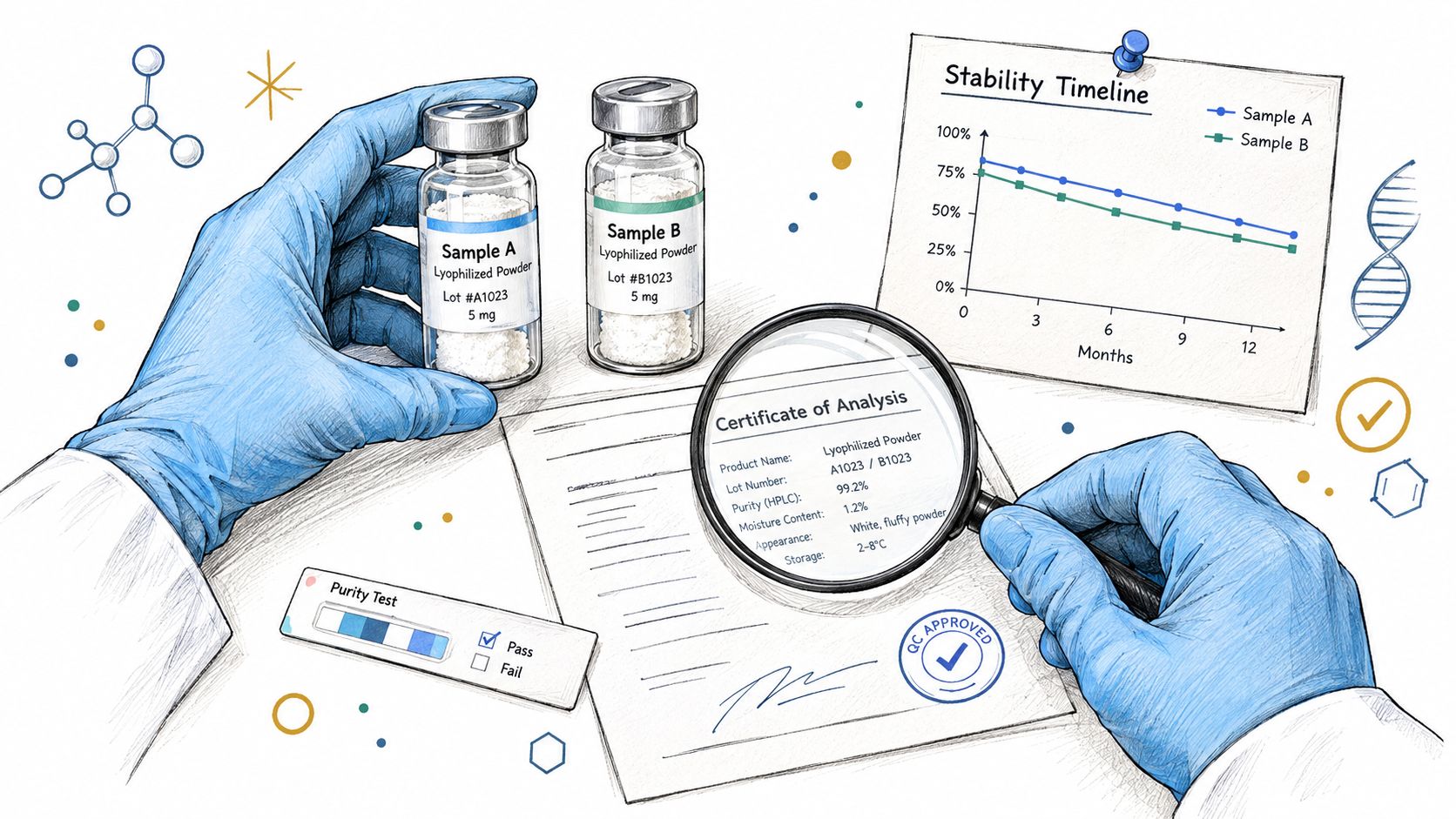
A sound comparison starts before the assay. Researchers should verify that the material has a traceable identity, a defined formulation state, and documentation linked to the exact batch. A generic certificate may describe a supplier's product category, but it doesn't establish the characteristics of the lot entering the experiment.
What a batch file should contain
A useful procurement checklist includes:
- Identity details: Formal compound name, common synonyms, CAS number, peptide sequence, molecular formula, and formula weight.
- Physical description: Formulation state, appearance where relevant, solubility guidance, and storage conditions.
- Stability information: Declared stability timeframe, temperature requirements, and any handling limits attached to the material.
- Batch evidence: A lot-specific Certificate of Analysis rather than an undated or generic document.
- Testing categories: Identity, purity, net content, sterility, endotoxins, heavy metals, and conformity.
Product-level purity specifications may state a minimum such as ≥98% where declared by the supplier. That value should be read as a specification for the listed material, not as a substitute for reviewing the batch record or confirming that the analytical method fits the intended study.
Cold-chain handling can matter for temperature-sensitive reagents. Researchers should record receipt conditions, storage placement, opening date, and any interval between removal from storage and sample preparation. A research testing documentation page can be useful when laboratories compare supplier testing categories, but institutional quality systems should still define acceptance criteria independently.
The analytical record also needs enough detail for a later investigator to reproduce the work. That includes lot number, formulation, storage history, preparation date, solvent or matrix, and the assay used to confirm identity or concentration.
The video below provides additional visual context for laboratory analysis and documentation workflows.
A supplier such as Pro Tec Pep lists research-use-only ipamorelin and tesamorelin materials with batch-linked documentation, product specifications, and optional cold-chain logistics. Those features can support procurement review, but they don't remove the laboratory's responsibility to validate the reagent for its own assay.
Designing Studies Around Each Compound's Strengths
A defensible study begins with the endpoint, not the product label. If the central question concerns a transient GH pulse, receptor signaling kinetics, or early exposure-response behavior, ipamorelin's short-acting human pharmacology makes narrow, time-resolved sampling more informative than a late single measurement.
Tesamorelin fits a different design logic when the study centers on visceral adipose tissue imaging and downstream endocrine markers. Its evidence base supports CT-defined visceral-fat analysis in a specific population, alongside attention to IGF-1 and glucose-related interpretation. Researchers should preserve that endpoint discipline rather than replacing imaging with total weight or treating any endocrine change as equivalent evidence.
A goal-first selection framework
- Acute mechanism: Prioritize ipamorelin when the assay measures GHS-R1a signaling, rapid GH release, or concentration-response behavior.
- Tissue-specific body composition: Prioritize tesamorelin when CT-quantified visceral adipose tissue is the predefined endpoint and the study population is justified.
- Biomarker interpretation: Track GH, IGF-1, IGFBP-3, and glucose-related measures as distinct variables rather than collapsing them into one composite result.
- Comparability: Match route, matrix, sampling schedule, imaging parameters, segmentation rules, and blinding procedures to the research question.
The key conclusion is counterintuitive: the compound with the broader clinical evidence isn't automatically the better tool for every mechanistic experiment. Tesamorelin offers stronger validation for a defined visceral-fat endpoint, while ipamorelin offers a clearer framework for studying a short, discrete secretagogue response. Combining them should be treated as a hypothesis requiring controlled testing, not as a shortcut to stronger evidence.
Researchers preparing a new study should begin by writing the primary endpoint in measurable terms, then select the compound, sampling window, analytical method, and documentation standard that can answer that question without extrapolation.
Pro Tec Pep supplies research-use-only ipamorelin and tesamorelin materials for laboratory investigations, with product specifications, batch-linked Certificates of Analysis, and optional cold-chain handling. Researchers comparing these compounds can review the available documentation and research catalog at Pro Tec Pep before selecting materials for a defined assay.
For laboratory research use only. Not for human or veterinary use. Not a drug, food, or cosmetic. Not evaluated by the FDA. Not intended to diagnose, treat, cure, or prevent any disease. By purchasing, you certify you are a qualified researcher and agree to use this product solely for in-vitro laboratory research.