Ipamorelin and Sermorelin Together in Research
Explore ipamorelin and sermorelin together in research settings, from mechanisms and co-formulation to compliance, sourcing, and literature gaps.
The popular claim that Ipamorelin and Sermorelin work better as a pair gets ahead of the evidence. Their pathways are distinct, which gives researchers a plausible reason to investigate them together. It doesn't prove that the combination produces a stronger clinical effect, or establish how a combined preparation would behave.
For a laboratory audience, the useful question isn't whether the pairing sounds complementary. It's what published work has measured, what remains unknown, and what a responsible research design would need to document. The compounds should be considered within a research-use-only (RUO) framework, not as a validated regimen for people.
Why Combining Two Secretagogues Is Not the Same as Combining Two Mechanisms
Mechanistic complementarity is a rationale for a study, not a result. Ipamorelin activates the ghrelin receptor, while Sermorelin acts through the growth-hormone-releasing hormone receptor. Because both pathways can influence growth-hormone (GH) release, it may seem intuitive that engaging them at the same time would create a larger or more useful response. That outcome has not been established for this specific pairing.
The distinction matters: a receptor-level explanation describes what a molecule may signal, while an outcome claim requires measurements in the relevant model. A stronger GH signal, even if demonstrated, wouldn't by itself show a meaningful clinical effect or establish safety. Those questions call for direct measurements, including GH pulse amplitude, insulin-like growth factor 1 (IGF-1) exposure, glucose metabolism, adverse events, and clinically meaningful outcomes.
A rationale is not a validated protocol
A peer-reviewed review of secretagogue development discusses clinical studies of Ipamorelin, but doesn't report a controlled human trial testing Ipamorelin and Sermorelin as a combined regimen (review of secretagogue development). Historical combination research has examined GHRH alongside other secretagogues, including GHRP-2 or GHRP-6. That work doesn't demonstrate the efficacy or safety of the Ipamorelin–Sermorelin pairing.
The absence of direct evidence is the key finding, not a reason to fill the gap with confident assumptions. Component-specific results can help researchers formulate a question, but they can't settle how two compounds will interact in combination.
Practical rule: Treat claims of reliable synergy as unverified research hypotheses unless direct, combination-specific evidence supports them.
The appropriate scope is therefore narrow and clear: distinguish the compounds' individual mechanisms, assess the rationale for studying them together, and consider the literature gap, bench-level co-formulation questions, and RUO documentation. Anecdotes or marketing language don't replace controlled measurements.
How Ipamorelin and Sermorelin Work on Their Own
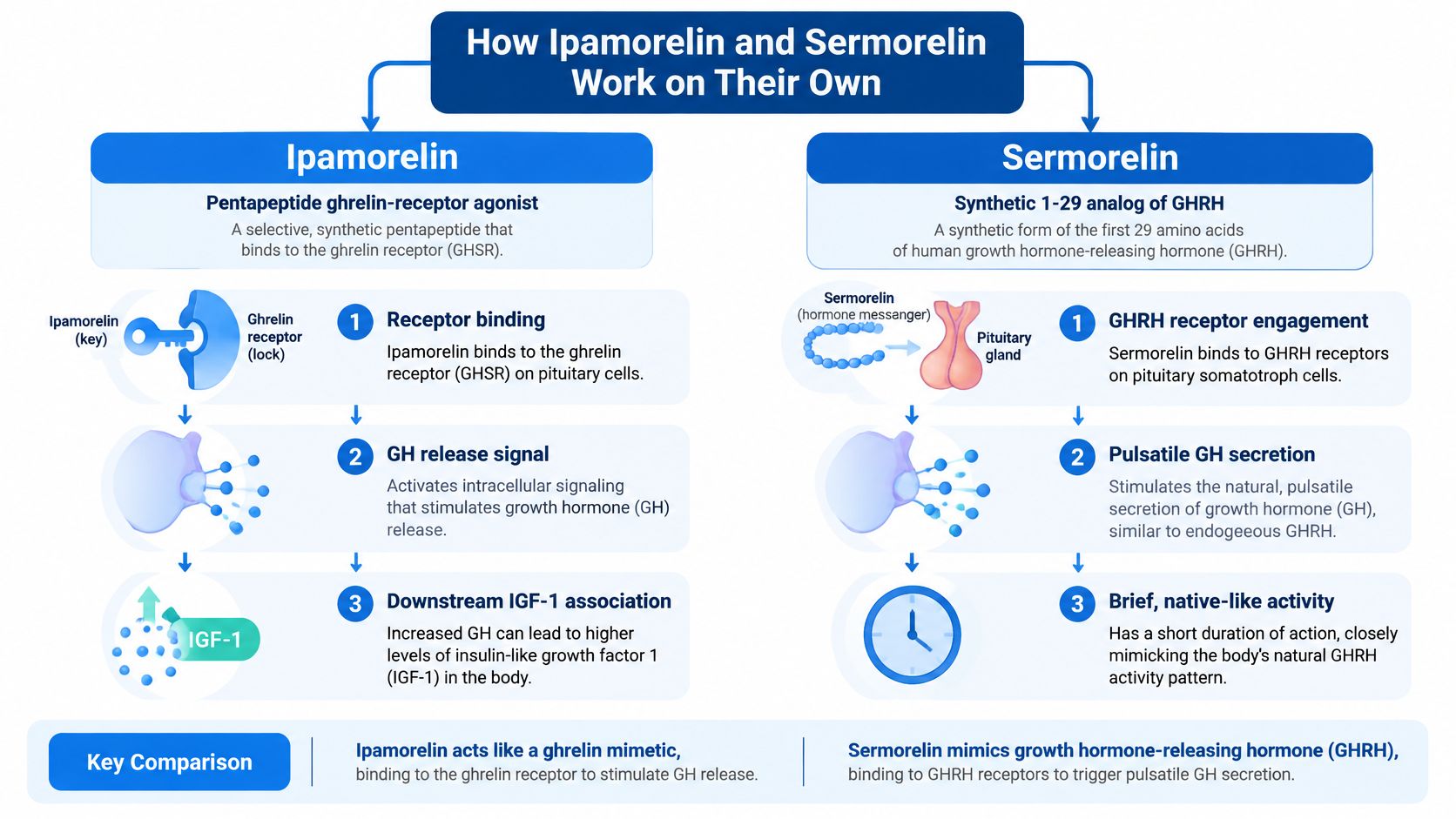
Think of receptor binding as a key meeting a lock. The comparison helps explain why the compounds are described as acting through different pathways, but it doesn't tell researchers what will happen when both are present. Each peptide needs to be understood on its own terms first.
Ipamorelin is a pentapeptide derived from GHRP-1 and acts as a ghrelin-receptor growth-hormone secretagogue. In plain language, it engages the receptor associated with ghrelin signalling and can stimulate GH release. Preclinical work has described a selective endocrine profile, but animal findings aren't a blanket safety finding for human research or combined exposure.
Sermorelin is a synthetic analog corresponding to residues 1–29 of growth-hormone-releasing hormone (GHRH). It acts through the GHRH receptor. The pathway can be compared to a messenger signalling the pituitary, while the receptor acts as the receiving point. This differs from Ipamorelin's ghrelin-receptor pathway, even though both are studied in relation to GH release.
What researchers can and can't infer
A thermostat is another useful analogy for pituitary feedback: signals operate within a wider endocrine system rather than independently of it. But an analogy doesn't establish that feedback will keep a combined response within any particular range. That requires measurement in the relevant experimental model.
Published Ipamorelin work has examined GH alongside other hormonal outputs, including ACTH, cortisol, prolactin, and aldosterone. Sermorelin research has also assessed endocrine markers, including GH, IGF-1, prolactin, follicle-stimulating hormone (FSH), and luteinizing hormone (LH). These measures help characterize individual compounds; they don't establish the combined profile.
Readers looking for the compound-level research listing can consult the Ipamorelin research product page. The essential distinction remains: a shared downstream hormone doesn't mean two receptors produce interchangeable signals, or that combining their ligands creates a predictable result.
Comparing the Two Mechanisms Side by Side
A side-by-side table helps only when each cell keeps its evidence label. The useful question is which observation came from which receptor pathway, assay, and dosing context; shared interest in GH is too coarse to carry a comparison by itself.
| Parameter | Ipamorelin | Sermorelin Acetate |
|---|---|---|
| Peptide class | Pentapeptide derived from GHRP-1 | Synthetic analog corresponding to GHRH residues 1 through 29 |
| Receptor pathway | Ghrelin receptor agonism | GHRH receptor agonism |
| Main research focus in the evidence described here | GH secretion, pharmacokinetics, and animal model gastrointestinal motility | GH axis and endocrine responses in clinical and endocrine studies |
| Selectivity evidence | Preclinical research describes GH stimulation with limited changes in some other measured hormones; this does not establish broad or combination specific safety | Endocrine studies have measured several hormone outputs; this does not define a combined profile |
| Pharmacokinetic observation | Healthy subject work describes an early GH peak followed by a rapid decline, as noted earlier; treat the timing as model and protocol dependent | Reported studies describe rapid concentration peaks after subcutaneous dosing, so sampling windows should be chosen for this compound rather than borrowed from another secretagogue |
| Combined human evidence | No controlled human trial has evaluated the pairing | No controlled human trial has evaluated the pairing |
Where the comparison stops
Two instruments can feed the same recorder and still need different calibration. Ipamorelin and Sermorelin both sit upstream of GH measurement, yet their receptor targets, study contexts, and reported timing observations differ enough that sampling design can change the apparent result. A protocol built around one compound's expected peak may miss or distort the other's signal.
The larger risk is false equivalence. A pharmacokinetic finding for one compound cannot be laid beside a concentration observation for another and treated as a head to head comparison. Route, assay design, participant or model characteristics, and the clock used for sampling all decide what a measurement means.
A catalog entry for Sermorelin Acetate for laboratory research confirms material identity and procurement context; it does not supply interaction evidence. Researchers still need to separate compound specifications from biological effect, and single agent evidence from evidence about a mixture.
The Research Rationale and Where the Evidence Stops
Two complementary mechanisms do not add up to a tested treatment. The case for studying Ipamorelin and Sermorelin together rests on their distinct receptor pathways: a researcher can reasonably ask whether engaging both routes changes the amplitude or pattern of GH secretion relative to either compound alone. That is a testable question. It is not evidence of an additive or synergistic effect.
The central limitation is easy to state and hard to work around: no controlled human trial has evaluated the two as a combined preparation. The clinical literature on this class covers Ipamorelin's own development and combination research involving other GHRH-secretagogue pairings, as noted earlier, yet none of it reports a randomized trial of this specific pair. Findings from other pairings can shape a hypothesis. They cannot stand in for one.
Match each rationale to a measurement
A serious protocol would test the proposed interaction rather than infer it from a receptor diagram. That means comparison conditions covering each compound individually and both together, with outcomes fixed before the first sample is drawn. Otherwise a shift in GH secretion is hard to interpret: the signal moved, but which mechanism moved it, and did the change matter?
Questions a combined study would need to answer:
- GH pulse characteristics: Does the combination alter pulse amplitude or timing compared with either single compound?
- IGF-1 exposure: Do downstream measurements change, and over what sampling period?
- Glucose metabolism: Do fasting glucose or HbA1c readings show a relevant shift?
- Adverse events: What events occur, and do they differ between study arms?
- Meaningful outcomes: Do measured changes map onto the outcome the study cares about, or only onto a hormone curve?
Why a hormonal signal isn't the endpoint
Ipamorelin's development history shows why a GH response should not be read as proof of clinical benefit. Early dose-escalation work reported sharp GH rises at low intravenous doses while ACTH, cortisol, prolactin, and aldosterone stayed statistically unchanged. That is a pharmacodynamic description under studied conditions. It says nothing about what Sermorelin adds.
The endpoint question got a harder test later. A placebo-controlled study of 117 patients recovering from surgery found a median time to tolerating a solid meal of 25.3 hours with Ipamorelin versus 32.6 hours with placebo, a numerical gap that did not reach significance for the primary composite endpoint (p = 0.15) (Ipamorelin development summary). A peptide can move a hormone and still fail to move the outcome that justified the trial. Any future combination study would need to measure both, with the outcome defined in advance.
Stability and Co-Formulation Considerations in the Lab
Biological plausibility doesn't establish that two peptides remain suitable for analysis in the same preparation. Co-formulation introduces laboratory questions about material handling, solvent compatibility, pH, storage, and possible peptide–peptide interactions. The cited clinical and pharmacology evidence doesn't supply a validated combined-vial stability protocol, so those properties must be established for the actual materials and experimental conditions.
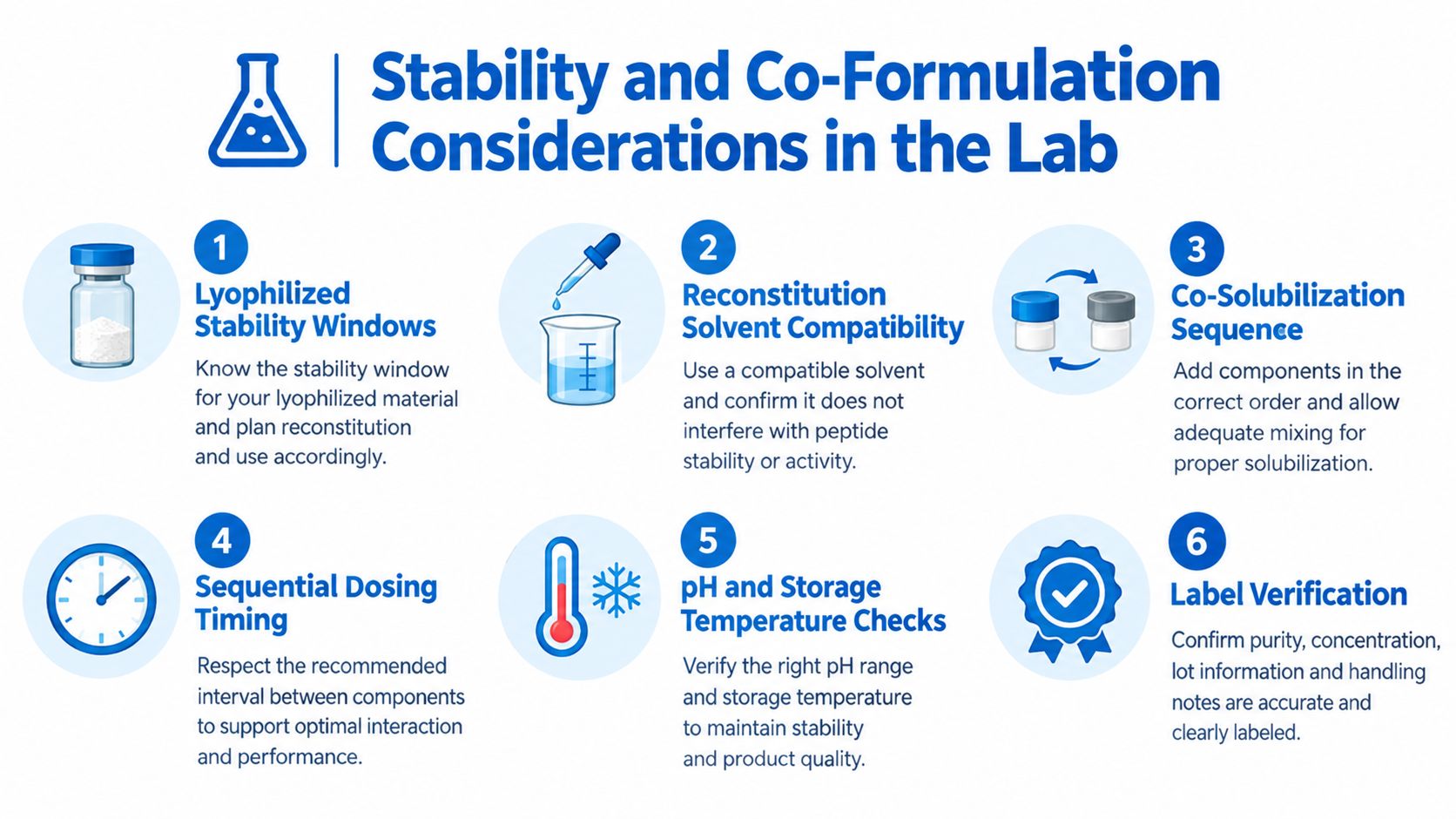
A researcher considering co-solubilization should first review each material's product-specific handling information. The relevant question isn't whether a solvent is commonly used for peptides in general, but whether the available documentation supports it for both materials under the planned analytical conditions.
Questions to resolve before preparing a shared sample
- Starting material: Are the identity, formulation state, and batch documentation recorded for each peptide?
- Solvent compatibility: Do the available specifications support the same solvent for both compounds, and has the resulting preparation been assessed?
- pH and solubility: Has the laboratory verified that the chosen conditions are appropriate for both materials, rather than assuming their requirements match?
- Interaction risk: Could a shared preparation affect recovery, aggregation, adsorption, or assay interpretation? If this hasn't been evaluated, a combined vial adds an unknown.
- Storage and handling: Are working and longer-term storage conditions documented for each material, and is there evidence supporting the combined preparation?
- Sample identification: Do labels and records distinguish the individual materials, batch identifiers, preparation conditions, and analytical purpose?
Sequential sample handling and co-formulation are different experimental designs. A shared vial may simplify some comparisons, but it can make it harder to determine whether a change reflects biology or preparation-related effects. Separate preparations may preserve clearer compound-level controls, although the appropriate design depends on the research question.
A combined sample is a new experimental condition. Its stability and analytical behaviour should be documented, not presumed.
Keep a preparation record that captures the materials' batch identifiers, solvent and preparation notes, storage history, and any relevant quality checks. If stability evidence is unavailable, state that limitation in the experimental record instead of implying a validated shelf life.
What Published Studies Show
The published record is best read as two sets of single-agent observations, each answering a narrow question about one compound, one model, and one set of measured endpoints. No study in the record tests Ipamorelin and Sermorelin in the same preparation or the same protocol. A researcher scanning these citations for combination evidence will find the rationale assembled by inference, not measured directly.

Separate studies, separate questions
The human evidence for Ipamorelin comes from a dose-escalation design. Intravenous dosing at 1 microgram per kilogram produced peak GH concentrations of approximately 40–50 nanograms per milliliter, without statistically significant changes in ACTH, cortisol, prolactin, or aldosterone at GH-maximizing doses, as noted earlier where the primary publication is cited. That result describes an acute pharmacodynamic response under controlled conditions. It says nothing about what happens when a second secretagogue enters the system.
Animal work answers a different kind of question. In a rat model of postoperative ileus, intravenous Ipamorelin was compared with vehicle at 0.014–0.14 micromoles per kilogram, and treated animals showed greater fecal-pellet output, food intake, and body-weight gain. Mechanistic experiments tied the accelerated gastric emptying to ghrelin-receptor activation involving cholinergic excitatory neurons (rat postoperative-ileus study). Gastrointestinal motility in rats sits far from growth-hormone-axis behavior of a two-peptide formulation in humans.
Sermorelin's literature asks yet another question. A short-term clinical study in children with pulsatile GH secretion, summarized in the endocrine review cited earlier, administered 1 mg Sermorelin and GHRH(1–40) in different sequences separated by a one-week interval and measured GH, IGF-1, prolactin, FSH, and LH. That design carries a useful lesson even for combination research: sequential dosing still places the two agents in separate exposures, so the study informs endocrine-axis interpretation without testing co-administration.
Read together, these studies form an evidence mosaic in which each tile shows one peptide acting alone. That is a weaker claim than "the combination works," and treating the two as equivalent is where summary articles tend to overreach. For RUO planning, the practical consequence is concrete: any co-administration hypothesis inherits two evidence chains yet no direct test of the interaction itself, so the experimental record should flag the pairing as an open question rather than a validated premise.
Sourcing, COAs, and RUO Compliance for Laboratory Procurement
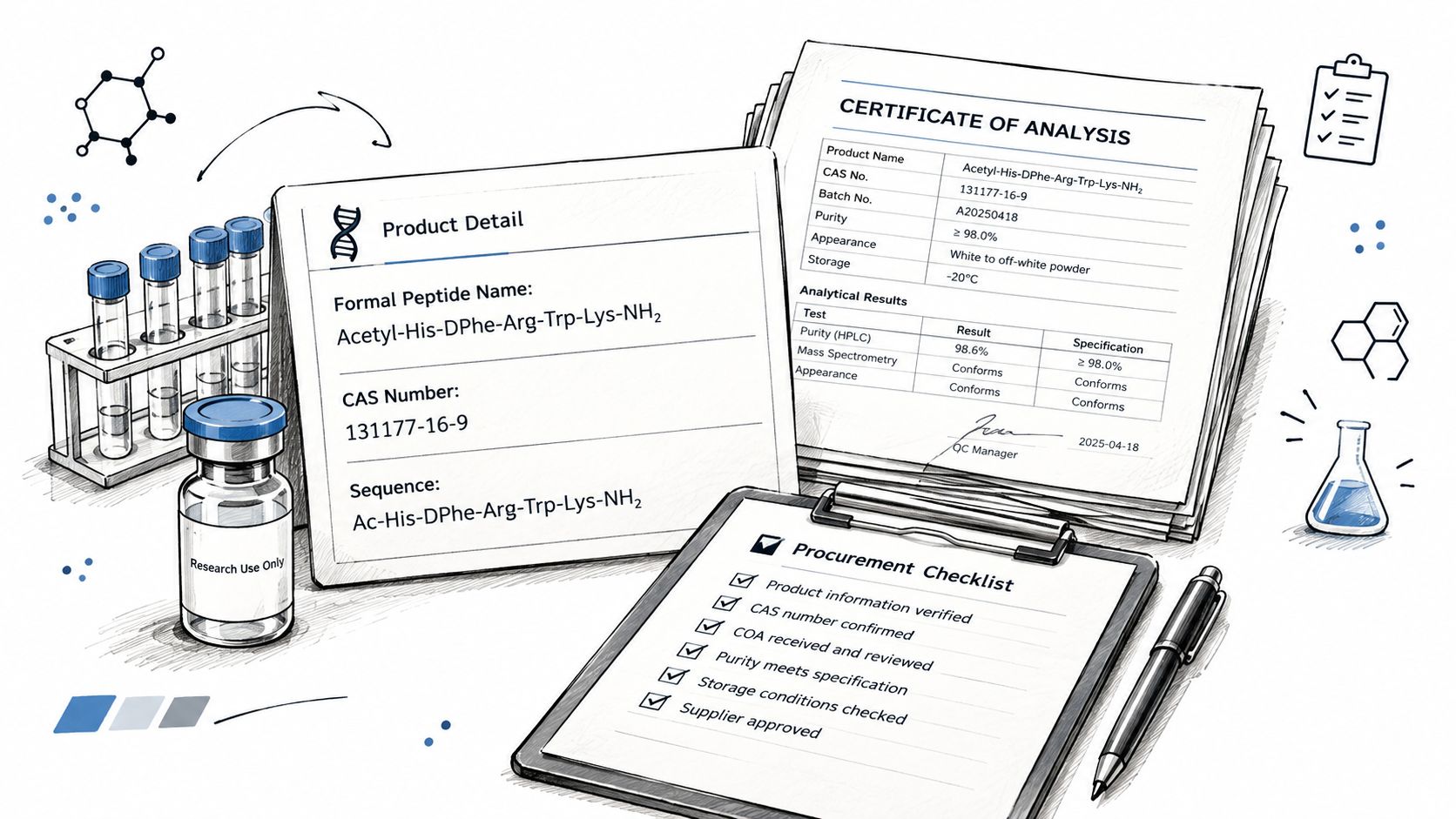
A procurement file does two jobs at once: it identifies the material, and it shows anyone reviewing the work later exactly what entered the experiment. A product detail page should supply the compound's formal name, CAS number, peptide sequence, molecular formula and formula weight, formulation state, solubility guidance, and storage conditions. Any specification left blank becomes a question the assay team has to answer later, under worse conditions.
Check the lot, not just the listing
A batch-specific Certificate of Analysis (COA) ties quality documentation to the physical material on the bench. A generic purity statement ties it to nothing. Confirm that the batch identifier on the COA matches the lot received, then file the document with the procurement and experimental records. That traceability supports reproducibility. It says nothing about whether two peptides remain stable in a shared preparation, and it establishes nothing about clinical suitability.
The Ipamorelin studies covered earlier illustrate the separation well. Single-agent work on GH response and postoperative gastrointestinal function describes what one compound did under defined conditions, and neither addresses a co-formulated Sermorelin preparation. No purchasing document can fill that gap. Paperwork and biological evidence answer different questions, and conflating them is a common way for a well-documented product to acquire an unearned reputation for validated combination behavior.
Before a material enters an experiment, record its identity, lot number, COA, receipt condition, storage history, and preparation notes. Temperature-sensitive shipments and cold-chain handling belong in the intake record. The verification steps a laboratory applies should match its institutional procedures and the demands of the study.
Operational details deserve the same scrutiny: processing arrangements, packaging standards, and age verification shape procurement planning while bearing nothing on biological activity. A laboratory comparing suppliers can review the vendor's research testing documentation alongside its batch records.
RUO means laboratory research use only. Procurement and experimental records should state plainly that the materials are not intended for human or veterinary administration. A clean documentation trail supports institutional review, purchasing audits, and reproducibility, and it keeps the boundary between laboratory investigation and clinical use visible.
Key Takeaways and Common Research Questions
Research summary
- Ipamorelin and Sermorelin act through different receptors, but that fact doesn't prove synergy.
- Published component studies describe individual pharmacology and selected outcomes, not a validated combined profile.
- Direct combination evidence, including route-specific and long-term human safety data, remains absent from the cited literature.
- Co-formulation needs its own compatibility and stability documentation.
- Batch-linked records and an explicit RUO boundary support responsible laboratory work.
Common research questions
What does Ipamorelin's reported selectivity establish?
It describes findings from particular experimental contexts, including preclinical work and single-agent studies. It doesn't establish the safety of repeated subcutaneous research exposure, a Sermorelin combination, or long-term use in people. Route and study context matter.
What should a future combined study measure?
At minimum, the design should address GH pulse characteristics, IGF-1 exposure, glucose metabolism, adverse events, and outcomes suited to the research question. It should also make clear how the combined condition is compared with each compound individually.
What makes an RUO procurement trail defensible?
Keep the lot-matched COA, compound specifications, receipt and storage records, preparation notes, and study documentation together. Maintain a clear record that the materials are for lawful laboratory research only and not for human or veterinary use.
For laboratory research use only. Not for human or veterinary use. Not a drug, food, or cosmetic. Not evaluated by the FDA. Not intended to diagnose, treat, cure, or prevent any disease. By purchasing, you certify you are a qualified researcher and agree to use this product solely for in-vitro laboratory research.
Pro Tec Pep provides research-use-only compounds with batch-linked documentation and product specifications to support laboratory procurement. Researchers evaluating Ipamorelin or Sermorelin can review the available materials and documentation at Pro Tec Pep.