How Long Can Peptides Be Stored Safely
How long can peptides be stored? Compare lyophilized vs reconstituted stability at -20°C and -80°C, plus handling tips for research labs.
Lyophilized peptides are commonly held at −20°C for 1 to 3 years and at −80°C for 3 to 5 years, while reconstituted peptides typically remain usable only for weeks at 4°C and a few months when frozen as single-use aliquots. The answer to how long can peptides be stored depends less on a single freezer number and more on whether the material is still dry, sealed, sequence-stable, and handled without avoidable thawing or moisture exposure.
That's the situation many labs are in right now. A vial leaves the freezer for a quick reconstitution, the bench work gets delayed, and suddenly the team has to decide whether the remaining material still belongs in the assay pipeline or should be re-qualified before it is trusted again. The practical problem isn't just storage, it's judging which stability claim applies to the lot in front of the researcher.
What Storage Timeframes Apply to Research Peptides
A vial sitting in the freezer does not answer the storage question by itself. The first check is form, whether the material is still a lyophilized powder or has already been turned into a solution. Supplier pages often compress those states into one shelf-life line, but that number only makes sense if the form, seal, and handling history match the claim.
Dry peptides are the long-term archive form. Published guidance generally treats −20°C as the default cold-storage condition for lyophilized material, with −80°C reserved for peptides that are more labile or need a longer holding window. A peer-reviewed comparative study also found that a 0.1% TFA solution stored between 4°C and −80°C slowed degradation, which reinforces a narrower rule: colder conditions extend usable life, but a solution is still not the same storage case as a dry solid (peer-reviewed comparative study).
The practical rule labs follow
Practical rule: dry, sealed, cold storage buys time, but reconstituted material needs its own clock.
That clock is shorter because solution introduces hydrolysis, oxidation, and extra handling exposure. Conservative lab guidance commonly places lyophilized storage at 1 to 3 years at −20°C, while −80°C is used when the peptide is more fragile or the project needs longer holding periods (storage protocols summary). For reconstituted material, short-term refrigeration is the more realistic frame, and frozen aliquots are better treated as workflow stock than as archival inventory (storage guidance review).
Vendor claims are conditional on the specific lot's COA data. A product page may give a broad stability range, but that range only applies to the stated formulation state, container integrity, moisture control, and sequence-specific liabilities. A lab should read “stable for X months” as a claim about one defined setup, not as a blanket promise for every vial pulled from every freezer.
Temperature Bands and Their Real Stability Windows
A freezer setting only makes sense when it is matched to the peptide's form and the lab's tolerance for loss. The same vial can justify different decisions at −80°C, −20°C, 4°C, or room temperature depending on whether it is dry, reconstituted, sealed, or repeatedly opened.
Archival cold, working cold, and short-term cool storage
At −80°C, the goal is archival holding for material that needs the widest margin against slow degradation. Published guidance for storage protocols places dry peptide in the coldest bands when the lot is labile or the project needs a longer hold, while short-term liquid storage is more of a controlled exception than a default (storage protocols summary). At −20°C, dry and sealed material is usually the routine lab choice for working inventory. At 4°C, the clock is short and the sample should already be treated as in-use material. Room temperature is a handling condition, not a storage plan.
Vendor stability statements deserve the same scrutiny as the freezer label. A COA or product page may describe a peptide as stable, but that claim only applies to the stated formulation state, container integrity, moisture control, and sequence-specific liabilities. Read “stable for X months” as a claim about one defined setup, not as a guarantee that transfers cleanly to every vial in every freezer.
| Temperature | Lyophilized Powder | Reconstituted Solution | Key Risk Factor | Recommended Use |
|---|---|---|---|---|
| −80°C | Best fit for archival holding when the sequence is fragile | Frozen aliquots can stay usable when handled as single-use stock | Freeze-thaw cycling and vial opening | Long studies, sensitive sequences, archive lots |
| −20°C | Common default for dry material held as working inventory | Frozen aliquots are better treated as workflow stock | Repeated access and imperfect sealing | Routine laboratory storage |
| 4°C | Short-term only if the vial stays dry and protected | Short holding before use, not archive storage | Hydrolysis and solution drift | Brief post-reconstitution holding |
| Room temperature | Transit or bench exposure only | Unfavorable for most research timelines | Heat, moisture, and exposure time | Immediate handling only |
The practical takeaway is simple. A frozen vial can still fail early if it keeps moving between temperatures, and a well-sealed dry vial can outlast a weaker sequence stored in a colder box. Storage temperature helps, but it does not cancel chemistry or poor handling.
Sequence and Chemistry Factors That Shorten Shelf Life
The peptide itself often decides whether a generic storage rule will hold. Two peptides can sit side by side at the same temperature and age at very different rates because their side chains and motifs invite different degradation routes.
The residues that drive loss
Methionine and cysteine are the classic oxidation liabilities, especially when residual oxygen or trace metals are present. That matters because oxidation doesn't need a dramatic failure event to show up, it can appear as a slow drift in purity. The same vulnerability is why oxygen control and sealed containers matter as much as the freezer setting in many workflows (handling guidance review).
Asp-Pro and Asn-Gly motifs are tied to hydrolysis and deamidation pathways, while glutamine and asparagine residues deamidate fastest at neutral to alkaline pH. Hydrophobic stretches and beta-amyloid-like sequences are more likely to aggregate, especially above 4°C or at high concentration (storage guidance review). That means a “stable peptide” is usually a statement about the sequence, not the category.
A peptide that looks chemically ordinary on paper can still be fragile if its motif profile favors oxidation or aggregation.
The useful conclusion is procedural. Sequence audit should come before freezer assignment. A methionine-rich or cysteine-rich construct may need tighter aliquoting and stricter archive conditions than a more inert analog, even if both came from the same vendor and both arrived as dry powder. The storage plan has to follow chemistry, not branding.
Lyophilized Powder Compared to Reconstituted Solution
A peptide that is still dry and one that has already been dissolved do not face the same failure modes. The lyophilized vial is the archive, while the reconstituted vial is the working stock.
Why dry material buys time
Bachem's storage guidance favors keeping peptides as the lyophilizate in a tightly closed container at below −15°C for longer storage, with even lower temperatures preferred for long-term holding, and 4°C reserved for short-term use (Bachem storage guidance). That matches the broader view in supplier summaries and storage reviews that dry, cold, dark, sealed storage is the state most likely to preserve material over longer holding periods, but only if the vial remains protected from moisture and repeated handling (storage protocols summary).
The reason is chemical, not just procedural. In dry form, the main pathways that speed loss are largely suppressed. Once water is added, hydrolysis and oxidation become easier, and the sample also becomes more sensitive to contamination. For that reason, a peptide should stay lyophilized until the project needs it in solution.
Why solution narrows the window
Reconstituted peptides are meant for use, not archive. Guidance generally treats refrigerated solution as a short-term option, while frozen single-use aliquots can extend usability if the sequence is not especially labile (storage guidance review). The window narrows because every extra day in solution gives oxidation, hydrolysis, and handling losses more chances to accumulate.
A useful way to read a COA or product page is to ask whether the stated stability applies to the dry lot, the dissolved stock, or only a specific buffer condition. That distinction matters more than the label “stored at cold temperature,” because the same peptide can behave very differently once reconstituted.
| Storage State | Primary Degradation Pathway | Typical Usable Window | Critical Handling Step |
|---|---|---|---|
| Lyophilized powder | Moisture-driven hydrolysis, gradual oxidation after exposure | Long-term archival holding | Keep sealed, dry, and dark |
| Lyophilized powder | Moisture uptake during repeated access | Best used when stock can stay untouched | Limit vial openings and temperature cycling |
| Reconstituted solution | Oxidation, hydrolysis, and handling loss | Short-term working stock | Prepare only what the assay needs |
| Reconstituted solution | Accumulated loss from refreezing and thawing | Extended only by single-use aliquots | Avoid repeated freeze-thaw cycling |
The practical rule is simple. Keep the peptide dry until you need it in solution, then treat the dissolved stock as a tighter risk-management problem rather than assume the freezer restores the same stability you had in the vial.
Moisture Light Oxygen and Container-Related Losses
Most peptide losses do not start with a dramatic failure. They start with water, air, light, or a vial that has been opened one too many times.
Moisture is the main silent problem
Lyophilized peptides stay stable only when the vial stays sealed and protected from humidity. Even brief room-temperature exposure is usually framed as acceptable for shipping or bench transfer, not routine storage, because moisture uptake accelerates hydrolysis and changes the effective state of the sample (handling guidance review). Repeated opening is a common cause of hidden drift, especially if desiccant protection has been compromised.
Light and oxygen do damage even in cold conditions
Light exposure can drive photo-oxidation in residues such as Trp, Tyr, Met, and Cys, which is why amber vials or foil wrapping matter for any peptide that leaves the freezer. Headspace oxygen pushes the same oxidation chemistry further, so nitrogen- or argon-purged vials are often preferable to air-filled stock when long holding is expected. Those choices matter even more for methionine-containing peptides, where oxidation can appear without an obvious visual change.
Container design matters too. A good seal, low dead space, and low-static handling can reduce sample loss, especially in small-volume lots. A vial can be technically cold and still be the wrong storage environment if the closure system leaks moisture or lets the sample adsorb to the container wall.
If a peptide has been opened repeatedly, the first question is often not the freezer it came from, but how many humidity events it has already absorbed.
Aliquoting Once and Avoiding Freeze-Thaw Cycling
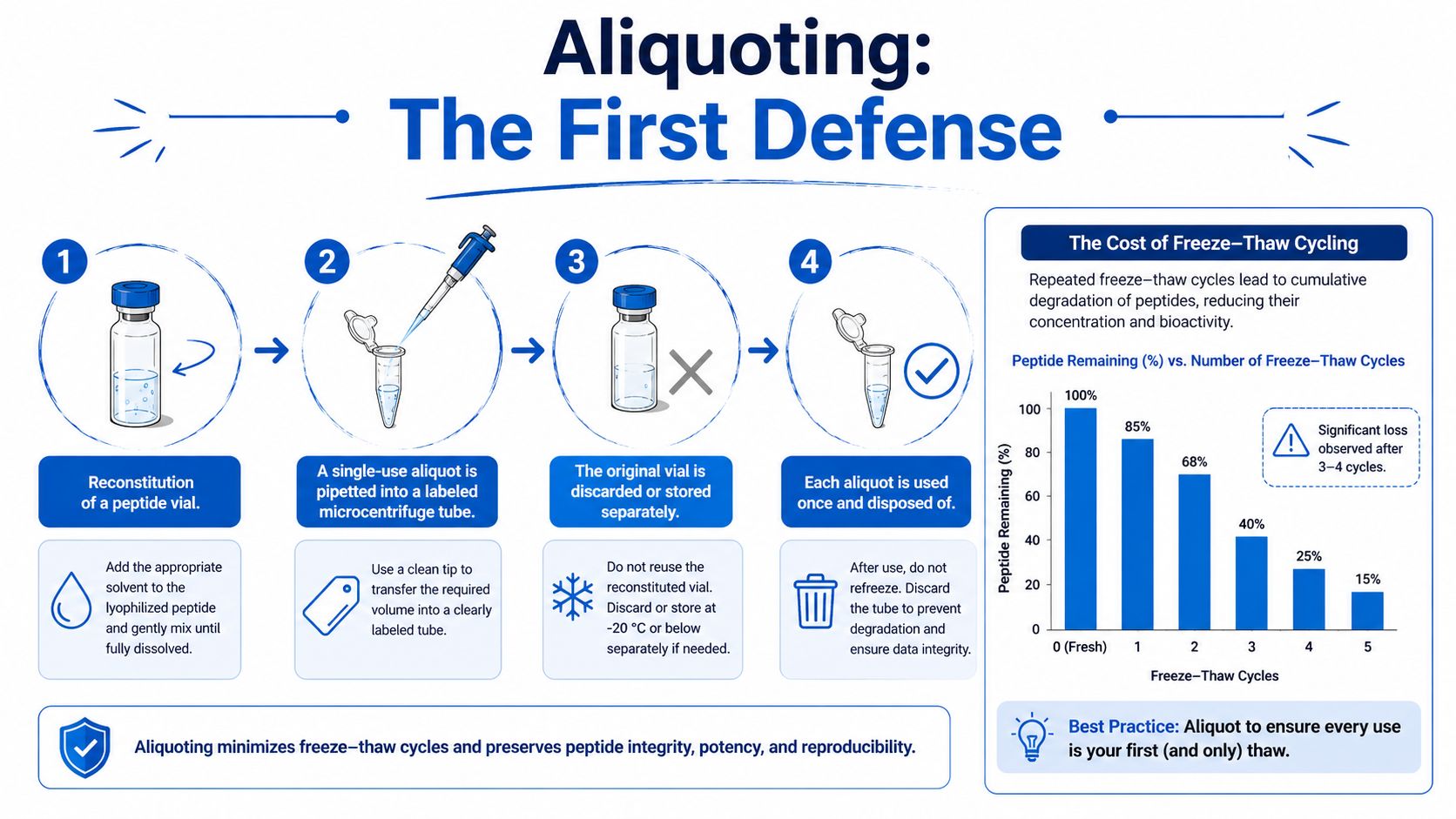
Once a peptide is reconstituted, aliquot once and treat each tube as single-use. That keeps freeze-thaw cycling from becoming the main source of loss.
The workflow is simple. Prepare a working stock at the assay concentration, split it into pre-labeled cryovials, freeze each aliquot promptly, and keep the parent tube out of routine use. Each extra thaw raises exposure to condensation, adsorption, oxidation at the air-liquid interface, and concentration drift during refreezing.
Why cycling degrades purity faster than expected
Each freeze-thaw cycle can cause measurable purity loss through oxidation at the air-liquid interface, and the effect becomes more visible after reconstitution. The published handling guidance review is consistent on one point, repeated cycling should be avoided because every thaw adds another chance for degradation. For oxidation-prone peptides, the loss can show up after only a few cycles, and hydrophobic sequences are more likely to aggregate during handling. The practical issue is assay fit, not just sample survival. Every thaw narrows the margin between a usable aliquot and a lot that no longer matches the original material.
A workable aliquot habit
- Label before filling: Put the peptide name, concentration, reconstitution date, and intended expiry on the tube first.
- Freeze small enough for one assay: Size aliquots to a single plate or single run, not to a vague future need.
- Do not refreeze bulk leftovers: Discard or quarantine the residual working tube after the planned use.
- Keep the transfer fast: Minimize bench exposure so the sample spends less time warming and re-cooling.
Aliquoting is a control step, not just a convenience. It limits the number of thaw events a lot can tolerate before it stops behaving like the original material.
Reading Stability Statements on Product Pages and COAs
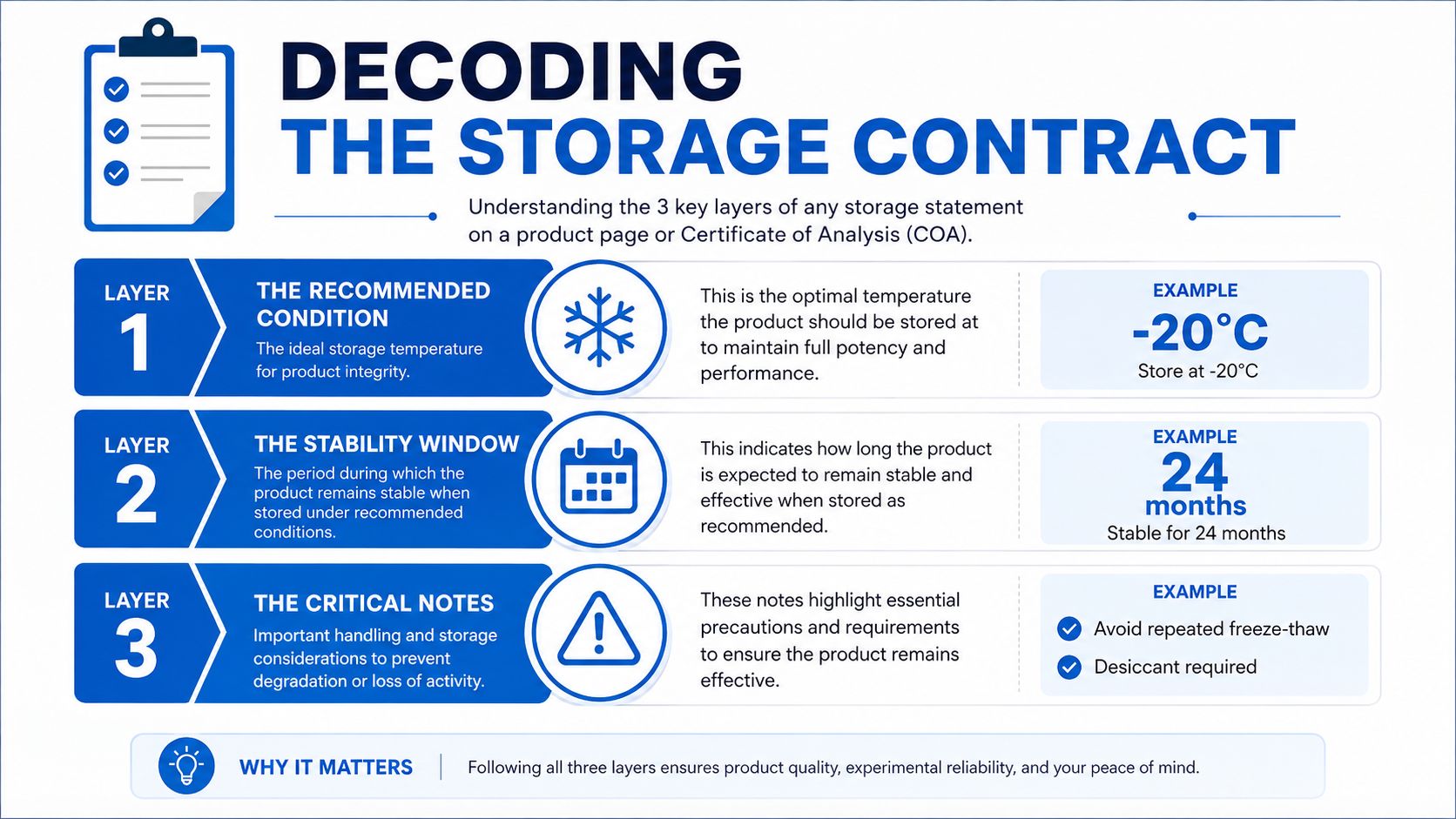
A storage statement should be read like a technical contract. The words on the product page tell one story, but the COA tells you what the vendor measured for that lot.
Three phrases to parse every time
First, find the recommended condition, usually written as something like “store at −20°C” or “store desiccated at −20 to −80°C.” That is the baseline handling expectation. Second, find the stability window, which should say how long the vendor claims the sample remains within specification under that condition. Third, look for the critical notes, such as “avoid repeated freeze-thaw” or “protect from light,” because those phrases define the storage claim's real boundary.
What to look for in the evidence
A strong COA will tie the storage statement to a defined purity threshold, often by HPLC, and will also note whether the material was tested as a dry powder or as a solution. Weak copy usually skips that part and leaves the reader with a duration but no test condition. That is where vendor claims can drift away from published evidence, especially when a page says “stable for a long time” without stating whether the claim applies to lyophilized powder, frozen aliquots, or a specific buffer system.
One useful example for procurement teams is Pro Tec Pep, which publishes batch-linked COAs and product-level storage and stability details for research materials, including lot-specific documentation that can be checked against the claimed storage state. That kind of lot-level record is more useful than a generic shelf-life label when a study needs a defensible archive decision.
The operational rule is simple. If the COA does not show what was tested, under what form, and against which acceptance criterion, then the storage claim is only a starting point, not a conclusion.
Quick Reference Storage Matrix by Formulation
A vial's storage route depends on formulation state, not just the coldest freezer available. Use the matrix below as a decision aid, then check the COA to confirm what was tested for that lot and whether the storage claim applies to powder, solution, or a solvent stock.
| Formulation | Best fit | Short-term holding | Re-qualification trigger | Primary risk |
|---|---|---|---|---|
| Lyophilized powder | Deep-cold archive storage | Sealed, dry, and protected from light for brief handling | Any sign of moisture exposure, cake collapse, or repeated opening | Moisture ingress |
| Aqueous reconstituted solution | Frozen single-use stock | Brief refrigerated use only if the assay tolerates it | Thawing beyond the planned run, clouding, or unexpected loss on recheck | Hydrolysis and oxidation |
| Organic-solvent stock, such as DMSO | Frozen reserve only if the sequence and solvent system support it | Short cool holding during setup | Precipitation, phase change, or loss of signal on verification | Solvent-dependent stability loss |
| Lyophilized after partial use | Re-archive only if the vial is still dry and tightly sealed | Short access window after opening | Any repeated opening, seal failure, or visible container exposure | Moisture, oxygen, and container exposure |
The practical rule is simple. Match the storage state to the least forgiving risk in the workflow. A dry powder can often tolerate archiving, but a reconstituted lot should be treated as a working material unless the COA and the assay plan support longer holding. For teams comparing supplier instructions with their own acceptance criteria, storage protocols summary is useful for checking how dry-state claims are framed, while storage guidance review is better for spotting how liquid-stock guidance narrows once a peptide has been reconstituted.
The matrix is not an expiry label. It is a risk-tolerance tool. If the lot has changed form, been opened again, or sits under a readout with tight sensitivity, it should be re-qualified before it re-enters a critical experiment.
In-House Checks That Confirm a Stored Peptide Is Still Fit
A stored peptide is fit for assay only if it still behaves like the original lot. Visual inspection, chromatography, and mass confirmation catch different failure modes, so a lab needs more than one check before moving a long-held vial back into a critical experiment.
Start with the vial itself. Compare the lyophilized cake to the original COA image, and flag shrinkage, discoloration, or melt-back, because those signs often point to moisture ingress. Then rerun analytical HPLC against the lot's reference chromatogram and judge the sample by area percent at the target wavelength, not by a vague impression of a clean trace. For sequences with known modification risk, a targeted LC-MS check can confirm whether the expected mass is still dominant.
A stored lot does not need to be perfect, it needs to be fit for the readout that follows.
The pass-fail line should come from the assay's risk tolerance. Many downstream workflows use a high-purity expectation, but the more important step is to document whether the material still meets the study's acceptance criteria. That makes drift auditable instead of anecdotal.
Putting It Together A Research Storage Playbook
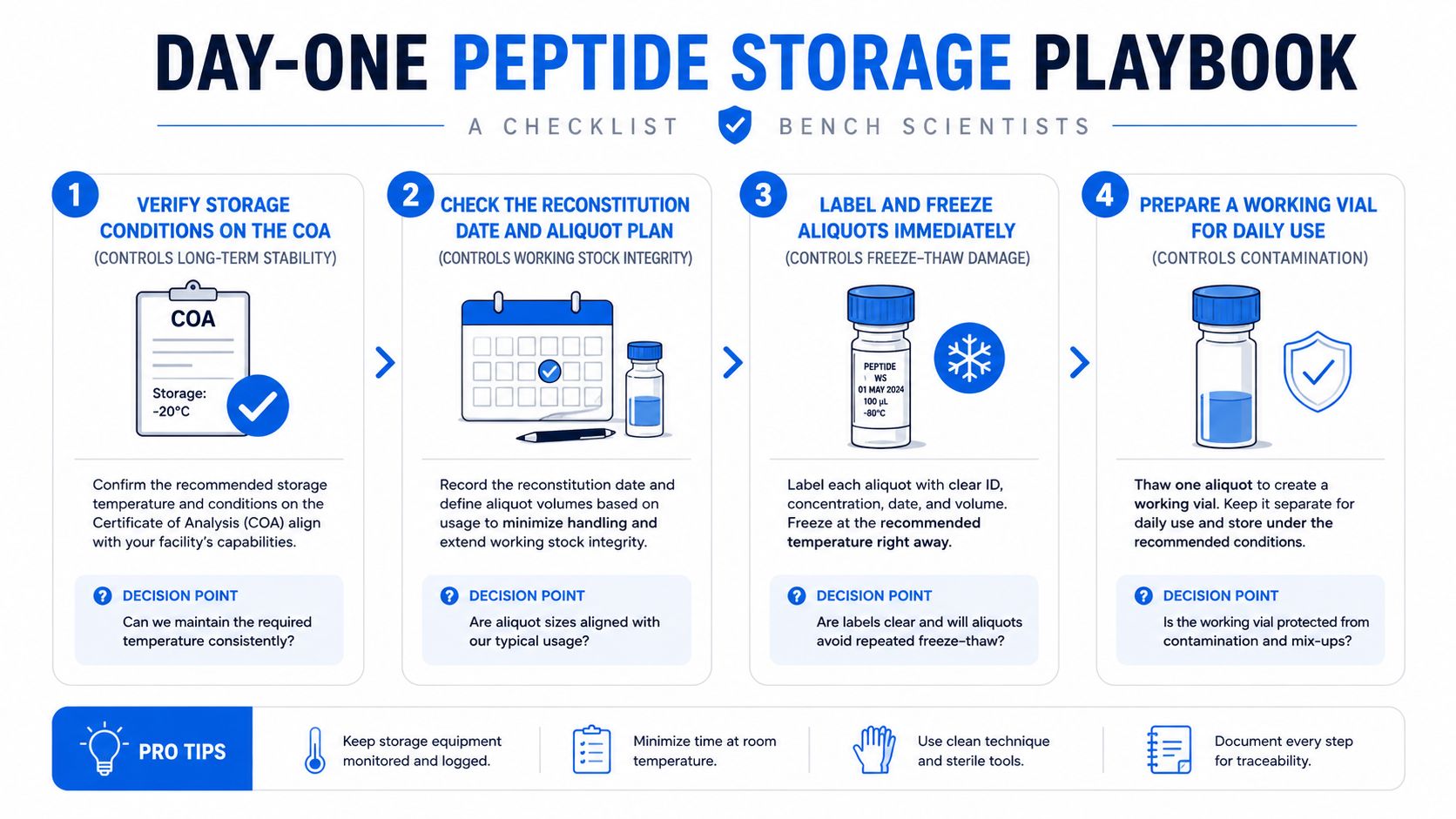
The most defensible storage plan is a chain of decisions, not a single freezer choice. First, match formulation state to the correct temperature band. Second, check whether the sequence carries oxidation, deamidation, or aggregation risk. Third, decide whether the lot should stay lyophilized or be converted into single-use aliquots only when the assay is ready.
A day-one workflow that holds up in real labs
- Verify the COA first. The storage claim only matters if it matches the lot and the form that was shipped.
- Set the reconstitution plan before opening the vial. That controls how many aliquots are needed and how many freeze-thaw events are avoided.
- Freeze aliquots immediately. That protects the working stock from bench exposure and repeated thawing.
- Schedule re-test points for critical lots. HPLC or LC-MS confirmation matters when a long study depends on one material staying within spec.
For teams that want batch-linked documentation, Pro Tec Pep provides research-use materials with product-level storage details and COAs that let labs verify what a specific lot is supposed to withstand. That kind of documentation is useful when a freezer decision has to be defended to a PI, a CRO, or a purchasing file.
For laboratories that need batch-linked documentation, cold-chain-aware fulfillment, and storage details tied to specific lots, Pro Tec Pep is a practical place to start comparing research materials against your workflow requirements. Visit Pro Tec Pep to review product-level COAs and storage information before the next lot goes into archive.