Heavy Metal Testing Urine: Practical Lab Workflow Guide
A practical lab guide to heavy metal testing urine workflows, including sample collection, ICP‑MS analysis, QA/QC, and result interpretation.
A urine heavy-metal run can look routine until the first result comes back unexpectedly high. The tube may be correctly labeled, the instrument may pass its calibration check, and the reported concentration may still reflect contamination, dilution, seafood-derived arsenic, or a specimen collected at the wrong time. Heavy metal testing urine is defensible only when the analyte, specimen, collection window, preservation method, analytical platform, and interpretation framework agree.
Building a Defensible Urine Heavy Metal Workflow
A defensible workflow starts before the specimen reaches the laboratory. The first decision is which metal requires measurement and why. A broad panel can be useful for an initial exposure investigation, but it shouldn't replace analyte-specific planning. Urine is established for selected metals, yet its value depends on the metal's chemical form, the exposure pathway, collection timing, and the analytical method, as explained in the Laboratory Medicine review of urine biomonitoring.
The laboratory should record whether the objective is recent exposure assessment, occupational monitoring, method development, or research characterization. That purpose affects whether a spot sample or timed collection is appropriate, whether total metal is sufficient, and whether speciation is essential. It also determines which reference population or biological decision framework can be applied later.
Start with the specimen, not the instrument
Specimen control is an analytical variable, not clerical housekeeping. A metal-free collection device, documented lot, controlled transport temperature, and complete collection record protect the result before digestion or dilution begins. Ordinary collection materials can contribute metals through dust, dirt, residues, or the container itself.
The same principle applies to instrumentation. Collision or reaction cell ICP-MS is often the practical choice for multielement trace work because one validated run can address several analytes while managing important polyatomic interferences. A narrower assay may justify atomic absorption spectrometry, particularly when the laboratory has established expertise and only a small number of metals are required.
Practical rule: A result is only as defensible as the chain of choices that produced it. A precise measurement from an unsuitable specimen is still the wrong answer.
Analyte-specific priorities
| Analyte | Preferred specimen | Key pitfall |
|---|---|---|
| Arsenic | Timed or spot urine with speciation when toxicity is suspected | Total arsenic can include relatively low-toxicity organic forms from seafood |
| Aluminum | 24-hour urine when a defined excretion measurement is required | A single-void sample is less reliable |
| Cadmium | 24-hour urine normalized to creatinine for chronic exposure assessment | Creatinine correction doesn't create a universal toxicity cutoff |
| Mercury | Blood for organic mercury exposure; urine for selected inorganic or elemental exposure questions | Urine isn't interchangeable with blood |
| Lead | Analyte-specific specimen selection based on exposure context | A urine value shouldn't be treated as a universal diagnostic measure |
The report should preserve the original units, collection duration, creatinine result, detection limit, species measured, and relevant exposure context. Micrograms per liter and micrograms per gram of creatinine answer related but different reporting needs, so the laboratory shouldn't treat them as interchangeable.
Collecting and Preserving Urine Samples for Trace Metal Work
A clean-looking urine cup can still add measurable trace elements to a run. For broad screening, collect approximately 4–7 mL in a sterile, lot-screened, or acid-rinsed container, following the CDC heavy-metals laboratory method. Record the container type and lot with every specimen.
Routine collection generally requires no fasting or special diet. Decide before collection whether the order requires a spot specimen or a timed sample. A spot sample is convenient, while a 24-hour collection integrates excretion across a defined interval and may be preferred for aluminum and arsenic under ATSDR biological monitoring guidance. Keep validated, non-challenge measurements separate from provoked collections. A challenge agent changes the collection question and should never be treated as a routine exposure measurement.
Control the container and collection environment
Keep the collection area free from dust, dirt, metal-containing surfaces, and unnecessary handling. Clean catch collection can reduce external contamination, but every item touching the urine matters, including the container, cap, label, transport bag, and transfer device.
Use this bench checklist:
- Container control: Choose sterile, lot-traced, or acid-rinsed vessels intended for trace-element work, rather than generic urine cups.
- Volume control: Confirm that approximately 4–7 mL is available for broad screening and repeat measurements.
- Collection record: Document the collection date, time, duration when applicable, specimen type, and custody details.
- Consumable traceability: Log the lots of tubes, pipette tips, transfer devices, preservatives, and other contact materials.
Preserve temperature and custody
Freeze specimens for transport when possible, preferably on dry ice. For storage longer than four weeks, keep samples at or below −20 °C, as specified in the CDC method. Record every freeze-thaw event. Without that history, later review cannot distinguish a collection problem from a preservation problem.
At receipt, inspect the seal, label, temperature condition, volume, and visible particles. Link the accession record to every later aliquot. Contamination can occur during collection, shipping, digestion, or instrument handling, so a defensible result requires custody and preservation records alongside the measured concentration.
Choosing Between ICP-MS and AAS for Urine Analysis
The platform decision depends on the panel, concentration range, throughput, interference profile, and need for chemical speciation. Collision or reaction-cell ICP-MS is commonly selected for multielement urine trace work because it measures several elements in one analytical sequence and can reduce selected polyatomic interferences through collision or reaction gases.
Atomic absorption spectrometry remains valuable when the scope is narrow. Graphite-furnace AAS can provide sensitive measurement for selected elements, while cold-vapor AAS has a specialized role in mercury analysis. The trade-off is operational breadth. AAS generally requires more element-specific preparation and runs, whereas ICP-MS introduces greater instrument complexity, higher maintenance demands, and a stronger need for matrix management.
The decision at the bench
ICP-MS fits a laboratory that needs a broad panel, frequent batches, low trace-level capability, and a platform that can support isotope dilution or internal-standard strategies. It also offers a practical foundation for methods involving collision or reaction-cell control, although it doesn't automatically solve every interference or speciation problem.
AAS can be the better choice when the laboratory measures a small number of metals, already has validated furnace or vapor-generation methods, or needs a dedicated mercury workflow. A lower platform burden doesn't remove the requirement for blanks, calibration verification, matrix checks, and contamination control.
| Criterion | ICP-MS | AAS |
|---|---|---|
| Panel size | Strong fit for multielement panels | Better suited to focused analyte lists |
| Interferences | Collision or reaction cells can address selected polyatomic species | Interference control is element and atomization specific |
| Throughput | Efficient when several analytes share a run | Often requires separate conditions for different metals |
| Method flexibility | Supports internal standards, isotope strategies, and broad trace workflows | Strong performance within established single-element methods |
| Mercury work | Requires an appropriate validated configuration | Cold-vapor AAS can be well suited to dedicated mercury analysis |
| Laboratory burden | Greater complexity, maintenance, and matrix-management demands | Narrower capability, often simpler for limited scopes |
The platform should be selected after the laboratory defines its reporting requirements, not because one instrument is fashionable. Method documentation and validation records matter more than the instrument label alone. Researchers comparing analytical resources can also review the compound research library when planning broader laboratory documentation workflows.
Running QA and QC on Every Batch
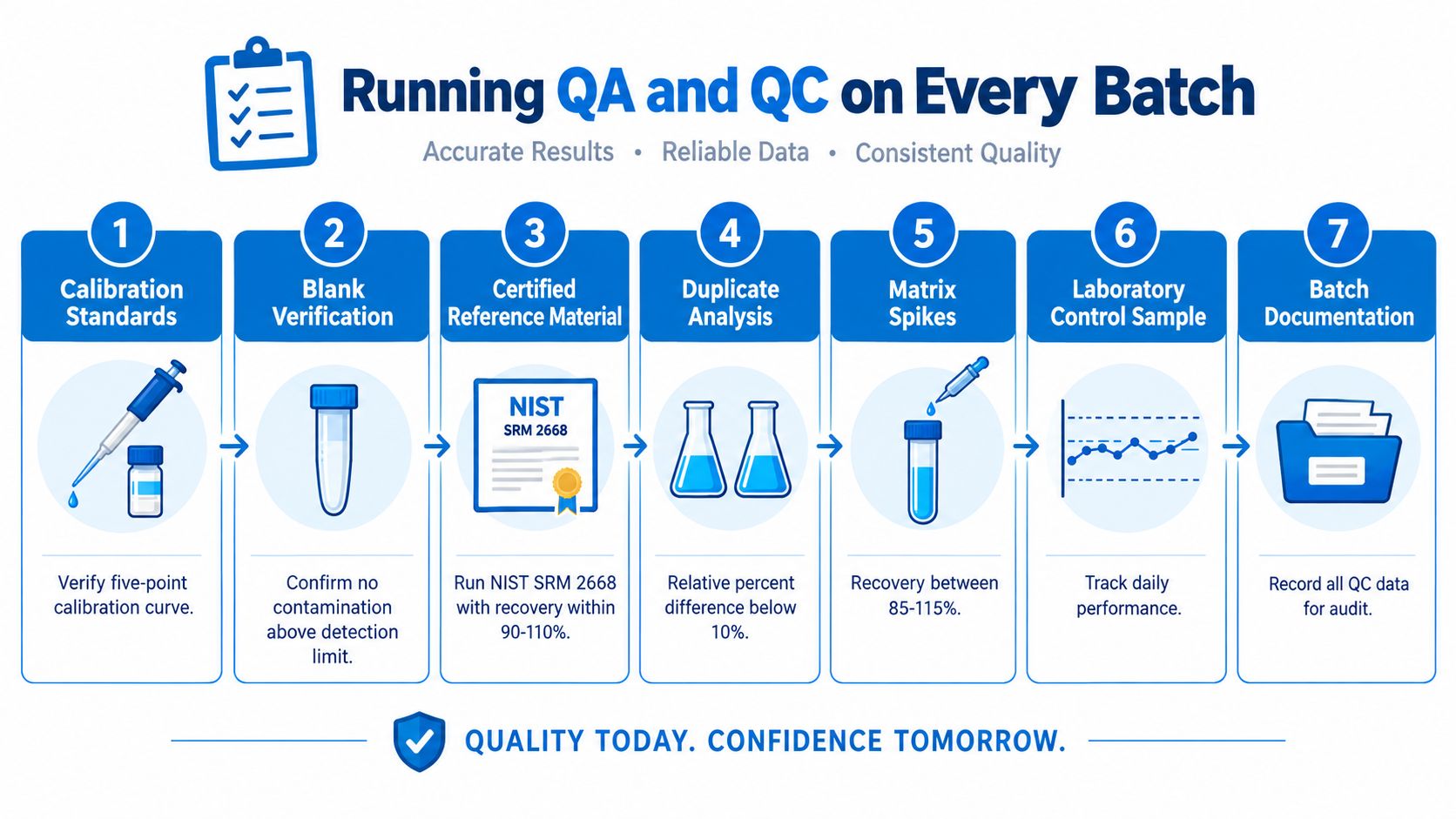
A trace-metal batch can fail through contaminated reagents, calibration drift, poor recovery, carryover, or transcription errors. Set acceptance rules before testing begins, then document them in the laboratory SOP. Blank limits, QC ranges, repeat criteria, and release authority should be clear enough that another analyst can apply them without guessing.
Build the batch around controls
Start with reagent and procedural blanks. A measurable target metal in a blank can expose contaminated acid, water, tubes, pipette tips, digestion vessels, or preparation areas before patient or research specimens are interpreted. The finding may require cleaning, replacement of supplies, or investigation of a specific lot.
Calibration should cover the intended reporting range. Use verification material independent of the calibration stock when the method requires it. Standard addition can help characterize matrix effects in difficult urine samples, while isotope dilution can improve correction for recovery and signal variation when supported by the validated method.
A practical batch sequence includes:
- Blank assessment: Determine whether reagents and consumables contribute measurable analyte.
- Calibration: Prepare the documented curve and verify its acceptance criteria before unknowns proceed.
- Low and high QC: Challenge the method near the concentrations relevant to the planned report.
- Sample preparation: Record dilution, acidification, digestion, and aliquot identity.
- Batch monitoring: Place controls throughout the run, not only at the beginning.
- Repeat criteria: Reanalyze or confirm results outside predefined blank or QC boundaries.
- Audit record: Preserve raw signals, calculations, lot numbers, analyst identity, and instrument status.
Make the run reconstructable
A reviewer should be able to trace a reported concentration to the original specimen, preparation worksheet, calibration files, blank results, QC charts, and instrument sequence. The record should also show dilution factors, internal-standard behavior, carryover checks, reruns, and the reason a result was released after corrective action.
A clean calibration curve does not prove that the specimen was clean. Blanks and matrix controls answer different questions.
Analysts should stop the batch when a blank is unexpectedly high, a control drifts, or carryover follows a highly concentrated specimen. Corrective action belongs in the record, including the affected samples and the evidence supporting release. For teams building research documentation alongside assay work, the laboratory testing resource consolidates verification materials worth reviewing. The analytical laboratory still sets and applies its own validated acceptance criteria.
Interpreting Creatinine, Timing, and Species Data
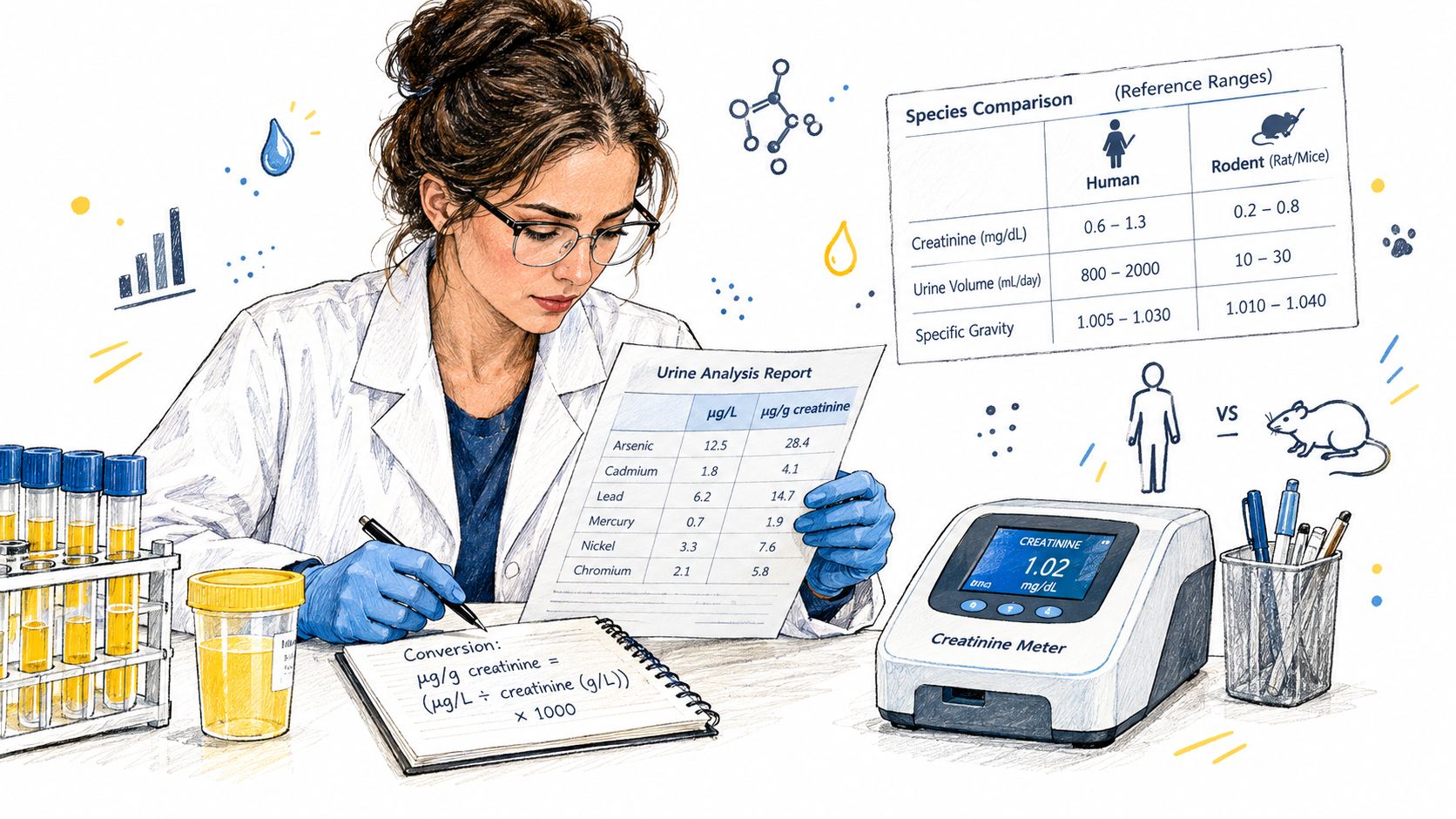
A urine concentration needs context before it can support a conclusion. Spot results may be reported in μg/L, which describes concentration in the submitted urine, or as μg/g creatinine, which attempts to compensate for variable dilution. Creatinine normalization improves comparability between dilute and concentrated specimens, but it doesn't convert a screening value into a toxicity threshold.
Creatinine is excreted by glomerular filtration at a relatively constant approximate rate of 1.0–1.6 g/day, allowing urine metals to be expressed as micrograms per gram of creatinine, according to NIOSH Method 8310. The same method emphasizes that acceptable and unacceptable metal levels aren't established by the analytical method itself. Unusually low or high creatinine excretion can also distort comparisons, and creatinine-corrected values may appear higher in young children because they excrete less creatinine.
Timing changes the question being answered
A 24-hour collection measures excretion over a defined period. A spot specimen reflects the concentration at one collection point and may be more vulnerable to hydration variation. ATSDR identifies 24-hour urine as the preferred specimen for aluminum and arsenic in the relevant guidance, while a single-void aluminum sample is less reliable except in an emergency assessment.
ATSDR cites typical 24-hour urinary aluminum concentrations of approximately 3–8 µg/L and describes total urinary arsenic below 50 µg/L as normal when seafood hasn't been consumed during the preceding 48 hours. Total arsenic above 200 µg/L is unusual and may require further clinical evaluation, but these values must be read with collection duration, dietary context, method, and species information. The ATSDR blood and urine testing guidance provides the relevant context for those figures.
Species can matter more than total concentration
Arsenic is a classic example. Total urinary arsenic can include organic arsenic from seafood that has a different toxicity relevance from inorganic arsenic and its metabolites. When arsenic toxicity is suspected, the laboratory should order speciation rather than treating total arsenic as a complete answer.
Mercury requires a separate specimen decision. The Laboratory Medicine review identifies blood as the preferred specimen for mercury exposure because highly toxic organic forms, including methylmercury, aren't usually eliminated primarily in urine. A urine mercury result therefore shouldn't be presented as a universal measure of mercury exposure.
A report should state the collection duration, units, creatinine concentration, hydration context when known, detection limit, species measured, and reference population. Without those fields, the number may be analytically correct but biologically ambiguous.
Reporting Results and Avoiding the Provoked-Testing Trap
A report should distinguish a validated non-challenge urine measurement from a post-chelation or provoked collection. The American College of Medical Toxicology states that non-challenge testing can be appropriate for selected exposures, particularly arsenic and inorganic mercury, when collected before chelation or after a sufficiently long interval such as 3–5 days. Its position statement also explains that scientifically acceptable reference ranges for post-challenge urine testing haven't been established, and that post-challenge results lack a valid demonstrated correlation with earlier exposure.
Chelating agents can increase urinary trace-element excretion in healthy people whose body burdens are within normal limits, producing misleadingly high results. A provoked value therefore isn't interchangeable with a baseline result and shouldn't be used as a standalone basis for diagnosing poisoning or deciding who benefits from chelation.
Minimum report fields
- Specimen identity: State spot or timed collection and the collection duration.
- Analytical result: Provide units, detection limit, method, and species measured.
- Dilution context: Include creatinine concentration and whether normalization was applied.
- Interpretive frame: Identify the reference population or validated decision limit.
- Quality review: Record contamination checks, repeat analysis, and relevant QC outcomes.
- Clinical limitation: State that a screening value isn't a diagnosis without exposure history and appropriate confirmation.
Any unexpected elevation should trigger review of collection materials, shipping, preparation blanks, matrix behavior, and instrument records. The next step is generally repeat testing from a new specimen, not an immediate conclusion from one number. Laboratories developing policy around research materials and documentation can consult the research-use-only policy while keeping clinical interpretation separate from laboratory procurement rules.
Pro Tec Pep supplies research-use-only compounds with batch-linked Certificates of Analysis, compound documentation, and optional cold-chain handling for laboratory workflows that require traceability. Research teams can review the catalog, verification materials, and fulfillment options at Pro Tec Pep and select documentation that fits their assay and audit requirements.