GHRP-2 vs GHRP-6 Research Comparison for Lab Studies
Compare GHRP-2 vs GHRP-6 for lab research. Sequences, receptor activity, potency and storage differences to guide experimental design.
Which peptide is the better research comparator, the compound that produces the larger acute growth hormone pulse, or the one that makes a repeat-exposure experiment easier to interpret? That question exposes the main weakness in conventional GHRP-2 vs GHRP-6 comparisons. Peak GH amplitude matters, but receptor affinity, downstream signaling, desensitization, assay model, and historical comparability can matter just as much.
Both compounds are synthetic hexapeptide growth hormone secretagogues that act through GHS-R1a, the receptor class later identified as the ghrelin receptor. Yet they aren't interchangeable experimental tools. GHRP-2 generally shows stronger receptor binding and GH secretagogue activity, while GHRP-6 remains valuable for work involving the broader ghrelin-like research profile and legacy models. The sections below treat the comparison as a laboratory design problem, not as a consumer product choice.
Introduction to GHRP-2 vs GHRP-6 in Research Context
Which compound is the better comparator: the one that produces the larger acute GH pulse, or the one that makes repeated exposure easier to interpret? That question exposes the limits of simple GHRP-2 vs GHRP-6 rankings. Peak GH amplitude matters, but receptor affinity, intracellular signaling, desensitization, assay model, and historical comparability can change the experimental conclusion.
Both peptides activate GHS-R1a and stimulate GH release in laboratory systems. A 1996 comparative study in rat primary pituitary cells found that both compounds increased GH release and acted synergistically with growth hormone-releasing factor. The original comparative paper is available through the rat primary pituitary cell study.
The decision depends on the assay
GHRP-2 generally produces the stronger pharmacological signal under matched acute conditions, making it useful when the primary endpoint is receptor-driven GH release. GHRP-6 is often chosen for experiments examining a broader ghrelin-like profile, including appetite-related pathways. Replication work should follow the compound and exposure schedule used in the historical protocol, even when another peptide appears more potent.
Acute response amplitude does not establish receptor affinity or predict repeat-dose behavior. Binding assays measure ligand-receptor interaction, whereas cell assays reflect receptor density, coupling efficiency, second-messenger signaling, and experimental conditions. Divergent cAMP responses can therefore produce different functional outputs even when both peptides activate GHS-R1a. Repeated dosing adds another variable: receptor or post-receptor desensitization may reduce the measured response, making washout duration and dosing interval part of the assay design rather than administrative details.
Animal models introduce species-specific physiology, while clinical studies add endocrine and metabolic variables absent from isolated pituitary preparations. Results should therefore be compared within the same model and endpoint before conclusions are transferred across systems.
Practical rule: Select the peptide according to the biological question, receptor assay, signaling readout, and exposure schedule, not a single peak GH value.
A useful comparison asks four separate questions. Which peptide binds GHS-R1a more strongly? Which produces the larger GH response under the selected conditions? Do their downstream signaling profiles match? What does the evidence support about repeated exposure and desensitization? Keeping those questions separate prevents an acute potency result from becoming an unsupported repeat-dosing recommendation.
What GHRP-2 and GHRP-6 Are and How They Are Studied
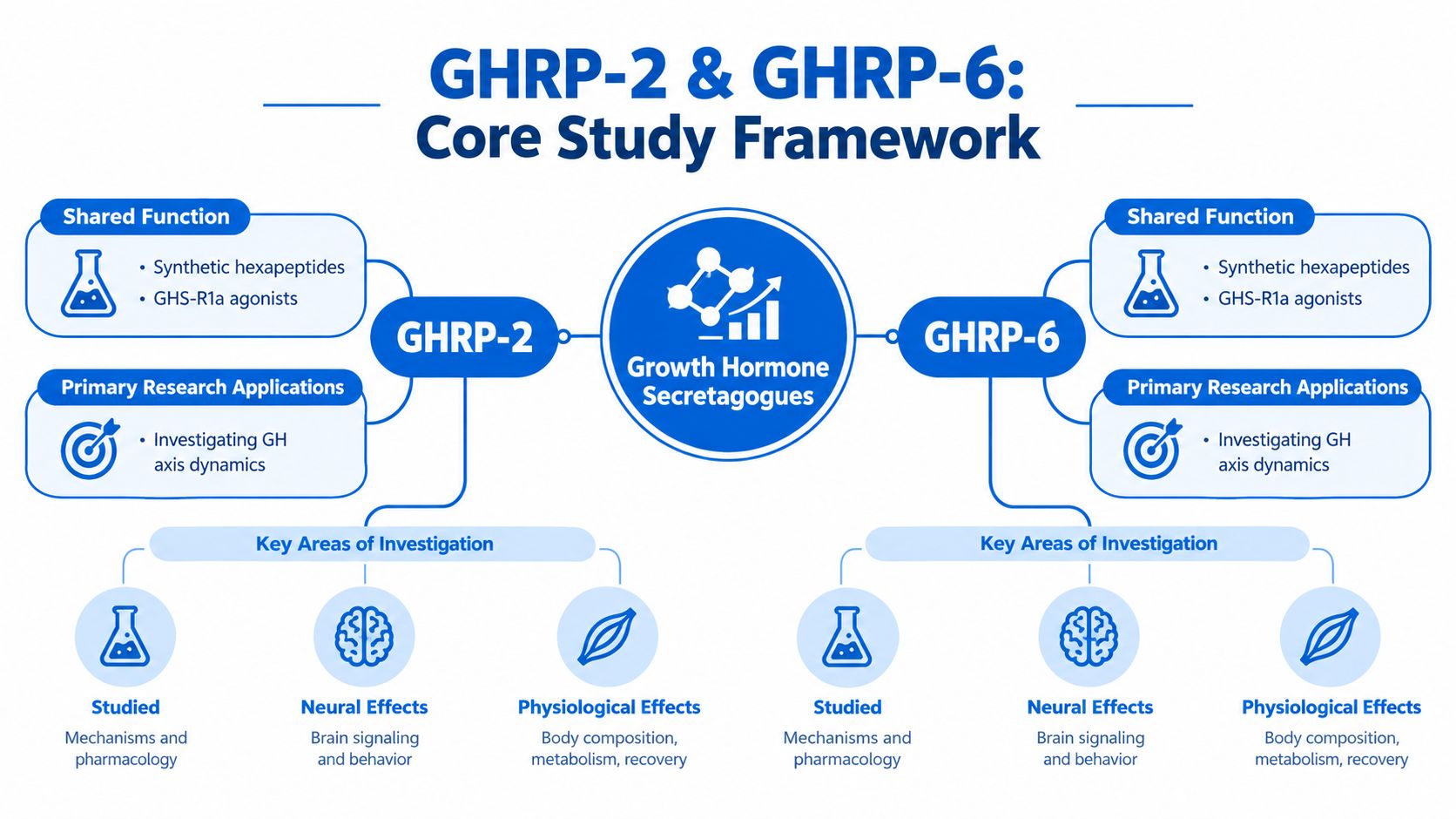
What can a study legitimately conclude when GHRP-2 and GHRP-6 produce different responses? Both are synthetic hexapeptide growth hormone secretagogues and agonists at GHS-R1a, the receptor activated by endogenous ghrelin. Their shared receptor establishes a common pharmacological starting point, not interchangeable experimental behavior.
Evidence comes from several model types:
- In-vitro pituitary studies: Isolated or cultured pituitary cells let investigators control receptor exposure, secretagogue conditions, and GH release measurements.
- Animal models: Rodent and other systems incorporate endocrine and physiological responses, while species-specific signaling can alter interpretation.
- Clinical trials: Human studies have examined GHRP-2 in relation to GH-axis responses, appetite, weight gain in anorexia, and IGF-1 normalization during critical illness, as summarized in a review of growth hormone secretagogues.
The historical sequence also informs interpretation. GHRP-6 appeared earlier in development of this research class, followed by GHRP-2 as a later analog. A 1996 paper comparing their activity in rat primary pituitary cells reported that both stimulated GH release and both acted synergistically with growth hormone-releasing factor, according to the published comparative record.
Why the model must be named
A shared receptor label does not establish identical signaling. In ovine pituitary cells, GHRP-2 increased cAMP even when calcium influx was blocked. GHRP-6, by contrast, induced GH release without increasing intracellular cAMP. The result is a functional divergence that peak GH measurements alone can conceal.
That distinction affects repeat-dosing studies. Receptor coupling, downstream cAMP behavior, and desensitization may shape responses differently across cell systems and exposure schedules. Washout duration and dosing interval therefore belong in the protocol, alongside species, cell preparation, receptor expression, endpoint, and comparator.
Both compounds are appropriately classified as GHS-R1a agonists and GH secretagogues, yet each remains a distinct experimental ligand. Reports should specify the model, readout, exposure conditions, and repeat-exposure design rather than treating one peptide as a universal substitute for the other.
Head to Head Comparison of Receptor Affinity and Potency
How much of the GHRP-2 versus GHRP-6 difference reflects receptor binding rather than peak GH output? Radioligand competition data report GHS-R1a affinity around Ki 0.3 to 0.4 nM for GHRP-2, compared with Ki 3.0 to 4.5 nM for GHRP-6, in comparative GHS-R1a pharmacology data. On those measurements, GHRP-2 has roughly an 8 to 12-fold affinity advantage.
| Parameter | GHRP-2 | GHRP-6 |
|---|---|---|
| Molecular class | Synthetic hexapeptide GH secretagogue | Synthetic hexapeptide GH secretagogue |
| Primary receptor | GHS-R1a | GHS-R1a |
| Reported GHS-R1a binding affinity | Ki about 0.3 to 0.4 nM | Ki about 3.0 to 4.5 nM |
| Relative binding interpretation | Roughly 8 to 12-fold stronger affinity in the cited comparison | Lower affinity relative to GHRP-2 |
| Acute GH response | About 25 to 40% greater peak GH amplitude in matched head-to-head summaries | Lower peak response under matched conditions |
| Research positioning | Often favored when maximizing GH output per microgram | Often retained for appetite-related and legacy comparative work |
Greater affinity can increase receptor occupancy at the same molar concentration, provided the assay supports a direct comparison. It does not, by itself, establish a larger GH response. Receptor density, ligand concentration, coupling efficiency, cellular state, endogenous secretory tone, and sampling interval can each alter the measured endpoint. The same binding advantage may therefore produce different apparent potency across models.
Potency is assay-dependent
Matched-dose summaries report approximately 25 to 40% larger peak GH responses for GHRP-2 than GHRP-6. Reviews also describe higher peak responses for GHRP-2 and, in some assay designs, larger area-under-the-curve responses. One review reports roughly 25 to 50% higher peak GH or about 6 to 7-fold lower ED50, depending on assay design and species, as discussed in the review of GHS-R ligands.
These findings should not be converted into a universal dose ratio. They come from different experimental systems, with differences in species, receptor preparation, cell context, exposure conditions, and endpoint timing. The defensible conclusion is directional: GHRP-2 is generally the more potent GH secretagogue per matched molar exposure, while GHRP-6 remains an active comparator for mechanistic and legacy studies.
For dose-response experiments, report molar concentration, receptor preparation, cell model, sampling window, endpoint definition, and repeat-exposure conditions. Binding affinity predicts receptor engagement, whereas observed potency reflects the full assay configuration. That distinction becomes important when comparing acute responses with protocols involving repeated dosing, washout, or changing receptor responsiveness.
Signaling Differences and Desensitization Behavior
Could equal GH output conceal different receptor signaling? Shared activation of the growth hormone secretagogue receptor does not imply identical intracellular responses. In ovine pituitary cells, GHRP-2 increased cAMP even when calcium influx was blocked, whereas GHRP-6 stimulated GH release without increasing intracellular cAMP. The comparative mechanistic findings are summarized in the PubMed record for the comparative mechanistic study.
This distinction changes how a GH assay should be interpreted. Similar hormone output can arise from different contributions of cAMP, calcium-dependent signaling, signal duration, and pathway recruitment. A larger GHRP-2 response may therefore reflect stronger receptor engagement, more effective downstream coupling, or both within that cell model. Peak GH amplitude alone cannot identify the mechanism.
What desensitization evidence shows
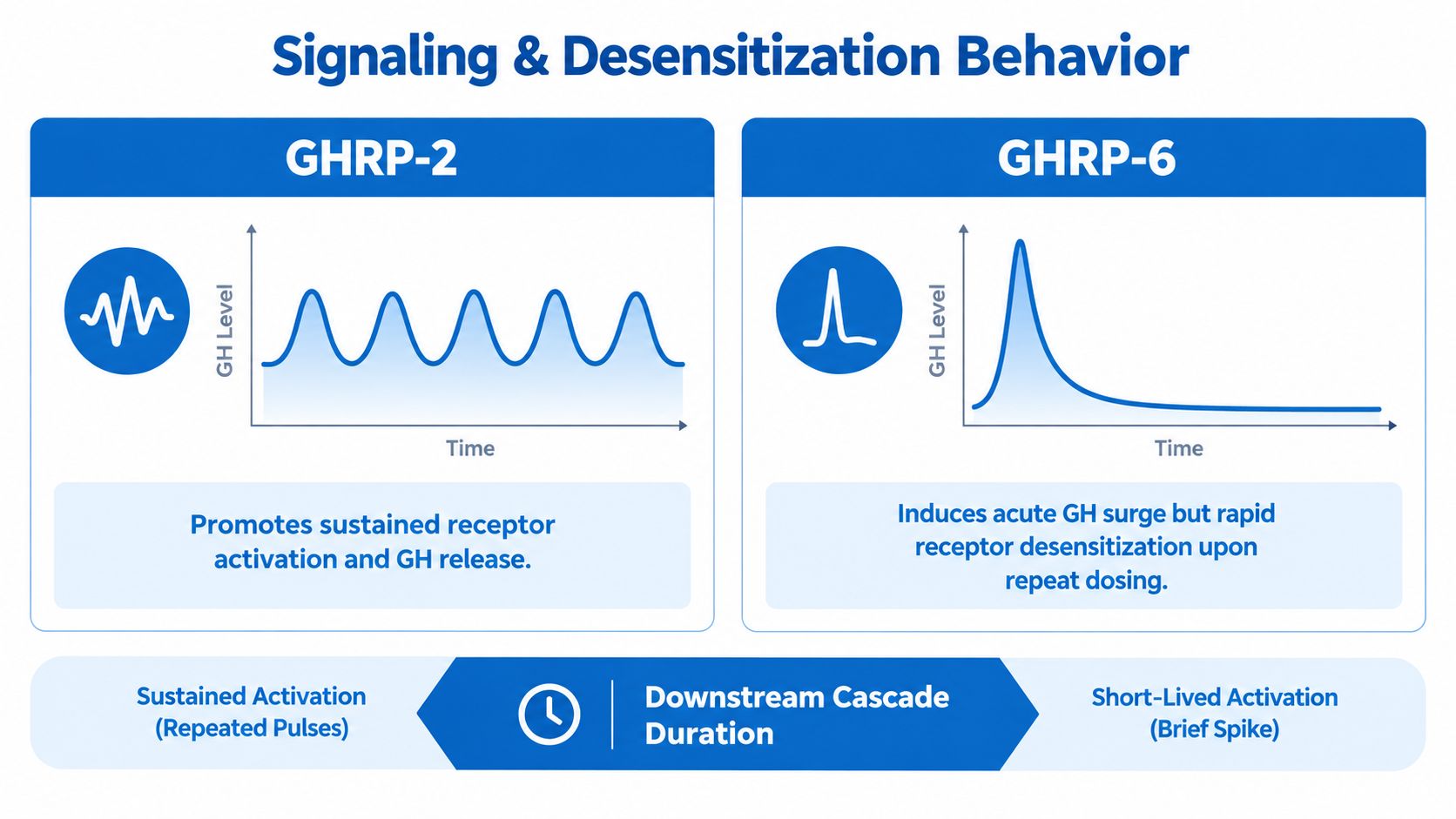
A comparative rat pituitary study concluded that GHRP-2 and GHRP-6 stimulate GH release through the same receptor and mechanism, despite their structural differences. Each compound also reduced the cells' response to the other, while neither produced the same desensitization toward GRF. This supports a shared secretagogue pathway rather than separate receptor mechanisms, as reported in the rat pituitary desensitization study.
The result has direct consequences for repeat-exposure experiments. If exposure to one ligand reduces the response to the other, switching compounds does not constitute a reliable washout or mechanistic reset. Alternating GHRP-2 and GHRP-6 can preserve receptor-level or cellular adaptation from the preceding treatment.
The unresolved chronic-protocol question
Current evidence does not establish a universal tachyphylaxis timeline, washout interval, or species-independent ranking for long-term reproducibility. A stronger early signal may become less informative if receptor downregulation, cellular adaptation, or assay variability increasingly determines later measurements.
Repeat-dosing protocols should prespecify baseline controls, exposure history, washout conditions, sampling times, and, where feasible, a direct measure of receptor or pathway behavior. The relevant comparison is not which ligand produces more GH initially. It is whether the signaling difference remains measurable after repeated exposure in the selected model.
A higher acute response is a pharmacological observation, not proof of superior longitudinal assay performance.
Laboratory Handling Reconstitution and Storage Considerations
Could preparation history change the effective exposure more than the nominal vial concentration suggests? For laboratory work, handling decisions concern sample integrity, not human administration. Record formulation state, lot identity, storage history, preparation solvent or buffer, aliquot condition, and every freeze-thaw event. Degradation, precipitation, or adsorption can change the concentration delivered to a cell system and weaken comparisons between GHRP-2 and GHRP-6.
Pharmacokinetic behavior provides context but does not define an in-vitro storage protocol. GHRP-2 has a short reported plasma half-life and low oral bioavailability, yet those biological properties should remain separate from material stability after reconstitution. A peptide that clears rapidly in vivo does not necessarily degrade at the same rate in a prepared assay sample.
A documentation-first workflow
- Confirm the formulation: Record whether the material is supplied as lyophilized powder or another stated formulation before preparing a working sample.
- Select the specified solvent: Use the supplier's stated solvent or a validated assay buffer compatible with the planned cell system. Document pH or other buffer conditions when they affect solubility.
- Limit adsorption and contamination: Low-protein-binding tips, sterile technique, and controlled handling can reduce avoidable variability during preparation.
- Aliquot prepared material: Small, clearly labeled aliquots limit repeated freeze-thaw exposure and make treatment history auditable.
- Record storage conditions: Distinguish short-term handling from long-term preservation, and follow validated supplier documentation rather than applying one universal rule.
Storage temperature alone does not establish stability. The laboratory should obtain batch-specific documentation, formulation details, solubility guidance, and stated stability timeframes. If the assay depends on a narrow concentration-response relationship, analytical confirmation of the prepared material can provide stronger evidence than appearance or nominal concentration.
For repeat-dose studies, preparation records should remain linked to exposure timing and assay results. This permits investigators to separate signaling or receptor effects from concentration loss during storage and handling.
Sample integrity principle: The concentration written on a vial label is only one part of the exposure record. Preparation history and storage history determine how confidently that label maps to the assay.
Choosing Between GHRP-2 and GHRP-6 for Different Study Goals
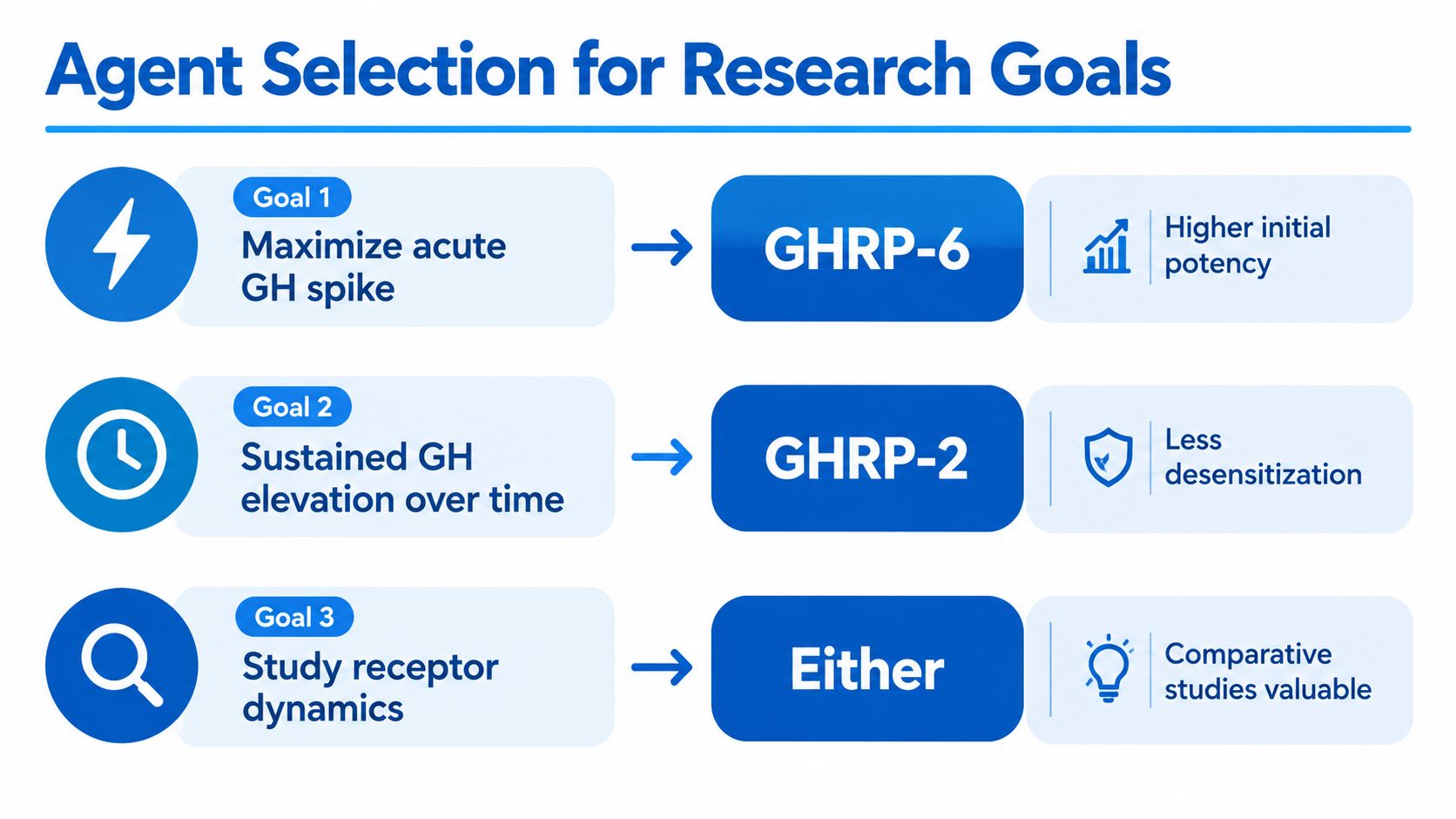
Which peptide best fits the study depends on the mechanism the experiment must resolve. GHRP-2 is usually the stronger starting comparator when the endpoint is GH output per microgram or a clear receptor-mediated secretagogue response. GHRP-6 is more informative for appetite-related ghrelin biology, historical comparability, or direct comparison of two GHS-R1a ligands with different downstream behavior.
| Research goal | More suitable starting comparator | Reasoning |
|---|---|---|
| Maximize acute GH output | GHRP-2 | Higher affinity and generally larger peak GH responses in matched comparisons |
| Examine appetite-related ghrelin pathways | GHRP-6 | Often described as the more appetite-stimulating comparator |
| Replicate an older laboratory model | The historically specified peptide | Reproducibility requires matching the original ligand and assay context |
| Compare receptor-linked signaling | Both compounds | Divergent cAMP findings make the pair mechanistically informative |
| Study repeated exposure | Both, with explicit controls | Shared-pathway desensitization makes cross-compound carryover a relevant variable |
Acute GH amplitude should not determine every selection. Comparative reviews generally place GHRP-2 ahead for peak response or area under the curve under equivalent conditions. GHRP-6 remains the more informative choice when the experiment centers on appetite-related signaling or requires the established ghrelin-like comparator role, as discussed in the comparative review literature.
How to avoid a misleading winner
A single-agent design establishes whether one ligand produces a response in a defined model. A paired design tests whether receptor activation, cAMP behavior, and downstream signaling remain functionally equivalent. That distinction becomes more important in studies involving legacy data, species differences, or repeat dosing.
Repeat exposure also changes the interpretation. Shared GHS-R1a signaling can make prior treatment relevant to later responses, so a compound that produces the larger initial GH peak may not be the better choice for a desensitization study. Protocols should therefore specify exposure order, washout conditions, and controls capable of separating ligand-specific effects from shared-pathway adaptation.
The appetite distinction is not an absolute biological boundary. Both compounds act through GHS-R1a, while the measured phenotype depends on the model, endpoint, receptor state, and exposure context. The defensible choice is conditional: select the ligand, or ligand pair, that makes the intended mechanism easiest to distinguish.
Final Recommendation and Research Sourcing Checklist
Which ligand should anchor the protocol? For acute GH-response experiments, GHRP-2 is usually the clearer first comparator because its reported GHS-R1a affinity and GH output are generally higher under matched conditions. GHRP-6 remains informative when appetite-related effects or continuity with historical studies defines the comparison. Neither compound is a universal substitute for the other.
Repeat dosing changes the decision. GHRP-2 and GHRP-6 can desensitize cells to subsequent exposure to one another while leaving GRF responsiveness comparatively distinct. Because both engage GHS-R1a, switching ligands may not remove prior receptor adaptation. A repeat-exposure protocol should therefore define dosing order, washout conditions, and controls that separate ligand-specific signaling from shared-pathway desensitization.
Sourcing checklist
- Identity: Confirm formal identity, sequence, and CAS information where available.
- Lot verification: Obtain a batch-specific Certificate of Analysis, not only a general product specification.
- Purity and composition: Review declared purity, net content, formulation state, and relevant analytical documentation.
- Sample preparation: Check solvent compatibility, solubility guidance, aliquoting requirements, and storage conditions.
- Transport: Confirm whether temperature-sensitive materials require cold-chain handling.
- Compliance: Verify that procurement and planned work fit a research-use-only framework and applicable institutional requirements.
Choose GHRP-2 for potency-focused GH experiments, GHRP-6 for a defined appetite-related or historical comparator role, and both when the objective is to resolve divergent signaling or desensitization behavior directly.
For laboratories sourcing either compound, Pro Tec Pep provides research-use-only materials with batch-linked documentation and product information for laboratory workflows. Review specifications, Certificates of Analysis, fulfillment options, and sample-preparation records before procurement.